Spector, Johanna LMareMagnum

5235 risultati
1947First edition. Original illustrated blue paper wrappers. 8vo. 59 pages, 20 cm. In German with musical notations. Title translates to Ghetto and Concentration Camp Songs from Latvia and Lithuania. Fifteen songs each preceded by a brief historical extract. Collected and edited by Latvian-born Johanna (Lichtenberg) Spector (1915-2008) , who grew to achieve renown as an ethnomusicologist specializing in the documentation of the musical culture of varied Jewish communities around the world. SUBJECTS: Holocaust, Jewish (1939-1945) -- Songs and music. Holocaust, Jewish (1939-1945) . OCLC lists 11 copies worldwide. Minor shelf wear. Overall Very Good Condition. (HOLO2-131-28) xx
19451st Edition. Later Wrappers with Original Paper Wrappers Bound Inside. 8vo. 24 pages ; 15 x 20 cm. In Czech. Title translates into English as, The Gentry-Volk: 11 Epigrams About The Teutonic Saviors Of The World. Published in the last year of the German occupation of Czechoslovakia, this book contains 11 outlandish caricatures of Nazi incompetence, and defeat, from the illustrator Josef Novák. The cover image is of a bird defecating on a Swastika SSI. SUBJECT (S) : Germany -- History -- 1933-1945 -- Humor, caricatures. OCLC lists just 4 copies worldwide (Hoover Institute, Yale, NL of Czech Republic, Bayerische Staatsbibliothek) . Slight wear to protective wrappers and a few minor discolorations and edge wear on Original Wrappers. Otherwise very good condition. (holo2-135-5)
19451st edition, original paper wrappers. 8vo, 8 pages. A sermon preached on New Years Morning, Saturday, September 8th, 1945 before Congregation Keneseth Israel of Allentown, Pennsylvania by Rabbi Braunstein, Ph. D. This sermon was preached before the release on Sept. 30, 1945 of Earl G. Harrisons Report to President Truman on the conditions of refugees and displaced persons in western Europe, and of the subsequent interchange of correspondence between the President and General Eisenhower. All of these strengthen and confirm the point-of-view expressed in this sermon. (page 8) Braunstein doesnt think that the Jews who fled should have to go back to their former homes. He says, The Intergovernmental Committee on Refugees, of which our Government is a member, recently declared that the Jewish D. P. will be given the opportunity to learn more about conditions in his country and give the governments more time to satisfy their nationals that they can return to their countries with the prospect of leading a healthy, normal life before reaching the conclusion that the person must be treated permanently as non-repatriable. These are elegant words to conceal the real decision of the Intergovernmental Committee on Refugees. That decision is this: Let the Jews cool off their heels in the German concentration camps until they realize they must return to their former homes. The simplest truth is that these Jews are afraid to return to their former homes. They who have cheated death for so many years at the hands of the Germans do not want to die at the hands of the Germans, do not want to die at the hands of their former co-citizens. And if their experiences in Poland and in Slovakia and elsewhere are any indication of how the wind is blowing, they have a right to fear. They have a right to refuse to return to their former homes. I have been wondering whether the late President Roosevelts promise of a world in which there would be freedom from fear will ever have meaning to the displaced Jews of Europe. (page 6) Subjects: Holocaust, Jewish (1939-1945) . OCLC: 992671406, OCLC lists two copies worldwide ( Harvard, NLI) . Slight wear to rear cover, Very Good Condition Overall. Rare and important (HOLO2-144-16)
19478vo; 1st edition. Original printed paper wrappers, 20, 52 pages. 1st 2 serially issued volumes of the detailed Dutch Red Cross report on deportation of Dutch Jews to Auschwitz via Westerbork; special attention to when & what train. Wiener Library (Wolff) I: 1659. Many Graphs. Includes errata Slip. An important and rare early document. Very light wear, pages starting to brown, Very Good Condition (Holo2-141-40)
1945rif. 121AqBudapest 1945 Grand In4 ( 30 X 21 cm ) - contient 18 dessins de Aldor Péter ( 1904/1976) survivant de l'extermination des juifs - Couverture légèrement défraîchie . Texte en Hongrois .
1945rif. 121AqBudapest 1945 Grand In4 ( 30 X 21 cm ) - contient 18 dessins de Aldor Péter ( 1904/1976) survivant de l'extermination des juifs - Couverture légèrement défraîchie . Texte en Hongrois .
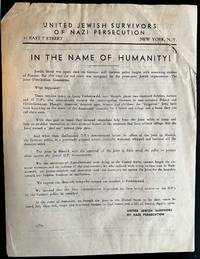
1947rif. 43409New York The Organization No Date 1947. 1st edition. Double-sided English-Yiddish leaflet 2 pages. The Yiddish header translates roughly as "An Announcement To the Jewish Public" Bilingual American Flyer condemning the Joint the American Joint Distribution Committee AJDC for not doing more to help the Jewish DPs and its "hiding" behind the German police when DP's demonstrated for more action on DP resettlement. The issuing organization the United Jewish Survivors of Nazi Persecution/Farband fun Geveyzene Yidishe Katsetler un Partizaner was the first survivor network founded in the US. Their Yiddish name translates as "The Association of Former Jewish Concentration Camp Inmates and Partisans." The word "Katsetler" in their name is a contraction of "kontsentratsyonslager-er" using the letters K and Z "ka" and "tset" and thus short for "kontsetratsyonslager" a concentration camp inmate or survivor sometimes also noted as a "katsetnik." The flyer announces: "Jewish blood was again shed on German soil! German police fought with remaining victims of Nazism. But this time the sad event was instigated by the prominent Jewish organization-The Joint Distribution Committee. What happened There remains today in Camp Foehrenwald near Munich about two thousand helpless forlorn and ill D.P's who miraculously escaped the extermination furnaces in nazi-occupied Poland and Hitler-Germany. Hungry desperate destitute men women and children the 'forgotten' Jews have been knocking at the doors of the democratic countries for a haven and refuge and a home they can call their own. With this goal in mind they demand immediate help from the Joint while in camp and help to establish themselves in their eventual homes in the countries that have offered refuge. But the Joint turned a 'deaf ear' toward their pleas. And when these disillusioned D.P.'s demonstrated before the offices of the Joint in Munich the German police in a previously planned attack critically wounded whipped and battered off the demonstrators. The Joint in Munich with the approval of the Joint in Paris asked the police to protect them against the Jewish D.P. demonstrators. We the survivors of Nazi-Germany now living in the United States cannot forget the extreme torments and the inferno of the nazi-torture; we who suffered with many victims now in Foch- renwald are horror-stricken and dismayed and our hearts cry out against the Joint for the brutality toward our helpless brethern in misfortune. We express our deep-felt sympathy toward our brothers in Foehrenwald. demand that the Joint representatives responsible for these brutal attacks on the D.P.'s by the German police be punished. In the name of humanity we beseech the Jews in the United States to let their voices be heard help these sick tragic and frustrated victims to find homes and a life of human dignity again" From the English side of the flyer. After World War II Munich served as a major center for Jewish Holocaust survivors the "Sh'erit ha-Pletah" who were living in DP camps. The "Joint" was the primary welfare organization providing aid clothing and food to these camps. While the Joint was a vital lifeline its Munich headquarters at Siebertstrasse 3 sometimes became the focal point for frustration regarding the pace of aid distribution or more frequently the slow pace of emigration to Palestine Aliyah and broader often frustrating postwar conditions. Following the 1947 Exodus ship incident where Jewish refugees were returned to Germany by the British Jewish DPs felt trapped and staged intense demonstrations including protests at the offices of international organizations like the Joint to highlight their despair. These demonstrations were part of a broader effort by survivors to assert their agency and demand rights during their time in Munich 1945-1951. For more on tensions between Munich's Jewish DPs and the Joint see www.juedisches-museum-muenchen.de/en/exhibitions/munich-displaced-online/moehlstrasse. Scholar David Slucki notes about the publishers of this leaflet that "Within months of arriving in the United States in 1946 Jewish Holocaust survivors began to organize themselves to help with the process of resettlement. The small band of socialists who established the Farband fun Geveyzene Yidishe Katsetler un Partizaner United Jewish Survivors of Nazi Persecution this group initiated a dual process of identity formation and memorialization of the Holocaust. The first survivor network founded in the United States the Katsetler Farband this group developed a memorial culture that included commemorations and publications replete with its own rituals and calendar. Moreover the organization was part of a broader process of defining what experiences constituted the Holocaust and who was to be considered a survivor. Ultimately they were among a host of survivor networks in the United States to lay the foundation for Holocaust memorialization" Slucki D. 2017. A Community of Suffering: Jewish Holocaust Survivor Networks in Postwar America. Jewish Social Studies 222 116-145. https://muse.jhu.edu/article/649094 We could locate no copies in OCLC-Worldcat Archive Grid nor using a google search. Touch of edgewear one diagonal fold paper generally bright and strong about Very Good- Condition. Holo2-163-28A. New York, The Organization, No Date unknown
19401st edition. Original photographic paper wrappers, 8vo, 24 pages. Issued by the National Industrial Assembly of the Young Women's Christian Association. From just prior to US entry into the war. Emphasizes that the incoming refugees fleeing Nazism are not a threat to American labor, nor might they represent a "Fifth Column. A copy sold at auction for over USD 550 (including commissions) at auction in 2015. Very Good Condition. (holo2-128-4) xx
19401st edition. Original photographic paper wrappers, 8vo, 24 pages. Issued by the National Industrial Assembly of the Young Women's Christian Association. From just prior to US entry into the war. Emphasizes that the incoming refugees fleeing Nazism are not a threat to American labor, nor might they represent a "Fifth Column. A copy sold at auction for over USD 550 (including commissions) at auction in 2015. Original price penned on margin of cover, light wear, Very Good Condition. (holo2-128-4A)
1945Cloth. 4to. 856 pages. In Dutch. Exile Dutch newspaper. A collection of bound original issues dating from July 1944 January 1945, including the critical time leading up to liberation of German occupation. Vrij Nederland (Free Netherlands) was established during the German occupation of the Netherlands in World War II as an free, weekly underground newspaper. Cover is slightly worn with some bumping at corners. Internal pages are darkened at edges, but all text is clear and binding is tight. Very good condition. (HOLO2-41-29)
19761st Edition. Original Paper Wrappers. 8vo. 8 pages ; 23 cm. In English. From the 3rd Annual Sol Feinstone Memorial Lecture series at West Point. This lecture given by Pulitzer Prize winning novelist and writer Herman Wouk. Wouk served in the Navy in the Pacific Theater of WWII. He addresses the west point graduates about The Meaning of Freedom, concluding, In the last five years, working on The Winds of War Ive spoken three times: to the Naval Academy, to the Naval War caollege, and now to the United States Military Academy. It isnt because Im a militarist. Im not intrigued by the romance of war. Let me make this plain to you. In my view war is a massive criminal absurdity I believe, heart and soul, that in days to come it will fade from the minds of men and nations as a possible way to behave. That is what Im trying to say in my books. OCLC lists only one copy worldwide (Westpoint) . This cannot have been well-received at West Point, and certainly would not have been a speech it would have wanted to promote or make readily available outside the academy. Ex-library with Jewish institutional stamp and usual markings. Some markings on cover and waterdamage to the top of the paper wrappers and first page. Text is not effected and is bright and clean. Overall in about very good condition. (SPEC-42-20A)
19421st Edition. Original Illustrated Wrappers. 8vo. 3 pages ; 23 cm. Holocaust-era Invitation Program for President Roosevelts 60th Birthday, held by The Religious Freedom Foundation asking Synagogues to arrange a service Commemorating our great President and the ninth consecutive year of the fight he has led against Infantile Paralysis in our nation. Includes a list of the ceremonies arrangement committee which is made up of about 100 notable Jewish leaders. Published 13 years before Salks vaccine. On January 3, 1938, Roosevelt founded the National Foundation for Infantile Paralysis, now known as the March of Dimes The organization initially focused on the rehabilitation of victims of paralytic polio, and supported the work of Jonas Salk and others that led to the development of polio vaccines. (Wikipedia, 2017) This memorial program was Chaired by Congressman Sol Bloom, the influential Jewish Congressman from New York. In the run-up to World War II, he took charge of high-priority foreign-policy legislation for the Roosevelt Administration, including authorization for Lend Lease in 1941. (Wikipedia, 2017) . Though FDR was open about his Polio, he also tried to downplay it; this is an unusually public connection of FDR and Polio: FDR requested that the press avoid photographing him walking, maneuvering, or being transferred from his car. The stipulation was accepted by most reporters and photographers but periodically someone would not comply. The Secret Service was assigned to purposely interfere with anyone who tried to snap a photo of FDR in a disabled or weak state (FDR Presidential Library, 2017) . OCLC lists no copies anywhere. Creased and worn, with a few small tears and some discoloration. Good condition. Very Rare and significant publication linking FDR, Polio, American Political Leadership, and American Jewish Life. (AMR-52-26)
1946Original illustrated paper boards. 12mo. 194 pages. 18 cm. In German. 1000 Days in a Concentration Camp; A First Hand Report from the Concentration Camps Dachau, Mauthausen and Gusen; with authentic photographs and documents. Illustrated with 16 black and white photographs. We go past the Jewish blocks. Their ranks have thinned. Many little snow-covered heaps, from which human arms stretch in rigid accusation, testify to a tragedy of which we are the witnesses. (Gostner; quotation translated [pg 159] in Narrating the Holocaust by Andrea Ilse Maria Reite) . Erwin Gostner (1914-1990) , from South Tyrol, was arrested as a catholic anti-nazi when Austria was annexed to Nazi Germany, and spent three years, from 1938 to 1941, in Dachau and Mauthausen; he survived the war, and worked as a detective for the remainder of his life; this being his only work, it was originally self-published in 1945, and printed in a larger number in 1946. Subjects: Concentration camps - Germany. Dachau - Konzentrationslager Mauthausen (Oberösterreich) - Konzentrationslager Gusen (Langenstein, Oberösterreich) Konzentrationslager. World War, 1939-1945 - Prisoners and prisons, German. World War, 1939-1945 - Personal narratives. OCLC lists 22 copies. The US Holocaust Museum keeps their copy in their Rare Book Collection. Light soiling to boards, internally lightly aged, otherwise fresh and clean. Very good condition. (HOLO2-104-23) Xx
1946Original illustrated paper boards. 12mo. 194 pages. 18 cm. In German. 1000 Days in a Concentration Camp; A First Hand Report from the Concentration Camps Dachau, Mauthausen and Gusen; with authentic photographs and documents. Illustrated with 16 black and white photographs. We go past the Jewish blocks. Their ranks have thinned. Many little snow-covered heaps, from which human arms stretch in rigid accusation, testify to a tragedy of which we are the witnesses. (Gostner; quotation translated [pg 159] in Narrating the Holocaust by Andrea Ilse Maria Reite) . Erwin Gostner (1914-1990) , from South Tyrol, was arrested as a catholic anti-nazi when Austria was annexed to Nazi Germany, and spent three years, from 1938 to 1941, in Dachau and Mauthausen; he survived the war, and worked as a detective for the remainder of his life; this being his only work, it was originally self-published in 1945, and printed in a larger number in 1946. Subjects: Concentration camps - Germany. Dachau - Konzentrationslager Mauthausen (Oberösterreich) - Konzentrationslager Gusen (Langenstein, Oberösterreich) Konzentrationslager. World War, 1939-1945 - Prisoners and prisons, German. World War, 1939-1945 - Personal narratives. OCLC lists 22 copies. The US Holocaust Museum keeps their copy in their Rare Book Collection. Light soiling to boards, internally lightly aged, otherwise fresh and clean. Very good condition. (HOLO2-104-23A)
1945Paper Wrappers. 4to. Each issue is 4 pages. 20 issues. Issues 2 and 8 have supplemental sheet laid in, as well. Holocaust-era American Anti-Fascist periodical commonly touching on racist and anti-Semitic topics. Contents Include: Anti Propaganda, Rand Leads Anti-Semites, A Report on Carl Mote, Commoner Party to Fight Negroes, Jews, Ku Kluxers Active, Anglo-Israel Convenes, Anti-Semitism Keynotes Annual Kingdom Convention, Hate Sheet Invades New York City, Anti-Semitism Promoted, A Report on J. A. Lovell, Hatriots Canonize Patton, Call Him Anti-Semitic, A Report on the German-American Press, A Report on Anti-Semitism in the N. Y. News. OCLC lists 15 copies worldwide. Issues 18 and 19 are darkened and fragile with some chipping. Most issues have checkmarks next to headlines, but all text is clear. Good condition. Important anti-Nazi periodical from US. (HOLO2-41-26)
rif. 1988Beeindruckendes Mappenwerk mit 111 ganzseigen, z.T. farbigen Heliogravüren. Gr. 8° (24,5 x 21 cm). [2], 11, [1] Blatt (Vorwort), 100 numerierte Tafeln, 11 n.n. Tafeln, davon 5 in Farbe, [5] Blatt (Register). Original-Mappe mit farbig illustriertem Deckel. Mappe mit Alterungsspuren und stärkeren Läsuren an den Faltlaschen. Innen tadellos erhalten.
rif. 20804° (33 x 26 cm). 39 Seiten, 2 Blatt. Mit 16 ganzseitigen Original-Lithographien von P. Jardel auf Tafeln und einem farbig gedruckten Frontispiz von L. Templier. Rohbögen in Original-Interimsbroschur. Umschlag fleckig mit leichten Alterungsspuren. Innen sauber und tadellos erhalten.
19681st edition. Original calf. 4to. X, 197, XXXI pages. 22 x 30 cm. In English, Hebrew, and Hungarian. Edited by Randolph L. Braham with the collaboration of Ervin Farkas. Brahams own copy, specially bound (in black leather and gilt title) and dedicated to Randolph L. Braham from the World Federation of Hungarian Jews (with dedication plate on endpage) . Profusely illustrated album of black and white photographs of Hungarian synagogues. "This album includes 467 photographs and drawings. The compilers succeeded in obtaining illustrations of most of the destroyed or converted synagogues. We hope this work will serve as an everlasting memorial to a significant element of Hungarian-Jewish culture and as a tribute to the thousands of martyrs who left from these very synagogues on their last fateful journey to destruction. (From the preface) . Subjects: Synagogues - Hungary. Edificios Religiosos (Arquitetura) Synagogues. Hungary. Light shelf wear to leather, overall very fresh and clean. Very good + condition. (BRAHAM-1-43)
No Date (1933? ) . 1st edition. Folded 1 leaf pamphlet. Unfolded 11x17 inches. Red and blue color, 12 photographs and illustrations in blue ink. The Non-Sectarian Anti-Nazi League to Champion Human Rights has opposed Nazism since 1933 when it began the boycott of German goods and services in America. By means of the boycott it is stopping millions of American dollars from going to Germany to be utilized for Nazi world-propaganda, to be converted into armaments for world war. By means of its educational campaign the League is arousing enlightened men and women to the need of defending our ideals. And (sic) institutions of our democratic government. These efforts to destroy Nazism in the United States also serve to aid the German people in their struggle for liberation. There is a section, Warnings vs. Nazism, which has quotes from President Roosevelt, Pope Pius XI, Sir Walter M. Citrine, The Nation, George II. Earle, William E. Borah, Fiorello H. LaGuardia, George W. Norris, George Cardinal Mundelein, Dorothy Thompson, and Dr. Paul Hutchinson about the dangers of Nazism. There is also a quote from Franklin D. Roosevelt under the title The Threat to Peace, in which he says There can be no peace if humble men and women are not free to think their own thoughts, to express their own feelings, to worship God. Very rare, no copies listed on OCLC. Very Good Condition. (HOLO2-144-24)
1941Original Wrappers. 8vo. 16 pages. 23 cm. First Edition. In Russian. Title translates as Fascist Antisemitism A Relic of Cannibalism. On Antisemitism in Germany. In 1935, V. V. Struve was elected a full member of the Academy of Sciences of the USSR, later became a member of the Bureau of the Division of Historical Sciences USSR. He was also a member of the National Committee of Historians of the Soviet Union and a member of the Archaeological Commission USSR. He was awarded the title of Honored Scientist of the USSR. Throughout the years V. V. Struve headed the Egyptian Department of the State Hermitage, was the director of the Institute of Ethnography and the Institute of Oriental Studies. (orientalstudies. Ru) Subjects: Antisemitism - Germany. National socialism. Holocaust, Jewish (1939-1945) Antisemitism. Ethnic relations. OCLC lists 4 copies worldwide. (Stanford, Libr. Of Congress, Univ. Of Toronto, Univ. Of Leeds) , none in New York. Spine repair. Some soiling, and age toning and edge wear. Good + condition. (HOLO-115-19)
1944rif. 003930Stockholm, Magnus Ekenbergs Tryckeri, 1944. 15 S. Orig.-Broschur. Die seltene Veröffentlichung enthält Berichte des Senders des Nationalkomitees Freies Deutschland, ist selbst jedoch keine Publikaton des Nationalkomitees. "KZ Lublin" war der offizielle Name des heute als Konzentrationslager Majdanek bekannten ersten deutschen Vernichtungslagers der SS auf polnischem Boden, das von Oktober 1941 bis zur Auflösung am 23. Juli 1944 bestand (Majdanek ist ein Vorort von Lublin). Inhalt u. a.: Freiherr Senft von Filsack: Das Vernichtungslager Lublin; Konstantin Simonov: Vernichtungslager; Die Todesfabrik Sobibur [d. i. Sobibor]; Erklärung des Generalleutnant Moser. Katalog des Deutschen Exilarchivs 1933-1945, Nr. 3548. Die Fotos zeigen Gasbüchsen, Personaldokumente von in Lublin Ermordeten, die Gaskammern und das Krematorium von Lublin. Ein gut erhaltenes Exemplar mit nur leichten Gebrauchsspuren.
1946rif. STAN0085Linz u. Wien, Ibis 1946. 4°. 57 nn. Bll., zahlr. Illustrationen, ill. OKart., die zweifarbige Umschlaggestaltung u. die Illustrationen stammen vom Verfasser. Sehr gut erhalten. Erste Ausgabe der ersten Buchveröffentlichung Wiesenthals, zugleich eines der ersten gedruckten Berichte eines KZ-Überlebenden. Als Häftling im Konzentrationslager Mauthausen arbeitete Wiesenthal auf dem Todesblock - unbemerkt von den Nazi-Schergen - an Skizzen und Zeichnungen, die einem Ziel dienen sollten: die Weltöffentlichkeit nach dem Ende der Naziherrschaft und der Befreiung der Konzentrationslager darüber zu informieren, was sich hinter deren Mauern und dem Stacheldraht zugetragen hat. Wiesenthal brauchte für seine Arbeiten nicht viel mehr als einen Bleistiftstummel und etwas Papier. Bildfragmente aus Nazi-Magazinen, wie sie in Papierkörben zu finden waren, baute er nach dem Krieg als optische Zitate in seine Collagen ein, und auch die Texte zu den Bildern entstanden erst im Zuge der Vorbereitungen zur Veröffentlichung des vorliegenden Buches. Infolge der kleinen Auflage war das Werk bald vergriffen und geriet in Vergessenheit, außerdem waren in der Zeit des beginnenden Kalten Krieges Bücher über Nazi-Greuel nicht weiter gefragt... (Objekt unterliegt der Differenzbesteuerung)
1995438 pages. Index. The gripping autobiography and fascinating reflections of a man, neither Jew nor Aryan, who recounts his dramatic WWII experiences and life afterwards. Unmarked. Above-average wear. Binding intact. A worthy copy of this fascinating life story. Book
1943rif. STAN0084New-York: Spett Printing Company 1943. Second printing, December 1943. 40 S., darin eine Skizze des KZ Treblinka, auf dem Umschlag ein Übersichtsplan von Warschau, das Ghetto rot umrandet. Umschlag etwas gebräunt, sonst gut erhalten / 40 pages, in it a sketch of the Treblinka concentration camp, on the cover an overview map of Warsaw, the ghetto outlined in red. Cover a little browned, otherwise in good condition Testimonies from Ghettos in Poland, collected and translated into English by the "World Jewish Congress" and the "Representatives of Polish Jewry". With a drawing of Treblinka Extermination Camp. Very rare.
19431st edition. Original paper wrappers. 8vo. 72 pages, 23 cm. In English. Front wrapper is marked Confidential print. Early (1943) confidential internal discussion by the US congress of rescue of the Jews of Europe, as well of how to deal with refugees abroad, including whether to admit them to the United States and other topics concerning anti-semitism and Nazi abuses. SUBJECTS: World War, 1939-1945 -- Refugees. World War, 1939-1945 -- Civilian relief. Ex-library with usual, minimal markings. Edgewear to wrappers, zionist stamp, number penned on cover, tape repair to spine, Good Condition. Very important, a core Holocaust document. (YID-41-20A) xx