5 266 résultats
réf. 21124° (29,5 x 21 cm). 18 (3) Blatt mit Illustrationen nach Zeichnungen von Peter Aldor. Mit einem Vorwort von Joszef Fodor. Text in ungarischer Sprache. Beiliegend ein Blatt mit übersetztem Text in englischer Sprache. Farbig illustrierte Originalbroschur. Sehr gut erhaltenes, sauberes Exemplar mit leichten Alterungsspuren. Papier altersbedingt gebräunt. Umschlag mit kleinen Knicken und Randeinrissen. Mit dem fast immer fehlenden Erklärungsblatt in englischer Sprache.
19421942. First Edition. Paper Wrappers, 8vo, 61 pages. Includes eight photographic illustrations, including three full-page photomontages by Polish avant-garde artist Teresa Zarnower, and original pictorial wrappers with two additional photomontages by Zarnower. Text in Polish. Published by the heavily Jewish Polish Labor Group in New York. The Destruction of Warsaw. Light wear to covers, with light crease through part of front cover and unobtrusive 4 digit number in pen at top near spine. Touch of wear to top of spine, Otherwise Very Good Condition, far better than generally seen of this rare and important Holocaust related avant-gard photography title. (HOLO2-117-61)
19221st edition. Period boards. 8vo. 16 volumes, 31 cm. Early volumes are generally around 200 pages each; later volumes end up more like 125 pages. Ca. 2800 pages total this run. Published quarterly, or ever 3 months; the run here includes the first 6 years of the Nazi period. After 1946, this publication was known as the JWB Circle. The National Jewish Welfare Board (JWB) was formed on April 9, 1917, three days after the United States declared war on Germany, in order to support Jewish soldiers in the U.S. military during World War I .In 1921, several organizations merged with the JWB to become a national association of Jewish community centers around the country in order to integrate social activities, education, and active recreation. These merged organizations included the YWHA, YMHA, and the National Council of Young Men's Hebrew and Kindred Association (Wikipedia). These quarterly journals report on those efforts and make suggestions for how to improve outreach, activities, and leadership; they also make other proposals and raise questions for the Jewish Community Center movement to grapple with. SUBJECTS: Jews - United States - Periodicals. OCLC: 2262910. Most OCLC holdings appear to be fragmentary. Excellent condition. (YID-33-10-el)
1967réf. 1824721967. Auschwitz memorialized - a record of "the first fully 'international' event" at the former camp A commemorative album for the opening of the memorial at Auschwitz on 16 April 1967 an important stage in its transition to an international memorial site. Situated at the western end of the railway lines that cross the camp the memorial remains a central part of the Auschwitz complex. The large granite memorial was designed by the Italian architects Andrea and Pietro Cascella. Approximately 200000 people attended the unveiling including Polish state officials the East German and Italian foreign ministers and prisoner organisations. The first two photographs show the memorial the third the crowd bound in by the barbed wire and the fourth the Polish prime minister Józef Cyrankiewicz laying a tribute. The remainder show the attendees eating lunch food stalls and chefs preparing the food. Given this the album was presumably produced for the organizers of the catering. "Abstract in form and vague in its message the monument and the events surrounding its unveiling in April 1967 certainly furthered the memorial site's growing international character and testified to the waning relevance of a traditional Polish-national commemorative idiom at Auschwitz. At the same time however the Birkenau monument failed to specify or acknowledge explicitly the suffering and death of Jews as Auschwitz and therefore took its place in the continuum of commemorative marginalization of the Shoah at the site" Huener pp. 145-6. The memorial does not mention the Jews specifically nor did Cyrankiewicz in his remarks at the event as he wished to continue to present the camp as a specifically Polish tragedy. Nonetheless the unveiling "drew tremendous attention from abroad and can therefore be understood as the first fully 'international' event held at the State Museum at Auschwitz. The highly publicized April ceremonies. reached the wider European public and through the presence of countless journalists the world" Huener p. 146. Oblong quarto 36 x 25 cm containing 28 silver gelatin prints ranging from 17 x 12 to 17 x 23 cm mounted on 21 leaves of thick black card string-tied within blue cloth covers. Fore edge of first leaf a little chipped otherwise binding and contents in excellent condition. Jonathan Huener Auschwitz Poland and the Politics of Commemoration 1945-1979 2003. hardcover
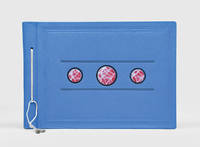
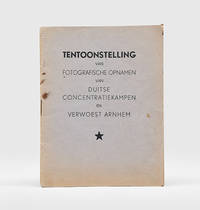
1945réf. 174825Amsterdam: United States Information Service 1945. Nazi crimes publicly revealed First edition first printing of the catalogue of one of the earliest Holocaust exhibitions held in the Netherlands soon after the war. The exhibition and catalogue were funded by the United States Information Service which supported exhibitions of photographs across Europe to show what had been done by the Nazis and build support for the coming war crimes trials. It includes one of the defining images of the Holocaust - the future Nobel laureate Elie Wiesel among other prisoners on the barracks at Buchenwald. Sextodecimo. With 25 half-tone photographs. Original grey wrappers printed in black. Short split at head of spine and 50 mm split at foot a little soiling to wrappers wrappers and contents slightly toned. A very good copy. unknown
1943réf. BRzz1310Berlin, Decker 1934-1943. 4°. je Band ca 800 S. Schwarze HLnBde mit Rückenpräg., Vorsatz u. Titelbll. gestempelt "Staatsanwaltschaft Wr. Neustadt" Nahezu vollständige Folge des von 1933-1945 erschienenen amtlichen NS-Rechtsorgans.
19411st edition, Later cloth with original wrappers bound in, 4to, approximately 200 leaves. 28 1/2cm. "Published ... Under the auspices of the American Jewish congress. "-- Foreword. Collection of detailed reports on the Jewish persuctions as of late 1941 throughout Europe, and organized by region, with anecdotal as well as statistical evidence and sources cited. The report came out just 2 months before the notorious Wansee Conference where German extermination policy became official, and the reports here, in detail and in in broad brush stroakes, reflect the quickly deteriorating situation for Jews under German occupation. For example from the Polish section: We must declare at the very outset that words are powerless to portray the agony and suffering of Polish Jewry in the 80 days of Germany role. The hell-like reality of the Polish Jews, a hell-like reality which has already lasted more than 80o days, and where literally every minute, every second demands Jewish victims, without a stop, without any interruption, and the hand of the torturer and murderer, the robber and offender is still unwearied, --this reality is not to he described in words. Let the reader multiply what is described tenfold, twentyfold, and he will perhaps come near to an idea of the life of our brothers under the German lash (p. POL-9) Sections include: Greater Germany, Rumania, Hungary, Italy, Czechoslovakia, Poland, Denmark, Norway, Belgium, Luxemburg, Holland, France, Yugoslavia, Bulgaria, Greece, Finland, Nazi-Soviet War Area, Refugees, Relief, & Conclusions. Prepared by the Institute of Jewish Affairs ; submitted to the Inter-American Jewish Conference, November 23-24-25, 1941, Baltimore, Md. Includes refugee and relief activity at conclusion, and 2 pages of corrections and addenda at rear. Even at this date, of course, the nature of the what was to be the total devastation was not yet clear. Very Good Condition. Rare. With original hole punches, as issued. Ex-library, but only one stamp on original pages, to blank rear of title page. Other markings are only to later-added endpapers and binding, not to any original pages, Very Good Condition thus. An important collection of evidence from the period. (Holo2-120-27)
19411st edition. Original paper wrappers. 4to, approximately 200 leaves. 28 1/2cm. "Published ... Under the auspices of the American Jewish congress. "-- Foreword. Collection of detailed reports on the Jewish persuctions as of late 1941 throughout Europe, and organized by region, with anecdotal as well as statistical evidence and sources cited. The report came out just 2 months before the notorious Wansee Conference where German extermination policy became official, and the reports here, in detail and in in broad brush stroakes, reflect the quickly deteriorating situation for Jews under German occupation. For example from the Polish section: We must declare at the very outset that words are powerless to portray the agony and suffering of Polish Jewry in the 80 days of Germany role. The hell-like reality of the Polish Jews, a hell-like reality which has already lasted more than 80o days, and where literally every minute, every second demands Jewish victims, without a stop, without any interruption, and the hand of the torturer and murderer, the robber and offender is still unwearied, --this reality is not to he described in words. Let the reader multiply what is described tenfold, twentyfold, and he will perhaps come near to an idea of the life of our brothers under the German lash (p. POL-9) Sections include: Greater Germany, Rumania, Hungary, Italy, Czechoslovakia, Poland, Denmark, Norway, Belgium, Luxemburg, Holland, France, Yugoslavia, Bulgaria, Greece, Finland, Nazi-Soviet War Area, Refugees, Relief, & Conclusions. Prepared by the Institute of Jewish Affairs ; submitted to the Inter-American Jewish Conference, November 23-24-25, 1941, Baltimore, Md. Includes refugee and relief activity at conclusion, and 2 pages of corrections and addenda at rear. Even at this date, of course, the nature of the what was to be the total devastation was not yet clear. Very Good Condition. Rare. With original hole punches, as issued. Markings on endpaper, title page, and back wrapper. Very Good Condition thus. An important collection of evidence from the period. (Holo2-120-27A)
19451st edition. original Paper Wrappers, 4to, [48] pages. Unpaginated. Text in Hungarian. Mostly illustrations. One of the first collections of Holocaust drawings published after the war. Original illustrated wrappers with red lettering on front cover. A pictorial album by Holocaust survivor Péter Áldor, depicting the atrocities of the German occupation and the repression of the local fascists. This work is profusely illustrated with 18 heart-gripping sketches illustrating in all its horror, human madness and misery. Light stains and wear to cover, internally extremely clean, Overall Very Good Condition, a nice copy. (Holo2-125-25)
1946Original Wraps. 4to. 112, [1] pages. 28 cm. First edition. In French. Includes 50 original color illustrations throughout of Compiegne Gusen 2, Buchenwald, Mauthausen, & Gusen 1. Illustrated narrative by the artist and survivor Bernard Aldebert. Jean Bernard-Aldebert (1909-1974) was born in Saint-Etienne, and began his career as an illustrator for Le Pêle-Mêle in 1928. He was arrested and deported to the Gusan extermination camp in early 1944, after publishing a satirical drawing in Ric et Rac. His deportation was via Compiegne, KZ Buchenwald, KZ Mauthausen, KZ Gusen I to KZ Gusen II (Bergkristall-Esche II underground plant) . One of the very few survivors of Gusen, he captured his experiences during this ordeal in the album 'Chemin de Croix en 50 Stations', published by the Arthème Fayard group in 1946 (Lambiek Comicopedia, 2014) . Subjects: Guerre mondiale (1939-1945) - Camps de concentration - Récits personnels français. Déportés français - 1939-1945 - Récits personnels français. Gusen (Concentration camp) - Pictorial works. Gusen (Concentration camp) . Pictorial works. OCLC lists 19 copies. Clean and fresh. Very good condition. (HOLO2-118-31) xx
1945Original Wraps. 4to. [32] pages. 27 cm. First edition. In French. Catalogue of the Exposition Crimes hitlériens. Page [2] contains color reproduction of lithograph poster 'S. S. Crimes Hitlériens' exhibition in Paris at the Grand-Palais, which was originally held from June 10 until July 31, 1945. Committee of honor includes Mitterand; organizing committee includes Coste-Floret, Boissieu, Webel, Paoli, Herst, Billiet. Page [3] includes plan and legend for lay out of the exposition. Complete illustrated throughout, in red and black ink. Includes many gruesome photos of the fate met by members of the French Resistance throughout France, photographs from the Struthof Camp, tallies of deportations of French Jews, tallies of the numbers of forced laborers from France, etc. In June 1945, the French government sponsored a huge exhibition, filling twenty-nine rooms of the Grand Palais, entitled 'Hitler's Crimes'. One of the rooms was devoted, according to the catalogue, to 'The Jews'. It presented a chronology of the internment of Jews in the French Camps of Pithiviers, Beuane-la-Rolande, and Drancy, in the occupied zone, and at Gurs in Southwestern France under the rule of Vichy. It also gave a tally of deportations from Drancy to Germany: 62, 608. Subjects: World War, 1939-1945-Atrocities-Exhibitions World War, 1939-1945-France-Exhibitions France-History-German occupation, 1940-1945-Exhibitions. OCLC lists 6 copies. Some wear and staining to wraps. Closed tears, tape repairs and pen markings. Interior clean and fresh. Good condition. Scarce. (HOLO2-118-28A)
1945Original Wraps. 4to. [32] pages. 27 cm. First edition. In French. Catalogue of the Exposition Crimes hitlériens. Page [2] contains color reproduction of lithograph poster 'S. S. Crimes Hitlériens' exhibition in Paris at the Grand-Palais, which was originally held from June 10 until July 31, 1945. Committee of honor includes Mitterand; organizing committee includes Coste-Floret, Boissieu, Webel, Paoli, Herst, Billiet. Page [3] includes plan and legend for lay out of the exposition. Complete illustrated throughout, in red and black ink. Includes many gruesome photos of the fate met by members of the French Resistance throughout France, photographs from the Struthof Camp, tallies of deportations of French Jews, tallies of the numbers of forced laborers from France, etc. In June 1945, the French government sponsored a huge exhibition, filling twenty-nine rooms of the Grand Palais, entitled 'Hitler's Crimes'. One of the rooms was devoted, according to the catalogue, to 'The Jews'. It presented a chronology of the internment of Jews in the French Camps of Pithiviers, Beuane-la-Rolande, and Drancy, in the occupied zone, and at Gurs in Southwestern France under the rule of Vichy. It also gave a tally of deportations from Drancy to Germany: 62, 608. Subjects: World War, 1939-1945-Atrocities-Exhibitions World War, 1939-1945-France-Exhibitions France-History-German occupation, 1940-1945-Exhibitions. OCLC lists 6 copies. Creased, hole in front cover, light wear to wraps. Interior unaffected. Good condition. Scarce. (HOLO2-118-28B)
19361st edition. Original illustrated wrappers, 4to (large) , 34 pages. Loaded with illustrations. Event program. Striking cover illustration and one text illustration by Mitchell Loeb. Includes illustrations in text (halftones) and a section of ads. The World Labor Athletic Carnival was organized to directly oppose U. S. Athletes' participation in the 1936 Berlin Olympic Games, which were viewd as providing both legitimacy and a prime propaganda opportunity to Hitler's Nazi government. Put together in 1936 by a coalition of New York left-wing political organizations and labor unions including the heavily Jewish International Ladies' Garment Workers Union (ILGWU) , the Socialist and Communist Parties, the Jewish Labor Committee, and others, the Carnival took place over two days, coinciding with the two final days of the Berlin Games, and involved an array of high-profile American, Canadian, and a few international competitors including high-jumper Walter Marty, sprinters Eulace Peacock and Perrin Walker, and pole vaulter George Varoff. In the end, the Carnival proved something of a disappointment from both an attendance and an athletic perspective. Aside from Varoff's world-record setting performance in the pole vault, "... The New York Herald Tribune described the athletic performances as 'mediocre' and noted that the spectators were unenthusiastic'" (for a detailed account of the event, see Edward S. Shapiro, "The World Labor Athletic Carnival of 1936: an American Anti-Nazi Protest, " in American Jewish History v.74, no.3 (Mar 1985) , pp.255-273) . No copies anywhere in OCLC. Exceedlingly rare, we have never seen a copy offered for sale. Slightly stained and creased, but Very Good. A few event results have been supplied by the original owner in pencil. (holo2-149-1)
1945Original Wraps. 8vo. 16 pages. 24 cm. First edition. In French. Buchenwald; 2me année, no 5. 'Special number'. Dated May 1945. Illustrated brochure on the horrors of Buchenwald. Demands vengeance for the dead. Subjects: Holocaust, Jewish (1939-1945) - Pictorial works. Concentration camps - Pictorial works. Concentration camps. Holocaust, Jewish (1939-1945) Pictorial works. OCLC lists 6 copies worldwide. Aged, edges of cover previously strengthened with tape, overall clean and fresh. Good condition. (HOLO2-124-10) xx
1926First edition and 1 of 5000 copies published. Period boards with photographic front cover mounted on front. 4to, 136 pages. Folio. In Russian. Jewish Massacre. 1918-1921. With numerous photographic illustrations. A detailed album highlighting the horrific results of a wave of ferocious pogroms afflicted upon Jewish communities in the Ukraine including Skvira (Skver) , Poltava, Uman, Kiev and Yelizavetgrad during the Civil War years of 1918-21. The text has a distinctly Nationalist element, portraying Jews saved from the attacking native population by the Red Army. The publication was issued by Z. S. Ostrovsky on behalf of the Jewish Committee for Aid to Victims of Pogroms. With well over 200 photos, this work is based on an exhibit of images and documents put together by the Jewish Committee of Victims of Pogroms which was shown in 1923 in Moscow. Its a brutal depiction of the third set of pogroms which swept in Russia from 1918 and 1921 in the wake of the Russian Revolution, much worse than the earlier massacres in the 1880s and then again in 1903-1906. This post-war set of pogroms were led by bands of soldiers from the disintegrating tsarist army. Ostrovsky's work doesnt state the fact that the first pogroms to be accompanied by slaughter of Jews were perpetrated by units of the Red Army which retreated from the Ukraine in the spring of 1918 before the German army. These pogroms took place under the slogan "Strike at the bourgeoisie and the Jews." The Jewish communities of Novgorod-Severski and Glukhov in northern Ukraine were the most severely affected. These pogroms reached their climax in the massacre at Proskurov on Feb. 15, 1919, when 1,700 Jews were done to death within a few hours. On the following day, a further 600 victims fell in the neighboring village of Felshtin (Gvardeiskoye). Those responsible for these pogroms went unpunished, and henceforward the Ukrainian soldiers considered themselves free to spill Jewish blood. The Jews regarded Simon Petlyura, the prime minister of the Ukraine and commander of its forces, as responsible for these pogroms. The general chaos which reigned in the Ukraine in 1919 resulted in the formation of large and small bands of peasants who fought against the Red Army. The Jews in the villages, shtetls, and towns there were constantly terrorized by the peasants, who extorted money and supplies from them or robbed and murdered them. One of the most notorious pogroms carried out by the peasant bands was that in Trostyanets in May 1919, when over 400 people lost their lives. In the fall of 1919, there was a wave of pogroms committed by the counterrevolutionary White Army, under the command of General A.I. Denikin. (credit: Klinebooks). See Z. Gitelman, A Century of Ambivalence: The Jews of Russia and the Soviet Union 1881 to the Present (1988) pp. 97-108. SUBJECT(S): Pogroms -- Soviet Union. Jews -- Persecutions Antisemitism -- Massacres -- Jews -- Ukraine. -- Belarus. -- URSS. Juifs -- Perse´cutions -- URSS. Antise´mitisme -- Massacres -- Juifs -- Bie´lorussie. Soviet Union -- History -- Revolution, 1917-1921. URSS -- Histoire -- 1917-1921 (Re´volution) OCLC: 702135039. OCLC lists 18 copies. Clean internal binding repair, paper toning, wear to boards, later front blank endpaper loose, Good Condition. Dramatic piece. (SPEC-35-4-BLV).
1946Together 27 vols., 8vo., First Edition, with 2 large folding charts; original printed wrappers, one or two backstrips scuffed at head and tail else a remarkably well-preserved, bright, clean set. The extended set comprises: Part 1: 20 Nov 1945 to 1 Dec 1945 (1946); Part 2: 3 Dec 1945 to 14 Dec 1945 (1946); Part 3: 17 Dec 1945 to 4 Jan 1946 (1946); Part 4: 7 Jan 1946 to 19 Jan 1946 (1946); Part 5: 21 Jan 1946 to 1 Feb 1946 (1946); Part 6: 2 Feb 1946 to 13 Feb 1946 (1947); Part 7: 14 Feb 1946 to 26 Feb 1946 (1947); Part 8: 27 Feb 1946 to 11 March 1946 (1947); Part 9: 12 March 1946 to 22 March 1946 (1947); Part 10: 23 March 1946 to 3 April 1946 (1947); Part 11: 4 April 1946 to 15 April 1946 (1947); Part 12: 16 April 1946 to 1 May 1946 (1947); Part 13: 2 May 1946 to 13 May 1946 (1947); Part 14: 14 May 1946 to 24 May 1946 (1947); Part 15: 27 May 1946 to 6 June 1946 (1948); Part 16: 7 June 1946 to 19 June 1946 (1948); Part 17: 20 June 1946 to 1 July 1946 (1948); Part 18: 2 July 1946 to 15 July 1946 (1948); Part 19: 16 July 1946 to 27 July 1946 (1949); Part 20: 29 July 1946 to 8 August 1946 (1949); Part 21: 9 August 1946 to 21 August 1946 (1949); Part 22: 22 August 1946 to 31 August 1946; 30 Sept 1946 and 1 October 1946 (1950); Part 23: Index (1951). WITH Opening Speeches of the Chief Prosecutors (1946); Speeches of the Prosecutors against the Indicted Organisations (1946); Speeches of the Chief Prosecutors against the Individual Defendants (1946); Judgement of the International Military Tribunal (with the Dissenting Opinion of the Soviet Member) (1946). Volume 1 includes the folding chart of the organisation of the NSDAP; Volume 3 contains the folding chart of the organisation of the SS. EXTENDED SETS ARE EXCEEDINGLY SCARCE.
1945Original Wraps. 4to (large) . 48 pages. 30 cm. First edition. In French. Rare extremely early (1945) illustrated French Exposition of Nazi Crimes. Catalogue, in magazine format, of Nazi crimes; illustrated throughout; with testimony, articles, and prefatory declarations by P. Teitgen, Bidault, Soustelle, and Frenay, denouncing the Nazi Crimes. Illustrated throughout; emphasizes the crimes of Vichy as well. Publié à l'occasion de l'exposition 'Crimes hitlériens'-Déclarations, articles, souvenirs. Sections as follows: l'allemagne et le nazisme, l'ordre hitlérien (congrès de Nuremberg, charnier de Belsen) Mensonges et pattes de velours, le vol de la terre, la guerre biologique, avec une composition de Paul Colin, pleine page, SS et gestapo, Buchenwald, témoignages de ceux qui "en" sont revenus, camp de femmes , l'homme cobaye, bloc 46, le criminel de guerre. [Published on the occasion of the exhibition 'Crimes hitlériens' Declarations, articles, memories. Sections as follows: Germany and Nazism, Hitler's order (the Nuremberg Congress, the grave of Belsen) Lies and velvet paws, theft of land, biological warfare, with a composition of Paul Colin, full screen, SS and Gestapo, Buchenwald, testimonies of those who survived, the women's camp, the pig man, block 46, the war criminal. ]Subjects: Guerre mondiale 1939-1945. Atrocités allemandes. OCLC lists only one copy worldwide (Nanterre) , located in France. Scarce. Damage to lower left coner, no loss of text, otherwise, Very Good Condition. (HOLO2-117-4)
19451st edition. Original paper wrappers, 12mo, 32 pages, chiefly photographic illustrations. 16 cm. Exhibition of Photographic Images of German Concentration Camps and Destroyed Arnhem. Catalog for the exhibition, with 24 pages of full-page photos, plus 8 pages of photo descriptions. Text in Dutch. On page 10 is the famous and controversial photo of the Nobel Laureate Elie Wiesel in Buchenwald (first published in the "New York Times" on May 6, 1945 with the caption "Crowded Bunks in the Prison Camp at Buchenwald" taken inside Block 56 by Private H. Miller of the Civil Affairs Branch of the U. S. Army Signal Corps on April 16, 1945.) . In the year following the defeat of the Nazis, exhibitions of photos showing the horrors of the Concentration Camps were a way to show the people of Europe what had been done by the Germans and their allies, and, eventually, to build support for the idea of War Crimes trials. Foto's ... Afgestaan door de U. S. I. S. (United States Information Service, Photographic Section, Amsterdam) en Jan Schiet, fotograaf, Amsterdam. Despite the title, there are no pictures nor text referring to Arnhem in the bookonly from the concentration camps. The Arnhem material may have appeared only in the exhibition itself. OCLC lists only 4 copies worldwide, all in the Netherlands (Sept 2015) . Blue wrappers are sunned with some spotting, spine repaired, otherwise Very Good Condition. Rare and important. (holo2-126-33A) xx
19451st edition. Original paper wrappers, 12mo, 32 pages, chiefly photographic illustrations. 16 cm. Exhibition of Photographic Images of German Concentration Camps and Destroyed Arnhem. Catalog for the exhibition, with 24 pages of full-page photos, plus 8 pages of photo descriptions. Text in Dutch. On page 10 is the famous and controversial photo of the Nobel Laureate Elie Wiesel in Buchenwald (first published in the "New York Times" on May 6, 1945 with the caption "Crowded Bunks in the Prison Camp at Buchenwald" taken inside Block 56 by Private H. Miller of the Civil Affairs Branch of the U. S. Army Signal Corps on April 16, 1945.) . In the year following the defeat of the Nazis, exhibitions of photos showing the horrors of the Concentration Camps were a way to show the people of Europe what had been done by the Germans and their allies, and, eventually, to build support for the idea of War Crimes trials. Foto's ... Afgestaan door de U. S. I. S. (United States Information Service, Photographic Section, Amsterdam) en Jan Schiet, fotograaf, Amsterdam. Despite the title, there are no pictures nor text referring to Arnhem in the bookonly from the concentration camps. The Arnhem material may have appeared only in the exhibition itself. OCLC lists only 4 copies worldwide, all in the Netherlands (Sept 2015) . Blue wrappers are sunned with some spotting, otherwise Very Good Condition. Rare and important. (holo2-126-33) xx
1944réf. 34835Tel Aviv: Haaretz Printing House 1944. First Edition with annotations in Hebrew. Illustrated with 17 full-page Zinco engravings created by Zincographies Ltd. Oblong folio 34 x 25 cm publisher's original linen backed boards the upper cover printed in Hebrew. 4 text and 17 plates pp. A very good copy well preserved with minor evidence of age or use. RARE EARLY ILLUSTRATED WORK ON THE HORRORS OF THE HOLOCAUST. The evocative illustrations include Jews being rounded up for transport to the camps a depiction of the "death wagons" used for transport the rebellion in the ghetto partisans Treblinka the "monster" Nazi the Underground resistence and more. The album of illustrations was prepared and published during the most intense years of the Holocaust. Lea Grundig 1906 – 1977 was a German painter and graphic artist. In the mid-1930s her work reflected themes of the new Nazi age with her cycles "Harzburger Front" "Unterm Hakenkreuz" 1936 "Der Jude ist schuld!" 1935–38 "Krieg droht!"1935–37 "Im Tal des Todes" 1942/43 and "Ghetto". In 1935 a ban was imposed on exhibits of her work and in May 1936 she was arrested. Later in 1936 she traveled to Switzerland but she then returned to her home city and it was in Dresden that in May 1938 she was again arrested. In March 1939 she was found guilty of "Preparing to commit High Treason" »Vorbereitung zum Hochverrat« as a result of her Communist activities and/or her Jewish provenance and was sentenced to four months imprisonment. She served her sentence which in the event lasted till November/December 1939 in a prison in Dresden. However on her release she was granted an emigration permit. She emigrated to Bratislava then the capital of the still notionally independent Slovak Republic Slovakia. In 1940 she reached a refugee camp in Slovakia from where she moved as an exile to Palestine. Here she survived in a British internment camp at Atlit till 1942. On release she remained till the end of 1948 in Palestine living successively in Haifa and Tel Aviv. She was again able to show her work legally: exhibitions of her work took place not just in Palestine where she was living but also in the USA France South Africa and Great Britain. Haaretz Printing House hardcover
1991réf. 36935Pittsburgh PA: Pittsburgh. New. Paperback. FREE UPGRADE to Courier/Priority Shipping Upon Request – – IN STOCK AND IMMEDIATELY AVAILABLE FOR SHIPMENT - FLAWLESS COPY BRAND NEW PRISTINE NEVER OPENED 13 pages; 4 black and white illustrations. -- with a bonus offer--; T-Holocen; Fellner Gene; The Holocaust Center of the United Jewish Federation; University of Pittsburgh; Drescher Ruth; Zupcic Steve And There Was a Train Full of Children : Pastel Drawings and Constructions - Gene Fuller - The Holocaust Center of the United Jewish Federation & The University of Pittsburgh; University Art Gallery - October 6 -27 1991 Fellner Anita . 1991. Pittsburgh paperback
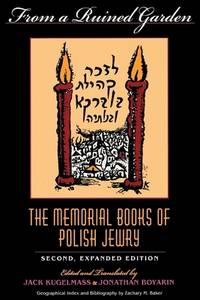
1998réf. 38769Bloomington Indiana U.S.A.: Indiana Univ Pr. New. Paperback. FREE UPGRADE to Courier/Priority Shipping Upon Request – – IN STOCK AND IMMEDIATELY AVAILABLE FOR SHIPMENT - FLAWLESS COPY BRAND NEW PRISTINE NEVER OPENED -- with a bonus offer--; T-Holmem; United States Holocaust Memorial Museum From a Ruined Garden: The Memorial Books of Polish Jewry JEWS HISTORY POLAND HOLOCAUST JEWISH . 1998. 0253211875 . Indiana Univ Pr paperback
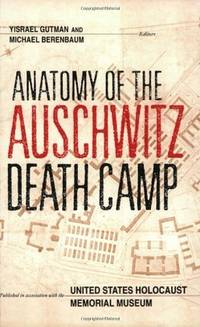
1998réf. 29144Bloomington Indiana U.S.A.: Indiana Univ Pr. New. Paperback. FREE UPGRADE to Courier/Priority Shipping Upon Request - IN STOCK AND IMMEDIATELY AVAILABLE FOR SHIPMENT - FLAWLESS COPY BRAND NEW PRISTINE NEVER OPENED -- with a bonus offer--; T-Gutman; AUSCHWITZ CONCENTRATION CAMP HOLOCAUST JEWISH . 1998. 025320884X . Indiana Univ Pr paperback
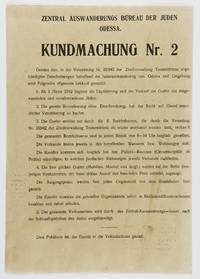
1942réf. 51752Odessa: Zentral Auswanderungs Büreau 1942. Original document. Loose leaf. Very good condition. Quarto. Original loose leaf with black lettering. Announcement based on ordinance no. 35/942 of the civil government of Transnistria relating to the emigration of Jews in Odessa and surrounding areas. The text printed biligually in German and Ukrainian is organized into five statements. The annoucement concerns the liquidation and sale of goods of emigrated or vanished Jews beginning on March 1 1942 with the whole population without limitations given the right to buy these items based on oral agreements. Furthermore the announcement regulates details and procedures of the sale and at the end announces that after the sale proceeds will by handed to the Jews by the Central Emigration Office. "The rapid development of Odessa began after the Russian conquest 1789. Its Jewish population also grew quickly and in the late nineteenth and early twentieth centuries it was the most important Jewish literary community after Warsaw. In 1926 there were 153194 Jews in Odessa 36.4 percent of the total population and by 1939 their numbers reached 180000." Encyclopedia of the Holocaust Vol. 3 page 1080. When Romanians and Germans laid siege to the city on August 5 1941 many Jews in Odessa managed to leave and eighty to ninety thousand Jews remained in the city. Odessa fell on October 16 and the German Einsatzkommando 11b and the Romanian intelligence service immediately slaughtered over eight thousand residents mainly Jews and Odessa was established as the capital of the Transnistria region. On October 22 the Romanian military headquarters were blown up killing sixty-six officers and the military governor. In reprisal the Romanian ruler Ion Antonescu ordered devastating retaliation including the arrest of one member of each Jewish family. By October 1941 some 40000 Jews were assembled in the ghetto of the nearby city of Slobodka and their valuables confiscated. Deportations of some 20000 Jews began in January of 1942. When Odessa was liberated on April 10 1944 authorities reported that about 99000 Jews had been killed. Odessa again became an important Jewish center with 102000 Jews living there according to a 1959 census. Considering the context of "Kundmachung Nr. 2 the Odessa massacre of October 22-24 1941 and the murder of Jews living between the rivers Dniester and Bug during the Romanian and German occupation this succinct notice including its misspellings and mistakes in the German language is a chilling mirror image of the attitude shown by the occupying powers towards the Jews. Approximately 30000 Jews were killed in Odessa and more than 100000 in Transnistria. The text is printed in German on one side and Ukrainian on the verso. Minor wear and smudging. Protected in modern mylar. Zentral Auswanderungs Büreau unknown
réf. 69182New York: Raw Books & Graphics 1986. Very Good. Slim folio 36 cm Saddle-stitched illustrated wraps. Wraps lightly rubbed. Moderate soiling to rear wraps of numbers 1 and 3. Volume 1 Number 1 Fall 1980. "Two-Fisted Painters" by Art Spiegelman booklet. Volume 1 Number 3. 1981. "Maus Chapter Two The Honeymoon" booklet. Volume 1 Number 4. 1982. Vinyl record "Reagan speaks for himself" detached and laid in. "Maus Chapter Three Prisoner of War" booklet. Volume 1 Number 5. 1983. Couple by Art Spiegelman. "Maus Chapter Four The Noose Tightens" booklet. Stapled in a little loosely. Volume 1 Number 6. 1984. "Maus Chapter Five Mouse Tales" booklet. Volume 1 Number 7. 1985. "Maus Chapter Six Mouse Trap" booklet. "Red Flowers" booklet by Yoshiharu Tsuge. Deliberately issued by the publisher with a torn front wrap. Volume 1 Number 8. 1986. Jimbo by Gary Panter. "Maus Chapter Seven Mauschwitz" booklet. The first number along with six other issues of RAW Magazine Volume 1. Number 2 is not present. A very colorful and bold comics and graphics anthology edited by Art Spiegelman and Françoise Mouly a husband and wife team which highlighted artists from around the world and was published in the United States from 1980 to 1991. In addition to the work of Spiegelman and Mouly RAW featured cutting-edge comic artists such as Robert Crumb Gary Panter Charles Burns Kim Deitch Sue Coe Jerry Moriarty Richard Sala and Ever Meulen among many others. In these issues of RAW one will find Gary Panter's best-known comic protagonist "Jimbo" a burly punk and existential adventurer as well as "The Voice of Walking Flesh" by Charles Burns "Love's Savage Fury" by Mark Newgarden and a centerfold by Ever Meulen captioned "Use the Mood of the Past to Rewire Your Brain for the Future." Of significant importance is the fact that Art Spiegelman's seminal graphic work "Maus: A Survivor's Tale" made it's first appearance in this magazine chapters 2-7 are present here as stapled-in booklets. Spiegelman's unrivaled Holocaust narrative "Maus" was awarded the 1992 Pulitzer Prize it was the first graphic novel to win the Pulitzer Prize and he was the first-ever cartoonist to receive the prestigious Edward MacDowell Medal a medal awarded annually since 1960 to artists who have made an outstanding contribution to American culture. A nearly consecutive run of volume 1 of this trailblazing magazine with original serialized chapters of "Maus." "The Graphix Magazine for Your Bomb Shelter's Coffee Table." Number 4 front cover caption. Raw Books & Graphics unknown