5 560 résultats
1944Original wraps. 8vo. 246, [2] pages. 23 cm. Serial publication. In Hungarian, with Yiddish. OMZSA Yearbook. The Országos Magyar Zsidó Segíto Akció (National Hungarian Jewish Aid Association; OMZSA) was a general assistance organization for the large Budapest community. The OMZSA was involved with cultural, legal, and economic battles on behalf of the (religious) Jewish Budapest community. For example, a series of drawings by the artist Imre Amos (1907-1945) entitled Zsidó ünnepek (Jewish Holidays) , representing the Jewish holidays in the shadow of annihilation, became emblematic for Hungarian Jewry. (The series appeared in 150 copies published in 1940 by the Országos Magyar Zsidó Segito Akció [National Hungarian Jewish Aid Action]. ) (YIVO encyclopedia) . According to OCLC, four issues of the yearbook are known to exist (the earliest issue is titled OMZSA Naptár OMZSA Calendar) . This issue contains a calendar of the days and holidays for the year (In Hungarian and Yiddish) , and extensive literary (poems, letters, short stories) and journalistic pieces by dozens of writers and editors from the Budapest community. For many of these authors, this would be their last published work. [T]he Germans occupied the country on 19 March 1944, Gestapo chief Adolf Eichmann set up his SS command in Budapest, and the Budapest Jewish Council was established. What had been an extended process of stigmatization, ghettoization, deportation, and murder elsewhere was greatly concentrated and executed with great efficiency and speed in Hungary. The deportation and gassing of almost 440, 000 provincial Jews at Auschwitz-Birkenau began in mid-May and was swiftly accomplished by July as a result of full cooperation of the Hungarian authorities. Only intense diplomatic pressure threatening harsh postwar retribution caused Regent Horthy to call a halt to the deportations on 6 July, giving Budapest Jewry a temporary reprieve. In Budapest, a series of measures increasingly placed limitations on Jews who remained in the capital. Restrictions were placed on using the public transport; later telephones, bicycles, and cars were confiscated, and an evening curfew was imposed. From 3 April, all persons defined as Jews were obligated to wear a yellow star on their outer clothing The reverses suffered by the Germans emboldened Horthy to announce in mid-October his intention to withdraw Hungary from the war. With German backing, Ferenc Szálasi and his Arrow Cross Party seized power on 15 October. Budapests Jews were now threatened by a far more vicious regime whose radical antisemitic ideology was wholly in tune with Hitlers apocalyptic vision. Forced death marches began on 20 October and along with German deportations, affected some 75, 000 Budapest Jews. The city rapidly descended into chaos as roving Arrow Cross bands combed the streets rounding up Jews. The first murders in the streets began on 12 November; the first executions took place by the riverbank on 23 November. (YIVO Encyclopedia) Subjects: Jews - Hungary - Periodicals. Jewish almanacs. OCLC lists 7 copies. Wraps lightly worn, with light pencil marks on front cover and first endpage. Pages lightly aged, otherwise fresh. Very good condition. (HOLO2-103-36)
1985328 pages. "A significant document by which the author acquitted himself of the obligation bequeathed on the survivors of the Holocaust by its victims to tell the world what happened to the Jews during World War Two, when to be a Jew was a crime. The Memoirs based on the author's own experiences and reports told to him by his relatives and friends, survivors of the Holocaust, describe the fate of hundreds of thousands of Polish Jews, banished by the Russians to Siberia and in particular the lot of those who came under the Nazi regime... A rich source of first hand information about the life in the ghetto, the Judenrat, the Jewish Ghetto Police and the methods used by the Nazis in the destruction of the Jews." - dust jacket. Author lost his parents, wife and two sons in the Holocaust. Map endpapers. Black and white illustrations. Book clean and unmarked with light wear. Dust jacket lightly sunned at spine, bears several closed tears and is missing some small chips - now preserved in glossy new archival-grade Brodart cover. A sound copy.. Book
18411st edition. Original period boards. 8vo. 328 pages, 21 cm. In German. Includes a 107-page dictionary of Jewish Criminals slang at rear. Title translates to The Jewish Crooks in Germany: Their Tactics, Peculiarities, and Language, along with Detailed News About the Most Notorious Jewish Criminals Staying in Germany and at its Borders. Thiele was a German court clerk in the criminal court in Berlin (Kierkegaard, 2015) . SUBJECTS: Jewish criminals. Jews -- Germany. Cant -- Dictionaries -- German. OCLC lists 19 copies worldwide (OCLC: 1423903) , most are in Europe. Spine is chipping. Some pages are lightly soiled, but no loss to text. Overall good condition. Important. (GER-54-4)
1947First edition. Original paper wrappers. 4to. [203] pages. 29cm. In English. Massive report written on November 21, 1947 and dealing with matters related to Jewish settlement in Palestine and the Jewish refugees coming from Europe to America and elsewhere. Section II on the ADJC, includes sections on: The Displaced persons Countries, Eastern European Countries, Western European Countries and then Shanghai, Central and South America, and Special Passover Relief. Section IV, on the United Service for New Americans, includes subsections on Who are the Newcomers? , Resettlement from New York, European Jewish Childrens Aid, Physicians and Dentist Unit, Location Service, Central Refugee Index, and many others. In January 1939, the United Jewish Appeal for Refugees and Overseas Needs was established, combining the efforts of American Jewish Joint Distribution Committee, led by Rabbi Jonah Wise; the United Palestine Appeal, led by Rabbi Abba Hillel Silver; and the National Coordinating Committee Fund led by William Rosenwald. The three founders emphasized that the funds needed to support Jews in Europe and Palestine would be triple to quadruple the amount raised in the previous year. While the organizations would raise funds together, the Joint Distribution Committee would assist Jews in Europe, the United Palestine Appeal would aid the Jewish community in Palestine, including refugees from Europe arriving there and the National Coordinating Committee Fund would assist refugees arriving in the United States (Wikipedia, 2016) . OCLC lists 3 copies worldwide (Harvard, JHU, NLI) , none in the US outside the East Coast. Wrappers are edgeworn and chipped. Minor soiling to some pages with no damage to text. Overall Good Condition. (ZION-10-13)
1945(1945) . Original Illustrated Paper Wrappers, Small 8vo, 216 pages. Eredeti borítóval. Includes 9 powerful original linocut illustrations, and cover design, by Shagra Weil. Also includes a bit of music.Title translates as "The Yellow Book. Data on the War Losses of Hungarian Jewry. 1941-1945." One of the earliest book about the Hungarian Holocaust. Published by Hechaluc (Hehalutz), the Zionist resistant movement, whose legendary headquarters was located at the Üvegház (Glasshouse) in Budapest, a former glass-store. During the Holocaust about 3000 people found shelter there and it was the center for producing fake identification documents to save Hungarian Jews from persecution. Shraga Weil (Ferenc Ferdinánd; 1918-2009) was a Hungarian born Israeli painter. He studied at the Academy of Art in Prague and École des Beaux Arts in Paris. During WWII he was active in the Zionist underground movement in Budapest, working in the workshop for forging documents. After the war he sailed for Palestine on an illegal immigrant ship and became a member of Kibbutz Ha'ogen where he lived until his death. In 1959 Weil was awarded the Dizengoff Prize for painting. He created the doors of the main entrance to the Knesset building and the President's residence in Jerusalem. Weil painted the wooden panels in the Israeli Hall at the Kennedy Center. Sándor Groszmann (Alexander Grossmann, Ben Erec; 1909-2003) was a journalist and publisher, one of the main activists of the Hungarian Zionist movement and co-founder of "Hashomer Hatzair" in Hungary. He was one of the leaders at the "Glasshouse". "When the argument arose about whether to absorb more Jews into the 'Glass House' as they might endanger the lives of those already living there, he said: 'For the sake of one hundred thousand Jews it is worth to endanger our own lives'". (Gur, D.; 2007). After the liberation he was the secretary of JDC (American Jewish Joint Distribution Committee) in Budapest and member of the board of the Hungarian Zionist Association and of the "Eretz-Israel" office. In 1949 he left Hungary and after living in Austria and Israel he settled down in Switzerland where he started to publish books and the periodical "Jöv?" (Future). [Bibl.: Gur, D.: Brothers for Resistance and Rescue. The Underground Zionist Youth Movement in Hungary during Word War II. Jerusalem-New York, 2007; Cohen, A.: The Halutz Resistance in Hungary, 1942-1944. New York, 1986.]. Paper aged, Very Good Condition. (holo2-125-27) xx
2014réf. 193357-1Oxford, University Press 1986-2014. Mit Abb. Original-Kartonband
réf. 21202° (39 x 29 cm). 13 Bll., 78 teils kolorierten Tafeln. Farbig illustrierte Original-Broschur. Rücken lädiert. Innen sehr sauber und gut erhalten.
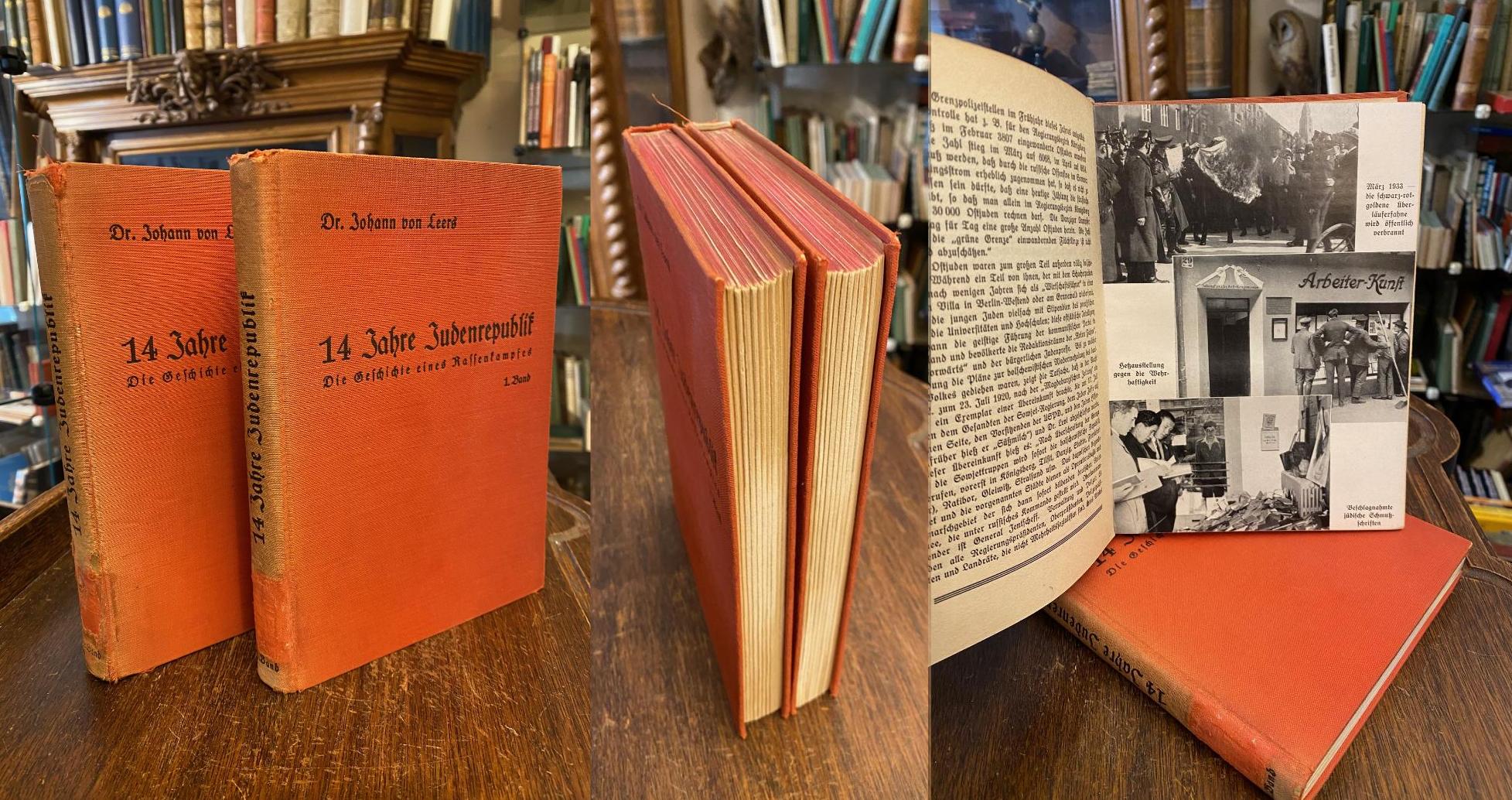
1933réf. 58726ABBerlin-Schöneberg, NS-Druck und Verlag, (1933). 8° (21x15), 165 S., 1 Bl. mit 13 fotograf Aufnahmen auf Tafeln (fortlaufend in der Paginierung; 191 S. mit 16 fotograf Aufnahmen auf Tafeln und 19 Porträtaufnahmen mit Kurzbiographien im Schlußkapitel 'Jüdischer Bolschewismus in Deutschland', einheitl rote Olnbde mit TitelPrägung, 1. Aufl. die Rücken aufgehellt, an den Rückenenden berieben und mit Schatten/Abrieb von entfernten Etiketten, sonst sauber und gut,
1947Original Cloth. 8vo. 482, [12] pages. 25 cm. First edition. In Hungarian. 'You are the Witness! From Ukraine to Auschwitz. ' With 12 pages of plates (printed in blue ink) . Includes name register of Hungarian Jewish victims of the holocaust on pages 209-482. Finely bound in buckram with gilt title. Subjects: Holocaust, Jewish (1939-1945) - Registers of dead Hungary. Holocaust, Jewish (1939-1945) - Registers of dead - Ukraine. Holocaust survivors - Hungary Registers. Holocaust, Jewish (1939-1945) Jews - Persecutions - Hungary. Jews - Persecutions. Holocaust, Jewish (1939-1945) . OCLC lists 18 copies. Light wear to cloth; pages lightly aged, otherwise clean and fresh. Very good condition. (HOLO2-115-20)
1941Original Wraps. 8vo. 15 pages. 22 cm. First edition. Declaration by Jan Stanczyk on the heroic struggle of the underground movement in Poland (Jewish and Polish) , the vicious eradication of all Polands citizens by the Nazi occupation, and the need to redress previous wrongs committed by the Polish government against its Jewish citizens. Contains six illustrations. A pledge of Jewish equality in a 'post-war democratic Poland freed of the Nazi yoke, ' was given here today by Jan Stanczyk, Polish Minister of Labor and Social Welfare at a press conference preceding his address to the executive committee of the Jewish Labor Committee. 'The future relations between Gentiles and Jews in liberated Poland, ' said Mr. Stanczyk, 'will be built on entirely new foundations. Poland will guarantee all her citizens including the Jews full legal equality. This Poland will be a true democracy and every one of her citizens will enjoy equal rights irrespective of race, creed or origin. ' Emphasizing that the Jewish underground movement in Poland today is part of the great Polish underground army waging the struggle for the common cause of liberation, Mr. Stanczyk declared that the present war 'has wiped out the institutions and destroyed the power of groups which had striven to foment hatred among the people of Poland' and that their common fate has created a strong bond between Gentile and Jew. - JTA, 'Post-war Poland Will Guarantee Equality to Jews, Stanczyk Pledges', December 11, 1941. Subjects: Rzeczpospolita Polska (Government-in-exile) ; Jewish Labor Committee (U. S. ) . Jews - Legal status, laws, etc. - Poland. Civil rights - Poland. World War, 1939-1945 - Poland. Civil rights. Jews - Legal status, laws, etc. World War (1939-1945) . OCLC lists 8 copies. Light wear to wraps, overall very clean and fresh. Very good condition. Very important. (HOLO2-123-27)
réf. DADAX0841911843New unknown
1979réf. 41929Warszawa Warsaw: Pan´stw. Wydawn. Naukowe 1979. 1st Edition. Original black printed portfolio 8vo. Portfolio of seven large folding maps on on 4 sheets of heavy paper 3 are double sided 1 is singled sided. Primarily black and white with some color. Text in Polish. Title translates to “Nazi camps in Poland 1939 - 1945. An Encyclopaedic Reference Book: Maps." Collection of 7 maps each 84 cm x 60 cm 33 x 24 inches produced by Jan Laskowski at the Main Commission for the Investigation of Nazi Crimes in Poland. The maps comprise Volume II of the work; Volume I is a heavily illustrated 676-page book of the same title which we offer separately. The Seven maps all present are: - Map 1 Single Sided: Hitlerowskie obozy na ziemiach polskich w latach 1939 - 1945. “Nazi camps in Poland in the years 1939 - 1945”. Showing: concentration and extermination camps sub-camps of concentration camps extermination centers POW camps more important sub-camps working divisions commandos and temporary POW camps penal labor camps major labor camps prisons transit camps & ghettos. - Map 2A: Getta na ziemiach polskich w okresie okupacji hitlerowskiej w latach 1939 - 1945 “Ghettos in Poland during the Nazi occupation in 1939 - 1945”. - Map 2B: Hitlerowskie obozy przejsciowe na ziemiach polskich w latach 1939 - 1945 “Nazi transit camps in Poland in 1939-1945”. - Map 3A: Hitlerowskie wiezienia i areszty na ziemiach polskich w latach 1939 - 1945 “Nazi prisons and arrests in Poland in 1939 - 1945”. - Map 3B: Hitlerowskie obozy pracy na ziemiach polskich w latach 1939 - 1945 “Nazi labor camps in Poland in the years 1939 - 1945”. - Map 4A: Hitlerowskie obozy jenieckie na ziemiach polskich w latach 1939 - 1945 “Nazi POW camps in Poland in 1939 - 1945”. - Map 4B: Hitlerowskie obozy koncentracyjne i osrodki zaglady na ziemiach polskich w latach 1939 - 1945 “Nazi concentration camps and extermination centers in Poland in 1939 - 1945”. Maps 2A & 2B have been described as a “Terrifying pair of maps showing the locations of German POW and internment camps in Poland during World War II highlighting the widespread locations of these establishments. In some parts of the map the information becomes so dense that three inset maps are shown. This map was designed by Jan Laskowski and printed in 1979 as part of a work on the Nazi extermination machine produced by PWN Warsaw a state-owned research-focused publishing house in Poland. The map on the front is particularly interesting for its depiction of symbols used to classify internees in German camps. The uppermost of these depictions shows the combinations that can be made for different types of prisoners of different levels of importance. The armbands that would have been worn by these prisoners is shown as well as the prison uniforms. Other details are also shown. The map lists hundreds of sites run by Nazi operators throughout the country. These include concentration camps death camps transitional camps and ghettos. The map is divided according to Poland's voivodeships with a key in the lower left. Names of cities too long to spell are also provided in the lower left. This map was produced during a point in Poland's history during which it was actively revisiting the period during the Second World War. Leading social scientists devoted their time to trying to gather all the living as well as the recorded history of the events of the Holocaust and related atrocities before this information vanished. Leading these efforts particularly during the 1960s and 1970s was the Glówna Komisja Scigania Zbrodni przeciwko Narodowi Polskiemu known as the Chief Commission for the Prosecution of Crimes against the Polish Nation. They were active in publishing maps both for domestic educational purposes and for international remembrance and diplomatic efforts regarding the Holocaust. Jan Laskowski was a leading cartographer who produced a number of maps in this field. These maps were produced as part of a series of maps that purported to combine to form an atlas of all of Hitler's crimes in Poland. Many of the large wall maps produced during this period could only show a fraction of the crimes or only the atrocities committed in one region. Thus a series of maps was needed to show all the points necessary which this present work contributes to. Polish Reinterpretations of the Holocaust: Studying the effects of German occupation in Poland is a delicate subject. While it is certain that Poland suffered at least as badly as any other European nation during the Second World War reinterpretations of the Holocaust in the country have also been used to satisfy nationalistic tendencies. It has become evident to Western observers in the last several years that there is a strong nationalist movement in Poland that seeks to place blame for the Holocaust solely on the shoulders of non-Polish actors a movement originally fostered under Soviet rule. This movement has gone so far as to limit freedom of speech criminalizing with a three-year sentence the suggestion that Poland or its citizens in any form participated in the murders committed by Nazis. As such the term ‘Polish concentration camps’ has been deemed unacceptable with the government-approved term being ‘concentration camps on Polish territory.’ All lines of evidence show that this map 2A & 2B was produced using the most accurate and impartial historical sources. The language on the map is simple naming only ‘Hitler's Atrocities’ and there is no evidence of a clear anti-German bias. However it is impossible to separate this map one of the most important productions of the remembrance movement during this period from the social situation in which it was produced. Maps like these can easily be converted into propaganda instruments and today's Polish leaders most of whom grew up during Soviet occupation will have formed their understanding of the Holocaust through maps like these. Soviet Censorship: While the content of the map appears to have been produced free from bias the map still had to go through Soviet censorship. Mentioning prisoner of war camps in which primarily Soviet troops were interned would have been a prerequisite condition upon which the publication of the map rested. Further the lack of mention of any Soviet killings or camps requires no explanation….The map unlike many later maps makes no differentiation between the populations who suffered at the various camps. This represents the Soviet agenda that all nations suffered fought and won equally which sought to limit divisions in this post-identity state” Ruderman 2022. SUBJECTS: World War 1939-1945 -- Prisoners and prisons German. -- Concentration camps -- Poland. Guerre mondiale 1939-1945 -- Prisonniers et prisons des Allemands. -- Camps d'internement -- Pologne. Obozy koncentracyjne -- Polska -- 1900-1945. OCLC: 830885973. Light shelf wear to portfolio as expected. All maps in pristine condition with normal folds as issued. Very Good Condition. Complete and dramatic BR5 holo2-147-19-'cc. Warszawa (Warsaw): Pan´stw. Wydawn. Naukowe unknown
1934Original Publisher's Boards. 8vo. 48 pages. 24 cm. First edition. Early photographic expose of Nazism in Germany, in French, with parallel German and English translations. Mostly illustrated (pgs 6-47) , containing photographs and the printed speeches of Nazi leaders. Photographs of childhood, training of youth, propaganda, S. A. , S. S. , police in the Third Reich, which demonstrate that the everyday tutelage of the people, no matter of what age, constitute the terror of the third Reich (p. 5) . The world is threatened by the brown hate! ! (p. 5) . Dt. Exilarchiv 4106; Sternfeld/Tiedemann 350. Subjects: National socialism. Political science. 1933 - 1945 Germany - Politics and government - 1933-1945. OCLC lists 29 copies. Light wear to spine, otherwise Very good condition. (HOLO2-125-23) xx
19481st edition. Later Cloth with covers bound in, Oblong 4to, Aproximately 100 leaves, mostly photographic plates. Includes 175 photographic illustrations. Introductory text and captions (many of Biblical origin) in English, Hebrew and Yiddish. This album seeks to present a picture of the wanderings of the 'remnants' of European Jewry - wanderings that began at the conclusion of the last war and still continue (From the introduction) . A collection of 175 black and white photographs documenting the Bericha - - the 'illegal' underground flight of surviving European Jews into Palestine immediately following the Holocaust. This was the great exodus of European Jews following the holocaust, who illegally crossed the borders of Soviet-occupied lands and made their way as illegal immigrants to the shores of Palestine. Special sections of this album are dedicated to children and orphans who took part in this immigration effort, and another section documents the famous journey of the ship Exodus. Compiled by Ephraim Dekel, a high-ranking Haganah officer and architect of the Bericha escape-route. SUBJECT(S) : Jewish refugees. Emigration and immigration. Jewish refugees. Berih? Ah (Organization) Israel -- Emigration and immigration -- Pictorial works. Staining to first 10 leaves, heavy wear to original cover, which is bound in, but photographic and text pages are very good--clear, solid, and powerful. A Good Copy. (holo2-125-10)
19381st printing of the 1938 edition. October, 1938. Original illustrated wrappers, 12mo (small) , 191 pages, including many, many period ads. Published just one month prior to Kristallnacht, this is a Name and Address Directory of the worlds leading Fur business district, the Brühl, and its counterpart in Berlin, both very heavily Jewish. Divided into 2 sections, one for the Brühl in Leipzig, and the other for Furriers in Berlin. In the 19th and early 20th Century, the Brühl had become synonymous with the Leipzig fur and Tobacco trade. It was the name of the large street where the trade was concentrated (also including Nikolai- and Reichs-strasse) . The Brühl reached its highest density with 794 shops in 1928. Of these, about 58 percent were Jewish run and owned. In the period 1926-1930, the Brühl controlled about one third of the world market in furs. With the great depression, followed by the Nazi seizure of power in 1933, the fur trade went into decline. For political reasons the fascist leadership limited the import quotas for goods from the USSR, such as raw fur. And, of course, increasingly, Jewish merchants in the Brühl were discriminated against and expelled. Many fled to England or the United States, where they established new fur businesses. Following Kristallnacht, which came only 1 month after the publication of this guide in October 1938, it became impossible for Jewish furriers to function. Some of the most famous Jewish fur traders included: Julius (Judel) Ariowitsch (1855-1908) ; Chaim Eitingon (1857-1932) , known as "Fur King from Brühl", founder of the Ez Chaim Synagogue and the Jewish hospital; the Frankel family; the Harmerlin Family; John B. (John [Joel] Berend) Oppenheimer & Company; F. Weiss (1893-1982) ; and Theodor Wolf (1833) . OCLC lists only one holding worldwide (German National Library) . Light wear, occational pencil scribbles, overall Very Good Condition. Quite rare and important. (holo2-125-28)
réf. 21182° (39 x 29 cm). 13 Bll., 78 teils kolorierten Tafeln. Farbig illustrierte Original-Broschur. Mit äußerst selten erhaltener Original-Chemise im Original-Schuber. Sehr gut erhaltenes, sauberes Exemplar. Der fast immer fehlende Schuber stark lädiert. Innen tadellos.
FIRST EDITION of this novel which, way ahead of its time, discusses the right of women to enjoy sexual pleasure. A LARGE-PAPER COPY, ONE OF ONLY TEN PRINTED ON FINE HANDMADE DUTCH LAID PAPER (the rest of the edition was printed on cheap wood-pulp paper.) Also a fascinating association copy, from the library of MARCEL GOMPEL, a Jewish professor at the College de France who became a hero of the French resistance and was finally tortured and executed on orders from Klaus Barbie. When Barbie came to trial, the prosecutors used Gompel's case as a particularly clear and egregious example of his guilt of crimes against humanity. 8vo. Beautifully bound (surely for Gompel) in half morocco and marbled boards. Top edge gilt, other edges uncut. Original covers and spine preserved. Silk ribbon page marker. FINE AND BRIGHT, with no defects. A truly unique book.
19441st Edition. Original Illustrated Paper Wrappers. 8vo. 70 pages ; 17 cm. Text in Polish. The first separate published account of the Warsaw Ghetto uprising, issued the year following the revolt. Title translates into English as, Warsaw Ghetto Uprising. Issued under Soviet auspices it was written by a participant, the Polish historian, journalist and anti-Fascist activist, Bernard Mark (1908-1966) . Mark narrates the events immediately preceding and during the 1943 armed uprising of Warsaw's Jews, and presents Jewish, Polish, and German documents pertaining to the Warsaw and other ghetto and camp rebellions. (Google Books, 2017) Published by Union of Polish Patriots in the USSR. SUBJECT(S) : Holocaust, Jewish (1939-1945) -- Poland -- Warsaw. Jews -- Poland -- Warsaw. Warsaw Ghetto Uprising. OCLC lists 16 copies worldwide, but none in New York. Paper toning. Very good+ condition, a beautiful copy. (holo2-135-2A)
1945Original Wraps. 8vo. 31 pages. 21 cm. First edition. In French. On cover: Temoignages de deportes politiques en Allemagne. 'Testimonies of political deportees in Germany'. 'Extermination Camps: Documents, Testimony, Photographs of the Camps of the deported in Germany. ' Contains 8 pages of photographs, depicting deportations, ovens, those murdered. Testimonies describe the deportations of Jews and resistance members to Drancy and on to Auschwitz. Subjects: Concentration camps - Germany. World War, 1939-1945 - Atrocities. Atrocities. Concentration camps. World War (1939-1945) . Wraps torn at edges and soiled; bumped edges, otherwise fresh and clean. Good condition. (HOLO2-124-9)
1941No Date (1941). 1st edition, original wrappers, 8vo. 12 pages. Almost certainly published in 1941, as the Rabbinical Association was founded in 1901 and this booklet is From the presidential message delivered at the 40th Annual Convention of the Rabbinical Assembly of America- Detroit, Michigan. Arzt says, The moral re-awakening of America will be tremendously enhanced by tangible acts of sympathy and succor for the innocent victims of the holocaust across the seas. The Jews of America must, with increasing generosity and self-sacrifice, contribute of their means for the maintenance of the overseas program of relief. Our suffering brethren in war torn Europe will continue to hope against hope, if our thoughts, our prayers and our united efforts will be with them and for them. The religious forces in America should champion legislation for the suspension of all restrictive legislation to make possible the immediate admission of children from Europe for the duration of the war. Millions of Americans will eagerly offer the hospitality of their homes for these unfortunates. The arrival of a huge expeditionary army of little ones to these shores will immediately fortify our spirit and will generate in us a spirit of selflessness and sacrifice which will enable us to face the future with courage and confidence. (page 8) Not listed on OCLC or anywhere else online. Creased down the middle, previous owners name on written on cover, cover rubbed, else Good Condition. Extremely rare, perhaps a unique surviving copy (HOLO2-141-28)
19371st edition. Original paper wrappers. 8vo, 4-8 pages each. Conservative Jewish men's group newsletter from the Holocaust period from the the second synagogue founded in New York (1825) and the third-oldest Ashkenazi synagogue in the United States. "The object of the 'Tattler' will be to provide the members with a regular source of information and entertainment....The Pogroms in Russia during the Czarist regime or the activities of the Zionist movement in recent years had no such effect on the consciousness of the average American Jew except to stir a sense of pity and sympathy for the afflicted ones. But the cruel, heartless persecutions of the Jews in Germany by Hitler and his crew, caused a stirring in the blood of Native Americans of Jewish birth that made them turn about and recall the religion of their fathers and the God of Israel. We of The Men's Club of the Congregation B'nai Jeshurun welcome with open arms all those who are returning to the fold." Most issues include commentary on the increasing oppression of the Jews in Germany; other issues discussed include some current Jewish news, some retelling of Jewish history, congregation news, editorials, fun facts, jokes with lessons. OCLC: 944959016, OCLC lists 2 holdings worldwide (JTS & USHMM), though these holdings appear to be incomplete. First issue shows edgewear, other issues show only creases from folding, touch of wear, good quality paper with just the slightest toning. About Very Good Condition Overall. Rare (HOLO2-159-22A)
1946Original Cloth. 8vo. 121 pages. 25 cm. First edition. In Hebrew. Scenes of the Destruction. Important collection of photographic images of Holocaust, published the year after the wars end in Palestine, not yet Israel. Introduction by Avraham Levinson. Subjects: World War, 1939-1945 - Pictorial works. Holocaust, Jewish (1939-1945) - Europe. Holocaust, Jewish (1939-1945) . World War (1939-1945) . Pictorial works. OCLC lists 18 copies. Light edge wear to cloth, endpages lightly foxed, otherwise clean and fresh. Very good condition. (HOLO2-124-4)
19381st edition. Original printed Publishers linen, 8vo, (5) , 283 pages. With 20 colored maps of countries and regions around the world, including one world map displaying distances from Berlin. Title translates as, Philo-Atlas: Guide for Jewish Emigration. Styled after the popular Philo Lexikon, this publication is a remarkable record of its time. Issued barely two weeks prior to the outbreak of Kristallnacht (9/10 November, 1938) , this appears as nothing but a tourist guide-book. Yet its contents reveal a far more urgent need: An alphabetical survey of countries world-wide with their respective rules for obtaining entry-visas. These are no tourist formalities, for now survival depends on them. Which countries still accept migrants? How much money do they demand? For which occupations is there a need? Which diseases need one be prepared for? Where to find local organizations who can assist immigrants? The Jewish owned Philo Verlag, was forcibly closed a month following the publication of this guide, by which time the Nazis decided they were no longer willing to permit Jews to leave Germany even if they could find a country willing to take them in, which after the Evian Conference of earlier that summer, was most unlikely. The Jews who remained in Germany were now quite trapped. Two copies sold at auction in 2018 for USD 1125 and USD 1375 each, with buyers premiums. Beautiful copy, near fine condition.
1945First edition. Original illustrated wrappers, 12mo, 43, 10 pages. Text in English and Hebrew. 13 drawings made by a Jewish woman of her fellow inmates while in the concentration camp at Leibitsch which consisted of 1200 Jewish women who had been deported from the Kaunas Ghetto in East Prussia. Lurie was liberated by the Red Army on 21 January 1945. In March 1945 she reached a camp in Italy, where she met Jewish soldiers from Palestine who were serving in the British army. One of them, the artist Menahem Shemi, organized an exhibition of drawings from the camps, which resulted in the publication of a booklet Jewesses in Slavery. This contained drawings by Lurie from Stutthof and Leibitz and was published by the Jewish Soldiers' Club of Rome in 1945. Lurie also created stage sets for the military song and dance group in the camp, which was founded by Eliahu Goldberg and Mordechai Zeira. Lurie reached Israel (Palestine) in July 1945 and was received with great excitement. Her stories were published in the press and her drawings were exhibited in exhibitions. In 1946 she was again awarded the Dizengoff Prize for a sketch Girl with Yellow Badge, which she had made in the Kovno ghetto (World ORT and Beit Lohamei Haghetaot, 2001) . SUBJECT(S) : World War, 1939-1945 -- Personal narratives, Jewish. Women in art. OCLC Worldcat lists 18 copies worldwide. Ex-library copy with small pocket and stamps in Hebrew, wrappers slightly toned with a couple of tiny stains, otherwise Very Good Condition. (holo2-125-38A)
19441st edition. Original paper wrappers, tall 12mo, 69 pages. 22 cm. In German. The first separate publication of a demand for Nazi reparations to the Jews. In July 1943, long before the war ended, Siegfried Moses coined the term reparations in relation to claims of Jewish citizens against the German state. He published an article on the restitution demands of Jews in the bulletin of the "Irgun Olej Merkaz Europa", Tel Aviv; they publish here those proposals as a separate work. For the first time, Moses proposed that a State can commit an injustice, for which it must then compensate the civilian population which suffered under that injustice. This legal opinion was later the basis for reparations by the Federal Republic of Germany. Siegfried Moses (1887-1974) was a German-Israeli lawyer and the first state comptroller Israel. After the Nazi seizure of power, he helped German Jews transfer assets to Palestine. From 1933 on he was also chairman of the Zionist Federation of Germany (ZVfD) and Vice President of the Reich Association of German Jews. In 1937 Moses himself fled to Palestine; then in 1941 he wrote (together with fellow German emigre Walter Schwarz) the text of the 1941 Palestinian Income Tax Act. In 1947 Moses was a member of the delegation of the Jewish Agency at the United Nations and in 1949, he became the first state comptroller Israel (Chief of Court) . In 1956-1957, he was also President of the "Council of Jews from Germany", the official association of Israelis of German origin. In 1955 he co-founded the Leo Baeck Institute, serving as its director, and was on the advisory board of the United Restitution Organization in Israel (Wikipedia, 2015) . SUBJECT(S) : Holocaust, Jewish (1939-1945) -- Reparations. World War, 1939-1945 -- Claims. Jews -- Europe. Jewish property -- Germany -- History -- Post war problems -- Reparations for historical injustices. OCLC lists 17 copies worldwide, but only 5 copies in the US (NYPL, Yale, US Holocaust Museum, UChicago, Princeton) . Spine worn, corners bumped through, Good Condition. Very important. (holo2-126-34).