5.235 Ergebnisse
Best.-Nr. 42502Bruxelles, Labor, 1994. 15 x 21, 137 pp., broché, très bon état.
Best.-Nr. 42503Bruxelles, Labor, 1996. 15 x 21, 192 pp., nombreuses photos en N/B, broché, bon état (jaquette légèrement défraîchie).
Best.-Nr. 65478Bruxelles/Paris, Fondation Auschwitz/Fondation pour la Mémoire de la Déportation, 1996. 16 x 23, 304 pp., quelques illustrations en N/B, broché, très bon état.
Best.-Nr. 69017Paris, Calmann-Lévy, 2005. 15 x 23, 343 pp., broché, très bon état.
Best.-Nr. 69024Paris, Centre de Documentation Juive Contemporaine, 2002. 15 x 24, 266 pp., quelques illustrations, broché, très bon état.
Best.-Nr. 69026Paris, Centre de Documentation Juive Contemporaine, 2003. 15 x 24, 638 pp., quelques illustrations, broché, très bon état.
Best.-Nr. 69029Paris, Centre de Documentation Juive Contemporaine, 2004. 15 x 24, 484 pp., quelques illustrations, broché, très bon état.
Best.-Nr. 71570Arles, Actes Sud, 2002. 14 x 24, 320 pp., quelques illustrations en N/B, broché, bon état.
1997Best.-Nr. 29682Paris Tallandier 1997 In-8 180 pp
1979Best.-Nr. 34298Paris Le club Express 1979 in-8°
Best.-Nr. 2975broché - 13,5x21,5 - 363 pp - 1979 - éditions Robert LAFFONT, Paris.
Best.-Nr. 3003relié avec jacquette - 13,5x22,5 - 404 pp - 1984 - éditions FRANCE-LOISIRS, Paris.Traduit de l'américain par Jean GUILOINEAU.
Best.-Nr. 3396broché - 15,5x24 - 249 pp - 1973 - éditions STOCK, Paris.collection dirigée par Claude GLAYMAN.
Best.-Nr. 10850broché - 14x19 - 413pp - 1979 - éditions france empire
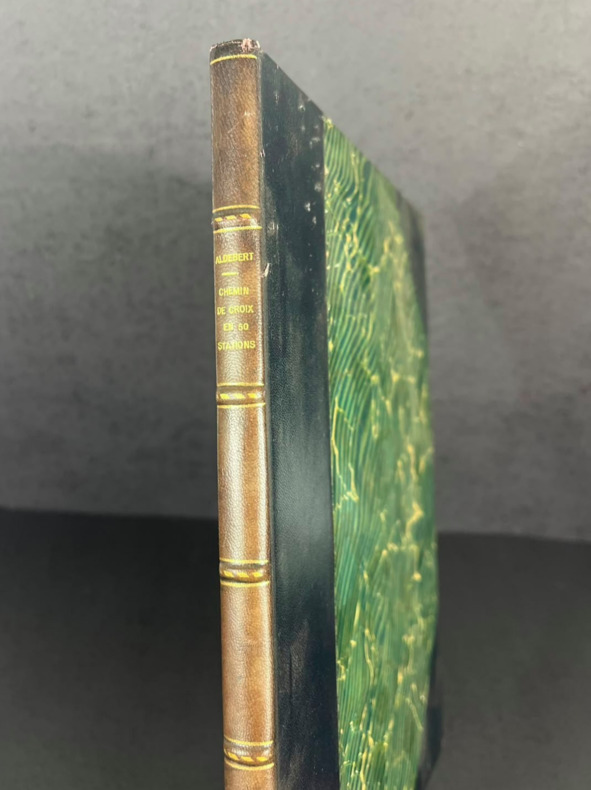
1946Best.-Nr. 563Paris, Arthème Fayard, 1946. Édition originale. Grand album de 22 x 28 cm, 112 (2) pp. Relié demi-cuir noir à coins, dos à 5 nerfs ornés de pointillés et traits dorés, nom d'auteur et titre en doré. Plats marbrés. Couverture originale conservée. Tranchefile. Ouvrage illustré d'une cinquantaine de dessins en noir et blanc de l'auteur. Cet ouvrage est un puissant récit autobiographique illustré de l'artiste français Jean Bernard-Aldebert (connu sous le nom de Bernard-Aldebert, 1909-1974), relatant sa captivité dans cinq camps de concentration nazis différents entre 1944 et 1945. Après avoir bâti une carrière d'illustrateur, de caricaturiste et de satiriste, l'artiste voit son destin basculer tragiquement en novembre 1943. Pour avoir caricaturé Hitler sous les traits d'un chimpanzé dans le numéro du 1er août de l'hebdomadaire humoristique français *Ric et Rac*, Bernard-Aldebert est arrêté par la Gestapo. Il est ensuite transféré en janvier 1944 au camp d'internement de Royallieu-Compiègne, puis successivement à Buchenwald, Mauthausen, Gusen I et enfin Gusen II, où il demeure jusqu'à sa libération le 5 mai 1945. Le texte et les illustrations de l'auteur dévoilent les horreurs subies par les prisonniers dans ces camps : travaux forcés brutaux, famine, tortures sadiques et violences diverses. Si Bernard-Aldebert était surtout connu pour des caricatures au style léger et de charme, les images présentées ici versent dans un tout autre registre. Elles rappellent son style habituel, mais se révèlent bien plus dépouillées, sombres et austères, comme un reflet des émotions des personnages qui y apparaissent. Le texte est accompagné, presque systématiquement sur la page en regard, d'une reproduction en noir et blanc d'un dessin original de l'artiste, pour un total de 50 images. Celles-ci sont issues d'une série de croquis dessinés par Bernard-Aldebert peu après sa libération ; ils offrent, encore aujourd'hui, un témoignage visuel et émotionnel inestimable.
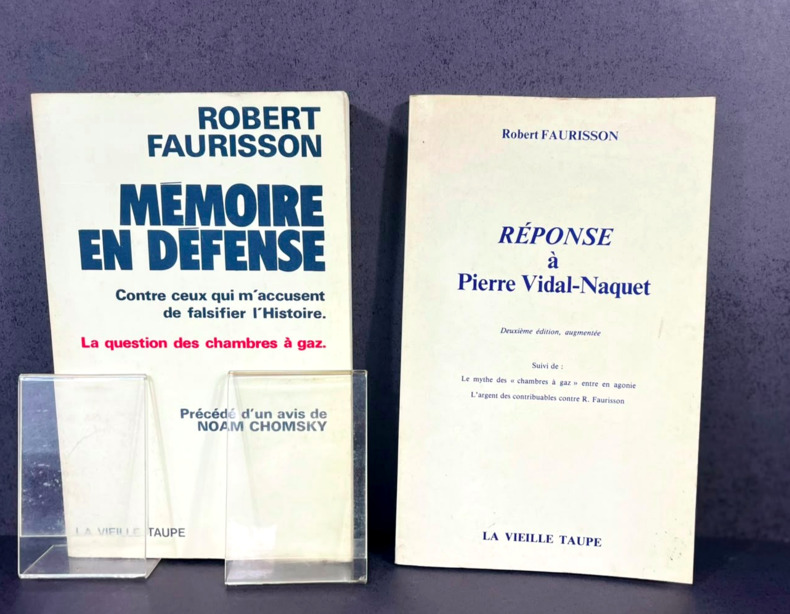
1980Best.-Nr. QZI-24Premier livre : Mémoire en défense contre ceux qui m'accusent de falsifier l'Histoire. La question des chambres à gaz. Paris, La vieille taupe, 1980. Édition originale. Préfacé par Noam Chomsky. In-8 broché, 14 x 22 cm, (xxiii) 275 + 3 pp. Intérieur propre, légers jaunissements par endroits. Avertissement au lecteur, Le professeur de médecine Johann Kremer devant le typhus à Auschwitz en 1942, Pièces annexes. Second livre : Réponse à Pierre Vidal-Nacquet, suivi de : Le mythe des chambres à gaz entre en agonie et L'argent des contribuables contre R. Faurisson. Paris, La vieille taupe, 1982. Deuxième édition, augmentée, définitive. In-8 broché, 14 x 22,5 cm, 95 pp. Légères rousseurs aux 2 premières pages, sinon intérieur propre. Portrait d'un historiocrate par Pierre Guillaume (éditeur), Note du Professeur Faurisson, Réponse à un historien de papier, etc. Ce livre répond à l'article "Un Eichmann de papier" paru en 1980.
1986Best.-Nr. 128885Couverture souple. Broché. 466 pages. Tranche brunie.
Best.-Nr. L8610Jérusalem. Yad Vashem. Institut commémoratif des martyrs et des héros, 1975. In-4 agrafé. Plusieurs textes en français. Importante iconographie en noir & blanc et reproductions en couleurs de dessins d'enfants en dépliant. Chronologie etc. E.O.
Best.-Nr. L11110Lodz. Commission Centrale d'Histoire Juive, 1946. Plaquette in-8 agrafée de 40 pages. M. Balberyszski était un juif lituanien, survivant de l'Holocauste. Ce livre est le récit de la vie et de l'organisation du Petit Ghetto depuis sa formation jusqu'à sa liquidation, c'est aussi le seul témoignage historique du sort de la population juive de Vilna depuis le jour de l'arrivée des Allemands, jusqu'à la libération des 84 Juifs survivants par l'armée soviétique. Préface de J. Kermisz. Catalogue des publications du centre. Textes en polonais. E.O.
Best.-Nr. L15847Varsovie. Ksuazka i Wiedza, 1968. In-12 br. Plaquette de 92 pages publiée à l'occasion de l'anniversaire des 25 ans du soulèvement du ghetto de Varsovie en 1943. Texte en polonais. Année de l'E.O.
Best.-Nr. L11112Moscou. Éditions militaires du Commissariat du Peuple à la Défense, 1944. In-12 agrafé de 28 pages. Texte du Communiqué de la Commission extraordinaire Polono-Soviétique pour l'étude des massacres commis dans le camp d'extermination de Majdanek, près de Lublin (Pologne). Dos recollé, extrêmement rare !
Best.-Nr. L14606New York. Museum of Jewish Heritage, 2008. In-4 br. Texte en anglais. Plusieurs contributions. Importante iconographie sur la Résistance juive durant la seconde guerre mondiale.
Best.-Nr. QWA-21212Association "Les Fils et les Filles des Déportés Juifs de France" / "The Beate Klarsfeld Foundation", 1993, in-12 rel. plast. souple (11 x 16,5), 1264 p., 1ère édition, ill. photos, fac-similés, couverture à rabats, bon état.
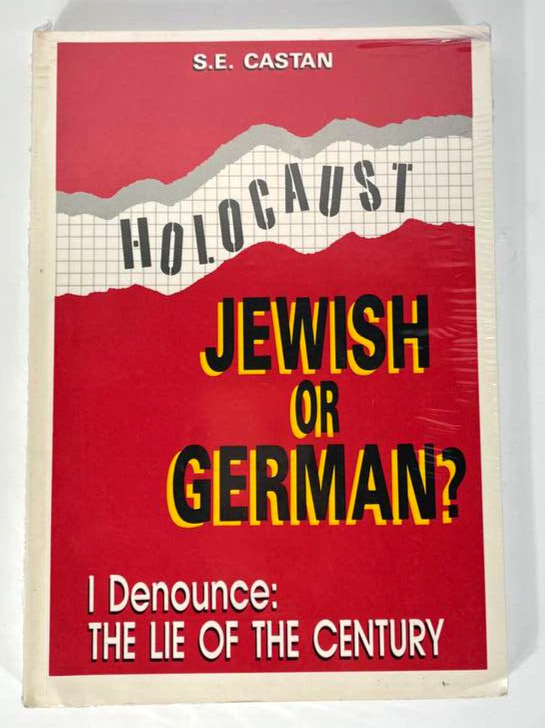
1988Best.-Nr. 0253Porto Alegre, Revisão, 1988. In-8, 228 x 160 mm, 320 pp. First English edition. Translated from Portuguese by Murilo Alves Lopes and Sandra Beatriz Zagonel. Original editor's colored softcover with flaps. Dedication, thank-you list and table of contents at the beginning. Translator's note and preface opening the book, epilogue and list of source at the end. Widely illustrated with pictures and maps. Tables and many quotes along the way. Please note: this book is still under wrappers and like new. The three last pictures on the ad have been taken from another copy of the same book (which I cracked open to take these pictures). This is the English edition of S. E. Castan's Holocausto: Judeu ou Alemão? published in 1987. The book puts forward "another version of the World War Two history" told by Germans themselves (Overture, p. 11) and gives another account than the orthodox Nuremberg judgment narrative. It went through multiple editions in Brazil, becoming a library success before Castan's publisher was trialed for "racism." Though the Brazilian law prohibits expressions of racism and offense to religious cults, it does not forbid from doubting the Nuremberg narrative and official version of the World War Two, which this book does. Both original Portuguese and translated English copies have become increasingly rare. Includes a reference to the Leuchter report, another staple of revisionism, which was also translated and published in Portuguese by Revisão (Acabou o gás: o fim de um mito) in 1989. A polemical title and a rare copy. The gaúcho Siegfried Ellwanger Castan (1928-2010) started working in a factory at 12 years old. He became an industrialist, dealing with iron and steel as a branch office organizer, then created production plans for the first "galvanized water pipes, soldered by induction, the first cold-drawn steel bars and the first rolled steel for special profiles that were imported into Brazil until then. He also invented support plates for rails... [and] sold the stock control of his organization a few years ago to devote himself mostly to researches about the second World War" (front flap).
1988Best.-Nr. 0188Porto Alegre, Revisão, 1988. In-8, 233 x 166 mm, 320 pp. First English edition. Translated from Portuguese by Murilo Alves Lopes and Sandra Beatriz Zagonel. Brown hardcover with author's name and book title on the front plate and the spine, original colored softcover inside with flaps. Dedication, thank-you list and table of contents at the beginning. Translator's note and preface opening the book, epilogue and list of source at the end. Widely illustrated with pictures and maps. Tables and many quotes along the way. This is the English edition of S. E. Castan's Holocausto: Judeu ou Alemão? published in 1987. This book puts forward "another version of the World War Two history" told by Germans themselves (Overture, p. 11) and gives another account than the orthodox Nuremberg judgment narrative. It went through multiple editions in Brazil, becoming a library success before Castan's publisher was trialed for "racism." Though the Brazilian law prohibits expressions of racism and offense to religious cults, it does not forbid from doubting the Nuremberg narrative and official version of the World War Two, which this book does. Both original Portuguese and translated English copies have become increasingly rare. Includes a reference to the Leuchter report, another staple of revisionism, which was also translated and published in Portuguese by Revisão (Acabou o gás: o fim de um mito) in 1989. The gaúcho Siegfried Ellwanger Castan (1928-2010) started working in a factory at 12 years old. He became an industrialist, dealing with iron and steel as a branch office organizer, then created production plans for the first "galvanized water pipes, soldered by induction, the first cold-drawn steel bars and the first rolled steel for special profiles that were imported into Brazil until then. He also invented support plates for rails... [and] sold the stock control of his organization a few years ago to devote himself mostly to researches about the second World War" (front flap).