ZAGORSKI WaclawBiblio.com

5 209 résultats
1974réf. 35023George Mann Maidstone 1974. 8vo. with plates and endpaper maps; blue cloth backstrip lettered in silver a very good bright clean copy in price-clipped dustwrapper. Much-needed reissue of the original UK edition of 1958. One of the best and best illustrated eye-witness accounts of the Uprising with useful photographs not easily available elsewhere. The endpapers give a detailed street map of the Ghetto quarter. VERY SCARCE ESPECIALLY IN THE DUSTWRAPPER. Enser p.469 recording the first edition. George Mann, Maidstone, hardcover
1946réf. 35413Montgomerys Newtown 1946. 8vo. First Edition; red cloth backstrip lettered in black a near fine copy in unclipped dustwrapper. EXTREMELY SCARCE IN THIS CONDITION. Enser p.345. Montgomerys, [Newtown], hardcover
1981réf. 34063Piatkus Loughton 1981. 8vo. First UK Edition neat signature on front paste-down; red cloth gilt back a very good bright clean copy in dustwrapper. Originally published in the US this is a vividly-written account of the resistance of Jews throughout Europe and the activities of a handful of survivors of the camps who after 1945 determined to avenge some of their dead brethren. Includes the formation of DIN and the plan to poison the water supply to a quarter of a million German homes. SCARCE IN THIS CONDITION. Piatkus, [Loughton], hardcover
1981réf. 33603Sidgwick & Jackson 1981. 8vo. First UK Edition with frontispiece map and plates; blue cloth gilt back a near fine copy in price-clipped dustwrapper. SCARCE. Sidgwick & Jackson, hardcover
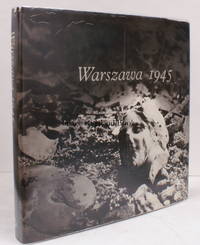
1985réf. 21346Panstwowe Wydawnictwo Naukowe Warsaw 1985. 4to. First Edition with very numerous full-page photographs throughout; oatmeal Holland backstrip lettered in black black endpapers a near fine copy in unclipped dustwrapper the latter very lightly chafed at extremities. Comprehensive photographic survey with over 240 contemporary images of WWII destruction. Very scarce especially in this condition. Panstwowe Wydawnictwo Naukowe, Warsaw, unknown
1939réf. 19746Soncino Press 1939. 8vo. First Edition on laid paper; original navy blue buckram gilt back gilt top a near fine copy. With relevant cuttings loosely inserted. Includes summary biographies of many notable German Jews. Scarce in this condition. Soncino Press, hardcover
2002réf. 19885Weidenfeld & Nicolson 2002. 8vo. First Edition thus page-edges very slightly browning; original black cloth backstrip lettered in silver a near fine copy in price-clipped dustwrapper. Bright copy of the book that forms the basis of Roman Polanski's Oscar-winning feature film 2002 starring Adrien Brody. SCARCE IN THIS CONDITION. Weidenfeld & Nicolson, hardcover
1998réf. 178489New York: Bulfinch 1998. First Edition; Second Printing. Hardcover. Near Fine in a Near Fine dust jacket.; 9.5 X 1 X 12.5 inches; 240 pages. Bulfinch hardcover
1997réf. 005154Boston MA: A Bullfinch Press Book/Little Brown and Company 1997 A Bullfinch Press Book/Little Brown and Company Boston MA. 1997. Hardcover. Stated First Edition. Book is tight square and unmarked. Book Condition: Fine. No DJ. Slipcase with gilt lettering and attached photo of Kovno; Near Fine: light dust soiling. Green cloth boards and spine with bright gilt lettering on spine. 255 pp Folio Edition. Kovno Ghetto was once a real place before it became German Concentration Camp in Lithuania where Jews were confined and forced to labor for Nazi Germany. The Jews there systematically recorded their experiences and this book uses the once-hidden materials to tell this remarkable community's life. A clean pristine copy. A Bullfinch Press Book/Little, Brown and Company hardcover
réf. 77-0327London UK: Viking 1993. 8vo. 243 pp. Hard covers. B&W plates. Very Good quality some wear from age. London, UK: Viking, 1993 hardcover
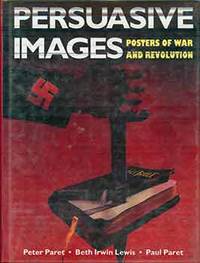
réf. 18-9396Princeton N.J.: Princeton University Press 1992. 4to. 233 pp. Very Good. Hard Cover. Blue cloth covered boards. Dust Jacket Very Good. In protective Mylar wraps. Color plates throughout.Heavy volume additional shipping fee may apply.The 317 posters reproduced in this volume are drawn from Russia the USA and Central and Western Europe documenting the political and military conflicts of the 20th century. The posters form a bridge between the claims of the State and the support or submission of those who must fight. Political posters are historical documents. They open windows to the conditions and conflicts of an earlier time. In their designs and slogans we see how governments and political factions responded to economic crises social change. and ideological and armed conflict and how they sought to sway the perceptions and feelings of the man and woman in the street. Posters are also aesthetic objects. Their composition color and symbols are both separate from their overt political message and the instruments of expressing it. Posters reveal their historical meaning more clearly if we pay attention to their visual characteristics as well as to their political intent. This book treats the poster both as art and as historical witness. Posters are not relegated to the secondary role of illustrating a historical text nor are they treated as autonomous aesthetic objects in a history of applied arts. Instead they are substantial components of a historical narrative that is made up of both image and text. The close interaction of words and posters drawn from Russia central and western Europe and the United States opens fresh perspectives on a half century of war and revolution and constitutes a step toward a new kind of integrative history that conveys the past with unusual immediacy. Contents: Introduction: Posters and modern history --Note on the posters --Prologue: before 1914 --I. The First World War --The outbreak of war --The enemy --Combat --Self-Images --Appeals to serve --War loans --Food and industry --The end of the war --II. The Interwar Years --Revolutions --The Soviet Union --Germany and National Socialism --The Spanish Civil War --III. The Second World War --Early stages --The air war --The invasion of Russia --The new order --Home fronts --The United States at war --The last year --Epilogue: after 1945 --List of posters --Index of artists.ISBN: 0691032041 9780691032047. Princeton, N.J.: Princeton University Press, 1992. paperback
1998réf. 203850New York: Bulfinch 1998. First Edition; Second Printing. Hardcover. Near Fine in a Near Fine dust jacket. Bulfinch hardcover
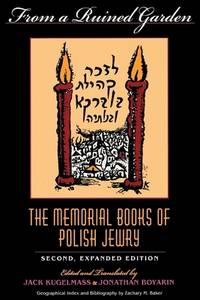
1998réf. 38769Bloomington Indiana U.S.A.: Indiana Univ Pr. New. Paperback. FREE UPGRADE to Courier/Priority Shipping Upon Request – – IN STOCK AND IMMEDIATELY AVAILABLE FOR SHIPMENT - FLAWLESS COPY BRAND NEW PRISTINE NEVER OPENED -- with a bonus offer--; T-Holmem; United States Holocaust Memorial Museum From a Ruined Garden: The Memorial Books of Polish Jewry JEWS HISTORY POLAND HOLOCAUST JEWISH . 1998. 0253211875 . Indiana Univ Pr paperback
1991réf. 36935Pittsburgh PA: Pittsburgh. New. Paperback. FREE UPGRADE to Courier/Priority Shipping Upon Request – – IN STOCK AND IMMEDIATELY AVAILABLE FOR SHIPMENT - FLAWLESS COPY BRAND NEW PRISTINE NEVER OPENED 13 pages; 4 black and white illustrations. -- with a bonus offer--; T-Holocen; Fellner Gene; The Holocaust Center of the United Jewish Federation; University of Pittsburgh; Drescher Ruth; Zupcic Steve And There Was a Train Full of Children : Pastel Drawings and Constructions - Gene Fuller - The Holocaust Center of the United Jewish Federation & The University of Pittsburgh; University Art Gallery - October 6 -27 1991 Fellner Anita . 1991. Pittsburgh paperback
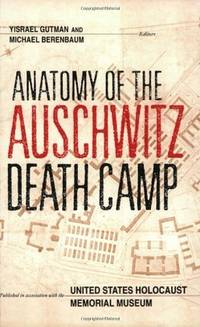
1998réf. 29144Bloomington Indiana U.S.A.: Indiana Univ Pr. New. Paperback. FREE UPGRADE to Courier/Priority Shipping Upon Request - IN STOCK AND IMMEDIATELY AVAILABLE FOR SHIPMENT - FLAWLESS COPY BRAND NEW PRISTINE NEVER OPENED -- with a bonus offer--; T-Gutman; AUSCHWITZ CONCENTRATION CAMP HOLOCAUST JEWISH . 1998. 025320884X . Indiana Univ Pr paperback
réf. 03240180.28C5Very Good. Vol. 7. Boards show only light surface and shelf wear. Binding intact. Text remains crisp clean and unmarked. hardcover
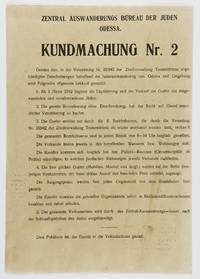
1942réf. 51752Odessa: Zentral Auswanderungs Büreau 1942. Original document. Loose leaf. Very good condition. Quarto. Original loose leaf with black lettering. Announcement based on ordinance no. 35/942 of the civil government of Transnistria relating to the emigration of Jews in Odessa and surrounding areas. The text printed biligually in German and Ukrainian is organized into five statements. The annoucement concerns the liquidation and sale of goods of emigrated or vanished Jews beginning on March 1 1942 with the whole population without limitations given the right to buy these items based on oral agreements. Furthermore the announcement regulates details and procedures of the sale and at the end announces that after the sale proceeds will by handed to the Jews by the Central Emigration Office. "The rapid development of Odessa began after the Russian conquest 1789. Its Jewish population also grew quickly and in the late nineteenth and early twentieth centuries it was the most important Jewish literary community after Warsaw. In 1926 there were 153194 Jews in Odessa 36.4 percent of the total population and by 1939 their numbers reached 180000." Encyclopedia of the Holocaust Vol. 3 page 1080. When Romanians and Germans laid siege to the city on August 5 1941 many Jews in Odessa managed to leave and eighty to ninety thousand Jews remained in the city. Odessa fell on October 16 and the German Einsatzkommando 11b and the Romanian intelligence service immediately slaughtered over eight thousand residents mainly Jews and Odessa was established as the capital of the Transnistria region. On October 22 the Romanian military headquarters were blown up killing sixty-six officers and the military governor. In reprisal the Romanian ruler Ion Antonescu ordered devastating retaliation including the arrest of one member of each Jewish family. By October 1941 some 40000 Jews were assembled in the ghetto of the nearby city of Slobodka and their valuables confiscated. Deportations of some 20000 Jews began in January of 1942. When Odessa was liberated on April 10 1944 authorities reported that about 99000 Jews had been killed. Odessa again became an important Jewish center with 102000 Jews living there according to a 1959 census. Considering the context of "Kundmachung Nr. 2 the Odessa massacre of October 22-24 1941 and the murder of Jews living between the rivers Dniester and Bug during the Romanian and German occupation this succinct notice including its misspellings and mistakes in the German language is a chilling mirror image of the attitude shown by the occupying powers towards the Jews. Approximately 30000 Jews were killed in Odessa and more than 100000 in Transnistria. The text is printed in German on one side and Ukrainian on the verso. Minor wear and smudging. Protected in modern mylar. Zentral Auswanderungs Büreau unknown
réf. BAY_05_SH_080437New. Well packaged and promptly shipped from California. Partnered with Friends of the Library since 2010. unknown
réf. 73DS. Haifa. A partly printed document signed "Olga Polok" regarding moving funds from her bank fund just four days after the start of World War II: "I. have conferred general authority upon Olga Polak whose signature please find below to administer - as he may think fit - all funds or securities now or in future lying for my our account with yourselves or with any other offices of the Hollandsche Bank Unie N.V. or with any one of their correspondents; to dispose of same to receive the countervalue of all securities moneys deposits bills cheques and promissory notes telegraphic and letter-payments. to give discharge for same to give all kinds of instructions and to sign as my our mandatory receipts. It is hereby expressly stipulated that I we waive the right to notarial notices in connection with any matter arising out of these presents. ". The document has a few light toning patches and is in fine condition overall. An unusual Holocaust-era document. unknown
2009réf. 032398Los Altos Hills CA: Anderson-Lovelace Publishers 2009. We have only this one copy but it is available now and ready to ship today from Henderson Nevada. Fine condition in a bright and shiny Very Good dust jacket. Only light shelfwear to the jacket. NO chips or fading. Square and tight. Sharp corners. NO owner's name or bookplate. NOTa library discard. Pages are fresh crisp clean and unmarked. NO underlining. NO highlighting. NO margin notes. Bound in the original gilt-stamped dark gray cloth. Complete with dust jacket. From Worldcat: "The large-scale pencil and graphite drawings are from a series that Feferman began in the 1990s. She had intended to make one hundred all told but the project was interrupted half way through by her illness. Forty-two of these are reproduced in the book Golden Hands: Drawings and Reflections 2009. They are inspired by the gift of a beautifully sewn cotton apron that her grandmother Helen Grand Feferman made at the age of 14 in pre-World War I Poland; an emigre to the United States following the war she lived to the age of 100. The drawings incorporate frequent references to the apron as well as to symbols of Jewish life and in the end to Helen herself while reminders of the Holocaust form a thrumming undercurrent. In praise of the 'wide graphic range and consummate artistry' in the Golden Hands series the art critic Irving Sandler wrote that 'Rachel Feferman's drawings are direct from the heart to the hand. Her poignant images - aprons hands with needles loaves of bread - set against unsettling backgrounds of bodies are pervaded by a sense of life's pain.'" Oversize Hardcover. 9.75" wide by 12.25" tall. This very large book will require SUBSTANTIAL postage at our cost for International shipments up to $100 or more but only the standard charge for priority or media mail. First Edition. Oversize Hardcover. Fine condition/Very Good dust jacket. Illus. by NOT a library discard. vi 98 pages. Great Packaging Fast Shipping. Anderson-Lovelace Publishers Hardcover
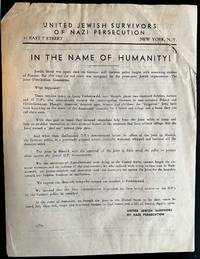
1947réf. 43409New York The Organization No Date 1947. 1st edition. Double-sided English-Yiddish leaflet 2 pages. The Yiddish header translates roughly as "An Announcement To the Jewish Public" Bilingual American Flyer condemning the Joint the American Joint Distribution Committee AJDC for not doing more to help the Jewish DPs and its "hiding" behind the German police when DP's demonstrated for more action on DP resettlement. The issuing organization the United Jewish Survivors of Nazi Persecution/Farband fun Geveyzene Yidishe Katsetler un Partizaner was the first survivor network founded in the US. Their Yiddish name translates as "The Association of Former Jewish Concentration Camp Inmates and Partisans." The word "Katsetler" in their name is a contraction of "kontsentratsyonslager-er" using the letters K and Z "ka" and "tset" and thus short for "kontsetratsyonslager" a concentration camp inmate or survivor sometimes also noted as a "katsetnik." The flyer announces: "Jewish blood was again shed on German soil! German police fought with remaining victims of Nazism. But this time the sad event was instigated by the prominent Jewish organization-The Joint Distribution Committee. What happened There remains today in Camp Foehrenwald near Munich about two thousand helpless forlorn and ill D.P's who miraculously escaped the extermination furnaces in nazi-occupied Poland and Hitler-Germany. Hungry desperate destitute men women and children the 'forgotten' Jews have been knocking at the doors of the democratic countries for a haven and refuge and a home they can call their own. With this goal in mind they demand immediate help from the Joint while in camp and help to establish themselves in their eventual homes in the countries that have offered refuge. But the Joint turned a 'deaf ear' toward their pleas. And when these disillusioned D.P.'s demonstrated before the offices of the Joint in Munich the German police in a previously planned attack critically wounded whipped and battered off the demonstrators. The Joint in Munich with the approval of the Joint in Paris asked the police to protect them against the Jewish D.P. demonstrators. We the survivors of Nazi-Germany now living in the United States cannot forget the extreme torments and the inferno of the nazi-torture; we who suffered with many victims now in Foch- renwald are horror-stricken and dismayed and our hearts cry out against the Joint for the brutality toward our helpless brethern in misfortune. We express our deep-felt sympathy toward our brothers in Foehrenwald. demand that the Joint representatives responsible for these brutal attacks on the D.P.'s by the German police be punished. In the name of humanity we beseech the Jews in the United States to let their voices be heard help these sick tragic and frustrated victims to find homes and a life of human dignity again" From the English side of the flyer. After World War II Munich served as a major center for Jewish Holocaust survivors the "Sh'erit ha-Pletah" who were living in DP camps. The "Joint" was the primary welfare organization providing aid clothing and food to these camps. While the Joint was a vital lifeline its Munich headquarters at Siebertstrasse 3 sometimes became the focal point for frustration regarding the pace of aid distribution or more frequently the slow pace of emigration to Palestine Aliyah and broader often frustrating postwar conditions. Following the 1947 Exodus ship incident where Jewish refugees were returned to Germany by the British Jewish DPs felt trapped and staged intense demonstrations including protests at the offices of international organizations like the Joint to highlight their despair. These demonstrations were part of a broader effort by survivors to assert their agency and demand rights during their time in Munich 1945-1951. For more on tensions between Munich's Jewish DPs and the Joint see www.juedisches-museum-muenchen.de/en/exhibitions/munich-displaced-online/moehlstrasse. Scholar David Slucki notes about the publishers of this leaflet that "Within months of arriving in the United States in 1946 Jewish Holocaust survivors began to organize themselves to help with the process of resettlement. The small band of socialists who established the Farband fun Geveyzene Yidishe Katsetler un Partizaner United Jewish Survivors of Nazi Persecution this group initiated a dual process of identity formation and memorialization of the Holocaust. The first survivor network founded in the United States the Katsetler Farband this group developed a memorial culture that included commemorations and publications replete with its own rituals and calendar. Moreover the organization was part of a broader process of defining what experiences constituted the Holocaust and who was to be considered a survivor. Ultimately they were among a host of survivor networks in the United States to lay the foundation for Holocaust memorialization" Slucki D. 2017. A Community of Suffering: Jewish Holocaust Survivor Networks in Postwar America. Jewish Social Studies 222 116-145. https://muse.jhu.edu/article/649094 We could locate no copies in OCLC-Worldcat Archive Grid nor using a google search. Touch of edgewear one diagonal fold paper generally bright and strong about Very Good- Condition. Holo2-163-28A. New York, The Organization, No Date unknown
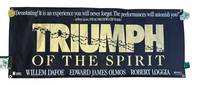
1990réf. 10089Nova International Films Inc. Epic Home Video 1990. Large banner approx. 2x4" in matte black white and metallic gold on Tyvek brass grommets at corners. Few stress wrinkles else nicely preserved. Large format banner for the VHS release of Triumph of the Spirit a Holocaust boxing film directed by Robert M. Young and starring Willem Dafoe and Edward James Olmos. Rare. Nova International Films Inc., Epic Home Video unknown
2009réf. 139947In English. Hard cover 30 cm 192 pp. Auschwitz - Birkenau. Words associated with horror and death. lnthebloodbath of innumerable victims who were sacrificed on the altar of the Hitlerian minotaur Greek blood was not absent. Sixty thousand Greeks whose only crime was that they had been born Jewish and a few dozen Christians who were arrested either for resistance or for aiding their Jewish compatriots to escape met with incredible torment in that particular version of hell that even Dante's pen would have difficulty to describe.This book comes to cover this dark mostly unknown chapter of Greek national history. With the aid of a photographic lens and both written and oral testimonies of those who managed to survive it undertakes a painful journey of memory and history treading step-by-step into the hellish lair of Auschwitz-Birkenau. . ================================================================== IMPORTANT: The shipping cost is an important parameter of this order; as a rule it is in NOT included in the price and depends on the actual weight and destination; sometimes it also includes insurance. For low price books it maybe higher than the book cost. You will have to approve it after the confirmation of the order. You may ask for an estimate before placing the order at: dem.siatras@gmail.com Papazeses hardcover
2014réf. 516Vilnius Press LLC 2014. Hardcover. Very good. No dustjacket as issued. Cover has light wear. Gift inscription on front endpaper which could be from the photographer. Signed by the photographer Carol J. Mohor on title page. Vilnius Press LLC hardcover
1964réf. 335850New York: Hawthorn Books Inc. 1964. First Edition. Hardcover. Very Good/No Jacket. No DJ tan cloth boards with minor stain to dront cover. Otherwise book is like new. Hawthorn Books Inc. hardcover