1989réf. 009431Frankfurt am Main und Wien, Büchergilde Gutenberg, 1989. 410 S. Orig.-Leinenband mit Schutzumschlag. Der Kopfschnitt etwas stockfleckig, sonst schönes, gut erhaltenes Exemplar mit nur leichten Gebrauchsspuren.
19361st edition. Original paper wrappers. 8vo. 26, 6 pages. 25 cm. In Hebrew and German. Title translates to Leaves of Agudist Yough. Nazi-era Newspaper of the Noar Agudati religious-nationalist youth movement. The group was founded in 1935 as a coalition of youth from Brit Ha-halutzim, Ezra, and Agudat Israel. They sought to encourage aliya to Israel in order to work the land and instill a spiritual element to settlement (EZRA, 2018) . SUBJECTS: Zionism. Orthodox Judaism. OCLC lists 2 copies worldwide (YIVO, TAU) . Wrappers are loose. Small chips to edges of wrapper. Pages browning. Overall very good. Rare and very displayable (YID-32-6)
1962Hardcover, 8vo, 206 pages, 21 cm. Contents: The return -- Rose Street -- The children -- Moral education -- Stephen and Anne -- Blue flames -- Hope. Short stories. Lustig (19262011) , was a Czech writer, screenwriter, and journalist. Born in Prague, Lustig was deported to the Theresienstadt concentration camp in 1942 and later to a number of others, including Auschwitz and Buchenwald. At the end of the war he managed to escape from the death train and reach Prague, where he later graduated from the School of Political and Social Sciences. Lustigs work is based mainly on his tragic experiences in concentration camps and postwar life in his homeland. He made his literary debut with the collection of stories Night and Hope (1958) filmed as Z. Brynychs A Transport from Paradise (1962) . Much of Lustigs fiction has been translated into several languages. In 2004 he was awarded the Vladislav Vancura Prize. From 2004 Lustig lived in Prague (Dagan and Pojar in EJ 2010) . Dust jacket in excellent condition. Light wear to binding. Excellent condition. Beautiful copy. (Holo2-71-8A)
1976Publishers cloth. 8vo. 206 pages. 21 cm. Second Edition. Contents: The return - Rose Street - The children - Moral education - Stephen and Anne - Blue flames - Hope. Short stories. Arnold Lustig (19262011) , was a Czech writer, screenwriter, and journalist. Born in Prague, Lustig was deported to the Theresienstadt concentration camp in 1942 and later to a number of others, including Auschwitz and Buchenwald. At the end of the war he managed to escape from the death train and reach Prague, where he later graduated from the School of Political and Social Sciences. Lustigs work is based mainly on his tragic experiences in concentration camps and postwar life in his homeland. He made his literary debut with the collection of stories Night and Hope (1958) filmed as Z. Brynychs A Transport from Paradise (1962) . Much of Lustigs fiction has been translated into several languages. In 2004 he was awarded the Vladislav Vancura Prize. From 2004 Lustig lived in Prague. (Dagan and Pojar in EJ 2010) . Dust jacket in excellent condition. Beautiful copy. (HOLO2-102-17)
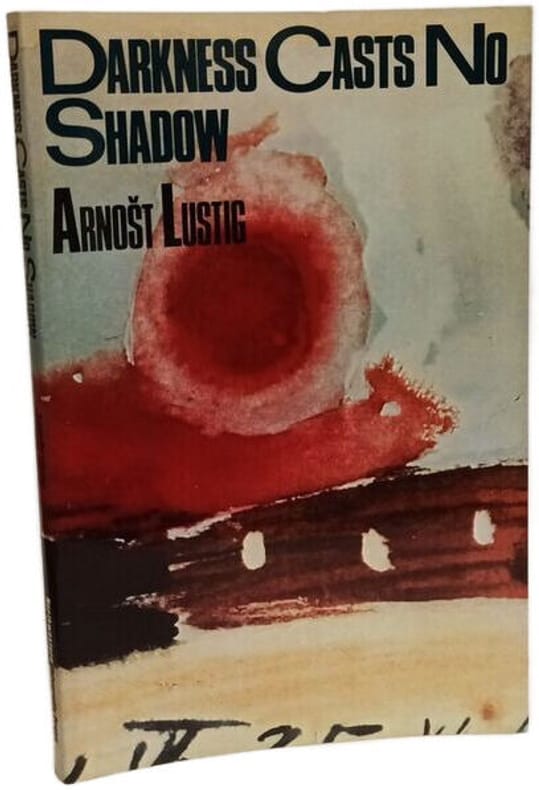
1985réf. 100147173Northwestern University Press 1985 173 pages 21 4x1x14cm. 1985. Broché. 173 pages. Darkness Casts No Shadow est un récit largement autobiographique d'Arnošt Lustig qui raconte l'évasion de deux jeunes garçons Manny et Danny d'un train de transport les menant vers un camp de la mort allemand en 1945. L'histoire mêle l'action présente de leur fuite à des souvenirs du passé allant des activités familiales aux horreurs de la vie dans les camps de concentration
1958Portfolio with Paper Dustjacket. 20 black and white sketches and 10 watercolors. With accompanying text by Esther Lurie; introd. Moshe Sharett ; foreword Eugene Kolb, Esther Lurie [1913-1998] was born in Liepaja, Latvia, to a religious Jewish family. From 1931-1934 she learned theatrical set design at the Institut des Arts Décoratifs in Brussels, and afterwards studied drawing at the Académie Royal des Beaux-Arts in Antwerp. In 1934 Lurie migrated to Palestine with most of her family and worked at various artistic activities. In 1939 she travelled to Europe to further her studies. World War II had begun while she was in Lithuania and during the Nazi occupation (1941-44) she was imprisoned in the Kovno ghetto along with the other Jews. As soon as she entered the ghetto, in mid-1941, Lurie began to sketch views of her new world. She has left behind a detailed written testimony of her life and work during World War II. This combination of literary and visual testimony make up a "living witness". Lurie drew everywhere in the ghetto, including the various workshops. Including a pottery workshop. During her visits there, Lurie got the idea of asking theJewish potters to prepare a number of jars for her. She would use these to conceal her art works if the situation worsened. After the deportation of 26 October 1943, in which 3,000 ghetto inmates were removed to forced labor camps in Estonia, Lurie hid her artcollection, approximately 200 drawings and watercolors, in the large jars she had prepared in advance. In July 1944, as the Red Army approached Lithuania, the ghetto was liquidated and those remaining were transferred to concentration camps and forced labor camps in Germany. The ghetto was set on fire and the buildings were blown up and burnt to prevent those hiding from escaping. Esther Lurie was sentto Stutthof concentration camp, leaving her hidden works behind. After the war some of her drawings were recovered, surviving with the Ältestenrat's archive. Avraham Tory succeeded in rescuing 11 sketches and watercolors and 20 of the photographs of her works. During the Eichmann trial, which took place in Jerusalem in 1961, Lurie's SecondWorld War works were exhibited as part of the testimony - giving an "official authorization" from Israel's Supreme Court to the rich documentary value of her sketches and watercolors. This is in addition to their aesthetic value as objects of art. SUBJECT(S): World War, 1939-1945 -- Pictorial works. Jews -- Lithuania -- Kaunas -- Holocaust, Jewish (1939-1945) -- Guerre mondiale, 1939-1945 -- Ouvrages illustre´s. Juifs -- Lituanie -- Kaunas -- Holocauste, 1939-1945 -- Ethnic relations. OCLC: 848164. Light edgewear & stain to portfolio & dustjacket, text and plates remain very clean and dramatic. Overall very good condition. (HOLO2-98-15C)
1958Portfolio with Paper Dustjacket. 20 black and white sketches and 10 watercolors. With accompanying text by Esther Lurie; introd. Moshe Sharett ; foreword Eugene Kolb, Esther Lurie [1913-1998] was born in Liepaja, Latvia, to a religious Jewish family. From 1931-1934 she learned theatrical set design at the Institut des Arts Décoratifs in Brussels, and afterwards studied drawing at the Académie Royal des Beaux-Arts in Antwerp. In 1934 Lurie migrated to Palestine with most of her family and worked at various artistic activities. In 1939 she travelled to Europe to further her studies. World War II had begun while she was in Lithuania and during the Nazi occupation (1941-44) she was imprisoned in the Kovno ghetto along with the other Jews. As soon as she entered the ghetto, in mid-1941, Lurie began to sketch views of her new world. She has left behind a detailed written testimony of her life and work during World War II. This combination of literary and visual testimony make up a "living witness". Lurie drew everywhere in the ghetto, including the various workshops. Including a pottery workshop. During her visits there, Lurie got the idea of asking theJewish potters to prepare a number of jars for her. She would use these to conceal her art works if the situation worsened. After the deportation of 26 October 1943, in which 3,000 ghetto inmates were removed to forced labor camps in Estonia, Lurie hid her artcollection, approximately 200 drawings and watercolors, in the large jars she had prepared in advance. In July 1944, as the Red Army approached Lithuania, the ghetto was liquidated and those remaining were transferred to concentration camps and forced labor camps in Germany. The ghetto was set on fire and the buildings were blown up and burnt to prevent those hiding from escaping. Esther Lurie was sentto Stutthof concentration camp, leaving her hidden works behind. After the war some of her drawings were recovered, surviving with the Ältestenrat's archive. Avraham Tory succeeded in rescuing 11 sketches and watercolors and 20 of the photographs of her works. During the Eichmann trial, which took place in Jerusalem in 1961, Lurie's SecondWorld War works were exhibited as part of the testimony - giving an "official authorization" from Israel's Supreme Court to the rich documentary value of her sketches and watercolors. This is in addition to their aesthetic value as objects of art. SUBJECT(S): World War, 1939-1945 -- Pictorial works. Jews -- Lithuania -- Kaunas -- Holocaust, Jewish (1939-1945) -- Guerre mondiale, 1939-1945 -- Ouvrages illustre´s. Juifs -- Lituanie -- Kaunas -- Holocauste, 1939-1945 -- Ethnic relations. OCLC: 848164. Wear and stains to portfolio & dustjacket, lacks rear panel of dustjacket, text and plates remain very clean and dramatic. Good condition thus. (HOLO2-98-15D)
1945First edition. Original illustrated wrappers, 12mo, 43, 10 pages. Text in English and Hebrew. 13 drawings made by a Jewish woman of her fellow inmates while in the concentration camp at Leibitsch which consisted of 1200 Jewish women who had been deported from the Kaunas Ghetto in East Prussia. Lurie was liberated by the Red Army on 21 January 1945. In March 1945 she reached a camp in Italy, where she met Jewish soldiers from Palestine who were serving in the British army. One of them, the artist Menahem Shemi, organized an exhibition of drawings from the camps, which resulted in the publication of a booklet Jewesses in Slavery. This contained drawings by Lurie from Stutthof and Leibitz and was published by the Jewish Soldiers' Club of Rome in 1945. Lurie also created stage sets for the military song and dance group in the camp, which was founded by Eliahu Goldberg and Mordechai Zeira. Lurie reached Israel (Palestine) in July 1945 and was received with great excitement. Her stories were published in the press and her drawings were exhibited in exhibitions. In 1946 she was again awarded the Dizengoff Prize for a sketch Girl with Yellow Badge, which she had made in the Kovno ghetto (World ORT and Beit Lohamei Haghetaot, 2001) . SUBJECT(S) : World War, 1939-1945 -- Personal narratives, Jewish. Women in art. OCLC Worldcat lists 18 copies worldwide. Ex-library copy with small pocket and stamps in Hebrew, wrappers slightly toned with a couple of tiny stains, otherwise Very Good Condition. (holo2-125-38A)
2018This is a fine softcover copy with no wear at all. Completely clean. The spine is not creased, Text in English and Polish. This catalog was prepared to accompany the exhibition at the MOCAK from October 26, 2018 to February 2, 2019. Illustrated in color. Limited edition of 600 copies. 11" high X 8" wide, 287 pages. Heavy book, foreign shipping will be extra. This book will be securely packed and shipped with tracking.
1938(FT) Hardcover, folio, 172 pages. In Hebrew. Published shortly before the Nazi invasion the following year. SUBJECT(S) : Title Subject: Talmud Bavli. Shevuot -- Commentaries. OCLC lists 1 copy worldwide (National Library of Israel) . Light wear to binding. Yellowing of pages. Good condition. (Heb-33-8)
1988réf. 009296Reinbek, Rowohlt, 1988. 312 S., 3 Blatt. Orig.-Pappband mit Schutzumschlag. Ein schönes, gut erhaltenes Exemplar mit nur leichten Gebrauchsspuren.
1929Cloth. 12mo. 16 pages. [36] leaves of plates. 74 ill. 20 cm. In German. Series: Schaubücher 2. Collection of iconic images from Russian Revolution-era films including Ivan the Terrible and Battleship Potemkin. Includes many films by Sergie Eisenstein and other modernist Soviet Jewish filmakers. "Anatoly Vasilievich Lunacharsky, Lenin's commissar for culture, believed that "aristocratic" arts such as ballet were the rightful heritage of the workers. He fought hard against the "revolutionaries" who insisted that ballet give way to physical culture, gymnastics, and folk dance. For the Bolshoi, this was disastrous" (Plisetskaya, 2001). SUBJECT (S) : Motion pictures -- Soviet Union -- Pictorial works. "Zu den Bildern, " by Leo Hirsch: pages 13-16. Pages are slightly stained, but all text is clear. Good condition. (HOLO2-39-29)
1945réf. 58096ABNew York, Willard, 1945. 40 S. Orig.-Kartoniert mit photogr. Porträt auf Vorderdeckel.
1984240x160 mm. XII+239 pages. Hardcover with dust jacket. Jacket yellowing. Jacket upper edge torn. Cover corners slightly rubbed. Spine edges slightly bumped and rubbed. Pen inscription on front inner cover. Else in good condition.
1979réf. 51293Ludwigsburg. Historischer Verein. 1979. 124 Seiten. Mit mehreren Abbildungen. Illustrierte Original-Broschur. Guetes Exemplar. 24x16 cm
1979réf. 18820Ludwigsburg. Historischer Verein für Stadt u. Kreis Ludwigsburg e.V. 1979. 125, (1) Seiten. Mit zahlreichen faks. Abbildungen u. Dokumenten. Ill. Originalbroschur. 24x16 cm
1965réf. 132357Heidelberg: Verlag Lambert Schneider, 1965. 69 S. ; 23 x 15 cm ; kart. ;
1957réf. 005285Ohne Ort, Ohne Verlag und Jahr, 1957. 416 S. Leinenband der Zeit. Hier wohl die amtliche Drucksache ohne Verlagsangabe; der Band erschien im selben Jahr in Bern bei Lang unter dem Titel "Die Flüchtlingspolitik der Schweiz seit 1933 bis zur Gegenwart." Mit einigen eingeklebten Zeitungsartikeln zur politischen Laufbahn von Hans Globke sowie geringen An- und Unterstreichungen mit Kugelschreiber auf ca. 120 Seiten. Die Rückseite des Titelblatts mit längerem Zitat in Kugelschreiber, insgesamt jedoch noch ordentliches Exemplar mit nur leichten Gebrauchsspuren.
1965Publishers cloth. 8vo. 335 pages. 22 cm. First edition. "The exciting and dramatic story of an English mother and daughter trapped in Nazi Germany from 1938 to 1944". Concerns the story of an Englishwoman living in Germany with her small child after her German violinist husband is liquidated by the Nazis. She is assisted by the resistance to rescue her child and later heroically dies obtaining information concerning the V2 missiles. Subjects: Germany - History - 1933-1945 - Fiction. Very good condition in very good jacket. (HOLO2-95-9)
194524.5x16cm. XVI+257 pages. Softcover. Cover edges wrinkled and slightly worn. Spine edges worn. Ex-library copy with usual marks. Pages yellowing. Else in good condition.
2001IN HEBREW. 23X16 cm. 247 pages. Hardcover. In good condition.
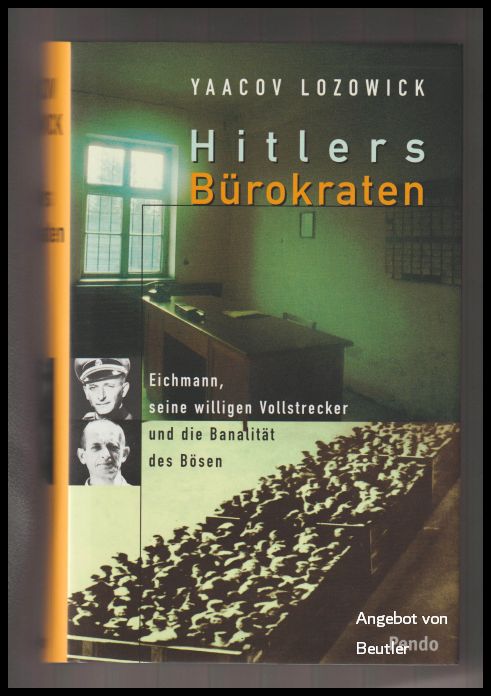
2000réf. 34608AZürich, München, Pendo, 2000. 8°. 407 Seiten. Original-Pappband mit Original-Umschlag. (Sehr gutes Exemplar).
1997réf. 15868it'Art 1997 156 pages collection Gli struzzi. 11 4x1 2x19 2cm. 1997. Broché. 156 pages.
2001220x145 mm. 100 pages. Gilt hardcover with dust jacket. Jacket stained and yellowing. Cover rubbed. Spine edges bumped. Inner cover stained. Pages slightly yellowing. Else in good condition.