5776 risultati
19808vo. Xiii, 266 pages. Illustrated with tables. First edition. SUBJECT (S) : Holocaust (Jewish theology) ; Holocaust survivors. CONTENTS: Introduction; The religious behavior of Holocaust survivors; The faith of Holocaust survivors; The meaning of the Holocaust; Seven theological questions. ISBN: 0029044200. Has dust jacket. Good+ condition. (Holo2-12-10)
19808vo. Xiii, 266 pages. Illustrated with tables. First edition. SUBJECT (S) : Holocaust (Jewish theology) ; Holocaust survivors. CONTENTS: Introduction; The religious behavior of Holocaust survivors; The faith of Holocaust survivors; The meaning of the Holocaust; Seven theological questions. ISBN: 0029044200. Tear to back of jacket. Very Good condition in good jacket. (Holo2-17-19)
2004INCLUDES CD. 210X145 mm. 394 pages. Hardcover. Cover slightly rubbed. Else in good condition.
2015Reichlich in Schwarzweiß illustriert.
2008Publishers Boards. 8vo. 118pages. 24cm. First edition. Using modern social theory, David Brenner examines how German-Jewish identity was influenced by the production and consumption of popular culture. Part of the Routledge Jewish Studies Series. David A. Brenner examines how Jews in Central Europe developed one of the first ethnic or minority cultures in modernity. Not exclusively German or Jewish, the experiences of German-speaking Jewry in the decades prior to the Third Reich and the Holocaust were also negotiated in encounters with popular culture, particularly the novel, the drama and mass media. Despite recent scholarship, the misconception persists that Jewish Germans were bent on assimilation. Although subject to compulsion, they did not become solely German, much less European. Yet their behavior and values were by no means exclusively Jewish, as the Nazis or other anti-Semites would have it. Rather, the German Jews achieved a peculiar synthesis between 1890 and 1933, developing a culture that was not only middle-class but also ethnic. In particular, they reinvented Judaic traditions by way of a hybridized culture. Based on research in German, Israeli and American archives, German-Jewish Popular Culture before the Holocaust addresses many of the genres in which a specifically German-Jewish identity was performed, from the Yiddish theatre and Zionist humour all the way to sensationalist memoirs and Kafkas own kitsch. This middle-class ethnic identity encompassed and went beyond religious confession and identity politics. In focusing principally on German-Jewish popular culture, this groundbreaking book introduces the beginnings of ethnicity as we know it and live it today. (Publishers description. ) Subjects: Jews in popular culture -- Germany -- History -- 20th century. Jews -- Germany -- Intellectual life -- 20th century. Popular culture -- Germany. Jews in popular culture -- Germany -- History -- 20th century. Jews -- Germany -- Intellectual life -- 20th century. Popular culture -- Germany. Massenkultur. Jews in popular culture -- Germany -- History -- 20th century. Jews -- Germany -- Intellectual life -- 20th century. Popular culture -- Germany. . Like new condition. (HOLO2-107-5) Xxxx
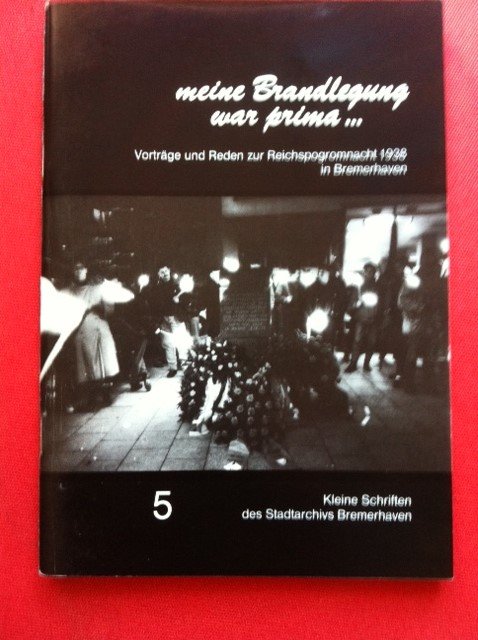
1989rif. 146319Bremerhaven 1989. 55 Seiten. Mit zahlreichen meist farbigen Abbildungen. Illustrierte Originalbroschur. 21x15 cm
1990rif. 170881Bremen, Steintor Verlag, 1990.
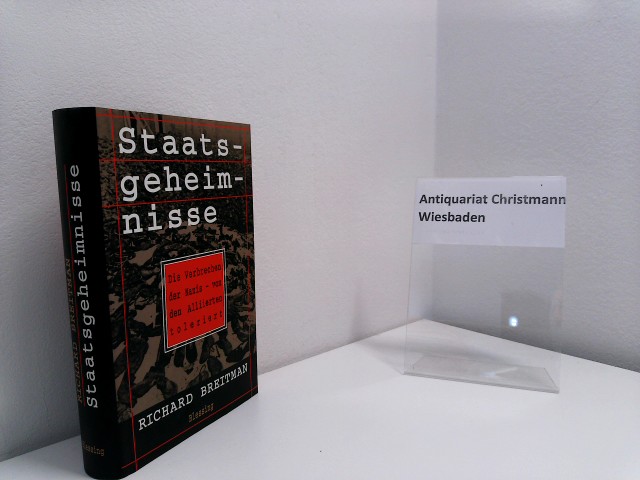
1999rif. 54626München : Blessing 1999. 414 S. ; 22 cm, mit Schutzumschlag Pp., gebundene Ausgabe, Hardcover/Pappeinband, Exemplar in gutem Erhaltungszustand
1971Original Wraps. 16mo. 115 pages. 17 cm. Third edition (revised and augmented) . In French. 'The Breendonk Fort. ' With 8 pages of plates, and one fold out plan of Breendonk. First published 1961, also issued in a Dutch edition. Contains history of Auffanglager Breendonk, known as the 'Hell of Breendonk'; with concluding chapters on the post-war trials of the guards, and of the creation of the Memorial and Museum. Subjects: Holocaust, Jewish (1939-1945) Belgium - Breendonk (Willebroek) . World War, 1939-1945 - Belgium. Breendonk (Concentration camp) Belgium - History - German occupation, 1940-1945. None on OCLC for this edition. Light wear to wraps, overall very fresh and clean. Very good condition. (HOLO2-115-44)
1999rif. 39505Köln : H + L, 1999. 522 S. Ill. 8°. Genehm. Ausg. OPpbd. mit Rückengoldpräg. ohne SU.
1999rif. 38531ABKöln H + L Verl. 1999. 522 S. Gewebe, verg. Rü.-Tit., O.-Umschl. Guter Zust.
1993265pp., 21cm., Doctoral Dissertation (Inaugural-Dissertation (Inaugural-Dissertation zur Erlangung des Doktorgrades der Philosophischen Fakultäten der Universität Augsburg), softcover, stamp at verso of title page, text is clean and bright, T113022
1994rif. lu2193Editons du Rocher Dos carré collé 1994 "In-8 (15,5 x 24 cm), dos carré collé, 283 pages, bel envoi de l'auteur : ""Pour Yannig Madin, ce roman tiré d'un épisode dramatique de l'histoire, malheureusement trop vrai, mais toujours soigneusement occulté par enseignement officiel. Bien amicalement, Yann Brekilien"" ; petite plissure au premier plat en tête, par ailleurs très bon état général. Livraison a domicile (La Poste) ou en Mondial Relay sur simple demande."
1993rif. T113022Augsburg, 1993 265pp., 21cm., Doctoral Dissertation (Inaugural-Dissertation (Inaugural-Dissertation zur Erlangung des Doktorgrades der Philosophischen Fakultäten der Universität Augsburg), softcover, stamp at verso of title page, text is clean and bright, T113022
2000Stapled Wrappers. 8vo. 45 pages. 23 cm. Series: Report on Anti-Semitism in Argentina. SUBJECT (S) : Antisemitism -- Argentina -- Periodicals. Geographic: Argentina -- Race relations -- Periodicals. General Info: Also issued in Spanish with title: Informe Sobre Antisemitismo En La Argentina. Light wear to cover. Previous owners initials on inside cover, otherwise clean copy. Very good condition. (HOLO2-28-21)
2004rif. 193354-1Paris, Fayard 2004. Gr.8°. 650 S. Original-Kartonband
19451st edition, original paper wrappers. 8vo, 8 pages. A sermon preached on New Years Morning, Saturday, September 8th, 1945 before Congregation Keneseth Israel of Allentown, Pennsylvania by Rabbi Braunstein, Ph. D. This sermon was preached before the release on Sept. 30, 1945 of Earl G. Harrisons Report to President Truman on the conditions of refugees and displaced persons in western Europe, and of the subsequent interchange of correspondence between the President and General Eisenhower. All of these strengthen and confirm the point-of-view expressed in this sermon. (page 8) Braunstein doesnt think that the Jews who fled should have to go back to their former homes. He says, The Intergovernmental Committee on Refugees, of which our Government is a member, recently declared that the Jewish D. P. will be given the opportunity to learn more about conditions in his country and give the governments more time to satisfy their nationals that they can return to their countries with the prospect of leading a healthy, normal life before reaching the conclusion that the person must be treated permanently as non-repatriable. These are elegant words to conceal the real decision of the Intergovernmental Committee on Refugees. That decision is this: Let the Jews cool off their heels in the German concentration camps until they realize they must return to their former homes. The simplest truth is that these Jews are afraid to return to their former homes. They who have cheated death for so many years at the hands of the Germans do not want to die at the hands of the Germans, do not want to die at the hands of their former co-citizens. And if their experiences in Poland and in Slovakia and elsewhere are any indication of how the wind is blowing, they have a right to fear. They have a right to refuse to return to their former homes. I have been wondering whether the late President Roosevelts promise of a world in which there would be freedom from fear will ever have meaning to the displaced Jews of Europe. (page 6) Subjects: Holocaust, Jewish (1939-1945) . OCLC: 992671406, OCLC lists two copies worldwide ( Harvard, NLI) . Slight wear to rear cover, Very Good Condition Overall. Rare and important (HOLO2-144-16)
19668vo; 428 pages; Veroffebtlichung des Leo Baeck Institute. Braun-Vogelstein fled to the US from Germany in 1935. Guido Kisch's copy. (GER-37-73)
1967Paperback, 8vo, 78 pages. Port. 23 cm. In Polish. Includes tipped in frontis portrait. Warsaw Uprising ballads. SUBJECT (S) : World War, 1939-1945 -- Poetry. Warsaw (Poland) -- Poetry. OCLC lists 18 copies worldwide. Very Good Condition. (H2-1-14) xxx
1937Original illustrated Paper Wrappers, 8vo, 192 pages. Includes Picutre cover with Antisemitic Jewish charicature on gold-colored foiled paper. Claims that low-life Jewish "Lumpen-traders" are taking over the Scandinavian economy (i. E. Moses Smith instead of Adam Smith) ; Brandt includes Bonniers publishing company as an example. Some edgewear, library stamp on cover, Good Condition. (Holo2-139-18)
1937Original illustrated Paper Wrappers, 8vo, 192 pages. Includes Picutre cover with Antisemitic Jewish charicature on gold-colored foiled paper. Claims that low-life Jewish "Lumpen-traders" are taking over the Scandinavian economy (i. E. Moses Smith instead of Adam Smith) ; Brandt includes Bonniers publishing company as an example.Light wear, about Very Good Condition. (Holo2-139-18A)
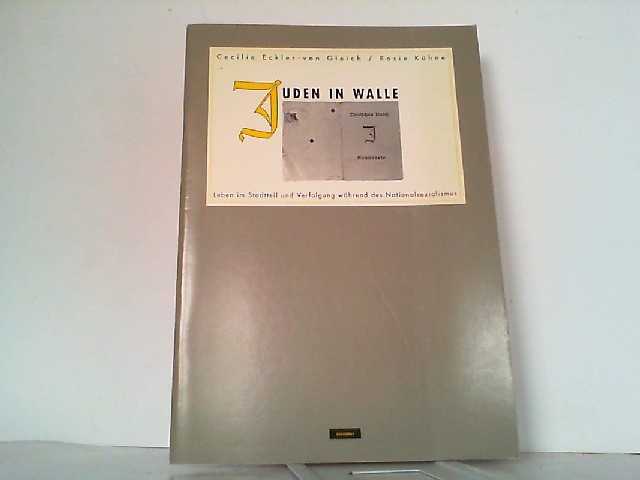
1980rif. 1164325Berlin, Oberbaum Vlg, 1980. 150 S., zahlr. Abb. OKart.
1957RARE report on the value of secular real estate in Israel owned by former residents of German nationality or extraction by Karl Brandt (1899-1975), Professor Emeritus and former Director of the Food Research Institute at Stanford University. After being appointed Professor of Agriculture in the University of Berlin in 1929 and Director of the Institute for Agricultural Market Research, Brandt left Nazi Germany in 1933, he took up residence in the United States as Professor of Agricultural Economics at the New School for Social Research in New York and from 1938 Professor of Agricultural Economics at Stanford University. He was also awarded an honorary doctorate by the University of Heidelberg and the Justus von Liebig Prize by the University of Kiel, and was the only American member of the French Academy of Agriculture and one of the few persons of German birth ever to receive the Order of Merit, France's highest award for civil service. Contains many b&w photographic plates. 280x210mm. XII+307 pages. Grey cloth Hardcover with gilt lettering on front cover and spine. Cover and spine somewhat stained and rubbed. Cover corners and spine edges bumped. Front cover bottom corner and spine hinge edges peeling. Spine upper edge worn. Several first pages bottom corner slightly wrinkled. Few pencil underlinings and Several tiny pen marks near text of pages 12-13, 15-16, 35, 45, 53, 80-82, 107, 122 and 268. Traces of erased pencil underlinings on some pages. Some pages bottom edge slightly bumped or slightly stained (no damage to text). Pages yellowing. [SUMMARY]: This extremely rare report on German property in Israel, written by a major authority in the field, is in good condition. PLEASE NOTE: This item is overweight. We may ask for extra shipping costs.