(Louven, Astrid)Antiquariat.de
5 261 résultats
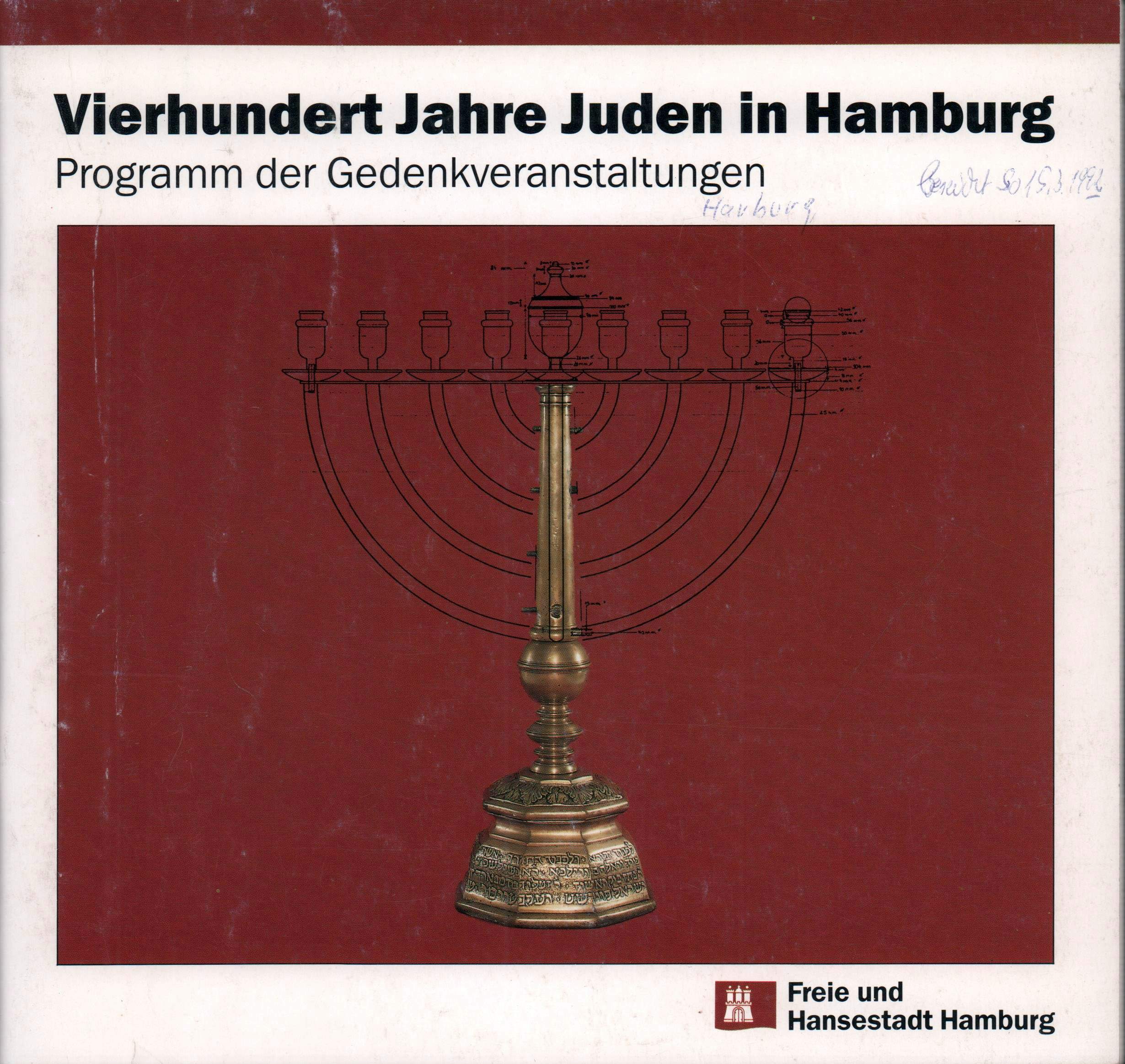
1991réf. 31357(Hamburg, 1991). 49 S. Mit zahlr. Abb. OBrosch.
1962Original Publisher's Cloth. 8vo. xvii, 528 pages. In Yiddish with added English Table of Contents, Summaries and Conclusion. Fold out maps. First edition. SUBJECT (S) : Jews Poland Lódz; Holocaust, Jewish (1933-1945) Poland Lódz; Jewish ghettos Poland Lódz. SERIES: Yad va-shem-Yivo monograph seriesm [Yad Washem-YIVO Monograph Series] No. 1. OCLC lists 26 copies worldwide. Bumped corners, very good condition. (HOLO2-7-2)
2000Original Publishers Cloth. Xii, 69, 200, [2] pages. Illus. Facsims. 32 cm. Includes approximately 200 black and white images. In Hebrew with added English title page and synopsis. A collection of facsimiles of all known fragments of Bavli Rosh Hashanah.David Golinkin received an M.A., rabbinical ordination and a Ph.D. in Talmud from the Jewish Theological Seminary in New York where he taught Talmud from 1980-82. His responsa and halakhic studies are known for their thoroughness, examining all sides of every issue using a wide range of talmudic, medieval, and modern sources. (EJ, 2007).SUBJECT(S): Manuscripts, Aramaic -- Facsimiles. Cairo Genizah. Title Subject: Talmud. Rosh ha-Shanah -- Manuscripts. Includes bibliographical references. ISBN: 965-456-030-5. New Condition with like dustjacket.
1919Original Red cloth. 8vo. 112pp. Illustrated paper-covered boards. Usual age toning to outer edges of pages. Fascinating history of the Jews of Lublin covering the 16th -18th centuries. Illustrated with b/w reproductions of in-text drawings by Karlrich Henker. Text in German. Faint dampstain to lower half of most pages. Otherwise Very Good Condition.(k-ee-1-1)
1936Original Cloth. 4to. (Various paginations) . 27 cm. In German, with lyrics in Hebrew and Yiddish. Nazi-era imprint. Two volumes in one. Both volumes of the Judische Volks-Lieder contain original elaborately designed title pages, both bound together with new wraps, in English, titled 45 Jeiwsh Folk Songs, Berlin-Boston, Hatikwah. Some individual scores contain original title pages as well. 45 songs, chiefly for voice and piano (though some for cello and violin accompaniment as well) . At the time of publication, Janot S. Roskin was actively involved as a composer for the Jüdischen Kulturbünde. He founded the Hatikvah music company in 1921, and refounded the company in the United States in 1941, after his emigration. Band 1 contains: Der Fuhrmann: Volkslied - Abram, Abram: Gebetlied - A Heem, A Heem: Refrain eines litauischen Volksliedes - Licht-Bentschen: Gebetlied - Der Schikkur: humoristisches Volkslied - A Brivele der Mamen: Familienlied / Text von B. W. Ehrenkranz - Hamawdil: Gebetlied / Text und Melodie v. A. Goldfaden - Roszinkes mit Mandlen: Wiegenl. - Jankele gejt in Schul: Goluslied - Der Alef-Bees: Chederlied / Text und Melodie v. M. Warschawski - Kinder mir hoben Ssimches-Torje / Text und Melodie v. M. Warschawski - Dem Milners-Treren: Goluslied - Dos Tojrele: a. D. Operette Di jiddische Neschome / v. Feinmann - Dos Pekele: Goluslied / Melodie von S. Russota - Ein schönes Lied hab ich gesungen / Melodie von Janot S. Roskin - Klip-klap, effen mir! : Liebeslied. I. / Melodie von Janot S. Roskin - Sehnsucht nach Jeruscholajim: Goluslied - Di Zimbel: Goluslied / Text und Melodie von Eljakim Zunser - Der Seeger Die Uhr - Der Parom Die Fähre - Dos heelige Rikud'l: Chassidisches Tanzlied - L'chajim Rebbe: Chassidisches Lied - Unser Rebbenju: Chassidisches Lied - Jismach Mojsche: Chassidisches Lied - Omar Adojschem Lejankojw: Chassidisches Lied. Band 2 contains: Nationale Volkslieder. Htikwah "Die Hoffnung" ; Dort wo die Zeder "Bimkom Haeres" ; Al tal s'a matar ; Ja chay lili ha, amali ; do Lid fun Jeruscholajim - Humoristischer Volkslieder. Dire-Gelt ; Balebuste Leben ; A Geneeweh ; Der Rebbe hot gehessen Freelich sajn ; Wus wet sajn m'kejech Burikes - Schlof, schlof, schlof ; Schlof sche majn Feegele ; Dos Kind ligt in Wigele ; Schlof, majn Kind ; Kumt der liber Sumer - Mädchen- und Liebeslieder. Di Bajke ; Do solst nit geen mit kajn andere Meedelech ; Kezele jajns! Klip-klap, effen mir! - Hochzeits- und Familienlieder. A Muters-Freed ; Chazkele, chazkele ; Ich bin sech mir a Kale ; Ale Mentschen Tanzendik ; Lejg ich mayn Kepele ; Frajtog ojf der Nacht. Subjects: Songs with piano. Songs with instrumental ensemble. Folk songs, Yiddish - Germany. Jews - Germany Music. OCLC lists 13 copies. Spine rebacked with old tape stains at spine. First few leaves aged; otherwise fresh and clean. Good condition. (GER-44-10)
2000Hardcover, 593 pages, illustrated, maps, 8vo, 25 cm. SUBJECT (S) : Jews -- Poland -- Biography. Holocaust, Jewish (1939-1945) -- Poland -- Biography. Holocaust survivors -- Louisiana - New Orleans -- Biography. Levy, Anne. Skorecki family. Duke, David Ernest. Skorecki (Family) . Louisiana -- Politics and government - 1951. Includes bibliographical references on pages 555-576 and index. In dustjacket. Very Good Condition. (Holo2-18-23)
1942Original Publisher's Cloth. xi, 202 pages, incl. tables. 26 cm. Holocaust-era imprint. Pinson (1904-1961) was "a U. S. Historian. Born in Lithuania, Pinson was taken to the U. S. In 1907. He lectured at the New School for Social Research from 1934 to 1937, when he went to Queens College, N. Y. , becoming professor of history in 1950. He was also history editor of the Encyclopedia of the Social Sciences (1929-35) , and an editor of Jewish Social Studies (1938-61) . In 1945-46, he was director of education and culture, Jewish Displaced Persons in Germany and Austria, United Nations Relief and Rehabilitation Association. Pinson's principal scholarly interests embraced modern European history, with special emphasis on nationalism and modern Germany, and recent Jewish history. His contributions to general history were Pietism as a Factor in the Rise of German Nationalism (1934) ; A Bibliographical Introduction to Nationalism (1935) ; and Modern Germany, Its History and Civilization (1954) . In Jewish studies, he edited a number of important books: Essays on Anti-Semitism (19462) ; Yivo Annual of Jewish Social Science, vols. 59 (1950-54) ; and notably Nationalism and History (1958) , which made available in English Simon Dubnow's classic, Essays on Old and New Judaism. Pinson analyzed Dubnow's national theories and appraised his role as historian. Pinson was actively involved in the work of the Yivo Institute for Jewish Research. He was also chairman of the modern Jewish history committee of the Jewish Publication Society of America. " (Janowsky in EJ, 2007) . Series: Jewish social studies. Publications, ; no. 2. SUBJECT(S): Jewish question. Some wear to cloth. Very good condition. (Holo2-16-15B)
1946Original Cloth. 8vo. IX, 369 pages. 24 cm. First edition. A historical survey of Jewish art; important text in the field. Profusely illustrated. Franz Landsberger, Born in Katowice in 1883, he grew up and studied in Breslau and subsequently in Berlin, Geneva and Munich. He specialized in art history; he was a lecturer at the Breslau University from 1912, and a professor there from 1918. He edited Polish art journals, published essays in 1926, and was considered the local authority in the field of art history. As an art expert and the manager of Berlin's Jewish museum, he was forced to leave Germany and was appointed a professor in Hebrew Union College and manager of the Jewish museum there, in Cincinnati. He passed away on March 17th, 1964. Subjects: Jewish art History. Contains bookplate of Steinhardt Family Library inside. Light wear to cloth, otherwise fresh. Very good condition. (ART-23-7)
19348vo; 79 pages; 23 cm. Fifth Edition. An early call to action to push for US government support for German Jews. Contents include: Precendents for Popular Protests; American Governmental Intercession on Behalf of the Jews; The Bernheim Upper Silesian Petition before the Council of the League of Nations [description & analysis]; Petition of Franz Bernheim to the Council of the League of Nations [exact text of the petition]. Very good Condition. (HOLO2-87-4)
19498vo; xv, 655 pages; 24 cm. Bibliography on pages 565-605. First edition. Kisch received the I. Hirschfield award for "Best non-fiction work on Jewish history" for this work. Some underlining, otherwise Very Good Condition in Good Jacket with edgewear. (mx-1-8)
19408vo. 112 pages. In Yiddish. First edition. Title translates as, "Refugees and Heroes: A Historical Overview of the Refugees in America 1492-1940" SUBJECT (S) : Jews United States; Refugees, Jewish. OCLC lists 21 copies worldwide. Covers and spine are faded. otherwise in good condition. (HOLO2-6-15)
1950(FT) Original Paper Wrappers, 8vo, 118 pages. Includes illustrations 22 cm. In Yiddish. Mayse-bikhlekh -- Bay a raykhn korev -- In geroysh fun mashinen -- 1905 -- Zump. SUBJECT(S) : Yiddish fiction. Some edgewear to covers, paper browning as generally found but no tears. Good+ Condition. (HOLO2-87-7)
2004First edition. Original paperback. 8vo, 599 pages. Ex-library with usual markings. SUBJECTS: KibbutzimIsraelPalestine. Very Good Condition. (AC-1-20)
19088vo. Xi, 170 pages. In German. Second edition. SUBJECT (S) : Judaism relations Christianity; Christianity and other religions Judaism. SERIES: Schriften hrsg. Von der Gesellschaft zur förderung der wissenschaft des judentums in Berlin. OCLC lists 24 copies worldwide. Marbled edges. Boards worn, stamp inside front cover, good condition. (GER-25-3)
1947Softcover. [4], v, 87, [9] pages. A response from the Jewish Welfare Board to questions that arose leading up to and during World War II. A few of the topics addressed include: Conscientious Objectors, Dietary Laws, Sabbath, Marriage, Interment and Disinterment. SUBJECT (S) : Responsa -- 1800-1948. War (Jewish law) . Preface by Aryeh Lev, Introduction by Solomon B. Freehof. Index included: pages [87-96]. OCLC lists 4 copies worldwide (American Jewish University, University of Southern California, Danish Union CAT & Danish National Library, DET Kongelige Bibliotek The Royal Library) . Moderate wear to spine with 2 of tape at top. Internal pages are tanned with underlining and margin notes on several pages, but all text is clear. Good condition. (HOLO2-55-7)xx
1990Softcover, 8vo, 118 pages, illustrated, 21 cm. In German. Title translates as: Jewish Life as a Human Resistance: Documents of Hamburg Chief Rabbi Dr. Joseph Carlebach From The Years 1939-1942. Series: Beitrage zur Geschichte Hamburgs; Bd. 37; Variation: Beitra? Ge zur Geschichte Hamburgs; Bd. 37. SUBJECT (S) : Rabbis -- Germany -- Hamburg -- Biography. World War, 1939-1945 -- Personal narratives, Jewish. Carlebach, Joseph, 1883-1942. Hamburg (Germany) -- Biography. Hamburg (Germany) -- Ethnic relations. Includes bibliographical references. Carlebach (1882-1942) was a rabbi and educator, son of Solomon Carlebach and rabbi of Luebeck for nearly 50 years. Joseph Carlebach probably served as the prototype for the rabbi in Thomas Manns Dr. Faustus. After a period of teaching, he opened a Hebrew high school in German-occupied Kovno, Lithuania, during World War I. He later became headmaster of the Talmud Torah high school at Hamburg and rabbi of Luebeck, Altona, and ultimately of Hamburg. Carlebach published commentaries on the Song of Songs, the Prophets, and Ecclesiastes, and his thesis on Levi b. Gershom as a mathematician, besides many articles in German-Jewish periodicals. He perished in the Holocaust, in a concentration camp near Riga, Latvia (Falk in EJ, 2007) . Lightwear. Very good condition. (Holo2-87-12)
19198vo; 79 pages; 21 cm. Backstrip absent, light soiling to cloth. Otherwise fresh. Good Condition. (GER-10-20-DW)
1970Softbound. 8vo. XVI, 113 pages. 22 cm. Reprint of the 1955 edition; including 1969 introduction as well as the author's letters to Lessing J. Rosenwald and Clarence L. Coleman, Jr. , from April 7 to June 24, 1955. Elmer Berger (1908-1996) was an American Reform Rabbi, outspoken since the 1930s against Zionism, an ideology which he interpreted to be a surrender to anti-semitic myths concerning race. He was the executive director of the American Council for Judaism for over 13 years, and when forced to resign, be became the founder of the American Jewish Alternatives to Zionism. The publisher, the Institute for Palestine Studies, is the oldest independent non-profit research institute in the Arab World, and has consistently committed itself to putting together analysis and documentation so as to allow the possibility of a peaceful resolution of the Arab-Israeli conflict (their words) . Subjects: Jewish-Arab relations. Jewish institutional stamp, Light wear to covers. Very good condition. (HOLO2-88-2)
1936Original paper wrappers, 8vo., Softcover, 12 pages, long 8vo, 22 cm. Holocaust-era look at the Jewish community/ies in the US. Article first written in response to recent "Nazi barbarities" (page 2) as well as an implied call for assimilation: "it still remains true that the future of the Jew in America is puzzling. Can this universal stranger be absored in the country which has absorbed every other European stock?" (page 12). SUBJECT (S) : Jews -- United States. Jewish question. Cover title. Condensed version of research originally published in Fortune magazine and later published in book form by Random House. OCLC lists 14 copies worldwide.Wear to edges. Light wear. Otherwise, very good condition. (Holo2-22-16A) .
1946Softcover, 88 pages, 8vo, 25 cm. In Dutch. Series: De Vrije bladen; jrg. 18, schrift 6/7; De Vrije bladen; jrg. 18, schrift 6/7. "Diary from a Camp. " Survivor's diary of camp life. "Loden Vogel (Louis Tas) was the son of an Amsterdam doctor and psychiatrist; he was arrested in Amsterdam on September 29, 1943, along with his parents, and taken to the transit camp at Westerbork. He was born on December 25, 1920, so he was 23 years old at the time. Everyone in his family had South American passports, so they were sent to Bergen-Belsen as "'exchange Jews'" on April 15, 1944. Loden was one of the survivors; he had spent exactly one year in the Star Camp. His father worked as a doctor in the camp and because of this, Loden was given a job as a nurse. In 1946, he published the diary that he kept in Bergen Belsen under the title "'Dagboek uit een kamp'" (scrapbookpages-com, 2013).SUBJECT (S) : Concentratiekampen. Vogel, Loden. Genre/Form: Dagboeken (vorm) . OCLC lists 12 copies online. Writing on front cover. Chipping to edges. Yellowing of pages. Wear and chipping to cover binding. Otherwise, good condition. (Holo2-19-71)
1936Original Wraps. 4to. [13] pages. 28 cm. First edition. Nazi-era booklet containing ten illustrated color charts, graphs, and maps. Charts demonstrate economic and demographic statistics, including chart detailing distribution of refugees from Germany worldwide. Subjects: Jews in Palestine History. Jews. Jews - Restoration. Middle East - Palestine. OCLC lists 6 copies. Previous owners signature on front wrap. Lightly soiled wraps, otherwise clean. Good + condition. (ZION-7-44) xx
19481st edition. Original Orange Paper Wrappers, 8vo, 34 pages + 8 pages of photo plates + maps. Very slight discoloration along top edge, otherwise Very Good Condition. (SPEC-35-16)
19451st edition. original Paper Wrappers, 4to, [48] pages. Unpaginated. Text in Hungarian. Mostly illustrations. One of the first collections of Holocaust drawings published after the war. Original illustrated wrappers with red lettering on front cover. A pictorial album by Holocaust survivor Péter Áldor, depicting the atrocities of the German occupation and the repression of the local fascists. This work is profusely illustrated with 18 heart-gripping sketches illustrating in all its horror, human madness and misery. Light stains and wear to cover, internally extremely clean, Overall Very Good Condition, a nice copy. (Holo2-125-25)
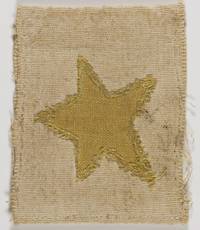
1943réf. 53630Tunisia 1943. Nearly Fine. Five-pointed yellow cloth star sewn onto plain beige cloth 7.3 by 9 cm. Yellow dye somewhat faded else in fine state of preservation. Specimen of the yellow star imposed on the Jewish population of Tunisia in March 1943 as a mark of the slave laboror. Tunisia was the only Islamic country to come under Nazi rule at first indirectly through the Vichy regime in France between 1940 and its liberation by Allied forces on May 7 1943. In response to the Allied invasion of Algeria and Morocco German and Italian forces invaded Tunisia on November 9 1942. By the end of November the Germans took the first anti-Jewish move by arresting four of the community leaders including Moïse Borgel the president of the Jewish congregation. "In addition to the governor-general's sympathetic attitude -- and in some degree to the pro-Jewish attitude of Bey Sidi Mohammed al-Mounsaf -- the Italians also in practice interfered with the application of the anti-Jewish laws" E.H. The dignitaries were released after a week following the intervention of the mayor of Tunis and the Italian consul. Because of objections by the Italians the edict to wear the star does not appear to have been generally enforced with rigor and was only formally imposed in two cities Sfax and Tunis. While 5000 Jews had originally been put on forced labor in thirty locations and camps along the front line "at the time of the collapse and surrenter in early May 1943 only sixteen hundred Jews were employed on forced labor" E.H. Given the relatively small labor force and the lack of zeal in imposing the anti-Jewish ordinances it is clear why so few of these yellow badges have survived. References: I. Gutman ed. Encyclopedia of the Holocaust vol. 4 pp. 1521-23. unknown books
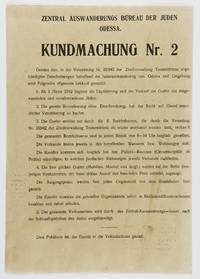
1942réf. 51752Odessa: Zentral Auswanderungs Büreau 1942. Original document. Loose leaf. Very good condition. Quarto. Original loose leaf with black lettering. Announcement based on ordinance no. 35/942 of the civil government of Transnistria relating to the emigration of Jews in Odessa and surrounding areas. The text printed biligually in German and Ukrainian is organized into five statements. The annoucement concerns the liquidation and sale of goods of emigrated or vanished Jews beginning on March 1 1942 with the whole population without limitations given the right to buy these items based on oral agreements. Furthermore the announcement regulates details and procedures of the sale and at the end announces that after the sale proceeds will by handed to the Jews by the Central Emigration Office. "The rapid development of Odessa began after the Russian conquest 1789. Its Jewish population also grew quickly and in the late nineteenth and early twentieth centuries it was the most important Jewish literary community after Warsaw. In 1926 there were 153194 Jews in Odessa 36.4 percent of the total population and by 1939 their numbers reached 180000." Encyclopedia of the Holocaust Vol. 3 page 1080. When Romanians and Germans laid siege to the city on August 5 1941 many Jews in Odessa managed to leave and eighty to ninety thousand Jews remained in the city. Odessa fell on October 16 and the German Einsatzkommando 11b and the Romanian intelligence service immediately slaughtered over eight thousand residents mainly Jews and Odessa was established as the capital of the Transnistria region. On October 22 the Romanian military headquarters were blown up killing sixty-six officers and the military governor. In reprisal the Romanian ruler Ion Antonescu ordered devastating retaliation including the arrest of one member of each Jewish family. By October 1941 some 40000 Jews were assembled in the ghetto of the nearby city of Slobodka and their valuables confiscated. Deportations of some 20000 Jews began in January of 1942. When Odessa was liberated on April 10 1944 authorities reported that about 99000 Jews had been killed. Odessa again became an important Jewish center with 102000 Jews living there according to a 1959 census. Considering the context of "Kundmachung Nr. 2 the Odessa massacre of October 22-24 1941 and the murder of Jews living between the rivers Dniester and Bug during the Romanian and German occupation this succinct notice including its misspellings and mistakes in the German language is a chilling mirror image of the attitude shown by the occupying powers towards the Jews. Approximately 30000 Jews were killed in Odessa and more than 100000 in Transnistria. The text is printed in German on one side and Ukrainian on the verso. Minor wear and smudging. Protected in modern mylar. Zentral Auswanderungs Büreau unknown books