5 560 résultats
2004235X160 mm. ix+326 pages. Hardcover with dust-jacket. Cover edges slightly bumped. Spine edges slightly bumped. Else in good condition.
1967réf. 1160776Göttingen, Vandenhoeck & Ruprecht, (1967). 375 S. OLwd.
1998Düsseldorf: Arbeitskreis NS-Gedenkstätten NW, 1998. Paper Wrappers. 8vo. 132 pages. Illustrated. In German. SUBJECT (S) : Holocaust memorials - Germany - North Rhine-Westphalia; Memorials - Germany - North Rhine-Westphalia; Concentration camps - Germany - North Rhine-Westphalia; National socialism - Germany - North Rhine-Westphalia. OCLC lists 2 copies worldwide (Harvard Col Libr, Nederlands Inst Voor Oorlogsdocumentatie) . Very little shelf wear. Very minimal staining to cover. Otherwise in Very Good condition. (GERA-12-6) .
1962Softcover, 12mo, 68 pages. In Swedish. The Wandering Jews. OCLC lists 1 copy worldwide (Nat Libr of Sweden) . Chipping to edges of pages. Lightwear to edges and corners of cover. Good condition. (Holo2-67-1)
1985Reichlich illustriert in Schwarzweiß.
1985réf. 219453Shazar Library Institute of Contemporary Jewry Vidal Sassoon International Center for the Study of Antisemitism Hebrew University of Jerusalem January 1985. Paper Back. Very Good. clean unmarked copy Shazar Library, Institute of Contemporary Jewry, Vidal Sassoon International Center for the Study of Antisemitism, Hebrew Univer unknown
1947Paper Wraps. 1st edition thus (not a reprint) 39 pages. 28 cm. A collection of foreign policy press releases from the State Department and the White House, as well as statements from the President and Secretary of State, and various articles on international affairs. Contents of this issue include: The Nurnberg Judgment: A Summary, by Katherine B. Fite; U. S. Polish Agreement on Compensation Claims. Some fraying to cover at binding and some tears on back cover. Internal pages are slightly darkened but all text is clear aside from one paragraph on inside back cover. Good condition. (HOLO2-41-16)
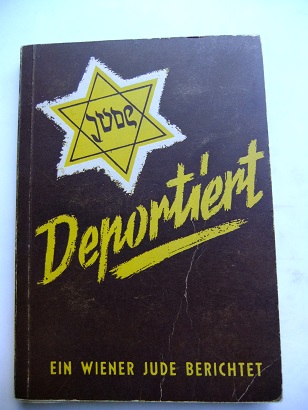
1947réf. 133159Stern Verlag. Wien 1947. 165, (2) Seiten. Zweifarbige Originalbroschur. (Einband etwas berieben. Vortitelblatt lose u. teils beschädigt). 19x13 cm
1947réf. JUDA0914aWien, Stern-Vlg. (1947). 165 (3) S., ill. obrosch., Vortitelblatt rissig, etwas gebräunt. Umschlag mit Gebrauchsspuren Erste und einzige Ausgabe des frühen Erlebnisberichts. Mit einem Vorwort von Nikolaus Hovorka. Nicht bei Wiener Library; HÖAJ 3487.
2007réf. BN547934Yad Vashem International School for Holocaust Studies 2007. 2007. Softcover. Der Alltag im Warschauer Ghetto 1941. Schülerheft und Lehrerheft mit beiliegender CD-ROM 31 Fotografien aus dem Warschauer Ghetto in Kunststoffbox. Deutsche Fassung. Redaktion und Bearbeitung: Deborah Hartmann Dr. Noa Mkayton Daniel Rozenga und Dr. Susanne Urban. Beratung: Shulamit Imber Shlomit Dunkelblum-Steiner und Shira Magen. Herstellung von Ami Sternschuss. Grafikdesign von Eran Zirman. Der Alltag im Warschauer Ghetto 1941. Schülerheft und Lehrerheft mit beiliegender CD-ROM 31 Fotografien aus dem Warschauer Ghetto in Kunststoffbox. Deutsche Fassung. Redaktion und Bearbeitung: Deborah Hartmann Dr. Noa Mkayton Daniel Rozenga und Dr. Susanne Urban. Beratung: Shulamit Imber Shlomit Dunkelblum-Steiner und Shira Magen. Herstellung von Ami Sternschuss. Grafikdesign von Eran Zirman. Yad Vashem International School for Holocaust Studies Hrsg. Yad Vashem, International School for Holocaust Studies paperback
1948(FT) Original Wrappers. 8vo. 55 pages. 23 cm. First edition. Title page verso: The Old Man of Lompaduni and other Stories. This beautifully illustrated book of childrens stories is printed in seven colors of ink. The author of these seven stories in Yiddish was Yuri Suhl, who emigrated from Poland to the United States in the 1920s, and became well known as a Yiddish poet and childrens writer. His other works included the popular "They Fought Back: The Story of Jewish Resistance in Nazi Europe. " That work was praised as a landmark contribution to Holocaust literature and Suhl spent more than five years documenting it before it was published in 1967. His other works included "Eloquent Crusader: Ernestine Rose, " a biography of the Polish-born feminist, and two autobiographical novels: "One Foot in America" and "Cowboy on a Wooden Horse. " He was also a trustee of the fund set up for the sons of Julius and Ethel Rosenberg. The illustrator, William Gropper (18971977) , a cartoonist, painter, lithographer, and muralist; he grew up in the lower east side, and an aunt of his died in the triangle shirtwaist factory fire. He was a dedicated left wing political cartoonist for both English and Yiddish papers. During the second half of the 1930s, Gropper dedicated his art to the efforts to raise popular opposition to fascism in Europe. Following World War II, Gropper traveled to Poland to attend the inaugural convention of the World Congress of Intellectuals for Peace of 1948 in Wroclaw. This Yiddish childrens book was printed there, both for an audience of international anti-fascist partisans and survivors gathering to found the World Peace Council, as well as for those survivors living in Wroclaw, one of the largest post-war Jewish communities in Poland for a few years. Rare, OCLC lists 12 copies. Subjects: Children's stories, Yiddish. Holocaust, Jewish (1939-1945) . Front cover repaired with tape, edges chipped. All pages lightly aged, but clean and fresh. Good condition. Scarce and important (HOLO2-97-42)
1960réf. 1164222Zürich, Die Gestaltung, (etwa) 1960. 99 S. OKart.
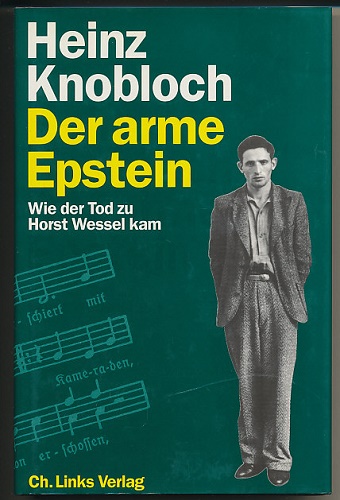
1993réf. 14656Berlin: Ch. Links Verlag 1993. 224 S. 21 x 13,5 cm. Original-Pappeinband mit Original-Schutzumschlag.
1957réf. 60422Berlin : Dietz 1957. 428 S., mit Abb., 1 Falttaf. : Mit 46 Abb. u. 1 Kartenbeil ; 8°, ohne Schutzumschlag, kleines Fehlstück oben Ecke am Vorsatzblatt Lw., gebundene Ausgabe, Leinen, Seiten alters- und papierbedingt gebräunt, sonst guter Zustand
1959réf. 1167583Berlin, Dietz, 1959. 468 S. m. 62 Abb., 1 Faltplan, 1 Bl. OLwd (Papier gebräunt).
1979réf. 1162667München), Bertelsmann, (1979). 413, (1) S., zahlr. Abb. auf Taf. OPp. m. OUmschl.
1965réf. 79750Wien, Europa Verlag, 1965. 460 S. 8° Oktav, Leinen
2007réf. 56938(Hamburg, 2007). 111 S. Mit 6 Abb. 23 cm. OKart.
1997réf. 54426Bodenheim: Syndikat 1997. 102 S. Reg. Br.
19821st edition. Original cloth. 4to, x + 205 (English) + 396 (Yiddish) + v pages. Illustartions throughout. Bialystok's strength rests only in its extraordinary features but in its normal characteristics as well. The fifty thousand living there are doing reasonably well financially and also spiritually, like other Jews in Poland. Still, Bialystok was the first, at the end of the German occupation after World War I, to abolish its autocratic community leadership, replacing it with an exemplary democratic system that will do down in history. The Hebraist movement in Bialystok was only a part of the diffuse cultural advance in all of Poland. But when Bialystok established its Hebrew Gymnasium (high school) it was the rank and file Jews, not the radical Hebraists, who erected it. The tall, sturdy building evoked the admiration of the local community as well as of visitors from near and far, especially since it could accommodate seven hundred students. The Yiddish influence in Bialystok was also only a part of the Yiddish movement in all of Poland and in the entire world. But with the exception of Wilno, no other Jewish town besides Bialystok was able to fashion such an intricate Yiddish school network, let alone a high school, despite difficult circumstances. The orphan problem became one of the most critical social issues in Bialystok after World War I. Surely no other city had someone like Mrs. Rabinowicz, who, when the situation became next to hopeless, was the only leader in all of Poland who went to America to obtain the necessary assistance for these unfortunate children. It is possible to mention hundreds of other examples of community and private initiatives in Bialystok which clearly depict its special atmosphere of effervescing creativity a contagion transmitted from one to another compelling everyone to outdo his neighbour. Such is the breeding ground for important accomplishments. (Pejsach Kaplan, a prominent Bialystoker writer and social activist) SUBJECT(S) : Jews -- Poland -- Bialystok. World War, 1939-1945 -- Jews. Memorial books (Holocaust) . Jewish (1939-1945) Ethnic relations. OCLC: 19303249. Ex library with usual marks, inscription on front end page by Max Ranter, Honorary Chairman of the Book Committee. Very Good Condition Overall (YIZ-16-2A)xx
19821st edition. Original cloth with dust jacket. 4to, x+ 205 (English) + 396 (Yiddish) + v pages. Illustrations throughout. Bialystok's strength rests only in its extraordinary features but in its normal characteristics as well. The fifty thousand living there are doing reasonably well financially and also spiritually, like other Jews in Poland. Still, Bialystok was the first, at the end of the German occupation after World War I, to abolish its autocratic community leadership, replacing it with an exemplary democratic system that will do down in history. The Hebraist movement in Bialystok was only a part of the diffuse cultural advance in all of Poland. But when Bialystok established its Hebrew Gymnasium (high school) it was the rank and file Jews, not the radical Hebraists, who erected it. The tall, sturdy building evoked the admiration of the local community as well as of visitors from near and far, especially since it could accommodate seven hundred students. The Yiddish influence in Bialystok was also only a part of the Yiddish movement in all of Poland and in the entire world. But with the exception of Wilno, no other Jewish town besides Bialystok was able to fashion such an intricate Yiddish school network, let alone a high school, despite difficult circumstances. The orphan problem became one of the most critical social issues in Bialystok after World War I. Surely no other city had someone like Mrs. Rabinowicz, who, when the situation became next to hopeless, was the only leader in all of Poland who went to America to obtain the necessary assistance for these unfortunate children. It is possible to mention hundreds of other examples of community and private initiatives in Bialystok which clearly depict its special atmosphere of effervescing creativity a contagion transmitted from one to another compelling everyone to outdo his neighbour. Such is the breeding ground for important accomplishments. (Pejsach Kaplan, a prominent Bialystoker writer and social activist) SUBJECT(S) : Jews -- Poland -- Bialystok. World War, 1939-1945 -- Jews. Memorial books (Holocaust) . Jewish (1939-1945) Ethnic relations. OCLC: 19303249. Dust jacket has light wear on edges and corners, else near perfect condition. Very Good Condition overall. (YIZ-16-2B)xx