5678 risultati
19441st Yiddish edition. Original illustrated paper wrappers. 12mo. 95 pages, 14 cm. In Yiddish with some Russian. Title translates to Lublin Extermination-Camp Majdanek. Soviet war correspondent and poet Konstantin Simonovs booklet on the atrocities of the Majdanek camp, published simultaneously in several languages, was only the second monograph published on the atrocities at Majdanek. Simonov (1915-1979) was a highly decorated poet, novelist, playright, and war correspondent whose works were widely known (Wikipedia, 2018) . A Polish-Soviet Special Criminal Court was established in Lublin in August 1944 in order to investigate the Nazi crimes in the Majdanek extermination camp, with Simonov covering the proceedings as the basis for this work. The Majdanek concentration camp was established on Heinrich Himmler's order and operated from October 1, 1941 until it was liberated by the Soviet Army on July 22, 1944. It is known to be the best preserved Nazi concentration camp of the Holocaust, as the Germans did not have enough time to destroy the evidences of their crimes. The Commission for investigating the German crimes was established in August 1944 and soon they published this booklet in several languages. Despite of the importance of this statement it must be mentioned that the Commission made many erroneous assumptions regarding the duration of the camp or number of people killed at Majdanek, probably because they were motivated rather by political and propaganda agenda than by a search for historical facts. The total number of the victims is still controversial, in this report 1.5 million victims of different nationalities were counted, however according to the latest researches there were 79, 000 victims, 59, 000 of whom were Jews. [Kranz, T. : Bookkeeping of Death and Prisoner Mortality at Majdanek. Pp. 81-110. In: Silberklang, D. (ed. ) : Yad Vashem Studies. Vol. 35: 1. Jerusalem, 2007.]. SUBJECTS: World War, 1939-1945 -- Atrocities. World War, 1939-1945 (OCLC: 145083668) . Light wear to wrappers and pages browning. Otherwise very good condition. (HOLO2-142-4-ALR)
19971st English language edition. Original cloth, with dust jacket. 4to, xx + 427 pages. Illustrations throughout. In English. The story of the former Polish-Jewish community (shtetl) of Luboml, Wolyn, Poland. Its Jewish population of some 4, 000, dating back to the 14th century, was exterminated by the occupying German forces and local collaborators in October, 1942. Luboml was formerly known as Lyuboml, Volhynia, Russia and later Lyuboml, Volyns'ka, Ukraine. It was also know by its Yiddish name: Libivne. SUBJECT(S) : Jews -- Ukraine -- Liuboml. Holocaust, Jewish (1939-1945) Ethnic relations. Russia, Volyn, Vladimir-Volynsk, Jewish history. Poland, Wolyn. OCLC: 36364181. Some wear on dust jacket, Very Good Condition overall. (YIZ-17-12A)
199728.5X22.5 cm. XX+427 pages. Gilt hardcover with dust jacket. Dust jacket stained. Spine edges slightly bumped. Cover corners slightly bumped. Pages slightly wrinkled. Pages slightly yellowing. Else in good conditions. PLEASE NOTE: This item is overweight. We may ask for extra shipping costs.
19838vo; 17 pages; Softcover, portraits, 23 cm. Contents: Luther and the Jews : toward a judgment of history by Eric W. Gritsch -- Luther and the Jews : from the past, a present challenge by Marc H. Tanenbaum. SUBJECT (S) : Christianity and antisemitism -- History -- 16th century. Reformation. Judaism. Luther, Martin, 1483-1546 -- Views on Jews. Cover title. Good condition. (Holo2-22-5).
1937Paper Wrappers. 8vo. 99 pages. In French. Pierre-Bloch was one of few parliamentarians to oppose the Munich Agreement. As a Jew, he was particularly concerned by the fate in store for the Jews of Adolf Hitler's Germany. This book covers the trial of David Frankfurter, a Jew who assassinated Swiss branch leader of the German NSDAP chef Wilhelm Gustloff in 1936 in Davos, Switzerland. This became an important pretext for German aggression. Pages discolored, worn at edges. Pages unopened. Covers are slightly stained, with writing in pencil on front. Tear at the top of spine. Good condition. (HOLO2-28-13)
1977Softcover, 8vo, 131 pages, illustrations, 20 cm. In French. SUBJECT (S) : Descriptor: Sephardim -- History. Sefarades -- Histoire. Bibliography: pages 127-129. Discography: pages 130-131. Filmography: page 131. Sephiha (1923) is a Judeo-Spanish linguist and activist. Sephiha was born in Brussels to a Sephardi family from Istanbul. During the German occupation of Belgium, he was arrested in 1943 and deported to Auschwitz in September. He survived the death camp, where his father perished. After liberation, he resumed his studies in natural sciences, graduating in 1948 and working as a chemical engineer; however, he eventually decided to study and defend the linguistic and cultural heritage of his community. His understanding of the language is based on a clear distinction between its two fundamental modalities. Sephiha, who retired in 1991, was instrumental in securing academic acceptance and public support for the agonizing language he spoke and taught. Besides his scientific and popular publications, from 1972 he launched several calls for revival of the language and in 1979 founded the Association Vidas Largas for the Defense and Promotion of the Judeo-Spanish Language and Culture, which organizes educational work in Sephardi communities as well as the rescue of literary, musical, and architectural treasures. Judeo-Spanish has since been included among the recognized minority languages of France. In 2003, Sephiha inaugurated at the Auschwitz site a memorial in honor of the 160, 000 Judeo-Spanish victims of the Holocaust (Wilke in EJ 2007) . Ex-library with usual markings. Very Good condition. (Sef-30-8A)
1977Softcover, 8vo, 131 pages, illustrations, 20 cm. In French. SUBJECT (S) : Descriptor: Sephardim -- History. Sefarades -- Histoire. Bibliography: pages 127-129. Discography: pages 130-131. Filmography: page 131. Sephiha (1923) is a Judeo-Spanish linguist and activist. Sephiha was born in Brussels to a Sephardi family from Istanbul. During the German occupation of Belgium, he was arrested in 1943 and deported to Auschwitz in September. He survived the death camp, where his father perished. After liberation, he resumed his studies in natural sciences, graduating in 1948 and working as a chemical engineer; however, he eventually decided to study and defend the linguistic and cultural heritage of his community. His understanding of the language is based on a clear distinction between its two fundamental modalities. Sephiha, who retired in 1991, was instrumental in securing academic acceptance and public support for the agonizing language he spoke and taught. Besides his scientific and popular publications, from 1972 he launched several calls for revival of the language and in 1979 founded the Association Vidas Largas for the Defense and Promotion of the Judeo-Spanish Language and Culture, which organizes educational work in Sephardi communities as well as the rescue of literary, musical, and architectural treasures. Judeo-Spanish has since been included among the recognized minority languages of France. In 2003, Sephiha inaugurated at the Auschwitz site a memorial in honor of the 160, 000 Judeo-Spanish victims of the Holocaust (Wilke in EJ 2007) . Bumped corners and edges. Wear to binding. Good condition. (Sef-30-8)
1950Original Wraps. 8vo. 23 pages. 21 cm. First edition. In French. Frontispiece portrait of Leon Bramson. 'Leon Bramson and the ORT Union. ' Published on the seventieth anniversary of the World Ort Union, in memory of Leon Bramson, founder of the ORT in France. A history of the French ORT, and the life and work of Leon Bramson (Leonty; 18691941) , communal worker and writer. Born in Kovno, Bramson graduated in law from Moscow University, then settled in St. Petersburg, where he practiced, and was active in the Society for the Promotion of Culture Among the Jews . He was also director of the central committee of the Jewish Colonization Association from 1899 to 1906. Under his direction a statistical study was carried out on the economic situation of the Jews in Russia (published in Russian in 1904 and in French in 19068) . He was one of the compilers of the Sistematicheskiy ukazatel literatury o yevreyakh na russkom yazyke ('Systematic Guide to Russian Literature About Jews, ' 1892) , and contributed many articles to Voskhod and other periodicals on problems of Jewish education, emigration, and colonization. Active in Jewish political life, Bramson was one of the founders of the 'Jewish Democratic Group. ' In 1906 he was elected to the First Duma as a deputy for Kovno province, joining the Labor faction ('Trudoviki') . During World War I, the Revolution, and the Civil War, Bramson was an organizer of the Central Committee for the Relief of Jewish War Sufferers (YEKOPO) . When he left Russia in 1920, he continued to work in Western Europe on behalf of ORT (with which he had been associated in Russia from 1909) , serving as its president from 1923 until his death. (EJ 2008) . The author, Dr David Lvovitch (1882-1950) studied law and economics in St Petersburg and later studied engineering in Munich. An early Zionist from a wealthy family, he visited the USA, spending the First World War years there. He returned to Russia and was elected to the short-lived 1918 Constituent Assembly. An industrialist, he was interested in ORT's agricultural and co-operative projects. Elected as a founder member of the World ORT Union Council in 1921, he was central in developing ORT into a world organisation. Lvovitch travelled abroad with Leon Bramson to find financial support for needy Russian Jews after the First World War. He worked successfully in the USA, cultivating support among the Russian emigre community. On Bramson's death Lvovitch and Aaron Syngalowski, as co-chairmen of the ORT Executive, shared the running of World ORT throughout the Second World War and after. Lvovitch, based in Paris, was in charge of ORT's remarkable programmes assisting and retraining displaced persons in Europe. When he died, the ORT Lvovitch School in Netanya was named in his memory. Subjects: Bramson, Leontii Moiseevich, 1869-1941. World ORT Union OCLC lists 3 copies (Yale, Biblio Natl France, Biblio Sainte-Genevieve) . Wraps previously folded down center, with crease line throughout; light soiling to wraps, with minor pen marks, otherwise fresh and clean. Good condition. (HOLO2-113-14)
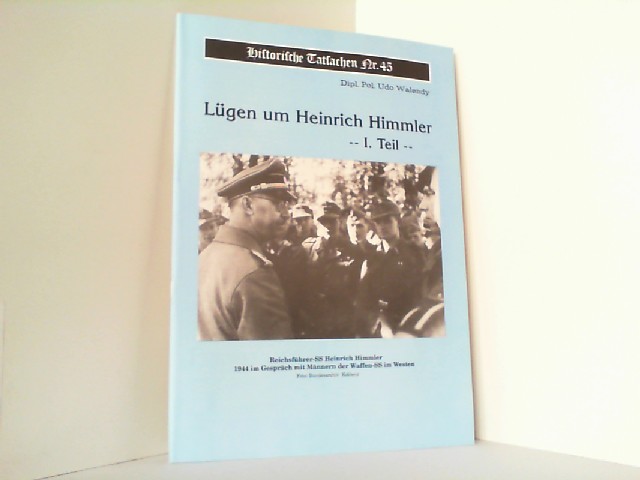
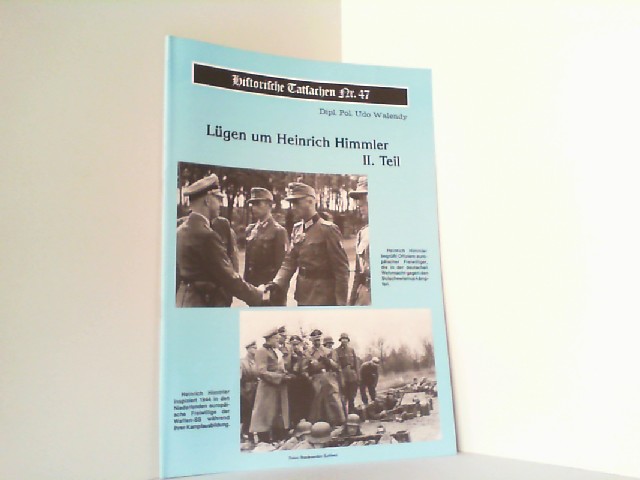
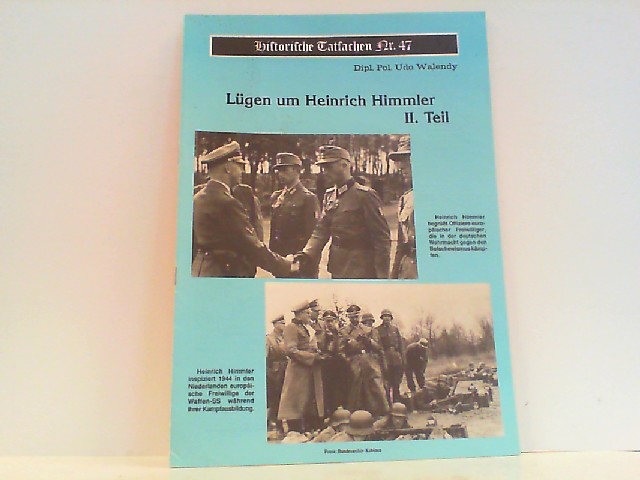
1991rif. 233558Vlotho, Verlag für Volkstum und Zeitgeschichtsforschung, 1991.
1991rif. 233561Vlotho, Verlag für Volkstum und Zeitgeschichtsforschung, 1991.
1991rif. 218422Vlotho, Verlag für Volkstum und Zeitgeschichtsforschung, 1991.
1972Cloth, 8vo, 200 pages. Includes illustrations, facsimiles, fold-out map, portraits, etc. 22 cm. In Hebrew. Memoir of Warsaw Ghetto Uprising. SUBJECT(S): World War, 1939-1945 -- Underground movements -- Jews. Geographic: Warsaw (Poland) -- History -- Warsaw Ghetto Uprising, 1943. Very Good Condition. (H-40-7)
200814x21.5 cm. 236 pages. Softcover. Top of spine slightly chafed. Else in good condition.
1994300x210mm. 64 pages. Softcover. Ex-Library copy with usual marks. Else in good condition.
1999rif. 40525Köln : DuMont 1999. 330 S. : 15 einfarb. Abb. ; 21 cm kart., Softcover/Paperback
1991RARE collection of articles by fifteen historians, dealing with the history of the infamous Majdanek concentration camp. Includes about 100 b&w photographs of the camp and its personnel, plans, maps and photos of survivors. Authors of the articles are: Aleksy Bornus, Edward Dziadosz, Bozena Fiala, Jolanta Gajowniczek, Jozef Kasperek, Zofia Leszczynska, Zygmunt Mankowksi, Jozef Marszalek, Tadeusz Mencel, Wieslaw Michalski, Zofia Murawska, Czeslaw Pilichowski, Czeslaw Rajca, Henryka Telesz, Anna Wisniewska. 245x175mm. 556 pages. Brown fake-leather Hardcover with grey dust jacket. Embossed lettering on front cover and spine. Jacket edges worn. This important book on Majdanek is in very good condition.
19868vo., First Edition, with numerous photographs throughout and large folding plan; printed wrappers, a very good, bright, clean copy. Detailed modern account with extensive collection of photographs.
1945rif. 47189Krakow: Spóldzielnia Wydawnicza "Czytelnik" Czytelnik Publishing Cooperative 1945. First edition. Softcover. g to von-. Octavo 8 1/4 x 6". 93pp. 13 leaves of double sided photographic plates interleaved and unpaginated. Illustrated tan red and black wrappers with black lettering on the front cover. Photographic b/w frontispiece. Spóldzielnia Wydawnicza "Czytelnik." Possibly an earlier publication on lower quality paper compare to a slightly smaller publication by the "Library of the Union of Polish Patriots in the USSR" Biblioteczka Zwiazku Patriotów Polskich w ZSRR with the same text in different layout. That publication issued on higher quality paper and with twenty-eight photogravures three more than in this publication with twelve photographs appearing in both publications though in lesser quality here. Court Proceedings of the Polish-Soviet Special Criminal Court established in Lublin in August 1944 in order to investigate the crimes committed by the Germans in the Majdanek extermination camp. Despite the importance of this document it must be mentioned that the Commission made erroneous assumptions regarding the duration of the camp and the number of people killed at Majdanek. The Publishing cooperative "Czytelnik" was established behind Soviet front lines in 1944. It became the first post-World War II. publisher in Poland. The total numbers of the victims is still controversial: In this report 1.5 million victims of different nationalities were counted however according to the latest researches there were 79000 victims 59000 of whom were Jews See: Kranz T.: "Bookkeeping of Death and Prisoner Mortality at Majdanek." pp. 81-110. In: Silberklang D. Ed.: Yad Vashem Studies. Vol. 35:1. Jerusalem 2007. Illustrated with 25 pages of b/w photographic reproductions including a frontispiece on 13 double-sided interleaved plates altogether thirty-two photographs depicting members of the Commission Nazi guards now prisoners who used to run the camp and survivors alike testifying before the Commission. Also includes views of the actual concentration camp piles of suitcases Zyklon B poison gas pellets gas chambers ovens and survivors amid corpses. Wrappers with some chipping rubbing creasing and/or closed tears to extremities. Small stain on the back cover and side edge of book block. Verso of frontispiece with a vertical crease. Some pages throughout with some light age toning or small water spots. Overall text and images clear and vibrant. Wrappers in good interior in very good- condition overall. One of two editions of this work published in Moscow and Krakow in 1945. It is not certain which was released first. Each has different wrappers size pagination and publishers. Spóldzielnia Wydawnicza "Czytelnik" (Czytelnik Publishing Cooperative) unknown
1983Softcover. 12mo. 101 pages. Ill. 17 cm. First Edition. A brief history of the Majdanek concentration camp outside of Lublin, Poland where nearly 80,000 were exterminated in less than three years. Also includes personal recollections from former prisoners including accounts of labor, executions, resistance and liberation. Translated by Anna Zagorska. SUBJECT (S) : Majdanek (Concentration camp) . Bibliography: pages 99-100. OCLC lists 18 copies worldwide. Nice, clean copy; very good condition. (HOLO2-49-20) .
19451st Polish edition. Later boards, 8vo, 91 pages. Includes 12 illustrated plates. In Polish. Title translates to Majdanek: Court Proceedings of the Special Criminal Court in Lublin. A recording of court Preceedings of the Polish-Soviet Special Criminal Court established in Lublin in August 1944, in order to investigate the Nazi crimes in the Majdanek extermination camp. This Polish edition was published with several photographic reproductions, showing the members of the commission, the Nazi officers of the camp, the findings, human remains in Majdanek. The Majdanek concentration camp was established on Heinrich Himmler's order and operated from October 1, 1941 until it was liberated by the Soviet Army on July 22, 1944. It is known to be the best preserved Nazi concentration camp of the Holocaust, as the Germans did not have enough time to destroy the evidences of their crimes. The Commission for investigating the German crimes was established in August 1944 and soon they published this booklet in several languages. Despite of the importance of this statement it must be mentioned that the Commission made many erroneous assumptions regarding the duration of the camp or number of people killed at Majdanek, probably because they were motivated rather by political and propaganda agenda than by a search for historical facts. The total number of the victims is still controversial, in this report 1.5 million victims of different nationalities were counted, however according to the latest researches there were 79, 000 victims, 59, 000 of whom were Jews. [Kranz, T. : Bookkeeping of Death and Prisoner Mortality at Majdanek. Pp. 81-110. In: Silberklang, D. (ed. ) : Yad Vashem Studies. Vol. 35: 1. Jerusalem, 2007.].. WorldCat lists 15 copies worldwide. Overall in very good condition. (HOLO-2-140-1U) .
1945rif. 47189Krakow: Spóldzielnia Wydawnicza "Czytelnik" Czytelnik Publishing Cooperative 1945. First edition. Softcover. g to von-. Octavo 8 1/4 x 6". 93pp. 13 leaves of double sided photographic plates interleaved and unpaginated. Illustrated tan red and black wrappers with black lettering on the front cover. Photographic b/w frontispiece. Spóldzielnia Wydawnicza "Czytelnik." Possibly an earlier publication on lower quality paper compare to a slightly smaller publication by the "Library of the Union of Polish Patriots in the USSR" Biblioteczka Zwiazku Patriotów Polskich w ZSRR with the same text in different layout. That publication issued on higher quality paper and with twenty-eight photogravures three more than in this publication with twelve photographs appearing in both publications though in lesser quality here. Court Proceedings of the Polish-Soviet Special Criminal Court established in Lublin in August 1944 in order to investigate the crimes committed by the Germans in the Majdanek extermination camp. Despite the importance of this document it must be mentioned that the Commission made erroneous assumptions regarding the duration of the camp and the number of people killed at Majdanek. The Publishing cooperative "Czytelnik" was established behind Soviet front lines in 1944. It became the first post-World War II. publisher in Poland. The total numbers of the victims is still controversial: In this report 1.5 million victims of different nationalities were counted however according to the latest researches there were 79000 victims 59000 of whom were Jews See: Kranz T.: "Bookkeeping of Death and Prisoner Mortality at Majdanek." pp. 81-110. In: Silberklang D. Ed.: Yad Vashem Studies. Vol. 35:1. Jerusalem 2007. Illustrated with 25 pages of b/w photographic reproductions including a frontispiece on 13 double-sided interleaved plates altogether thirty-two photographs depicting members of the Commission Nazi guards now prisoners who used to run the camp and survivors alike testifying before the Commission. Also includes views of the actual concentration camp piles of suitcases Zyklon B poison gas pellets gas chambers ovens and survivors amid corpses. Wrappers with some chipping rubbing creasing and/or closed tears to extremities. Small stain on the back cover and side edge of book block. Verso of frontispiece with a vertical crease. Some pages throughout with some light age toning or small water spots. Overall text and images clear and vibrant. Wrappers in good interior in very good- condition overall. One of two editions of this work published in Moscow and Krakow in 1945. It is not certain which was released first. Each has different wrappers size pagination and publishers. Spóldzielnia Wydawnicza "Czytelnik" (Czytelnik Publishing Cooperative) unknown books
1996rif. 192313-1Jerusalem, Yad Vashem 1996. Gr.8°. 754 S. Original-Pappband
1947Paper Wrappers, 95 pages, 18 cm. Fiction. In Yiddish. Series: Kleyne bibliotek; Other Titles: Malkhus geto. Title on title page verso:; Krolewstwo ghetta SUBJECT(S): Holocaust, Jewish (1939-1945) -- Poland -- Lódz -- Fiction. Jews -- Poland -- Lódz -- Fiction. Originally bound in flimsy and fragile paper wrappers, this copy has been rebound in paper wrappers with original illustrated cover mounted on front. Paper browning as generally found, but solid. Good Condition. Scarce (H-40-17)
2000rif. 94506Berlin: Ullstein Verlag, 2000. 21 cm ; Pp.