Zydowski Instytut Historyczny W Polsce.MareMagnum

5.235 Ergebnisse
1950Paper wrappers, 4to. , 39 pages. In Yiddish. November 1950 issue. News: Bulletin of the Jewish Historical Institute in Poland. Annual periodical published in Yiddish and Polish (Yiddish issue published in Nov. , Polish translation published in March) . SUBJECT(S) Descriptor: Jews -- Poland -- History Periodicals. Title on back cover: Biuletyn Zydowskiego Instytutu Historycznego. Edgewear to cover, pages tanned and somewhat fragile. Good condition. (YID-17-21)
19651st edition. Original stiff paper wrappers. 4to. 11 sheets of illustrations, 33 cm. In Hebrew, English, and Yiddish, with a Hebrew introduction. Title translates to Children in the Ghetto. An assortment of illustrations from the Warsaw Ghetto. SUBJECTS: Jewish children -- Poland -- Warsaw -- History -- 20th century -- Pictorial works. The US Holocaust Museum keeps their copy in their Rare Book Collection. OCLC lists 12 copies worldwide (OCLC: 54613924) . Very light edge wear to stiff wrappers. Very Good Condition. (YID-41-44)
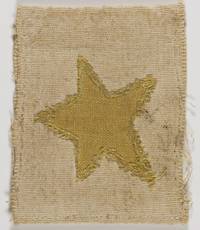
1943Best.-Nr. 53630Tunisia 1943. Nearly Fine. Five-pointed yellow cloth star sewn onto plain beige cloth 7.3 by 9 cm. Yellow dye somewhat faded else in fine state of preservation. Specimen of the yellow star imposed on the Jewish population of Tunisia in March 1943 as a mark of the slave laboror. Tunisia was the only Islamic country to come under Nazi rule at first indirectly through the Vichy regime in France between 1940 and its liberation by Allied forces on May 7 1943. In response to the Allied invasion of Algeria and Morocco German and Italian forces invaded Tunisia on November 9 1942. By the end of November the Germans took the first anti-Jewish move by arresting four of the community leaders including Moïse Borgel the president of the Jewish congregation. "In addition to the governor-general's sympathetic attitude -- and in some degree to the pro-Jewish attitude of Bey Sidi Mohammed al-Mounsaf -- the Italians also in practice interfered with the application of the anti-Jewish laws" E.H. The dignitaries were released after a week following the intervention of the mayor of Tunis and the Italian consul. Because of objections by the Italians the edict to wear the star does not appear to have been generally enforced with rigor and was only formally imposed in two cities Sfax and Tunis. While 5000 Jews had originally been put on forced labor in thirty locations and camps along the front line "at the time of the collapse and surrenter in early May 1943 only sixteen hundred Jews were employed on forced labor" E.H. Given the relatively small labor force and the lack of zeal in imposing the anti-Jewish ordinances it is clear why so few of these yellow badges have survived. References: I. Gutman ed. Encyclopedia of the Holocaust vol. 4 pp. 1521-23. unknown
1943Best.-Nr. 53630Tunisia 1943. Nearly Fine. Five-pointed yellow cloth star sewn onto plain beige cloth 7.3 by 9 cm. Yellow dye somewhat faded else in fine state of preservation. Specimen of the yellow star imposed on the Jewish population of Tunisia in March 1943 as a mark of the slave laboror. Tunisia was the only Islamic country to come under Nazi rule at first indirectly through the Vichy regime in France between 1940 and its liberation by Allied forces on May 7 1943. In response to the Allied invasion of Algeria and Morocco German and Italian forces invaded Tunisia on November 9 1942. By the end of November the Germans took the first anti-Jewish move by arresting four of the community leaders including Moïse Borgel the president of the Jewish congregation. "In addition to the governor-general's sympathetic attitude -- and in some degree to the pro-Jewish attitude of Bey Sidi Mohammed al-Mounsaf -- the Italians also in practice interfered with the application of the anti-Jewish laws" E.H. The dignitaries were released after a week following the intervention of the mayor of Tunis and the Italian consul. Because of objections by the Italians the edict to wear the star does not appear to have been generally enforced with rigor and was only formally imposed in two cities Sfax and Tunis. While 5000 Jews had originally been put on forced labor in thirty locations and camps along the front line "at the time of the collapse and surrenter in early May 1943 only sixteen hundred Jews were employed on forced labor" E.H. Given the relatively small labor force and the lack of zeal in imposing the anti-Jewish ordinances it is clear why so few of these yellow badges have survived. References: I. Gutman ed. Encyclopedia of the Holocaust vol. 4 pp. 1521-23. unknown books
1948Best.-Nr. 16623Paris: L'Union Populaire Juive en France 1948. First Edition. Octavo. Printed paper wrappers; 515pp; illus some folding; facs. Includes bibliography. Text entirely in Yiddish. Text slightly tanned but a tight clean copy overall VG or better in the original wrappers. First-hand account of atrocities in the Vilnius ghetto by a survivor; extensively documented including facsimiles of original documents and photographic evidence of Nazi atrocities. Uncommon especially in this state of preservation. L'Union Populaire Juive en France unknown books
19671st edition. Original illustrated wraps. Folio. 11 pages. 35 cm. In Yiddish and English, captions in English, Hebrew, Yiddish, and Russian. We present six pages from various chapters of the Album Jerusalem of Lithuania in pictures. " With 27 illustrations, of various facets of Jewish Vilna (the Gaon, courtyard scenes, war refugees, partisans in the ghetto) . With a brief introductory piece (Yiddish, and English) requesting for contributions to the upcoming Album to be submitted, in the form of photographs of Vilna or subscriptions. The complete work appeared in 1974 with the title Jerusalem of Lithuania, edited by Leizer Ran. Subjects: Jews - Lithuania - Vilnius - Pictorial works. One copy on OCLC (Natl Libr Israel) . Scarce. Wraps lightly soiled, otherwise fresh and clean. Very good condition. (YIZ-15-21)
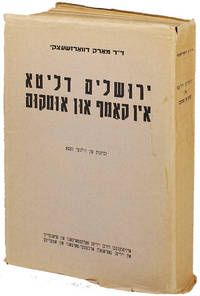
19744to; 1st edition. 4to, Volume 1 and 2 cloth, Volume 3 softcover, all as issued. An outstanidng photgraphic memorial to the Jewish Vilna, "The Jerusalem of Lithuania. " with well over 2000 photos and facsimiles. Folding map of Vilna, often missing, is present in the pocket of volume I, as issued. Title and all text and captions in Russian, English, Hebrew, and Yiddish. Includes indexes. SUBJECT(S): Jews -- Lithuania -- Vilnius -- Pictorial works. Juifs -- Lituanie -- Vilnious -- Ouvrages illustre´s. Juden. OCLC: 970933020. Very Good Condition. (YIZ-12-15)
19488vo; 515 pages; Paris, Published By the Author?, 1948. 1st Edition. Paper-wrappers, 8vo, 515 pages. 25 cm. "Aroysgegebn durkn Yidishn natsyonaln arbeter-farband in Amerike un Yidishn folks-farband in Frankraykh. Now a classic and oft-cited work on resistance in the Vilna Ghetto. Includes large (18" x 30") fold out map montage at rear, as well as many photos, charts (1 folds out) & illustrations. Also includes an added title page in French: "Lutte et chute de la Jerusalem de Lithuanie; histoire du ghetto de Vilna. " Page 482 is missing a piece, edgewear to cloth, spine repaired. Otherwise very good copy. (Holo2-83-48) Wear to paper wrappers, paper browning by not fragile, Good Solid Condition.
200221.5X27 cm. 247 pages. Softcover. Cover and spine bottom cover and spine bottom edge slightly rubbed. Else in good condition.
1977IN HEBREW. THIS VOLUME ONLY. 270X215 mm. 343 pages. Softcover. Cover slightly yellowing. Cover corners slightly wrinkled. Spine yellowing. Spine edges slightly torn. Pages slightly yellowing. Else in good condition.
1946(FT) Softcover, 8vo. , 55 pages. In Yiddish. Jewish Children: Back to Life. A publication by the Jewish Labor Committee describing the activities of the organization to help Jewish children after the war, with programs, Summer camps, schools, and childrens houses. Includes portraits of children and statistics about Jewish children in Europe before and after the war. Illustrated with many black and white photographs throughout. SUBJECT(S) r: Jewish children. World War, 1939-1945 -- Civilian relief. World War, 1939-1945 -- Children. Child welfare -- Europe. International relief. Jews -- Charities. OCLC lists 20 copies worldwide. Very good condition. (YID-15-1xx)
1948Original paper wrappers, 4to, 180 pages; 29 cm. With errata slip present. In Yiddish. All three authors were survivors; published amid the rubble of post-war Poland as Jewish life was being rebuilt there. Not the more common 1946 work of the same title with far fewer pages and different editorship. SUBJECT (S) : Yiddish literature -- Poland. OCLC-Worldcat lists 11 copies worldwide. Light wear, Very Good Condition (Holo2-125-42)
19351st edition. Original cloth. 4to, 284+ [1] pages. Illustrations throughout. Yiddish. Title translates as, "Jews in the USSR. A Symposium." Nazi-era Soviet description the Soviet Jewish experience in the lead-up to the Holocaust and the great purges. Loaded with photos. Beautiful sepia photographic endpapers. SUBJECT (S) : Jews -- Soviet Union -- Political and social conditions. OCLC: 7431478. Ex-library with usual markings, usual cover stains and wear, Good Condition (YIZ-16-12B)
19351st edition. Original cloth. 4to, 284+ [1] pages. Illustrations throughout. Yiddish. Title translates as, "Jews in the USSR. A Symposium." Nazi-era Soviet description the Soviet Jewish experience in the lead-up to the Holocaust and the great purges. SUBJECT (S) : Jews -- Soviet Union -- Political and social conditions. OCLC: 7431478. Ex- library with usual marks, heavy wear on spine, some wear on cover, Good Condition Overall. (YIZ-16-12)
19351st edition. Original cloth. 4to, 284+ [1] pages. Illustrations throughout. Yiddish. Title translates as, "Jews in the USSR. A Symposium." Nazi-era Soviet description the Soviet Jewish experience in the lead-up to the Holocaust and the great purges. Loaded with photos. Beautiful sepia photographic endpapers. SUBJECT (S) : Jews -- Soviet Union -- Political and social conditions. OCLC: 7431478. Bit of staining to covers, but attractive, excellent condition inside, far better than usually found, really an excellent Copy, Very Good Condition (YIZ-16-12A)
19671st edition. Original publisher's cloth, 4to; 342 + 145 pages; In Yiddish. Title translates as, "Jews in the Ukraine." With lots of illustrations and detailed index. OCLC: 18462513. Ex-library with usual marks, Light wear, about Very Good Condition. (YIZ-5-8A)xx
19671st edition. Original publisher's cloth, 4to; 342 pages; In Yiddish. With lots of illustrations and detailed index. Light wear, Overall Very Good Condition. (YIZ-5-8)xx
19561st edition. original cloth, 8vo. 303 pages. Inscribed by author in year of publication on front end paper. Illustrated. In Yiddish. Unusual design where illustrated "cover" is instead mounted as front pastedown, as issued. SUBJECT (S) : Jews South Africa Johannesburg history; Johannesburg (South Africa) ethnic relations. lightly bumped corners, Very Good condition. (YIZ-8-4)
19568vo. 303 pages, illustrated. First edition. In Yiddish. Includes English translation of title on copyright page: "The Jews of Johannesburg. " Dustjacket worn but present, otherwise very good condition. (ComHist-15-9A)
19568vo. 303 pages, illustrated. First edition. In Yiddish. Includes English translation of title on copyright page: "The Jews of Johannesburg. " Inscribed by the author. Very good condition. (ComHist-15-9)
19421st edition. Original boards. 8vo. 80 pages, includes maps, 22 cm. In Yiddish. Title translates to Jews after the War: Report from the First Conference of the Jewish Labor Committee. The Jewish Labor Committee was founded in 1934 in response to the rise of Nazism in Europe. Today, it works to maintain and strengthen the historically strong relationship between the American Jewish community and the trade union movement, and to promote what they see as the shared social justice agenda of both communities (Wikipedia, 2018). OCLC 937355974.SUBJECTS: Holocaust Reconstruction (1939-1951) -- Jews. Very Good Condition. (YID-40-84)
1983st edition. Original boards with gilt lettering. 8vo. 304 pages. 24cm. Decorative inscription from Sutskever, the subject of the book. It is written in Yiddish and spirals off into a drawing self portrait. In Hebrew and Yiddish. Title translates to The Lineage of a Song: In Honor of Avraham Sutskever. A commemorative book for Abraham Sutzkever on his seventieth birthday. Sutzkever was an acclaimed Yiddish poet who the NY Times referred to as the greatest poet of the Holocaust. (Wikipedia, 2018) . Edited by Dov Sadan (1902-1989) who was an Israeli literary critic and politician who served as a member of the Knesset. He was awarded the Israel Prize for Jewish Studies and the Bialik Prize for Literature. (Wikipedia, 2018) . SUBJECTS: Sutzkever, Abraham, 1913-2010 -- Criticism and interpretation. OCLC lists 4 copies worldwide (Royal Danish Lib. , NYBC, Haifa, Hebrew U. ) . A beautiful copy. Very Good Condition. (YID-30-24)
19541st edition, original cloth, 8vo. 806 pages, illustrations throughout. In Yiddish with a Spanish title page. German soldiers first passed through Ratne at the end of June 1941, but Nazi rule was established in the town only in July. Between the retreat of the Soviets and the arrival of German security forces and administrators, locals plundered Jewish homes and businesses. Shortly after the Germans arrived, they shot 27 Jews and 30 Soviet prisoners of war. Acting through the Ukrainian police, they also introduced an array of anti-Jewish measures: Jews had to wear identifying armbands (later yellow patches) , comply with a curfew, hand in valuables, including ritual objects, and provide forced labor. It was forbidden for Jews to speak to Ukrainians. As early as July 1941, Jews from the countryside were already being relocated to Ratne. In the spring of 1942, a ghetto was set up there. After a partisan raid on Ratne in June 1942, the Germans shot more than 110 Jews, along with a few Ukrainians. The Destruction of the Jewish Community. In August, the Germans recruited Ukrainian peasants from Prokhid to dig pits at a nearby sand lot. On August 26, the ghetto was liquidated by a unit from the Gestapo outpost in Brest supported by the local German Gendarmerie post and Ukrainian auxiliary police force. Although several hundred Jews fled before they could be taken to Prokhid. Many others hid in the ghetto. Most were eventually caught and murdered as well. Between 1, 300 and 1, 500 Jewish men, women, and children were killed during this operation. A few dozen skilled laborers were left alive and employed in a workshop. They were shot in February 1943. (protecting-memory.org 2018) SUBJECT(S) : Jews -- Ukraine -- Ratne. Holocaust, Jewish (1939-1945) Ratno (Ukraine) -- Ethnic relations. OCLC: 38702086. Light wear on cover and spine, page edges yellowed, previous owners name and imprint on front end page. Good Condition Overall. Inscription on Spanish title page. (YIZ-19-16A)
1990IN HEBREW. 230x160 mm. 394 pages. Hardcover. Cover yellowing and slightly rubbed. Spine yellowing. Spine edges bumped. Pages yellowing. Else in good condition.
1945Original Paper Wrappers. 8vo. 160 pages. 25 cm. In Yiddish with added Table of Contents and abstracts in English. CONTENTS: The Yivo Faces the Post-War World, by Max Weinreich Ignacy Schipper (1884-1943) , by Raphael Mahler Franz Rosenzweig, by Nahum Glatzer The Jews in Relation to the German Cultural Milieu in America up to the Eighties, by Rudolf Glanz Karaite Exegesis of the Ninth Century, by Judah Rosenthal reviews and miscellanea. SUBJECT(S) : Yiddish literature -- History and criticism -- Periodicals. Jews -- Periodicals. Jiddisch. Some wear to covers, especially along spine with some tears; top and bottom portions of backstrip are absent. Internal pages are nice and clean and binding is tight. Overall in very good condition. (HOLO2-61-16)