Fuks, MarianMareMagnum

5 266 résultats
1999Hardbound. 8vo. 341, [68] pages. 25 cm. First edition. In Polish. Title roughly translates as: The History of the Great Catastrophe of the Jewish Nation. Written by Marian Fuks, Jewish-Polish historian, researcher at the Jewish Historical Institute; this detailed volume analyzes the origins of Nazism and its genocidal ideology and describes the outbreak and course of World War II. It discusses the beginning of the persecution of the Jews (the development of anti-Semitic agitation in the press since 1935, proclaimed toleration of racist ideas) and their apogee in the ghettos and extermination in death camps, as well as the situation and fight of the Jews in the ghettos, the Warsaw Ghetto Uprising in 1944 and partisans in the allied armies in the Polish Army. With appendices on the Jewish underground press 1940-1943; Jews in the Allied armies fighting on the fronts of World War II; Estimated losses of the Jews in the Holocaust, and abundant (approximately 150 illustrations) , often shocking documentary material: photographs of people, examples of newspaper articles, a list of politicians and celebrities, announcements, images from the ghettos and death camps. Subjects: Holocaust, Jewish (1939-1945) - Poland. Jews - Poland - History - 20th century. Poland - Ethnic relations. Backstrip previously torn, repaired with tape. Otherwise fine. Very good + condition. (HOLO2-99-20)
1979Paper wrappers, 10 pages. In Spanish. Title in English: " Z. Z. W. (Zydowsky Zwiazek Wojksowy) In the Warsaw Ghetto Uprising" Z. Z. W. Was a Jewish Military Union, founded by David Wdowinski (1895-1970) . "The ZZW never integrated into the main underground fighting organization in Warsaw, the Zydowska Organizacja Bojowa (The Jewish Fighting Organization) , but the two groups did coordinate their activities to a certain extent during the spring of 1943. The ZZW did not participate in the first armed clash in the ghetto, in January 1943. During the April uprising its fighters fought fiercely near Muranowska Square, in one of the major battles of the rebellion. Other ZZW men fought in the Brushmakers' area of the ghetto, and still others in the area where supplies were kept. Wdowinski was captured by the Germans during the uprising and was sent to various concentration camps but survived. He settled in the United States after the war and in 1961 was a witness at the Eichmann Trial. He published his memoirs, And We Are Not Saved (1963) . " (Rozette, EJ, 2007) Very good condition. (HOLO2-25-4)
1945First edition. Original tan boards with red spine. 8vo. 157 pages; 23 cm. In Czech. Title translates roughly to Toward the Wire Fenced Concentration Camp. Divided into 45 chapters. A personal narrative. SUBJECT (S) : WWII, Prisoners and prisons, Concentration camps. OCLC lists 7 holdings worldwide. Minimal pencil markings that do not affect text. Toning to pages. Minimal staining. Very good condition. (HOLO2-134-41)
1994réf. 009368Berlin, Edition Hentrich, 1994. 204 S., 2 Blatt. Orig.-Broschur. Der Vortitel mit Preisnotizen in Kugelschreiber, sonst schönes, gut erhaltenes Exemplar mit nur leichten Gebrauchsspuren.
198418.5x12 cm. 165 pages. Softcover. Cover slightly wrinkled. Text block edges slightly stained. Else in good condition. PLEASE NOTE: This item is overweight. We may ask for extra shipping costs.
1973Advanced Uncorrected Proof. 8vo. 173 pages ; 22 cm. A rare advanced proof of Wiesels 1974 Play, which was performed on Broadway in 1976 and later made into a full-length movie. As a marketing tool, publishers provide free copies of new book titles to booksellers, stores, PR people, journalists and even celebrities.
2009BILINGUAL POLISH-ENGLISH EDITION. 29x21.5cm. 151 pages. Hardcover. Cover slightly rubbed. Ex-library copy with usual marks. Else in good condition. PLEASE NOTE: This item is overweight. We may ask for extra shipping costs.
1914réf. EXzz0908jWien, Der "Alldeutsche Verein für die Ostmark" 1914. gr.-8°, 203 S., OBrosch., ausgebleicht, Rücken gebräunt. Georg Heinrich Ritter von Schönerer (1842-1921) österreichischer Gutsherr und Politiker. Schönerer hatte von 1879 bis zur Jahrhundertwende Bedeutung als Führer zunächst der Deutschnationalen und später der Alldeutschen Vereinigung. Er war ein heftiger Gegner des politischen Katholizismus, ein radikaler Antisemit und übte starken Einfluss auf den jungen Adolf Hitler aus, der ihn als eines seiner Vorbilder ansah.
1914réf. JUDA0759cWien, Der "Alldeutsche Verein für die Ostmark" 1914. gr.-8°, 203 S., neuerer HLnBd. mit goldgepr. Deckeltitel, sehr gut erhalten. Georg Heinrich Ritter von Schönerer (1842-1921) österreichischer Gutsherr und Politiker. Schönerer hatte von 1879 bis zur Jahrhundertwende Bedeutung als Führer zunächst der Deutschnationalen und später der Alldeutschen Vereinigung. Er war ein heftiger Gegner des politischen Katholizismus, ein radikaler Antisemit und übte starken Einfluss auf den jungen Adolf Hitler aus, der ihn als eines seiner Vorbilder ansah.
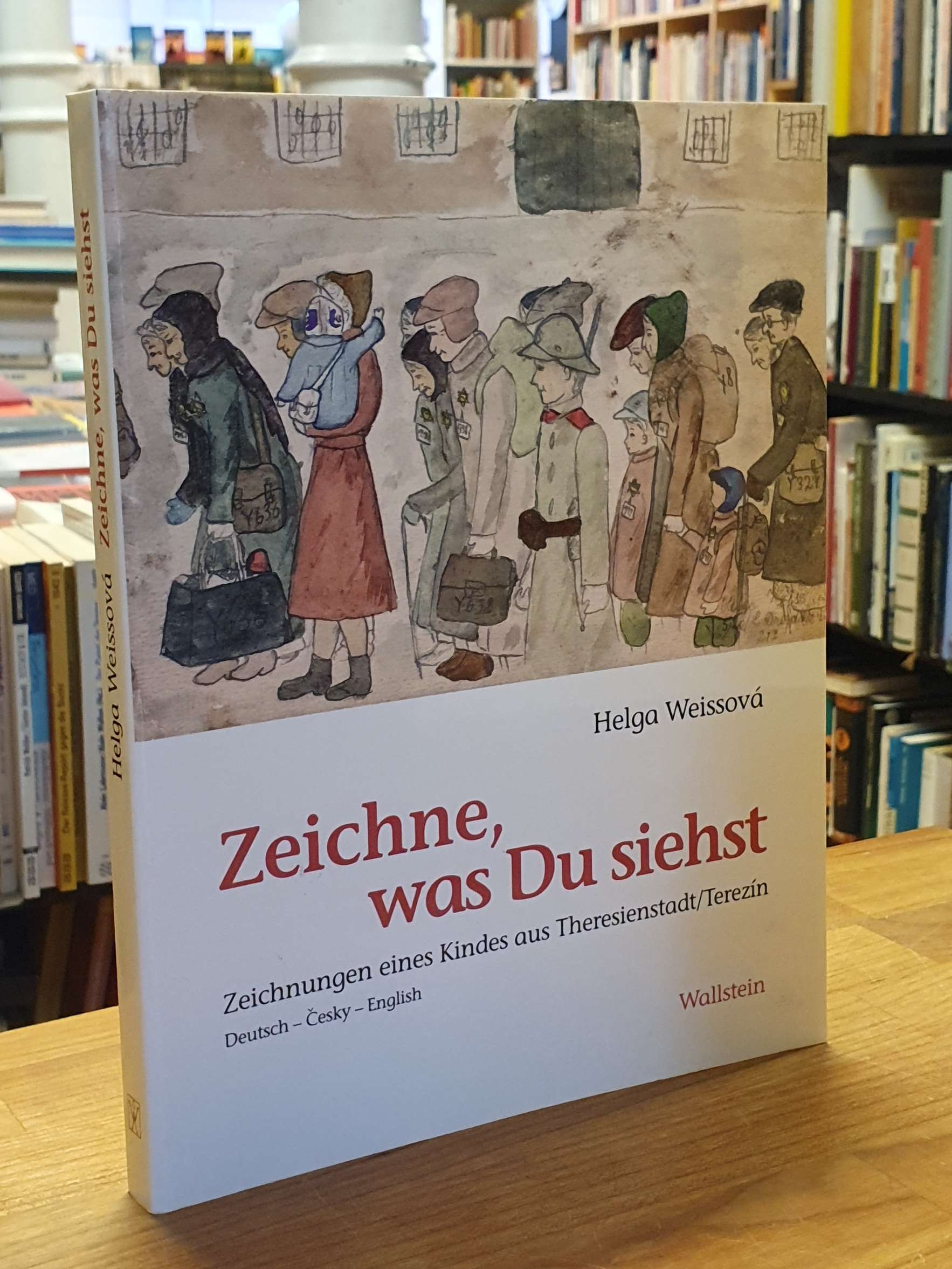
1998réf. 18605CBGöttingen, Wallstein-Verlag, 1998. 4°, 167 S. mit zahlreichen Farbabbildungen, dreisprachige Ausgabe: tschechisch, englisch und deutsch, farbig illustr. original Kartonage (Paperback), Erstausgabe sehr schönes, sauberes Exemplar
1998réf. 9737AGöttingen: Wallstein, 1998. 4°. 167 (1) Seiten. Mit 62 farbigen Abbildungen. Original-Broschur. (Gutes Exemplar).
2009réf. 22223ABSankt Augustin/Berlin, Konrad Adenauer Stiftung, 2009. 8°. 96 Seiten deutsch, 84 Seiten englisch. Broschiert. Die Versandkosten für Kunstwerke und mehrbändige Werke können von den Standard-Versandkosten abweichen. Guter Zustand.
2005réf. 38643(Hamburg, Forschungsstelle für Zeitgeschichte in Hamburg (FZH), 2005). 117 S. Mit 1 Abb. OBrosch.
2013réf. 33971Kassel, Selbstverlag des Vereins für hess. Geschichte und Landeskunde, 2013. gr. 8°, 338 S., mit zahlreichen s/w Abb., Karten, Bezahlung per PayPal möglich, we accept PayPal, min. Gebr.sp., Pappband, gebunden
1930Paper Wraps. 8vo. 16 pages. In German. Second Sequence (1924-1931) . . "Magazine for Demography and Statistics of the Jews. " Population statistics played and continue to play a special role in Jewish Studies because of the continuing movement of Jewish popluations around the world. Within the pages of the Zeitschrift can be found the first historical-sociological studies looking at the massive Jewish migrations at the close of the 19th Century. With the establishment in Berlin of the Bureau für Statistik der Juden (office for statistics of the Jews) in 1904, sociologists like Arthur Ruppin and the statisticians like the physician Jacob Segall had at their fingertips massive amounts of data for this purpose. Monthly, began in 1905, ceased in December 1931, 26 volumes published in all. SUBJECT(S) : Jews -- Population -- Periodicals. Jews -- Statistics -- Periodicals. Issued by the Bureau für Statistik der Juden. Cover is stained and worn, but in good condition. Pages only lightly worn and binding is in very good condition. Also contains publicity insert from publisher laid in. Excellent source for information on Jews just before the Holocaust (HOLO 2-31-1)
1930Paper Wraps. 8vo. 16 pages. In German. Second Sequence (1924-1931) . . "Magazine for Demography and Statistics of the Jews. " Population statistics played and continue to play a special role in Jewish Studies because of the continuing movement of Jewish popluations around the world. Within the pages of the Zeitschrift can be found the first historical-sociological studies looking at the massive Jewish migrations at the close of the 19th Century. With the establishment in Berlin of the Bureau für Statistik der Juden (office for statistics of the Jews) in 1904, sociologists like Arthur Ruppin and the statisticians like the physician Jacob Segall had at their fingertips massive amounts of data for this purpose. Monthly, began in 1905, ceased in December 1931, 26 volumes published in all. SUBJECT(S) : Jews -- Population -- Periodicals. Jews -- Statistics -- Periodicals. Issued by the Bureau für Statistik der Juden. Cover is stained and worn, with stamp from University of Geneva, but in good condition. Pages only lightly worn and binding is in very good condition. (HOLO 2-31-2)
1931Paper Wraps. 8vo. 16 pages. In German. Second Sequence (1924-1931) . . "Magazine for Demography and Statistics of the Jews. " Population statistics played and continue to play a special role in Jewish Studies because of the continuing movement of Jewish popluations around the world. Within the pages of the Zeitschrift can be found the first historical-sociological studies looking at the massive Jewish migrations at the close of the 19th Century. With the establishment in Berlin of the Bureau für Statistik der Juden (office for statistics of the Jews) in 1904, sociologists like Arthur Ruppin and the statisticians like the physician Jacob Segall had at their fingertips massive amounts of data for this purpose. Monthly, began in 1905, ceased in December 1931, 26 volumes published in all. SUBJECT(S) : Jews -- Population -- Periodicals. Jews -- Statistics -- Periodicals. Issued by the Bureau für Statistik der Juden. Cover is stained and worn with small tear in middle and bending at corners. Internal pages bent at corner with slight crease down the middle but text is very clear. Binding is in very good condition. (HOLO 2-31-3)
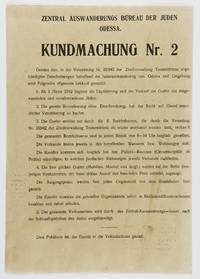
1942réf. 51752Odessa: Zentral Auswanderungs Büreau 1942. Original document. Loose leaf. Very good condition. Quarto. Original loose leaf with black lettering. Announcement based on ordinance no. 35/942 of the civil government of Transnistria relating to the emigration of Jews in Odessa and surrounding areas. The text printed biligually in German and Ukrainian is organized into five statements. The annoucement concerns the liquidation and sale of goods of emigrated or vanished Jews beginning on March 1 1942 with the whole population without limitations given the right to buy these items based on oral agreements. Furthermore the announcement regulates details and procedures of the sale and at the end announces that after the sale proceeds will by handed to the Jews by the Central Emigration Office. "The rapid development of Odessa began after the Russian conquest 1789. Its Jewish population also grew quickly and in the late nineteenth and early twentieth centuries it was the most important Jewish literary community after Warsaw. In 1926 there were 153194 Jews in Odessa 36.4 percent of the total population and by 1939 their numbers reached 180000." Encyclopedia of the Holocaust Vol. 3 page 1080. When Romanians and Germans laid siege to the city on August 5 1941 many Jews in Odessa managed to leave and eighty to ninety thousand Jews remained in the city. Odessa fell on October 16 and the German Einsatzkommando 11b and the Romanian intelligence service immediately slaughtered over eight thousand residents mainly Jews and Odessa was established as the capital of the Transnistria region. On October 22 the Romanian military headquarters were blown up killing sixty-six officers and the military governor. In reprisal the Romanian ruler Ion Antonescu ordered devastating retaliation including the arrest of one member of each Jewish family. By October 1941 some 40000 Jews were assembled in the ghetto of the nearby city of Slobodka and their valuables confiscated. Deportations of some 20000 Jews began in January of 1942. When Odessa was liberated on April 10 1944 authorities reported that about 99000 Jews had been killed. Odessa again became an important Jewish center with 102000 Jews living there according to a 1959 census. Considering the context of "Kundmachung Nr. 2 the Odessa massacre of October 22-24 1941 and the murder of Jews living between the rivers Dniester and Bug during the Romanian and German occupation this succinct notice including its misspellings and mistakes in the German language is a chilling mirror image of the attitude shown by the occupying powers towards the Jews. Approximately 30000 Jews were killed in Odessa and more than 100000 in Transnistria. The text is printed in German on one side and Ukrainian on the verso. Minor wear and smudging. Protected in modern mylar. Zentral Auswanderungs Büreau unknown
1987Mit zahlreichen Abbildungen.
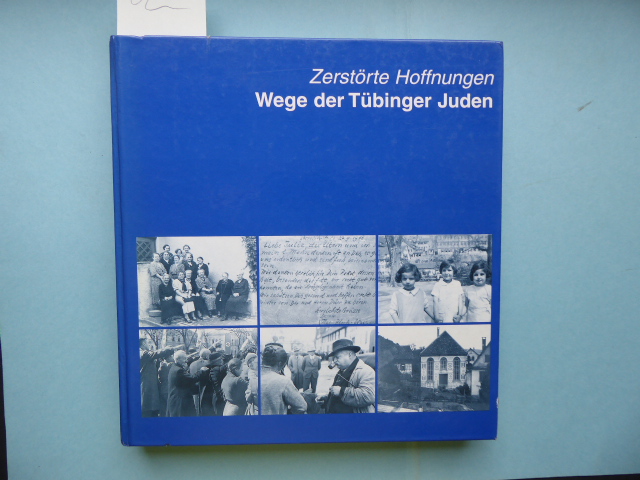
1995réf. 143058Kommmissionsverlag Konrad Theiss 1995. 436 Seiten. Mit zahlreichen faks. Abbildungen u. faks. Dokumenten. Illustrierter, blauer OKart.-Einband. (Titelblatt gestemplet. Zahlreiche Textmarkierungen in Gelb). 23x22 cm
1970W O´swiecimiu, Wydawn. Pa´nstwowego Muzeum. Paper Wrappers, 8vo; 211 pages. In Polish. Robinson & Friedman # 1713. "Auschwitz Leaves. " The organ of the Museum at Auschwitz. An important journal. This issue includes 2 fold out maps as well as many photos and facsimilies. Small tear in cover, Very Good Condition. (h2-3-15)
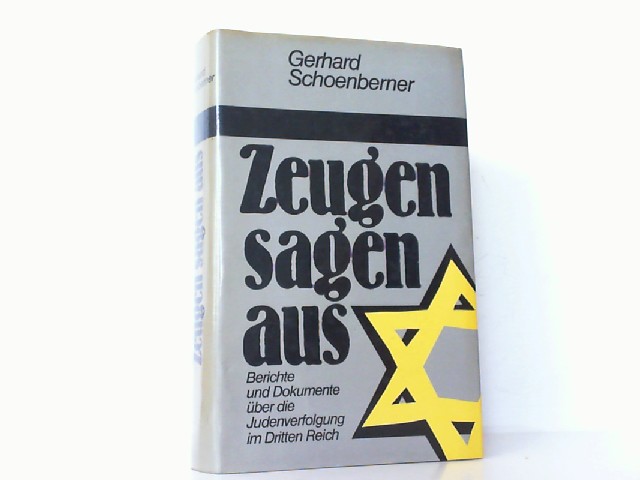
1980réf. 42109Lizenzausgabe des Bertelsmann ca., 1980. gebundene Ausgabe
1983réf. 009195Gütersloh, Bertelsmann ohne Jahr [ca. 1983], 1983. 430 S. Orig.-Pappband mit Schutzumschlag. Der Kopfschnitt gering stockfleckig, sonst schönes, gut erhaltenes Exemplar mit nur leichten Gebrauchsspuren.
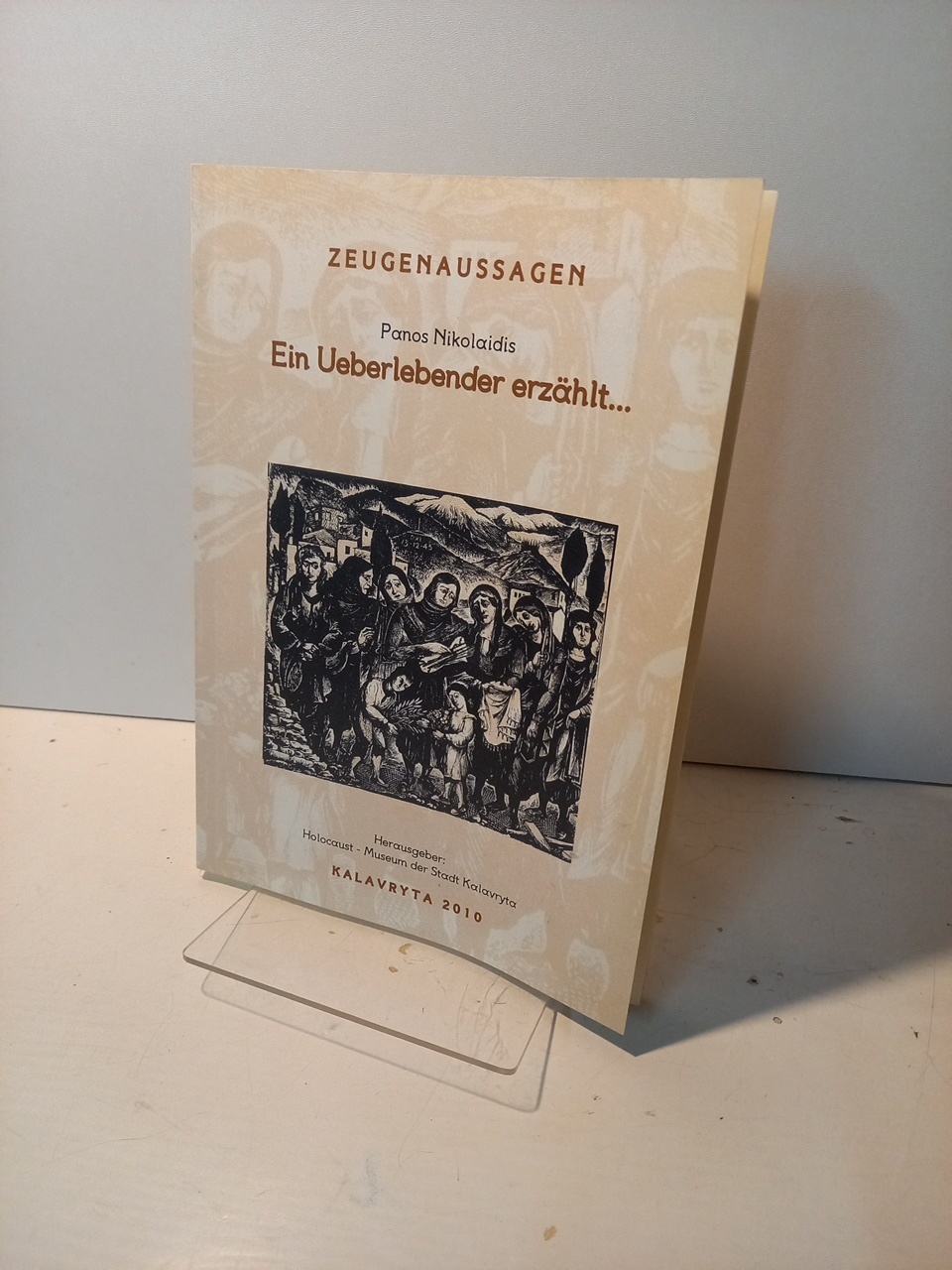
2010réf. 33667Kalavryta, 2010. 96 S., mit Abbildungen. 8°. Orig.-Karton.