Bensew, Abraham.MareMagnum

5.257 Ergebnisse
19361st Edition. Original Paper Wrappers. 8vo. 16 pages ; 24 cm. In German. Title translates into English roughly as, Flight From Europe. The author discusses and argues in support of the Palestine Tax. SUBJECT (S) : Zionism. OCLC lists 11 copies worldwide. Very good condition. (HOLO2-130-46)
19571st Edition. Original Paper Wrappers 4to. 92 pages ; 28 cm. In German. Title translates into English as, Biographies and Bibliographies. Published by the PEN Center for German-speaking Authors Abroad, this work gives a list of the biographies and bibliographies of exiled German authors living in the UK during and after World War II. The first author on the list (in alphabetical order) is Walter Benjamin. SUBJECT(S) : Authors, German -- Biography. German literature -- Exiled authors. OCLC lists 16 copies worldwide. Ex-library with Jewish Institutional Stamp. Original hole-punched binding. Some toning/discoloration on wrappers. Otherwise very good condition. (GER-58-77)
1999240x160mm. XIV+212 pages. Hardcover. In good condition.
1999275x220 mm. 51+220 pages. Hardcover. Cover slightly rubbed. Cover corners bumped. Spine edges bumped. Pages yellowing. Else in good condition.
1943Original Cloth. 8vo. 64 pages. 24 cm. First edition. In Yiddish. 'Merciful Father'. With illustrations throughout by Ezekiel Schloss. Holocaust poems by David Einhorn (18861973) , Yiddish poet and publicist. Av Ha-Rahamim is a memorial prayer for Jewish martyrs and martyred communities. This prayer, by an unknown author, was composed in memory of the martyrs massacred in Germany during the First Crusade. It is first known from a prayer book dated 1290. The prayer emphasizes the merit of the martyrs who died for kiddush ha-Shem. - EJ 2008. Subjects: World War, 1939-1945 - Poetry. World War (1939-1945) . Yiddish poetry. Top of backstrip torn, otherwise very fresh and clean. Very good condition. (HOLO2-117-48)
2002210x145 mm. 242 pages. Softcover. Cover slightly rubbed. Cover corners and spine slightly wrinkled. In good condition.
1994IN HEBREW. Signed By Author. 23X16 cm. 221 pages. Hardcover. In good condition.
1946Original wraps. 8vo. 52, [2] pages. 22 cm. First edition. In Spanish. At head of cover: Para que ellos puedan volver a vivir, which translates as So they may live again. Title translates as: Emergency Relief and Reconstructive Aid: annual report on the work of the Joint (for the year 1945 and early months of 1946) . The 1946 annual report of the American Jewish Joint distribution committee; detailing the activities of the Joint in assisting holocaust survivors and refugees all over Europe, as well as in south America, Palestine, and Shanghai. Includes tables of figures of the situation for refugees, and the assistance given by the Joint; includes 22 black and white facsimile contemporary photographs. Subjects: Jews in Europe. World War, 1939-1945 - Jews. Jewish refugees. Holocaust (1939-1945) . OCLC lists one copy. Pen and ink marks on front cover, light soiling and wear to wraps, otherwise fresh and clean. Good + condition. (HOLO2-103-47)
1946Softcover, 52 pages, illustrated, 8vo. In Spanish. Series: Hechos y cifras; ano 3, no.12. SUBJECT (S) : American Jewish Joint Distribution Committee. Other Titles: Cover title: Para que ellos puedan volver a vivir...OCLC lists 1 copy worldwide (National Lib of Israel) . Writing and markings on front cover. Wear to edges and binding. Very good condition. (Holo2-19-78)
2006Hardback. 4to. 563 pages. 29 cm. First edition. In Hungarian. Geographical Encyclopedia of the Holocaust in Northern Transylvania. Subjects: Holocaust, Jewish (1939-1945) - Romania - Transylvania - Encyclopedias. Jews - Persecutions - Romania - Transylvania - Encyclopedias. Holocaust, Jewish (1939-1945) - Romania - Transylvania - Maps - Encyclopedias. Transylvania (Romania) - Ethnic relations Encyclopedias. OCLC lists 1 copy (Yeshiva U) . Light shelf wear. Very good condition. (BRAHAM-1-46) xxx
19461st Edition. Original Illustrated Boards depicting a devil holding the world with a Nazi-flag. 8vo. 525 pages ; 24 cm. In Yiddish. Title translates into Englihs as, Thus It Began: A Novel in Five Parts An early post-war novel about the Holocaust from Mosheh Kats (1885-1960) . OCLC lists 14 copies worldwide. Ex-library with Jewish Institutional Bookplate and usual markings. Spine is missing. Boards and paper show toning. Overall about very good condition. (holo2-135-55)
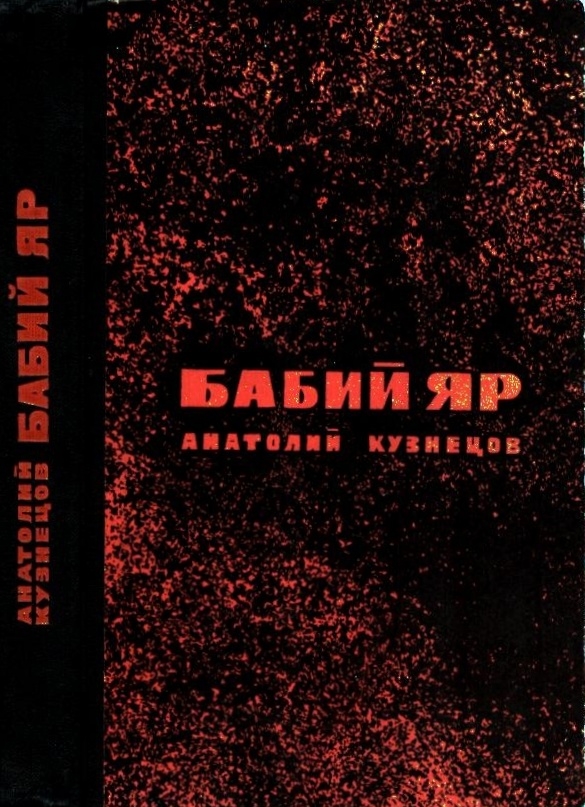
1967Best.-Nr. 029284New York: The Dial Press 1967. Appears never read. Near Fine condition in a bright and shiny Very Good dust jacket. NOT price clipped $5.95. The jacket is lightly rubbed/frayed at the edges with a small mark where a price sticker was removed. Sharp corners. Square and tight. NO owner's name or bookplate. NOT a library discard. NOT a remainder. Pages are fresh crisp clean and unmarked -- apparently unread. NO foxing. Translated by Jacob Guralsky. With black & white illustrations by S. Brodsky. First published censored in 1966 in a Soviet periodical. This is the first printing of the first edition in English. Bound in the original black cloth stamped in bright red on the spine. From the dust jacket: "In the vast literature of World War II no story is more tragic more awesome than the two-year occupation of the Russian city of Kiev by Nazi troops. Here is the first extensive account. of that terrible period of time from 1941 to 1943 in which the Germans systematically murdered some 200000 people beginning with the barbaric massacre of 50000 Russian Jews at the ravine on the outskirts of the city known as Babi Yar. Using. the reseach of many years -- interviews newspaper clippings posters diaries -- the author reveals to us the awful trauma of foreign invasion the destruction of life and property the thunderous entry of German troops. the sickening mass annihilation of Kiev's Jewish population.". First printing so stated. Hardcover. Near Fine condition/Very Good dust jacket. Illus. by NOT a library discard. 8vo. xvi 399pp. Great Packaging Fast Shipping. The Dial Press Hardcover
1967Best.-Nr. 82645(Moskva), Molodaja gvardija, 1967. 288 S. Mit Illustr. von S. Brodskij. 20,5 cm. OHLn.
1998Softbound. 8vo. 181 pages. 25 cm. First edition. In Polish. Arnold Mostowicz was born in 1914, the only son of a middle-class Jewish family. He grew up in Lodz which, before the German invasion, had a population of at least a quarter of a million Jews and was a prominent and prosperous centre. At the age of 19, and because as a Jew I did not have a chance of studying medicine at a Polish university, he travelled to France and enrolled as a medical student. Upon completing his studies he returned to Poland in July 1939, and when, in September, all young men were called to defend Poland against the Nazi invasion, he packed up two shirts, a jar of home-made jam and a volume of poems and walked to Warsaw to join the war. During the siege of Warsaw, Mostowicz worked as a physician in the Child Jesu Hospital where he treated victims of the German air raids. When Warsaw capitulated, Mostowicz returned to Lodz and the ghetto. There he worked in the isolation department of the hospital, and took part in the resistance movement. By the end of the war almost all of the ghetto's inhabitants were gone - either dead from starvation and exhaustion or sent to death camps. Mostowicz himself was deported, in 1944, to Auschwitz, before being moved to the Gross Rosen concentration camp from which he was liberated in May 1945. Most of his family, including his parents, perished at Treblinka and at other camps. For a time after the war Mostowicz ran a hospital but he soon turned his back on medicine and devoted himself to writing. He was editor of the satirical Polish magazine Szpilki, before being ousted in an anti-Semitic Communist purge in 1968. Mostowicz wrote science fiction and books about Lodz, as well as an autobiographical memoir, The Yellow Star (1989) . In 1994, he founded the Monumentum Judaicum Lodzense Association, to maintain the cultural heritage of Lodz's Jews. (The Telegraph, 2/8/2002) Subjects: Jews -- Poland -- Lodz -- Biography. Borensztain, Max. Lodz (Poland) -- Biography.. OCLC lists 4 copies worldwide. (CT State University, Florida Atlantic Univ, HUC, Natl. Libr of Israel. ) Occasional pencil marking in text, inscription on title page. Very good + condition. Difficult to find. (HOLO2-107-12)
1947Cloth. 8vo. 138 pages. 21 cm. First edition. In Dutch. Beige cloth over boards, with ten black and white illustrations by Henk Hulshof. Title translates as: Exile, six months hostage in Haaren. Hans Leenderts was the alias of the hostage J. Th. B. Hoff, a teacher from Ruurlo. The municipality of Haaren was used from 1941 through 1941 as a prison camp for eliminating political prisoners and members of the resistance, as well as a camp for hostages of the general Dutch population being held by the SS to supposedly curb resistance and opposition. Among the hostages were 150 leaders from business, 133 people from the professions, 60 professors and teachers, 103 officers, 60 chaplains, three trade union leaders and five students. Twice, on 15 August 1942 and October 16, 1942, (a total of 85) Haaren hostages were shot. In 1944, 3, 500 of those held in the camps were deported to Saxenhausen or Ravensbruck. Subjects: World War, 1939-1945 - Prisoners and prisons, German. World War, 1939-1945 - Personal narratives, Dutch. OCLC lists 6 copies worldwide. Cover and backstrip soiled, with heavy soiling near edges. Pages browned at edges, with fresh text. Very good condition. (HOLO2-80-10)
Best.-Nr. 33849o.J. [3 Warenabbildungen]
1997Original Wrappers. 8vo. 99 pages. 21 cm. First edition. In Russian. A history of the Baranovichi Ghetto and the Koldychevo Camp. On the eve of the Holocaust, 12, 000 Jews lived in Baranovichi. Under Soviet rule (193941) , Jewish community organizations were disbanded and any kind of political or youth activity was forbidden. Some youth groups organized flight to Vilna, which was then part of Lithuania, and from there reached Palestine. The Hebrew Tarbut school became a Russian institution. A Jewish high school did continue to function, however. In the summer of 1940 Jewish refugees from western Poland who had found refuge in Baranovichi after September 1939 were deported to the Soviet interior. When Germans captured the city on June 27, 1941, 400 Jews were kidnapped, leaving no trace. A Judenrat was set up, headed by Joshua Izikzon. The community was forced to pay a fine of five kg. Of gold, ten kg. Of silver, and 1, 000, 000 rubles. The ghetto was fenced off from the outside on Dec. 12, 1941. The ghetto inhabitants suffered great hardship that winter, although efforts were made to alleviate the hunger. The Jewish doctors and their assistants fought to contain the epidemics. On March 4, 1942, the ghetto was surrounded. In a Selektion carried out by the Nazis to separate the "productive" from the "nonproductive", over 3, 000 elderly persons, widows, orphans, etc. , were taken to trenches prepared in advance and murdered. Resistance groups, organized in the ghetto as early as the spring of 1942, collected arms and sabotaged their places of work. Plans for rebellion were laid, but the uprising never came to pass, partly due to German subterfuge. In the second German Aktion on Sept. 22, 1942, about 3, 000 persons were murdered. On Dec. 17, 1942, another Aktion was carried out, in which more than 3, 000 persons were killed near Grabowce. Baranovichi was now declared judenrein . At the end of 1942 Jews were already fighting in groups among the partisans. A few survivors from the ghetto were still in some of the forced labor camps in the district, but most of them were liquidated in 1943. On July 8, 1944, when the city was taken by the Soviet forces, about 150 Jews reappeared from hiding in the forests. Later a few score more returned from the U. S. S. R. (EJ 2007) Koldychevo Camp (Koldyczewo) , forced labor camp in Belorussia, located 11 miles from Baranovichi, established by the Germans in late 1941. In November 1942 a crematorium was constructed in which some 600 people were incinerated. It later became an extermination camp in which Russians and Polish underground members were interned along with the Jews transferred from the surrounding ghettos of Baranovichi, Nowogrodek, Slonim , and others. Jews were separated from the other prisoners and the camp in the stables of what had once been a farm. Prior to the camp's liquidation on June 29, 1944, more than 22, 000 inmates were murdered and buried in 38 mass graves in and around the camp. A prisoner, Dr. Zelik Levinbrook, supplied medicine to the partisans with the help of a former patient. An active Jewish resistance, headed by Shlomo Kushnir, a former shoemaker, existed in Koldychevo. Its arms supply was meager: two guns, four grenades, and some acid. On the night of March 17, 1944, it succeeded in leading almost all the Jewish inmates out of the camp after killing ten Nazi guards and poisoning the guard dogs. Kushnir committed suicide when he was caught with 25 others. Seventy five prisoners survived. The rest joined the partisans in the forest. (EJ 2007) . Subjects: Holocaust, Jewish (1939-1945) -- Belarus -- Baranavichy. Jewish ghettos -- Belarus -- Baranavichy. Concentration camps -- Belarus -- Koldychevo. World War, 1939-1945 -- Atrocities. Condition. (HOLO2-107-39)
19401st Edition? Original Paper Wrappers. 8vo. 15 pages ; 18 cm. In English. Report based on information received by the International Brigade Association about Spanish refugees and battalion fighters in concentration camps in France and a statement of the position of the Association. SUBJECT (S) : Concentration camps -- France. Fascism -- Prisoners and prisons. OCLC lists 13 worldwide. None in New York or France. Browning. Overall about very good condition. (holo2-130-66)
19401st Edition? Original Paper Wrappers. 8vo. 15 pages ; 18 cm. In English. Report based on information received by the International Brigade Association about Spanish refugees and battalion fighters in concentration camps in France and a statement of the position of the Association. SUBJECT (S) : Concentration camps -- France. Fascism -- Prisoners and prisons. OCLC lists 13 worldwide. None in New York or France. Some foxing. Creased. Overall good+ condition. (holo2-130-66a)
19401st Edition? Original Paper Wrappers. 8vo. 15 pages ; 18 cm. In English. Report based on information received by the International Brigade Association about Spanish refugees and battalion fighters in concentration camps in France and a statement of the position of the Association. SUBJECT (S) : Concentration camps -- France. Fascism -- Prisoners and prisons. OCLC lists 13 worldwide. None in New York or France. Creased. Some browning. About very good condition. (holo2-130-66b)
1980Cloth. 8vo. 231 pages. 22 cm. First Edition. A fictional novel based on the true events of German-born Jews who escaped from Holland to England only to be imprisoned. SUBJECT (S) : World War, 1939-1945 -- Isle of Man -- Fiction. World War, 1939-1945 -- Jews -- Fiction. Jews -- Isle of Man -- Fiction. Genre/Form: War stories. ISBN: 0151106711. Light wear to edge of dust jacket and previous owners bookplate on front end page, but otherwise very good condition. (HOLO2-49-6) .
1989Best.-Nr. 58938Berlin : Verl. d. Nation 1989. 181 S. ; 22 cm kart., Softcover/Paperback, Einband bräunlich, sonst Exemplar in gutem Erhaltungszustand
19531st Edition. Cloth. 8vo, 97 pages, 22 leaves of plates, illustrations, maps, frontis photo, 23 cm. Includes index. Subjects: World War, 1939-1945--Lesotho. Sotho (African people). Very good condition. (H-10-1)
19681st edition. Original cloth. 4to. X, 197, XXXI pages. 22 x 30 cm. In English, Hebrew, and Hungarian. Edited by Randolph L. Braham with the collaboration of Ervin Farkas. Profusely illustrated album of black and white photographs of Hungarian synagogues. "This album includes 467 photographs and drawings. The compilers succeeded in obtaining illustrations of most of the destroyed or converted synagogues. We hope this work will serve as an everlasting memorial to a significant element of Hungarian-Jewish culture and as a tribute to the thousands of martyrs who left from these very synagogues on their last fateful journey to destruction. (From the preface) . Subjects: Synagogues - Hungary. Edificios Religiosos (Arquitetura) Synagogues. Hungary. Ex-library with usual marks, binding repaired, spine rebacked, otherwise Good condition. (BRAHAM-1-43A)
19681st edition. Original calf. 4to. X, 197, XXXI pages. 22 x 30 cm. In English, Hebrew, and Hungarian. Edited by Randolph L. Braham with the collaboration of Ervin Farkas. Brahams own copy, specially bound (in black leather and gilt title) and dedicated to Randolph L. Braham from the World Federation of Hungarian Jews (with dedication plate on endpage) . Profusely illustrated album of black and white photographs of Hungarian synagogues. "This album includes 467 photographs and drawings. The compilers succeeded in obtaining illustrations of most of the destroyed or converted synagogues. We hope this work will serve as an everlasting memorial to a significant element of Hungarian-Jewish culture and as a tribute to the thousands of martyrs who left from these very synagogues on their last fateful journey to destruction. (From the preface) . Subjects: Synagogues - Hungary. Edificios Religiosos (Arquitetura) Synagogues. Hungary. Light shelf wear to leather, overall very fresh and clean. Very good + condition. (BRAHAM-1-43)