Antiquariat.de
5 511 résultats
1988réf. 14483(Hamburg, 1988). 31 S. OBrosch.
1979réf. 49138Berlin, Union, 1979. Englische Broschur, Abbildungen, 125 Seiten. Leichte Gebrauchsspuren an Einband, Schnitt etwas angegilbt, insg. in Ordnung.
réf. 45894ABAachen, Rimbaud 2019. Gr.-8°. 356 S., [2] Bll. Original-Flügelkarton. Zeitungsartikel zum Buch am hinteren Innendeckel montiert.
1998TWO VOLUME SET (with supplement/Ergänzungsband). 245x175 mm. [LIII+483]+[XIII+194] pages. [BOTH VOLUMES]: Hardcover with dust jacket. Jacket edges slightly wrinkled. Cover corners and spine edges slightly bumped. [VOL.I]: Cover upper edge slightly bumped. [SUMMARY]: Else both volumes in good condition. PLEASE NOTE: This item is overweight. We may ask for extra shipping costs.
1998245x180 mm. LIII+483 pages. Hardcover with dust jacket. DJ edges wrinkled. Cover corners bumped. Else in good condition. PLEASE NOTE: This item is overweight. We may ask for extra shipping costs.
2012réf. 009106Horn-Wien, Berger, 2012. 218 S. Großformatiger Orig.-Pappband. Ein schönes, gut erhaltenes Exemplar mit nur leichten Gebrauchsspuren (Buchhandelspreis neu Euro 29,90).
1988210x145 mm. Unpaginated. Softcover. Spine slightly rubbed. Pages slightly yellowing. Else in good condition.
1986réf. L65Koblenz: Bundesarchiv 1986. Orig.cloth. Very Good. Folio -. 2 heavy books together over 1800pp containing the register alphabetic list of Jews names and cities who lived in the area of the "German Reich" and became victims of the holocaust . Very good and clean copy. Bundesarchiv hardcover
1947Original Publishers Cloth. Large 8vo. 432 pages. Illus. 25 cm. In Dutch. Second, Expanded and Improved Edition. Title translates to English as, Commemorative Book of the Orange Hotel. Weber was a Reserve-retired Major of Infantry Commander of the camp in the "Orange Hotel" in May 1945. The Orange Hotel was the nickname given to a Nazi prison in Scheveningen in South Holand which served as a penitentiaryfor members of the resistance during the German occupation. The name Orange refers to the Dutch royal colors. OCLC lists 8 copies worldwide. Lightly sunned spine, but otherwise a nice, clean copy. Internal pages are darkened, but not fragile. Very Good condition. (HOLO2-79-2)
1945Paper wrappers. 12mo. 16 pages. 20 cm. Fourth Supplement. In Dutch. Gedenckclanck was originally the name of a volume published in the Netherlands in 1626 which contains the well known hymnal, we go out together now, a celebration of Dutch independence and liberation. In the occupied Netherlands consecutive four part anthologies of illegal poetry, letters, and writings, all in the service of the resistance, were printed at the same underground press in Alphen aan den Rijn, and each collection was given the same title Gedenckclanck. Gedenckclanck 1940-1944 was printed in three parts, in the years 1944, 1944, and 1945, of lengths of 112, 176, and 68 pages respectively, in editions of 2200, 400, 200 respectively. The first volume was printed hastily, without corrections being made to the print run. The latter two volumes were reserved for the Royal House (presumably the Dutch Royal Family was allowed to obtain any type of literature even during the occupation) , prisoners in the camps, prisoners overseas, and those fighting in Free Dutch units elsewhere. Part four, entitled Gedenckclanck 1940-1945 was printed in the early spring of 1945. Four supplements, prepared during the occupation and which appeared one month after the liberation, were produced in very limited print runs. The pamphlet we have to offer is the last of the four in the series. Approximate translation from the title page recto: This little book was commenced after a presentation entitled "The Message of the Dead". / We go out together now! Radiant, young, happy. But above all grateful. / Closing with the farewell letter from a condemned man. / To the memory of Jaap Sickenga, shot by the Germans on May 11, 1942. This supplement to pt. 4 of the clandestinely published series of the same title contains letters and poems by or about Dutch victims of Nazi terror. Gedenckclanck first appeared in the autumn of 1944. They included only illegal poems, referring to the sacrifice of the dead and suffering in prisons and camps. The second Gedenckclanck offered an anthology of illegal poetry, from bundles and loose sheets of papers that had made the rounds. In the third Gedenckclanck illegal prose poetry was also included. Volume four appeared in the early spring of 1945. In the first months after liberation there appeared four 'supplements' also titled: Gedenckclanck. The compiler lectured in various places on 'The Message of the Dead ", after which a few small anthologies of illegal literature were offered. The mimeographed supplements, respectively: 26, 18, 31 and 16 page count. The first was dedicated to the sacrifice of the dead and suffering in prisons and camps. Nos. 2 and 4 contain only testimonies of martyrs. The third supplement is subtitled: Prayers. (This information, and the preceding specifications, with gratitude taken from Dirk de Jong (red. ) , HET VRIJE BOEK IN ONVRIJE TIJD. BIBLIOGRAFIE VAN ILLEGALE EN CLANDESTIENE BELLETTRIE. Interbook International, Schiedam 1978 (THE FREE BOOK OF UNFREE TIME. BIBLIOGRAPHY OF ILLEGAL AND CLANDESTINE BELLES LETTRES. Interbook International, Schiedam 1978) . Subjects: Dutch poetry -- 20th century. Netherlands -- History -- German occupation, 1940-1945 -- Poetry. OCLC lists only 2 copies worldwide (Univ Amsterdam, British Library) , none in the US. Paper wrappers worn, with a slight tear to cover at edge, and marked water stains on the back cover. Light pencil marks on title page. Pages browned, but very clean. Very good + Condition. (HOLO2-80-6)
1992réf. EDZZ3066Frankfurt, Suhrkamp 1992. 358 S., OPpbd. m. OUmschlag. Erste Ausgabe
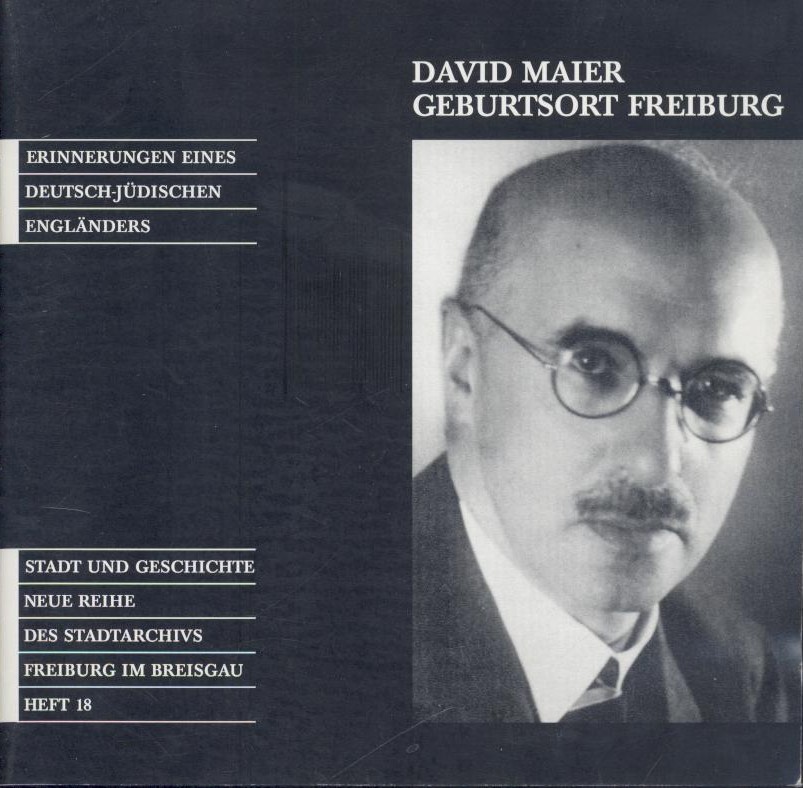
2001réf. 17069Schillinger, Freiburg 2001 (Stadt und Geschichte. Neue Reihe des Stadtarchivs Freiburg im Breisgau, Heft 18). 54 S. mit 26 Abbildungen. Brosch. Geringe Gebrsp. - Als die Heimat zur Fremde wurde - Löb David Meier und seine Familie.
1947Buenos Ayres: Tsentral-farband fun Poylishe Yidn in Argentine, 1947. Cloth, 8vo, 255 pages, 20 cm. Related Titles: Pasos candentes. Subjects: Refugees, Jewish. Palestine--Emigration and immigration. Argentia Buenos Aires Series: Poylishe Yidntum; bd. 22. Cover worn and chipped, inner-pages very clean. Ex-library copy. Very good condition. (COMHIST-18-15)
1956réf. 23151ABAmsterdam, De Beuk, 1956. 8°, 35 (+1)S., gelber OBrosch.m. mont. TSchild, ger. gebräunt; schönes Expl.
1975(FT) Original Publishers Cloth. Xxii, 458 pages. In Hebrew with English summaries. Series: Publications of the Diaspora Research Institute, Book 9 = Pirsume ha-Merkaz le-heker ha-tefutsot `a. Sh. Goldshtain-Goren. CONTENTS INCLUDES: The Jews and the Factors in the Development and Location of Industry in Warsaw Wilhelm Feldman and Alfred Nossig - Assimilation and Zionism in Lvov The Jewish Trade Union Movement in Congress Poland in the First World War (in Yiddish with Hebrew Summary) The Economic Struggle of Polish Jewry between two Wars The First Stages of Organizing the Jews in Poland at the End of World War II Cultural and Social Trends of the Jews in Poland as Reflected in Yiddish Literature 1914-1939. SUBJECT(S) : Jews -- Poland -- Periodicals. Joden. Geographic: Poland -- History -- Periodicals. Polen (land) . Previous owners signature on inside cover. Otherwise a nice, clean copy with tight binding. Very good condition. (HOLO2-60-30)
1961(FT) Cloth. 8vo. 219 pages, 25 pages of plates. Ill. Ports. Facsims. 23 cm. In Hebrew. Inscription from author on front endpaper. Title translates to English as, Embers of the Rotem Plant: In Memory of the Refugees of the Warsaw Ghetto. Subjects: Szwizgold, Shlomo. Jews -- Poland Warsaw -- Biography. World War, 1939-1945 -- Poland -- Warsaw -- Personal narratives, Jewish. Holocaust, Jewish (1939-1945) -- Poland -- Warsaw -- Biography. Warsaw (Poland) -- History -- Warsaw Ghetto Uprising, 1943. OCLC lists only 24 copies worldwide. Dust jacket has some wear at edges and on spine. Internal pages are nice and clean with tight binding. Private inscription inside. Very good condition. (HOLO2-83-75)
1998réf. 66113Frankfurt am Main : S. Fischer 1998. 318 S. ; 21 cm, mit Schutzumschlag Pp., gebundene Ausgabe, Hardcover/Pappeinband, Exemplar in sehr gutem Erhaltungszustand
1984réf. ZEIT1479Augsburg, Presse-Druck- und Verlags-GmbH (1984). gr.-8°, 231 S., mit zahlr. sw. Abb., flex. OKart. m. ill. OU., wie neu.
1988réf. KIBU2689Berlin, Der Kinderbuchverlag (1988). 128 S., mit Illustrationen von Gertrud Zucker, ill. OPpbd., sehr guter Zustand.
1901réf. 1161288Berlin, J. Edelheim, 1901. 340 S. m. 8 Abb. u. Faks. im Text. Hlwdbd. OLwd. Einbd. Etwas fleckig u. angestaubt, Rücken oben etwas gestaucht.
19381st printing of the 1938 edition. October, 1938. Original illustrated wrappers, 12mo (small) , 191 pages, including many, many period ads. Published just one month prior to Kristallnacht, this is a Name and Address Directory of the worlds leading Fur business district, the Brühl, and its counterpart in Berlin, both very heavily Jewish. Divided into 2 sections, one for the Brühl in Leipzig, and the other for Furriers in Berlin. In the 19th and early 20th Century, the Brühl had become synonymous with the Leipzig fur and Tobacco trade. It was the name of the large street where the trade was concentrated (also including Nikolai- and Reichs-strasse) . The Brühl reached its highest density with 794 shops in 1928. Of these, about 58 percent were Jewish run and owned. In the period 1926-1930, the Brühl controlled about one third of the world market in furs. With the great depression, followed by the Nazi seizure of power in 1933, the fur trade went into decline. For political reasons the fascist leadership limited the import quotas for goods from the USSR, such as raw fur. And, of course, increasingly, Jewish merchants in the Brühl were discriminated against and expelled. Many fled to England or the United States, where they established new fur businesses. Following Kristallnacht, which came only 1 month after the publication of this guide in October 1938, it became impossible for Jewish furriers to function. Some of the most famous Jewish fur traders included: Julius (Judel) Ariowitsch (1855-1908) ; Chaim Eitingon (1857-1932) , known as "Fur King from Brühl", founder of the Ez Chaim Synagogue and the Jewish hospital; the Frankel family; the Harmerlin Family; John B. (John [Joel] Berend) Oppenheimer & Company; F. Weiss (1893-1982) ; and Theodor Wolf (1833) . OCLC lists only one holding worldwide (German National Library) . Light wear, occational pencil scribbles, overall Very Good Condition. Quite rare and important. (holo2-125-28)
1944Paper Wraps. 8vo. 31 pages. Holocaust-era imprint. Monthly periodical by the Labor Zionist Youth organization. Contents of this issue include, The Month: Still No Decision, Shalom Wurm; Seder Diary, Ben Simcha; Boundaries of Exile, Ben Halpern; Palestine Letter: Crisis in the Party, S. Aharoni; A Day in Yagur, Willliam Siegel; Labor in Search of Policy, Samuel M. Ehrenhalt. SUBJECT (S) : Jews -- United States -- Periodicals. Labor Zionism -- United States -- Periodicals. Jewish youth -- United States -- Periodicals. OCLC lists no copies. Cover has some stains, fraying at binding. Pages darkened and crease through corner of some pages, but all text is clear. Good condition. (HOLO2-41-17)
1946Moskve [Moscow]: Melukhe-farlag "Der Emes", 1946. Cloth, 8vo, 167 pages. Includes portraits. 20 cm. In Yiddish. SUBJECT (S) : Jews -- Persecutions -- Belarus -- Minsk. Holocaust, Jewish (1939-1945) -- Belarus -- Minsk -- Personal narratives. World War, 1939-1945 -- Jewish resistance -- Belarus -- Minsk. OCLC: 12284925. Backstrip replaced. Very Good Condition. (YID-17-15A-ALEX)