7 066 résultats
1945Original Wraps. 4to. 123 pages; 32 pages of plates. 30 cm. First edition. In Czech. 'Lidice, Bloody Terror and violation of laws and fundamental human rights. ' History of the Lidice massacre, a mining town just north of Prague, where in 1942 the town and its population was completely destroyed by the Nazis as a reprisal action. Pages 64-78 contain a name register of those who perished. This memorial book also mentions the international reaction to the massacre, in film and journalism. 32 pages of plates of photographs. Subjects: World War, 1939-1945 - Czech Republic - Lidice. World War, 1939-1945 - Atrocities. Atrocities. World War (1939-1945) History. Lidice (Czech Republic) History. Light edge wear to wraps, otherwise clean and fresh. Very good + condition. (HOLO2-118-32)
19861st edition. Paperback, 4to (large) , ii, 168 pages. Includes facsimiles 28 cm. Includes bibliographical references on pages 140-167. SUBJECT(S) : Letters rogatory -- United States. War crime trials -- United States. Letters rogatory -- Canada. War crime trials -- Canada. Letters rogatory -- Soviet Union. Commissions rogatoires -- États-Unis. Procès (Crimes de guerre) -- États-Unis. Commission rogatoires -- Canada. Procès (Crimes de guerre) -- Canada. Light wear to covers, about Very Good Condition. (H2-1-7)
1955(FT) Paper Wraps. 8vo. 213 pages. Ill. 25 cm. In Yiddish; Summaries in Polish, and English, French, or Russian, 1948-52. Standard No: ISSN: 0006-470X; National Library: 100966491; LCCN: 74-648572 Title translates to English as: Leaves of History. SUBJECT(S) : Jews -- Poland -- History -- Periodicals. Holocaust, Jewish (1939-1945) -- Poland -- Periodicals. Joden. Geographic: Poland -- History -- Periodicals. Journal of the Yidisher historisher institut in Poyln. / Issued by the Yidisher historisher institut in Poyln. General Info: INDEXES: Vols. 1-12, 1948-59, in v. 13. (HOLO2-31-24)
19611st edition, original cloth, 4to. 826 columns, illustrations throughout. In Yiddish, foreword also in English. This book describes the city of Suwalk, Poland and the surrounding communities. Many black and white photographs are included, along with reproductions of important documents. SUBJECT (S) : Jews -- Poland -- Suwalki -- History. Holocaust, Jewish (1939-1945) . Ethnic relations. OCLC: 11558550, OCLC lists 29 copies worldwide. Some wear on corners, some marks on page edges, spine replaced, very good internally, Good Condition overall. (YIZ-19-12)
1936in tedesco 2 voll. in 4°, tela edit. con titoli impressi in nero al piatto e al dorso, illustrazione in oro impressa ai piatti, testo su due colonne, minime macchie alla tela
19458vo; 214 pages; Original Paper Wrappers. 8vo. xv, 214 pages. 23 cm. In Polish. Documents of Crimes and Martyrdom. Includes 2-page names-index & 4-page bibliography. SUBJECT(S):World War, 1939-1945 -- Prisoners and prisons, German. Jews -- Poland. Picture cover and many facsimiles. Front cover is slightly worn with closed tear and some tape along spine. Otherwise a nice, clean copy in good+ condition. (HOLO2-62-10)
1945in-16, pp. 127, bross. edit. con cop. fig. La data del 1945 si deduce dalla dedica dell'A. datata Roma, marzo 1945. [099]
1936In-16° (18,5 x 12 cm). 171 (5) pp. Brossura editoriale. Il libro raccoglie i contributi di Hitler: Le noveau plan quadriennal, del dr. Goebbels: Le bolchevisme en théorie et en pratique, di Alfred Rosemberg: L'U.R.S.S. enjuivée, di von Ribbentrop: Déclarations, e il saggio dello scrittore e giornalista Maurice Yvan Sicard (1910-2000): Étude sur l'Allemagne. Il testo è edito in un momento cruciale del regime nazista, il varo del piano quadriennale del 1936, che aveva lo scopo di rendere autosufficiente economicamente la Germania. Sicard, da parte sua, auspica una unione di francia e Germania sotto le bandiere del nazionalsocialismo.
1936réf. rg1173Librairie Félix Alcan Relié 1936 In-8 (18 x 26 cm), reliure demi-toile, dos lisse, pièce de titre, 470 pages ; traces sur la toile au quatrième plat, papier bruni, par ailleurs bon état général. Livraison a domicile (La Poste) ou en Mondial Relay sur simple demande.
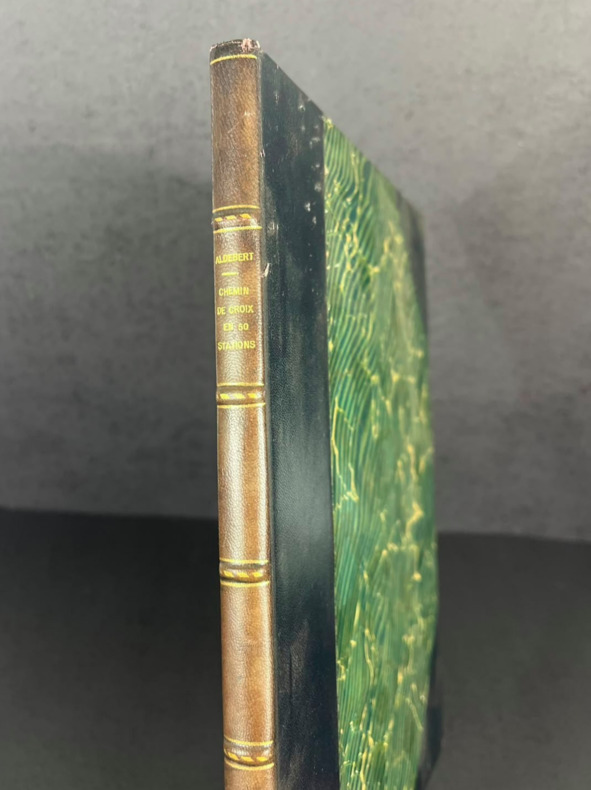
1946réf. 563Paris, Arthème Fayard, 1946. Édition originale. Grand album de 22 x 28 cm, 112 (2) pp. Relié demi-cuir noir à coins, dos à 5 nerfs ornés de pointillés et traits dorés, nom d'auteur et titre en doré. Plats marbrés. Couverture originale conservée. Tranchefile. Ouvrage illustré d'une cinquantaine de dessins en noir et blanc de l'auteur. Cet ouvrage est un puissant récit autobiographique illustré de l'artiste français Jean Bernard-Aldebert (connu sous le nom de Bernard-Aldebert, 1909-1974), relatant sa captivité dans cinq camps de concentration nazis différents entre 1944 et 1945. Après avoir bâti une carrière d'illustrateur, de caricaturiste et de satiriste, l'artiste voit son destin basculer tragiquement en novembre 1943. Pour avoir caricaturé Hitler sous les traits d'un chimpanzé dans le numéro du 1er août de l'hebdomadaire humoristique français *Ric et Rac*, Bernard-Aldebert est arrêté par la Gestapo. Il est ensuite transféré en janvier 1944 au camp d'internement de Royallieu-Compiègne, puis successivement à Buchenwald, Mauthausen, Gusen I et enfin Gusen II, où il demeure jusqu'à sa libération le 5 mai 1945. Le texte et les illustrations de l'auteur dévoilent les horreurs subies par les prisonniers dans ces camps : travaux forcés brutaux, famine, tortures sadiques et violences diverses. Si Bernard-Aldebert était surtout connu pour des caricatures au style léger et de charme, les images présentées ici versent dans un tout autre registre. Elles rappellent son style habituel, mais se révèlent bien plus dépouillées, sombres et austères, comme un reflet des émotions des personnages qui y apparaissent. Le texte est accompagné, presque systématiquement sur la page en regard, d'une reproduction en noir et blanc d'un dessin original de l'artiste, pour un total de 50 images. Celles-ci sont issues d'une série de croquis dessinés par Bernard-Aldebert peu après sa libération ; ils offrent, encore aujourd'hui, un témoignage visuel et émotionnel inestimable.
19541st edition, original cloth, 8vo. 806 pages, illustrations throughout. In Yiddish with a Spanish title page. German soldiers first passed through Ratne at the end of June 1941, but Nazi rule was established in the town only in July. Between the retreat of the Soviets and the arrival of German security forces and administrators, locals plundered Jewish homes and businesses. Shortly after the Germans arrived, they shot 27 Jews and 30 Soviet prisoners of war. Acting through the Ukrainian police, they also introduced an array of anti-Jewish measures: Jews had to wear identifying armbands (later yellow patches) , comply with a curfew, hand in valuables, including ritual objects, and provide forced labor. It was forbidden for Jews to speak to Ukrainians. As early as July 1941, Jews from the countryside were already being relocated to Ratne. In the spring of 1942, a ghetto was set up there. After a partisan raid on Ratne in June 1942, the Germans shot more than 110 Jews, along with a few Ukrainians. The Destruction of the Jewish Community. In August, the Germans recruited Ukrainian peasants from Prokhid to dig pits at a nearby sand lot. On August 26, the ghetto was liquidated by a unit from the Gestapo outpost in Brest supported by the local German Gendarmerie post and Ukrainian auxiliary police force. Although several hundred Jews fled before they could be taken to Prokhid. Many others hid in the ghetto. Most were eventually caught and murdered as well. Between 1, 300 and 1, 500 Jewish men, women, and children were killed during this operation. A few dozen skilled laborers were left alive and employed in a workshop. They were shot in February 1943. (protecting-memory.org 2018) SUBJECT(S) : Jews -- Ukraine -- Ratne. Holocaust, Jewish (1939-1945) Ratno (Ukraine) -- Ethnic relations. OCLC: 38702086. Light wear on cover and spine, page edges yellowed, previous owners name and imprint on front end page. Good Condition Overall. Inscription on Spanish title page. (YIZ-19-16A)
1943réf. yl8033 Epis Broché 1943 "In-8 (13.5x20cm), 111 pages, rare plaquette de propagande datant de 1943, textes extraits d'un numéro spécial de la revue ""Notre Combat"" du 20 avril 1943, où l'on retrouve notamment Brasillach, Déat et Chateaubriant, avec une introduction de ce dernier, riche iconographie de photos de propagande ; dos montrant une réparation, intérieur frais malgré de très légères annotations au crayon gris dans l'introduction, bon état général. Livraison a domicile (La Poste) ou en Mondial Relay sur simple demande."
2003réf. fa1005Editions du Septentrion Dos carré collé 2003 RARE. In-8 (16 x 24 cm), dos carré collé, 463 pages, ouvrage épuisé ; quelques rousseurs sur la tranche, par ailleurs très bon état général. Livraison a domicile (La Poste) ou en Mondial Relay sur simple demande.
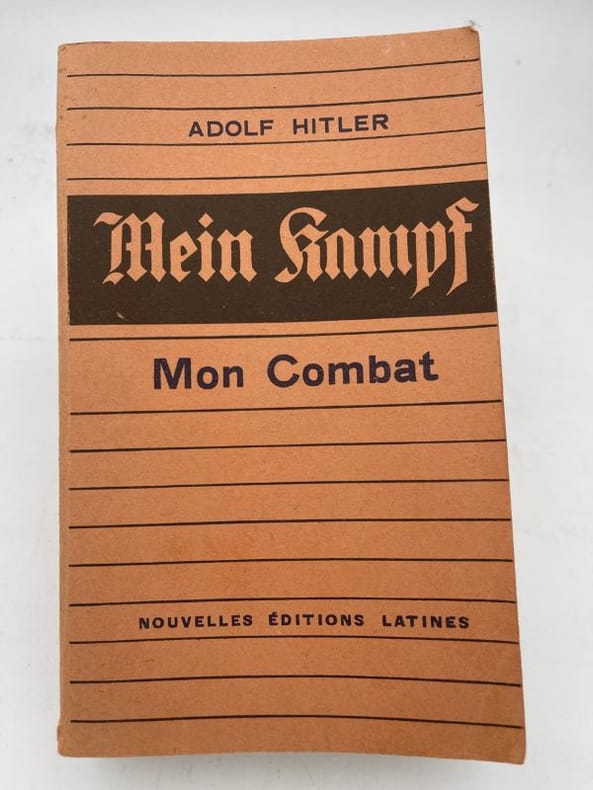
1970réf. 190423Nouvelles Editions Latines Nouvelles Editions Latines, sans date, vers 1970. Fort In-8 broché, 688 pages. Imprimerie off-set Jean Grou Radenez à Paris. Exemplaire antérieur à 1979 car c'est à cette date que l'éditeur (Fernand Sorlot) n'a été autorisé à publier ce titre qu'à "condition qu'il soit accompagné d'un rappel de la loi de 1972 contre le racisme et d'un texte rappelant aux lecteurs l'étendue et l'horreur des crimes contre l'humanité commis par les nazis ou en leur nom. Ce texte, imposé à l'éditeur couvrira 8 pages". Il n'est pas présent dans notre exemplaire, nous datons donc antérieurement à 1979, avant la date d'obligation, sans pouvoir apporter plus de précisions. Ouvrage en bon état, la plus grande partie des pages ne sont pas coupées.
1941781, [1] p. con un ritratto in antiporta; 19,5 cm. Tutta tela blu con titoli in oro al dorso. Ottimo stato
réf. 82401Paris, Robert Laffont / Collection Vécu, 10 octobre 1972, in-8, broché, 401p. Edition originale. Exemplaire signé. Ouvrage illustré de photographies N/B. Joint quelques coupures de presse.
1981réf. 540Neville Spearman, Sudbury, UK, 1981. First edition. Hardcover, dust jacket with flaps. 8vo, 182pp. plus two sections of black and white photographic plates. Black cloth-covered boards, gilt titles on spine. Discrete stamp of the former owner on the first white endpaper. Yellowed paper, though all the plate pages are crisp and clear. DJ slightly soiled. In good condition, complete, spine is solid. A rare find of continuing interest on a topic (Nazi occultism) which remains both fascinating and controversial.
1948Original Paper Wrappers. 8vo. 94 pages. 22 cm. Series: Jewish Life in America, Number Three. CONTENTS: Characteristics of the Jewish Settlement --- The Pre-Historic Period --- The New Immigration [refugees & survivors] --- Economic Development --- Culture and Press --- Jews and Cubans --- Organizing the Community. Translated from Spanish by Simon Wolin. Covers lightly worn with small chip to one corner; internal pages are nice and clean. Very Good Condition. (HOLO2-101-19)
2001réf. 178059Puf Puf, 2001. In-8 carré broché, couverture à rabats de 363 pages. Collection Léviathan. Le nomos de la terre dans le droit des gens du Jus Publicum europaeum. Très bon état
1936réf. 514Third Reich annual publication "Volk und Heimat", in German, for Germans living in Brazil. For the year 1936. Softcover, as published. 392 pp. in-8, 16.5 x 23 cm. Plenty of ads, with blue pictures (for ads) and black-and-white pictures for the "serious" content. Many companies either unknown today or famous, i.e. Siemens, Philips, the Antarctica beer and so on. The first 40 pages are ads and a calendar/blank (intended for handwritten notes) pages. Several texts, including "Der Lebenslauf Des Fuhrers", "Germany ist Schön", all written in Gothic script. Content about the Berlin Olympic Games of 1936, planes, boats, historical narratives and other topics. Several full page black-and-white pictures. Published each year for the "Brasilianer Deutsche", these profuse documents are a lively testimony of how a highly specific segment of the Brazilian society saw its native country and itself... or how the Third Reich wanted them to see the world. Many copies were destroyed or stocked in poor conditions during and after WW2.
18771st edition. Bound in contemporary boards, ; 12mo; 61 pages; Late 19th Century Philosemitic tract aimed at fellow German Christians, critical of the Antisemitism of the day. OCLC lists 8 copies worldwide. Light wear, Good Condition. (GERO-1-1)
19388vo. 1 page, quarter folded. Illustrated. In German. Holocaust-era steam ship promotional from travel from Germany. SUBJECT (S) : Voyages and travels United States; Voyages and travels Germany; Ocean travel; Voyages to the pacific coast. An advertisment for steamer ship voyages to and from Europe and the United States, including the 1938-39 schedule. OCLC lists no copies worldwide. Pencil in margins, good condition. (MX-20-20)
19511st edition, original wrappers, 8vo. 64 pages, portraits throughout. In Yiddish with English title page. Book 3 part 1 of History of the Jews in Bialystok. SUBJECT (S) : Jews -- Poland -- Bialystok. OCLC: 970935047, OCLC lists 17 copies worldwide. Staples rusted, light wear on spine, Very Good Condition overall. (YIZ-18-12)
19521st edition, original cloth, 4to. X + 377 pages, illustrations throughout. In Hebrew. English title: Lomza- In Memory of the Jewish Community. After the end of World War I, the ethnic structure changed significantly. After Orthodox Russians and German Protestants had left Lomza, it became a city of two religions, being inhabited by Catholic Poles and Jews. After regaining independence, Lomza reached the status of a county town in Bialystok Province (from 1939 on in Warsaw Province) . It was also the local centre of trade, crafts and industry, and also the seat of garrison at the same time. A few high school operated there, and what is more, the local press in Polish and Yiddish language was published. In 1925, Pope Pius XI made Lomza the capital of Lomza Diocese. After the outbreak of World War II, on 7 September 1939, Lomza was destroyed as a result of bombing. Three days later Germans entered the city. On 28 September 1939, the city was handed over to Red Army units. Lomza was incorporated into the Byelorussian Soviet Socialist Republic. The occupiers transported to Siberia. When the war between the Germans and the Soviets began, on 22 June 1941, Lomza was bombarded by German Luftwaffe, while on 24 June occupied by Wehrmacht. In July, the city and the whole land of Bialystok were subordinated to the Gauleiter of East Prussia. A ghetto was formed in August. Jewish inhabitants and refugees from other areas were relocated there. In September 1941 about 31, 000 Jews from the ghetto were sent before a firing squad; most of those who remained were killed in Treblinka and Auschwitz-Birkenau. During the war (fights on the line of the River Narew) , in winter 1944/1945, about 70 per cent of Lomza's buildings were destroyed. The reconstructed city was the centre of county in Bialystok Province to 1975, and next it was the capital of Lomza Province, existing to 1998, as a result of an administrative reform in 1975. In 2013, the city had a status of the centre of Lomza County and a city with county rights (so-called municipal county) . (sztelt.org 2018) SUBJECT(S) : Jews -- Poland -- Lomz? A -- History. Holocaust, Jewish (1939-1945) -- Poland -- Lomz? A. Ethnic relations. OCLC: 19162885. Ex library with usual marks, wear on cover and spine, pages are separating from binding slightly in some parts, Good Condition Overall. (YIZ-18-2)
19721st edition, original cloth with dust jacket, 4to, 11 pages + 754, 170 columns. Illustrations throughout. In Hebrew, with an English section. This is the story of a vanished world, the shtetel of Antopol. The material for this presentation was gathered painstakingly over a long period of time by a relatively small group of dedicated people who wished to preserve its memory and heritage for the descendants of its martyred. More than a history, this story is very personal because our parents, grandparents and great-great grandparents going back many generations came from this community. This is also a place whose many sons and daughters in years past left to seek a new and free life. Many achieved success and prominence all over the world - the United States, South Africa, Argentina, and other areas of the globe. We are the fortunate descendants of these hardy forebears and pioneers. It is hard to imagine that only a few decades ago there existed a vibrant, living community called Antopol, with its men, women and children; its market place, stores, schools. Beth medroshim (Houses of Prayer) , orphanages, Gmilas Hasodim (free loan society for the needy) , newspaper stands - all so familiar and so dear to memory. This little town was typical of hundreds of similar smaller and larger communities. And, like Atlantis, or some past people recounted in a saga, it suddenly vanished in the most bloody massacre in all of history. But this presentation is for the living - to convey to us, the she'erit or last remnant of descendants, something of the heritage, spirit and, record of the life of this community which many of us know only in an abstract and detached way. The task is too great, and our resources too limited to write the whole story. This little volume, condensed and translated into English, is both a record and a personal memorial to a profoundly meaningful and warmly nostalgic past. (foreword from the English version of this book) SUBJECT(S) : Jews -- Belarus -- Antopal. Holocaust, Jewish (1939-1945) . Ethnic relations. OCLC: 19155706. Dust jacket has some tearing and damp stains, cover corners are dented, some wear on bottom of spine, page edges slightly yellowed, internally very good. Good Condition overall. (YIZ-17-7A) xx