7.056 Ergebnisse
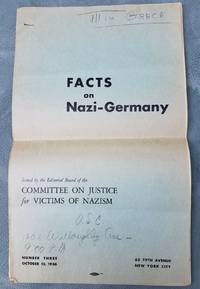
1936Best.-Nr. 159271936. Committee on Justice for Victims of Nazism. Facts on Nazi Germany 1936 anti-Nazi report documenting early concentration camp discipline and political repression under the Third Reich issued to mobilize American awareness during a period of widespread isolationist sentiment in the United States. Produced three years before the outbreak of World War II the document records one of the earliest organized efforts by an American advocacy group to circulate evidence of Nazi violence specifically targeting the treatment of political prisoners in the initial concentration camp system established after 1933. The report identifies Esterwegen as a site of incarceration for political opponents and includes translated internal regulations that detail punitive discipline forced labor expectations and execution threats directed at prisoners categorized as political dissidents Jews and alleged enemies of the state. Editorial Board of the Committee on Justice for Victims of Nazism. Facts on Nazi Germany. Number Three. New York: Committee on Justice for Victims of Nazism October 15 1936. Mimeographed document. The publication consists of 11 mimeographed pages and includes contemporary marginalia and underlining in pencil indicating close reading by an early owner. The text opens with an editorial statement noting that the committee had obtained the material "a few days ago" followed by an appeal to American audiences: "By publishing this horrendous document we wish to bring to the consciousness of the American public the plight of the German people under barbarian Hitler rule.the vast majority of the German population looks to the world outside particularly America for moral support." The reprinted German directives emphasize coercion and ideological enforcement stating "Tolerance means weakness.ruthlessness will be exercised when the interests of the Fatherland are at stake." Detailed disciplinary measures include confinement on bread and water corporal punishment and execution for acts such as alleged mutiny or resistance. Specific infractions are enumerated including penalties for writing more than two letters monthly speaking disrespectfully to guards or minor breaches of barracks discipline demonstrating the totalizing regulatory system imposed within the camp. Issued during a period when U.S. public opinion remained divided over involvement in European affairs this document contributes to the study of early transnational anti-fascist networks exile politics and information dissemination prior to the consolidation of wartime alliances. Advocacy groups such as the Committee on Justice for Victims of Nazism attempted to counter limited press coverage and official reluctance to confront Nazi Germany by distributing translated materials that documented internal repression. The inclusion of Esterwegen regulations situates the publication within the early development of the concentration camp system before its later expansion and transformation during the war. Minor edge wear horizontal crease last page detached with toning and small losses at the fold and scattered pencil markings; overall good to very good. A scarce example of prewar American anti-Nazi advocacy in printed form with documented engagement by a contemporary reader. unknown books
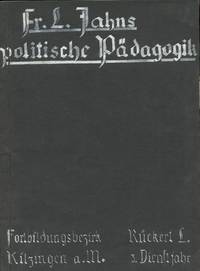
1937Best.-Nr. 131548 pp. bound typescript with manuscript corrections German language. 4to. Very good. Black paper wrappers with title texts and author in white ink. 1315 A fascinating original work perhaps by an advanced student or young teacher concerning the political pedagogy of Friedrich Ludwig Jahn founder of modern gymnastics and his importance for German ethno-nationalism's spiritual and athletic preoccupations. The text is a chilling demonstration of the links between the sport of gymnastics and ideas of physical perfection and the purification of bodies that Nazis advocated. We believe it was never published. No record in OCLC. books
1936Best.-Nr. 159271936. Committee on Justice for Victims of Nazism. Facts on Nazi Germany 1936 anti-Nazi report documenting early concentration camp discipline and political repression under the Third Reich issued to mobilize American awareness during a period of widespread isolationist sentiment in the United States. Produced three years before the outbreak of World War II the document records one of the earliest organized efforts by an American advocacy group to circulate evidence of Nazi violence specifically targeting the treatment of political prisoners in the initial concentration camp system established after 1933. The report identifies Esterwegen as a site of incarceration for political opponents and includes translated internal regulations that detail punitive discipline forced labor expectations and execution threats directed at prisoners categorized as political dissidents Jews and alleged enemies of the state. Editorial Board of the Committee on Justice for Victims of Nazism. Facts on Nazi Germany. Number Three. New York: Committee on Justice for Victims of Nazism October 15 1936. Mimeographed document. The publication consists of 11 mimeographed pages and includes contemporary marginalia and underlining in pencil indicating close reading by an early owner. The text opens with an editorial statement noting that the committee had obtained the material "a few days ago" followed by an appeal to American audiences: "By publishing this horrendous document we wish to bring to the consciousness of the American public the plight of the German people under barbarian Hitler rule.the vast majority of the German population looks to the world outside particularly America for moral support." The reprinted German directives emphasize coercion and ideological enforcement stating "Tolerance means weakness.ruthlessness will be exercised when the interests of the Fatherland are at stake." Detailed disciplinary measures include confinement on bread and water corporal punishment and execution for acts such as alleged mutiny or resistance. Specific infractions are enumerated including penalties for writing more than two letters monthly speaking disrespectfully to guards or minor breaches of barracks discipline demonstrating the totalizing regulatory system imposed within the camp. Issued during a period when U.S. public opinion remained divided over involvement in European affairs this document contributes to the study of early transnational anti-fascist networks exile politics and information dissemination prior to the consolidation of wartime alliances. Advocacy groups such as the Committee on Justice for Victims of Nazism attempted to counter limited press coverage and official reluctance to confront Nazi Germany by distributing translated materials that documented internal repression. The inclusion of Esterwegen regulations situates the publication within the early development of the concentration camp system before its later expansion and transformation during the war. Minor edge wear horizontal crease last page detached with toning and small losses at the fold and scattered pencil markings; overall good to very good. A scarce example of prewar American anti-Nazi advocacy in printed form with documented engagement by a contemporary reader. unknown
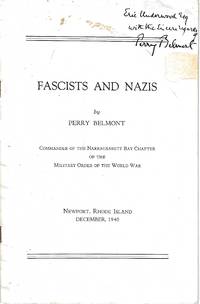
Best.-Nr. 8736Privately printed. Newport Rhode Island: December 1940. Stapled pamphlet. 8vo 27 pp including full-page photograph of Mussolini embracing a man in Nazi uniform Himmler. Fair: internally clean and tight; some marking and wear to covers. Inscribed on title-page to 'Eric Underwood Esq with the sincere regards of Perry Belmont'. Underwood is perhaps the English-born Australian nutritionist 1905-1980. Curious digressive energetic attack on fascism with sections on the Teutonic Order 'Oath-bound organisations' Freemasonry and 'Gangsters'. Belmont contrasts the present state of Germany with that in 1873 when with Neilson Winthrop he attended the University of Berlin after his graduation from Harvard. A footnote gives an idea of the tone: '. We attended the lectures of Rancke Mommsen and other magic professorial names which did not quite live up to their world wide reputation. We engaged the tutor of other Americans who was an amiable fanatic on Hegel. We were amused at his conviction that the perfection of the human brain was personified in Hegel and could not exist outside of the boundaries of Germany. Today the Nazi doctrine is more comprehensive. .' One copy on WorldCat Harvard - no indication of inscription none on COPAC or in the current market. [Privately printed.] Newport, Rhode Island: December, 1940. unknown
1941Best.-Nr. 141058Bordeaux.: Imprimerie Delmas 1941. Paperback. Aigle et croix gammée en gaufrage de la couverture. Livre en français. Couverture souple. Broché. 104 pages. 16 x 22 cm. ref. 141058 Imprimerie Delmas paperback
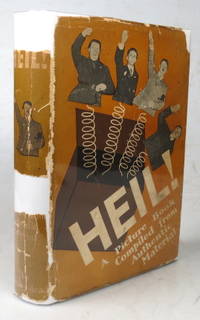
1934Best.-Nr. 46966London: John Lane The Bodley Head 1934. First edition. 8vo. xvi 203 5 pp. Publisher's black cloth yellow lettered to the spine and upper board owner's inscription dated 1937 illustrated dust jacket. 40 black and white photographic plates mostly portraits of the leading figures of the Nazi Party. The uncommon jacket rather perished with losses and splits the latter rejoined with tissue on the verso the book itself generally very good. "An instructive book for anyone on the look-out for a dictator" written in a slightly mocking tone including portraits of some of those executed on the Night of the Long Knives. London: John Lane The Bodley Head unknown
1976Best.-Nr. 2090502113709065Not Available 1976. Soft Cover. Fine. The book is in fine condition. Not Available paperback
1937Best.-Nr. 131548 pp. bound typescript with manuscript corrections German language. 4to. Very good. Black paper wrappers with title texts and author in white ink. 1315 A fascinating original work perhaps by an advanced student or young teacher concerning the political pedagogy of Friedrich Ludwig Jahn founder of modern gymnastics and his importance for German ethno-nationalism's spiritual and athletic preoccupations. The text is a chilling demonstration of the links between the sport of gymnastics and ideas of physical perfection and the purification of bodies that Nazis advocated. We believe it was never published. No record in OCLC.
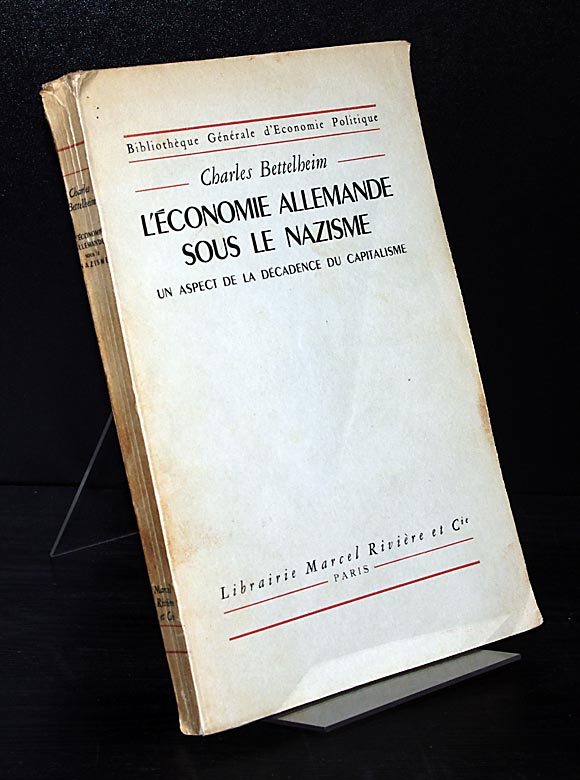
1946Best.-Nr. 3084785Paris: Librairie Marcel Riviere 1946. (4), XII, 302 Seiten. Gr. 8° (22,5-25 cm). Orig.-Broschur. [Softcover / Paperback].
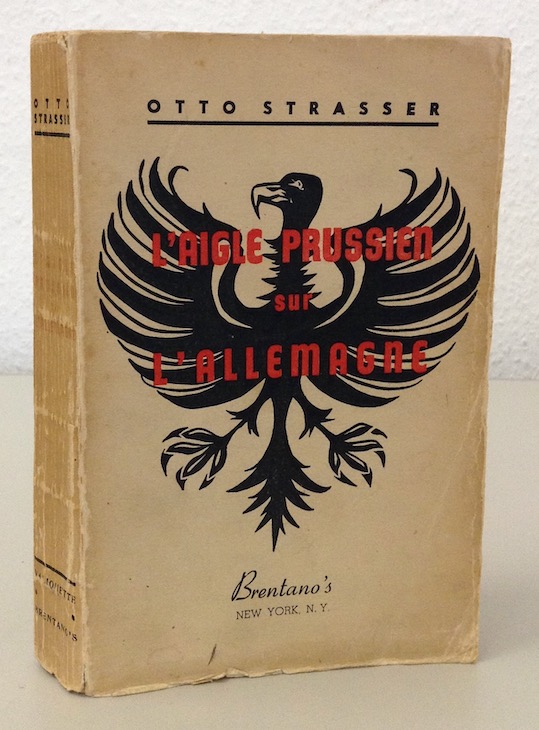
1941Best.-Nr. 124309Montréal u. New York, (1941). 386 S. Illustrierter Originalumschlag (berieben u. gebräunt, Gelenke mit kurzen Einrissen).
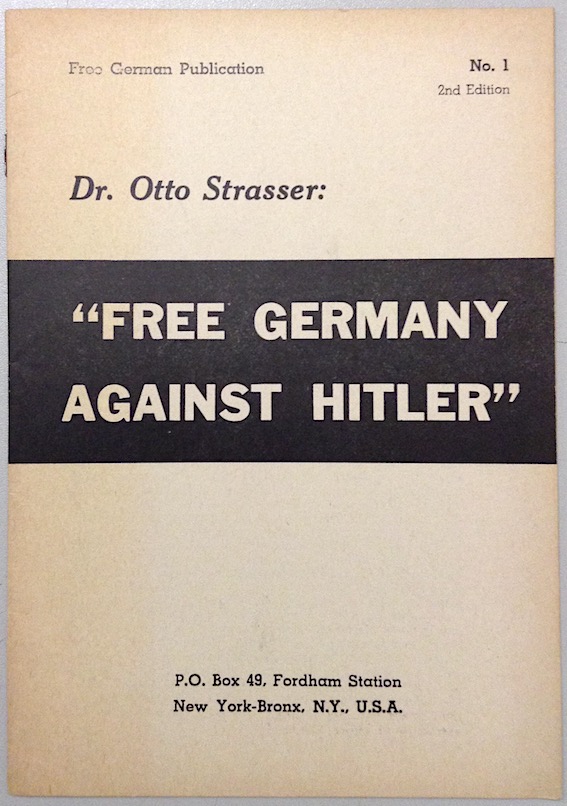
1941Best.-Nr. 124318New York, (1941). 15 S. (inkl. Umschlag).
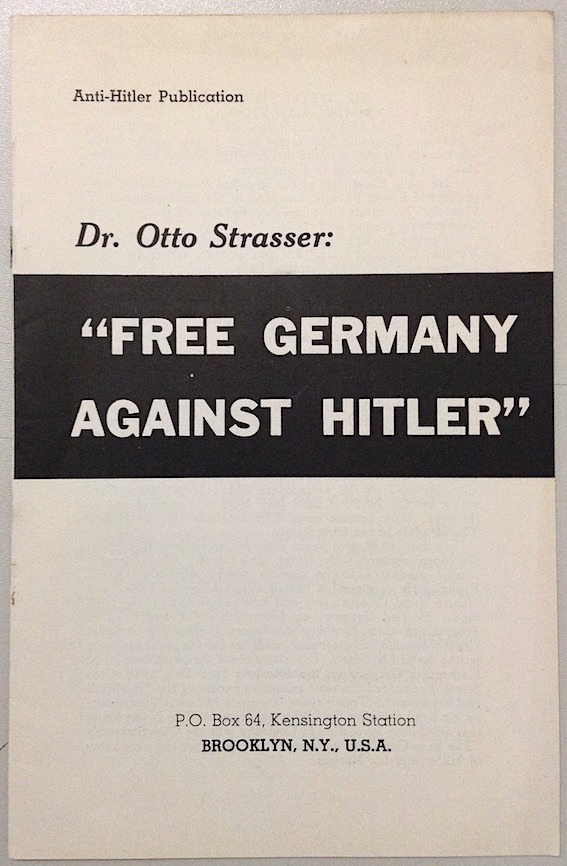
1941Best.-Nr. 124317Brooklyn, New York, (1941). 15 S. (inkl. Umschlag).
1934Best.-Nr. 494211München, Lehmann, 1934. 272 S. Mit Abbildungen auf Tafeln und im Text. Originalleinen (verstaubt).
1934Best.-Nr. 227656München, Lehmann, 1934. 272 S. Mit Abbildungen auf Tafeln und im Text. Originalleinen.
1938Best.-Nr. 614348Berlin, (1938). 120 num. Bl. Mit 2 Karten. Klammergeheftet, vom Umschlag nur noch der lose u. eingerissene Vorderdeckel erhalten. [2 Warenabbildungen]
1938Best.-Nr. 491512Wien, Braumüller, 1938. VIII, 85 S., 1 Bl. Anzeigen. Originalumschlag (Vorderdeckel mit Bibliotheksschild).
1967Best.-Nr. 3429410Malmö, Berghs Förlag, 1967. 404 S. Mit Abbildungen auf Tafeln. OKart. (Einband sauber mit Folie überzogen).
1947Best.-Nr. 3217619Washington, Infantry Journal Press, 1947. XIII, 243 S. Mit Karten. OLwd (mit OUmschlag).
1943Best.-Nr. 3437489Berlin, de Gruyter, 1943. 83 S. OKart.
1935Best.-Nr. 3105390Karlsbad, Graphia, 1935. 258 S. Lwd. St. a. Tit.
1938Best.-Nr. 3329461(Paris, 1938). Zusammen ca. 350 S. OBroschur.
1944Best.-Nr. 3041615London, London Representativ of G.D.P. 1944. 12 S. Broschur.
1934Best.-Nr. 3503283Jena, 1934. XVI, 378 S. OLwd.
1937Best.-Nr. 3606637Hamburg, Hanseatische Verlagsanstalt, 1937. 41 (3) S. OKarton (Stempel auf Titel).
1953Best.-Nr. 3229826New York, Boars Head Books, 1953. XXIV, 322 S. OPpbd (mit illustriertem OUmschlag).