Gostner, Erwin.MareMagnum

7.067 resultados
1946Original illustrated paper boards. 12mo. 194 pages. 18 cm. In German. 1000 Days in a Concentration Camp; A First Hand Report from the Concentration Camps Dachau, Mauthausen and Gusen; with authentic photographs and documents. Illustrated with 16 black and white photographs. We go past the Jewish blocks. Their ranks have thinned. Many little snow-covered heaps, from which human arms stretch in rigid accusation, testify to a tragedy of which we are the witnesses. (Gostner; quotation translated [pg 159] in Narrating the Holocaust by Andrea Ilse Maria Reite) . Erwin Gostner (1914-1990) , from South Tyrol, was arrested as a catholic anti-nazi when Austria was annexed to Nazi Germany, and spent three years, from 1938 to 1941, in Dachau and Mauthausen; he survived the war, and worked as a detective for the remainder of his life; this being his only work, it was originally self-published in 1945, and printed in a larger number in 1946. Subjects: Concentration camps - Germany. Dachau - Konzentrationslager Mauthausen (Oberösterreich) - Konzentrationslager Gusen (Langenstein, Oberösterreich) Konzentrationslager. World War, 1939-1945 - Prisoners and prisons, German. World War, 1939-1945 - Personal narratives. OCLC lists 22 copies. The US Holocaust Museum keeps their copy in their Rare Book Collection. Light soiling to boards, internally lightly aged, otherwise fresh and clean. Very good condition. (HOLO2-104-23A)
1941Original Wrappers. 8vo. 16 pages. 23 cm. First Edition. In Russian. Title translates as Fascist Antisemitism A Relic of Cannibalism. On Antisemitism in Germany. In 1935, V. V. Struve was elected a full member of the Academy of Sciences of the USSR, later became a member of the Bureau of the Division of Historical Sciences USSR. He was also a member of the National Committee of Historians of the Soviet Union and a member of the Archaeological Commission USSR. He was awarded the title of Honored Scientist of the USSR. Throughout the years V. V. Struve headed the Egyptian Department of the State Hermitage, was the director of the Institute of Ethnography and the Institute of Oriental Studies. (orientalstudies. Ru) Subjects: Antisemitism - Germany. National socialism. Holocaust, Jewish (1939-1945) Antisemitism. Ethnic relations. OCLC lists 4 copies worldwide. (Stanford, Libr. Of Congress, Univ. Of Toronto, Univ. Of Leeds) , none in New York. Spine repair. Some soiling, and age toning and edge wear. Good + condition. (HOLO-115-19)
ref. 997373Nationalsozialistische Deitsche Arbeiterpartei Berlin 1944 In-8 carré ( 240 X 215 mm ) de 100 pages, broché sous couverture décorée en relief. Photographies dans et hors-texte en couleurs et en noir. Edition originale très rare de cet ouvrage de propagande à la gloire du IIIe Reich. Bon exemplaire.
1997Softbound. 8vo. 252 pages. 24 cm. First English edition. Translated from Croatian into English by Lidija Simunic Mesic. Original title: Gubitci stanovistva Jugoslavije 1941-1945. Written by Vladimir erjavic (1912 2001) a Croatian economist and a United Nations consultant; this volume is a survey of the demographic shifts and accompanying population losses during the second world war in Yugoslavia, the author arrives at a figure of one million deaths, rather then the 1.7 million presented by Tito to the United Nations in the late 1940s. A controversial work. Subjects: World War, 1939-1945 - Casualties - Yugoslavia. World War, 1939-1945 - Casualties - Yugoslavia - Statistics. Kriegsopfer Geschichte 1941-1945. Yugoslavia - Population - History. OCLC lists 25 copies. Light shelf wear to wraps, otherwise fine. Great condition. (HOLO2-104-38)
ref. 11669Editions de France. Collection « Notre Temps ». 20 octobre 1926. In-8°, reliure bradel demi-chagrin, couverture conservée (reliure moderne). 244 pages. E.O. 1/18 sur japon impérial. [18 japon impérial / 80 hollande / 238 pur fil Lafuma / 1.525 alfa]. Très bel exemplaire. (Dupont, 25). /// Notre catalogue " Henri Béraud " est disponible sur simple demande.
1946Original Wrappers. 8vo. 163 pages. 21 cm. Illustrated. First edition. In Ukrainian. Line drawing illustrations depicting prisoners, and camp labor. Written by Daniel Tchaikovsky, under the pseudonym O. Danskyi. Tchaikovsky was a journalist, member of the Organization of Ukrainian Nationalists, and supporter of OUN leader Stepan Bandera. He was imprisoned in Auschwitz from 1942 until the camp was liberated in 1945. (Wikipedia) This account of Auschwitz is the first survivor's account to be published in Ukrainian, and is one of the earliest accounts of the horrors Nazi concentration camps. (Preface to the second edition) Subjects: Concentration camps -- Germany. Auschwitz. Some age toning and edgewear. Repair to spine. Missing page 161. Otherwise fine. (UKR-1-45A)
1946Original Wrappers. 8vo. 163 pages. 21 cm. Illustrated. First edition. In Ukrainian. Line drawing illustrations depicting prisoners, and camp labor. Written by Daniel Tchaikovsky, under the pseudonym O. Danskyi. Tchaikovsky was a journalist, member of the Organization of Ukrainian Nationalists, and supporter of OUN leader Stepan Bandera. He was imprisoned in Auschwitz from 1942 until the camp was liberated in 1945. (Wikipedia) This account of Auschwitz is the first survivor's account to be published in Ukrainian, and is one of the earliest accounts of the horrors Nazi concentration camps. (Preface to the second edition) Subjects: Concentration camps -- Germany. Auschwitz. Previous owners markings on title and half title pages. Previous institutional markings on cover. Some age toning and edgewear. Back strip has tears and previous repair with non-archival tape. Light staining internally along top edge, not affecting text. Good condition. (UKR-1-45)
19451st edition. Original Color paper wrappers, 16mo (small) , 92 pages, plus 8 pages of photo plates. In French. Title translates as, Sadistic Germany. Very early (1945) photo documentary on the Nazi Concentration camps, part of the immediate postwar effort to document the atrocities, gain justice for the victims, and rebuild a democratic Europe. SUBJECT(S) : National socialism -- Psychological aspects. Concentration camps -- Germany. Sadism. Allemands. Nazisme. Guerre mondiale, 1939-1945 -- Atrocités -- Allemagne. OCLC: 34502035. OCLC lists only 5 holdings in the Western Hemisphere (NYPL, USHMM, Harvard, Northwestern, UNIVERSITE LAVAL). Edgewear to covers, internally excellent, overall Very Good Condition. (KH-9-10A-A) xx
19372 volumi in 8 (cm 19 x 26,5) rilegati in un tomo unico, pp. 102; 96. Legatura editoriale in tela grezza con simboli oro al piatto anteriore del partito nazionalsocialista tedesco e del partito fascista e la scritta in caratteri oro "Achse Berlin-Rom". Le due opere uscirono separatamente in brossura presso l'editore Verlag Heinrich Hoffmann nel 1937 e nel 1938. L'editore curo' poi questa particolare edizione che le riuniva corredandole dalla copertina in tela che rimarcava l'asse Berlino-Roma in chiave propagandistica. Volumi interamente fotografici in bianco/nero con reportage della visita di Mussolini in Germania nel settembre 1937, e della visita di Hitler in Italia nel maggio 1938. Heinrich Hoffmann fu fotografo personale di Hitler ed editore a Monaco e fu per il suo tramite che Hitler conobbe Eva Braun.
1947ref. G31300Nünrnberg, Internationaler Militär Gerichtshof 1947-'49 volumes 1 till 41, together +/- 24000pp. with some ills., in-8, text in german, puyblisher's hardcovers in blue cloth with gilt lettering (some covers are bit discoloured or have few stains, back of few vols.repaired, some corners bumped or used), foxing on some vols.'edges, good condition (interior/text VG), G31300
1939Original Wraps. 8vo. 36, [31] pages. 23 cm. First edition. In German. 'The Reallocation Campaign of the Emigration Department in the first year of existence'. Profusely illustrated (32 pages of plates at rear) report from the Jewish Community of Vienna concerning its work and skills training program, to assist the Jews of Vienna in emigration. One of the last publications of the Israelitische Kultusgemeinde during the holocaust period. Subjects: Jews - Austria - Vienna - History. Vocational education - Austria - AustriaIsraelitische Kultusgemeinde Wien. OCLC lists 6 copies (JTSA, Natl Libr Israel, Biblio Amsterdam, Tel Aviv, Univ Haifa, LBI) . Light wear to wraps, very clean and fresh. Very good condition. (HOLO2-115-11) xx
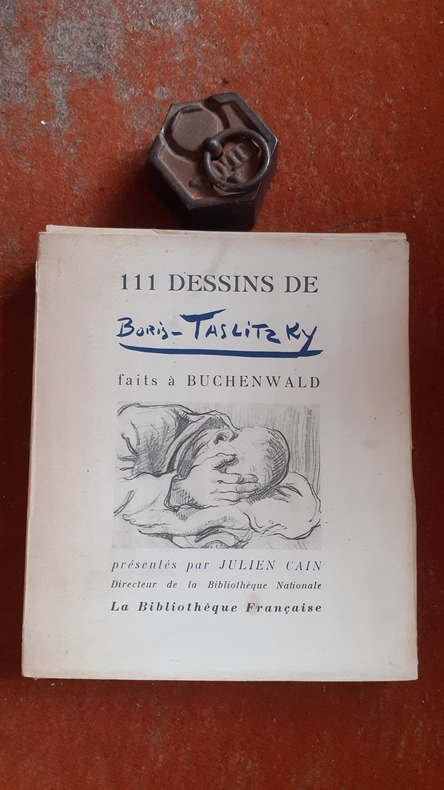
ref. QWA-21448La Bibliothèque Française, 1945,pet. in-4 en feuillets sous chemise cartonnée (21,5 x 24,5),11 p. + 110 fnch , 1ère édition, tirage à 3214 exemplaires numérotés, celui-ci l'un des 510 exemplaires sur vélin pur fil du Marais (après les 104 sur vélin de Rives et avant les 2600 sur papier de châtaignier), préface de Julien Cain, reproduction à pleine page de 100 dessins en n. et b., 6 portraits en n. et b. et 5 aquarelles en couleur ; les titres des dessins sont traduits en langues anglaise et russe ; la plupart des dessins sont des esquisses au crayon ; seule la série de portraits (Julien Cain, Émile Chevalier, Roger Arnoux, Maurice Hewitt, Salme, Madiot), plus travaillée, semble être un travail à l'encre ; bel envoi autographe signé de l'auteur à Marcel Blanc (ancien résistant et déporté, préfet de Corrèze de 1968 à 1971) : "Pour mon camarade L. Blanc parce qu'il a su conserver une attitude impeccable à Buchenwald dans la misère et dans la boue, et avec mon (....) amitié Boris Taslitzky 1946" (on joint une carte de voeux de 1997 adressée au même, signée Boris, l'ouvrage provient de la bibliothèque de M. Blanc), cartonnage passé avec rabats comportant des déchirures réparées, intérieur très propre, exemplaire bien complet, bon état.
193412mo; 134 pages; Very Early (1934) anti-Nazi booklet by this heavily Jewish organization led by Samuel Untermeyer. "Selected addresses and writings by Samuel Untermyer" appear on pages 55-128. Also includes speeches by the Archbishop of Canterbury, Sir Austin CHamberlain, Sir John Simon, Lady Violet Bonham-Carter, Rev. James N. Gilli, Hon. Samuel Seabury, Prof. Raymond Moley, William Green (pres. Of AFL) , Dr. Abba Hillel Silver, David Brown ("Nazi Peace with Jews Unthinkable") Walter M. Citrine, etc. "Public Opinion as the force, the Boycott as the weapon, will break the power of Hitlerism." Certainly larger than most pamphlets, but has an ephemeral, agitational feel. Removed from later binding, so spine area on cover is worn, otherwise Very Good Condition. (Holo2-159-19)
ref. 87013Paris Le Matin est le premier journal à reparaître à Paris, le 17 juin 1940, sous la direction collaborationniste de Maurice Bunau-Varilla qui le mit à la disposition des occupants allemands, surtout par anticommunisme et par admiration pour Hitler. "Le Matin, un des plus importants journaux français de la première moitié du XXe siècle, est à la fois le premier quotidien « à l'américaine » lancé en France (en 1884) et le premier titre à reparaître sous l'Occupation. Ce journal, tiré à plus d'un million et demi d'exemplaires au cours de la Première Guerre mondiale, devait révolutionner la presse française en important les méthodes du journalisme américain. Dès le départ dirigé par un affairiste sans scrupules, il devint cependant très rapidement une feuille de chantage et un organe corrompu largement discrédité. Entre campagnes de chantage et coups de bluff, grandes fêtes patriotiques et opérations philanthropiques, Le Matin se distingue de ses concurrents par son caractère outrancier et son arrogance, particulièrement après son rachat en 1903 par le légendaire Maurice Bunau-Varilla, qui dirigea le journal pendant plus de quarante ans. Propriétaire d'un grand quotidien populaire qui connaît son « âge d'or » dans les années 1900-1910, celui qu'on surnomme l' « Empereur du Matin », et dont la vénalité n'a d'égale que la mégalomanie, fait trembler députés, ministres et chefs d'État. Mais, dans l'entre-deux-guerres, l'équilibre qui avait fait le succès et la puissance du Matin est progressivement rompu. Le quotidien vire à l'extrême droite et Bunau-Varilla, plus préoccupé par ses lubies (dont la production du Synthol) que par la modernisation de son journal, précipite le déclin commercial du titre en le radicalisant. Champion du rapprochement franco-allemand dans les années trente, il met aussitôt son journal au service de l'occupant en 1940, ce qui vaut au Matin, symbole de la « presse pourrie », d'être aussitôt interdit de parution à la Libération, avant de tomber dans un certain oubli." (source Dominique Pinsolle, Le Matin (1884-1944) : Une presse d'argent et de chantage). MANQUENT les numéros du 12, 13, 15, 16 juin / 13, 23, 28 juillet / 4, 5, 10 août / 2, 3, 11, 12, 25 septembre. Ensemble en bon état.
1935Some wear, paper starting to brown but not fragile. Many are stamped "probenummer" ("Sample Number"--issues sent in free exchange with other political journals and left wing parties) on front cover. ; 8vo; This run includes the following 17 issues: Vol 10 (1935) : #s 1, 2, 3, 4, 11, 12; Vol 11 (1936) : #s 4, 8, 9, 10, 11, 12, 13; Vol 13 (1938) : #s 23; Vol 15 (1940) #s 8, 10, 18, 19; 24 cm. German anti-fascist periodical published from France during Hitler's reign, essentially as an exile periodical. Excellent insight in to Socialist critiques of the Nazis from those who had been, until recently, inside Germany. Some writers include: Martin Hart, Hans Israel, Walter Buchholz, E. Kolb, Fritz Kempf, Arthur Seehof, Fritz Dreher, etc, Includes material on Antisemitism, Zionism, the Spanish Civil War, Pacifism, etc. Socilaistische Wart was issued monthly through 1935; then biweekly and later weekly. It began in May 1934 and ceased publication in May 1940 with Volume 15. Issues for May-Oct. 1934 are called 1. Jahrgang [volume 1]. ; beginning Nov. 1934, they are called 9. Jahrgang [Vol 9], continuing the numbering of the earlier title, ISK. (HOLO2-135-27)
In 8° grande (24 cm), legatura in piena pelle editoriale con nervi, titolo in oro su tassello al dorso, taglio superiore dorato, fregi e titolo oro al piatto ed al dorso, custodia in cartone editoriale muto, ritratto dell'Autore su tavola in antiporta protetto da velina, pagine 705 con 28 pagine non numerate alla fine del testo, che riproducono alcuni manifesti e volantini della prima ora del partito. Esemplare in condizioni molto buone, lieve difetto ad un nervo al dorso, dedica manoscritta all'occhiello coperta successivamente incollandoci sopra una cartolina d'epoca raffigurante il Mahnmal, monumento commemorativo dei caduti durante il Putsch di Monaco del Novembre 1923. Mancano la parte inferiore e quella superiore alla custodia in cartone editoriale muto. Si tratta della rara edizione "lussuosa" realizzata nel 1939, per celebrare i cinquant'anni di Adolf Hitler.
1969ref. UUI-12652In-8 broché carré sous papier cristal d’origine (me semble-t-il), La Table ronde, 1969, 230 pp. Bon état général, bel exemplaire de cette édition originale rare d’un livre mythique, un des 25 sur vélin Périgord, seul grand papier avec quelques hors commerce. Poids 380 g. Envoi lettre verte. Frais d'envoi 6 euros sur la France, 12,90 euros pour l’étranger (tarifs de base hors envois suivis). Possibilité de remise en mains propres sur Paris, possibilité d’envoi MONDIAL RELAY, n'hésitez pas à me contacter avant de passer commande. Twitter : @Pontneuf06.
1946xxiv, 344 pages. Index. Translated from the German manuscript of the third, revised and enlarged edition. Earlier German editions were "smuggled across the German border in great numbers and enthusiastically received by the illegal revolutionary movement. The Fascists banned it in 1935." - xiv. The ten chapters include: Authoritarian Family Ideology and the Mass Psychology of Fascism; The Race Theory; The Symbolism of the Swastika; Organized Mysticism - The International Antisexual Organization; Some Problems of Sex-Political Practice; The Masses and the State; and more. Binding sound. Prior owner's name atop front free endpaper, otherwise unmarked with moderate wear. Above-average wear to dust jacket which is patched at spine ends and preserved in glossy new archival-grade Brodart. A sound vintage copy. Kehr & Langmaid 258, Madden p.55. Book
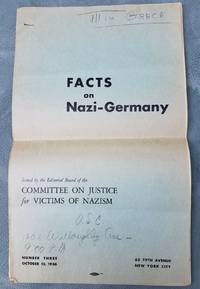
1936ref. 159271936. Committee on Justice for Victims of Nazism. Facts on Nazi Germany 1936 anti-Nazi report documenting early concentration camp discipline and political repression under the Third Reich issued to mobilize American awareness during a period of widespread isolationist sentiment in the United States. Produced three years before the outbreak of World War II the document records one of the earliest organized efforts by an American advocacy group to circulate evidence of Nazi violence specifically targeting the treatment of political prisoners in the initial concentration camp system established after 1933. The report identifies Esterwegen as a site of incarceration for political opponents and includes translated internal regulations that detail punitive discipline forced labor expectations and execution threats directed at prisoners categorized as political dissidents Jews and alleged enemies of the state. Editorial Board of the Committee on Justice for Victims of Nazism. Facts on Nazi Germany. Number Three. New York: Committee on Justice for Victims of Nazism October 15 1936. Mimeographed document. The publication consists of 11 mimeographed pages and includes contemporary marginalia and underlining in pencil indicating close reading by an early owner. The text opens with an editorial statement noting that the committee had obtained the material "a few days ago" followed by an appeal to American audiences: "By publishing this horrendous document we wish to bring to the consciousness of the American public the plight of the German people under barbarian Hitler rule.the vast majority of the German population looks to the world outside particularly America for moral support." The reprinted German directives emphasize coercion and ideological enforcement stating "Tolerance means weakness.ruthlessness will be exercised when the interests of the Fatherland are at stake." Detailed disciplinary measures include confinement on bread and water corporal punishment and execution for acts such as alleged mutiny or resistance. Specific infractions are enumerated including penalties for writing more than two letters monthly speaking disrespectfully to guards or minor breaches of barracks discipline demonstrating the totalizing regulatory system imposed within the camp. Issued during a period when U.S. public opinion remained divided over involvement in European affairs this document contributes to the study of early transnational anti-fascist networks exile politics and information dissemination prior to the consolidation of wartime alliances. Advocacy groups such as the Committee on Justice for Victims of Nazism attempted to counter limited press coverage and official reluctance to confront Nazi Germany by distributing translated materials that documented internal repression. The inclusion of Esterwegen regulations situates the publication within the early development of the concentration camp system before its later expansion and transformation during the war. Minor edge wear horizontal crease last page detached with toning and small losses at the fold and scattered pencil markings; overall good to very good. A scarce example of prewar American anti-Nazi advocacy in printed form with documented engagement by a contemporary reader. unknown
1974ref. List3157St. Petersburg Florida: unpublished 1974. Ninety-four typed and photocopied pages measuring 8 ½ x 11 inches in a soft binding. Binding with wear; pages generally excellent to Near Fine. Overall excellent to Near Fine. Annemarie Bliwernitz 1905-2005 née Entz was born in Notzendorf East Prussia. In 1952 after surviving both World Wars she and her husband Bruno 1900-1992 immigrated first to Canada and then to the United States. Offered here is Annemarie's unpublished memoir written between 1972 and 1974. Bliwernitz grew up in a wealthy land-owning country family which she remembers lived far west enough that they did not have to flee the Russians during World War I and was less affected by the postwar economic situation than were city residents. Most of the memoir is taken up by Bliwernitz's remembrances of World War II and life leading up to it. Of Hitler's rise she writes: "During these years conditions got worse in Germany . A new name came up 'Adolf Hitler.' - It was not hard for him to find followers now by the thousands and soon by the millions. He dared to stand up against the Communists with his brown uniformed S.A. men and a new wind seemed to blow over our illfated land. No wonder young people looked up to him and followed the new star nobody had much to lose. . Bruno and brother-in-law Willy after some meetings attended showed up in the new brown uniform also and farmers and laborers seemed to be united in that new idea. - It really changed Germany in a short time nobody could deny that unemployment ceased people got jobs again and housewives and mothers could buy the necessities of life for their families especially food. And it brought us to our feet again also." Though of course Bliwernitz maintains that the "Concentration Camps and what happened in them was not known to the German people" she mentions that Bruno quickly became an Arbeitsdienstführer-essentially a labor camp overseer-and remembers dissenters being disappeared: "As an example I will tell about Bruno's oldest brother Alfred. He was all against Hitler from the beginning. One day he came home and picked up his neighbor's paper at his frontdoor and wrote his ideas about Hitler and his lies down with pencil. This neighbor reported him they picked him up and that was the last his family saw of him. They were told ½ year later that he had died in Stuhm West Prussia a Concentration Camp. No explanation to his wife whatsoever. The same destiny happened to my co-worker a highly educated person at the Translation Office. She said in the lavatory where many ladies could hear: Hitler's big picture in the office should be placed here in the toilet-rooms where it belongs. One of the 'kind' co-workers reported her and she came next day only to pick up her belongings and was not seen any more." While Bruno is sent to the Eastern Front Bliwernitz and their children flee the Russians trying to reach the Americans on the Western Front. Along the way they encounter deserting German soldiers and near Hamburg liberated camp inmates: "Shooting started close to us and we heard bombs exploding would we be hit We found out that the Concentration Camp near us had been opened and those freed inmates had shot their guardians. At daybreak we met the first one still in his black and white striped prison-suit kneeling on the ground by the chicken-coop and with his both hands feeding himself out of the bowl with the chicken food. . They came to us begging for a little bit of salt to cook the horse-meat they had cut out of the dead horses lying along the ditches . We talked to them and I remember one told me he was imprisoned because of his religion not to go to any war. He was from Elbing where I had gone to school as a young girl." The family are reunited with Bruno and shortly before they surrender to the Americans they destroy the evidence of their party involvement: "Bruno's N.S.D.A.P. membership-card my certificate for the 'mother's cross' the passports of Horst and Juergen showing that they had been students of the Nazi-school in Stuhm etc." After the German surrender the family is sent back east where they struggle to avoid starvation then return west where they are sent to live in Hardegsen. They finally decide in 1951 to emigrate as life in postwar Germany is simply too difficult but make the mistake of being honest about their history: "Another big obstacle for us was that Bruno had been in a member in a Nazi-party though not an active one. But it was still a handicap in those days for any undertaking. We had not kept it secret in our immigration papers and they wanted a detailed description about our political involvement. That we did wrote a long letter in German didn't have the money for an interpreter and never got an answer. . That was a bitter pill to swallow." After this they decide to try for Canada instead and this time savvily "didn't mention any Nazi-party attachment". This is a success; the family moves to Winnipeg and eventually to St. Petersburg Florida where the narrative was written. Bliwernitz recalls working as a housekeeper which she contrasts with her previous life in which she and her family would not allow maids farm hands or tradesmen to eat at their table with them. Of interest to historians of the German civilian experience during the Second World War especially that of women and children. unpublished unknown
1944ref. 123391Signal 1944-1945 1 grand in 4 Pleine toile verte avec étiquette de titre en rouge 1 fort volume regroupant 15numéros se suivant de cette revue dans saversion italienne recouvrant les années 1944 et 1945 ( numéros rarissimes) jusqu'à la fin de la guerre. Reliure moderne en pleine toile verte avec étiquette de titre sur fond rouge - Importante documentation en reproduction jointe dans de nombreux numéros. Couvertures originales conservées
1947Original Cloth. 8vo. 482, [12] pages. 25 cm. First edition. In Hungarian. 'You are the Witness! From Ukraine to Auschwitz. ' With 12 pages of plates (printed in blue ink) . Includes name register of Hungarian Jewish victims of the holocaust on pages 209-482. Finely bound in buckram with gilt title. Subjects: Holocaust, Jewish (1939-1945) - Registers of dead Hungary. Holocaust, Jewish (1939-1945) - Registers of dead - Ukraine. Holocaust survivors - Hungary Registers. Holocaust, Jewish (1939-1945) Jews - Persecutions - Hungary. Jews - Persecutions. Holocaust, Jewish (1939-1945) . OCLC lists 18 copies. Light wear to cloth; pages lightly aged, otherwise clean and fresh. Very good condition. (HOLO2-115-20)
19441st Edition. Original Illustrated Paper Wrappers. 8vo. 70 pages ; 17 cm. Text in Polish. The first separate published account of the Warsaw Ghetto uprising, issued the year following the revolt. Title translates into English as, Warsaw Ghetto Uprising. Issued under Soviet auspices it was written by a participant, the Polish historian, journalist and anti-Fascist activist, Bernard Mark (1908-1966) . Mark narrates the events immediately preceding and during the 1943 armed uprising of Warsaw's Jews, and presents Jewish, Polish, and German documents pertaining to the Warsaw and other ghetto and camp rebellions. (Google Books, 2017) Published by Union of Polish Patriots in the USSR. SUBJECT(S) : Holocaust, Jewish (1939-1945) -- Poland -- Warsaw. Jews -- Poland -- Warsaw. Warsaw Ghetto Uprising. OCLC lists 16 copies worldwide, but none in New York. Paper toning. Very good+ condition, a beautiful copy. (holo2-135-2A)
ref. SHL-43Paris, Les Editions de Minuit, 1943, 1 vol. in-16 broché, couverture blanche ivoire imprimée, titre répété en long au dos, 91 pp. dont 2 ff. blanc, faux-titre, titre - 2 ff. n.c. dont l’achevé d'imprimer “Cet ouvrage publié aux dépens de quelques bibliophiles patriotes a été imprimé sous l’occupation nazie le 25 juillet 1943 jour de la chute du tyran de Rome [Mussolini est mis en minorité par le Grand Conseil fasciste, destitué et placé en résidence surveillée]”. Annotation manuscrite au stylo à bille sur la page de titre autour du nom de l’auteur “ = BRULLER […] graveur, caricaturiste d’origine hongroise [...] prononcer ère n’a écrit ensuite que “la marche à l’étoile” dans cette même collection” Bon état général : très légères et discrètes salissures dans les marges de la couverture, pliure au dos se prolongeant sur un centimètre environ sur le plat sup. au niveau de la couture basse, petites rousseurs pâles au dos de la page de titre et au f. de dédicace en regard “A la mémoire de SAINT-POL-ROUX, Poète assassiné.” [pp. 8 et 9] ; tranche sup. salie. Très rare seconde et ultime édition clandestine de ce titre fondateur des Editions de Minuit.
19371st edition. Original paper wrappers. 8vo, 4-8 pages each. Conservative Jewish men's group newsletter from the Holocaust period from the the second synagogue founded in New York (1825) and the third-oldest Ashkenazi synagogue in the United States. "The object of the 'Tattler' will be to provide the members with a regular source of information and entertainment....The Pogroms in Russia during the Czarist regime or the activities of the Zionist movement in recent years had no such effect on the consciousness of the average American Jew except to stir a sense of pity and sympathy for the afflicted ones. But the cruel, heartless persecutions of the Jews in Germany by Hitler and his crew, caused a stirring in the blood of Native Americans of Jewish birth that made them turn about and recall the religion of their fathers and the God of Israel. We of The Men's Club of the Congregation B'nai Jeshurun welcome with open arms all those who are returning to the fold." Most issues include commentary on the increasing oppression of the Jews in Germany; other issues discussed include some current Jewish news, some retelling of Jewish history, congregation news, editorials, fun facts, jokes with lessons. OCLC: 944959016, OCLC lists 2 holdings worldwide (JTS & USHMM), though these holdings appear to be incomplete. First issue shows edgewear, other issues show only creases from folding, touch of wear, good quality paper with just the slightest toning. About Very Good Condition Overall. Rare (HOLO2-159-22A)