236 resultados
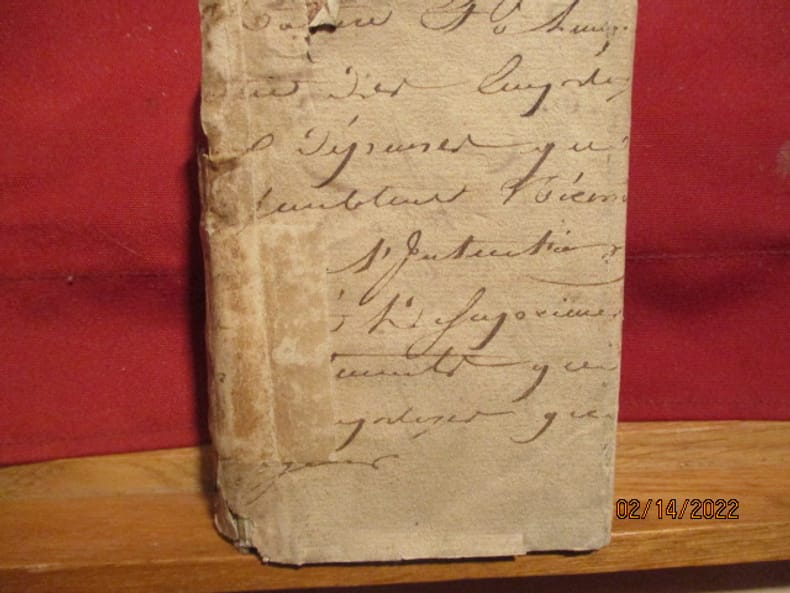
1598ref. 66701598. 22 leaves including some blanks or pages ruled in ink for entries. Agenda format 315 x 100 mm. stitched as issued uncut. Nuremberg: 1598. A fascinating document of a type that rarely survives: the manuscript account book for the spring 1598 Leipzig fair of Hans Straub I or the Elder 1541-1610 the prominent Nuremberg gold- and silversmith alderman and son-in-law of Wenzel Jamnitzer the best-known German goldsmith of his time. The first leaf bears Straub’s hallmark interwined initials “HS” over an arrow pointing upward within a plain shield & also containing the inscription “No. 72”. Our manuscript sheds important light on the business relations in the late 16th century between the Nuremberg goldsmiths and their trade at the Leipzig fairs. Our account book is a list of sales orders and expenditures of Nuremberg goldsmith Hans Straub the Elder during the Leipzig Easter fair held in May 1598. While Straub is not expressly named he can be identified by his hallmark on the first leaf. At the fair trade was done in goblets rings knife-sheaths cutlery jewelry gemstones etc. Several business partners are named including the Nuremberg goldsmiths Heinrich Hahn Haan David Lauer and Paulus Koch. As an example of a transaction we see that the council of Halle paid over 33 florins for a goblet. In 1596 Straub was elected Alderman of the Artisans the most elevated and honorable office to which a Nuremberg artisan could aspire. Straub retained this position until his death in 1610. In 1569 he married Anna daughter of the famous goldsmith Wenzel Jamnitzer. On his father-in-law’s death in 1585 Straub inherited his casting molds and used them extensively in his own creations. Despite his long period of activity relatively few pieces made by Hans Straub have survived see Nürnberger Goldschmiedekunst 1541-1868 2007 ed. by Karin Tebbe et al. Vol. I p. 409. In fine condition. ⧠The mark is similar to Marc Rosenberg Der Goldschmiede Merkzeichen Frankfurt 1925 Vol. III no. 3969. unknown
1598ref. 66701598. 22 leaves including some blanks or pages ruled in ink for entries. Agenda format 315 x 100 mm. stitched as issued uncut. Nuremberg: 1598. A fascinating document of a type that rarely survives: the manuscript account book for the spring 1598 Leipzig fair of Hans Straub I or the Elder 1541-1610 the prominent Nuremberg gold- and silversmith alderman and son-in-law of Wenzel Jamnitzer the best-known German goldsmith of his time. The first leaf bears Straub’s hallmark interwined initials “HS” over an arrow pointing upward within a plain shield & also containing the inscription “No. 72”. Our manuscript sheds important light on the business relations in the late 16th century between the Nuremberg goldsmiths and their trade at the Leipzig fairs. Our account book is a list of sales orders and expenditures of Nuremberg goldsmith Hans Straub the Elder during the Leipzig Easter fair held in May 1598. While Straub is not expressly named he can be identified by his hallmark on the first leaf. At the fair trade was done in goblets rings knife-sheaths cutlery jewelry gemstones etc. Several business partners are named including the Nuremberg goldsmiths Heinrich Hahn Haan David Lauer and Paulus Koch. As an example of a transaction we see that the council of Halle paid over 33 florins for a goblet. In 1596 Straub was elected Alderman of the Artisans the most elevated and honorable office to which a Nuremberg artisan could aspire. Straub retained this position until his death in 1610. In 1569 he married Anna daughter of the famous goldsmith Wenzel Jamnitzer. On his father-in-law’s death in 1585 Straub inherited his casting molds and used them extensively in his own creations. Despite his long period of activity relatively few pieces made by Hans Straub have survived see Nürnberger Goldschmiedekunst 1541-1868 2007 ed. by Karin Tebbe et al. Vol. I p. 409. In fine condition. ⧠The mark is similar to Marc Rosenberg Der Goldschmiede Merkzeichen Frankfurt 1925 Vol. III no. 3969. unknown books
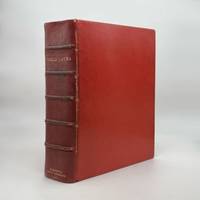
1482ref. 372091Nuremberg: Anton Koberger 1482. Eighth edition of the Bible printed by Koberger his first was 1475. Date from the colophon at end of text on fol. 427. Text in black letter two columns 53 lines. Red initials rubricated throughout. Foliation irregular. Bound without first and last blanks. 460 of 462 leaves. 1 vols. Folio. Twentieth century orange morocco by Zaehnsdorf preserving earlier gauffered and gilt edges. Spine darkened from smoke minor rubbing. First leaf remargined at foot; some traces of damp and stains from old marginal tabs internally clean overall closed tear in fol. 388. Very good plus. Eighth edition of the Bible printed by Koberger his first was 1475. Date from the colophon at end of text on fol. 427. Text in black letter two columns 53 lines. Red initials rubricated throughout. Foliation irregular. Bound without first and last blanks. 460 of 462 leaves. 1 vols. Folio. ISTC ib00575000; GW 4250; Goff B575. Provenance: George Livermore Harvard bookplate recording 1859 deposit with ink release dated 1894; General Theological Seminary gift of Cornelius Vanderbilt and Dean Augustus Hoffman bookplates and blindstamps Anton Koberger unknown
1482ref. 372091Nuremberg: Anton Koberger 1482. Eighth edition of the Bible printed by Koberger his first was 1475. Date from the colophon at end of text on fol. 427. Text in black letter two columns 53 lines. Red initials rubricated throughout. Foliation irregular. Bound without first and last blanks. 460 of 462 leaves. 1 vols. Folio. Twentieth century orange morocco by Zaehnsdorf preserving earlier gauffered and gilt edges. Spine darkened from smoke minor rubbing. First leaf remargined at foot; some traces of damp and stains from old marginal tabs internally clean overall closed tear in fol. 388. Very good plus. Eighth edition of the Bible printed by Koberger his first was 1475. Date from the colophon at end of text on fol. 427. Text in black letter two columns 53 lines. Red initials rubricated throughout. Foliation irregular. Bound without first and last blanks. 460 of 462 leaves. 1 vols. Folio. ISTC ib00575000; GW 4250; Goff B575. Provenance: George Livermore Harvard bookplate recording 1859 deposit with ink release dated 1894; General Theological Seminary gift of Cornelius Vanderbilt and Dean Augustus Hoffman bookplates and blindstamps Anton Koberger unknown books
1955Signed and inscribed by author upon front free endpaper. 552 pages. Index. Black and white photographic plates. "One of the most important autobiographies of the post-war period, for there can be few personalities still alive who have been so intimately connected with the march of world events for so many years... His first great triumph was to rescue the German Mark from the inflation of 1921... As the Nazi avalanche swelled, Hitler persuaded him to occupy the Presidential chair at the Reichsbank... but (Schacht) soon saw that the Fuhrer was driving relentlessly towards war. A quarrel resulted and he left the Government, remaining under a cloud until he was arrested towards the close of the regime." - from dust jacket. Schact was aquitted of war crimes at Nuremberg. Moderate wear to book. Binding intact. Several patches and touch-ups to dust jacket which is now preserved in archival-grade Brodart. Kehr & Langmaid 1217, Aldcroft & Rodger p.83. Book
1927247 pages. Black and white photographic frontis portrait of author. "This is a book written by a German after a war which brought defeat to his country and a great civilized people to a condition of dependence and subordination... The German Inflation can only be understood as part of the general history of the time. May we all learn from the past and emerge from the destructive era of reciprocal hostility into a new constructive period of international well-being." - from Foreward. Chapters include: The Inflation of the War Period; From the Armistice to the Invasion of the Ruhr; From the Invasion of the Ruhr to the Stabilization of the Mark; The Stabilization of the Mark; From Rentenbank to Golddiskontbank; From Currency Crisis to Economic Crisis; The Dawes Plan; The Reconstruction of German Money and Capital Markets; Foreign Credits; International Co-operation. "(Schacht) became one of the directors of the Reichsbank in 1916 and in 1923 became currency commissioner for the Reich. After his economic policies helped reduce German inflation and stabilize the German mark, Schacht was appointed president of the Reichsbank. He collaborated with other prominent figures in economics to form the Young Plan to modify the way that war reparations were paid after Germany's economy was destabilizing under the Dawes Plan. Though on March 7, 1930, six months after the beginning of the Great Depression, he stepped down from the position of Reichsbank Chairman, but returned on March 17, 1933 after Hitler's rise to power." - from wikipedia dot org. Binding intact. Unmarked with average wear. Bright gilt lettering upon black cloth backstrip. Mild foxing to endpapers. A sound copy. Aldcroft & Rodger p.83, Peterson p.367. Book
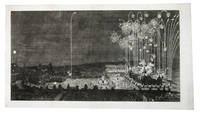
1750ref. B4SB1E23SY47Nuremberg 1750. Ca. 39.5 x 71.5 cm. Kept in a white passe-partout. One large etching. Large etching with a spectacular night view of the fireworks display held during the Nuremberg Peace Festival. The festival took place in July 1650 to celebrate the end of the Thirty Years' War 1618-1648 one of the most devastating conflicts in European history. It was intended as a sign of hope for a better future in Europe and particularly in Germany. The present etching may have been printed to spread this message of peace.The Thirty Years' War began as a civil war within the Holy Roman Empire but eventually developed into a wider European conflict. Although fought primarily in present-day Germany it brought widespread disease starvation and the depopulation of large parts of the region. After five years of negotiations the Peace of Westphalia was signed in October 1648. The remaining unresolved issues were settled during a major diplomatic congress held in Nuremberg between May 1649 and July 1650. To mark the successful conclusion of the negotiations a grand festival was organised culminating in an elaborate fireworks display. The present etching captures this spectacular event with countless rockets launched from all sides of the castle. Particularly striking are the burning statue in the centre and the figures wielding flaming swords that surround it.The image was engraved after designs by the German artists Peter Troschel ca. 1620-after 1667 and Michael Herr 1591-1661. It was first published in 1650 with a title at the top and a legend below. The present version most likely dating from the mid-18th century has been significantly enlarged particularly in width. These altered proportions give the composition an even more dramatic effect.The work has been folded in the past the lower part of the left margin has been restored insect droppings in a small area on the left side of the head margin not affecting the etched image. Otherwise in good condition. unknown
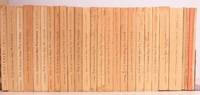
1946ref. 46438HMSO 1946-1951. Together 27 vols. 8vo. First Edition with 2 large folding charts; original printed wrappers one or two backstrips scuffed at head and tail else a remarkably well-preserved bright clean set. The extended set comprises: Part 1: 20 Nov 1945 to 1 Dec 1945 1946; Part 2: 3 Dec 1945 to 14 Dec 1945 1946; Part 3: 17 Dec 1945 to 4 Jan 1946 1946; Part 4: 7 Jan 1946 to 19 Jan 1946 1946; Part 5: 21 Jan 1946 to 1 Feb 1946 1946; Part 6: 2 Feb 1946 to 13 Feb 1946 1947; Part 7: 14 Feb 1946 to 26 Feb 1946 1947; Part 8: 27 Feb 1946 to 11 March 1946 1947; Part 9: 12 March 1946 to 22 March 1946 1947; Part 10: 23 March 1946 to 3 April 1946 1947; Part 11: 4 April 1946 to 15 April 1946 1947; Part 12: 16 April 1946 to 1 May 1946 1947; Part 13: 2 May 1946 to 13 May 1946 1947; Part 14: 14 May 1946 to 24 May 1946 1947; Part 15: 27 May 1946 to 6 June 1946 1948; Part 16: 7 June 1946 to 19 June 1946 1948; Part 17: 20 June 1946 to 1 July 1946 1948; Part 18: 2 July 1946 to 15 July 1946 1948; Part 19: 16 July 1946 to 27 July 1946 1949; Part 20: 29 July 1946 to 8 August 1946 1949; Part 21: 9 August 1946 to 21 August 1946 1949; Part 22: 22 August 1946 to 31 August 1946; 30 Sept 1946 and 1 October 1946 1950; Part 23: Index 1951. WITH Opening Speeches of the Chief Prosecutors 1946; Speeches of the Prosecutors against the Indicted Organisations 1946; Speeches of the Chief Prosecutors against the Individual Defendants 1946; Judgement of the International Military Tribunal with the Dissenting Opinion of the Soviet Member 1946. Volume 1 includes the folding chart of the organisation of the NSDAP; Volume 3 contains the folding chart of the organisation of the SS. EXTENDED SETS ARE EXCEEDINGLY SCARCE. HMSO, unknown
1968ref. 58898Nurnberg Germany: Albrecht Durer Gesellschaft; Et Al. As New. Paperback. FREE UPGRADE to Courier/Priority Shipping Upon Request – – IN STOCK AND IMMEDIATELY AVAILABLE FOR SHIPMENT - AS NEW THE TEXT BLOCK IS PRISTINE CLEAN UNMARKED AND IN EXCELLENT CONDITION - - Text in German. 92 pp. With 53 ills. 3 col. . 20 x 20 cm. -- with a bonus offer-- . 1968. Albrecht Durer Gesellschaft; Et Al paperback
1967ref. 58873Nuremberg Germany: Germanisches Nationalmuseum. As New. Paperback. FREE UPGRADE to Courier/Priority Shipping Upon Request – – IN STOCK AND IMMEDIATELY AVAILABLE FOR SHIPMENT - AS NEW THE TEXT BLOCK IS PRISTINE CLEAN UNMARKED AND IN EXCELLENT CONDITION - - Text in German. 100 pp. With 65 ills. 2 col. > 20 x 18 cm. -- with a bonus offer-- . 1967. Germanisches Nationalmuseum paperback
2014ref. 108762Hirmer Publishers. New. Paperback. FREE UPGRADE to Courier/Priority Shipping Upon Request - IN STOCK AND IMMEDIATELY AVAILABLE FOR SHIPMENT - Flawless copy brand new pristine never opened - Text in English and German. -- with a bonus offer-- . 2014. 3777422185 . Hirmer Publishers paperback
1946Together 27 vols., 8vo., First Edition, with 2 large folding charts; original printed wrappers, one or two backstrips scuffed at head and tail else a remarkably well-preserved, bright, clean set. The extended set comprises: Part 1: 20 Nov 1945 to 1 Dec 1945 (1946); Part 2: 3 Dec 1945 to 14 Dec 1945 (1946); Part 3: 17 Dec 1945 to 4 Jan 1946 (1946); Part 4: 7 Jan 1946 to 19 Jan 1946 (1946); Part 5: 21 Jan 1946 to 1 Feb 1946 (1946); Part 6: 2 Feb 1946 to 13 Feb 1946 (1947); Part 7: 14 Feb 1946 to 26 Feb 1946 (1947); Part 8: 27 Feb 1946 to 11 March 1946 (1947); Part 9: 12 March 1946 to 22 March 1946 (1947); Part 10: 23 March 1946 to 3 April 1946 (1947); Part 11: 4 April 1946 to 15 April 1946 (1947); Part 12: 16 April 1946 to 1 May 1946 (1947); Part 13: 2 May 1946 to 13 May 1946 (1947); Part 14: 14 May 1946 to 24 May 1946 (1947); Part 15: 27 May 1946 to 6 June 1946 (1948); Part 16: 7 June 1946 to 19 June 1946 (1948); Part 17: 20 June 1946 to 1 July 1946 (1948); Part 18: 2 July 1946 to 15 July 1946 (1948); Part 19: 16 July 1946 to 27 July 1946 (1949); Part 20: 29 July 1946 to 8 August 1946 (1949); Part 21: 9 August 1946 to 21 August 1946 (1949); Part 22: 22 August 1946 to 31 August 1946; 30 Sept 1946 and 1 October 1946 (1950); Part 23: Index (1951). WITH Opening Speeches of the Chief Prosecutors (1946); Speeches of the Prosecutors against the Indicted Organisations (1946); Speeches of the Chief Prosecutors against the Individual Defendants (1946); Judgement of the International Military Tribunal (with the Dissenting Opinion of the Soviet Member) (1946). Volume 1 includes the folding chart of the organisation of the NSDAP; Volume 3 contains the folding chart of the organisation of the SS. EXTENDED SETS ARE EXCEEDINGLY SCARCE.
ref. 202Nüremberg, Secrétariat du Tribunal, 1947-1948 41 vol. in-8, bradel toile bleue (reliure de l'éditeur).
195280 pages. Features: Magnificent cover illustration by William Winter depicts a quintessentially Canadian backyard skating rink; Household Finance (HFC) ad on page one features photo of Mr. J.B. Vaillancourt, manager of the Shawinigan Falls, Quebec office; Our Sham Defense Battle - Editorial; Krupp, Schacht and Rommel - Beverley Baxter reflects on what happened at the Castle Harben on October 1, 1946 in the wake of the Nuremberg Trials verdicts; William Stephenson - The Biggest Private Eye of All - he directed the most secret of all cloak-and-dagger operations of the Second World War - here, for the first time, is the story of the man who pulled the strings which spiked Hitler's guns in the western hemisphere - article with photo; Dr. Gordon M. Bell's School for Sobriety - The Shadow Brook Health Foundation for men and the Willowdale Hospital for Women, both located on the outskirts of Toronto; Karsh's Charlottetown (PEI) - The City That's One Big Farm - article with great Karsh photos, especially a large shot of Premier Walter Jones meeting voters to resolve their issue, and another of Dr. Roderick Macdonald at age 94; Maude Burbank and her Musical Moppets - she takes care of two musical bands of Moncton youngsters; Manitoulin Island - The Eden Isle of Evil Spirits - article with nice colour photos; What the Boyd Gang Fiasco Can Teach Us - the Mayor or Toronto, Allan Lamport assails conditions which helped the Boyd Gang terrorize his city; The Slide That Shook The West - A Maclean's Flashback article to the April 29, 1903 Frank Slide, in which part of Turtle Mountain crashed into Crowsnest Pass, destroying the town of Frank; The World's Most Ardent Birdwatcher - Peter Scott, the gifted son of Scott of the Antarctic will fly anywhere to gaze lovingly at rare wildfowl - article with photos; You Can't Stop a Woman Crying; Nice one-page colour ad for Stanfield's "Look-Alike" Balbriggan Pajamas with happy family scene; Gaines Meal dog food ad features illustration of Saint Bernard; Vintage Frigidaire ad includes lengthy Christmas message and suburban evening scene of appliances being delivered to happy homes; Cream of Wheat ad features Li'l Abner; Vintage colour ad for Christie's Premium Crackers; Colour centrefold ad for Ekco and their many kitchen products; Champion Spark Plug ad includes photos of 12 new members of the 100-mile-an-hour club at Indianapolis; Two-page colour ad for Revere Cookware - 'the world's finest'; Lightning Zipper ad shows irate wife fixing husband's trousers while he stands, semi-dressed, taking her abuse; and more. Unmarked with moderate wear. Two-inch opening to fore-edge of front cover and first two pages mended with archival tape. A sound copy of this very special issue. Book
1571ref. 486271571 (Lyon) Lugduni, Apud Ioan. Tornaesivm (Jean de Tournes), Typogr. Regium (Typographe royal). MDLXXI - 1571 - In-16, 12 x 8,5 x 3,8 cm - Edition Originale - Reliure vélin de récupération avec manque -Collationné complet des 110 gravures sur bois- 637 pagers + Index (3) manque pages d'index- fortes mouillures - Envoi rapide et soigné - Réf. 48627
1955vi, [2], 552 pages. Index. Black and white photographic plates. "One of the most important autobiographies of the post-war period, for there can be few personalities still alive who have been so intimately connected with the march of world events for so many years... His first great triumph was to rescue the German Mark from the inflation of 1921... As the Nazi avalanche swelled, Hitler persuaded him to occupy the Presidential chair at the Reichsbank... but (Schacht) soon saw that the Fuhrer was driving relentlessly towards war. A quarrel resulted and he left the Government, remaining under a cloud until he was arrested towards the close of the regime." - dust jacket. Schact was later aquitted of war crimes at Nuremberg. Average wear to unmarked book. Above-average wear and soiling to dust jacket which is now preserved in archival-grade Brodart. KEHR & LANGMAID 1217, ALDCROFT & RODGER p.83. Book
1961320 pages. Name index. Subject index. "A shortened version of the second edition (1957) of a work first published in Polish under the title 'Dziennik Hansa Franka' (Hans Frank's Diary). Frank was a Minister of the Third Reich and Governor General of those areas of Poland occupied by Nazi Germany which were not incorporated into the Reich. At the International Military Tribunal in Nuremberg for the first time in the history of the world thousands of secret documents were revealed belonging to a state in the grip of the imperialist idea of world conquest. Among those documents Hans Frank's Diary occupies one of the leading positions both on account of its contents and on account of its more than ordinary length: 11,000 typwritten pages in foolscap, making up 38 volumes. Any study of the history of the last war must include a reading of Hans Frank's Diary." - Preface. Author was a member of the Polish delegation to the International Military Tribunal at Nuremberg. Usual library markings. Above-average wear. Front hinge taped. Back hinge going. A worthy reading copy of this very important work. LASKA 316, KEHR & LANGMAID 5385. Book
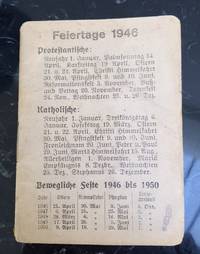
1946ref. 132911946. Kesselring Albert. Personal diary kept during imprisonment following the Second World War and during the Nuremberg war crimes proceedings. Albert Kesselring served as Field Marshal in the German Luftwaffe and commanded major German military operations in multiple theaters of the war including air campaigns in Poland and France the Battle of Britain operations during the invasion of the Soviet Union and later the Mediterranean and Italian fronts. After Germany's defeat he was arrested and prosecuted for war crimes committed during the German occupation of Italy. This diary documents his daily life during the immediate postwar period while he remained under Allied custody and while the major trials of German leaders were underway at Nuremberg. Entries note visits court appearances and personal reflections recorded during a period when former senior commanders awaited the outcome of postwar legal proceedings. Personal pocket diary for the year 1946 containing 58 pages with scattered pencil entries written by Albert Kesselring. The calendar format volume measures approximately 4 x 6 inches. The entries record numerous visits from his wife Paulina whom Kesselring notes simply as "Liny" and also mark the dates on which he traveled to Nuremberg to testify during the trial of Hermann Göring on February 15 April 26 and May 14. The diary concludes with a handwritten entry on December 31 reading "All's well that ends well!" reflecting Kesselring's outlook at the close of the year. Following the war Kesselring was tried by a British military tribunal for actions carried out during the German occupation of Italy and initially received a death sentence. The sentence was later commuted and he was released from imprisonment in 1952. Personal writings from senior German military commanders during the immediate postwar years provide direct documentary evidence of how individuals connected to the German war effort experienced detention testimony and the legal processes that followed the collapse of Nazi Germany. Slight foxing to the verso of the cover. Overall condition very good. unknown
1946ref. 132911946. Kesselring Albert. Personal diary kept during imprisonment following the Second World War and during the Nuremberg war crimes proceedings. Albert Kesselring served as Field Marshal in the German Luftwaffe and commanded major German military operations in multiple theaters of the war including air campaigns in Poland and France the Battle of Britain operations during the invasion of the Soviet Union and later the Mediterranean and Italian fronts. After Germany's defeat he was arrested and prosecuted for war crimes committed during the German occupation of Italy. This diary documents his daily life during the immediate postwar period while he remained under Allied custody and while the major trials of German leaders were underway at Nuremberg. Entries note visits court appearances and personal reflections recorded during a period when former senior commanders awaited the outcome of postwar legal proceedings. Personal pocket diary for the year 1946 containing 58 pages with scattered pencil entries written by Albert Kesselring. The calendar format volume measures approximately 4 x 6 inches. The entries record numerous visits from his wife Paulina whom Kesselring notes simply as "Liny" and also mark the dates on which he traveled to Nuremberg to testify during the trial of Hermann Göring on February 15 April 26 and May 14. The diary concludes with a handwritten entry on December 31 reading "All's well that ends well!" reflecting Kesselring's outlook at the close of the year. Following the war Kesselring was tried by a British military tribunal for actions carried out during the German occupation of Italy and initially received a death sentence. The sentence was later commuted and he was released from imprisonment in 1952. Personal writings from senior German military commanders during the immediate postwar years provide direct documentary evidence of how individuals connected to the German war effort experienced detention testimony and the legal processes that followed the collapse of Nazi Germany. Slight foxing to the verso of the cover. Overall condition very good. unknown books
ref. elala3548Nuremberg: Sigmund Soldan’schen…August Zemsch 1896. oblong folio. title 16 photographs mounted on heavy card. loosely laid in original gilt-stamped cloth portfolio photo mounted on upper cover small tear to lower spine light foxing to edges of title Nuremberg: Sigmund Soldan’schen…August Zemsch, [1896] hardcover
1493ref. 48447Nuremberg: Anton Koberger 1493. Single leaf in Latin printed recto and verso. Folio 12" X 17½". Very good. Mildly age toned with expected stitching traces along gutter edge. This encyclopedic account of world events is one of the best-known incunabula highly regarded for integrating dramatic and numerous woodcuts with text. German merchant Sebald Schreyer and his son-in-law Sebastian Kammermeister commissioned scholar Hartmann Schedel to write the text hired printer Koberger and produced versions in both Latin and German. The Latin version 1400 to 1500 copies appeared in July 1493 and the German version 700 to 1000 copies in December. According to one source about 400 Latin copies survive today and about 300 German copies with some of each having been disbound. "Folium CCVII" offered here includes an image at upper left of two "Linea imperatory" "Imperial rule" -- half-length portraits of Phillipus at top and beneath him Otto Quartus each holding orb and scepter. Leaf CCVIII features large woodcuts of monastery structures at upper left and lower right the former titled "Ordo cruciferorum" and the latter "Ordo carmelitarum." At upper right is a smaller woodcut of an unnamed clergyman clutching a crucifix. Anton Koberger unknown
1933152 pages. Text in German. Over 200 black and white photos all present. Neatly written atop front free endpaper is the signature of a member of the Canadian Army Occupation Force (C.A.O.F.) 1945-46, who presumably brought this book home as a memento of his duty in post-WWII Germany. No other markings. Binding intact. Moderate wear. Epic six-panel foldout photo of Nuremberg rally at back is present and intact, although moderately misfolded in places. This copy has been respectully handled over these many years so remains in quality condition. A magnificent written and photographic historical record of Germany's Nazi party to 1933. Book
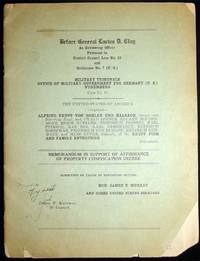
1949ref. 027267Washington D.C.: U.S. Government 1949. 25 pages; inscribed by the author "Frida My best Joe" on the cover and with a hand-written note on The Dodge Hotel Washington D.C. letterhead paper referring to details of this landmark WWII case: ".Dear Frida: General Clay affirmed the confiscation about ten days ago but with some awfully strained wording last Sunday's Times. I am fighting it out by cable. Hope to be in next week. Cordially Joe." Joseph William Kaufman 1899 - 1981 lawyer and judge; ".made his most distinctive mark as a prosecutor in the Nuremberg war crime trials. He functioned as a deputy chief counsel overall and as chief prosecutor at the trial of Alfried Krupp and eleven other executives of the Krupp armaments industries. The Krupp trial held in the Palace of Justice in Nuremberg lasted eleven months and resulted in the conviction of the defendants for the crimes of plunder and using slave labor. They were found not guilty of the charge of waging aggressive war. Kaufman was praised by contemporaries for his handling of the difficult and detailed case." Barry Ryan in the ANB The text of this "memorandum" defends the confiscation of the Krupp holdings refuting the arguments used by the defense against the decree point by point. ".For nearly 11 months the Krupp case unfolded in a sprawling dirty gray sandstone courthouse known as the Palace of Justice where the other major war crimes trials had been held. More than 200 witnesses were called and 4200 exhibits offered and the transcript of the proceedings ran to 13454 pages. Mr. Kaufman's presentation of the evidence was later praised by colleagues as detailed thorough and overwhelming. He told of atrocities and offenses that included murder torture enslavement imprisonment deportation and other abuses against Jews and other civilians as part of a conspiracy with Hitler to dominate the world." 1981 Robert D. McFadden NY Times obituary Also laid-in is a partial article by General Lucius Clay concerning the trial proceedings particularly that of the I.G. Farben corporation. The Memorandum printed at The Court Press N.Y.C. Approx. 8" x 10 1/2" size; light green stapled paper covers; corners chipped sunned; contents with light wear bottom corner chipped away no loss to text. In good condition. Inscribed By Author. First Edition. Soft Cover. Good. U.S. Government paperback
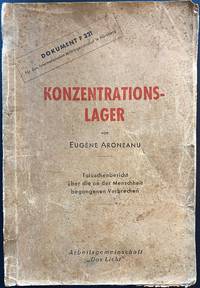
1945ref. 43099No Place Baden-Baden: Arbeitsgemeinschaft "Das Licht 1945. Paperback. No Date 1945 1st edition original printed paper wrappers. Large 8vo 130 pages plus 56 unnumbered pages of photo plates. 27 cm. In German. Title translates as “Concentration Camps: Factual Report on the Crimes Committed Against Humanity. Document F 321 for the International Military Tribunal in Nuremberg.” Compiled by Eugène Aroneanu the creator of the concept of “Crimes Against Humanity under International Law” with the first prosecution under this concept taking place during the Nuremberg trials against defeated leaders of Nazi Germany as outlined in this work. Includes 17-page list of camps and prisons on pages 113-130 listing the name location and type of each camp. This report provides the evidentiary material given to each participant of the Nuremberg Military Tribunal to become acquainted with the evidence to be presented. The report recounts the German crimes against humanity detailing deportation detention concentration camps tortures medical experimentation execution gassing and incineration. It also delineates the web of procedures and complex organizational structure of concentration and extermination camps set up by the Germans during the course of Nazi rule. With an appendix of dozens of unimaginably gruesome photographs. Table of contents translated: - Foreword - List of witnesses reports and documents - The four main Nazi accusations - Deportation departure / arrival - Internment admission / theft / clothing / housing / food / hygiene - Administration and camp regulations distinction between prisoners - Camp life discipline / customs / religion / everyday scenes / roll call / punishments and torture - Work men's work / women's work - Sanitary conditions illnesses / medical examinations / hospital accommodation / sick conditions / nursing and treatment of the sick / abortions / childbirths / sterilization of women / sterilization and castration of men / the German medical corps - Medical experiments and vivisection - Various executions - Repercussions on the prisoners revolt escape suicide - Extermination selection in the camp / selection upon arrival / gassing and cremation - Liberation - Number of deaths percentage / balance - Before the war - Appendix - List of the camps commandos and prisons used for incarceration - Illustrations Eugène Aroneanu “was a Romanian lawyer resistance fighter and author of several works on international law. In the mid-1930s he emigrated to Paris. When World War II broke out in September 1939 he conducted radio broadcasts to Romania. When France was occupied in 1940 he joined the French Resistance operating underground under the name Aréne. In 1943 he managed to escape to Switzerland . Aroneanu authored 58 publications. In 1945 he was tasked with compiling a documentation of Nazi wartime atrocities for the Nuremberg Trials. He also drafted a corresponding legal plea intending to expand the prosecution beyond the treatment of the extermination of the Jews as merely a crime against peace and war crimes as desired primarily by the British to include the new territory of crimes against humanity under international law” Wikipedia SUBJECTS: World War 1939-1945 -- Concentration camps. Holocaust Jewish 1939-1945 -- Personal narratives. -- Atrocities. Guerre mondiale 1939-1945 -- Camps d'internement. Holocauste 1939-1945 -- Re´cits personnels. -- Atrocite´s. Internment camps. Crimes against humanity -- Germany. OCLC: 37149416. Light wear to wrappers toning to paper Very Good Condition overall. BK5 Holo2-162-39XX-EGGACC-'l. No Place [Baden-Baden]: Arbeitsgemeinschaft "Das Licht paperback
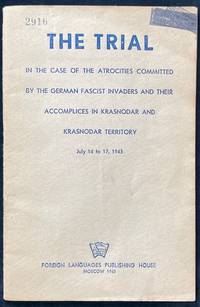
1943ref. 42274Moscow Foreign Languages Pub. House 1943. Paperback. 1st English Language Edition. Original Wrappers. 8vo. 40 pages; 19 cm. Koppel Pinson's copy with gift bookplate. Contemporary account published in 1943 of the very first war crimes trial against Nazi defendants held following the Russians’ recapturing of Krasnodar From the Germans who had occupied it. SS-sonderkommando units massacred thousands of Russian citizens Jews and communists. The trials were held immediately in the summer of 1943 while the war against Hitler was ongoing. Includes transcript from the trial and gruesome photographs of the victims of the atrocities. SUBJECT S : War crimes -- Soviet Union. OCLC: 11136869. Small donation bookplate number on margin of final leaf otherwise Very Good condition excellent copy. Very important. B holo2-135-10-LWWEV-'mmacc. Moscow, Foreign Languages Pub. House paperback