Nuremberg War Trials StaffBiblio.com
212 Ergebnisse
Best.-Nr. 68457175-6A M S Press Incorporated. Used - Good. Former library copy. Pages intact with minimal writing/highlighting. The binding may be loose and creased. Dust jackets/supplements are not included. Includes library markings. Stock photo provided. Product includes identifying sticker. Better World Books: Buy Books. Do Good. A M S Press, Incorporated unknown
1949Best.-Nr. 046935Wash.: GPO. inner hinges cracked; trial of von Weizsaecker Lammers and others; this is from the 15 vol. set on the trials after the main Nuremberg Trial of 1946 . Good. Hardcover. First. 1949. GPO hardcover
1950Best.-Nr. 046933Wash. D.C.: GPO. nice copy; front inner hinge cracked . Very Good. Hardcover. First. 1950. GPO hardcover
Best.-Nr. 35865Broché, 21X13 cm, 2006, 384 pages, éditions Belin. Légère marque de pliure en angle du second plat, bon exemplaire.
2014Best.-Nr. 108762Hirmer Publishers. New. Paperback. FREE UPGRADE to Courier/Priority Shipping Upon Request - IN STOCK AND IMMEDIATELY AVAILABLE FOR SHIPMENT - Flawless copy brand new pristine never opened - Text in English and German. -- with a bonus offer-- . 2014. 3777422185 . Hirmer Publishers paperback
Le document consigne les sentences des différents procès du 20 août 1947 au 31 Juillet 1948: procès des médecins, des juges, des industriels tels que Flick et Krupp et des Einsatzgruppe. Les chefs d'accusation sont "conspiration, crime contre l'humanité, crime de guerre, appartenance à la SS, spoliation, aryanisation, esclavagisme, meurtres de masse, crimes contre la paix".
Best.-Nr. 320Bibliothèque-Charpentier-Eugène Fasquelle, éditeur, Paris, 1909 et 1907. In-12, demi-percaline bleue, pièce de titre peau sciée, titre en lettres dorées, couverture conservée, 356 et 340 pp. Nuremberg, paysage austère - Le Rococo et la frivolité - Le paysage de l'idéalisme et Francfort, le paysage maternel - Wetzlar, le paysage de Werther - Weimar, le paysage des folies - La route de Belvédère - Le paysage du ...
1770Best.-Nr. 27651Paris CHEREAU 1770 une vue d'optique en couleurs, GRAVÉE A L'EAU-FORTE ET AQUARELLÉE, format de la gravure : 42 x 30,5 cm, sans date (1770) à Paris chez CHEREAU rue St Jacques Editeur
1945Best.-Nr. 61-1168Nurnberg: Nuremberg Military Tribunal 1945. 1945. 7 stenciled pages. Brief biographies of the 21 defendants a plan of the court room showing the layout of the tables and seating. Neat contemporary annotations on the plan as to the locations of individuals and support staff. Paper toned. Stapled. Apparently a handout for those attending the proceedings. Very Good Copy. Paperback. Very Good. Book. (Nuremberg Military Tribunal), 1945. Paperback
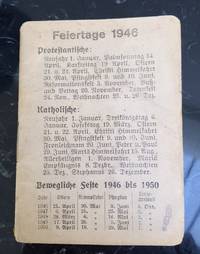
1946Best.-Nr. 132911946. Kesselring Albert. Personal diary kept during imprisonment following the Second World War and during the Nuremberg war crimes proceedings. Albert Kesselring served as Field Marshal in the German Luftwaffe and commanded major German military operations in multiple theaters of the war including air campaigns in Poland and France the Battle of Britain operations during the invasion of the Soviet Union and later the Mediterranean and Italian fronts. After Germany's defeat he was arrested and prosecuted for war crimes committed during the German occupation of Italy. This diary documents his daily life during the immediate postwar period while he remained under Allied custody and while the major trials of German leaders were underway at Nuremberg. Entries note visits court appearances and personal reflections recorded during a period when former senior commanders awaited the outcome of postwar legal proceedings. Personal pocket diary for the year 1946 containing 58 pages with scattered pencil entries written by Albert Kesselring. The calendar format volume measures approximately 4 x 6 inches. The entries record numerous visits from his wife Paulina whom Kesselring notes simply as "Liny" and also mark the dates on which he traveled to Nuremberg to testify during the trial of Hermann Göring on February 15 April 26 and May 14. The diary concludes with a handwritten entry on December 31 reading "All's well that ends well!" reflecting Kesselring's outlook at the close of the year. Following the war Kesselring was tried by a British military tribunal for actions carried out during the German occupation of Italy and initially received a death sentence. The sentence was later commuted and he was released from imprisonment in 1952. Personal writings from senior German military commanders during the immediate postwar years provide direct documentary evidence of how individuals connected to the German war effort experienced detention testimony and the legal processes that followed the collapse of Nazi Germany. Slight foxing to the verso of the cover. Overall condition very good. unknown
1946Best.-Nr. 132911946. Kesselring Albert. Personal diary kept during imprisonment following the Second World War and during the Nuremberg war crimes proceedings. Albert Kesselring served as Field Marshal in the German Luftwaffe and commanded major German military operations in multiple theaters of the war including air campaigns in Poland and France the Battle of Britain operations during the invasion of the Soviet Union and later the Mediterranean and Italian fronts. After Germany's defeat he was arrested and prosecuted for war crimes committed during the German occupation of Italy. This diary documents his daily life during the immediate postwar period while he remained under Allied custody and while the major trials of German leaders were underway at Nuremberg. Entries note visits court appearances and personal reflections recorded during a period when former senior commanders awaited the outcome of postwar legal proceedings. Personal pocket diary for the year 1946 containing 58 pages with scattered pencil entries written by Albert Kesselring. The calendar format volume measures approximately 4 x 6 inches. The entries record numerous visits from his wife Paulina whom Kesselring notes simply as "Liny" and also mark the dates on which he traveled to Nuremberg to testify during the trial of Hermann Göring on February 15 April 26 and May 14. The diary concludes with a handwritten entry on December 31 reading "All's well that ends well!" reflecting Kesselring's outlook at the close of the year. Following the war Kesselring was tried by a British military tribunal for actions carried out during the German occupation of Italy and initially received a death sentence. The sentence was later commuted and he was released from imprisonment in 1952. Personal writings from senior German military commanders during the immediate postwar years provide direct documentary evidence of how individuals connected to the German war effort experienced detention testimony and the legal processes that followed the collapse of Nazi Germany. Slight foxing to the verso of the cover. Overall condition very good. unknown books
Best.-Nr. 25574LETTERS: 9 July 1953 and 11 May 1954. NOTE: 14 July 1953. All three items on letterheads of the Royal Courts of Justice Strand London WC2. The third letter gives an excellent indication of Birkett’s pride in his use of language. See his entry in the Oxford DNB. The recipient Vere Henry Collins 1872-1966 was an author and grammatical stickler. All three signed ‘Norman Birkett’. In fair condition lightly aged and little grubby. The first letter with a small hole to one corner and the two leaves of the last letter held together with a pin. ONE: ALS 9 July 1953. 1pp 4to. He is adding Collins’s book to his ‘select library on “words”’. ‘I am afrait that “finalise” is in frequent use as “I was sent to finalise the arrangements” and it is often used by witnesses in court and sometimes not without protest from me by barristers.’ He ends: ‘But the purpose of this letter is to thank you if somewhat belatedly for the interest you took in the subject of my address and for your kindness in writing to me.’ TWO: ANS 14 July 1953. 1p 4to. He has no objection if Collins adds the note he sends him ‘to the book now at the printers’. He will get ‘One Word and Another’ when it is published. THREE: ALS 11 May 1954. 3pp 4to. He will read the book Collins has sent him with great pleasure ‘for as you know anything written about words has a great fascination for me’. Turning to Collins’s ‘criticism of some remarks of mine uttered in the course of an after-dinner speech’ which have appeared without Birkett’s knowledge or consent he is for the most part in agreement ‘but I take it a little hard that the unpremeditated effusion of the moment should be treated as though it were a carefully prepared essay. I will say no extempore speech can survive a scrutiny such as the scrutiny you send to me.’ With regard to Collins’s seven points he feels he should ‘keep in mind the difficulties of extempore speaking. The perfect word does not always come readily to the tongue. The sentences do not always flow as one could wish and the “verbal expert” seated in his comfortable study might make a little allowance for human frailty!’ In the following paragraph he turns the tables on Collins analysing his use of language in his letter to Birkett. With a veiled criticism of Collins he explains how ‘the lover of words as I am can become a “tiresome pedant” ’ Collins’s criticism has clearly hit home as Birkett adds a fourteen-line postscript in his distinctive close hand ending: ‘I cannot even be sure that the reporter took down accurately what I did say: I had no notes and never dreamt that what I said would receive this unwanted publicity and subject me to the criticism of lovers of good English!’ LETTERS: 9 July 1953 and 11 May 1954. NOTE: 14 July 1953. All three items on letterheads of the Royal Courts of Justice, Strand, unknown