rif. 05256Paris: Chez Aubert & Cie. Editeurs 1848. When the Women Took Up Arms - and the Men Took Up the Babies! The Vésuviennes: Twenty Superb Hand-Colored Lithographs Satirizing the Women's Emancipation Movement of 1848 BEAUMONT Charles-Édouard de. Les Vésuviennes ou les Soldats pour rire. The Vésuviennes or Soldiers for a Laugh. Paris: Chez Aubert & Cie. Éditeurs 1848; this publisher's album issue not before 1856. Folio 12 15/16 x 9 3/4 inches; 328 x 247 mm. Elaborate pictorial lithograph title-page and twenty superb hand-colored lithograph plates all heightened with gum arabic. Complete. Publisher's original lithographed pale green front wrapper entitled Album Comique par E. de Beaumont advertising Le Journal amusant and Le Petit Journal pour rire at 20 rue Bergère Paris. Rear wrapper expertly replaced with nearly identical paper. Original glassine wrapper preserved. An exceptionally fine copy the coloring exceptionally fresh and brilliant throughout. Housed in a felt-lined clamshell case of half black morocco over gray cloth boards spine with five raised bands ruled and lettered in gilt. An exceptionally attractive and complete collection of twenty brilliantly colored political and social caricatures satirizing one of the most controversial manifestations of the women's emancipation movement during the French Revolution of 1848. Following the overthrow of King Louis-Philippe in February 1848 and the proclamation of the Second Republic Paris witnessed an extraordinary outburst of political activity. Women who remained excluded from the newly expanded male electorate organized clubs published newspapers attended public meetings and demanded a greater voice in political and social affairs. Among the most notorious figures to emerge from this turbulent period were the Vésuviennes named after Mount Vesuvius whose volcanic eruptions provided an irresistible metaphor for the supposedly explosive consequences of female emancipation. The Vésuviennes were popularly represented as a militant sisterhood of young women who demanded the right to bear arms wear trousers serve in the National Guard and enjoy complete equality with men including the reversal or redistribution of traditional domestic responsibilities. The historical reality behind this sensational movement is considerably more complicated. Contemporary reports document women identifying themselves as Vésuviennes including working-class women associated with Belleville. However the existence of the organized female military legion so enthusiastically described by contemporary satirists has been seriously questioned by modern historians. Some have suggested that much of the legend originated in hostile journalism deliberate fabrication or efforts to discredit the emerging feminist movement. Whether real imaginary or an ingenious mixture of the two the Vésuviennes proved an irresistible subject for the caricaturists of Paris. Charles-Édouard de Beaumont 1819-1888 one of the most prolific illustrators associated with Le Charivari responded with this wonderfully entertaining series of twenty lithographs originally published in 1848. In Beaumont's topsy-turvy world women become soldiers sentries corporals sergeants and commanding officers while their husbands are reduced to the less glamorous occupations of childcare sewing and domestic obedience. Armed with rifles swords and an apparently inexhaustible supply of self-confidence his young heroines patrol the streets arrest unfortunate civilians supervise military exercises and enthusiastically demonstrate their newly acquired authority. The resulting scenes are delightful examples of Beaumont's lively draughtsmanship and comic imagination. One unfortunate husband protests that his wife has abandoned him with three children and not even a feeding bottle. A young female sentry threatens to skewer a gentleman with her bayonet unless he responds correctly to her challenge. Another Vésuvienne refuses to sew a button onto a comrade's uniform while a female sergeant orders the arrest of a man whose only apparent offense has been to submit to a beating from his wife. Perhaps the most amusing lithograph depicts the enrollment of the Vésuviennes in the Napoleonic party under the command of the formidable Joséphine Frenouillot who exploits her resemblance to Napoleon Bonaparte to persuade her troops that the Emperor is still alive. Although Beaumont's satire reflects contemporary anxieties about female independence and the disruption of established gender roles his caricatures are not without ambiguity. His attractive energetic and frequently resourceful female protagonists often appear considerably more capable than the bewildered men whom they dominate. The artist's mockery is directed as much toward the absurdities of masculine authority as toward the ambitions of the women themselves. The series is thus not merely a collection of amusing lithographs but an important visual document of the political and cultural conflicts surrounding women's emancipation during one of the most revolutionary years in nineteenth-century French history. A bibliographically interesting publisher's album issue. The twenty lithographs belong to Beaumont's original series of 1848 while the surviving pale green publisher's wrapper advertises Le Journal amusant and Le Petit Journal pour rire both established in 1856. The present album was therefore issued or assembled in its surviving wrapper no earlier than that year. The precise date of this album issue has not been established. Complete copies retaining their publisher's wrappers particularly in such fresh hand-colored condition are especially desirable. The Twenty Lithographs - French captions with English translations. The translations preserve the humor colloquial expressions and military terminology of the originals. 1. Mâme Coquardeau j'te défends d'aller au rappel. n'y a pas d'bon sens de me laisser comme ça avec trois enfans sur les bras. et pas de biberon !. "Madame Coquardeau I forbid you to go off to the military assembly!. It makes no sense to leave me here with three children on my hands. and not even a feeding bottle!." 2. Grosse Ronde-Major. "The Major's Grand Inspection Round." 3. Entre Deux Patrouilles. "Between Two Patrols." 4. Tambour tes flas commencent à être agréables mais trop souvent tes ras sont ratés !. "Drummer your flams are beginning to sound quite good but your rolls are still all too often botched!." 5. Tiens Virginie c'est la première fois qu'on peut se flatter de m'avoir mise au pas !. "Well Virginie this is the first time anyone can boast of having made me march in step!." 6. Comment p'tite malheureuse je te donne un état honorable je te mets dans les chemises d'homme et v'là que je te r'trouve dans les culottes d'une Vésuvienne. va tu n'es plus ma fille !. "What! You wretched little creature! I give you a respectable occupation set you up making men's shirts and now I find you wearing the trousers of a Vésuvienne!. Away with you! You're no longer my daughter!." 7. Qui vive . Eh ! mais je ne me trompe pas c'est m'am'selle Virginie ! N'y a pas de Virginie qui tienne. réponds au qui vive ou j't'embroche !. "Who goes there." "Why surely I'm not mistaken! It's Mademoiselle Virginie!" "Never mind who I am!. Answer the challenge or I'll run you through with my bayonet!." 8. Danger d'insulter une femme armée. "The Danger of Insulting an Armed Woman." 9. Il est gentil tout d'même notre vivandier. allons versez petit. "Our canteen boy really is rather sweet isn't he. Come along pour us another drink my boy." 10. Me conseilles-tu de me mettre une barbe . "Do you think I ought to grow a beard." 11. Allons habille-toi Clorinde essaye ton uniforme. je t'apporte une carabine toute neuve elle est à piston. Tiens j'croyais qu'il n'y avait que la trompette de m'sieu Dufrène qui était à piston ! "Come along get dressed Clorinde try on your uniform!. I've brought you a brand-new carbine; it's got a percussion mechanism." "Well! I thought Monsieur Dufrène's trumpet was the only thing with pistons!" 12. Entre camarades. "Between Comrades." 13. Prête-moi donc la plume de ton chapeau de paille d'Italie j'ai envie de l'ajouter encore à mon panache. "Do lend me the feather from your Italian straw hat. I'd like to add it to my plume." 14. Phrasie. recouds-moi rien que ce bouton-là je n'peux pas sortir sans ça !. Plus souvent !. "Phrasie just sew this one button back on for me. I can't possibly go out without it!." "Not on your life!." 15. Sergente. voici un homme à fourrer au violon. la patrouille l'a surpris au moment même où il était en train d'être battu par sa femme. elle était bien fatiguée faut que ce soit un fier gueux !. "Sergeant!. Here's a man who ought to be thrown into the lockup!. The patrol caught him in the very act of being beaten by his wife. She was quite exhausted so he must be a thoroughly wicked scoundrel!." 16. Caporale faites courir après un homme qui se sauve. il m'a offensée moi factionnaire !. Il fallait l'arrêter toi-même !. Je n'ai pas pu. il m'a insultée par derrière. le lâche !. "Corporal send someone after that man who's running away!. He insulted me a sentry!." "You should have arrested him yourself!." "I couldn't!. He insulted me from behind. the coward!." 17. Un homme découvert pour avoir été surpris. Bourgeois si vous voulez ravoir votre chapeau c'est cinq sous !. "A Gentleman Deprived of His Hat for Being Taken by Surprise." "Citizen if you want your hat back that'll be five sous!." 18. Pour un Mobile. "For a Mobile Guardsman." 19. Eh bien pékines. qu'est-ce que vous attendez encore pour vous enrôler dans mon régiment "Well then you civilians!. What are you still waiting for Why haven't you enlisted in my regiment." 20. Enrôlement des Vésuviennes dans le parti Napoléonien. Joséphine Frenouillot abuse de sa ressemblance avec Napoléon pour faire croire à sa troupe que l'Empereur n'est pas mort comme la police en avait fait courir le bruit. "Enlistment of the Vésuviennes in the Napoleonic Party." "Joséphine Frenouillot exploits her resemblance to Napoleon to convince her troops that the Emperor is not dead as the police had spread rumors to the contrary. Paris: Chez Aubert & Cie. Editeurs, 1848 unknown books
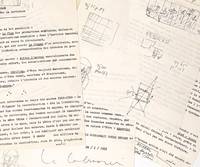
1951rif. 3031Paris: np 1951. first edition. folder. Very Good. UNIQUE ANNOTATED TYPESCRIPT SIGNED WITH TWO FULL PAGES OF LE CORBUSIER DRAWINGS PRESENTING ONE OF HIS MOST FAMOUS AND INFLUENTIAL PHILOSOPHICAL ACHIEVEMENTS. Born in 1887 Le Corbusier found himself situated between two competing historical and architectural moments: an intricate history of grandiose Gothic and Renaissance style and the sleek efficient creation of the Second Industrial Revolution. In his canonical 1923 Towards an Architecture Le Corbusier argued that modernity must be matched with architectural innovation. Functionality took a core place in Le Corubusier’s thinking. Houses were to be understood as machines for living said Le Corbusier famously and machines were to be governed by the economies in which they existed. From this conviction came Le Corbusier’s famous villas his massive housing blocks in the suburbs of Paris and perhaps most importantly a fathering of modern architecture as defined by an emphasis on function simplicity and new material Towards an Architecture. In 1942 Le Corbusier was asked to create a universal measurement for construction materials. What Le Corbusier deemed necessary was not only the creation of a new unit but the arduous task of unifying metric and Anglo-Saxon systems integrating the inch and the centimeter into one intuitive scale. Although an ambitious project this unification coined Modulor existed within the ethos of Le Corbusier’s New Architecture. As Le Corbusier identified it the importance of an architect was in their giving of “a physical order which we feel to be in accordance with that of the world.” This order was not only in aesthetic sleekness but in an ethos of design that mirrored the social moral and political reality surrounding the architect. Therefore units of measurement —as enablers of creation—were to reflect modern efficiency with new universal standards Towards an Architecture. It was not immediately clear what should be the basis for the new standardized units. Metric and Anglo-Saxon systems after all are based on different ‘orders’—a meter defined by the speed of light a law of science; a foot defined by the proportions of the human body. Le Corbusier framed this tension in this rare manuscript: “the human body exists on one side and the mathematicians on the other.” Le Corbusier struggled with the concept of the Modulor over many years and the present text dated by Le Corbusier 28/1/1951 represents a more mature and developed presentation of his theories. It reads as a manifesto-like preamble to the Modulor’s ambitions in the postwar world: to “harmonize the flow of worldwide production” to systematize standardization without deadening compromise and to reduce the friction of incompatible systems metric versus foot–inch. Le Corbusier presents the Modulor as a human-scale “gamut” of measurements—explicitly compared to the musician’s scale—grounding chosen dimensions in bodily proportion and number. He invokes the golden ratio and the Fibonacci series as ordering principles and includes the well-known endorsement attributed to Einstein “a scale of proportions that makes the bad difficult and the good easy” framing the Modulor as a tool of order rigor and harmony applicable from the architect’s drafting table to the engineer’s office and the building site. The two full drawing sheets marked with figure callouts e.g. “Fig. 35…” “Fig. 65…” “Fig. 100…” and geometric/proportional constructions including a right-angle scheme marked “90°” and φ symbols reinforce the document’s working character: argument paired with visual proof capturing Le Corbusier’s drive to make proportion not merely theoretical but operational. Although we haven’t been able to find this exact text published anywhere the present typescript closely aligns—often in phrasing and argumentative sequence—with Le Corbusier’s published presentation of the Modulor and can be read as a self-contained “preamble” distilled from that larger project. However the dated and signed terminal leaf 28 January 1951 and the presence of working ink annotations and separate diagram leaves with figure callouts suggest an independent studio or promotional iteration rather than a simple excised page from a printed book documenting the Modulor as an evolving actively circulated tool. The Modulor proved enduringly influential as a conceptual and pedagogical framework for proportion—reinforced by its use in Le Corbusier’s own buildings and its broad afterlife in architectural discourse—even as it never achieved its founder’s ambition of becoming a universally adopted international standard of measurement. Paris: January 28 1951. Text in French. 6 leaves each approx. 8.25 × 10.75 in.; with writing or drawings on rectos only including 4 typed leaves with ink annotations and small drawings; 2 leaves of original drawings; last typed leaf signed and dated. In excellent condition with only very light toning and minor handling wear consistent with working material. English translation available upon request. A UNIQUE FIRST-HAND ACCOUNT WITH NUMEROUS DRAWINGS PRESENTING ONE OF LE CORBUSIER'S CORE PHILOSOPHIES. np unknown
1951rif. 3031Paris: np 1951. first edition. folder. Very Good. UNIQUE ANNOTATED TYPESCRIPT SIGNED WITH TWO FULL PAGES OF LE CORBUSIER DRAWINGS PRESENTING ONE OF HIS MOST FAMOUS AND INFLUENTIAL PHILOSOPHICAL ACHIEVEMENTS. Born in 1887 Le Corbusier found himself situated between two competing historical and architectural moments: an intricate history of grandiose Gothic and Renaissance style and the sleek efficient creation of the Second Industrial Revolution. In his canonical 1923 Towards an Architecture Le Corbusier argued that modernity must be matched with architectural innovation. Functionality took a core place in Le Corubusier’s thinking. Houses were to be understood as machines for living said Le Corbusier famously and machines were to be governed by the economies in which they existed. From this conviction came Le Corbusier’s famous villas his massive housing blocks in the suburbs of Paris and perhaps most importantly a fathering of modern architecture as defined by an emphasis on function simplicity and new material Towards an Architecture. In 1942 Le Corbusier was asked to create a universal measurement for construction materials. What Le Corbusier deemed necessary was not only the creation of a new unit but the arduous task of unifying metric and Anglo-Saxon systems integrating the inch and the centimeter into one intuitive scale. Although an ambitious project this unification coined Modulor existed within the ethos of Le Corbusier’s New Architecture. As Le Corbusier identified it the importance of an architect was in their giving of “a physical order which we feel to be in accordance with that of the world.” This order was not only in aesthetic sleekness but in an ethos of design that mirrored the social moral and political reality surrounding the architect. Therefore units of measurement —as enablers of creation—were to reflect modern efficiency with new universal standards Towards an Architecture. It was not immediately clear what should be the basis for the new standardized units. Metric and Anglo-Saxon systems after all are based on different ‘orders’—a meter defined by the speed of light a law of science; a foot defined by the proportions of the human body. Le Corbusier framed this tension in this rare manuscript: “the human body exists on one side and the mathematicians on the other.” Le Corbusier struggled with the concept of the Modulor over many years and the present text dated by Le Corbusier 28/1/1951 represents a more mature and developed presentation of his theories. It reads as a manifesto-like preamble to the Modulor’s ambitions in the postwar world: to “harmonize the flow of worldwide production” to systematize standardization without deadening compromise and to reduce the friction of incompatible systems metric versus foot–inch. Le Corbusier presents the Modulor as a human-scale “gamut” of measurements—explicitly compared to the musician’s scale—grounding chosen dimensions in bodily proportion and number. He invokes the golden ratio and the Fibonacci series as ordering principles and includes the well-known endorsement attributed to Einstein “a scale of proportions that makes the bad difficult and the good easy” framing the Modulor as a tool of order rigor and harmony applicable from the architect’s drafting table to the engineer’s office and the building site. The two full drawing sheets marked with figure callouts e.g. “Fig. 35…” “Fig. 65…” “Fig. 100…” and geometric/proportional constructions including a right-angle scheme marked “90°” and φ symbols reinforce the document’s working character: argument paired with visual proof capturing Le Corbusier’s drive to make proportion not merely theoretical but operational. Although we haven’t been able to find this exact text published anywhere the present typescript closely aligns—often in phrasing and argumentative sequence—with Le Corbusier’s published presentation of the Modulor and can be read as a self-contained “preamble” distilled from that larger project. However the dated and signed terminal leaf 28 January 1951 and the presence of working ink annotations and separate diagram leaves with figure callouts suggest an independent studio or promotional iteration rather than a simple excised page from a printed book documenting the Modulor as an evolving actively circulated tool. The Modulor proved enduringly influential as a conceptual and pedagogical framework for proportion—reinforced by its use in Le Corbusier’s own buildings and its broad afterlife in architectural discourse—even as it never achieved its founder’s ambition of becoming a universally adopted international standard of measurement. Paris: January 28 1951. Text in French. 6 leaves each approx. 8.25 × 10.75 in.; with writing or drawings on rectos only including 4 typed leaves with ink annotations and small drawings; 2 leaves of original drawings; last typed leaf signed and dated. In excellent condition with only very light toning and minor handling wear consistent with working material. English translation available upon request. A UNIQUE FIRST-HAND ACCOUNT WITH NUMEROUS DRAWINGS PRESENTING ONE OF LE CORBUSIER'S CORE PHILOSOPHIES. np unknown books
rif. 05309Paris: Chez Aubert & Cie. Editeurs 1848. From the Boudoir to the Barricades - And Back Again! A Remarkable Collection of Ninety-Seven Lithographs by Charles-Édouard de Beaumont Including Two Complete Suites and Fifty-Seven Superb Hand-Colored Plates BEAUMONT Charles-Édouard de. Les Vésuviennes ou les Soldats pour rire. and Quartier de la Boule Rouge and La Guerre des Femmes and Fariboles and Au Bal Masqué and Les Jolies Femmes de Paris. Paris: Chez Aubert & Cie. 1846-ca. 1851. A remarkable collection of six celebrated series of Parisian social and political caricatures by Charles-Édouard de Beaumont comprising two complete suites and selections from four others. In all ninety-seven lithographic plates of which fifty-seven are beautifully hand-colored and heightened with gum arabic together with a pictorial lithographed title-page. Folio 13 1/8 x 10 inches; 334 x 254 mm. Late nineteenth-century quarter red morocco over marbled boards. Spine with five raised bands ruled in blind and lettered in gilt. Marbled endpapers. All plates mounted on stubs. The six series comprise: 1. Les Vésuviennes ou les Soldats pour rire. Paris: Aubert & Cie. 1848. Complete. Pictorial lithographed title-page and twenty superb hand-colored lithographs all heightened with gum arabic. An extraordinarily entertaining and historically significant series satirizing the supposed revolutionary regiment of women known as the Vésuviennes whose appearance in the political imagination of 1848 provoked considerable controversy. 2. Quartier de la Boule Rouge. Paris: Aubert & Cie. 1847-1848. Nineteen superb hand-colored lithographs all heightened with gum arabic selected from the larger series of fifty-one plates. A delightfully mischievous collection of Parisian social satire depicting the intrigues jealousies flirtations extravagances and romantic complications of fashionable life. 3. La Guerre des Femmes. Paris: Aubert & Cie. ca. 1848. One superb hand-colored lithograph heightened with gum arabic: plate 7 Complication de la crise. 4. Fariboles. Paris: Aubert & Cie. 1848-1849. Three superb hand-colored lithographs all heightened with gum arabic: plates 10 15 and 22. 5. Au Bal Masqué. Paris: Aubert & Cie. 1848-1851. Fourteen superb hand-colored lithographs all heightened with gum arabic selected from the larger series of forty-seven plates. A wonderfully amusing assortment of masked-ball scenes carnival disguises amorous misadventures and social encounters. Particularly noteworthy is plate 29 Le Roi du Carnaval de 1850 which provides an important indication of the series' chronology. 6. Les Jolies Femmes de Paris. Paris: Aubert & Cie. 1846. Complete. Forty fine black-and-white lithographs. One of Beaumont's most engaging explorations of fashionable Parisian society presenting an exuberant succession of romantic intrigues domestic misunderstandings extravagant fashions jealous lovers and the endlessly complicated relationships between men and women. Charles-Édouard de Beaumont 1821-1888 was among the most prolific and accomplished French caricaturists and lithographers of the nineteenth century. A contemporary of Daumier and Gavarni he contributed extensively to Le Charivari and other illustrated journals developing an especially recognizable style of social satire centered upon Parisian manners fashion courtship and relations between the sexes. His exceptional gift for capturing the comedy of everyday life is abundantly demonstrated in the present collection. The Vésuviennes and the Revolution of 1848: Of particular historical importance is the complete series Les Vésuviennes ou les Soldats pour rire created during the extraordinary political upheavals accompanying the French Revolution of 1848. Following the overthrow of Louis-Philippe and the establishment of the Second Republic demands for women's political and social emancipation assumed a new prominence. Among the more sensational manifestations of this movement was the proposed formation of a female military regiment whose members would wear masculine clothing bear arms and assert an unprecedented degree of independence. Known as the Vésuviennes these revolutionary women became the subject of numerous articles pamphlets and satirical illustrations. Whether such a military organization ever existed as described remains a matter of historical debate. Some historians have associated the name with genuine working-class feminist activism while others regard the supposed regiment largely as a creation of the contemporary satirical press calculated to ridicule demands for women's emancipation. In Beaumont's brilliant lithographs the traditional distinctions between masculine and feminine roles are gleefully reversed. Women become soldiers sentries officers and military commanders while men are reduced to domestic responsibilities or compelled to submit to the authority of their formidable female counterparts. The resulting images are frequently hilarious but beneath the comedy lies a revealing commentary upon the anxieties generated by the prospect of women's political and social equality. The exceptional appeal of the present album lies not merely in the beauty of its fifty-seven hand-colored lithographs but in the extraordinary range of Beaumont's subject matter. From the fashionable drawing rooms and clandestine romantic adventures of Paris to the revolutionary ferment of 1848 and the exuberant masquerades of the Parisian carnival these six series offer a wonderfully entertaining panorama of French society in the middle of the nineteenth century. A particularly desirable collection of ninety-seven lithographs by one of the foremost French caricaturists of his generation. Full listing of plates on application. Paris: Chez Aubert & Cie. Editeurs, 1848 unknown
rif. 05309Paris: Chez Aubert & Cie. Editeurs 1848. From the Boudoir to the Barricades - And Back Again! A Remarkable Collection of Ninety-Seven Lithographs by Charles-Édouard de Beaumont Including Two Complete Suites and Fifty-Seven Superb Hand-Colored Plates BEAUMONT Charles-Édouard de. Les Vésuviennes ou les Soldats pour rire. and Quartier de la Boule Rouge and La Guerre des Femmes and Fariboles and Au Bal Masqué and Les Jolies Femmes de Paris. Paris: Chez Aubert & Cie. 1846-ca. 1851. A remarkable collection of six celebrated series of Parisian social and political caricatures by Charles-Édouard de Beaumont comprising two complete suites and selections from four others. In all ninety-seven lithographic plates of which fifty-seven are beautifully hand-colored and heightened with gum arabic together with a pictorial lithographed title-page. Folio 13 1/8 x 10 inches; 334 x 254 mm. Late nineteenth-century quarter red morocco over marbled boards. Spine with five raised bands ruled in blind and lettered in gilt. Marbled endpapers. All plates mounted on stubs. The six series comprise: 1. Les Vésuviennes ou les Soldats pour rire. Paris: Aubert & Cie. 1848. Complete. Pictorial lithographed title-page and twenty superb hand-colored lithographs all heightened with gum arabic. An extraordinarily entertaining and historically significant series satirizing the supposed revolutionary regiment of women known as the Vésuviennes whose appearance in the political imagination of 1848 provoked considerable controversy. 2. Quartier de la Boule Rouge. Paris: Aubert & Cie. 1847-1848. Nineteen superb hand-colored lithographs all heightened with gum arabic selected from the larger series of fifty-one plates. A delightfully mischievous collection of Parisian social satire depicting the intrigues jealousies flirtations extravagances and romantic complications of fashionable life. 3. La Guerre des Femmes. Paris: Aubert & Cie. ca. 1848. One superb hand-colored lithograph heightened with gum arabic: plate 7 Complication de la crise. 4. Fariboles. Paris: Aubert & Cie. 1848-1849. Three superb hand-colored lithographs all heightened with gum arabic: plates 10 15 and 22. 5. Au Bal Masqué. Paris: Aubert & Cie. 1848-1851. Fourteen superb hand-colored lithographs all heightened with gum arabic selected from the larger series of forty-seven plates. A wonderfully amusing assortment of masked-ball scenes carnival disguises amorous misadventures and social encounters. Particularly noteworthy is plate 29 Le Roi du Carnaval de 1850 which provides an important indication of the series' chronology. 6. Les Jolies Femmes de Paris. Paris: Aubert & Cie. 1846. Complete. Forty fine black-and-white lithographs. One of Beaumont's most engaging explorations of fashionable Parisian society presenting an exuberant succession of romantic intrigues domestic misunderstandings extravagant fashions jealous lovers and the endlessly complicated relationships between men and women. Charles-Édouard de Beaumont 1821-1888 was among the most prolific and accomplished French caricaturists and lithographers of the nineteenth century. A contemporary of Daumier and Gavarni he contributed extensively to Le Charivari and other illustrated journals developing an especially recognizable style of social satire centered upon Parisian manners fashion courtship and relations between the sexes. His exceptional gift for capturing the comedy of everyday life is abundantly demonstrated in the present collection. The Vésuviennes and the Revolution of 1848: Of particular historical importance is the complete series Les Vésuviennes ou les Soldats pour rire created during the extraordinary political upheavals accompanying the French Revolution of 1848. Following the overthrow of Louis-Philippe and the establishment of the Second Republic demands for women's political and social emancipation assumed a new prominence. Among the more sensational manifestations of this movement was the proposed formation of a female military regiment whose members would wear masculine clothing bear arms and assert an unprecedented degree of independence. Known as the Vésuviennes these revolutionary women became the subject of numerous articles pamphlets and satirical illustrations. Whether such a military organization ever existed as described remains a matter of historical debate. Some historians have associated the name with genuine working-class feminist activism while others regard the supposed regiment largely as a creation of the contemporary satirical press calculated to ridicule demands for women's emancipation. In Beaumont's brilliant lithographs the traditional distinctions between masculine and feminine roles are gleefully reversed. Women become soldiers sentries officers and military commanders while men are reduced to domestic responsibilities or compelled to submit to the authority of their formidable female counterparts. The resulting images are frequently hilarious but beneath the comedy lies a revealing commentary upon the anxieties generated by the prospect of women's political and social equality. The exceptional appeal of the present album lies not merely in the beauty of its fifty-seven hand-colored lithographs but in the extraordinary range of Beaumont's subject matter. From the fashionable drawing rooms and clandestine romantic adventures of Paris to the revolutionary ferment of 1848 and the exuberant masquerades of the Parisian carnival these six series offer a wonderfully entertaining panorama of French society in the middle of the nineteenth century. A particularly desirable collection of ninety-seven lithographs by one of the foremost French caricaturists of his generation. Full listing of plates on application. Paris: Chez Aubert & Cie. Editeurs, 1848 unknown books