1 167 résultats
réf. SONG0230103804Used: Good unknown
réf. SONG0865712565Used: Good unknown
1938réf. 63447Boston & New York: Houghton Mifflin Co. 1938. Sml. 4to. 16 pp. Colour-illusts throughout. Tan publisher’s cloth black illustration & lettering front cover minor edgewear ex-lib markings on endpapers w/ d.j. cover art by Inez Hogan minor chipping head & foot of spine minor tears to corners some scuffing still VG/G copy. Early printing of this curious and subtly racist children’s story written in an affected southern Black dialect about a young African-American boy who always did the wrong thing. Although once considered standard reading in many secondary schools this book is now quietly considered fairly offensive and reinforcing of Black stereotypes. See: David Pilgrim Understanding the Book Epaminondas and His Auntie Jim Crow Museum Jan. 2009. Houghton Mifflin Co., hardcover
1915réf. 63112New York: Grosset & Dunlap ca. 1915. 8vo. 8 374 pp. Photo frontisp. 7 photo illust. Red cloth white lettering minor shelfwear faint tidemark wicked into fore-edges of plates at the very fore-edge w/ d.j. cover art with KKK rider on horseback next to heroine minor chipping head & foot of spine minor closed tears edgewear still G/VG- copy. First Photoplay edition of the notorious movie starring Lilian Gish Henry B. Walthall Mae Marsh Miriam Cooper Ralph Lewis George Siemann and others which steeped in the Confederacy’s Lost Cause mythos which had heavily influenced the misguided Dunning School’s interpretation of Reconstruction and significantly influenced Dixon and Woodrow Wilson. Directed by D.W. Griffith the movie was very successful but the racist overtones and blatant support of the Ku Klux Klan triggered widespread protests and it was banned in several cities. Very much like 21st-Century media Birth of a Nation’s portrayal of African-Americans created a justification for prejudice and discrimination which undermined Civil Rights for decades and reactivated the largely quiescent Ku Klux Klan movement and was the first film ever screened at the White House for President Wilson. See: Petaja Photoplay Edition p. 53; The Influence of “The Birth of a Nation” Facing History & Ourselves March 14 2016. Grosset & Dunlap, hardcover
1719réf. 62577Erie PA: Erie Litho & Printing Co. March 17 1923. Large double atlas folio dual-sided broadside printed on newsprint sized 9.25 x 42 in. photo & woodcut engraving illustrations recto & verso toning to paper some chipping & edgewear paper repairs to closed tears still a G- copy. First edition thus of this advertising broadside for Erickson’s “J.W. Johnson’s Old Reliable Virginia Minstrels World’s best colored show. . . “ which touts their supposed 15 year history and appear to have either been reformed from the “Alabama Minstrels” show which played throughout the West and Midwest from 1905-1914 or simply taken over some of their acts. The contortionist fire king Hi Henry Hunt who appears in this broadside regularly performed with the “Alabama Minstrels” from 1905-1913. The silver voiced tenor A.J. McFarland and Grace Arniot Royal Entertainer depicted on the broadside also appear to have been African-American rather than black face performers. The name appears to have been drawn from the 19th-Century original “Virginia Minstrels” or the “Melodious Ethiopian Band” which featured Billy Whitlokc Dick Pelham Frank Brower and Dan Emmett performing in New York’s Bowery Amphitheater in 1843 and launched the minstrelsy form of entertainment. Emmett is perhaps best remembered as the author of “Dixie” which ironically would become the Confederate States unofficial anthem. Assorted versions dating 1920-1924 with different content & sizing appear in 6 libraries Harvard DLC 3 versions Middle Tenn. State Lib. of VA; See: Dr. Karl Koenig The History & Music of the Minstrels Rue Basin Source for Historical Jazz 2024. Erie Litho & Printing Co., unknown
1936réf. 61085Washington D.C.: Associates in Negro Folk Education 1936. 8vo. 6 98 pp. Decorated tan softcovers Art Deco designs on front cover lettering in black gilt & red minor scuffing lower fore-edge front cover still a VG copy. First edition of this 4th installment in the storied “Bronze Booklet” series which quickly became a standard reference for teaching African-American history in the United States and Europe and addressed a number of racial conflicts and issues surrounding the impact of race on political and economic history. This important groundbreaking work by Bunche not only represented his most extended analysis of the issues of racism but also the role of race and racism in World economic and political conflicts Imperialism and inherent racism as well as the fact that race “has been used to whitewash some of the blackest pages in American history.” Bunche 1904-1971 was a leading African-American intellectual diplomat supporter of the US Civil Rights movement and would later be awarded the 1950 Nobel Peace Prize the first African=American so honored. Associates in Negro Folk Education, paperback
réf. DADAX0791415368New unknown
réf. DADAX0803949944New unknown
réf. SONG0789031086Used: Good unknown
réf. SONG0415105102Used: Good unknown
réf. SONG158826002XUsed: Good unknown
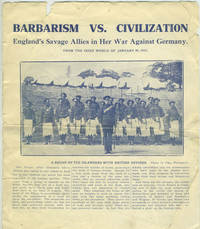
1915réf. 26775New York 1915. Irish propaganda targeting the British during W.W.I. from the Irish World of January 30 1915. During W.W.I the struggle for Irish independence was suspended with the Nationalist forces splitting over support of the war. This handbill appears to be an effort to incite hatred of the British with racist descriptions of Fijian soldiers "the cannibals we may say" who fought for the British. There is a clear preference for Germany - "And these are the savages the cannibals we may say whom Britain is bringing over to fight the most enlightened nation of Melancthon and SchlegeL of Kant. of Mozart and Beethoven and Wagner of Goethe and Heine." The text characterized the Fijians as cannibals "dark copper colored have black eyes and bushy hair worn in the form of a mop" short stature protruding stomachs legs bowed and feet flat and usually nude. The photograph shows the Fijian soldiers standing at attention behind a British Officer photo by Paul Thompson. The text of the handbill is extracted from The Irish World and American Industrial Liberator published in New York between 1878-1951. Hand bill 9 x 7 3/4" printed in blue on cream paper verso blank. Creased with marginal tears and small margin loss. Unrecorded on OCLC although there is a W.W.I poster with the title "Civilization Vs. Barbarism" 1914 but associated with Red Cross Week. OCLC: 894257435. unknown
réf. DADAX184277395XNew unknown
réf. DADAX0520066014New unknown
réf. DADAX0742560066New unknown
réf. DADAX0802077420New unknown
réf. DADAX0801488893New unknown
réf. DADAX1856494217New unknown
réf. SONG0739121995Used: Good unknown
réf. SONG0333643178Used: Good unknown
réf. DADAX0197265243New unknown
réf. DADAX0415724341New unknown
réf. DADAX036718527XNew unknown
réf. DADAX0190056746New unknown
réf. DADAX0231193734New unknown