LYDIAT, ThomasMareMagnum

1,407 results
1675In -4°, pp. (8), 126, (2), 200, 254 (i.e. 256). Legatura in marocchino rosso con stemma inciso ai piatti di Jacques-Nicolas de Colbert, tagli spruzzati. Al frontespizio nota di possesso manoscritta (“Bibliotheca colbertina”); ex libris “Wican free public library”. Ex libris Biblioteca Colbertina. Red morocco binding witha arms of De Colbert, marbled edges.
1998ref. 34245Chapel Hill North Carolina U.S.A.: Univ of North Carolina Pr. New. Paperback. FREE UPGRADE to Courier/Priority Shipping Upon Request - IN STOCK AND IMMEDIATELY AVAILABLE FOR SHIPMENT - FLAWLESS COPY PRISTINE NEVER OPENED -- 441 pages; clean and crisp tight and bright pages with no writing or markings to the text. -- DESCRIPTION: Examines the relation between phrenology and many artists particularly of the 19th century. -- with a bonus offer--; 520-Colbe; Colbert Charles A Measure of Perfection: Phrenology and the Fine Arts in America PHRENOLOGY ARTS ART PSYCHOLOGY Examines the relation between phrenology and many artists particularly of the 19th century. . 1998. 0807846732 . Univ of North Carolina Pr paperback
ref. 16-4296Genève: Jean-Leonard Pellet 1780. 8vo. 12 x 19.5cm. 10 vols. Without the atlas. Contemporary mottled roan; some small defects to the bindings. Gouged hole in the center of the first 4 pages in vol. 1.Engraved portrait frontispiece of Raynal after C.N. Cochin by N. de Launay in Vol. I 9 engraved frontispiece plates after J.M. Moreau le Jeune by de Launay and othersIn 1770 Raynal published the first edition of his Histoire philosophique et politique. In this effort he had the assistance of various members of the philosophe côteries—indeed Denis Diderot is credited with a third of this work. The other chief collaborators were Pechméja Holbach Paulze the farmer-general of taxes the Abbé Martin and Alexandre Deleyre. Banned in 1772 a new edition was published by Raynal in 1774 which was immediately placed on the index of banned books by the Roman Catholic church. The present edition appeared in 1780 and was more violently radical then any of the previous editions. Some of the ideas that Raynal was advocating were enough to ensure that a warrant for his arrest was issued and the book was condemned by the Parlement de Paris and burnt by the public executioner. Raynal escaped into exile and did not return until 1784. Despite the radical anti-colonialism tone of this work Raynal came to realize the impossibility of the peaceful revolution that he had advocated.Cohen/de Ricci 854; Phillips 652 atlas; Sabin 68081.not in OCLC.10 vol. in-8basane havane mouchetée époque dos à nerfs caissons ornés accidents et défautsd'usage aux reliures trous aux trois premiers feuillets du T. 1 rousseurs.Illustré d'un portrait de l'auteur gravé par De Launay d'après Cochin et de 9 planchesgravées d'après Moreau le jeune. Sans l'atlas. Genève: Jean-Leonard Pellet, 1780 unknown
1673ref. 148440Paris: Chez les Associez choisis 1673. Legal absolutism in the age of the Sun King First edition of this important codification of French commercial law in a contemporary limp vellum binding. One of Colbert's principal legal achievements the Commercial Ordinance imposes uniform legislative practices for commercial cases introduces standardized regulations for business practices and makes interest upon interest illegal. Jean-Baptiste Colbert 1619-1683 Louis XIV's chief minister for 20 years dominated French legislation in the mid-17th century. As part of his vast programme of absolutist reform he drove a major codification and standardization of French law. The overdue need for legal reform combined with a spirit of absolutist uniformity as idiosyncratic local systems were brought under a centrally imposed framework. Bluche claims that "it would provide a model for the enlightened despots of the next century" pp. 136-7. Quarto 240 x 175 mm pp. viii 120 24. Woodcut royal device to title woodcut head- tailpieces and initials to contents. Contemporary limp vellum spine and front cover lettered in manuscript. Elaborate contemporary annotation to p. 73. Early 19th-century ink inscriptions on financial & accounting business to endpapers and rear cover. Light bumping and wear infrequent spotting to covers inner hinges split but holding firm minor foxing to contents otherwise fresh: a very good copy indeed. Goldsmiths' 2037. François Bluche Louis XIV 1990. hardcover
1647ref. 3600Paris: Toussainct Quinet printed by Estienne Migon 1647. Dark brown gold-tooled calf ca. 1700 sewn on 5 cords. Folio. With title-page printed in red and black with a woodcut flower basket 4 divisional titles in red and black 48 full-page engraved plates of French infantry-men exercising with musket 35 and pike 13 after the models of Jacques de Gheyn 400 full-page or larger folding woodcut diagrams of battle formations all printed in red and black some also in yellow with troops represented by red and black dots one includes 30 small woodcut horse-drawn carts with various loads a few smaller woodcut illustrations large woodcut headpieces tailpieces and decorated initials 3 series and a few cast arabesque fleurons. First edition of a practical manual for use of the French army commanders composed by the French Marshall and Commander of the French Royal Guards by order of Louis XIV who wanted to establish a strictly uniform military science for his whole army. Jähns curtly mentions the work rather chauvinisticly as an imitation of Wallhausen's works which may be partly true as far as basic military principles are concerned but for its numerous practical applications and especially for its rich illustration of 17th century French army tactics Lostelneau's work stands on its own for its original contributions to the documentation of 17th-century military practice. It is also of special interest as an example of early colour printing in books with no less than 400 colour printed plates. Intended at the time as a purely practical aid the arrays of coloured dots in patterns of various symmetries can now also be appreciated as rather modernistic decorative art. Restoration to foot margin of title-page a few leaves slightly browned or waterstained but otherwise in good condition. Binding slightly rubbed with minor damage to the spine and edges. Magnificent thorough and well-illustrated manual documenting mid-17th-century French military practice and a feast of decorative coloured patterns for the modern eye.l Jhns p. 1293; Lipperheide 2080; Sloos Warfare 10003. Toussainct Quinet (printed by Estienne Migon), unknown
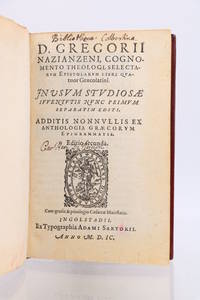
1599ref. 92210Ingolstadt: Adam Sartorius 1599. Fine. From the library of immense book collector and Sun King's minister Colbert Adam Sartorius Ingolstadt 1599 10.9 x 16.2 cm Relié Second edition published the year after the first. Text in Greek and Latin. Illustrated with the printer's device on the title page headpieces initials and tailpieces. Superb contemporary red morocco binding spine with five raised bands bearing Colbert's crowned cipher centre of both covers stamped with his arms boards framed three times in gilt gilt roll-tooling on the board edges all edges speckled spine very lightly sunned discreet rubbing to the corners board edges and spine-ends on one abrasion to the lower cover and a faint dark mark on one compartment of the spine. A sumptuous copy bound in morocco stamped with the arms and cipher of Colbert minister to Louis XIV. Colbert acquired a vast collection comprising Byzantine manuscripts and printed editions of Gregory of Nazianzus 4th-century theologian Doctor of the Church and Bishop of Constantinople. His second son Jacques-Nicolas Colbert 1655-1707 doctor of theology was himself Archbishop of Nazianzus like his illustrious predecessor. He too collected his works and had a later edition of Nazianzus's works bound in his own arms Bibliothèque de l'Institut des Sources Chrétiennes Lyon. At the head of the title page appears the manuscript ex-libris of his library written by his famous librarian Étienne Baluze. The luxurious binding is in ""Levant morocco which diplomats and scholars are asked to seek out alongside books medals and manuscripts . A memorandum preserved in the archives of the Bibliothèque du Roi records the use between 1668 and 1683 of 4104 morocco skins of which 1820 were allocated for the Colbertine library. The usual binder was Éloy Le Vasseur who also worked for the Bibliothèque du Roi and whose receipts and memoranda appear regularly in the registers of Carcavy and Baluze. The name of Bernard Picart also appears once. The calfskin or more often red morocco binding generally bears at the centre of the boards the arms or 'an undulating serpent palewise azure' surmounted in the earliest period by an open helm facing forward with seven bars the spine with raised bands then bearing in the compartments the title in gilt capitals and a lozenge-shaped tool. In 1668 Colbert had Simon Thomassin the Elder engrave four bookbinder's tools for his library. These were doubtless the coat of arms surmounted by a marquis's coronet and encircled by the collars of the king's orders to which the minister had been appointed grand treasurer in 1665. The spine thereafter bore the title and the cipher formed of the interlaced initials JBC sometimes accompanied by the serpent within a gilt dentelle border"" reports Denise Bloch Histoire des bibliothèques françaises - t. II Les bibliothèques sous l'Ancien Régime 1530-1789. In 1672 Simon Thomassin engraved new tools - a note on the flyleaf dates the binding tool to this last set of arms. Like his former patron Cardinal Mazarin before him Colbert assembled one of the largest and finest libraries in France which he continually expanded until the end of his life. A bibliomane ahead of his time he engaged numerous correspondents charged with tracking down books not only in France's provinces but across all of Europe. His library like the king's he also took care of became one of the great European repositories of Greek philology: acquisitions copies and groupings of manuscripts brought hundreds of sources to Paris to feed the work of Hellenists and scholarly editors. Two months after Colbert's death in 1683 his family had the books in his library inventoried comprising more than 20000 printed volumes and more than 8000 early manuscripts. The Colbertine book collections passed first to the Marquis de Seignelay then to the Archbishop of Rouen Jacques-Nicolas Colbert and finally to Colbert's grandson Charles-Eléonor Comte de Seignelay: ""The Adam Sartorius hardcover
1669ref. 167114Paris: Chez Frederic Leonard 1669. Codifying the law of the ancien régime A collection of statutes passed by the Sun King including Colbert's landmark forest ordinance "a monument of legislative wisdom" de Colyat p. 78 which remained in force until the 19th century. Jean-Baptiste Colbert 1619-1683 dominated French legislation in his role as Louis XIV's chief minister from 1661 until his death in 1683. Colbert's programme of absolutist reform drove a major standardization of French law. The forestry legislation bound 20th in this volume was the product of eight years' work by a 21-man commission. They were charged with securing a stable supply of timber for shipbuilding largely by eradicating the widespread corruption in the forestry industry. The resulting ordinance codified a mass of medieval laws from Charlemagne onwards imposed uniform jurisprudence throughout the land and reformed various minor offences. The other edicts regulate government offices court jurisdictions and commercial regulations. The ninth provides that "les Nobles pourront faire le Commerce de Mer sans deroger a la Noblesse" the aristocracy will be able to trade at sea without compromising their noble status. All except the first are printed by Frederic Leonard 1624-1711 the royal and parliamentary printer. 24 works in one quarto 235 x 176 mm. Woodcut vignettes to title pages woodcut head- and tailpieces and initials to contents. Contemporary mottled calf spine lettered decorated and panelled in gilt edges sprinkled red. Ownership inscription of Jacques Triboudet royal counsellor mayor of Bourges and a lieutenant particulier magistrate dated 1749 on the title page of the first statute. Spine ends and corners professionally restored. Light rubbing upper front joint split but holding firm minor browning and foxing to contents small chip to upper margin of leaf B1 16th edict: a very good copy. H. A. de Colyar "Jean-Baptiste Colbert and the Codifying Ordinances of Louis XIV" Journal of the Society of Comparative Legislation vol. 13 no. 2 1912. unknown