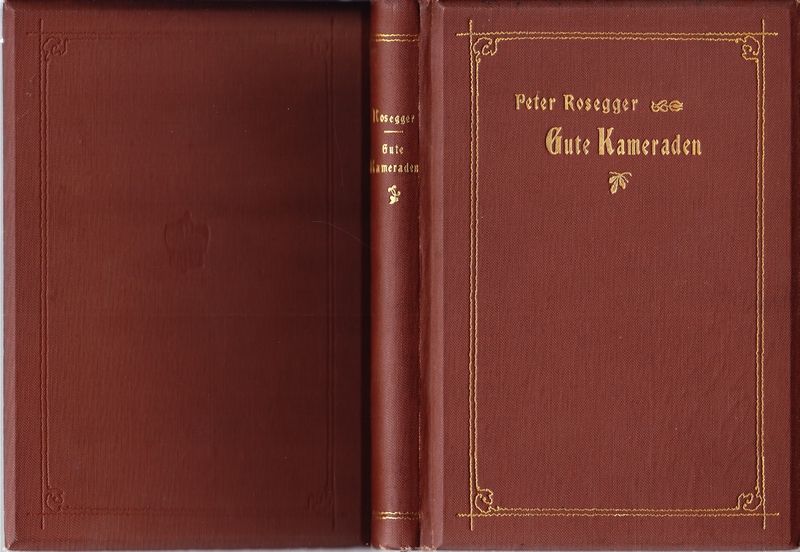
1904Best.-Nr. 26589BBerlin:, Schildberger., 1904. Gr.8°. 71 S. Original Interims-Karton mit Deckeltitel, unbeschnitten. Einband gerändert und mit einigen randseitigen Fehlstellen. Sonst gut erhalten.
Gr.8°. 71 S. Original Interims-Karton mit Deckeltitel, unbeschnitten. Einband gerändert und mit einigen randseitigen Fehlstellen. Sonst gut erhalten. Mit Verfasservorwort.
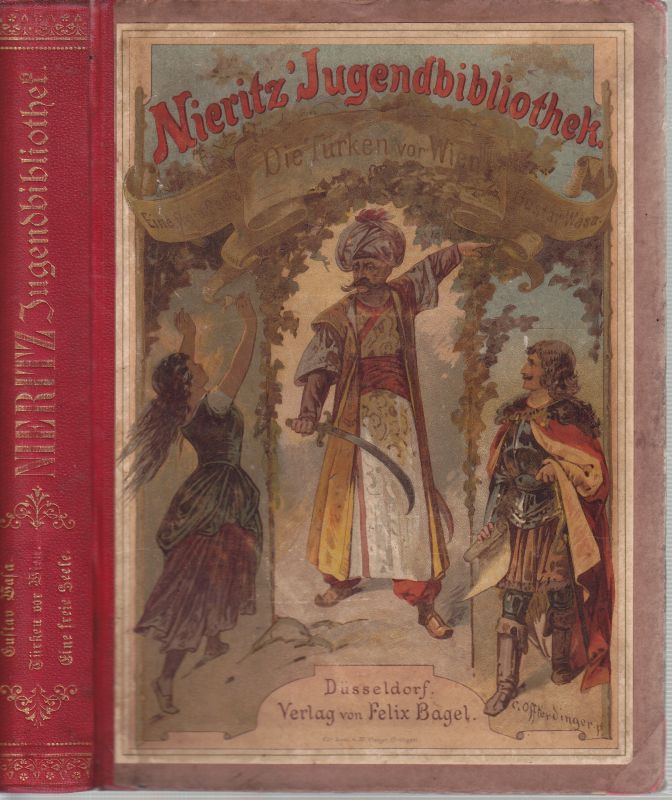
1884Best.-Nr. R0764-KDüsseldorf,Bagel [1884]. Neue Ausg. 319 S. mit farbigem Deckelbild u. 3 Chromolithogr. auf Taf. Ohln. mit mont. Deckelbild, etw. berieben, bestoßen u. fleckig, kl. Namensstempel auf Vors. u. Titel, tlw. etw. stock- bzw. fingerfleckig, insges. aber noch gut erh. - Nieritz' Jugendbibliothek
1969In-8 gr., tela edit., sovrac., pp. 140, con 127 ill. in b.n e colori nel testo. In buono stato (good copy).
Best.-Nr. 2566Koninklijk museum voor schone kunsten, Antwerpen, 1961. In-4, broché sous couverture illustrée en couleur, 172 pp. Woord vooraf - , W. Vanbeselaere - Herinneringen : Maurice Gilliams. - Jean Milo. - Over het vlaams expressionisme : W. Vanbeselaere. - F.M. Huebner. - Georg Schmidt. - W.E. Gessner. - André Lhôte. - Karel van de Woestyne. - ...
Best.-Nr. 2090Kestner-Gesellschaft, Hanovre, Katalog Nr. 5, 1956-1957. In-12, agrafé sous couverture illustrée en couleur, s.p. [40 pp.] Zur Ausstellung, W. Schmalenbach - Lebensdaten, Ausstellungen - Verzeichnis : Gemälde [54 n°]. - Druckgraphik [[13 n°].
1973This is an almost very good hardcover copy with light wear.The white illustrated boards have some toning. Also tan spots on the page-edges. Generally clean inside. Text in Russian, with English summary at the end. Plate list in English as well. Illustrated in color and black & white with 153 plates. This book is a history of the famous Russian glass company Gus Crystal which is known as one of the oldest centers of glass industry in Russia and stands on the Gus River. Gus-Khrustalny was founded in 1756 with the construction of a crystal plant, Gus Crystal. About half the plates show the glass of the late 18th and 19th centuries, the other half the glass of the 20th century. 12" X 9" wide, 214 pages. This book will be securely wrapped and shipped with tracking.
1986Best.-Nr. 62449ABHagen, v. d. Linnepe, 1986. gr. 8° 191 S., Ill., Kt. kart. Bibl.-Merkmale am Rücken, Vortitel und Einband, ans. guter Zustand Schriften / Westfälisches Industriemuseum ; Bd. 3.
1986Best.-Nr. 50547ABHagen, v. d. Linnepe, 1986. 27 cm. 191 S., Ill., Kt. kart. Sauber u. gut erhalten. Schriften / Westfälisches Industriemuseum ; Bd. 3.
Best.-Nr. 2908Galerie nationale du Jeu de Paume, Paris, 1999. In-4, broché sous couverture illustrée en couleur et rempliée, 286 pp. L'art japonais et le culte de "l'imperfection", par Antoni Tàpies - Yoshihara Jiro : l'envers de l'épopée, par Michael Lucken - "Nul n'est prophète en son pays", le cas de Michel Tapié, par Eric Mézil - La peinture et le ...
1930Best.-Nr. 10263Berlin, Wien und Leipzig, Zsolnay, 1930. 194 S., 1 Bl. 8°. Original-Leinwand mit Schutzumschlag.
1893Best.-Nr. R3375-94Wien-Pest-Lpz.,Hartleben 1893. VI,(2),223,(1) S. mit 12 kleinen, ovalen Holzstichporträts neben den Kapitelüberschriften. Oln., innen ganz vereinzelt min. stockfleckig, sonst gut erh.
1875Best.-Nr. 1202142Leipzig, Spamer, 1875. 10, 192 S. 52 Textillustr., 6 xylograph. Tafeln (1 farbig) (Das Illustrirte Goldne Kinderbuch 13). Farbig illustr. OHlwdbd (Einbd etwas bestoßen u. gering fleckig, stellenweise stärker braunfleckig).
1909Best.-Nr. 27681Berlin, Schuster & Löffler, 1909. 147 S., 2 Bl. Mit Frontispiz (Totenmaske). 8° (19 x 13 cm). Halbleder der Zeit mit Rückentitel und Kopfgoldschnitt.
1978Best.-Nr. 53347MARIFON 27/11/1978. 1. LP. Maloftege! MARIFON unknown
1901Best.-Nr. 3121041Mainz: Hermann Quasthoff 1901. 139 Seiten. Mit Frontispiz. Gr. 8° (22,5-25 cm). Späterer Bibliotheks-Halbleinenband mit intergrierter Orig.-Broschur. [Hardcover / fest gebunden].
1817Best.-Nr. 1146878Leipzig, Fr. Chr. W. Vogel, 1817. 26, 268; 272 S. Mit 1 Titelkupfer u. 1 gest. Titelvign. Hldrbd d. Zeit (berieben, Vorsätze leimschattig).
1996illustrazioni a colori e in nero
2018ill., br. Un dossier dedicato a Renato Guttuso. In sommario: "Il legame con la Sicilia"; "La maturazione artistica e politica nella Roma degli anni Trenta; "La conquista dello stile; "Un realismo 'sui generis"'. Come tutte le monografie della collana "Dossier d'art", una pubblicazione agile, ricca di belle riproduzioni a colori, completa di un utilissimo quadro cronologico e di una ricca bibliografia.
1986In-8 (cm. 23.50), brossura editoriale illustrata (minime sgualciture alle punte inferiori), pp. 143, (1), con numerose illustrazioni a colori ed in bianco e nero nel testo. E’ presente un contributo di Cesare Brandi, “Guttuso a Vignano”.
1970In-4 gr., bross., custodia, pp. 20, con 60 tavv. in tinta f.t. che riproducono i disegni eseguiti dall'artista nel corso degli anni '30. Tirat. di 1000 esempl. numer. Ben conservato.
1970In folio, brossura orig., custodia, pp. 20, a fogli sciolti, e 60 tavv. in tinta f.t. che riproducono i disegni eseguiti da Guttuso nel corso degli anni '30. Edizione di 150 esemplari numer. con una litografia originale a colori firmata dall’artista. Al ns., n. 57, "manca" la litografia. Ben conservato.
1942In-8 gr., brossura (piccola mancanza), pp. (14), con 24 disegni e 1 tav. a colori applic. su cartoncino, f.t. Edizione numerata di 300 esemplari. Testo ben conservato.
1983illustrazioni in nero
2015br. La scrittura di questo pamphlet sulla filosofia sovversiva di Guy Debord e l'Internazionale Situazionista è composta secondo la strategia del ragno: molti sono i fili, i ritorni, le citazioni di altri nostri studi sulla bandiglia situazionista che qui abbiamo ripreso, rovesciato, détournato. L'architettura comunicazionale è quella del motto di spirito, del witz, del calembour... a memoria di ubriaco non si era vista tanta insolenza espressiva se non nelle opere di Villon, Rebelais, Céline e negli atti concreti della Banda Bonnot. Sovente il linguaggio, le metafore, le allusioni non escono dal vocabolario, ma sono ripresi dalla strada. Del resto - come sosteneva Debord i gitani, gli indiani d'America, gli anarca... considerano a ragione che la verità non vada mai detta se non nella propria lingua, perché in quella del nemico regna la menzogna.