126,316 results
ref. 51565Paris Chez Jean-Baptiste Coignard et Antoine Boudet 1749 in 8 (20x13) 1 volume reliure plein veau fauve marbré de l'époque, dos à nerfs orné de riches caissons dorés, pièces de titre de maroquin rouge, tranches teintées rouge, page de titre illustrée d'une vignette gravée, XII et 372 pages, et 2 feuillet non chiffrés, dont errata, avec 4 planches gravées dépliantes in fine ( schémas, et instruments d'optique ). Avec une instruction sur l'usage des Lunettes ou Conserves pour toutes sortes de vües. Marc Mitouflet Thomin, 1707-1752, Ingénieur en Optique, de la Société des Arts. Edition originale. Très bel exemplaire ( Photographies sur demande / We can send pictures of this book on simple request )
ref. 8525"Trois volumes in 4, 10 ff., 697-(8)-54-(4) pp., et 2 vol. de planches annotés, 489 planches, 1 f. et 4 pp. de table manuscrite; basane fauve, dos à nerfs ornés (reliure de l'époque). Exemplaire abîmé (accidents aux coiffes et mors, coins usés, épidermures, manques les gardes et titre découpé sans manque). "
ref. 9315Leide,Verbeek, 1744. Plein veau de l’époque, dos à nerfs orné, (qq. traces d’usures, coins émoussés).
ref. ORD-10612Lugduni. Joannis Baptistae Devenet. 1655. (Pour les 2 ouvrages mais editio quarta pour le 1er et editio quinta multo emendiator pour le second). 2 ouvrages en 1 volume in-f°(240 x 362mm) pleine basane brune, dos à 6 nerfs, caissons or, 10ff.n.ch. (titre-frontispice avec gravure allégorique signée N. AUROUX, Verbo ineffabili..., Préface, Index et privilège), 487 pages, pour le 1er ouvrage. Second ouvrage qui rassemble les 4 opuscules suivants: De lithiasi. De Febribus. De Humoribus Galeni. De Peste: 192 pages et 27ff.n.ch. (Index et approbations). Impression sur 2 colonnes. Rares rousseurs, coins supérieurs des dernières feuilles (de la page 189 à la fin) grignotés sans atteinte au texte, menus défauts d'usage, reliure vieillie mais solide.
1753ref. 15766Paris, Durand et chez Pissot, 1753. 2 vol. in-8 de XLVII-(1)-589 pp. et (2)-284-256-(4) pp., veau havane marbré, dos orné à nerfs, pièce de titre et de tomaison en maroquin rouge, tranches rouges (reliure de l'époque).
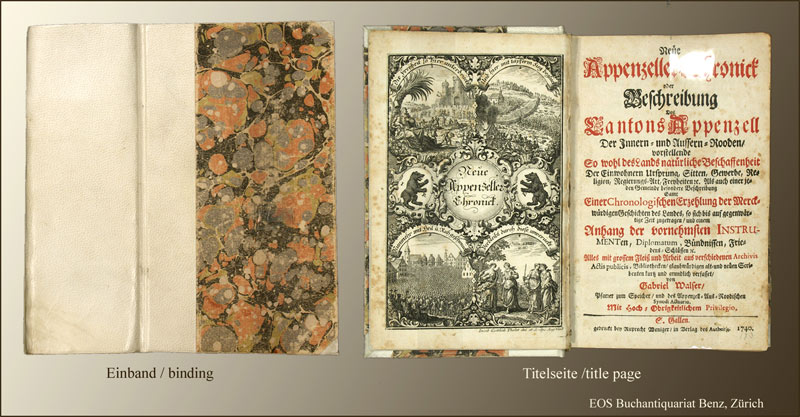
1740ref. 3718BBSt. Gallen, Ruprecht Weniger, 1740. 8°. (1) Bl., (8) Bl., 752 S., 112 S. Mit 1 gest. Fronistp. u. 1 gef. und kolorierten Karte. Neuer Halbpergamentband im Stile der Zeit mit altem Marmorpapierbezug. + Wichtig: Für unsere Kunden in der EU erfolgt der Versand alle 14 Tage verzollt ab Deutschland / Postbank-Konto in Deutschland vorhanden +, 3718B
1732A Paris, chez Guillaume Desprez et Jean Desessartz, 1732. In/4 reliure plein veau du temps, dos à nerfs à caissons dorés et pièce de titre, tranches jaspées, xxx ff., 740 p., 4 ff., bandeaux, lettrines historiées, 4 planches. Petits défauts : 2 trous d’insecte sur le dos. Manque en coiffe supérieure, mors inférieur ouvert sur 2 cm et sur 5 cm en coiffe inférieure. Ex-libris, notes manuscrites en page de garde, nom en page de titre. Coins et accident au plat restaurés. planches rempliées in-fine. 1ère édition. Petits défauts : 2 trous d’insecte sur le dos. Manque en coiffe supérieure, mors inférieur ouvert sur 2 cm et sur 5 cm en coiffe inférieure. Ex-libris, notes manuscrites en page de garde, nom en page de titre. Coins et accident au plat restaurés. -4to in contemporary spotted full calf, ribbed spine with gilt panels & red label, jaspered edges, [30], 740 p. [4], head-bands & historical letters, 4 folding plates. Few flaws : 2 wormholes on the spine, loss of leather on upper-tip, lower joints split, restauration on corners. booklabel. First edition of the piecemaster of the anatomist who did much to condense and systematize the anatomical knowledge of his time. Popular among teachers and students, the book was widely used as a text for nearly a century after its publication. -Winslow (1669-1760) Danois d’origine, fut médecin spécialisé en anatomie. Le présent ouvrage est considéré comme l’oeuvre anatomique la plus importante du XVIIIe siècle. Winslow fit en effet beaucoup pour condenser et rassembler les connaissances anatomiques de son époque et rejeter toute hypothèse hasardeuse, il fut très utilisé par les professeurs et les étudiants. On lui doit les termes de “grand et petit sympathiques” encore en usage aujourd’hui. Cet ouvrage contient le fameux discours de Stenon sur l’anatomie du cerveau dont l’édition originale de 1669 est très rare. Morton 1314.
1891ref. 86092Paris 22 oct[obre] 1891 | 13.30 x 20.50 cm | une page sur un bifeuillet
1746ref. 30229Chez Pierre Mortier | à Amsterdam [Paris] 1746 | 9.50 x 17 cm | 2 tomes reliés en un volume
1984ref. R200002268N.V.N.. 1984. In-4. Broché. Bon état, Couv. convenable, Dos satisfaisant, Intérieur frais. 715 pages illustrées de nombreuses figures en noir et blanc. Coiffe en tete de la jaquette légèrement abimée.. Avec Jaquette. . . Classification Dewey : 610-Sciences médicales. Médecine
1799ref. 64671799 Paris, Didot l'aîné, Firmin Didot (éd. stéréotype), Imp. Plassan , VII, 1799 - 1804. 74 vol. in-18 reliés: 8.5 x 13.5 cm. Manque les 2 vol. consacrés aux Cétacés imp. seulement en 1809. Ensemble illustré de 833 planches gravées d'après S. Pauquet et de 4 cartes dépliantes. Reliure de l'époque en basane. Dos lisse avec pièces de titre et de tomaison en chagrin vert sombre, filets, dentelles et motifs de lions en dorés. Gardes et tranches marbrées. Reliures frottées par endroit, coins parfois émoussés, rares piqûres, gravures dans l'ensemble très propres. Bon exemplaire.
First edition, 4to, [2], viii, [2], iii, [1], 76, [2, advert]pp., folding engraved plate of strata with with key leaf, old signature of G. A. Garton [?], one plate of the first vase made of Blue John, orig. printed boards, rebacked. White Watson (1760-1835), sculptor, marble-worker, and mineral-dealer. Lived at Bakewell, Derbyshire, where travellers visited his museum-shop. Here, in this rare publication, Watson here describes "Derbyshire strata, with a section across them. The section is nearly two feet long; the general broad anticlinal structure is well shown, but the vertical scale is so enormously exaggerated as to distort the natural arrangement."?Challinor. Challinor, 25.
ref. 1187BRUXELLES, HAYES, 1837, un fort volume in 4 relié en pleine basane, dos orné de fers dorés (reliure de l'époque), (cachet de bibliothèque), (2), 851pp.
ref. 61603, Hatje Cantz, 2011-2017 Hardcovers; clothbound with dustjacket, 26.70 x 30.20 cm. 6 volumes; 1/ 2011. 512 pages., 539 ills. - 2/ 2017. 656 pages, 715 ills - 3/ 2013. 640 pages, 702 ills. - 4/ 2015. 600 pages, 645 ills. 5/ 2020. 600 pages, 700 ills. 6/ 2022. 528 pages, 700 ills - Text in German, English. **** VERY FINE CONDITION!!!! ISBN 9783775719780.
ref. 11642ou tableau de l’état actuel de cet Empire contenant 1) la description topographique des 15 provinces qui le composent, elle de la Tartarie, des isles & autres pays tributaires qui en dépendent, le nombre et la situation de ses villes, l’état de sa population, les productions variées de son sol, & les principaux détails de son histoire naturelle ; 2) Un précis ces connoissances le plus récemmens parvenues en Europe sur le gouvernement de la religion, des mœurs, & les usages, les arts & les sciences des chinois. In 4 plein cuir fauve raciné à nerfs,pièce de titre chagrin rouge, roulette, caissons dorés. Faux-titre, titre, 798 pages, tranches rouges. A Paris Chez MOUTARD imprimeur-Libraire de la Reine, de Madame, & de Madame Comtesse d’Artois 1785. ( à signaler une découpe page de titre- une pâle mouillure en marge supérieure page 16 puis de la page 392 à 488- puis de la page 775 à la fin)- petits raccommodages. ) bon exemplaire L’abbé GROSIER travailla pendant 40 ans à la composition de l’histoire de la Chine compilée à Pékin par le père MARILLA, sur des documents originaux parue, de 1777 à 1784 en douze volumes ; Il rédigea seul le treizième volume qui complète cette histoire et fut publiée en supplément en 1785. 格鲁贤(Jean-Baptiste Grosier 《中华帝国志》, 巴黎,穆塔(Moutard)出版社,1785年In4,棕色花岗石斑纹小牛皮,书脊有装饰,原版
First Irish edition, 8vo (198 x 125 mm),12 parts bound in 3 vols., (complete) each part with its own title-page, viii, 9-124; viii, 125, [3 adverts]; viii, 9-126, [2 adverts]; viii, 9-132; xii, 147, [1]; viii, 145, [3 adverts]; viii, 112, [1]; vii, [1], 104; viii, 114, [2 adverts]; [2], cxix-cxxiii, [1], 125-244; [2], ccxlv-cclii, [2], 253-368; [2], ccclxxv-ccclxxviii, 379-496pp., with all advert leaves, part II has title and contents leaves misbound, part XII has title bound at rear, small ink stain to several leaves of vol. I which doesn't intrude into the text, cont. full calf, morocco spine labels lettered in gilt, label to vol. III slightly chipped otherwise a very handsome set in a contemporary binding. This is Ellis's most important work, arranged in the form of an agricultural calendar. Each part was issued separately with its own title page, complete set are extremely hard to find. William Ellis (c.1700?1758), agriculturist and writer. After a short period in the brewing industry, Ellis bought Church Farm at Little Gaddesden, near Hemel Hamstead, Hertfordshire, were he combined the practice of farming with his passion for writing on the subject. His writings were far more successful than his farming activities and his early books were very well received and "farmers in all parts of the country asked him to visit and report on their farms. He travelled over the country giving advice and observing different farming methods... Many farmers visited Ellis's farm at Little Gaddesden, but they found that he did not practise what he advocated in print, that his implements were old-fashioned, and that his land was neglected and in bad condition." (ODNB). Provenance: Small neat ink stamp of the Lawes Agricultural Library to the title of the first 2 volumes. Fussell II, p. 7; Perkins 561 (the London edition of 1744); Aslin, p.43.
1916Very Good Turkish, Ottoman (1500-1928) Contemporary red cloth. Roy. 8vo. (24 x 16 cm). In Ottoman script (Old Turkish with Arabic letters). [1], 229, [1] p., many b/w and color ills., 30 chromo-lithographed maps. Wear and fading on spine, some ex-library stamps on the colophon and several blank pages, ownership ink inscription and signature on the first page-overall a good copy. First edition of this rare Ottoman atlas for the primary schools in the late Ottoman Empire, including beautiful 30 chromo-lithographed maps of the Ottoman land according to administrative regions (provinces) and richly illustrated with b/w plates of the cities and provinces in the Middle East. Map list: 1. World map 2. Complete Imperial Ottoman 3. Arabian Peninsula 4. Anatolia 5. Asia Minor 6. Marmara and Black Sea 7. Aegean (The Archipelago) 8. Demography of Anatolia and Syria, Libya, etc 9. Administrative map of Anatolia 10. Map of mines of Anatolia 11. Agricultural map of the Imperial Ottoman 12. Arabian Peninsula 13. Map of the Edirne Vilayat [Adrianople Province of the Ottoman Empire] 14. Map of the Bosphorus 15. Map of the Hüdavendigâr Vilayat [Brusa Province] 16. Maps of Izmit and Biga Sanjaks 17. Map of Aydin Vilayat and Mentese Sanjak 18. Map of the Konya Vilayat 19. Maps of the Adana Vilayat and the Mediterranean Sea 20. Maps of the Erzurum and Ankara Vilayats 21. MAps of Kastamonu Vilayat and Bolu Sanjak 22. Map of the Trebizond Vilayat 23. Maps of the Van and Bitlis Vilayats 24. Maps of the Sivas and Harput Vilayats 25. Maps of the Bagdad and Basrah Vilayats 26. Map of the Mosul Vilayat and Day al-Zor Sanjak 27. Map of the Aleppo Vilayat and Urfa Sanjak 28. Map of the Syria and Beirut Vilayats 29. Map of the Arabia 30. Maps of the Yemen vilayat and Asir Sanjak. This atlas was printed four times for the different classes of the early Turkish / Ottoman schools, during World War 1 (two times in 1916) and the National Struggle (two times in 1921). Geylangil was born in Istanbul in 1887 and studied in Aleppo and Baghdad. Geylangil, who also studied economic geography, taught geography at many schools, including Galatasaray High School. Until his death, he wrote 14 books on geography, most of which were geographical atlases. In 1941, he was among the founding members of the Turkish Geographical Society. Özege 23216.; TBTK 11481.; We couldn't find any copy of this edition worldwide.
Rudolf Diesel's retained copy of his own signed manuscript letter to Samuel Breslauer, concerning the installation of a gas engine. Text is in German. 4to. Two single leafs, 2 pages of text on onion skin paper measuring approximately 30 x 24 cm. Minor age-toning, otherwise in very good condition. In this correspondence, Diesel describes alterations being made to the design of his first prototype, making comments on the compressor, transmission, and the lighting system (ignition), among other things. The second prototype, described here, would be built by October the same year. The specific plan for this engine model is noted in the upper margin: Plan F.B.930. Rudolf Christian Karl Diesel (1858-1913), needing no introduction, was a German inventor and mechanical engineer who is world-famous for having invented the Diesel engine. At the time of this letter, Diesel was diligently working on altering and perfecting his 1893 engine design. This design would later be known as the diesel engine. The first prototype Motor 150/400, had been completed 12 July 1893. Initial tests proved it to be a successful concept. By October 1895, after the first prototype had been converted into the second prototype Motor 220/400. After testing, and always seeking to improve, again it was decided that a completely new engine had to be designed from scratch. On 20 February 1896, Krupp, Maschinenfabrik Augsburg, and Diesel, decided to start the development of the new engine. The new engine was supposed to be a 250 mm bore engine with a 400 mm stroke. On 5 March 1896, Diesel filed a patent application for supercharging; on 26 March, it was decided to build the new engine with a supercharger. In order to improve the efficiency of the development process, a new design bureau was built directly into Diesel's Augsburg testing laboratory. Several young engineers worked there, including Imanuel Lauster. On 30 April 1896, after Lauster had completed the drawings, the workshop at Augsburg began making parts for the engine. The first successful Diesel engine Motor 250/400, designed by Rudolf Diesel, was officially tested in 1897 by German industrial engineer Moritz Schröter. Schröter concluded, "we are beholding a quite marketable machine that has been thoroughly designed with great attention to every single detail." At this time, several firms bought licences for building legal copies of the Motor 250/400. It is now on display at the German Technical Museum in Munich. The recipient of the correspondent is Samuel Breslauer (1870-1942), a lawyer, journalist and editor, who rose to be head of the Politics department for the Berlin newspaper "Berliner Lokal Anzeiger", a daily newspaper with one of the highest national circulations of its time. Breslauer is remembered as one of the numerous Jews who were captured and deported camp during the holocaust. Surely his public role would have made him an immediate target by the German extremist leader. In August 1942, Breslauer and his wife Bertha were taken to the Theresienstadt concentration camp where they both died, she within four days.
1886Very Good Turkish, Ottoman (1500-1928) Contemporary quarter leather bdg. Foolscap 8vo. (17 x 12 cm). In Ottoman script (Old Turkish with Arabic letters). [8], 106 p., b/w plates. With bound other two illustrated books titled "Kiraat" and "Takvîmü'l-edvâr". Slight foxing and fading on the spine and some papers, peeling on the rear board. Overall a good copy. First and only edition of this extremely rare first Turkish book on microbiology, including an uncommon account of microbiological observations in Paris by both authors, additionally the partial translation of French zoologist Trouessart's book titled "Les microbes, les ferments et les moisissures" [i.e. "Microbes, ferments, and moulds] in 1886, with the chapter of the anthrax disease written by French microbiologist Chamberland. Hüseyin Remzi (1839-1896) prepared this book when he was the teacher of zoology in Mekteb-i Tibbiye-i Sâhâne [i.e. The Imperial Ottoman Medicine School] with Hüseyin Hüsnü Bey who was the teacher of veterinary in the same school. The chapters including both authors' accounts of their microbiological observations in Paris are unique and the first scientific examples of the field. The Imperial Military School of Medicine or the Imperial School of Medicine was a school of medicine in Ottoman Constantinople, originally commissioned by Sultan Mahmud II on March 14, 1827, to be operated by the military, it was the empire's first medical school, modeled on those in the West. Özege 13562.; TBTK 12357.; We are not able to trace any institutional physical and duplicate copy in OCLC or Library Hub. Not obtainable from online sources.
1868Very Good Turkish, Ottoman (1500-1928) Contemporary quarter leather bdg. Rebacked boards. Foolscap 8vo. (18 x 12 cm). In Ottoman script (Old Turkish with Arabic letters). 220 p. Very rare early book of the concise biographies of 137 people who served as admirals in the Ottoman Empire between 1352 and 1853, written by Mehmed Izzet Pasha (d. 1853), son of Turkish admiral Abdullah Râmiz Pasha (d. 1813). Ceridehâne Printing House was founded for publishing Ceride-i Havâdîs [i.e. The Journal of News], which was the first semi-official newspaper in the Ottoman Empire. This journal was published from 1840 to 1877 and was founded by William Nosworthy Churchill (1796-1846), a British-born journalist who moved to Turkey aged 19. He was the cause of a diplomatic incident that resulted in the temporary severance of diplomatic relations between Britain and the Ottoman Empire. Babinger p. 323/2.; Özege 6951.; Library of Congress. Karl Süssheim Collection, no. 1336., OCLC: 11810438, 880485954.
1957ref. 213284Frankfurt, 1957-84. Fehlt: Jg. 30 Reg. zu Schrifttum.
1853- Delahaye, Masson, Etc., Paris, Liège 1853, fort in 8 (16x22cm), Un Vol. relié. - Editions originales de ces articles et mémoires. Demi Basane verte. Dos lisse avec pièces de titres noirs. Frottements aux coiffes et mors. Bordures et coins avec manques de papier. Très intéressante et remarquable réunion de plaquettes sur le choléra, relatant les nombreuses épidémies, notamment celles de 1865 et 1866, et le combat que la médecine engagea contre cette maladie. - Choléra asiatique. Sa nature et son traitement par J. Quaissac. Montpellier et Paris. Coulet et Baillère. 1875. 20pp. - Le choléra à l'hopital Cochin (1865). Etude clinique par Bourneville. Paris. Delahaye. 1873. 48pp. - Le choléra est-il contagieux ? par le dr Stanski. Paris. Baillère. 1866. 45pp. - Du choléra épidémique de 1865 observé à l'hopital Laribosière par le dr E.A Langronne . Paris. Parent. 1866. 73pp. Envoi de l'auteur sur la p. de faux titre. - Notice historique sur les épidémies de l'arrondissemnt de Clermont suivi d'un rapport sur l'épidémie de Mezel. Année 1866. Par le dr Nivet. Clermont-Ferrand. F. Thibaud. 1869. 20pp. - Mémoire sur le choléra morbus asiatique. Desciption du bagne de Brest, relation d'une épidémie de choléra qui a régné dans cet établissement en 1849... Par Marcellin Duval. Paris, brest. Baillère. 1853. 84pp. Un tableau dépliant. - Recherches sur la nosographie et le traitement de choléra épidémique considéré dans ses formes et ses accidents secondaires (épidémies de 1835 et 1866) par le Dr Besnier. Paris. Delahaye. 1877. 192pp. Envoi de l'auteur. - Ce qu'on pense du choléra dans le monde médical. Etat actuel de cette question par le dr L. Corréger. Paris. Noblet. 1866. 32pp. - Préservatifs et remèdes du choléra à la portée de tout le monde par P. Poggioli. Paris. Baillère et fils. 1866. 39pp. Article répété 2 fois. - Quelques considérations sur la thérapeutique générale du choléra par M. Davreux. Liège. Carmanne. 1869. 17pp. Article répété 2 fois. - Statistique annotée des décès cholériques du quartier de la folie-Méricourt (XIe arrondissement) pendant les deux années 1865 et 1866 par le Dr Géry père. 16pp. Sans page de titre. - Contribution à l'étude de la thermométrie dans le choléra (épidémie observée à Paris en 1873) par le Dr H. Gripat. Angers. 1876. 30pp. 4 tableaux dépliants. - Choléra. Mode de propagation et moyens préservatifs par Félix Boureau. Paris. Delahaye. 1868. 47pp. - Etude sur le choléra par le docteur Nicaise. Paris. Baillère. 1868. 45pp. - Notice sur les mesures de préservation prises à Batna (Algérie) pendant le choléra de 1867 et sur leurs résultats par E. I. Dukerley. Paris. Delahaye. 1868. 69pp. Une carte dépliante. Relation de l'épidémie de choléra de 1865 à l'hôpital Saint-Antoine par le Dr C. Decori. Paris. Delahaye. 1866. 91pp. - Des infiniment petits rencontrés chez les cholériques. Etiologie, prophylaxie et traitement eu choléra avec planches micrographiques par G. Danet. Paris. Delahaye. 1873. 159pp. 7 pl. - Notice sur le traitement du choléra dans une division du bureau de bienfaisance comparé au traitement du choléra dans les hôpitaux civils de Paris par le Dr C. Pinel. Séance du 15 novembre 1866. 31pp. [ENGLISH DESCRIPTION ON DEMAND]
1801- Chez A.-J. Marchant, à Paris An 10 (1801), in-8 (12x20,5cm), (4) 227 pp. (3), relié. - Rare édition originale bien complète de sa planche dépliante décrivant le fourneau in-fine. "Première édition collective de ces différents rapports concernant des établissements de bienfaisance construits selon le modèle des fameux "Fourneaux" de Rumford" (Oberlé) Reliure de l'époque en demi basane blonde, dos lisse richement orné de filets et fers dorés en formes d'étoiles et de feuilles ainsi que d'une pièce de titre de maroquin rouge, plats de papier à la cuve, toutes tranches jaunes. Le premier feuillet de garde présente, au crayon de papier, des notices bibliographiques concernant les auteurs du recueil. [ENGLISH DESCRIPTION ON DEMAND]
1783- Chez la veuve Desaint, à Paris 1783, in-4 (20x26cm), 758pp. et 850pp., 2 volumes reliés. - Édition originale de la traduction française de Camus avec le texte en grec en regard. Reliures en plein veau d'époque marbré. Dos lisses ornés de deux caissons à la grotesque et de deux fers, filets et roulettes. Pièces de titres en maroquin rouge et de tomaisons en maroquin noir. Coiffe du tome I élimée. Frottements. La traduction de Camus est tout à fait estimée, elle ne concerne cependant que le premier volume, le second rassemblant notes et observations quant à l'histoire naturelle moderne. Camus établit en outre l'importance de l'oeuvre d'Aristote et son influence sur la bibliographie d'histoire naturelle. On trouve une intéressante table permettant de repérer les animaux dans Aristote, en grec, latin et français. Cette seconde partie est fort érudite et contient de nombreux renvois à d'autres ouvrages, elle décrit in situ chaque animal que l'on trouve dans le traité d'Aristote. [ENGLISH DESCRIPTION ON DEMAND]
1990ref. 48484145 numéros dont 4 H.S., sous 12 emboîtages éditeurs verts, couv. ill. couleurs, photos couleurs ou noir et blanc, Connaissance de la pêche, éditions Larivière, 1978 à 1990, env. 85 pp. par numéro.