TREMBLEY A.MareMagnum

124,796 results
1744- Chez Jean & Herman Verbeek, à Leyde 1744, In-4 (19x25,5cm), XV (1) 324pp., relié. - Édition originale, illustrée de 4 très jolis entêtes par Pronk, 4 culs-de-lampe et 13 planches dépliantes sur les polypes. Exemplaire aux armes frappés sur le dos (hermines et macles) des Rohan-Chabot. Les reliures aux armes des Rohan et des Rohan-Chabot ont en effet la particularité de porter les meubles d'armes sur le dos exclusivement. Reliure en plein veau blond d'époque. Dos à nerfs orné d'hermines et de macles couronnés. Mors intégralement fendus. Coiffes arasées. Coins frotement émoussés. Rares petites pîqûres, dernières planches avec la marge haute salie. C'est dans ces mémoires que Tremblay découvrit l'hydre, ou hydra, polype d'eau douce qu'il observa durant plusieurs années, alors qu'il était précepteur du fils d'un comte qui possédait une propriété avec étang et ruisseaux. Il y relate méticuleusement et à l'aide d'un esprit particulièrement éclairé ses observations et ses expériences. Après avoir pris l'hydre pour une plante, Tremblay comprend qu'il a affaire à un animal, capable de se déplacer avec ses tentacules (les cornes), et qui est photosensible, se dirigeant instinctivement vers le point le plus lumineux. Il constate, par de multiples et intelligentes expérimentations que l'hydre a le pouvoir de se régénérer grâce à la division cellulaire, et enfin que l'hydre peut se reproduire de façon asexuée. Les études de Tremblay trouvèrent un écho auprès de ses contemporains, mais tombèrent rapidement dans l'oubli, certainement parce qu'elles étaient concurentielles de celles de Réaumur. La zoologie moderne réhabilita l'importance de ses travaux et la qualité de ses expérimentations. [ENGLISH DESCRIPTION ON DEMAND]
1748ref. 1641Amsterdam: Chez l'honore et fils libraires 1748. First Edition. Hardcover. Very good. 2 vols. in one. 8vo. I: 10 cxix 7 208 pp. 1 f. "Errata" for Tom. 1. II: 2 231 pp. 1 f. "Addition" 1 f. "Errata" for Tom 1 sic. First title page with unobtrusive paper defect on lower margin not affecting text; this copy is lacking half-title and Errata leaf for Tom. 2. Very attractive 19th-century French red glazed boards red morocco spine lettered in gilt directly two insignificant worm-holes on lower hinge leading nowhere; trifle wear to binding extremities. Completely unsophisticated. First printing of "Telliamed" in every way a remarkable book. Disguised as an Oriental fantasy it contains perhaps the earliest appearance of one of the most important of all evolution speculations namely the so-called ultra-neptunian theory: that the entire Earth was and is a marine deposit and that all life on land originated from creatures of the sea. Maillet hypothesized that the earth was once entirely covered with water and that the water gradually evaporated into space causing land masses to appear. Maillet also created an ingenious methodology to calculate the age of the Earth: he concluded that the Earth is 2 billion years old evolutionists today consider this figure to be more like 4.5 billion. It is known that Buffon Lamark Cuvier and Darwin read this book and that they were very much influenced by Maillet's unorthodox "heretical" views. Well aware that such an immense figure would incur the wrath of the Church de Maillet presented his conclusions in the guise of a dialogue between a French missionary and an Eastern mystic named Telliamed an anagram for the author's last name i.e. de Maillet spelled backwards. The manuscript remained unpublished until a decade after Maillet's death. In order to present his radical conclusions in the guise of an Oriental tale Maillet interspersed monsters and mythological creatures into his text. Overtly anti-Christian "Telliamed" dismisses the Flood of the Old Testament as a fable because rainfall that lasted forty days would have been insignificant to submerge entire mountains. Maillet asserted that the Earth's history could not be read from the Bible but through the rocks themselves. ¶ With uncanny prescience Maillet describes how species have overlapping physical characteristics that suggested a common life origin namely the sea. Through a Oriental mystic we are told that: "The little Wings had under their Belly and which like their Fins helped them to walk in the Sea became Feet and served them to walk on Land." ¶ REFERENCES: Caillet No. 7009. Versins Utopie p. 640. LITERATURE: "Charles Darwin et ses Precurseurs francais Paris 1870 Chapter 1: "the moss-grown fragments from the ruins of another world." See also Albert Carozzi "De Maillet's 'Telliamed' 1748: An Ultra-Neptunian Theory of the Earth" in: Toward a History of Geology; Proceedings of the New Hampshire Inter-Disciplinary Conference on the History of Geology Sept. 7-12 1967. Mary Efrosini Gregory "Evolutionism in Eighteenth-century French Thought" Chapter 1. See also the article on Maillet in DSB IX pp. 26 et seq: "Maillet's ideas unquestionably influenced many leading naturalists for almost a century notably Buffon and Cuvier. Chez l'honore et fils, libraires hardcover
1748ref. 1641Amsterdam: Chez l'honore et fils libraires 1748. First Edition. Hardcover. Very good. 2 vols. in one. 8vo. I: 10 cxix 7 208 pp. 1 f. "Errata" for Tom. 1. II: 2 231 pp. 1 f. "Addition" 1 f. "Errata" for Tom 1 sic. First title page with unobtrusive paper defect on lower margin not affecting text; this copy is lacking half-title and Errata leaf for Tom. 2. Very attractive 19th-century French red glazed boards red morocco spine lettered in gilt directly two insignificant worm-holes on lower hinge leading nowhere; trifle wear to binding extremities. Completely unsophisticated. First printing of "Telliamed" in every way a remarkable book. Disguised as an Oriental fantasy it contains perhaps the earliest appearance of one of the most important of all evolution speculations namely the so-called ultra-neptunian theory: that the entire Earth was and is a marine deposit and that all life on land originated from creatures of the sea. Maillet hypothesized that the earth was once entirely covered with water and that the water gradually evaporated into space causing land masses to appear. Maillet also created an ingenious methodology to calculate the age of the Earth: he concluded that the Earth is 2 billion years old evolutionists today consider this figure to be more like 4.5 billion. It is known that Buffon Lamark Cuvier and Darwin read this book and that they were very much influenced by Maillet's unorthodox "heretical" views. Well aware that such an immense figure would incur the wrath of the Church de Maillet presented his conclusions in the guise of a dialogue between a French missionary and an Eastern mystic named Telliamed an anagram for the author's last name i.e. de Maillet spelled backwards. The manuscript remained unpublished until a decade after Maillet's death. In order to present his radical conclusions in the guise of an Oriental tale Maillet interspersed monsters and mythological creatures into his text. Overtly anti-Christian "Telliamed" dismisses the Flood of the Old Testament as a fable because rainfall that lasted forty days would have been insignificant to submerge entire mountains. Maillet asserted that the Earth's history could not be read from the Bible but through the rocks themselves. ¶ With uncanny prescience Maillet describes how species have overlapping physical characteristics that suggested a common life origin namely the sea. Through a Oriental mystic we are told that: "The little Wings had under their Belly and which like their Fins helped them to walk in the Sea became Feet and served them to walk on Land." ¶ REFERENCES: Caillet No. 7009. Versins Utopie p. 640. LITERATURE: "Charles Darwin et ses Precurseurs francais Paris 1870 Chapter 1: "the moss-grown fragments from the ruins of another world." See also Albert Carozzi "De Maillet's 'Telliamed' 1748: An Ultra-Neptunian Theory of the Earth" in: Toward a History of Geology; Proceedings of the New Hampshire Inter-Disciplinary Conference on the History of Geology Sept. 7-12 1967. Mary Efrosini Gregory "Evolutionism in Eighteenth-century French Thought" Chapter 1. See also the article on Maillet in DSB IX pp. 26 et seq: "Maillet's ideas unquestionably influenced many leading naturalists for almost a century notably Buffon and Cuvier. Chez l'honore et fils, libraires hardcover books
1987ref. 212972Leipzig, Harrassowitz u. Bibliogr. Inst. 1884-1987. Fast alle Jgg. in Bibl.-Einbdn., einige in Hlwd. u. in Heften. Teilw. St. a. Tit. 6 Rücken beschäd. 3 Jgg. m. Bleistiftanstreich. Fehlen: Jg. 45 H. 1-2; 100 H. 3; 101 H. 7, 10 u. TI.
ref. 41711Montpellier Chez Guillaume Cavelier 1737 in 4 (25,5x20) 1 volume reliure plein veau fauve de l'époque, dos à nerfs orné, pièce de titre de maroquin rouge, tranches teintées rouge, XXVI [1] 630 pages, XX, et 1 faux-feuillet non chiffré de privilège, avec 4 cartes et 6 plans, trace de mouillure claire dans la marge inférieure, petite restauration ancienne sur 3 mors. Ex-libris armorié gravé de A. Brölemann. Jean Astruc, 1684-1766. Edition originale. Bel exemplaire ( Photographies sur demande / We can send pictures of this book on simple request )
18201 vol. in-8 cartonnage marbré de l'époque, Chez Crochard, Paris, 1820, 448 pp. avec 5 planches dont 1 dépliante. Contient notamment : Mémoire présenté à l'Académie royale des Sciences le 2 octobre 1820, où se trouve compris le résumé de ce qui avait été lu à la même Académie les 18 et 25 septembre 1820, sur l'action des courans voltaïques (Ampère ) ; Suite du mémoire sur l'Action mutuelle entre deux courans électriques, un courant électrique et un aimant ou le globe terrestre, et entre deux aimans (Ampère) ; Note sur des Essais ayant pour but de décomposer l'eau avec un aimant (Fresnel) ; Recherches chimiques sur les Quinquinas (Pelletier et Caventou) ; Suite des recherches chimiques sur les Quinquinas ; Résumé d'un Mémoire sur la réflexion de la lumière (Fresnel) ; Nouvelles déterminations des proportions de l'eau, et de la densité de quelques fluides élastiques (Berzélius et Dulong) ; etc.. Rare exemplaire du très important tome 15 des "Annales de Chimie et de Physique", contenant plusieurs articles de grande importance, et d'abord l'article fondateur d'André Marie Ampère (pp. 59-76 et 170-218 avec 5 planches hors texte dont 1 dépliante). Ampère "immediately accepted Oersted's discovery and turned his mind to it. On 18 September he read his first paper on the subject to Academy ; on 25 September and 9 October he continued the account of his discoveries. In these feverish weeks the science of electrodynamics was born" (DSB, I, 143). Etat satisfaisant (cartonnage frotté avec accroc en coiffe sup., mouill. en tête) Français
1737ref. 2382A PARIS. CHEZ GUILLAUME CAVELIER. 1737. IN-4 (20,5 X 25,5 X 5 CENTIMETRES ENVIRON) DE XXVI + (2) + 630 ET (2) PAGES, RELIURE D'EPOQUE PLEIN VEAU HAVANE, DOS A CINQ NERFS ORNE DE CAISSONS A FLEURONS DORES, TITRE DORE SUR ETIQUETTE MAROQUIN ROUGE, ROULETTE DOREE SUR COUPES, TRANCHES ROUGES. ILLUSTRE DE 4 CARTES A DOUBLE PAGE ET DE 6 PLANCHES REPLIEES. EDITION ORIGINALE RARE. (BRUNET. VI. 4490 - BARBIER. III. 234). BON EXEMPLAIRE.
1890ref. 7135012 juillet 1890 | 11.20 x 17.90 cm | une feuille
ref. 60773Paris -, Librairie Hachette, 1860-1897 Soixante et onze volumes in-4 demi chagrin vert, dos nerfs orn s, titre dor , 435 pages par semestre.
1775ref. AMO-4003s.l.n.d. (vers 1775) 1 volume in-folio (37,5 x 25 cm) de 378 et 170 pages. L'intégralité du volume a été rempli (4 feuillets blancs intercalaire entre les deux parties. Reliure de l'époque plein parchemin tacheté, lacets de soie verte, étiquette de titre manuscrite au dos (petits manques). Reliure très fraîche, décorative et très solide (un coin endommagé). Intérieur parfait, calligraphié d'une très belle et très lisible écriture cursive avec quelques éléments décoratifs à l'encre au pochoir (culs-de-lampe). Collationné complet. D'une même écriture soignée d'un bout à l'autre du volume. Compilation didactique anonyme ayant probablement servi à l'étude personnelle de quelque Grand de la fin du siècle des lumières. On y trouve une compilation d'extraits historiques pour la première partie (depuis le règne de Philippe II surnommé Auguste (1181) jusqu'à la mort de François Ier (1547), tirés de différents historiens. La seconde partie contient des extraits scientifiques tirés de plusieurs sources (Dictionnaire encyclopédique, L'Histoire du commerce dans les deux Indes par Raynal). Les citations d'articles entiers tirés de Raynal laissent supposer une recueil compilé vers 1770 ou 1775. Dans les extraits historiques on s'arrêtera particulièrement sur le récit complet de l'histoire de Jeanne d'Arc et de son procès. Dans les extraits scientifiques on s'arrêtera sur des articles consacrés au tonnerre, les volcans, la lave, le Vésuve, l'éclair, les tremblements de terre, le diamant, la taille du diamant, le marbre, le stuc ou marbre factice, puis le sucre, la canne à sucre, la culture des cannes à sucre, cases à bagasses, la purification du sucre, travail et raffinage du suce dans les îles, etc. Un ensemble parfaitement conservé et très intéressant. Nous n'avons aucune idée de l'auteur de cette compilation qui nous semble faite pour la culture générale et personnelle d'une personne de la seconde moitié du XVIIIe siècle en mal d'érudition. Aucune marque de provenance. Bel exemplaire. Unique et imposant manuscrit.
ref. 2638P., Hérissant, 1760, 2 tomes reliés en un fort volume in 4, 1 frontispice, 18pp., 404pp. pour la première partie, 526pp., 5 planches dépliantes pour la deuxième partie, plein veau, dos orné de fers dorés, tranches rouges (reliure de l'époque).
1583ref. 11101Lyon, s.n. (François Conrard), 1583 ; in-8 ; demi-vélin à petits coins, étiquette orange titre manuscrit (reliure probablement de la mi-XIXe) ; (32), 362, (10) pp., *-2*-8 A-Z8 [croix]2 ; marque 2 au titre.
1825ref. 89619Imprimerie de Madame Huzard | Paris 1825 | 13.5 x 21.5 cm | Broché
ref. 055694Paris Bossange père, Libraire 1824 in 8 (20,5x13) 1 volume reliure demi basane à petits coins de l'époque, plats recouverts de papier marbré raciné assorti, dos lisse orné de fleurons et de filets dorés, pièce de titre de cuir noir, tranches teintées, XLIV et 198 pages, rousseurs éparses au début du volume. Rare. Heinrich Friedrich von Storch, 1766-1835. Relié à la suite: LETTRES A M. MALTHUS sur différens sujets d'économie politique, notamment sur les causes de la stagnation générale du commerce. Par Jean-Baptiste Say (Paris, Chez Bossange, Père et Fils 1820), 184 pages. Jean Baptiste Say, 1767-1832]. Edition originale (First edition). Bel exemplaire, bien relié à l'époque ( Photographies sur demande / We can send pictures of this book on simple request )
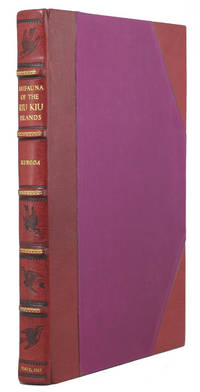
ref. 2830Tokyo published by the author 1925. First edition. No ownership marks a beautiful copy in fine condition. Pp. vi 293 8 full page color plates from painting by Juzo Kobayashi 1 large folding map 1 table. Later red morocco with five gilt-decorated raised bands with gilt-lettering in two panels and blind-stamped birds in four other panels over rose-colored silt cloth top page edge gilt folio 15.25 x 10.75 inches. This monograph is based primarily on 14 months of fieldwork from 1921-1922 in the Riu Kiu islands also known as the Loo Cho islands that stretch between the Japanese island chain and Formosa now Taiwan. Zoogeographically the islands span the Palaearctic region Japan and the Oriental region Taiwan; Kuroda thought this was one of the most interesting ornithological regions of the world from a zoogeographic point of view. The monograph describes 281 species and subspecies based on 1621 skins collected in 1921-22 and reviews all other specimens in museums in around the world. A very through monograph of great regional import in an exceedingly attractive binding. Less than 500 copies were printed. Tokyo, published by the author, 1925. First edition hardcover
1900Beirut, Damascus, Hama, Bhamdoun: 28 February 1900 - June 1901. Lot of 5 manuscript letters written and signed by Harvard anthropologist Henry Minor Huxley, concerning anthropological work performed for the Howard Crosby Butler Archaeological Expedition to the Middle East, as well as a noteworthy archaeological discovery of an ancient and curious stone inscription, its location guarded with secrecy by the few expedition members having this knowledge. 8vo. double-leafs varying in size. 24 pages combined, each letter signed in the original. Two letters are on hotel stationery. Occasional light creasing, otherwise in very good condition, clean and bright, a fascinating and candid primary source account. Writing to a trusted source, his mother, Huxley's reveals the discovery of an ancient inscription carved into an overturned stone, in a language possibly not yet identified, stating that he took the first photograph of it, and that only a select few expedition members are privy to knowing its location. His commentary on experiences with the local civilians and officials are straightforward and occasionally blunt. Henry Minor Huxley, A.M. accepted the offer to join the American Archaeological Expedition led by American archaeologist Howard Crosby Butler. The first part of the archaeological work took place from mid-October to mid-December 1899, and a second trip was made for continued work from March to June, 1900. In the summer of 1900, he was devoted to acquiring a working knowledge of the vernacular Arabic. Huxley's work, however, involved a broader scope. During this second trip, he was also tasked with the study of physical anthropology, as is apparent in the present correspondence. This work proved so valuable that Huxley, owing to the patronage of New York businessman and archeological enthusiast B.T. Babbitt Hyde, remained for another year to further these anthropological observations, independently. What does not appear to be officially documented in publications, but is highly fascinating, is what Huxley writes in his last letter of the present lot. That is, in June 1901, just prior to returning to America, he alone returned to the site of a stone inscription discovered during the earlier part of the expedition (presumably in 1899), to copy it, photograph it, and turn it back face down so that no others would see it. This would increase the likelihood that he and one other would have a better chance of being the first to decipher it.
1892ref. ZB445183Mdison: Democrat Printing Co. etc. 1892-1900. Price HAS BEEN REDUCED by 10% until Monday Oct. 26 weekend SALE item volumes 8-13 complete volumes original paper wrappers untrimmed as issued some external wear and tears overall very good PRICE IS FOR THE LOT:. - If you are reading this this item is actually physically in our stock and ready for shipment once ordered. We are not bookjackers. Buyer is responsible for any additional duties taxes or fees required by recipient's country. Photos available upon request. Mdison: Democrat Printing Co., etc. unknown
1782ref. 42107Marseille, Imprimerie de Sibié, 1782. In-4 de 20 pp.sur grand papier vergé, titre et texte encadré.Exercice sur la Méchanique. S.l.n.d. (Marseille, Sibié, 1782). In-4 de 26 pp.Les deux pièces reliées en 1 vol. in-4, maroquin rouge aux armes de la ville de Marseille, dos lisse orné à la grotesque, filet et frise dorés d'encadrement sur les plats (reliure de l'époque).
1940ref. 218582Neubrandenburg, Güstrow u. Rostock, 1849-1940. M. mehr. (teils gef.) Taf. u. Tab. Verschieden geb. u. in OBr. Einbde. teils bestoßen. Umschlage teils eingerissen u. angestaubt. Meist m. mehr. St. u. Sign. Wenige m. handschrftl. Anm. Seiten teils braunfl. Teilw. mehr. Jgge. in 1 Bd.
1789ref. 21181789 cartonnage époque (dos manquant, coins émoussés). Signature de l'auteur sur le fx. titre. grand in-folio, (2ff.), XVIpp., 19 tableaux de 59 sur 86 cms, (1f. privilège), Paris L'auteur 1789,
ref. 7994P., Moreau, 1702, un volume in 12 relié en pleine basane, dos orné de fers dorés (reliure de l'époque), (petit accroc sans gravité à la coiffe, mouillures pâles dans les marges de quelques feuillets), (12), 277pp., 9pp., 4 PLANCHES
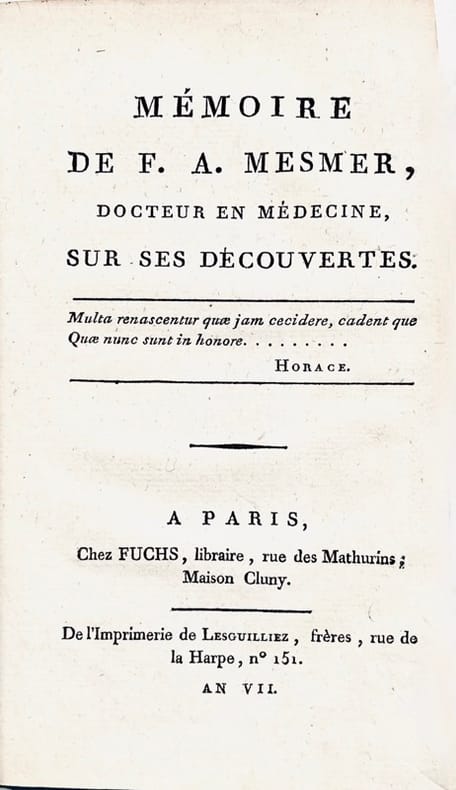
1799ref. 43552A Paris, chez Fuchs, de l'Imprimerie de Lesguilliez, 1799 (an VII). In-12 de (4)-XII-110-(2) pp., cartonnage moderne à l'imitation.
1818ref. 15279A Paris, de l'Imprimerie de P. Didot l'Ainé, 1818. 2 vol. in-8 de XXXI-(5)-502 pp. ; 398 pp., demi-veau brun à petits coins, dos orné à 4 nerfs, pièces de titre et de tomaison en veau noir (reliure de l'époque).
ref. 4776P., Gueffier, 1775/1779, 3 VOLUMES in 8 reliés en plein veau marbrés, dos ornés de fers dorés, tranches rouges (reliures de l'époque), (petit accroc sans gravité à une coiffe), Description et usage d'un cabinet de physique expérimentale : T.1 : 24pp., 342pp., 23 planches dépliantes, T.2 : 4pp., 456pp., 28 planches dépliantes, soit 51 planches dépliantes ; Essai sur différentes espèces d'air : (4), 26pp., 400pp., 5 planches dépliantes
ref. 76858aafParis, Bureaux du Correspondant, 1880 - 1913, gr. in-8vo, par volume ca. 1200 p., reliure en demi-cuir / demi-parchemin. (Reliures de bibliothèque).