TALISMAN BUDDHIST SCROLLSBiblio.com
69 résultats
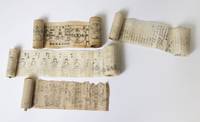
réf. 9814Of various heights & lengths ranging from 48 to 80 mm. in height & 4000 to 10500 mm. in length all in very good condition some with silk front endpapers four with orig. core rollers. Japan: mid- to late Edo. Ten very rare examples of kokonoe no mamori good luck talismans printed in the form of extremely long and narrow scrolls; because of their ephemeral nature they are rare today. These talisman scrolls were not really meant to be unrolled and studied; instead they were intended to be tightly rolled and kept in a small pouch close to the chest for good luck. “Such narrow but extremely long handscrolls veritable encyclopedias of Buddhist iconography received the name kokonoe no mamori amulet in nine layers during the Edo period because they begin with a red seal but not always there are many without; we have two with the red seal in the shape of a cauldron containing characters that can be read kokonoe no mamori. All the scrolls start with an image but not always there are many without of Ususama Myoo S: Ucchushma the king who has the power to burn away impurity and evil which is followed by powerful magical syllables J: shingon S: mantra various ‘seed’ mandalas in Sanskrit and sutras in Chinese. Next Buddhist deities including Esoteric icons are depicted along the length of the handscroll; buddhas bodhisattvas the four guardian kings the five great kings of light Yakushi Buddha with sixteen protectors and a thousand-armed Kannon S: Sahasrabhuja with twenty-eight attendants. Many cosmological deities are included: the nine luminaries and Taizanfusei related to the Big Dipper. Such popularized Esoteric icons as Shoten S: Nandikeshvara Dakiniten S: Dakini Idaten S: Skanda Gozu Tenno and Tawara Daikokuten S: Mahakala are also shown. The last section of the scroll contains a series of dharani sutras in Sanskrit magical formulas of knowledge that are composed of syllables with symbolic content… “Two types of kokonoe no mamori became popular in the Edo period as talismans for journeys and pilgrimages and as a part of the wedding trousseau. One type has at the end of the scroll a portrait of Kukai the founder of Shingon Esoteric Buddhism while the other portrays Saicho the founder of Tendai Esoteric Buddhism.”–Masako Watanabe The Written Image. Japanese Calligraphy and Painting from the Sylvan Barnet and William Burto Collection item 22 pp. 86-88. As noted these scrolls are in very good to excellent condition. A few have some wear at the beginning. Two of the scrolls are in their original wooden boxes and all of the scrolls are preserved in a modern wooden box. unknown
réf. 9814Of various heights & lengths ranging from 48 to 80 mm. in height & 4000 to 10500 mm. in length all in very good condition some with silk front endpapers four with orig. core rollers. Japan: mid- to late Edo. Ten very rare examples of kokonoe no mamori good luck talismans printed in the form of extremely long and narrow scrolls; because of their ephemeral nature they are rare today. These talisman scrolls were not really meant to be unrolled and studied; instead they were intended to be tightly rolled and kept in a small pouch close to the chest for good luck. “Such narrow but extremely long handscrolls veritable encyclopedias of Buddhist iconography received the name kokonoe no mamori amulet in nine layers during the Edo period because they begin with a red seal but not always there are many without; we have two with the red seal in the shape of a cauldron containing characters that can be read kokonoe no mamori. All the scrolls start with an image but not always there are many without of Ususama Myoo S: Ucchushma the king who has the power to burn away impurity and evil which is followed by powerful magical syllables J: shingon S: mantra various ‘seed’ mandalas in Sanskrit and sutras in Chinese. Next Buddhist deities including Esoteric icons are depicted along the length of the handscroll; buddhas bodhisattvas the four guardian kings the five great kings of light Yakushi Buddha with sixteen protectors and a thousand-armed Kannon S: Sahasrabhuja with twenty-eight attendants. Many cosmological deities are included: the nine luminaries and Taizanfusei related to the Big Dipper. Such popularized Esoteric icons as Shoten S: Nandikeshvara Dakiniten S: Dakini Idaten S: Skanda Gozu Tenno and Tawara Daikokuten S: Mahakala are also shown. The last section of the scroll contains a series of dharani sutras in Sanskrit magical formulas of knowledge that are composed of syllables with symbolic content… “Two types of kokonoe no mamori became popular in the Edo period as talismans for journeys and pilgrimages and as a part of the wedding trousseau. One type has at the end of the scroll a portrait of Kukai the founder of Shingon Esoteric Buddhism while the other portrays Saicho the founder of Tendai Esoteric Buddhism.”–Masako Watanabe The Written Image. Japanese Calligraphy and Painting from the Sylvan Barnet and William Burto Collection item 22 pp. 86-88. As noted these scrolls are in very good to excellent condition. A few have some wear at the beginning. Two of the scrolls are in their original wooden boxes and all of the scrolls are preserved in a modern wooden box. unknown books
2007réf. 17198San Francisco: The Book Club of California 2007 One of 350 copies. This is book number 222 of the Book Club of California. Quarto. With eight photographs and illustrations from the author's collection. Designed by Jack W. Stauffacher of the Greenwood Press of San Francisco. Computer layout by Kina Sullivan. Set in Cycles type designed by Summer Stone. Printed by Hatcher Press on Finch Vellum #70 paper under the supervision of Susan Schaefer. Bound by the Roswell Book Bindery. Green cloth boards titled in gilt. Prospectus laid in. A fine copy in the plain white dustjacket. The Book Club of California hardcover
2007réf. 17198San Francisco: The Book Club of California 2007 One of 350 copies. This is book number 222 of the Book Club of California. Quarto. With eight photographs and illustrations from the author's collection. Designed by Jack W. Stauffacher of the Greenwood Press of San Francisco. Computer layout by Kina Sullivan. Set in Cycles type designed by Summer Stone. Printed by Hatcher Press on Finch Vellum #70 paper under the supervision of Susan Schaefer. Bound by the Roswell Book Bindery. Green cloth boards titled in gilt. Prospectus laid in. A fine copy in the plain white dustjacket. The Book Club of California hardcover books
réf. 13981451Milan: Editions 5 continents, 2019 in-4 (24,5 x 34 cm), 192 pages, 148 illustrations en couleurs. Reliure d'éd., comme neuf. Les tablettes coraniques appelées allo kafii gida, conservées par l'ethnie des hausa qui peuplent le nord du Nigeria, sont marquées du sceau du secret. Les hausa ont peur de révéler à des étrangers les formules de bon augure qui ornent ces objets. Et ils refusent aussi de prendre le risque d'exposer des représentations d'êtres humains et d'animaux dans un contexte islamique iconoclaste. Aujourd'hui encore, l'islam radical punit sévèrement la possession d'allo kafii gida par des sanctions pouvant aller jusqu'à l'exécution capitale. Si elles n'avaient pas été sauvées au fil du temps, toutes les tablettes de ce livre auraient été vouées à la destruction par les fondamentalistes musulmans. Les auteurs des décorations qui ornent les tablettes coraniques ne sont pas de simples illustrateurs, ce sont de véritables conteurs : ils ont peint sur ces planches de bois les récits qui reflètent la vision cosmique de leur société. A travers la création artistique, ils ont incorporé des idées étrangères et lointaines dans le système de pensée des hausa, faisant de ces allo kafii gida de véritables capsules cosmologiques sur bois. Dans ce contexte difficile, on peut qualifier les propriétaires de ces oeuvres d'art de "conservateurs ", car ces tablettes secrètes, bien que liées à la religion musulmane, témoignent de la cosmologie hausa. Les objets dont les photographies illustrent cet ouvrage, uniques dans le domaine des arts extraeuropéens, appartiennent à une collection privée fruit de plus de vingt années de recherches
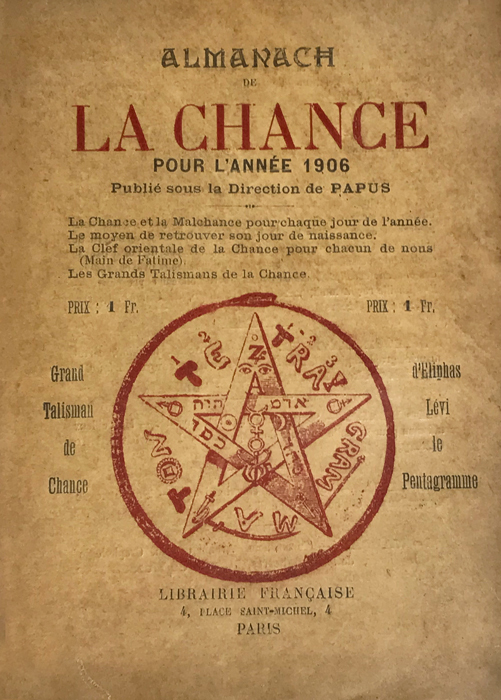
1906réf. 3510Paris, Librairie Française, 1906 ; in-12, broché ; 63 pp. et couverture illustrée en rouge et noir.
1966réf. 70715München, Verlag George D.W.Callwey, 1966. Original-Leiennband mit Schutzumschlag, 4°, 270 Seiten.
1966réf. 40701München, Callwey, 1966. 1. Aufl. 270 S. mit zahlr. Ill. (z.T. farb.) 29 x 26 cm, Leinen mit OSchU
1925réf. 5205Paris, Cité des Livres (Abbeville, F. Paillart), 1925, collection balzacienne N°1 ; in-12, broché ; (2) ff. blancs, 22, (2) pp., (2) ff. blancs, couverture rempliée lie-de-vin.
réf. 369351 vol in-8 broché - 119 pages - années 1873 - Tome VII - 27 ème livraison
195218,6x11,8 cm; 104, (8) pp. Bella brossura editoriale esoterica con titolo in nero e immagine in azzurro. Numero 13 parte della collana "L'Occultisme Simplifiè". Rara edizione esoterica che tratta i poteri occulti dei colori e la loro possibile applicazione nella Cromoterapia, ai talismani, nell'astrologia. L'opera tratta anche delle gemme. Opera in parte intonsa ed in ottime condizioni di conservazione. Poinsot fu autore di numerosi tetsi di occultismo.
1970réf. 4323Den Haag: Couvreur um 1970 (?). 2. vollst. neubearb. Auflage. Mit 52 Abbildungen, 214 S., 8° , OKart.
1985réf. 40922Berlin, Verlag Neues Leben, 1985. 2. Auflage 252 Seiten , 24 cm, Hardcover/Pappeinband
1843réf. 66732Wien, Joh. Bapt. Wallishausser, 1843. 8°. Mit einem kolor. Frontispiz. 148 S., Späterer Ldr.-Bd. m. Rückenverg. u. goldgepr. Rückenschild.
réf. 22776Bielefeld und Leipzig, Von Belhagen und Klasing, 1910 Gebunden, Leinen illustriert, 130 x 200mm., 272S., illustriert.
réf. 9786557123386BEST SELLER. new. Os astros como voc� nunca viu: escrito por Maria Talism� a astr��loga da pǭgina Astroloucamente � maior pǭgina brasileira de astrologia no Instagram com mais de 45 milh��es de seguidores � Deu a louca nos signos Ǹ um guia informativo descontra�do e revelador do zod�aco. Voc� pode n�o acreditar em astrologia e ��s vezes atǸ n�o entender muito bem do assunto mas que Ǹ divertido adivinhar o signo das pessoas e conversar sobre os clich�s de cada integrante do zod�aco isso Ǹ inegǭvel. � nesse esp�rito que Deu a louca nos signos aborda o tema: com a descontra��o e a simplicidade de um papo entre amigos mas ao mesmo tempo com a profundidade necessǭria para que voc� d� sua opini�o com propriedade. Neste guia Maria Talism� a astr��loga da pǭgina Astroloucamente � a maior pǭgina brasileira de astrologia no Instagram com mais de 45 milh��es de seguidores � tra��a um perfil mais que completo do zod�aco com o humor que Ǹ marca registrada do perfil. Em Deu a louca nos astros voc� vai encontrar: dados tǸcnicos como elemento polaridade modalidade decanatos posi����es no mapa astral c�spides e mais BEST SELLER unknown
2011New English Paperback. Pbo. Mint. 4to. (30 x 24 cm). In Turkish. Many b/w and color ills. 160 p. Catalogue of the Haluk Perk collection on healing cups. Duanin sudaki gizemi: Sifa taslari. Halûk Perk Koleksiyonu.
1985réf. 19298Cracow, Jagiellonian University Press, 1985. 1. Edition. 93 pages, 1 n.n., XXIV plates with 144 figures.
2026réf. LRB27061006Paris: Editions Recreasoft 2026 Langue : Français. Environ 506 pages. Français : Réimpression à la demande. Édition originale : 1888. Ouvrage en français. Ouvrage scientifique majeur relatant les expéditions océanographiques des navires français Travailleur et Talisman entre 1880 et 1883. Dirigé par Alphonse Milne-Edwards puis Edmond Perrier ce volume fait partie d'une série documentant la faune marine recueillie lors de ces missions. Il couvre divers groupes d'organismes marins incluant des études sur les cirripèdes némertiens opistobranches holothuries et autres espèces. Une référence essentielle pour les chercheurs en biologie marine et en histoire des sciences. Images du livre non contractuelles English: Print-on-demand reprint. Original edition : 1888. Text in French. Major scientific work documenting the oceanographic expeditions of the French ships Travailleur and Talisman between 1880 and 1883. Directed by Alphonse Milne-Edwards and later Edmond Perrier this volume is part of a series detailing the marine fauna collected during these missions. It covers various marine organism groups including studies on barnacles nemerteans sea slugs sea cucumbers and other species. An essential reference for marine biologists and historians of science. Book images are non-contractual. Editions Recreasoft. Softcover. New. Editions Recreasoft paperback
réf. 117962176X.Gpaperback. Good. Access codes and supplements are not guaranteed with used items. May be an ex-library book. paperback
1994réf. 000657Paris Editions Des Femmes Antoinette Fouque 1994 Grand In-8 Un tampon de bilbiothèque . Traduit du bengali par Shishir Bhattacharja et Thérèse Réveillé , titre original - Nirbachito Column - Condamné à mort par les intégristes musulmans , l'auteur médecin, journaliste et écrivain , en 1994 lance un appel au secours à l'éditeur qui engage une action pour obtenir sa libération. Elle vit maintenant en dehors de son pays , libre . -106 p. , 250 gr.
1933réf. 15428Paris, Librairie Orientale et Américaine Maisonneuve, 1933 ; fort in-8, broché ; pp.317-792 et (1) f. de corrections, 2 cartes dépliantes.
1952réf. 1071Paris, Editorial Argentor, 1952, deux forts volumes in-8, plein cartonnage décoré d’éditeur ; XXIV-624 pages, 12 planches hors-texte ; 522 pages, 15 planches hors-texte, très nombreuses photographies et figures.
1961réf. 14920Paris, Les Productions de Paris (Hachette), sans date (1961, date du Dépôt légal) ; in-16 (20 cm) ; pleine toile violette, titre en blanc sur le dos et le plat, illustration sur le plat, rhodoïd transparent (reliure de l’éditeur) ; 621, (3) pp., y compris les nombreuses illustrations à pleines pages comprises dans la pagination.
1952réf. 508Paris, Desclée de Brouwer, 1952, in-8, broché, 244 pages (dont index).