[div. Fachautoren]Antiquariat.de
7 243 résultats
1830réf. 35974ABPrag, Gottlieb Haase Söhne., 1830-1833. 8°. [22 x 13,5 cm]. Insgesamt über 900 Seiten. Karton der Zeit. Fest gebundener unbeschnittener Buchblock. (Deckelränder partiell bestossen/beschädigt. Deckel, Titel- und Inhaltsseite mit minimalen Frassspuren. Lagenüberstände angeschmutzt). - Ansonsten ein gut erhaltenes, innen sauberes, fleckenfreies Exemplar ohne Eintragungen.
1837réf. 35973ABPrag, Gottlieb Haase Söhne., 1837. 8°. [21,5 x 13 cm]. Insgesamt etwa 700 Seiten. Karton der Zeit. Fest gebundener nicht beschnittener Buchblock. (Lagenüberstände angeschmutzt). - Ansonsten ein gut erhaltenes, innen sauberes, fleckenfreies Exemplar ohne Eintragungen.
1684réf. 50786BBLyon, Anisson, Posuel & Rigaud., 1684. 12°. 6 ff.n.ch., 502 p. avec 5 gravures sur bois dans le texte et une carte géographique gravée sur bois. Reliure plein cuir d'époque, dos décoré, pièce de titre. Tome V (sur VII).
1684réf. 50786BBTome V (sur VII). Lyon, Anisson, Posuel & Rigaud. 1684. 12°. 6 ff.n.ch., 502 p. avec 5 gravures sur bois dans le texte et une carte géographique gravée sur bois. Reliure plein cuir d'époque, dos décoré, pièce de titre.
réf. 16610Editions Bergeret (Bordeaux) (1988) - Diffusé par la librairie Blanchard - Fort in-4 broché de 720 pages - 1° traduction complète du latin en français, avec un avertissement et des notes par Jean Peyroux - Nombreux tableaux et croquis dans le texte - Exemplaire en excellent état
Quattro tomi in folio (cm 21 x 27), ottime legature mod. mezza pelle con titoli e filettature in oro al dorso. Tome premier: pp xvj, 556; in fine, tavola nel testo del "Système des cabalistes dans la distribution des Anges, Intellegences et Esprits Planétaires". Tome second: (4), 302 [COPAC censisce erroneamente 304]; 304 (per il "Traité des Mystères"); Tome troisième: (4), 104 [per la "Table générale"], iv, 367, 358 [per il "Tableau historique, explicatif et nominatif des signes du Zodiaque"], iv. Tome quatrième: frontespizio di Pauquet e Trière inciso in rame a piena pagina; pp 16, 22 tavole incise in rame a doppia pagina, fuori testo, più una tavola denominata "Planche III", posta tra la 9 e la 10. COPAC censisce, in più schede, solo 21 "planches". Ad ogni tomo, al frontespizio fregio silografico con simboli rivoluzionari; finalini silografici con simboli rivoluzionari. Nel tomo terzo, tre tavole fuori testo più volte ripiegate: tra pagina 310 e 311, grande (cm 23,8 x 42,2), "Table des Signes du Zodiaque, de leurs Génies et de leurs Influences", con tabella relativa ai segni, elementi, geni, pietre preziose, piante, animali corrispondenti, qualità dell'individuo nato sotto ogni segno. La p 357 è costituita da tavola più volte ripiegata raffigurante il "Tableau des mois"; p 358, analogo per il "Tableau nominatif des Planètes". Esemplare in buone condizioni, in barbe, rade ingialliture. Nel 1794-'95 esce edizione in 8° in sette volumi presso lo stesso stampatore. Eruditissima opera tipicamente illuminista, con il duplice obiettivo di smascherare i miti antichi e, impresa ben più ponderosa, demolire alla base cristianesimo e cattolicesimo. Grazie all'amicizia con Joseph Jérôme Lefrançois de Lalande, l'A. si appassionò all'astronomia, e accostando allo studio di essa le sue conoscenze mitologiche, immaginò che le divinità non siano altro che costellazioni, i nomi degli dei gli stessi che quelli degli astri, le loro vicende espressione allegorica del corso degli astri e dei loro mutui rapporti. Il suo sistema era già consolidato nell'articolo del 1777 sul "Journal des savants"; nel 1798 diede alla luce un "Abrégé" della presente opera. La seconda parte del terzo tomo è vero e proprio trattato di astrologia, con descrizione di ogni segno, ascendenti, campi, case, ecc.; un capitolo è dizionario dei nomi delle stelle; poi, la divisione dei secoli, anni, mesi giorni, presso tutti i popoli. Molto citata da Dupuis è l'opera di Kircher. Caillet 520.
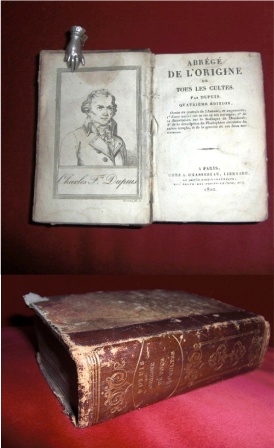
1822réf. 011939A. Chasseriau, Paris 1822. 4ième Édition / 4. Auflage Hartkarton Der Zeit/Halbleder Altersschön
1993réf. 97888ABHamburg:, Dölling und Galitz, 1993. 398 (2) Seiten, Fadenheftung, OPpbd. mit schwarzgedrucktem Rückenlängstitel, 30 x 21,5 cm.
réf. 5404Pleine reliure carton, Jaquette défraîchie, voir photo, bon état général, 140x220, 447 gr, environ 300 pages, traduit par J.N Bhasin, texte en anglais et hindi.
réf. 5405Pleine reliure carton,couverture légèrement défraîchie, bon état général, 140x220, 518 gr, environ 300 pages, traduit par J.N Bhasin, texte en anglais et hindi.
1980SUPPLEMENTO AL N. 4 DI FUTURA
1992Rimini, 1992, 8vo br. cop. ill. col. pp. 174 con ill.
1968réf. 2395BBBern, Edition Rüedi, 1968. Kl.-4°. 20 Bl. Mit zahlreichen Illustrationen. Illustriertes Orig.-Heft. + Wichtig: Für unsere Kunden in der EU erfolgt der Versand alle 14 Tage verzollt ab Deutschland / Postbank-Konto in Deutschland vorhanden +
1968réf. 2395BBBern, Edition Rüedi, 1968. Kl.-4°. 20 Bl. Mit zahlreichen Illustrationen. Illustriertes Orig.-Heft.
1975Ada Cessari Ada Cessari. Tuo figlio e il suo astro. Un trattato di astrologia con l'oroscopo per il tuo bambino. Milano, Baldini and Castoldi 1975 - I italiano, cm 20 x 13 pp. 27397 Brossura con sovraccoperta stampata. Sul dorso sono presenti macchie di colla.
1975Ada Cessari Ada Cessari. Tuo figlio e il suo astro. Un trattato di astrologia con l'oroscopo per il tuo bambino. Baldini and Castoldi. 1975 - I. Milano, Baldini and Castoldi 1975 - I italiano, in ottavo pp. 504 14983 Ada Cessari. Tuo figlio e il suo astro. Un trattato di astrologia con l'oroscopo per il tuo bambino. Baldini and Castoldi. 1975 - I. In-8. Brossura con alette. pp. 504 Volume in ottime condizioni.
1991réf. 7215Gütersloh, Bertelsmann Club 1991. Hardcover mit Schutzumschlag, 8 , 288 S., mit 27 Farbfotos, "Wie lange gibt es wirklich schon Menschen auf der Erde, und wo lag ihr Ursprung? Liegt des Rätsels Lösung auf Pheaton, dem sagenhaften zehnten Planeten, dem verlorenen Paradies?" Schutzumschlag etwas bestoßen. Schutzumschlag Hardcover
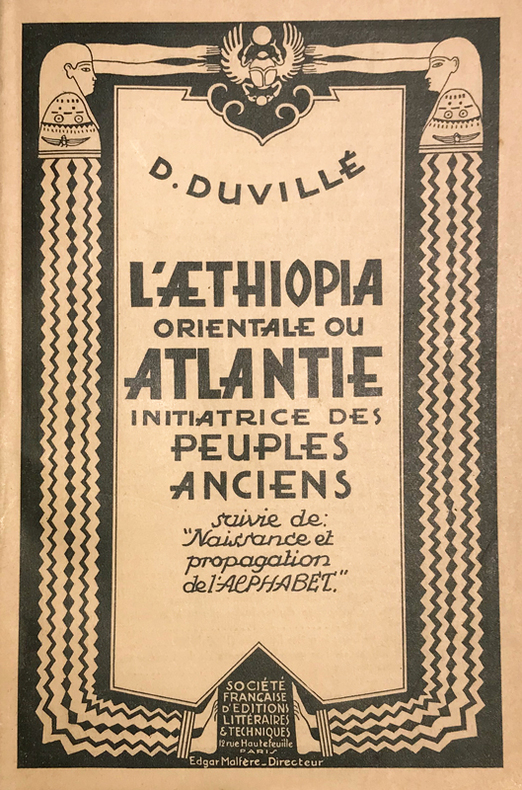
1936réf. 3776Paris, Malfère, 1936 ; in-12, broché ; 232 pp., figures, alphabets, couverture illustrée de l’auteur.
1994réf. 13775Mercure de france 1994 364 pages in-8. 1994. Reliure editeur cartonnée. 364 pages. Cet ouvrage de Nym J. Wei publié en 1993 par Mercure de France dans la collection L'Avenir sans peine est un guide détaillé sur les particularités de chaque signe astrologique et leurs interactions. Il se présente comme un outil d'astro-psychologie pour la connaissance de soi et des autres
Palma de Mallorca, Edit. José J. de Olañeta, 1990. Edición de 4000 ejemplares numerada, este el 1302. Numerosas ilustraciones en color. 273 p. 4º. Tela editorial estampada con lámina ilustrada. Muy buen ejemplar.
1524réf. 5256Augsburg: Simprecht Ruff 1524. FIRST GERMAN-LANGUAGE EDITION. Hardcover. Fine. Bound in modern boards. A fine copy. First German edition of a book written to quell the growing hysteria around the conjunction of Jupiter and Saturn in the sign of Pisces in February 1524 which was rumored to herald a catastrophic flood. Written by Paul of Middelburg renowned astrologer professor of astronomy at the University of Padua and personal physician to the Duke of Urbino the book "A most useful book to read at the present time concerning the Deluge or the Great Flood: That is that one will not be caused by the heavens as some astrologers have clumsily written and that no one should worry about it… Translated into German to bring consolation to the fearful." first appeared in Latin as "Prognosticon ostendens anno 1524 nullum diluvium futurum"1523. "The Jupiter-Saturn conjunction of February 1524 proved a stimulus to industry—about sixty Renaissance authors penned more than 160 pamphlets… Even a remove of nearly five-hundred years has done little to dampen scholarly interest in this signal episode of the intellectual history of the 1500s." "In a world view shaped by a natural philosophy much imbued with and indebted to astrology the theory of great conjunctions which was originally formulated by the Arab scholars Messehala Masha'allah and al-Kindi and more fully articulated thereafter by Albumasar Abu Ma'shar in his 'De magnis coniunctionibus' played a particularly important role… "The most important of these conjunctions involved the more slowly revolving planets—Jupiter and Saturn… Little wonder then that the attention of astrologers was drawn to the powerful planetary alignment even many years before it would supposedly take place in the watery house of Pisces in February 1524. But this time not only would Mars Jupiter and Saturn unite in celestial embrace they were also to be joined in a far more massive display by the Sun Mercury and Venus viz. six of the then seven known planets… "On 20 March 1523 a libel bearing the imperial seal was published in Vienna by the court astrologer Georg Tannstetter who noted that '…this rumour about the impending flood has already taken root everywhere in every sense creeping into everyone's mind: it has provoked the wise and the learned to heated debate and in some it has caused such consternation that they can no longer manage their affairs properly: they sell their lands fields and other properties or refuse to purchase those for sale because they believe it will be easier to convey money up to the mountains than castles and farms. Others still postpone weddings rescind contracts refuse holy orders listlessly tend to their crops while exclaiming if I understand rightly: what good are riches if in a few years no one will be able to enjoy them' "The Spanish astrologer and theologian Pedro Ciruelo a man of vast erudition who was widely acclaimed in his own time wrote an analysis in Spanish of the 1524 conjunction that was later translated into Latin Italian and German. He even advises his readers at a certain point about precautionary measures they might take: 'those of means should store provisions of flour oil wine firewood salted beef dried fish … so that if any watery event were to occur in the months hither everyone shall have their store and can go with it to a safer place.' For the poor who cannot afford such provisions Ciruelo recommends that their needs be seen to at public expense. He also suggests that peasants refrain from sowing lowland fields and that shepherds and cowherds drive their animals to highland pastures where forage is abundant… "A pre-eminent figure in the reform of the calendar taken up at the Lateran Council of 1512-1517 Paul of Middelburg who had long refrained from publishing any predictions was finally persuaded to a change of heart by the tightening grip of anxiety and fear throughout Italy and published in 1523 his 'Prognosticon' which was addressed to Pope Clement VII and refuted any possibility of either a universal deluge or a more local flash-flood."Barillà Drawing Nigh to February 1524: The Spate of Fear p. 2 ff. Simprecht Ruff hardcover
1524réf. 5256Augsburg: Simprecht Ruff 1524. FIRST GERMAN-LANGUAGE EDITION. Hardcover. Fine. Bound in modern boards. A fine copy. First German edition of a book written to quell the growing hysteria around the conjunction of Jupiter and Saturn in the sign of Pisces in February 1524 which was rumored to herald a catastrophic flood. Written by Paul of Middelburg renowned astrologer professor of astronomy at the University of Padua and personal physician to the Duke of Urbino the book "A most useful book to read at the present time concerning the Deluge or the Great Flood: That is that one will not be caused by the heavens as some astrologers have clumsily written and that no one should worry about it… Translated into German to bring consolation to the fearful." first appeared in Latin as "Prognosticon ostendens anno 1524 nullum diluvium futurum"1523. "The Jupiter-Saturn conjunction of February 1524 proved a stimulus to industry—about sixty Renaissance authors penned more than 160 pamphlets… Even a remove of nearly five-hundred years has done little to dampen scholarly interest in this signal episode of the intellectual history of the 1500s." "In a world view shaped by a natural philosophy much imbued with and indebted to astrology the theory of great conjunctions which was originally formulated by the Arab scholars Messehala Masha'allah and al-Kindi and more fully articulated thereafter by Albumasar Abu Ma'shar in his 'De magnis coniunctionibus' played a particularly important role… "The most important of these conjunctions involved the more slowly revolving planets—Jupiter and Saturn… Little wonder then that the attention of astrologers was drawn to the powerful planetary alignment even many years before it would supposedly take place in the watery house of Pisces in February 1524. But this time not only would Mars Jupiter and Saturn unite in celestial embrace they were also to be joined in a far more massive display by the Sun Mercury and Venus viz. six of the then seven known planets… "On 20 March 1523 a libel bearing the imperial seal was published in Vienna by the court astrologer Georg Tannstetter who noted that '…this rumour about the impending flood has already taken root everywhere in every sense creeping into everyone's mind: it has provoked the wise and the learned to heated debate and in some it has caused such consternation that they can no longer manage their affairs properly: they sell their lands fields and other properties or refuse to purchase those for sale because they believe it will be easier to convey money up to the mountains than castles and farms. Others still postpone weddings rescind contracts refuse holy orders listlessly tend to their crops while exclaiming if I understand rightly: what good are riches if in a few years no one will be able to enjoy them' "The Spanish astrologer and theologian Pedro Ciruelo a man of vast erudition who was widely acclaimed in his own time wrote an analysis in Spanish of the 1524 conjunction that was later translated into Latin Italian and German. He even advises his readers at a certain point about precautionary measures they might take: 'those of means should store provisions of flour oil wine firewood salted beef dried fish … so that if any watery event were to occur in the months hither everyone shall have their store and can go with it to a safer place.' For the poor who cannot afford such provisions Ciruelo recommends that their needs be seen to at public expense. He also suggests that peasants refrain from sowing lowland fields and that shepherds and cowherds drive their animals to highland pastures where forage is abundant… "A pre-eminent figure in the reform of the calendar taken up at the Lateran Council of 1512-1517 Paul of Middelburg who had long refrained from publishing any predictions was finally persuaded to a change of heart by the tightening grip of anxiety and fear throughout Italy and published in 1523 his 'Prognosticon' which was addressed to Pope Clement VII and refuted any possibility of either a universal deluge or a more local flash-flood."Barillà Drawing Nigh to February 1524: The Spate of Fear p. 2 ff. Simprecht Ruff hardcover books
Milano, Mondadori, 1973. In 8°pp.341n.+10nn. con 132 figg.n.t.
1965réf. RO20065305Editions traditionnelles. 1965. In-8. Broché. Etat d'usage, Couv. légèrement passée, Dos frotté, Intérieur bon état. 112 pages, illustrations noir et blanc dans le texte, tableaux, annotations. . . . Classification Dewey : 133.5-Astrologie
1981réf. 110935Albuquerque, N.M., USA, Sun Books 1981 In-8 21 x 13,5 cm. Broché, couverture orange, titre en noir sur le dos et le premier plat orné d’une figure, portrait de Alan Leo en frontispice, 205 pp. Exemplaire en bon état.