7 263 résultats
1993Libro che tratta il campo poco esplorato della astrologia di derivazione sumerica.
1968Mit vier Holzschnitten von Peer Wolfram.
2021ill., br. Esistono 12 Porte dell'Anima in questo Universo. Gli Starseed (anime extraterrestri incarnate in terra), possono provenire e incarnarsi dai più svariati sistemi stellari. Ma portano i segni psichici e fisici di una o due di queste "Porte dell'Anima", od origini planetarie principali. Numerosissime sono le provenienze degli Starseed, ma solo 12 sono le porte dell'anima. Questo libro riduce gli Starseed a 12 gruppi fondamentali. Ogni essere umano in Terra, così come ogni essere umano, non umano e animale in questo Universo, porta i segni psichici e fisici (gli occhi) di una o due di queste Origini Planetarie dell'anima. Esse corrispondono al luogo della prima manifestazione in questa Galassia, e al luogo di incarnazione scelto a livello dell'anima.
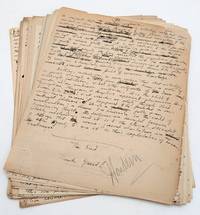
1926réf. 71978Providence RI: H. P. Lovecraft 1926. Manuscript. Very Good. Twenty-three letter-sized manuscript leaves approx. 8.5" x 11". Written in dark ink and hand-numbered by Lovecraft: page numbers 16 18 24 25 26 26b and 27-43. The manuscript pages feature heavy contemporary ink revisions cancellations interlinear additions and a data table. Lovecraft concludes on page 43 in ink: "The End / Thank Gawd!" and the manuscript is signed "Houdini" by Harry Houdini in pencil at the conclusion. The manuscript is written on the reverse sides of correspondence and constitutes a rich literary archive preserving original incoming letters to H.P. Lovecraft. Professional and personal correspondence typescript poetry submissions and editorial rejections sent to Lovecraft between 1922 and 1926 by associates editors and other contemporaries are represented here. Some horizontal folding creases sporadic edge wear and chipping age-toning. The Manuscript Rectos: A major autograph working draft of The Cancer of Superstition the ghostwritten treatise commissioned by Harry Houdini in 1926 to combat spiritualism and commercial fortune-telling. Writing entirely in his own hand Lovecraft systematically deconstructs astrology using modern astronomical scientific knowledge-citing the precession of the equinoxes light-speed delays and extragalactic nebulae-while refuting astrological claims through logic probability and history. Lovecraft mounts a rigorous scientific assault on astrology treating pseudoscience not merely as an intellectual failing but as a cosmic absurdity. On page 39 he constructs a detailed planetary data table tracking diameters solar distances and revolution periods arguing that when viewing these immense scales "we can no longer entertain the astrological illusion that our earth is a considerable object for whose benefit the rest of the universe is arranged." Turning his venom toward the commercial occult trade Lovecraft decries "how many dollars are snatched from the unwary by a device so ancient & so simple" warning that "many lives have been utterly wrecked through the random bombast & gibberish of some ignorant & unscrupulous soothsayer" page 26. Elsewhere he dismantles horoscopic predictions through celestial mechanics noting that zodiac signs "sprang partly from apparent conditions no longer existing" 35 and questions the clockwork of the planets reckoning with light-speed delays crossing vast distances of the cosmos: "If the planets rule the earth why are not the real times of their aspects calculated; instead of the apparent times as judged by their light as it reaches us" 38. Driving his argument to its climax Lovecraft brands astrology as "a legacy from primitive times; a sister of witchcraft fetichism . a shame & a nuisance in the world of broadening thought" and brings his draft to an exhausted close: "The End / Thank Gawd!" 43. The Correspondence Versos: Lovecraft reused the blank backs of incoming correspondence received between 1922 and 1926 to draft the text-a lifelong habit born of extreme poverty and his frequent inability to afford fresh writing paper. These versos contain letters poems and notes from key associates including W. Paul Cook James F. Morton Jr. Anne T. Renshaw Horace L. Lawson Leo Fritter Edward L. Sechrist and John Ravenor Bullen. Notably Leaf 26b preserves a typed rejection letter from Macfadden Publications Ghost Stories magazine dated September 13 1926 establishing the precise date of composition weeks prior to Houdini's death on October 31 1926. Beyond serving as draft paper these recycled letters capture vivid glimpses into Lovecraft's inner circle and literary network. James F. Morton Jr. bemoans his paid ghostwriting work lamenting "The more I work on this stuff the more I realize the hopeless inadequacy of the profanity division of the English language" while praising mutual associate Samuel Loveman as "a greater genius than both of us together" see letter on reverse of HPL's corresponding manuscript page 41. A remarkably interesting and macabre letter from entomologist Edward L. Sechrist is present. Inspired by Lovecraft's horror fiction Sechrist muses on having little "reverence for human meat than for any other kind of flesh and I believe I could contentedly pick a bone with the rest of a group of cannibals squatted beside a little fire. So I rather appreciate your Doctor's experiments. I have no shivers for anything." 28-29. Crucially anchoring the entire assembly is a formal rejection letter 26b from Macfadden Publications' Ghost Stories magazine "I regret that I am unable to use it" typed September 13 1926-providing the definitive date of this manuscript composition just weeks before Houdini's untimely death. Historical & Publication Context: Following their successful 1924 collaboration on "Imprisoned with the Pharaohs" Harry Houdini retained Lovecraft to spearhead a book-length crusade against spiritualism and pseudoscience. Lovecraft devised the work's master outline and drafted its core scientific arguments bringing in his Providence associate C. M. Eddy Jr. to expand prose chapters under his editorial direction. The project came to a sudden halt when Houdini unexpectedly died on Halloween 1926 prompting his widow Bess Houdini to discontinue the work. Long regarded as a legendary lost collaboration-represented in print for decades only by Lovecraft's outline in Arkham House's The Dark Brotherhood 1966 and a partial typescript discovery in 2016-the text remained unpublished for nearly a century until its debut release in March 2025 by 1878 Press Co. titled The Cancer of Superstition and credited to "Harry Houdini & C.M. Eddy Jr. Outline by H.P. Lovecraft." Here preserving twenty-three pages written entirely in Lovecraft's own hand this manuscript proves he penned far more than a mere outline for this famous lost work. H. P. Lovecraft unknown books
1926réf. 71978Providence RI: H. P. Lovecraft 1926. Manuscript. Very Good. Twenty-three letter-sized manuscript leaves approx. 8.5" x 11". Written in dark ink and hand-numbered by Lovecraft: page numbers 16 18 24 25 26 26b and 27-43. The manuscript pages feature heavy contemporary ink revisions cancellations interlinear additions and a data table. Lovecraft concludes on page 43 in ink: "The End / Thank Gawd!" and the manuscript is signed "Houdini" by Harry Houdini in pencil at the conclusion. The manuscript is written on the reverse sides of correspondence and constitutes a rich literary archive preserving original incoming letters to H.P. Lovecraft. Professional and personal correspondence typescript poetry submissions and editorial rejections sent to Lovecraft between 1922 and 1926 by associates editors and other contemporaries are represented here. Some horizontal folding creases sporadic edge wear and chipping age-toning. The Manuscript Rectos: A major autograph working draft of The Cancer of Superstition the ghostwritten treatise commissioned by Harry Houdini in 1926 to combat spiritualism and commercial fortune-telling. Writing entirely in his own hand Lovecraft systematically deconstructs astrology using modern astronomical scientific knowledge-citing the precession of the equinoxes light-speed delays and extragalactic nebulae-while refuting astrological claims through logic probability and history. Lovecraft mounts a rigorous scientific assault on astrology treating pseudoscience not merely as an intellectual failing but as a cosmic absurdity. On page 39 he constructs a detailed planetary data table tracking diameters solar distances and revolution periods arguing that when viewing these immense scales "we can no longer entertain the astrological illusion that our earth is a considerable object for whose benefit the rest of the universe is arranged." Turning his venom toward the commercial occult trade Lovecraft decries "how many dollars are snatched from the unwary by a device so ancient & so simple" warning that "many lives have been utterly wrecked through the random bombast & gibberish of some ignorant & unscrupulous soothsayer" page 26. Elsewhere he dismantles horoscopic predictions through celestial mechanics noting that zodiac signs "sprang partly from apparent conditions no longer existing" 35 and questions the clockwork of the planets reckoning with light-speed delays crossing vast distances of the cosmos: "If the planets rule the earth why are not the real times of their aspects calculated; instead of the apparent times as judged by their light as it reaches us" 38. Driving his argument to its climax Lovecraft brands astrology as "a legacy from primitive times; a sister of witchcraft fetichism . a shame & a nuisance in the world of broadening thought" and brings his draft to an exhausted close: "The End / Thank Gawd!" 43. The Correspondence Versos: Lovecraft reused the blank backs of incoming correspondence received between 1922 and 1926 to draft the text-a lifelong habit born of extreme poverty and his frequent inability to afford fresh writing paper. These versos contain letters poems and notes from key associates including W. Paul Cook James F. Morton Jr. Anne T. Renshaw Horace L. Lawson Leo Fritter Edward L. Sechrist and John Ravenor Bullen. Notably Leaf 26b preserves a typed rejection letter from Macfadden Publications Ghost Stories magazine dated September 13 1926 establishing the precise date of composition weeks prior to Houdini's death on October 31 1926. Beyond serving as draft paper these recycled letters capture vivid glimpses into Lovecraft's inner circle and literary network. James F. Morton Jr. bemoans his paid ghostwriting work lamenting "The more I work on this stuff the more I realize the hopeless inadequacy of the profanity division of the English language" while praising mutual associate Samuel Loveman as "a greater genius than both of us together" see letter on reverse of HPL's corresponding manuscript page 41. A remarkably interesting and macabre letter from entomologist Edward L. Sechrist is present. Inspired by Lovecraft's horror fiction Sechrist muses on having little "reverence for human meat than for any other kind of flesh and I believe I could contentedly pick a bone with the rest of a group of cannibals squatted beside a little fire. So I rather appreciate your Doctor's experiments. I have no shivers for anything." 28-29. Crucially anchoring the entire assembly is a formal rejection letter 26b from Macfadden Publications' Ghost Stories magazine "I regret that I am unable to use it" typed September 13 1926-providing the definitive date of this manuscript composition just weeks before Houdini's untimely death. Historical & Publication Context: Following their successful 1924 collaboration on "Imprisoned with the Pharaohs" Harry Houdini retained Lovecraft to spearhead a book-length crusade against spiritualism and pseudoscience. Lovecraft devised the work's master outline and drafted its core scientific arguments bringing in his Providence associate C. M. Eddy Jr. to expand prose chapters under his editorial direction. The project came to a sudden halt when Houdini unexpectedly died on Halloween 1926 prompting his widow Bess Houdini to discontinue the work. Long regarded as a legendary lost collaboration-represented in print for decades only by Lovecraft's outline in Arkham House's The Dark Brotherhood 1966 and a partial typescript discovery in 2016-the text remained unpublished for nearly a century until its debut release in March 2025 by 1878 Press Co. titled The Cancer of Superstition and credited to "Harry Houdini & C.M. Eddy Jr. Outline by H.P. Lovecraft." Here preserving twenty-three pages written entirely in Lovecraft's own hand this manuscript proves he penned far more than a mere outline for this famous lost work. H. P. Lovecraft unknown
1968Rupert Gleadow Origin of the Zodiac. , Jonathan Cape Ltd 1968, Buono (Good) . 0224613995
2015ill., br. Se c'è una cosa che l'analisi astrologica riesce a fare benissimo è descrivere il temperamento e le attitudini di una persona. E dunque, perché non sfruttare questa peculiarità della materia per conoscere i nostri talenti e migliorare davvero la nostra vita? Studiare gli argomenti che ci interessano profondamente, fare un lavoro che ci piace vuol dire essere realizzati e, di conseguenza, molto più felici, più allineati al tipo di energia che ci anima. Seguiamo le nostre stelle e raggiungeremo gli obiettivi, il successo e la nostra realizzazione. In questo libro vengono forniti gli strumenti utili per individuare, dalla lettura del Tema natale, le attitudini personali e consigliare i giovani nelle scelte scolastiche. Il testo è di aiuto anche quando si decide di compiere una svolta in campo professionale perché ci si accorge che il proprio lavoro non è più quello che si desidera. Conoscere se stessi permette di percorrere le strade più consone alla propria natura e di sperimentare le infinite possibilità a disposizione.
1925réf. OKKU2037Potsdam, Müller (1925). 167 S. Mit Titel, Zwischentitel und 24 Tafeln in Farben- und teils in Golddruck. Farbig illustr. OPappband. Beiliegend die oft fehlende bewegliche Horoskop-Scheibe. Kanten etwas berieben, Rückenkanten leicht angeplatzt. Aufwendig gedruckt. Die Träume samt ihren Deutungen in alphabetischer Ordnung. Die 24 Tafeln zeigen Traumerscheinungen mit ausführlicher Beschreibung auf dem gegenüberliegenden Blatt dar, z.B. Engel / Flug / Nacktheit / Orgie / Selbstmord / Unglück. Endet mit einer Beschreibung der 12 Sternzeichen.
2003réf. 187703Fayard Fayard,2003. In-folio carré relié toile sous jaquette de 393 pages, nombreuses illustrations dans et hors-texte, certaines dépliantes. Bon état
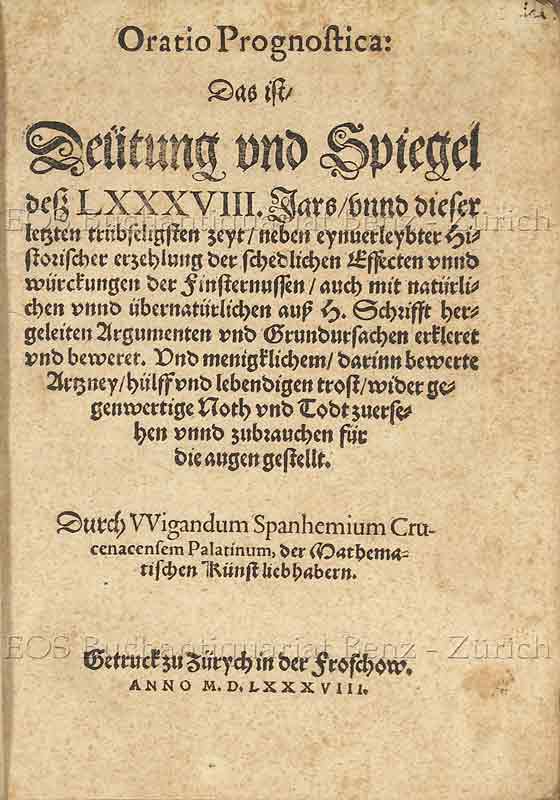
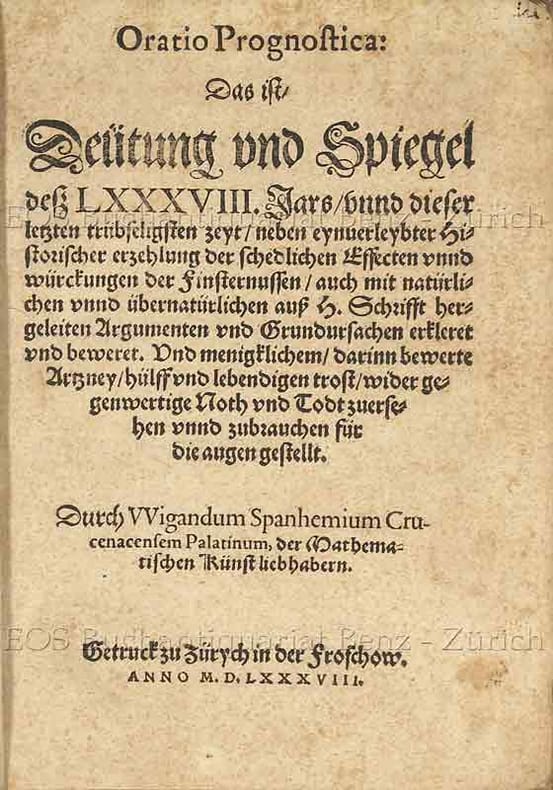
1588réf. 5638CBGetruckt zu Züriych, in der Froschow, anno 1588. Kl.-4°. XXXI, (1) Bl. (letztes leer). Spätere schlichte Borschur. + Wichtig: Für unsere Kunden in der EU erfolgt der Versand alle 14 Tage verzollt ab Deutschland / Postbank-Konto in Deutschland vorhanden +, Titelblatt
1588réf. 5638CBGetruckt zu Züriych, in der Froschow, anno 1588. Kl.-4°. XXXI, (1) Bl. (letztes leer). Spätere schlichte Borschur.
2006réf. 425www.sacredscience.com Sacred Science Institute. 2006. Deluxe Hardcover Facsimile Edition Privately Printed. H Hard Cover Maroon Suede Guilt. New. Exact Facsimile Reprint of Original Edition Published: 1693. 167p. In Which The Common Errors of that Art are Modestly Exposed & Rejected. With an Essay towards Reviving the True & Ancient Method Laid Down for Our Direction by the Great Ptolemy; & More Agreeable to the Principles of Motion & Nature Than That Commonly Practiced & Taught. In Two Parts.ìAxiom: That every Cause must have a Certain Effect; and by that Rule any Direction that hath Power to kill at one time hath another or else a good substantial Rule to shew reason to the contrary. A Very Rare And Interesting 17th Century Astrological Treatise. www.sacredscience.com Sacred Science Institute hardcover
1583in-folio, pp. (12), 624, (6), leg. coeva p. perg. (minimo restauro al dorso) conservato in elegante astuccio-custodia moderno m. pelle, dorso a nervi, con tit. e ricchi fregi oro. Marca tipogr. al titolo, al verso del foglio ritratto silogr. dell'autore, ripetuto in fine; nel testo vi è la straordinaria serie di circa 2000 figure silografate attinenti alle materie trattate. Dedica a stampa al barone Giov. Giacomo Fugger. Seconda edizione, in tutto identica alla prima apparsa nella stessa città nel 1562, di uno dei più completi trattati cinquecenteschi sulla chiromanzia (a cui sono dedicati i primi 6 libri), la fisiognomia (il settimo), l'astrologia e l'arte divinatoria in generale (l'ultimo). Le pp. 387-449 contengono numerosi oroscopi, basati sulla lettura della mano di personaggi contemporanei viventi e le pp. 450-51 un curioso studio fisiognomico di San Pietro e Paolo e di Giuda Iscariota, con il loro ritratto. L'autore (nato nel 1509) fu illustre matematico, fisico, filosofo e musicista. Prese parte alla spedizione di Carlo V a Tunisi, insegnò matematica a Palermo, Roma e Ferrara e negli ultimi anni di vita fu maestro di musica presso l'arcivescovato di Colonia. Scrisse anche altre importanti opere concernenti la geometria ed il magnetismo. Bell' esempl. (lievissime arrossature della carta e minimi restauri nell'estremo margine interno).. Houzeau e Lancaster 4885. Thorndike, V, pp. 580-88. Zinner 2296. Caillet III, 10524. STC., German Books, 848. Dorbon 4760 cita un'ediz. della sola ''Chyromancie'' del 1677: "très rare ouvrage". Bibl. Magica Casanatense 1160; Cantamessa, III, n. 7841..
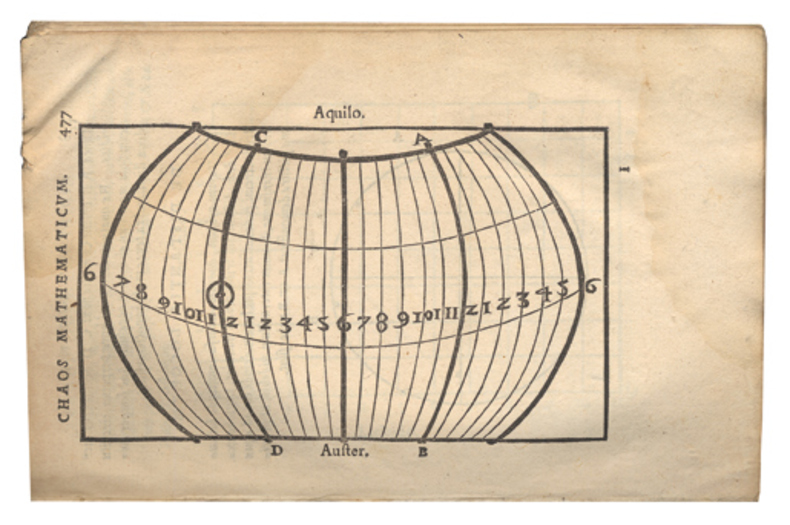
1620réf. 102693Francofurti ad Oderam impensis Johannis Thymii 1620 1 vol. relié in-folio, vélin ivoire, dos à nerfs avec filets à froid, plats à recouvrement encadrés d'un double-filet à froid, 4 ff.n.ch. + 178 pp. + 1 f. blanc + 900 pp. + 38 ff.n.ch. (index). Seconde édition. Compositeur et théoricien de la musique, astronome, historien, libraire et éditeur de musique originaire de Gorsleben (Thuringe), Sethus Calvisius (1556-1615) publie son Opus chronologicum en 1605. Cet important ouvrage se propose d'étudier les grands événements historiques - des origines à la fin du XVIe siècle - à la lumière de l'astronomie, notamment par 300 éclipses enregistrées et confirmées. Il connut un franc succès et au moins 6 rééditions jusqu'en 1685. Plat inférieur et dos tachés, important manque de cuir au dos. Manque le portrait-frontispice. Mouillure à l'angle supérieur des 60 derniers feuillets, le dernier feuillet a été renforcé. Rare et recherché. En l'état.
réf. 47192Firenze, Sismel - Edizioni del Galuzzo 2008, 210x145mm, 304pages, broché. Exemplaire neuf.
1657In-12°, (12), 406pp, legatura in piena pergamena coeva, titolo manoscritto al dorso, nervature, frontespizio con fregio xilografico, iniziali xilografiche , buone condizioni. Numerose notizie sul clima romano, e sulla peste a Roma e a Napoli. Riccardi lo cita senza averlo visto. Contiene, con proprio frontespizio Il Setaccio, in cui si ripassa la farina de’ Pronostici d’Osmur Zerith gran satrapa della Persia. In-12 °, (12), 406pp, contemporary full vellum binding, handwritten title on the spine, bands, frontispiece with woodcut frieze, woodcut initials, good condition. Numerous news on the Roman weather, and on the plague in Rome and Naples. Riccardi mentions it without having seen it. It contains, with its own title page Il Setaccio, in cui si ripassa la farina de’ Pronostici d’Osmur Zerith gran satrapa della Persia.
1974bross. edit. ill. con bandelle, segni di piega al dorso - prima edizione it. - trad. di Roberta Rambelli - illustrazioni in b.n. fuori testo
1769In 4° (24,8x18,3 cm); (8), 282, (2) pp. e 5 c. di tav. fuori testo ripiegate ed incise da Nicola Orazi (le stesse che illustrano la prima edizione latina napoletana del 1752). Legatura degli inizi del XIX° secolo in cartoncino rigido foderato con bella carta a ricchi motivi in rosso e blu. Tassello in pelle rossa al dorso con titolo in oro. Esemplare in barbe. Testatine, finalini e iniziali riccamente ornati. Qualche insignificante brunitura in alcune pagine dovute alla qualità della carta napoletana utilizzata e per il resto nel complesso esemplare in buone-ottime condizioni di conservazione. Rarissima, nessun esemplare censito in ICCU, prima ed ultima edizione latina nella sua versione definitiva ed emendata di questa celebre raccolta di scritti del grande medico britannico Richard Mead (Stepney, 11 agosto 1673 - Londra, 16 febbraio 1754). La sua opera A Short Discourse concerning Pestilential Contagion, and the Method to be used to prevent it (1720), fu di storica importanza per comprendere le malattie contagiose. Il suo trattato Mechanical Account of Poisons venne pubblicato nel 1702, e l'anno successivo venne ammesso alla Royal Society, alla quale contribuì alla stesura di un documento sulla natura parassitaria della scabbia. Nello stesso anno, fu eletto medico del San Thomas Hospital e nominato a leggere lezioni anatomiche alla Surgeon's Hall. Alla morte di John Radcliffe nel 1714, Mead divenne il capo riconosciuto della sua professione. Egli assistette la regina Anna sul letto di morte e nel 1727 divenne medico di Giorgio II, che in precedenza era già suo paziente quando era principe di Galles. Mentre era al servizio del re, Mead venne coinvolto nella creazione di una nuova opera umanitaria, l'Ospedale degli Innocenti, sia come fondatore che come consulente medico. L'opera contiene oltre ai celebri scritti sul vaiolo, il morbillo e la Peste anche il curioso studio sull'influsso della luna e del sole sulla salute umana, un'opera di interesse numismatico sulle monete coniate nell'antichità greca a Smirne dedicate a celebri medici (tre delle tavole fuori testo sono di interesse numismatico) ed il noto trattato sui veleni diviso in sei parti dedicate al veleno di Vipera, di Tarantola, Dei cani idrofobi (l'autore considera l'idrofobia come una malattia causata da un veleno), veleni di origine minerale e vegetale, l'Oppio, Veleni di terra aria e acqua (due tavole fuori testo illustrano uno la struttura ossea di una vipera e l'altra una scolopendra, una tarantola, uno scorpione e tre licheni velenosi). Esemplare in buone-ottime condizioni di conservazione stampato a Napoli da Domenico Terres.
1752In 8° (23,5x18 cm); (12), 202, (2) pp. e 5 c. di tav. fuori testo ripiegate ed incise da Nicola Orazi. Legatura coeva in piena pergamena. Rigida con piccolo tassello in pelle rossa al dorso con titolo in oro. Bell'incisione al frontespizio opera di B. de Grado. Testatine, finalini e iniziali riccamente ornati. Abile, antico ed insignificante restauro all'angolo superiore della prima carta e delle ultima 4 carte (solo nella penultima carta si segnala che l'interazione di carta ha portato alla perdita del numero della pagina). Qualche insignificante brunitura in pochissime pagine dovute alla qualità della carta napoletana utilizzata e per il resto nel complesso esemplare in buone-ottime condizioni di conservazione. Prima edizione latina non comune (nello stesso anno venne stampata un'edizione veneziana ed una seconda edizione napoletana) di questa celebre raccolta di scritti del grande medico britannico Richard Mead (Stepney, 11 agosto 1673 - Londra, 16 febbraio 1754). La sua opera A Short Discourse concerning Pestilential Contagion, and the Method to be used to prevent it (1720), fu di storica importanza per comprendere le malattie contagiose. Il suo trattato Mechanical Account of Poisons venne pubblicato nel 1702, e l'anno successivo venne ammesso alla Royal Society, alla quale contribuì alla stesura di un documento sulla natura parassitaria della scabbia. Nello stesso anno, fu eletto medico del San Thomas Hospital e nominato a leggere lezioni anatomiche alla Surgeon's Hall. Alla morte di John Radcliffe nel 1714, Mead divenne il capo riconosciuto della sua professione. Egli assistette la regina Anna sul letto di morte e nel 1727 divenne medico di Giorgio II, che in precedenza era già suo paziente quando era principe di Galles. Mentre era al servizio del re, Mead venne coinvolto nella creazione di una nuova opera umanitaria, l'Ospedale degli Innocenti, sia come fondatore che come consulente medico. L'opera contiene oltre ai celebri scritti sul vaiolo, il morbillo e la Peste anche il curioso studio sull'influsso della luna e del sole sulla salute umana, un'opera di interesse numismatico sulle monete coniate nell'antichità greca a Smirne dedicate a celebri medici (tre delle tavole fuori testo sono di interesse numismatico) ed il noto trattato sui veleni diviso in sei parti dedicate al veleno di Vipera, di Tarantola, Dei cani idrofobi (l'autore considera l'idrofobia come una malattia causata da un veleno), veleni di origine minerale e vegetale, l'Oppio, Veleni di terra aria e acqua (due tavole fuori testo illustrano uno la struttura ossea di una vipera e l'altra una scolopendra, una tarantola, uno scorpione e tre licheni velenosi). Esemplare in buone-ottime condizioni di conservazione stampato a Napoli da Giuseppe de Boni.
1536In-16 p. (mm. 152 x 98), p. pergam. coeva (risg. rifatti), titolo ms. al dorso, cc.nn. 392, cornice figurata al frontesp., con bella xilografia a p. pag. al verso della terza carta; ornato da grandi iniz. figur. a vignetta inc. su legno. Di questo celebre trattato, che ebbe numerosiss. edizioni a partire dal XV secolo, cosi' precisa Gamba,374: "Il Crescenzio scrisse quest'opera in latino tra il 1307 e il 1311, ed è stata opinione di Leonardo Salviati, che'l volgarizzamento siasi fatto verso il 1350. Egli notò che dee riguardarsi come una delle principali scritture del volgar nostro, si' per li nomi specialissimi degli affari della villa, e talora anche di astrologia e di medicina e di altre arti, e si' perchè in genere di buone voci e di pura lingua è ripiena..". Cfr. anche Sander,I,2240: “Page du titre, encadrement orné à la grotesque; dans le haut, le chat des Sessa. Bois de page, portrait de l’auteur assis in cathedra” - Ceresoli, p. 184. Esemplare corto del margine sup., peraltro ben conservato.
1677In 8° ant. (mm 162x101), p. perg. rigida di primo Settecento, pp. 210,(2), con 6 fig. astrologiche inc. e frontesp. in rosso e nero buon es., con modeste fioriture per il tipo di carta, e sporadiche postille coeve (per questa ed. seicentesca, cfr. Cantamessa, 823).
1556réf. 1835Lugduni, apud Joannem Frellonium, [marque N°1] 1556 ; petit in-8 ; vélin à recouvrements, titre manuscrit au dos (reliure de l'époque) ; 664 pp., (2) ff. (au recto de l'avant-dernier feuillet, marque de Du Bois N°1, Lugduni, ex officina typographica Michaelis Sylvii, MDLVI, dernier feuillet blanc), caractères italiques, manchettes ; nombreuses figures (édition partagée entre Jean Frellon et A. Vincent).
1980Brossura vintage segnata dal tempo, vol. 4 della collana, copertina con toni sbiaditi dalla luce, alterati da velature di polvere, comuni tracce da attrito e compressione, marcate alle estremità, patinato usurato da sfregamento e manipolazione, fogli con qualche imperfezione, velati da ossidazione effetto vintage, intensa ai margini, pulviscolo denso da umido ai tagli, inserto fotografico completa i testo, fresatura delicata, instabile e fragile, a tratti scomposta. N. pag. 315. USATO
2009trad. di Paolo Lorenzin n. 50 bross. edit. ill.