3558 resultados
ref. 26124'B.B.C. / London'. No date Second World War. See his entry in the Oxford DNB. 1p 12mo. In poor condition aged worn and creased with damage to edges. Tape was previously present as a border along all the edges and the corners are still strengthened with tape causing discoloration that affects the end of Handley's signature. Reads: 'B.B.C. / London / Dear Pte Dean. / In reply to Yours. I would send you a ticket with Pleasure but I have no control over same. I'm afraid you will have to write direct to the B.B.C. / Best wishes. / Tommy Handley'. Scan available. 'B.B.C. / London'. No date (Second World War). unknown
1957ref. 262649Los Angeles: One Inc 1957. Magazine. 32p. including covers 5.5x8.5 inches very good digest size magazine in stapled pictorial wraps. Cover story "Poems of Other Love" with photo of Alden Kirby Umo's "The Echo of a Voice". Special focus on gay and lesbian poetry. Also a report on The Mattachine Society Convention. One Inc. which took its name from Thomas Carlyle's statement that "A mystic bond of brotherhood makes all men one" was founded in LA in 1952 as a homophile organization with connections to the Mattachine Society. As the first pro-gay journal of its kind it serves as an important source for pre-Stonewall homophile studies. In 1954 the US Post Office declared it obscene leading to a four-year legal battle chronicled in its pages that concluded with a favorable decision as part of Roth vs. United States. Aside from its articles covering topics ranging from the Beatniks and Gay marriage to homosexuality and national security One Magazine also featured poetry and short fiction by numerous prominent authors. One, Inc unknown
1901ref. 023597General Grand Chapter Of The Eastern Star 1901. Hardcover. Very Good/Not Issued. 16mo - over 5¾ - 6¾" tall. Bound In Brown Stamped Cloth With Gilt Eastern Star Symbol On The Front. Stated Eighth Edition As Amended September 1901. Later Printing Of February 1906. All Edges Red Dye. Light Foxing To The Endpapers. Faint Musty Smell. Very Good Condition For This Age. General Grand Chapter Of The Eastern Star hardcover
1981ref. 81559Washington DC: The Washington Star Company 1981. Presumed First Edition First printing thus. Newspaper. Good. Some page browning noted. The Washington Star previously known as the Washington Star-News and the Washington Evening Star was a daily afternoon newspaper published in Washington D.C. between 1852 and 1981. The Sunday edition was known as the Sunday Star. The paper was renamed several times before becoming Washington Star by the late 1970s. For most of that time it was the city's newspaper of record and the longtime home to columnist Mary McGrory and cartoonist Clifford K. Berryman. On August 7 1981 after 128 years the Washington Star ceased publication and filed for bankruptcy. On February 2 1978 Time Inc. purchased the Star for $20 million. Their flagship magazine Time was the arch-rival to Newsweek which was published by The Washington Post Company. Time Inc.'s president James R. Shepley convinced Time's board of directors that owning a daily newspaper in the national capital would bring a unique sense of prestige and political access. The paper's labor unions agreed to work concessions that Shepley demanded. An effort to draw readers with localized special "zonal" metro news sections however did little to help circulation. The Star lacked the resources to produce the sort of ultra-local coverage zonal editions demanded and ended up running many of the same regional stories in all of its local sections. An economic downturn resulted in monthly losses of over $1 million. Overall the Star lost some $85 million following the acquisition before Time's board decided to give up. On August 7 1981 after 128 years The Washington Star ceased publication. From information found on-line: After word came that the Washington Star would cease publication on August 7 the first reaction of the talented young reporters on the paper was what you might expect: shock dismay grief. But within a few days according to several of them these same young reporters began to shudder each time they heard a rumor that someone somehow might step in and save the paper at the last moment. Job offers from the New York Times the Washington Post the Wall Street Journal and other prestigious publications had begun to pour in and they were contingent on the folding of the Star. It is compelling testimony to the paper's evisceration under the management of Time Inc. that its disappearance would so clearly provide a career boost to many of the people who worked for it. The Washington Star was a good newspaper possibly the best afternoon paper in the country with some of the finest journalists in the profession: Mary McGrory John Fialka Lyle Denniston Jack Germond Jules Witcover. But it has been pointed out just as consistently that there was no reason for people who read the Washington Post in the morning to read the Washington Star in the afternoon. The Star three years and $85 million after being bought by Time Inc. had become lifeless predictable and superfluous. For decades the leitmotif of the newspaper business has been the dirge. Evening papers in particular have been vulnerable for a variety of reasons: a switch to television for evening news; later starting work days which leave time to read a morning paper; the difficulty of distribution through evening rush hour. Added to this the Star was forced to compete with one of the strongest and best newspapers in the country. Perhaps nothing could have saved Washington from becoming a one-newspaper town. But in spite of its $85 million. Time Inc. never brought to it the commitment and daring of the company which early in its existence created Time Life and Fortune. It seems that since the Star couldn't be plugged into a formula for success that it was just a matter of time before Time Inc. cut its losses. There is no guarantee that if Time Inc. had done it right-if it had fulfilled people's expectations and used its resources and the Star's staff to create something glorious-it would have as newspapers must made money. But Time Inc. didn't do it right. And this city's mourning of another lost voice is tinged with regret for what that voice might have been. The Washington Star Company unknown
1963ref. 81557Washington DC: The Evening Star Newspaper Company 1963. Presumed First Edition First printing thus. Newspaper. Good. 76 pages. John Fitzgerald Kennedy the 35th President of the United States was assassinated on Friday November 22 1963 at 12:30 p.m. Central Standard Time in Dallas Texas while riding in a presidential motorcade through Dealey Plaza. Kennedy was riding with his wife Jacqueline Texas Governor John Connally and Connally's wife Nellie when he was fatally shot by former U.S. Marine Lee Harvey Oswald firing in ambush from a nearby building. Governor Connally was seriously wounded in the attack. The motorcade rushed to Parkland Memorial Hospital where Kennedy was pronounced dead about 30 minutes after the shooting; Connally recovered. Oswald was arrested by the Dallas Police Department 70 minutes after the initial shooting. Oswald was charged under Texas state law with the murder of Kennedy as well as that of Dallas policeman J. D. Tippit who had been fatally shot a short time after the assassination. At 11:21 a.m. November 24 1963 as live television cameras were covering his transfer from the city jail to the county jail Oswald was fatally shot in the basement of Dallas Police Headquarters by Dallas nightclub operator Jack Ruby. After a 10-month investigation the Warren Commission concluded that Oswald assassinated Kennedy that Oswald had acted entirely alone and that Ruby had acted alone in killing Oswald. Kennedy was the eighth and most recent US President to die in office and the fourth following Lincoln Garfield and McKinley to be assassinated. Vice President Lyndon B. Johnson automatically became president upon Kennedy's death. The Washington Star previously known as the Washington Star-News and the Washington Evening Star was a daily afternoon newspaper published in Washington D.C. between 1852 and 1981. The Sunday edition was known as the Sunday Star.1 The paper was renamed several times before becoming Washington Star by the late 1970s. For most of that time it was the city's newspaper of record and the longtime home to columnist Mary McGrory and cartoonist Clifford K. Berryman. On August 7 1981 after 128 years the Washington Star ceased publication and filed for bankruptcy. In the bankruptcy sale The Washington Post purchased the land and buildings owned by the Star including its printing presses. The Washington Star was founded on December 16 1852 by Captain Joseph Borrows Tate. It was originally headquartered in Washington's "Newspaper Row" on Pennsylvania Avenue. Tate named the paper The Daily Evening Star. In 1853 Texas surveyor and newspaper entrepreneur William Douglas Wallach purchased the paper. As the sole owner of the paper for the next 14 years Wallach built up the paper by capitalizing on reporting of the American Civil War among other things. In 1867 a three-man consortium of Crosby Stuart Noyes Samuel H. Kauffmann and George W. Adams acquired the paper with each of the investors putting up $33333.33. The Noyes-Kauffmann-Adams interests would own the paper for the next four generations. The next major change to the newspaper came in 1938 when the three owning families diversified their interests. On May 1 the Star purchased the M. A. Leese Radio Corporation and acquired Washington's oldest radio station WMAL in the process. Renamed the Evening Star Broadcasting Company the 1938 acquisition would figure later in the 1981 demise of the newspaper. The Star's influence and circulation peaked in the 1950s; it constructed a new printing plant in Southeast Washington capable of printing millions of copies but found itself unable to cope with changing times. Nearly all top editorial and business staff jobs were held by members of the owning families. Suburbanization and television were accelerating the decline of evening newspapers in favor of morning dailies. The Post meanwhile acquired and merged with its morning rival the Times-Herald in 1954 and steadily drew readers and advertisers away from the falling Star. By the 1960s the Post was Washington's leading newspaper. In 1972 the Star purchased and absorbed one of Washington's few remaining competing newspapers The Washington Daily News. For a short period of time after the merger both "The Evening Star" and "The Washington Daily News" mastheads appeared on the front page. The paper soon was retitled "Washington Star News" and finally "The Washington Star" by the late 1970s. The Evening Star Newspaper Company unknown
2006ref. 57858New York: HarperCollins Publishers 2006. First edition. Stated. Hardcover. Very good/Very good. xv 288 p. Illustrations. Index. Signed by author. Told from her unique perspective the author introduces an uplifting and inspirational guide to getting physically emotionally and spiritually prepared for one's greatest relationship. Divided into three sections the book includes quizzes and self-assessment exercises. Star Jones Reynolds had done it all. College on scholarship law school on loans and life by faith. She had achieved a prestigious career as a lawyer and prosecutor provided much-needed calm and insight while reporting the Rodney King and O. J. Simpson trials on television and landed a spot cohosting one of America's most popular daytime television shows The View. HarperCollins Publishers hardcover
1999ref. 363HL20N_9b899806-5a8a-4Atria 1999-06-01 . Hardcover. New. Atria hardcover
ref. 1434361179.Gpaperback. Good. Access codes and supplements are not guaranteed with used items. May be an ex-library book. paperback
ref. 1098355512.Ghardcover. Good. Access codes and supplements are not guaranteed with used items. May be an ex-library book. hardcover
1961ref. ddFhcNF10041113International Star Class Yacht Racing 1961-01-01. Hardcover. Acceptable. International Star Class Yacht Racing Association 1961 hardcover rubbed blue cloth w/ bright gilt sailboat and star - short tears on gutter at ends of sunned spine very good interior - tight binding clean text Prompt reliable service shipped next business day. Int'l mailed via first class or priority. International Star Class Yacht Racing hardcover
1961ref. 531442Washington D.C.: The Federal Publishing Company 1961. Softcover. Very Good. First edition. Spiral-bound illustrated wrappers. 216pp. Illustrated. Spotting rubbing and creasing else very good with gift inscription on the first page. The Federal Publishing Company unknown
1940ref. 775Marion OH: The Satr Newspaper 1940. 24 1/4 x 16. Very good. This is afull page advertisement publishes in Marion OH by The Satr newspaper. It has an excellent map of the Buckeye Stages System. Running the principal roads between Cleveland and Cincinnati. the tentacles of the system span the entire state of Ohio. This artifact of the bus era hgihgly defines the operation of the company during a period of prosperity for bus companies. This is also a schedule and listing of fares for one-way tickets from Marion. Marion is a town in west central Ohio an the road to Ft. Wayne IN. This is a handsome broadside in black and toned white paper. See Pics. The Satr (Newspaper) unknown
2013ref. 250714004MNR EDICIONES 2013-01-01. hardcover. Good. 10x8x0. Ships Out Tomorrow! MNR EDICIONES hardcover
ref. 1582611068.Gleather_bound. Good. Access codes and supplements are not guaranteed with used items. May be an ex-library book. hardcover
ref. 0559793138.Ghardcover. Good. Access codes and supplements are not guaranteed with used items. May be an ex-library book. hardcover
ref. 1803508140.Gpaperback. Good. Access codes and supplements are not guaranteed with used items. May be an ex-library book. paperback
ref. 9546Letter One: 24 October 1943; Queen's Hotel Leeds. Letter Two: 2 April no year; 18 Southwick Street London. Both items on 'Bebe' letterheads and both with signature 'Bebe' incorporating a drawing of a stick figure with hat. Letter One: 12mo 1 p. Twelve lines. Good on lightly-aged paper. With addressed envelope. She is sorry they missed one another 'at the station especially after all the trouble you went through to get there'. Gives news of show: 'Boy it will be good to get back to town again. I have enjoyed the tour but as you know travelling nowadays isn't what it used to be by a long shot.' Letter Two: 8vo 1 p. 21 lines. She makes an excuse for not meeting: 'I was feeling so ill that I just had to get home right after the show and you are so sweet that I knew you would understand.' Suggests supper 'at the Jewish Restaurant you were telling Ben about'. Of an injury to Colleano's finger she writes 'Anyway it gave you a chance to sing!'. Letter One: 24 October [1943]; Queen's Hotel, Leeds. Letter Two: 2 April [no year]; 18 Southwick Street, London. unknown
ref. FORT884611Dark Horse Comics. Used - Good. Dark Horse Comics unknown
ref. 9501234525.Gpaperback. Good. Access codes and supplements are not guaranteed with used items. May be an ex-library book. paperback
2005ref. 323380Whitehorse Yukon: Wolf Creek Books 2005. First edition. Hardcover. Very Good/Very Good. 8vo. Signed and dedicated by the authors. pp. 348 SIGNED and dedicated by both authors. ""Like many men of the nineteenth century Joseph Francis Ladue 1854-1901 sought to rise from humble origins to a position of wealth-by way of the mother lode. This is the story of one man's ambitions failures trials and triumphs. His quest took him to the dusty rowdy… Wolf Creek Books hardcover
1954ref. 28271954. Fine. This is an ORIGINAL fine pencil drawing of MARLENE DIETRICH by artist Dorothy Ahrens. The Drawing is SIGNED in ink by Marlene Dietrich. It is also signed by artist Ahrens and dated 1954. 14" x 18". Marlene Dietrich is shown in her costume as Actress "Monica Teasdale" in the 1951 20th Century Fox movie "NO HIGHWAY IN THE SKY" also starring Jimmy Stewart Glynis Johns and Jack Hawkins. Ms. Dietrich famously wore garments by Christian Dior in this movie. Fine. Shipped flat. unknown
ref. 0743418476.Gpaperback. Good. Access codes and supplements are not guaranteed with used items. May be an ex-library book. paperback
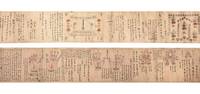
ref. 9137Numerous fine paintings & diagrams throughout using blue green red gray yellow much gold silver & flesh-colored pigments. Siddham script in several places. Two scrolls 185 x 17660 mm.; 175 x 9210 mm. each with gold-speckled inner endpapers at front dark blue paper on outsides. At the end of the first scroll a note states these texts were first written in 1192 Kenkyū 建久 3 & copied on an auspicious day in the 12th month of Genna 元和 5 this part of Genna 5 corresponds to 1620; the second scroll is also dated at end “the 12th month of Genna 5.” These two scrolls are related to a kind of Daoist-influenced star worship that was associated with esoteric Buddhism. This practice became popular within the Japanese aristocracy in the medieval period. It drew on several strands of thought imported from China that were synthesized in Japanese religious practice. Buddhism as it appeared when imported to China from India and Central Asia in the first millennium CE carried with it astronomical and astrological knowledge including an identification of the planets and their association with the calendar e.g. the association between the planets and the days of the week still apparent in the modern Japanese names for them. In China this knowledge became influenced by Daoism exemplified for example by the worship of the stars of the Big Dipper Ch.: beidou J.: hokuto 北斗. In medieval Japan star worship under the auspices of esoteric Shingon and Tendai Buddhism became popular and highly ritualized. One star-related ritual expressed the worship of an individual’s birth and year stars. During these rituals offerings were made to a star or a constellation to obtain fortune or longevity. Such rituals are described in these two scrolls. Mandala dhÄraṇī and mudrÄ were important features of ritualized star worship and the three of them are present in the first scroll. There is a fine series of 158 flesh-toned paintings of mudrÄ gestures of the hand depicted and labeled. MudrÄ were hand and arm gestures made during the course of ritual practice or depicted in images of buddhas bodhisttvas tantric deities and other Buddhist images. With the development of Mahayana and Vajrayana iconography the number of mudrÄ proliferated and reaching the hundreds. DhÄraṇī were incantations and are presented as lists of syllables written in the Indic Siddham script. There is also a diagram a mandala depicting the Big Dipper the legends reference the earthly branches each listed as either yin or yang. The second scroll includes among other things a list of the Seven Planets sun moon and the planets of the solar system minus Neptune and Pluto and associated Buddhist deities stars in the constellation of the Big Dipper and years in the sexagenary calendrical cycle. Through this list an individual’s personal star can be determined. Further into the scroll the layout of the altar featuring e.g. silver coins food offerings and candles and the conduct of the rituals for various kinds of worship are described and illustrated in a series of scenes. Ritual objects like mandalas with Siddham characters are depicted as well. The instructions for the conduct of these rituals include the performance of combinations of mudrÄ and dhÄraṇī associated with the mystery of the body and the mystery of speech respectively. In addition to the importance of the Big Dipper the Daoist influence on these scrolls is evident in its mention of deities such as the Dongyue emperor and Huang Shigong. Very good preserved in a modern box. Some worming carefully repaired. unknown
1959ref. 30277AUG 21 1959 & JULY 4 1960 FIRST DAY OF ISSUE 3 STAMPED CANCELLED ENVELOPES VG- WITH TAPE RESIDUE TO THE BACK OF 3 ENVELOPES STAMPS USPS
2019ref. 2-6202157658Editorial Académica Española 2019. Paperback. New. 156 pages. Spanish language. 8.66x5.91x0.36 inches. Editorial Académica Española paperback