755 résultats
2007Minor creasing to wraps. ; 2 vol. (XXI-282 p. , 112 pp of pl. + 15 p. -[1] foldout ) La présente étude comporte une analyse des vestiges architecturaux du théâtre de Délos, une nouvelle publication des passages des comptes des gestionnaires de la caisse sacrée concernant sa construction et son entretien, enfin une synthèse sur les concours qui y étaient célébrés. Elle permet de restituer l’évolution du projet et les étapes du chantier entre la fin du ive siècle et les environs de 240 avant J. -C. , de préciser les modes de mise en scène des spectacles à l’époque hellénistique. Elle conduit aussi à cerner la place du monument dans l’architecture et l’urbanisme déliens. Le théâtre de Délos, qui associe des gradins en demi-cercles outrepassés et un bâtiment de scène à proskènion et skènè avec un étage à front percé de larges baies, est tributaire des édifices réalisés à Athènes puis à Épidaure. Certains de ses dispositifs se rencontrent uniquement dans les Cyclades, à Cos et sur une courte frange de la côte occidentale de l’Asie Mineure. ; Exploration Archéologique De Délos. XLII
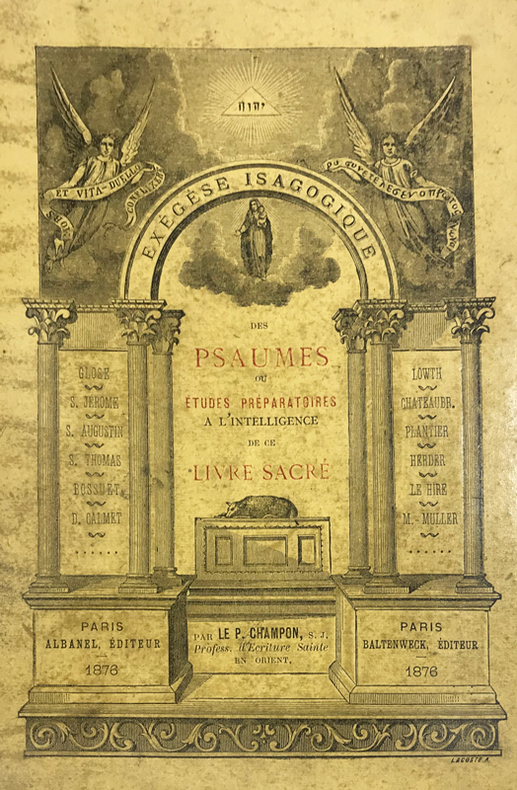
1876réf. 3786Paris, Albanel et Baltenweck (Le Puy en Velay, Imp. Freydier), 1876 ; in-8, broché ; XXXIV pp., 491 pp., (1) f. d'errata et couverture jaune illustrée.
réf. Fab1886Tours, Alfred Mame Et Fils ,Editeurs - 1886 - Traduits de L'Anglais par Richard Viot et précédé d'une introduction de Léon Gautier - 399 pages - Tables in finé - Illustrations dans le texte et en 10 grande compositions, nombreuses gravures d'après les monuments antiques. Paganisme et Christianisme - Volume in quarto, cartonnage de l'éditeur pleine percaline ,intérieur assez frais ,quelques rousseurs ,Bon exemplaire.
1936réf. 10472ÉDITIONS SPES PARIS 1936 303 pages in8. 1936. broché. 303 pages. Ouvrage religieux de l'auteur jésuite Albert Bessières publié par les Éditions Spes en 1935 qui aborde le thème du paganisme à travers les figures bibliques de Jean-Baptiste et Hérodiade. Le livre présente une reliure en cuir et provient d'une bibliothèque religieuse
1928réf. GITj605Paris Honoré Champion, Berger-Levrault 1928. In-8 broché couverture illustrée 249pp. Orné de 114 illustrations dans le texte en sépia ou hors texte sous serpente légendée; belle couverture en couleurs et 3 hors texte appliqués sur papier fort d'après les aquarelles de Emile Gudin. Couverture poussiéreuse et un peu fanée, intérieur très frais, complet, non coupé. (4952)
1996Large stamp to verso of dedication page for the John Deyell company with number written in. Else book is fine. ; An important contribution to social history, linking the life and nature of the polis with its festivals and rituals and the legends which went with them and used for the elucidation of a state's self-identity. ; Phoenix Supplementary Volume; 1 x 9.5 x 6.5 Inches; 287 pages
1996Very light shelfwear else fine. ; An important contribution to social history, linking the life and nature of the polis with its festivals and rituals and the legends which went with them and used for the elucidation of a state's self-identity. ; Phoenix Supplementary Volume; 1 x 9.5 x 6.5 Inches; 287 pages
1996Large stamp to verso of dedication page for the John Deyell company with number written in. Else book is fine. ; An important contribution to social history, linking the life and nature of the polis with its festivals and rituals and the legends which went with them and used for the elucidation of a state's self-identity. ; Phoenix Supplementary Volume; 1 x 9.5 x 6.5 Inches; 287 pages
1983DJ has edgewear to extremities. DJ has 2 closed tears (1 cm). ; Wisconsin Studies in Classics; 122 pages; The festivals of the Athenian sacred calendar constitute a vital key to classical Greek culture and religion. Erika Simon sets out here to explicate those complex and often obscure festivals. By careful marshaling of a variety of proofs from literary, historical, and archaeological sources, she is able to justify some startling conclusions and achieve a comprehensive and truly original synthesis that clarifies, as never before, the probable origins and meanings of the Attic cults.
1977Scholars' bookplate to inner cover. DJ is yellowed. Dustjacket has minor shelfwear and rubbing with one chip to upper corner. Bottom of spine rubbed. ; Parke was an authority on Greek religion and gives an account of the chief ceremonial occasions of ancient Athens in their order in the calendar. The festivals he surveys exhibit an extraordinary variety of activity associated with different religious cults. ; Aspects of Greek & Roman Life; 208 pages
1977Former owner's name on ffep. DJ is price-clipped. Dustjacket has minor shelfwear and rubbing. Slight yellowing to DJ. ; Parke was an authority on Greek religion and gives an account of the chief ceremonial occasions of ancient Athens in their order in the calendar. The festivals he surveys exhibit an extraordinary variety of activity associated with different religious cults. ; Aspects of Greek & Roman Life; 208 pages
2008Scholars' bookplate to inner cover (Slater & Dunbabin). Faint foxing to front wrap. ; Studien Und Texte Zu Antike Und Christentum / Studies and Texts in Antiquity and Christianity 48; 9.1 X 6.1 X 0.7 inches; 228 pages
2007Very faint shelfwear. ; Studies in Ancient Folklore and Popular Culture; 344 pages; Drawing upon the latest research in gender studies, history of religion, feminism, ritual theory, performance, anthropology, archaeology, and art history, Finding Persephone investigates the ways in which the religious lives and ritual practices of women in Greek and Roman antiquity helped shape their social and civic identity. Barred from participating in many public arenas, women asserted their presence by performing rituals at festivals and presiding over rites associated with life passages and healing. The essays in this lively and timely volume reveal the central place of women in the religious and ritual practices of the societies of the ancient Mediterranean. Readers interested in religion, women's studies, and classical antiquity will find a unique exploration of the nature and character of women's autonomy within the religious sphere and a full account of women's agency in the public domain
2007Very mionr shelfwear. Faint creasing to wraps. ; Studies in Ancient Folklore and Popular Culture; 344 pages; Drawing upon the latest research in gender studies, history of religion, feminism, ritual theory, performance, anthropology, archaeology, and art history, Finding Persephone investigates the ways in which the religious lives and ritual practices of women in Greek and Roman antiquity helped shape their social and civic identity. Barred from participating in many public arenas, women asserted their presence by performing rituals at festivals and presiding over rites associated with life passages and healing. The essays in this lively and timely volume reveal the central place of women in the religious and ritual practices of the societies of the ancient Mediterranean. Readers interested in religion, women's studies, and classical antiquity will find a unique exploration of the nature and character of women's autonomy within the religious sphere and a full account of women's agency in the public domain
1935Wraps are tanned and have some tear. Some pencil underlining and marginalia. 1 page of plates has been clipped to remove certain coins -- therefore plates at end are incomplete. Reading copy only. ; 28 pages of plates at end. Important study in which Bluma Trell used coins as an aid to archaeology. She pushed the study forward, especially in the use of bronze coins, which had previously been neglected. A model she constructed of the temple of Artemis based on coin illustrations was displayed for a time in the British Museum. ; Numismatic Notes and Monographs 68; 12mo 7" - 7½" tall; 67 pages
1900réf. 11095S.l., s.n., s.d. (circa début XXe siècle) ; in-16, broché ; 15, (1) pp., couverture grise muette.
19183 vols., 8vo., First Edition, free endpapers lightly browned; original green buckram, gilt backs, uncut, boards lightly chafed at extremities else a very good, bright, clean set. The original edition is elusive in this condition. Besterman CXLVII-CXLIX.
1950Light bump to top of spine. Light pencil to a few pages. Minor shelfwear. ; 8vo 8" - 9" tall; 340 pages
1934Upper corners a bit bumped. Lower corners slightly edgeworn. Minor darkening to boards. Very minor bumping along top edges. ; 545 pages
1998Scholar's name to ffep (R. E. Fantham). Else book is fine. 1 small closed tear to DJ (1 cm). Else Very light shelfwear to DJ. ; 0.79 x 8.43 x 5.67 Inches; 207 pages; The role of women in Roman culture and society was a paradoxical one. They enjoyed social, material and financial independence yet they were denied basic constitutional rights. Although Roman history is not short of powerful female figures, such as Agrippina and Livia, their power stemmed from their associations with great men and was not officially recognized. Ariadne Staples' book examines how women in Rome were perceived both by themselves and by men through women's participation in Roman religion, as Roman religious ritual provided the single public arena where women played a significant formal role. From Good Goddess to Vestal Virgins argues that the ritual roles played out by women were vital in defining them sexually and that these sexually defined categories spilled over into other aspects of Roman culture, including political activity. Staples provides an arresting and original analysis of the role of women in Roman society, which challenges traditionally held views and provokes further questions.
1998Very minor edgewear to top corners of DJ else Fine. ; 0.79 x 8.43 x 5.67 Inches; 207 pages; The role of women in Roman culture and society was a paradoxical one. They enjoyed social, material and financial independence yet they were denied basic constitutional rights. Although Roman history is not short of powerful female figures, such as Agrippina and Livia, their power stemmed from their associations with great men and was not officially recognized. Ariadne Staples' book examines how women in Rome were perceived both by themselves and by men through women's participation in Roman religion, as Roman religious ritual provided the single public arena where women played a significant formal role. From Good Goddess to Vestal Virgins argues that the ritual roles played out by women were vital in defining them sexually and that these sexually defined categories spilled over into other aspects of Roman culture, including political activity. Staples provides an arresting and original analysis of the role of women in Roman society, which challenges traditionally held views and provokes further questions.
2004Very light shelfwear else Fine. ; BAR International Series 1220; 153 pages; The Greek and Roman year were divided into festivals and games even more than our year is today. Politics and competition went together and the spectacle and even danger of games and sports spiced up the lives of Greek and Roman citizens. This volume presents fourteen papers, half of which originated at a conference held in Edinburgh in 2000, which examine the archaeological, material and documentary evidence for ancient sports and festivals, making comparison between Greek and Roman habits and placing the events in their political and religious setting. Subjects include: Minoan bull sports; the evidence of dance imagery; Pindar; chariot racing and politics in 5th-century Athens and Sophocles' Electra; competitive Greek games; Dionysiac festivals in Aristophanes' Acharnians; cock fighting and dicing in classical Athens; the festival of Artemis Leukophyrene; Roman games and Greek origins in Dionysius of Halicarnassus; epic and real games in Statius and Virgil; Roman naumachiae or naval battles in artifical basins; Dionysiac scenes on Oinophoroi vessels from Sagalassos; Christianising the celebrations of death in Late Antiquity; the portraits of champions in Palazzo Te.
19961.25 x 10 x 6.75 Inches; 288 pages; In recent years, the topic of ancient Greek hero cult has been the focus of considerable discussion among classicists. Little attention, however, has been paid to female heroized figures. Here Deborah Lyons argues for the heroine as a distinct category in ancient Greek religious ideology and daily practice. The heroine, she believes, must be located within a network of relations between male and female, mortal and immortal. Using evidence ranging from Homeric epic to Attic vase painting to ancient travel writing, she attempts to re-integrate the feminine into our picture of Greek notions of the hero. According to Lyons, heroines differ from male heroes in several crucial ways, among which is the ability to cross the boundaries between mortal and immortal. She further shows that attention to heroines clarifies fundamental Greek ideas of mortal/immortal relationships. The book first discusses heroines both in relation to heroes and as a separate religious and mythic phenomenon. It examines the cultural meanings of heroines in ritual and representation, their use as examples for mortals, and their typical "biographies." The model of "ritual antagonism," in which two mythic figures represented as hostile share a cult, is ultimately modified through an exploration of the mythic correspondences between the god Dionysos and the heroines surrounding him, and through a rethinking of the relationship between Iphigeneia and Artemis. An appendix, which identifies more than five hundred heroines, rounds out this lively work.
1996Book in plastic sleeve. Light Foxing/dustsoiling to book and DJ. Else very minor shelfwear. ; 1.25 x 10 x 6.75 Inches; 288 pages; In recent years, the topic of ancient Greek hero cult has been the focus of considerable discussion among classicists. Little attention, however, has been paid to female heroized figures. Here Deborah Lyons argues for the heroine as a distinct category in ancient Greek religious ideology and daily practice. The heroine, she believes, must be located within a network of relations between male and female, mortal and immortal. Using evidence ranging from Homeric epic to Attic vase painting to ancient travel writing, she attempts to re-integrate the feminine into our picture of Greek notions of the hero. According to Lyons, heroines differ from male heroes in several crucial ways, among which is the ability to cross the boundaries between mortal and immortal. She further shows that attention to heroines clarifies fundamental Greek ideas of mortal/immortal relationships. The book first discusses heroines both in relation to heroes and as a separate religious and mythic phenomenon. It examines the cultural meanings of heroines in ritual and representation, their use as examples for mortals, and their typical "biographies." The model of "ritual antagonism," in which two mythic figures represented as hostile share a cult, is ultimately modified through an exploration of the mythic correspondences between the god Dionysos and the heroines surrounding him, and through a rethinking of the relationship between Iphigeneia and Artemis. An appendix, which identifies more than five hundred heroines, rounds out this lively work.
1974V1: small chip to fore-edge of front wrap. Very minor shelfwear else fine. Pages unopened. V2: portfolio of maps. Portfolio cover has some edgewear but maps are fine. ; V1: TEXTE: A-Q pages of plates/planches at rear. V2: ATLAS: maps are present and complete. ; Collection Latomus Volume 129. 2 Volume Set COMPLETE; 363 pages