RANTZAU (Henri)Livre Rare Book

405 results
1657ref. 002869Paris, Pierre Ménard, 1657
ref. 185882Japan: early 19th century. An ominous cloud over the battlefield A guide to interpreting cloud shapes to discover the outcome of battle passed down as secret knowledge between military strategists. Clouds reveal when and when not to attack enemy movements and treacherous allies. One of the techniques reads "If you see a black cloud rising above yellow clouds that means the enemy is approaching seeking battle. However even if this does not turn out to be the case you should take note of this and prepare within nine days" f. 2r. Others advise "If you see a sheep cloud above your castle you must not attack - you will incur great losses" f. 4v and "If you see 5 or 10 people standing in the clouds above your castle their heads all touching each other that means your allies are not to be trusted. There is a large conspiracy being planned" f. 13r. The techniques were supposedly acquired in China by the scholar Kibi no Makibi. According to the colophon they had been practised there since the reign of Jiang Ziya 12th century BCE. The scribe is unknown but the colophon is attributed to Morita Izumi no Kami Shigetsugu. Oblong octavo. With 29 watercolour illustrations on recto and verso of 15 leaves each with manuscript explanation; text in Japanese. Original paper wrappers original brown thread fukuro-toji binding. Contemporary black keiin completion stamp on front wrapper. A little creased especially at edges wrappers moderately foxed sometime relined with Japanese paper illustrations bright: a very good example. unknown
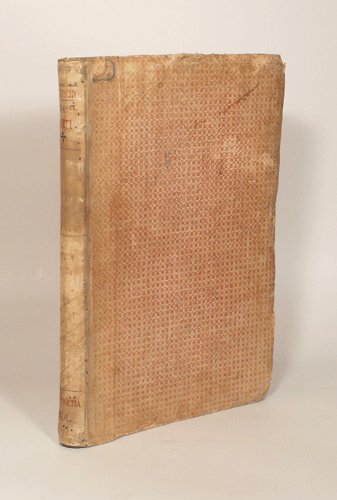
1550ref. 0033071550 Venise, Francesco Marcolini, juillet 1550. Petit in-folio (225 X 322) demi-vélin ivoire, plats de papier dominoté, auteur, titre, lieu d'édition et date calligraphiés au dos en rouge et noir (reliure XVIIIe) ; A-Z4, Aa-Cc4 : 104 feuillets. A partir des figures des philosophes (page 64) il est donné un même numéro pour deux pages. Nombreuses restaurations aux premiers feuillets, l'encadrement architectural du portrait de l'auteur est masqué par un feuillet de doublure, marges du feuillet 43/44 rognées.
1623"In-8°piccolo, (4cc), 643pp, (33cc), legatura in piena pergamena coeva con unghiature, titolo manoscritto al dorso. Prima edizione, curata da Peiresc. Raguseo, un chierico che arrivò a Padova come secondo professore ordinario di filosofia,diventando amico di Galileo, fu uno dei maggiori esponenti di quella corrente contraria all'astrologia, così in voga in quel periodo. Questo volume contiene le sue lettere sulla divinazione e sull'astrologia, che condanna assieme ad altre scienze occulte quali la chiromanzia, la fisiognomica e la geomanzia. ""Inizialmente coltivò l'eloquenza, quindi la filosofia e teologia, poi si dedicò interamente alla medicina e alla matematica...E non si fermò qui, ché diventò presto seguace dell'arte di Lullo...Possedeva una famosa biblioteca, che sfortunatamente venne venduta dopo la sua morte"" (Thorndike, VI, pp 201-02) Riccardi I. 336. Cantamessa 3693. In-8 ° small, (4cc), 643pp, (33cc), contemporary full vellum binding with overlapping fore-edges, handwritten title on the spine. First edition, published by Peiresc. Raguseo, a cleric who arrived in Padua as a second professor of philosophy, becoming a friend of Galileo, was one of the leading exponents of that current contrary to astrology, so in vogue at that time. This volume contains his letters on divination and astrology, which he condemns along with other occult sciences such as palmistry, physiognomy and geomancy. ""Initially he cultivated eloquence, then philosophy and theology, then he devoted himself entirely to medicine and mathematics ... And he didn't stop there, as he soon became a follower of Llull's art ... He owned a famous library, which unfortunately was sold after his death ""(Thorndike, VI, pp 201-02) Riccardi I. 336. Cantamessa 3693. "
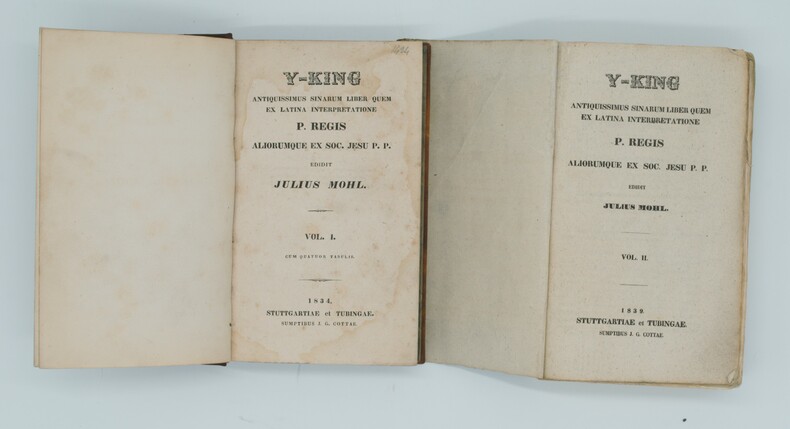
1834ref. PHO-1520Stuttgart & Tubingue, Cotta, 1834-1839. 2 volumes in-8 de [1] f., xvi-474-[1] pp., 4 planches dépliantes ; [1] f., 588 pp. Premier tome relié en demi-basane brune, dos lisse, titre doré, date en queue (reliure moderne) et second tome broché, couverture d’attente, inscriptions manuscrites sur la couverture ("à Monsieur M. Barucchi - Directeur du Musée égyptien, professeur d'histoire à l'Université de Turin), dos usé avec qqs fentes. Les deux volumes réunis dans un emboîtage toilé bleu moderne. Très légères mouillures claires par endroits.