395 résultats
2003réf. 888522003 Grenoble, Editions Jérôme Millon (Collection Horos), 2003, fort volume grand in 8° broché, 1109 pages ; index général in fine ; couverture illustrée en couleurs (infimes défauts).
1973réf. 116901973 broché (paperback) in-octavo, dos muet noir (black spine - no title), tranches lisses (smooth edges), illustrations : tableaux, 150 pages, 1973 à Paris Editions Matignon,
1950réf. 99942387Fournier Valdés 1950, In Fournier Valdés 1950, In-8 broché, 190 pages. Couverture un peu salie, intérieur en bon état.
Fournier Valdés 1950, In-8 broché, 190 pages. Couverture un peu salie, intérieur en bon état.
2000réf. 902252000 Editions Ariane - 2000 - In-8 Broché - 273 p.
Larousse 1987, In-12 broché, 221 pages + dessins et illustrations. Bon état.
réf. 41232Paris CELT Editions Culture, Art, Loisirs 1975 in 8 (23x17,5) 1 volume reliure skivertex noir de l'éditeur, dos orné, 254 pages [1], avec des illustrations en noir et blanc, dont hors-texte. Collection " Bibliothèque de l'irrationnel et des grands mystères " dirigée par Louis Pauwels. Bel exemplaire
1957réf. 22521Partitions sur la Divination Breton Raoul 1957
1987réf. 641081987 Presses Normales de l'Ecole Supérieure, 1987, 1 volume in-8 de 158 pages, broché.
2002réf. sc865Editions Dervy Dos carré collé 2002 In-8 (14 x 22 cm), dos carré collé, 357 pages, envoi de l'auteur ; très bon état général. Livraison a domicile (La Poste) ou en Mondial Relay sur simple demande.
1950réf. 10709Partitions sur la Divination Edition universelle 1950
réf. 61161Paris, E. Nourry 1913, 250x165mm, 330pages, broché. Etiquette de cotation sur le haut du dos et couverture supérieure tachée, autrement bon état, intérieur propre.
in-8°, 220 pp., figures, cartonnage illustre plastifie. Tres bel exemplaire. [109B-11]
réf. 70758Paris, Editions Traditionnelles, 1982. 13 x 22, 109 pp., broché, bon état.
réf. 70759Paris, Editions Traditionnelles, 1983. 13 x 22, 109 pp., broché, bon état.
réf. 231914,5X22,5, 94 pages, broché, état d'usage, texte entier mais quatrième page et dos manquants, nombreux dessins explicatifs -
réf. 47030Paris Editions Dangles 1971 in 8 (21x13,5) 1 volume broché, couverture illustrée à rabats, 124 pages [2], 2 petites traces brunes sur la marges des 3 derniers feuillets. Bon exemplaire ( Photographies sur demande / We can send pictures of this book on simple request )
1984réf. 1231081984 Aubenas-en-Vivarais - 1984 - In-8, broché, couverture illustrée à rabats - 127 pages
réf. 102830Librairie du magnétisme In-12 broché 17,5 cm sur 11,4. 59 pages. Sans date. Dos muet, légèrement passé, avec petit manque en tête et pied. Bon état d’occasion.
1926réf. 18805Partitions anciennes sur la Divination et Magie Labbé Marcel 1926
réf. 057961London: Herbert Jenkins Book. Very Good. Hardcover. 15th printing. Chips tears and rubbing to dust jacket which is now in protective mylar. Yellow boards with red stampings. 128PP. Herbert Jenkins Hardcover
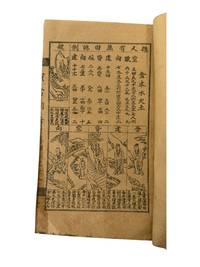
1910réf. 237771910. Chinese astral divination and fate calculation in four illustrated thread bound woodblock reprints dating from early twentieth century preserving yanqin 演禽 methods that coordinate the twenty eight lunar mansions with animal correspondences the twelve palaces calendrical calculation and Five Phases cosmology in order to interpret individual destiny. Titled 演禽相法秘笈 Yanqin xiangfa miji "Secret Manual of Yanqin Physiognomic Divination" the work belongs to a technical divinatory tradition in which the twenty eight lunar mansions are assigned animals including dragon rabbit fox tiger leopard ox mouse swallow pig wolf dog pheasant monkey sheep deer horse snake and others and their positions are calculated against the circumstances of an individual birth. The present set gives this system a compact visual form through numerical tables cosmological diagrams celestial and terrestrial classifications Five Phases correspondences and illustrated figures showing how astronomical categories were converted into a practical technology for reading the course of a human life. Four Chinese thread bound illustrated woodblock booklets approximately 4.5 x 8 inches early twentieth century printed in Chinese and illustrated throughout the original title labels reading 演禽相法秘笈 Yanqin xiangfa miji with the imprint éŒ¦ç« åœ–æ›¸å±€å°è¡Œ Jinzhang Book Bureau and individually designated å·ä¸€ through å·å››. 1 å·ä¸€ Juan I. Opens the sequence of calculations with densely printed tables arranging numbers and characters within a ruled field including material headed ç²¾è©³è€ƒæ£æ¼”禽三世相é‡å¤©å°º establishing the computational character of the work through tabular correspondences used to locate and interpret a subject within the divinatory system. 2 å·äºŒ Juan II. Continues the system through illustrated cosmological and prognostic material including a full page composition in which textual instructions are surrounded by landscape mountains trees birds and other natural imagery. The combination of written calculation and pictorial environment places human fortune within a larger ordered cosmos rather than treating prediction as an isolated numerical operation. 3 å·ä¸‰ Juan III. Includes ruled diagrams organizing 天 heaven and 地 earth with celestial bodies stars cyclical characters calendrical terms and other correspondences distributed around the central divisions. Such tables provided a visual means of coordinating multiple categories required by the practitioner when converting birth and calendrical information into a prognostic reading. 4 å·å›› Juan IV. Includes an illustrated 五行 Five Phases table headed 金木水ç«åœŸ metal wood water fire and earth combining numerical correspondences with small narrative figures set in landscape compartments. The illustrations place human types and circumstances directly beneath the cosmological categories governing their interpretation making visible the movement from abstract correspondence to predictions concerning individual lives. Yanqin belongs to the wider history of Chinese astral and calendrical divination in which the twenty eight lunar mansions served simultaneously as divisions of the heavens and as components of systems for choosing times and calculating fortune. In the yanqin method each lodge receives an animal identity among them å°¾ç«è™Ž "Tail Fire Tiger" 箕水豹 "Winnowing Basket Water Leopard" å¿ƒæœˆç‹ "Heart Moon Fox" 鬼金羊 "Ghost Metal Sheep" and 翼ç«è›‡ "Wings Fire Snake." A surviving table of contents for Yanqin sanshi xiangfa proceeds from yin and yang classifications of the heavenly stems and earthly branches and time conversion to a natal palace reference table the twenty eight animal lodges their distribution among the twelve palaces and calculations concerning offspring spouses yearly misfortune official rank and other aspects of destiny. The method therefore joins observational categories inherited from Chinese astronomy to the practical concerns of popular fate calculation translating heaven calendar animal classification Five Phases theory and the circumstances of birth into a single interpretive apparatus. Traditional post-Qing method of artificial aging to covers edge and corner wear and wear at the thread bound spines; interiors artificially aged and the printed text diagrams and illustrations remaining strong and legible. Overall good condition. Four compact manuals preserving the printed transmission of a Chinese divinatory system in which the twenty eight lunar mansions animal identities twelve palaces Five Phases and calendrical calculation provided a structured vocabulary for interpreting individual fate. unknown
réf. 22024201China ca. 20th century. A hanging scroll very good 34 x 95 cm. image 32.5 x 21.5 cm. mounted on buff silk small mend on lower part of silk image not affected else solid 3 cinnabar chops/seal. OBSCURE AND RARE WORK The work shows two faces: one female right one male left and are both woodblock printed on two joined sheets then the whole is mounted on an attractive hanging scroll with silk additions. This exact work was used to illustrated item 110 p. 127-8 in Ecke's work: CHINESE FOLK ART II: see below for bibliographic citation. We now quote and summarize what she stated about this work: "The woman's face is divided in half vertically by thirteen horizontally placed sections of Chinese characters which vary in the number of individual characters they contain. The characters are terms of physiognomy and a reading of the history of the woman's life past present and future can be taken from the sections. The characters on the man's face also denote a reading. Around the center of his face between the eyes & above the bridge of the nose are twelve sections which encircled the words. The physiognomic terms for this man are numbered. From the placement of the characters on his face one can read about the people in his life including his relatives and about his own health and fortune. Below the facial diagrams are definitions of the terms." PROVENANCE: The work was acquired directly from Prof. Richard C. Rudolph 1909-2003 the late great author professor and scholar of Chinese studies at the University of California Los Angeles. His cinnabar chop is found in the lower center. As per Ecke this work was mounted as a hanging scroll or Kakejiku in the Japanese style. It has delicate pale yellow silk brocade mounting with a beige silk above that. It is likely that Prof. Rudolph collected these silks in China during his 1948-49 collecting trip. Google him for copious details. ABOUT THE SEALS OR CHOPS: This copy was loaned to Ecke for her book and used in the exhibition at LACMA see below for more details. Our copy is the actual one exhibited in the book Prof. Rudolph affixed his seals to it prior to sale as was his habit. THE SCROLL & MOUNTING: As per Ecke this work was mounted as a hanging scroll or Kakejiku in the Japanese style it is 34 cm. wide 95 cm. long in all. The actual image is 31.5 x 32 cm. and consists of actually two images joined together. The mounting silk is a pale yellow brocade with beige silk above that a very clean nice mounting. It is likely that Prof. Rudolph collected these silks in China during his 1948-49 book buying trip. Google him for copious details. For a more in-depth discussion of this Chinese medical practice see Lessa below who illustrates a similar male face on p.51 fig. #5 and throughout several very similar examples. He explains the thirteen parts in much detail. The whole of chapter 4 is on the face and head he also offers much valuable insight to the significance of reading the face and its associated meanings. The Chinese have reduced the reading of facial attributes to a medical science per Lessa: "No people have exceeded the Chinese in their efforts to determine character and destiny by the very scrutiny of the body itself. In China the documentation is ancient and begins at the time before that of Confucius 220 B.C." He also discusses the "Six Treasuries Three Forces and Three Sections;" also the "Five Planets Six Stars Five Mountains and Four Rivers;" the "Twelve Temples and Five Senses;" in facial line reading. The "Thirteen Parts" resembles our example in that half of the face is covered with explanatory text covering these "parts." All were extracted from Ku China 1728. He further details on pp.54-55 the meanings of lines on the face marks and significance. Moles ear eye nose eye brow and forehead also has their various readings. This text supports the information found on this set of prints we now offer. BIBLIOGRAPHY: Tseng Yu-ho Ecke: CHINESE FOLK ART I see #58 p.90 91 which again cites and illustrates this exact work. Tseng Yu-ho Ecke: CHINESE FOLK ART II: page 127 illustrates this exact item offered see our scan for a copy of this article and example her # 110. Another identical example is found illustrated & described in the Los Angeles County Museum of Art Member's Calendar July 1977 vol.14 no.7. This example is again the one used in the Ecke book loaned to her by Prof. Rudolph ergo this item offered. William A. Lessa: CHINESE BODY DIVINIATION: Its Forms Affinities and Functions. This resource is valuable as it illustrates and discusses in much detail this sort of print and its significance. See chapter 4 pp.41-88 and figures plates 1-17. A very fascinating item and unusual subject seldom found on the market. The current example is an obscure 20th century reprint of the Sung Dynasty original. Suitable for library display. . unknown
réf. 82933Lyon, Ger, Editeur, 1971. 14 x 21, 81 pp., quelques illustrations, broché, couverture à rabats, très bon état.
réf. 60769Paris, Les Belles Lettres 1992, 210x130mm, XIV- 247pages, broché. Couverture à rabats. Bel exemplaire.