MareMagnum

6587 risultati
1992La Bibbia di San Paolo (Bible of St. Pauls Outside the Walls). Istituto Poligrafico e Zecca dello Stato (Editalia), Roma, 1992. Facsimile del codice membranaceo dell’Abbazia di San Paolo fuori le Mura, Roma (secolo IX), per la corte di Carlo il Calvo. Commentario a cura di G. Arnaldi, S. Baiocchi, B. Bischoff, L. Maximilians, H. de Sainte-Marie, M. L. di Franco, J. E. Gahede, J. Gribomont, J. Mallet, F. Mütherich, G. Nardin, S. Pisano, A. Pratesi, K. F. Werner ormato cm 33x27 cm. 580 pagine; carta filigranata con 73 tavole fuori testo, legatura in mezza pelle ed in seta ricamata. Due contenitori-espositori in plexiglass permettono di proteggere il codice e il commentario. Formato facsimile 37x45 cm. Pagine 684. Tiratura limitata e numerata a 1000 esemplari. Condizioni ottime.
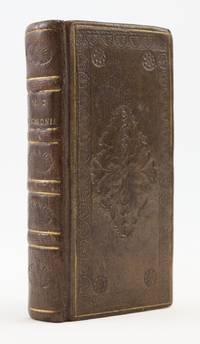
1515rif. ST19567-062Venezia Venice: Alessandro Paganini 1515. 98 x 50 mm. 3 7/8 x 2". 3 p.l. CXXXII leaves. Early 19th century olive brown calf decorated in blind raised bands gilt lettering red morocco label marbled endpapers. Front flyleaf with mostly effaced ownership signature. Brunet II 21-22 "very rare"; EDIT16 CNCE 14575; USTC 822101. Two very small portions of lost patina minor signs of wear to the leather gilt on label not especially bright but the binding entirely solid and perfectly inoffensive. The first three leaves a little browned and with a dampstain in the top few lines other trivial imperfections but the text generally very clean and fresh. Small enough to fit into the palm of a hand this printing of five popular treatises by Cicero exemplifies three of printer Alessandro Paganini's innovations: the vigesimo-quarto or 24mo book a typeface that's a blend of italic and roman and the concept of a publishing series. The son of Venetian printer Paganino Paganini Alessandro fl. 1509-38 sought to outdo rival Aldus Manutius in the production of small format versions of classics as well as cursive-style typefaces. In 1515 he began producing a series of books in 24mo beginning with Dante and Petrarch and continuing with a mix of Classical and Italian authors. The Oxford Companion to the Book declares his books "visually splendid if not always easy on the eye"; that seeming contradiction is demonstrated by the text here a very elegant semi-italic that perhaps is not as easy to read as a simple roman serif--but worth the effort for the beauty. Offered in the most portable form available in the 16th century our volume contains Cicero's essays on moral responsibility friendship old age paradoxical Stoic aphorisms and the dream vision of Scipio. The diminutive size that makes this edition--and other books in this series--so appealing also makes them scarce since small books like other objects no bigger than a mouse tend to be easy to lose. Works from Paganini's series of 24mos are quite scarce in the market and we could trace no copies at all of the Cicero in RBH or ABPC. OCLC and USTC between them find just seven copies of the Cicero in libraries none in North America. Alessandro Paganini unknown
1515rif. ST19567-062Venezia Venice: Alessandro Paganini 1515. 98 x 50 mm. 3 7/8 x 2". 3 p.l. CXXXII leaves. Early 19th century olive brown calf decorated in blind raised bands gilt lettering red morocco label marbled endpapers. Front flyleaf with mostly effaced ownership signature. Brunet II 21-22 "very rare"; EDIT16 CNCE 14575; USTC 822101. Two very small portions of lost patina minor signs of wear to the leather gilt on label not especially bright but the binding entirely solid and perfectly inoffensive. The first three leaves a little browned and with a dampstain in the top few lines other trivial imperfections but the text generally very clean and fresh. Small enough to fit into the palm of a hand this printing of five popular treatises by Cicero exemplifies three of printer Alessandro Paganini's innovations: the vigesimo-quarto or 24mo book a typeface that's a blend of italic and roman and the concept of a publishing series. The son of Venetian printer Paganino Paganini Alessandro fl. 1509-38 sought to outdo rival Aldus Manutius in the production of small format versions of classics as well as cursive-style typefaces. In 1515 he began producing a series of books in 24mo beginning with Dante and Petrarch and continuing with a mix of Classical and Italian authors. The Oxford Companion to the Book declares his books "visually splendid if not always easy on the eye"; that seeming contradiction is demonstrated by the text here a very elegant semi-italic that perhaps is not as easy to read as a simple roman serif--but worth the effort for the beauty. Offered in the most portable form available in the 16th century our volume contains Cicero's essays on moral responsibility friendship old age paradoxical Stoic aphorisms and the dream vision of Scipio. The diminutive size that makes this edition--and other books in this series--so appealing also makes them scarce since small books like other objects no bigger than a mouse tend to be easy to lose. Works from Paganini's series of 24mos are quite scarce in the market and we could trace no copies at all of the Cicero in RBH or ABPC. OCLC and USTC between them find just seven copies of the Cicero in libraries none in North America. Alessandro Paganini unknown books
rif. 125263Qajar Persia circa 1800. . Single illuminated miniature painting with decorated borders miniature 180 x 110mm total leaf 260 x 140mm; illustration depicting a seated teacher with three pupils in attendance sitting by a running stream under some poplar trees illustration heightened in gilt mounted to cats with gilt decorations to borders framed and glazed. A charming and beautifully drawn illustration in the style of Reza Abbasi 1565-1635 the leading Safavid miniaturist known for his distinctive ability to capture texture and movement in his drawings by combining ink lines with wash colours. This illustration is likely from the early Qajar period and demonstrated the lasting influence and legacy the great classical artists had over the future generations of artists and patrons alike. Qajar Persia, circa 1800. unknown
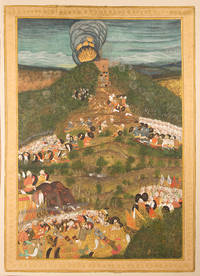
rif. 114054Post Mughal India probably late 19th century. . Single large illuminated miniature on paper ink and gouache on paper depicting the view of the Siege of Khandahar in modern-day Afghanistan total leaf 760 x 545 mm miniature 690 x 470 mm; miniature double-ruled in gilt framed decorated with spiraling florettes a few light surface smudges leaf a little cockled mounted to thick card. A very large and impressive view of the Siege of Khandahar the Mughal-Safavid war of 1649-1653 as presented in the Padshahnameh of Shah Jahan. The Padshahnameh is illustrated chronicle of the reign of Shah Jahan the fifth Mughal emperor commissioned during his reign as a propagandist celebration of his kingdom and dynasty. The text is a detailed chronological narrative of each day of the emperor's reign describing his daily activities court ceremonies as well as the significant events in Emperor Shah-Jahan's life such as the durbars lavish processions and glorious victories on the battlefield. Post Mughal India, probably late 19th century. unknown
1821rif. ST16814London: William Pickering 1821-31. 85 x 45 mm. 3 1/2 x 1 7/8". 12 volumes. VERY PLEASING CRIMSON MOROCCO ATTRACTIVELY GILT BY CAPÉ stamp-signed on verso of front free endpaper covers with central gilt fleuron enclosed by blind-ruled frame with oblique gilt floral tools at corners raised bands spine panels with gilt bellflower tool gilt titling turn-ins densely gilt with multiple decorative rolls marbled endpapers all edges gilt. One volume recently placed in a remarkably faithful replica binding. Engraved frontispiece in all but three volumes the second volumes of Dante Tasso and Homer. Virgil with errata slip bound in between pp. 282-83. Keynes 45 47 51 61 72 79 80 81; Bondy pp. 86-90; Spielman 83 93 113 198 205A 407 473 476 502. Isolated tiny rust spots or faint foxing but A SPLENDID SET with no signs of use the text clean fresh and bright the bindings lustrous and unworn. This is an exceptionally fine rarely seen complete collection of Pickering's famed miniature Diamond Classics series elegantly bound in red morocco by Capé. William Pickering began his career as a bookseller before turning to publishing in the late 1810s. In 1820 he issued the first in the popular series of "Diamond Classics" miniature books set in tiny 4-1/2 point "diamond" types. Bondy who set aside his arbitrary three-inch limit on size in order to include these books says "Due to the great editorial care and the superb printing and binding which went into their manufacture combined with the importance of their contents these little volumes are now very eagerly collected by minibibliophiles and even more generally by lovers of finely produced books." A number of collectors had their volumes rebound by leading artisans like Charles-François Capé 1806-67 one of the most distinguished binders in France in the middle years of the 19th century and especially well known for the delicacy of his work. He was the binder to the Empress Eugénie and Béraldi calls him "the Bozérian of the second Empire." The present set includes the Pickering Catullus 1824 Cicero 1821 Dante two volumes 1822 Homer's "Iliad" and "Odyssey" two volumes 1831 Horace second printing 1826 Petrarch 1822 Tasso two volumes 1822 Terence 1822 and Virgil 1821. Spielmann singles out the Homer for special praise noting that with its "clear easily legible type" printed by Charles Whittingham it is "one of the best-printed Greek miniature books ever produced." And the Virgil is especially rare: Spielmann and Sheringham aver that all but 100 copies were destroyed by a fire at the offices of printer C. Corrall. The condition here is simply outstanding. William Pickering unknown
1821rif. ST16814London: William Pickering 1821-31. 85 x 45 mm. 3 1/2 x 1 7/8". 12 volumes. VERY PLEASING CRIMSON MOROCCO ATTRACTIVELY GILT BY CAPÉ stamp-signed on verso of front free endpaper covers with central gilt fleuron enclosed by blind-ruled frame with oblique gilt floral tools at corners raised bands spine panels with gilt bellflower tool gilt titling turn-ins densely gilt with multiple decorative rolls marbled endpapers all edges gilt. One volume recently placed in a remarkably faithful replica binding. Engraved frontispiece in all but three volumes the second volumes of Dante Tasso and Homer. Virgil with errata slip bound in between pp. 282-83. Keynes 45 47 51 61 72 79 80 81; Bondy pp. 86-90; Spielman 83 93 113 198 205A 407 473 476 502. Isolated tiny rust spots or faint foxing but A SPLENDID SET with no signs of use the text clean fresh and bright the bindings lustrous and unworn. This is an exceptionally fine rarely seen complete collection of Pickering's famed miniature Diamond Classics series elegantly bound in red morocco by Capé. William Pickering began his career as a bookseller before turning to publishing in the late 1810s. In 1820 he issued the first in the popular series of "Diamond Classics" miniature books set in tiny 4-1/2 point "diamond" types. Bondy who set aside his arbitrary three-inch limit on size in order to include these books says "Due to the great editorial care and the superb printing and binding which went into their manufacture combined with the importance of their contents these little volumes are now very eagerly collected by minibibliophiles and even more generally by lovers of finely produced books." A number of collectors had their volumes rebound by leading artisans like Charles-François Capé 1806-67 one of the most distinguished binders in France in the middle years of the 19th century and especially well known for the delicacy of his work. He was the binder to the Empress Eugénie and Béraldi calls him "the Bozérian of the second Empire." The present set includes the Pickering Catullus 1824 Cicero 1821 Dante two volumes 1822 Homer's "Iliad" and "Odyssey" two volumes 1831 Horace second printing 1826 Petrarch 1822 Tasso two volumes 1822 Terence 1822 and Virgil 1821. Spielmann singles out the Homer for special praise noting that with its "clear easily legible type" printed by Charles Whittingham it is "one of the best-printed Greek miniature books ever produced." And the Virgil is especially rare: Spielmann and Sheringham aver that all but 100 copies were destroyed by a fire at the offices of printer C. Corrall. The condition here is simply outstanding. William Pickering unknown books
Grande miniatura su pergamena (mm. 227x313) firmata in maiuscolo dall'artista nell'angolo inf. destro "Nicolaus Balduinus F.". Stupendo foglio miniato di grandi dimensioni e firmato, rarissimo. L'episodio della Vita del Cristo è animato da apostoli e soldati che passano sotto un arco. In primo piano la Vergine. Sullo sfondo raffinata veduta di Gerusalemme. Le opere note di questo pittore miniaturista veneziano del ‘500 sono assai poche e la presente è apparentemente unica ed inedita.. Thieme-Becker V, 186. D'Ancona-Aeschliman p. 39. Favaro, l'arte dei pittori in Venezia e i suoi statuti, p. 141..
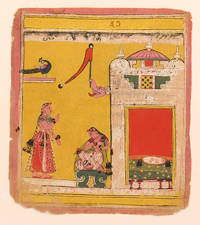
rif. 112940India Malwa circa 1630 AD. . Single leaf ink & gouache painting on paper image double-ruled and framed within red borders total leaf 200 x 175 mm; lightly faded with some chipping of paint with slight loss of pigmentation outer edges a little worn contemporary ink inscription to reverse in Sanskrit tipper-into card mount. Keshav Das d. 1601 was a renowned Indian court poet best known for the Rasikapriya which is considered a pioneering work of Hindu literature dealing with the classification of idealised types of male and female lovers nayakas and nayikas and their emotions and interactions. The work was compiled around the 1590s probably in Bundelkhand to the east of Malwa and the present painting is from a near-contemporary series of illustrations depicting scenes from the poems. Three leaves from the same series are housed in the Ashmolean Museum's collections these all dated c. 1630 also described as Malwa accession nos. EA2012.200 EA2012.202 EA2012.201. India, Malwa, circa 1630 AD. unknown
1820rif. 12635London Newton & Son 1820-1830. Newton's new & improved terrestrial and celestial globes The diameter of the globes is 2.75 inches 7 cm. The total height including the stands is 6.75 inches 15 cm. A beautiful pair of miniature desk globes with 12 hand-colored engraved gores on plaster spheres mounted to nineteenth-century calibrated brass meridian rings and carved wooden stands. The Terrestrial and celestial globes are made of carved wood and are in fine condition. The Newton family was among the foremost English globe makers of the early 19th century producing globes of many sizes under various names. The origins of the firm began in the previous century in fact back to Nathaniel Hill for it was he who taught the art of globe making to Thomas Bateman fl.1754-1781 who in turn trained John Newton 1759-1844 who was the patriarch of the Newton firm. John began his firm in 1780 publishing a reissue of a Nathaniel Hill pocket globe in partnership with William Palmer. At the beginning of the 19th century John Newton had located his business at 97 Chancery Lane in London and was quickly joined by his second son William 1786-1861 under the name J.& W. Newton. For the decade between 1831 and 1841 Miles Berry a civil engineer became a member of the firm known then as Newton Son & Berry. After 1841 ownership passed to William Newtons eldest son William Edward Alfred Vincent 1821-1900 who became associated with the firm which continued in operation through future generations until the early years of the 20th century. London, Newton & Son unknown
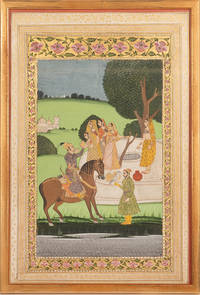
rif. 119661Mughal India possibly Murshidabad mid- to late-18th century. . Single miniature painting on card opaque pigments with gold depicting a scene with a Prince on horseback accepting a drink from a gold vessel from a village maiden miniature 282 x 179 mm full album page 394 x 255 mm; painting framed within multiple gilt rulings innermost frame painted with delicate pink and white flowers on a spiralling green vine set against a richly gilt background some very minor surface soiling overall in exceptionally bright and attractive condition floating in modern cream mount. Scenes painted around imagined amorous encounters between the 'prince and village girl' were popular among artists during the late Mughal period in centres such as Delhi Lucknow and Murshidabad. The concept of 'love at first sight' was similarly echoed in the tradition of the courtly poets of the pan-European middle ages and can be seen echoed through their visual arts. The inspiration behind the theme in this painting was likely rooted in Persian literary sources the Nayrang'i Eshq The Charm of Love by Mughal Sufi poet Ghanimat Kunjahi d. 1695 AD being one such example. Written during a period of considerable Muslim-Hindu cultural interaction the poem was later absorbed into Sanskrit works and grew further in popularity. One notable section of the poem stanza 40.7 describes how in pursuit of a stag Shahid comes upon a village where he is struck by the sight of village girls at a well and is particularly struck by the beauty of Wafa the daughter of the village headsman see C. Shackle Persian Poetry and Q dir Sufism in Later Mughal India: Ghan mat Kunj h and his Mathnaw -yi Nayrang-i 'ishq in The Heritage of Sufism: Volume 3 Late Classical Persianate Sufism Boston 1999. In this painting a beautiful maiden leans across to offer the handsome stranger a drink from the well. Neither appears abashed and their eyes fix upon each other as if a spell has been cast. Of note is the way their hands come together around the vessel of water though they do not touch. The mono green background gives a prominence to this encounter watched by the other village girls. There are subtle details that give context to the scene the stranger's courtly attire and jewelled ruby dagger. His companion's falcon hints at their noble status. By contrast the village girl's sari is tied in the style of a working women as she draws water from the well. For notable examples see Indian Painting 16001870 Oliver Forge & Brendon Lynch New York 2012 and Painting 91 in Domains of Wonder B.N Goswamy & C. Smith 2006. Mughal India, possibly Murshidabad, mid- to late-18th century. unknown
ff. 172 (su 174), legatura inizio '500 in marocchino bruno decorato da bande trasversali alternate a secco e in oro; in testa ad entrambi i piatti impressione a secco "+S+ Emilia". Al primo f. grande iniziale "B" miniata su fondo oro, istoriata all'interno con una finissima figura di Davide in preghiera; la decorazione si estende su 3 margini. In assenza del calendario, l'esame della scrittura, dell'ornamentazione e del testo (litanie ed innario), conducono all'ambiente lombardo e più in particolare ad un ambiente femminile domenicano della regione bresciana. Di notevole interesse la legatura: un ferro assai simile, seppur altrimenti utilizzato, si ritrova su due legature che rivestono edizioni aldine (De Marinis I, 439 e 441, tavv. LXXVIII e LXXVII). Il manoscritto si compone di 17 quaderni di 10 ff. + uno di 4 ff., con richiami. Mancano due fogli tra le attuali carte 12/13 e 16/17. La miniatura misura mm 43x50; nel testo 9 capilettera (mm 40x40) dipinti in blu o rosso su fondo di elaborati e finissimi fregi calligrafici in rosso, verde e seppia. Scrittura semigotica in nero e rosso; notazione musicale quadrata. Il codice, nello stato attuale, non contiene il calendario, né sembra l'attuale legatura averlo potuto contenere, essendo piuutosto stretta e non mostrando segni di asportazione. Di grande interesse è la decorazione della rilegatura. Lo stile della lunga doppia banda verticale (in blu ed oro) che si estende lungo il margine sinistro del primo f. è assai simile a quello dei fogli miniati del Messale romano di scuola lombarda (Brescia, Queriniana, ms. C II 3). Il testo del codice pare avvicinarsi molto a quello del Salterio domenicano commissionato per il monastero domenicano femminile di Santa Caterina di Brescia (Bergamo, Bibl. A.Mai, MA 418). Mentre lo stile della pittura dell'iniziale del f. 1 ricorda parecchio le miniature del Salterio e Innario di scuola lombarda (Brescia, Queriniana, ms. A II 5).. .