PIAF Edith & EMER Michel JAN-MICHMareMagnum

5 742 résultats
1952- Editions musicales Paul Beuscher, Paris 1952, 24,7x32,2cm, une feuille rempliée. - Edition originale de cette partition piano et chant, premier plat illustré d'un montage photographique de Jan-Mich représentant Edith Piaf de profil regardant un avion. Très bel exemplaire. [ENGLISH DESCRIPTION ON DEMAND]
1906- E. Leroux, Paris 1906, 11,5x17cm, broché. - Edition originale de la traduction française et de la présentation établies par Léon Pineau. Rare et agréable exemplaire. [ENGLISH DESCRIPTION ON DEMAND]
1853- Hachette & Cie, Paris 1853, 11,5x19cm, broché. - Nouvelle édition. Dos défraîchi, premier plat volant, quelques petites rousseurs. Rare. [ENGLISH DESCRIPTION ON DEMAND]
1937- Editions Francis Salabert, Paris 1937, 27x35cm, une feuille repliée et une libre. - Edition originale de cette partition chant (bilingue) et piano, au premier plat illustré, "Le grand succès du célèbre Cotton Club de New York dans la revue "Cotton Club Parade" présentée par Edmond Sayag et qui triomphe aux Ambassadeurs et au Moulin Rouge. Très bel exemplaire. [ENGLISH DESCRIPTION ON DEMAND]
1940- Paris s.d. (circa 1940), 10x12,5cm, une feuille. - Dessin original au feutre vert monogrammé de Carlo Rim représentant le pianiste François Samson comme se dirigeant vers un piano. Le dessin monogrammé à l'encre noire en marge inférieure gaucheporte cette légende au stylo rouge en dessous : "Samson François". Le dessin a été encollé sur un morceau de feuille de papier portant aussi la mention au crayon de papier : "Samson François" Carlo Rim fut un écrivain provençal auteur notamment de "Ma belle Marseille", un caricaturiste, un cinéaste et fut notamment l'ami de Fernandel, de Raimu et Marcel Pagnol mais aussi de Max Jacob et André Salmon qu'il rencontra à Sanary. [ENGLISH DESCRIPTION ON DEMAND]
1937- Gallimard, Paris 1937, 14,5x20,5cm, broché. - Edition originale de la traduction française établie par Louise Servicen, un exemplaires du service de presse. Dos légèrement bruni et plats marginalement salis. Envoi autographe signé de Louise Servicen à (Lucien) Rebatet. [ENGLISH DESCRIPTION ON DEMAND]
1920- Lucien Vogel éditeur, Paris 1920, 18x24cm, une feuille. - Original color print, printed on vergé paper, non signed. An original print used to illustrate the Gazette du bon ton, one of the most attractive and influential 20th century fashion magazines, featuring the talents of French artists and other contributors from the burgeoning Art Deco movement. A celebrated fashion magazine established in 1912 by Lucien Vogel, La Gazette du bon ton appeared until 1925, with a hiatus from 1915 to 1920 due to the war (the editor-in-chief having been called up for service). It consisted of 69 issues printed in only 2,000 copies each and notably illustrated with 573 color plates and 148 sketches of the models of the great designers. Right from the start, this sumptuous publication "was aimed at bibliophiles and fashionable society," (Françoise Tétart-Vittu, "La Gazette du bon ton", in Dictionnaire de la mode, 2016) and was printed on fine vergé paper using a type cut specially for the magazine by Georges Peignot, known as Cochin, later used (in 1946) by Christian Dior. The prints were made using stencils, heightened in colors, some highlighted in gold or palladium. The story began in 1912, when Lucien Vogel, a man of the world involved in fashion (he had already been part of the fashion magazine Femina) decided, with his wife Cosette de Brunhoff - the sister of Jean, creator of Babar - to set up the Gazette du bon ton, subtitled at the time: "Art, fashion, frivolities." Georges Charensol noted the reasoning of the editor-in-chief: "'In 1910,' he observed, 'there was no really artistic fashion magazine, nothing representative of the spirit of the time. My dream was therefore to make a luxury magazine with truly modern artists...I was assured of success, because when it comes to fashion, no country on earth can compete with France.'" ("Un grand éditeur d'art. Lucien Vogel" in Les Nouvelles littéraires, no. 133, May 1925). The magazine was immediately successful, not only in France but also in the United States and Latin America. At first, Vogel put together a team of seven artists: André-Édouard Marty and Pierre Brissaud, followed by Georges Lepape and Dammicourt, as well as eventually his friends from school and the School of Fine Arts, like George Barbier, Bernard Boutet de Monvel and Charles Martin. Other talented people soon came flocking to join the team: Guy Arnoux, Léon Bakst, Benito, Boutet de Monvel, Umberto Brunelleschi, Chas Laborde, Jean-Gabriel Domergue, Raoul Dufy, Édouard Halouze, Alexandre Iacovleff, Jean Émile Laboureur, Charles Loupot, Chalres Martin, Maggie Salcedo. These artist, mostly unknown when Lucien Vogel sought them out, later became emblematic and sought-after artistic figures. It was also they who worked on the advertising drawings for the Gazette. The plates put the spotlight on, and celebrate, dresses by seven designers of the age: Lanvin, Doeuillet, Paquin, Poiret, Worth, Vionnet and Doucet. The designers provided exclusive models for each issue. Nonetheless, some of the illustrations are not based on real models, but simply on the illustrator's conception of the fashion of the day. The Gazette du bon ton was an important step in the history of fashion. Combining aesthetic demands with the physical whole, it brought together - for the first time - the great talents of the artistic, literary, and fashion worlds; and imposed, through this alchemy, a completely new image of women: slender, independent and daring, which was shared by the new generation of designers, including Coco Chanel, Jean Patou, Marcel Rochas, and so on... Taken over in 1920 by Condé Montrose Nast, the Gazette du bon ton was an important influence on the new layout and aesthetics of that "little dying paper" that Nast had bought a few years earlier: Vogue. [FRENCH VERSION FOLLOWS] Estampe originale en couleur, tirée sur papier vergé, non-signée. Gravure originale réalisée pour l'illustration de La Gazette du bon ton, l'un
AA. VV., Abbasso Petrolini di U. Ojetti - f. Paolieri - L. D'Ambra - M. Bontempelli - M. Ramperti - P. Buzzi - F. T. Marinetti - C. Levi - E. Settimelli - O. Vergani - L. Folgore - A. Orsi - B. Corra - S. D'Amico - P. Mazzuccato - G. Craig - P. Pancrazi - M. Dessy - E. Petrolini, ed altri... Tip. Cooperativa, Galluzza I, Siena, s. d. ma 1921, cm 18,5x13,5, pp. 240 con qualche ill. in b/n nel t. e un ritratto fotogr. in b/n del Petrolini fuori t., brossura ed. Condizioni di conservazione Esemplare in buone condizioni con tracce d'uso, brossure con alcune piccole leggere bruniture, parte centrale della brossura post. con poche piccole lievi abrasioni. Interni buoni con poche minime bruniture, cuciture dei primi due fascicoli allentate (vedi foto). Rara edizione originale (1921). SETT126.L12378 N P
AA. VV., Arena di Verona Cinquanta stagioni liriche nei programmi e nelle immagini Ente Autonomo Spettacoli Lirici, Verona 1973, cm 34,5x24,5, pp. non num. (pp. 120), con numerose ill. in b/n e a colori, tutta tela ed. con fregio impresso in oro al dorso, sovraccoperta ed. ill. a colori. Volume inserito entro cofanetto in tutto cartonato ed. ill. in b/n a entrambi i piatti. Condizioni di conservazione Volume in ottime condizioni con minime tracce di utilizzo. Interni ottimi. Sovraccoperta ed. ben conservata con minime tracce d'uso, leggermente ingiallita al dorso per eccessiva prolungata esposizione a fonte di luce. Cofanetto ed. ben conservato con alcuni piccoli difetti e qualche minimo graffietto, qualche piccolo alone. Edizione fuori commercio, in tiratura limitata di 500 esemplari numerati, realizzata per la ditta Davide Campari (per maggiori informazioni vedi foto colophon). N/s 323. SETT184.L17313 N
"Lettera autografa, Fausto Maria Martini (Roma 1886 - Ivi 1931) Lettera autografa firmata datata Roma, 22 dicembre 1922 Lunga lettera autografa firmata redatta su due fogli con intestazione a stampa de Fausto Maria Martini, datata Roma, 22/12/1922, testo redatto su due facciate, con firma autografa al termine del testo (vedi foto), margine sup. di un foglio con breve annotazione a matita del precedente proprietario. Cm 27,5x21,5. Acclusa busta originale di spedizione anch'essa autografa, parzialmente conservata (vedi foto). Condizioni di conservazione Lettera ben conservata con tracce d'uso, normali pieghe di spedizione, poche lievissime bruniture. Diretta all'attrice Giannina Chiantoni, per l'esecuzione della commedia "L' altra Nanetta". Il Martini nel descrive le caratteristiche e l'esecuzione che ne fece Emma Giannatica, ne indica il motivo del cambio del titolo, gli eventuali tagli. Busta di spedizione autografa parzialmente conservata (vedi foto). SC03.D12758 N "
"Lettera autografa firmata, Ferdinando Paolieri (Firenze 1879 - Ivi 1928) Lettera autografa firmata 1926, lunga lettera interamente autografa firmata su foglio in carta, testo disposto ad entrambe le facciate, con parte finale in senso verticale a un margine esterno (vedi foto), firma autografa "Nando" al termine del testo (vedi foto). Cm 30x21. Accluso uno schedino dattiloscritto del precedente collezionista, che contiene una breve biografia del Paolieri e una lunga descrizione dell'autografo (vedi foto). Condizioni di conservazione Lettera ben conservata con tracce d'uso, normali pieghe di spedizione, minuscole irregolarità, a un margine esterno. Lunga, poliedrica, scoppiettante lettera autografa firmata, con numerosissimi riferimenti a opere teatrali, autori, critici dell'epoca (per maggiori informazioni vedi foto schedino). SC03.D12278 N "
1927réf. 79335Editions Max Eschig | Paris 1927 | 27 x 35 cm | une feuille rempliée
1923réf. 79333Editions Francis Salabert | Paris 1923 | 27.10 x 35 cm | une feuille rempliée
1936Mm 175x245 RARO. Prima edizione. "Libri Teatrali di A.G.B." - Brossura editoriale a stampa, 181 interamente illustrate da splendidi disegni in nero di artisti celebri, benché quasi tutti non firmati. I commenti spaziano dalle danze tribali e popolari (flamenco, saltarello romano, danze dell'Indocina) alla danza contemporanea, l’aerodanza futurista, Ida Rubinstein, Ruskaja, Jo Mihaly e Sakharoff. Brunitura al dorso e rettangolare al piatto causa esposizione al sole, così ai risguardi, peraltro copia ben conservata. SPEDIZIONE IN 24 ORE DALLA CONFERMA DELL'ORDINE.
1823réf. 13393F. Louis | Paris 1823 | 9 x 14.50 cm | broché
1966réf. 686261 ff. couleurs et reproduction du rideau de Copélia.
réf. 117018Paris Aux Editions du Cygne 1931-1932 3 vol. broché 3 vol. in-4, brochés, 364, 366 et 366 pp., nombreuses reproductions en noir et en bistre in et hors-texte, bien complet des 3 planches coloriées. Série complète en bon état.
réf. 117018Paris Aux Editions du Cygne 1931-1932 3 vol. broché 3 vol. in-4, brochés, 364, 366 et 366 pp., nombreuses reproductions en noir et en bistre in et hors-texte, bien complet des 3 planches coloriées. Série complète en bon état.
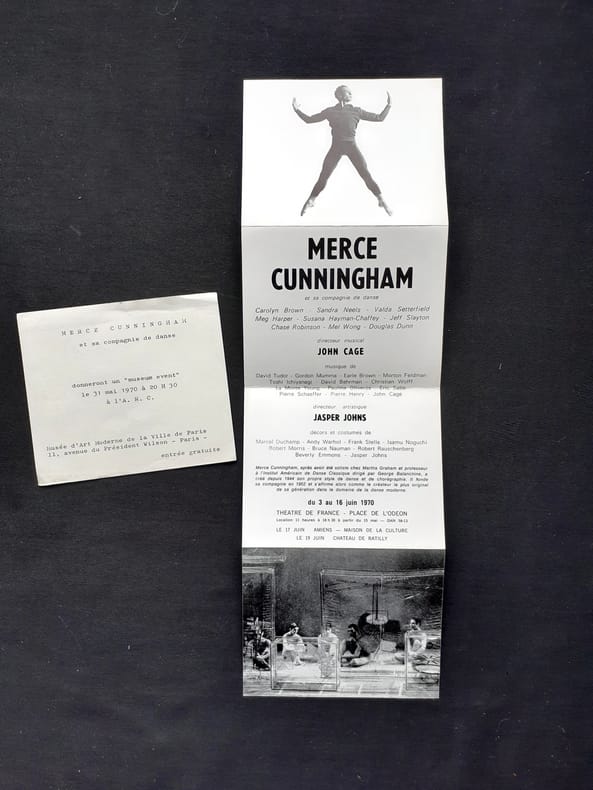
réf. 48110Paris : Théâtre de France - Place de l'Odéon, 1970. un dépliant illustré 10x12,5cm à 4 volets, impression noire sur papier couché blanc, recto seul. Programme du ballet de Merce Cunningham présenté du 3 au 16 juin 1970 à Paris. Direction musicale de John Cage, direction artsitique de Jasper Johns, décors et costumes de Marcel Duchamp, Andy Warhol, Frank Stella, Isamu Noguchi, Robert Morris, Bruce Nauman, Robert Rauschenberg, Beverly Emmons, et Jasper Johns. Musique de Morton Feldman, La Monte Young, Pierre Schaeffer, Pierre Henry, John Cage, etc. 2 illustrations photographiques dont l'une montre les danseurs derrière une reprodcution sur verre de la Broyeuse de chocolat de Marcel Duchamp. Joint une invitation à un "Museum event" donné par Merce Cunningham et sa troupe à l'A.R.C. du Musée d'art moderne de la ville de Paris, le 31 mai 1970.
1922réf. 79294A. Bosc éditeur | Paris 1922 | 27 x 35 cm | une feuille rempliée
1968Giovanni Maria Artusi. L'Artusi overo delle imperfettioni della moderna musica. 1968. Collana Bibliotheca Musica Bononiensis n° - 36Sezione II. Forni Bologna. Tela rossa con titoli in nero. Pagine 260. Cm. 23 x 32. Ristampa anastatica dell'edizione stampata a Venezia nel 1600. Firma e timbri di possesso all'interno, per il resto esemplare in ottime condizioni.
1983In quarto grande, su carta Centaure ivoire a la grain, con disegni di Christiane Moreau in serigrafia, impaginato da Arnal, sotto l'autorità di Croquet assistito da Jacques Breil e Michel Sorel, esemplare nº 460/1200, 32 carte in un faldone (compresa la carta con la dedica autografa di sette righe dell'Etoile a "monsieur Aldrovandi"), e 42 pp di testo in altro faldone, il tutto chiuso in cofanetto cartonato, tale si presenta quest'omaggio alla splendida Noella Pontois, Etoile indiscussa della danza parigina in occasione del suo addio al palcoscenico. Un soffuso senso di malinconica festa pervade le pagine, accarezzate dall'estro di Breil, curato dal biografo, soffuso della dolce magia della danza che secernono i delicatissimi schizzi dell'illustratrice. In belle condizioni, curioso, insolito e raro, interessante anche bibliograficamente per la presenza delle notizie delle interpretazioni e dei partner della dolce Noelle in tutto l'arco della carriera..
1949réf. 79293Editions Martin Cayla | Paris s. d. [ca 1949] | 27.40 x 35.40 cm | une feuille rempliée sous couverture
1927P., Editions du Grenier, 1927. In-4 broché, couverture rempliée, 86 pp. Illustrés de dessins inédits (sous serpente) par Antoine Bourdelle, José Clara et Grandjouan. 1 des 725 ex. surpur-fil Lafuma.petits manques de papier au dos, quelques marques au stylo bille à quelques endroits du texte, sinon bon exemplaire.
2008réf. yam0269in-8 broché en très bon état de 194 pages Textes choisis et présentés par Philippe Despoix traduits de l'allemand par Sabine Cornille éditions de la maison des sciences de l'homme