PERRONET Jean RodolpheLivre Rare Book

72 813 résultats
1783réf. 51809Imprimerie royale, 1782 1783 2 volumes grand in-folio demi-basane rel. post., 12- 112- 6- 154 pp. Portrait frontispice gravé par Saint Aubin d’après Cochin. 67 planches gravées par Tardieu, Duval, Germain & Berthault d'après Eustache de St Fare & Le Sage. Lég. mouillures marginales au second volume. Bon exemplaire.
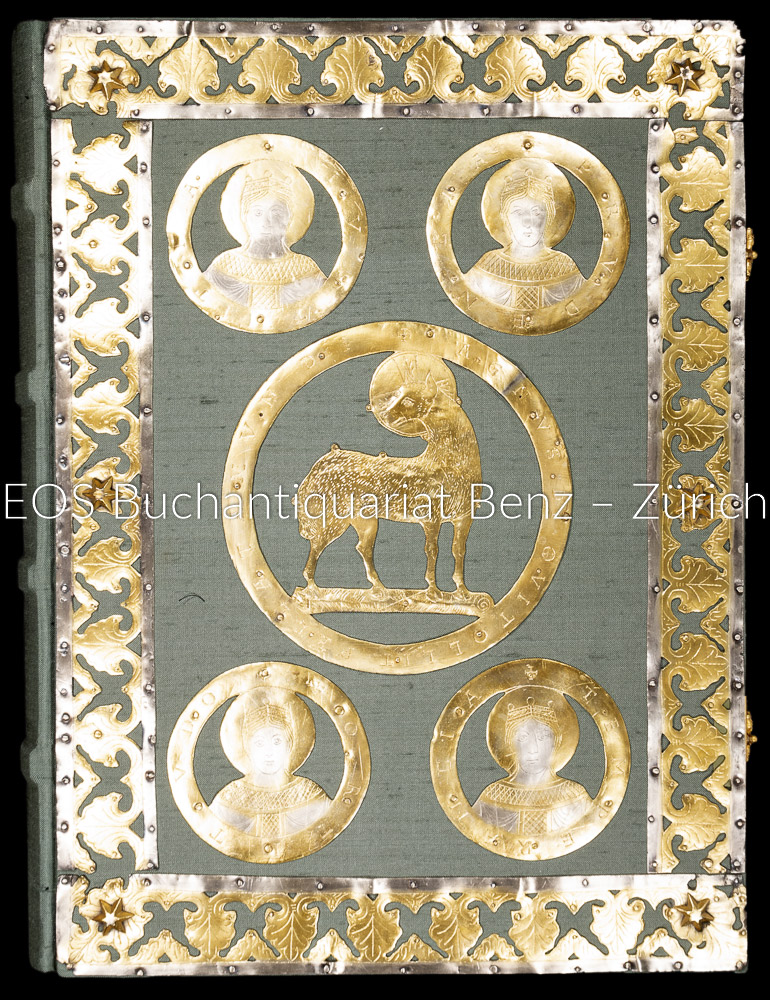
1994réf. 31128ABStuttgart und Frankfurt, Verlag Müller und Schindler, S. Fischer, 1994. Folio. 203 Blatt mit vielen Initialen und 40 ganzseitigen Miniaturen in Blattgold, 148 Seiten (Kommentar). Seideneinband auf Holzdeckel. Auf dem Vorderdeckel wurde die Goldschmiedearbeit des Original-Buchdeckels mit 23-Karat-Vergoldung kopiert. Mit zwei Schliessen. In schwarzem Samtsack. Halblederband (Kommentar) in Pappschuber. + Wichtig: Für unsere Kunden in der EU erfolgt der Versand alle 14 Tage verzollt ab Deutschland / Postbank-Konto in Deutschland vorhanden +, A|B 2 Bände.
réf. LCS-18542Précieux exemplaire revêtu d’une élégante reliure en maroquin rouge de l’époque. A Paris, chez Antoine Chrétien, 1603 [pour 1703]. In-8 de (5) ff., 363 pages, (1) p., 5 planches dépliantes, (23) ff. de tables, (1)f.bl. Maroquin rouge, triple filet doré encadrant les plats, dos à nerfs orné, roulette dorée sur les coupes, roulette intérieure dorée, tranches dorées sur marbrure. Reliure de l’époque. 160 x 93 mm.
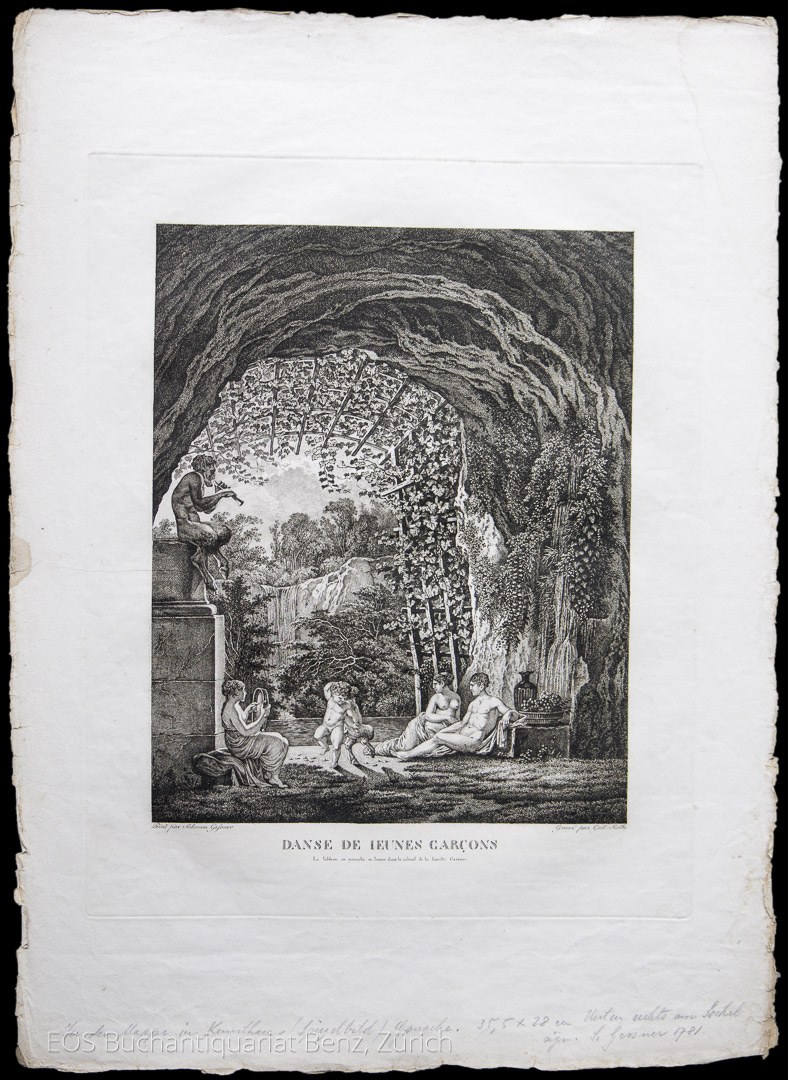
1811réf. 31297ABZürich, à Librairie de Gessner, 1811. Gr.-folio. Titelblatt mit Vignette von Gessner, gest. von Lips, gedrucktes Blatt mit Vorwort Widmung an die Kaiserin von Russland (der Witwe von Salomon Gessner. Mit Radierung vom Denkmal Salomon Gessner, von W. Kolbe und 25 Radierungen von W. Kolbe nach Originalen von Salomon Gessner. Lose Blattsammlung in Mappe mit 4 Orig.-Umschlagblättern (beiliegend deuxième und troisième cahier). + Wichtig: Für unsere Kunden in der EU erfolgt der Versand alle 14 Tage verzollt ab Deutschland / Postbank-Konto in Deutschland vorhanden +, 31297AB|31297AB_2|31297AB_3|31297AB_4
réf. LCS-17934Précieux catalogue regroupant 66 planches d’ameublement dont 54 coloriées à la main à l’époque. Paris, E. Maincent, 1855-1866. In-folio oblong regroupant 66 planches à pleine page dont 54 en couleurs, qq. rousseurs. Demi-veau brun à coins, plat de percaline vert bouteille, étiquette sur le plat supérieur portant la mention manuscrite « Salon Louis XVI », usures. Reliure de l’époque. 263 x 347 mm.
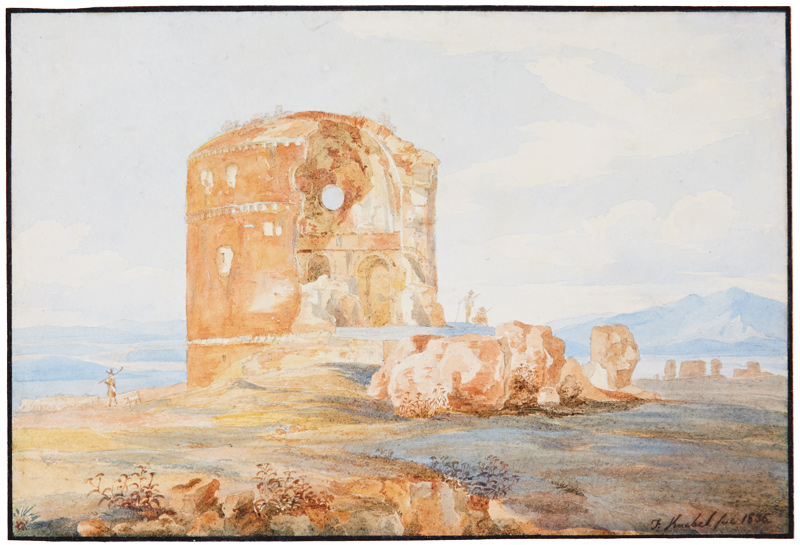
réf. 011-Io.J. Aquarell, über Bleistift, mit schwarzer Tuschlinie umrandet, auf cremefarbenem Velin, rechts unten signiert und datiert ?F. Knebel fec 1836?. 14,1:20,7 cm. - Farben leicht verblichen und mit kleinen sorgfältigen Restaurierungen.
1829réf. 9273Paris, Firmin-Didot, 1829 - 1833 ; 2 tomes reliés en 3 volumes in-folio atlantique (53 x 35,3 cm) ; demi-chagrin maroquiné à coins grenat, dos à nerfs soulignés de filets fins à froid, titre doré en lettres majuscules, filets à froid sur les plats, armes poussées à froid sur le premier plat de chaque volume, ex-libris Belton House (Grande-Bretagne), tête dorée, tranches juste ébarbées (reliure de l’époque) ; [4], 4, 9, [1 bl.], 50 pp. ; [4], pp.51-143, [1 bl.] pp.; [4], 143, [1bl.] pp. et en tout 254 lithographies hors-texte tirées sur Chine contrecollé sur vélin fort (quelques unes le sont directement sur la feuille), par Taylor, Fragonard, Eugène Isabey (17), Jorand, Deroy, Bourgeois, Sabatier, Bouton, Jaime, Athalin, Adam, J.D. Harding, Dauzats, Daguerre, Regnier, Brascassat, Ciceri, Bichebois, Tirpenne, Goré, Nouveaux, Villeneuve, Hubert, Monthelier, Alcaux, etc... ; 15 dessins in-texte lithographiés, 3 grandes lettrines de style celtique.
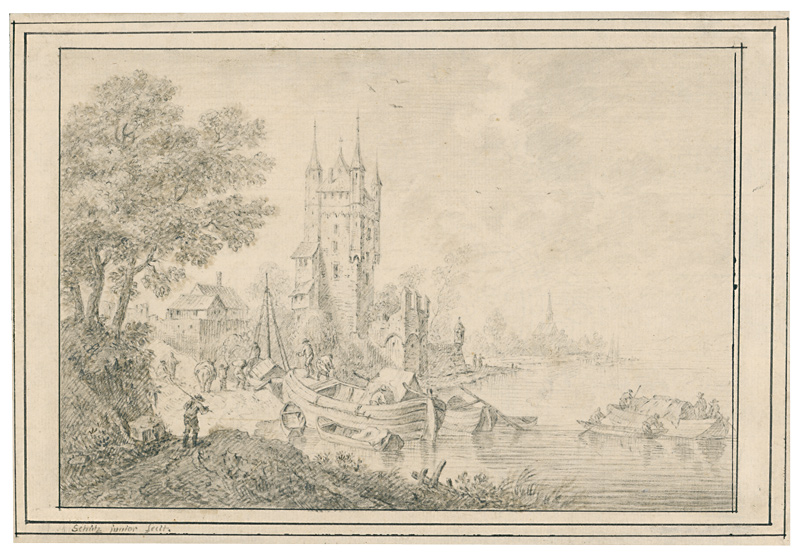
réf. 112-Do.J. Schwarze Kreide, mit mehreren schwarzen Tuschlinien umrandet, links unten zwischen zwei Linien signiert ?Schütz junior fecit.?, auf Bütten mit Wasserzeichen: bekröntes Wappen mit Posthorn. 17,8:26 cm. Provenienz: Sammlung Ernst Max von Grunelius, Frankfurt am Main Inv. Nr. V, 181 (auf ehemaligem verso bezeichnet); Sotheby?s, Amsterdam, Sale AB 0631, 15.11.1995, Lot 120 mit Abb. Literatur: E. Schilling: Katalog der deutschen Zeichnungen. Alte Meister, 3 Bde., München 1973, Bd. I, Nr. 2013, Suppl. Taf. 297, Nr. 2014 (Inv. Nr. 1874), Abb. Bd. III, S. 230; Ph. F. Gwinner: Kunst und Künstler in Frankfurt am Main, Frankfurt am Main 1862, S. 313 ff. Hier heißt es auf S. 315, ausgeführte Zeichnungen von Franz Schütz, einem ausgesprochenen ?Originalgenie? der Sturm- und Drangzeit, sind selten. Eine der beiden zum Vergleich genannten Zeichnungen aus dem Städel Museum ist wie unser Blatt mit dem Namen und - zur Unterscheidung von seinem Vater - mit ?junior? signiert.
réf. 14476Nouvelle collection de 530 dessins ou feuilles de texte, relatif à l’art de l’ingénieur et lithographiés à l’école Royale des Ponts et Chaussées, sous la direction de M. BRISSON, de 1821 à 1825. Deux tomes en deux volumes grand in folio, 500x370mm, demi-cuir fauve, pièces de titre chagrin rouge, roulette, fers, filets dorés. Reliure d’époque. Premier volume : titre, observation relative au classement des dessins, une feuille d’errata, 4 pages : table par ordre des matières des dessins composant la seconde collection lithographiée, exécutée à l’Ecole royale des Ponts et Chaussées, sous la direction de M. BRISSON Barnabé. 2 pages. 13 pages de texte et de tableaux, à la suite 302 dessins ou feuilles de texte, large filet noir en encadrement, l’ensemble sur beau papier vergé hollande. Second volume comprenant les travaux des ports maritimes, l’architecture, les machines et les objets divers. Table : 2 pages, à la suite 299 dessins ou feuilles de texte. Au total 601 dessins ou feuilles de texte. Tranches jaunes. Quelques petits défauts mineurs, à quelques pages. Sinon ensemble en très bon état. Poids 17kg. Très rare complet.
réf. 104-Do.J. Sepia-Pinsel über Bleistift, auf Bütten. 17,9:21,9 cm. Aus dem Album ?Scizzen nach der Natur bey München? (vgl. Ausst. Katalog: Franz Kobell. Ein Zeichner zwischen Idylle und Realismus, München 2005, S. 17, Abbildung des Albums). Vergleichsliteratur: Katalog: Deutsche Landschaftszeichnungen des 18. Jahrhunderts aus der Graphischen Sammlung Staatsgalerie Stuttgart, Stuttgart 1985, Nrn. 32 u. 33; Th. Herbig: Franz Kobell. Ein Landschaftszeichner um 1800, Traunstein/Reutlingen 1997, Abb. 46-48, Abb. 51 sowie Abb. 74-78 (Farbabb.); Ausst. Katalog: Von Mannheim nach München. Die Künstlerfamilie Kobell, Mannheim/München 1993, Nrn. 38-42, mit Farbabb.; Ausst. Katalog: Franz Kobell, München 2005, Farbabb. S. 40-75. ?Zu den Überraschungen im zeichnerischen ?uvre Franz Kobells gehören die zahlreichen Skizzen, die ohne Vorzeichnung mit dem Pinsel in Sepia ausgeführt sind [...] In dieser Art der Landschaftssicht und in ihrer zeichnerischen Umsetzung löst sich Franz Kobell von der Tradition des 17. und 18. Jahrhunderts und darf darin als einer der frühen Vertreter realistischer Landschaftsdarstellung angesehen werden. Da Zeichenstil und Auffassung unverändert bleiben, ist die Datierung nicht eindeutig möglich. Erste Blätter dieser Art dürften bereits im letzten Jahrzehnt des 18. Jahrhunderts entstanden sein.? (zitiert aus: Kat. Graphische Sammlung Staatsgalerie Stuttgart 1985, S. 72). Das als ?Gespensterschlößl? oder ?Rockerl? bezeichnete Bastionsschlößchen, gehörte zu den Resten der Wallbefestigungen an der heutigen Galeriestraße. Es wurde in der zweiten Hälfte des 18. Jahrhunderts von der Akademie der Wissenschaften als Sternwarte benutzt. Vor dem 1886 erfolgten Abbruch war hier die Gastwirtschaft ?Maigarten? untergebracht. Die Bezeichnung ?Rockerl leitet seinen Namen vermutlich von einem dort früher bestehenden kurfürstlichen ?rocolo? (Vogelherd) ab. Einer anderen Ableitung zufolge käme das Wort von Rocaille = Grottenwerk, Grottenarbeit, wie sie im 17. Jahrhundert sehr gebräuchlich war.
1944réf. ARCHITEC008360Folkwang-Verlag Hagen. 1919. i.e. Tokyo 1944. Reissue of the 1919 edition. Folio. Black cloth wrappers with Japanese lettering in silver. Japanese title-page and 37 card leaves comprising 29 mounted monochrome sheets and eight colour lithographs all facsimile reproductions of the 1919 edition. The translation into Japanese is in a booklet at the rear. It is sometimes stated that this is in fact a reissue of the original Folkwang sheets which had somehow been transported to Japan but it has been established that there is some variation in dimensions and therefore these are in fact lithographic reproductions of a very high quality. Utopian visions of fantasy crystalline constructions. In the mid-thirties Taut in exile from Nazi Germany spent a few years in Takasaki where he wrote extensively on Japanese architecture and culture. He compared the historical simplicity of Japanese architecture with the modernist style. Near fine in very good indeed dustwrapper printed in Japanese with a tear to the front flap. Scarce especially in such brilliant condition.Offered with: the other four volumes of the Collected Works of Bruno Taut published simultaneously with the above but in a different format octavo: very good set in card slipcases. Illustrated; texts in Japanese. Folkwang-Verlag, Hagen. 1919. i.e. Tokyo, hardcover
1920réf. 192348Japan: 19th - early 20th century. With designs for lost carvings on Japan's most decorated shrine A vivid album collecting together drawings of bird carvings on the shrines at Nikko. Over 5000 sculptures many first carved in the 17th century adorn these buildings the most famous of which houses the first Tokugawa shogun's mausoleum. The caption on one of the designs states that the carving itself has since been destroyed and used to sit above a meeting spot. The shrines and temples of Nikko designated as a UNESCO World Heritage Site in 1999 encompass over 100 buildings decorated with hand-carved sculptures of dragons phoenixes birds and human figures. Those adorning Nikko Toshogu the mausoleum of Tokugawa Ieyasu were produced by master craftsmen brought in from across Japan. These included Hidari Jingoro a legendary sculptor who despite only having his left arm possessed a Pygmalion-like ability to produce lifelike carvings of people and animals. The deft illustrations in this album focus on the carvings of birds including songbirds sparrows magpies rainbow-tailed Chinese phoenixes and ducks. Three are captioned with a note saying that they stand above a general-purpose room goyojo while a fourth states that the original artwork no longer exists. 3 albums landscape quarto concertina-bound. With 35 hand-coloured illustrations 1 folding on Japanese paper mounted on white card 4 with manuscript captions. Original blue cloth front boards lettered in gilt. Contemporary manuscript numbering on 14 illustrations remains of excised bookplate on final page of one vol. Illustrations bright a little creased at corners binding rubbed and sunned square shadow on front boards of two albums: a very good example. hardcover
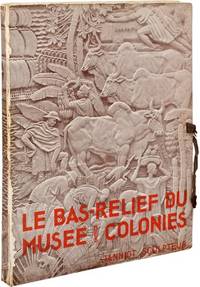
1931réf. 115768Paris: Librairie d'art Louis Reynaud 1931. Small folio. INSCRIBED by the author on the title page. An additional inscription on the front pastedown to John Amore is signed by six of the architects of Rockefeller Center and two of its most important contributing artists. The architects who have signed include John R. Todd L. Andrew Reinhardt Henry Hofmeister Wallace Harrison J. Andre Fouilhoux and George N. Pauly. Reinhard and Hofmeister are credited with Rockefeller Center's basic scheme with Raymond Hood contributing significantly to the design of the main buildings. The artists who have signed are Rene F. Chambellan who co-designed and cast the Atlas sculpture and designed several promenade fountains and Gaetano Cecere sculptor. Alfred Janniot was a French sculptor who contributed to the bas-relief sculptures of Rockefeller Center in New York City. The portfolio on offer here is a record of Janniot's bas-reliefs on the Palais de la Porte Doree in Paris delivered in 1931 for the Paris Colonial Exposition and designed by Janniot between 1928 and 1931. The work he contributed to Rockefeller Center is the gilded panel "Paris and New York Joining Hands Above Figures of Poetry Beauty and Elegance" on the facade of Le Maison Francaise circa 1930. Folded title sheet with an introduction in French and 66 full-page plates printed on rectos only. In a folding photo illustrated portfolio with brown silk tie as issued. Plates Near Fine portfolio Very Good with some wear along the hinge folds. Librairie d'art Louis Reynaud unknown
1931réf. 115768Paris: Librairie d'art Louis Reynaud 1931. Small folio. INSCRIBED by the author on the title page. An additional inscription on the front pastedown to John Amore is signed by six of the architects of Rockefeller Center and two of its most important contributing artists. The architects who have signed include John R. Todd L. Andrew Reinhardt Henry Hofmeister Wallace Harrison J. Andre Fouilhoux and George N. Pauly. Reinhard and Hofmeister are credited with Rockefeller Center's basic scheme with Raymond Hood contributing significantly to the design of the main buildings. The artists who have signed are Rene F. Chambellan who co-designed and cast the Atlas sculpture and designed several promenade fountains and Gaetano Cecere sculptor. Alfred Janniot was a French sculptor who contributed to the bas-relief sculptures of Rockefeller Center in New York City. The portfolio on offer here is a record of Janniot's bas-reliefs on the Palais de la Porte Doree in Paris delivered in 1931 for the Paris Colonial Exposition and designed by Janniot between 1928 and 1931. The work he contributed to Rockefeller Center is the gilded panel "Paris and New York Joining Hands Above Figures of Poetry Beauty and Elegance" on the facade of Le Maison Francaise circa 1930. Folded title sheet with an introduction in French and 66 full-page plates printed on rectos only. In a folding photo illustrated portfolio with brown silk tie as issued. Plates Near Fine portfolio Very Good with some wear along the hinge folds. Librairie d'art Louis Reynaud unknown books
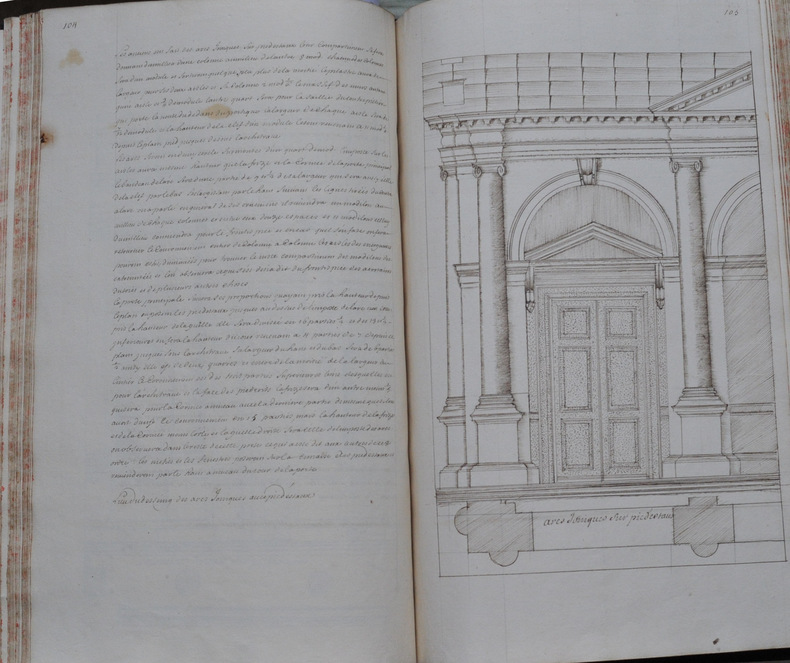
réf. 46404668SUPERBE ET PRÉCIEUX MANUSCRIT soigneusement calligraphié d’une traduction inédite du traité d’architecture de Vincent Scamozzi. Il s’agit du principal traité d’architecture classique de cette époque, en 35 chapitres et une conclusion. Ce livre est connu en français depuis 1685 grâce à la traduction d’Aviler sous le titre Les cinq ordres de l’architecture ou Le sixième livre d’architecture de Vincent Scamozzi. La traduction diffère parfois assez fortement de celle de d’Aviler. D’Aviler précise dans une introduction à l’édition de 1685 qu’il a pris des libertés vis à vis du texte original afin d’en restituer au mieux le sens général. La version de Lefebvre de Chassenay est peut-être plus fidèle à l’originale italienne. Le manuscrit est orné de 38 planches hors-texte dessinées à la plume reproduisant les planches des éditions tant italiennes que françaises (les illustrations de l’originale italienne ayant été réemployées pour la traduction française).Un article de Louis Thuillier donne quelques précisions sur Théodore Lefebvre de Chassenay dans Le Marteau Pilon 1995-96 : “Un des personnages clefs de la métallurgie nivernaise entre 1690 et 1715 : cet ingénieur devenu “écrivain général de la Marine” était aussi un inventeur, et on assure que Trésaguet était son prête-nom (il aurait entrepris la fourniture des ancres sous le nom de Trésaguet)” Lefebvre de Chassenay avait inventé une machine pour les ancres vers 1710. Il exploitait la fonderie de Thiot et le fourneau de Sardolles en société avec Prisye de Limoux. À Toulon il était associé avec un sieur Renou dans une entreprise pour ouvrages de la Marine. Il est mort à Toulon en 1721. Sa fille unique, Dorothée Lefebvre avait épousé en 1714, François Bouys.Voir aussi Jacques Gay. Les promoteurs du progrès technique pour la fabrication des ancres en Nivernais autour des années 1700 in Innovations métallurgiques 1996.Sur la garde on trouve l’ex-libris manuscrit de Lefebvre de Chassenay, ainsi que celle de son gendre Bouys. La signature de Bouys se trouve aussi sur la première page du manuscrit.
réf. 105335A Paris, de l'Imprimerie de Pierre Didot l'Aîné, an VII in-4, [4]-II-83 pp., planches, veau fauve, dos lisse orné (reliure de l'époque). Quelques griffures sur le second plat.
1788In -4°, quattro voll.; cartonato d’epoca. esemplare in barbe, esemplare ex dono auctoris al primo e secondo volume. Prima rara edizione di quest’opera che è considerata la prima vera e propria bibliografia dell’architettura. Concepita come più ampia, i lavori s’interruppero per la scomparsa prematura di Comolli. Cicognara (2152) scrive: “Nessun libro sarebbe più utile di questo agli amatori e agli artisti, se l'autore rapito dalla morte avesse potuto condurlo al suo termine”. Copia estremamente bella, con l’invio autografo del Comolli. In -4 °, four volumes .; contemporary cardboard with deckle edges. Ex dono auctoris copy. Rare first edition of this work which is considered the first real bibliography of architecture. Conceived as larger, the works were interrupted by the premature death of Comolli. Cicognara (2152) writes: “No book would be more useful than this to amateurs and artists, if the author kidnapped by death could have brought it to its end”. Extremely beautiful copy, ex dono auctoris.
réf. 67922Barcelona, M. Moleiro Editor,, 2009 Bound in luxurious brown-marron leather with gilt Greek lettering, housed in a slipcase with gold motifs. 384 pages, 204 illuminations with gold-decorated miniatures, either full-page or arranged across the page in multiple pictorial strips. Full-colour facsimile edition. Size: 32 23 cm. ****NUMBERED COPY NO. 588 OF A LIMITED FACSIMILE EDITION OF 987 COPIES, ISSUED WITH A CERTIFICATE OF AUTHENTICITY.**** Includes a full-colour commentary volume, 376 pages, hardcover with dust jacket, text by Marianne Besseyre.
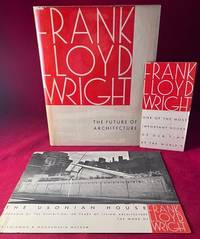
1953réf. 8764New York: Horizon Press 1953. First Edition. Hardcover. Very Good/Fair. 8 1/4 X 10 1/4 Inches. 224 PP. First edition copy in original cloth. Jacket retains price of $7.50 on front flap. SIGNED AND INSCRIBED BY FRANK LLOYD WRIGHT TO HIS PUBLISHER AND FRIEND BEN RAEBURN. Signed "To Ben with gratitude and admiration" on the title-page. Some light scuffing and wear. Jacket missing spine but is the original one owned by Ben Raeburn that is backed with a newer underneath. THIS ASSOCIATION COPY ACCOMPANIED AN ORIGINAL 1953 "USONIAN HOUSE" GUGGENHEIM EXHIBITION CATALOG AN ORIGINAL FOLDING PROSPECTUS FOR THE BOOK FROM HORIZON PRESS AND AN ORIGINAL POSTCARD MAILED FROM TOKYO TO MRS. FRANK LLOYD WRIGHT. Likely the most important association copy of this book that exists. Wright signed to the publisher and designer of the book itself. The first book in Horizon's run of Wright's lifetime works. From the personal collection of Ben Raeburn owner of the influential Horizon Press. Ben who actually did a two-year stint in prison for mailing "obscene" books in the 30's is best remembered for his work with Frank Lloyd Wright. Raeburn published many books by and about Wright's architecture. His published work also included James T. Farrell Robert Olen Butler Helen Levitt James Agee Aaron Siskind Berenice Abbott Edwin Denby and many more. Raeburn's Horizon Press was known for it's exquisite book design. Horizon Press hardcover
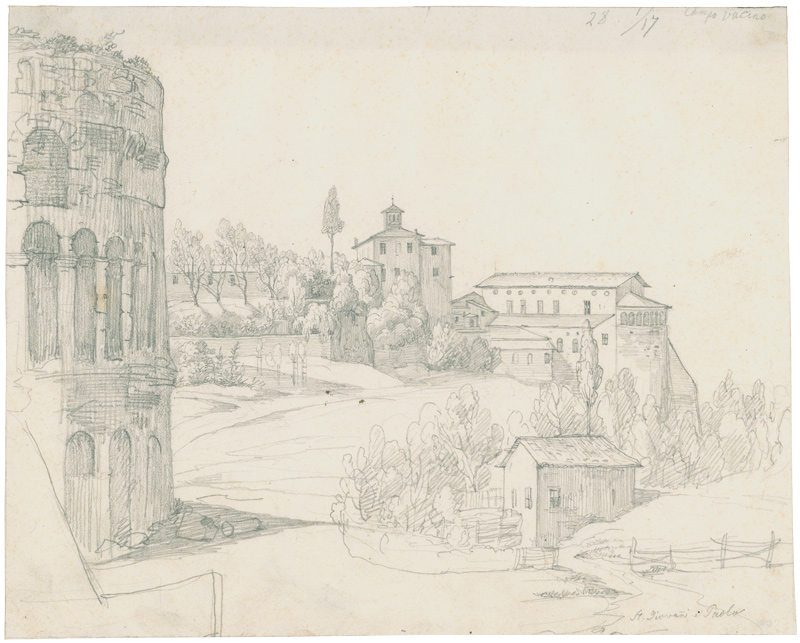
réf. 090-Io.J. Bleistift, auf Velin, rechts unten bezeichnet ?St. Giovanni e Paolo?, rechts oben datiert und bezeichnet ?28. 7. 17 Campo vacino?. 18,3:23,1 cm. Provenienz: Sammlung GW, nicht bei Lugt.
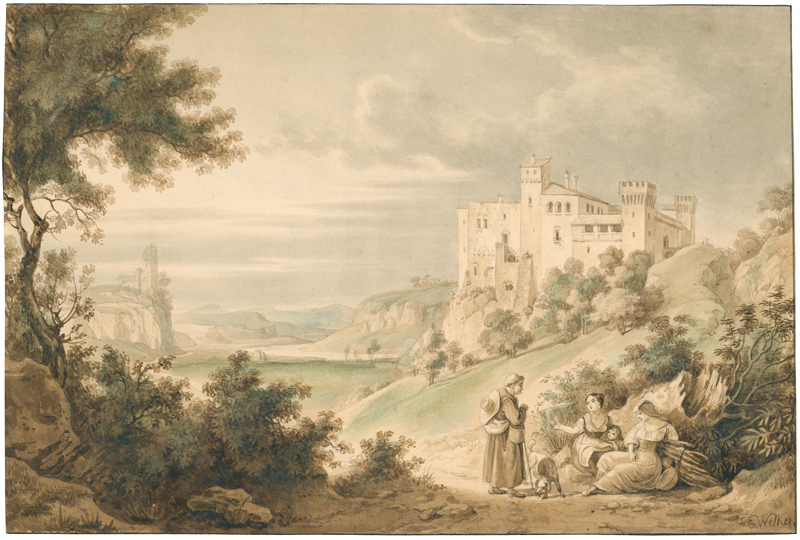
réf. 083-Io.J. Aquarell in Braun, Grau und Grün, über Bleistift, auf chamoisfarbenem festem Velin, rechts unten signiert ?E. Welker?, verso vom Künstler bezeichnet ?La Cresenza / Tenuta nella Campagna di Roma / Detto La Fabrica di Pussino.?. 21,2:31,7 cm. Provenienz: Ernt Jürgen Otto, Celle, Lugt 873b.
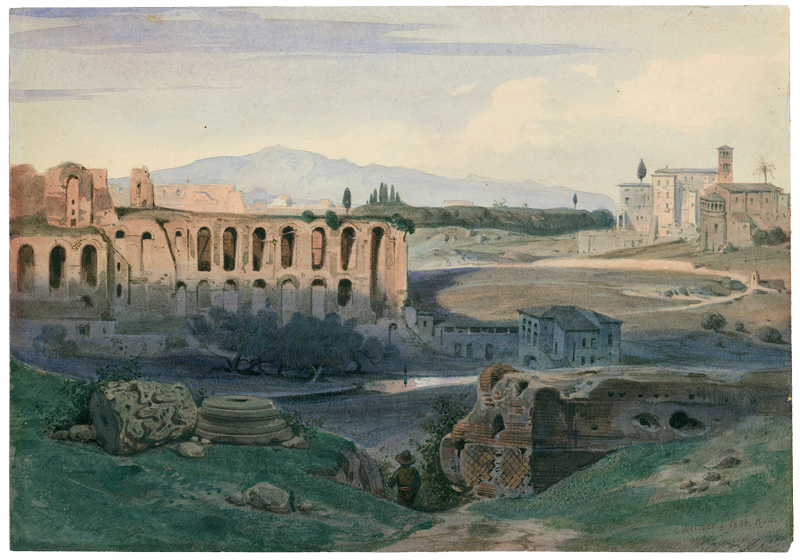
réf. 014-Io.J. Aquarell, über Bleistift, teils mit Deckweiß gehöht, auf Velin, rechts unten signiert, datiert und bezeichnet ?C. Werner f. 1838. Roma?. 19,2:27,5 cm. Verso Reste einer alten Montierung und mit einer genauen topographischen Bestimmung versehen. An der rechten unteren Ecke kleine Fehlstelle, sonst sehr gut erhalten und farbfrisch.
1945réf. 420781 vol. in-folio reliure demi-toile grise, Contient, de manière suivie, du numéro 1 de la 3e année (28 septembre 1945) au 24 de la 3e Année (27 décembre 1946), puis toujours de manière suivie n°1 de la 4e année (10 janvier 1947) au n°49 de la 6e Année (24 octobre 1950), Le Maître d'Oeuvre de la Reconstruction Française.
1983réf. AR-110Firenze Italy: Edizioni Il Ponte 1983. Atmos and Thanatos contains the extraordinary works of the Valdarnese painter Marco Fidolini inspired by electric power stations. Fidolini associates two aspects of the contrast of dualism fascination and repulsion in his works to the Freudian theory of Eros and the instict of death. Atmos being the symbol of steam a component of power stations; and Thanatos being the instinct of death in parallel association; thus drammatizes the positive and negative aspects of technology and industrial complexes in the artist's paintings. Includes a bio-chronology of the artist and exhibition works. Illustrated with 73 plates. Text in Italian and English. Includes an original limited to 100 lithograph Signed and Numbered 40/100 by Fidolini. Text is also Signed dated and inscribed by Fidolini on the half-title page. Dustjacket has a few tiny closed edge tears on the upper front cover and a tiny scrape on a blank area of the lower front cover. In mylar. Scarce. Signed by the Artist. Limited/Numbered First Edition. Hard Cover. Fine/Near Fine. Folio - over 12" - 15" tall. Edizioni Il Ponte Hardcover