5093 resultados
1968ref. 25013Boston Little Brown 1968. HBDJ 1968 STATED 1st edition 1st Printing NF/VG- Small mended Tear Front DJ with Tiny Chips edges Back DJ small chip top Edge Not Affecting Illustration of 2 men with Closed Eyes Black cloth Boards Titled in Gold Gilt on Spine light wear Interior nice tight clean light Fox Wear 264 PGS 8vo. DJ protected in Clear Mylar Brodart As Myra she moves from New York to Hollywood so she can immerse herself in the industry con her uncle Buck Loner out of half a million dollars and symbolically destroy the American male." "Gore Vidal's 1968 novel was the beginning of Myra mania. With no advance publicity the highly satirical story of a man-hatiNg transsexual quickly became a sensational Bestseller. Those who understood it were amused; those who dIdn't were shocked. On the surface Myra Breckinridge is an outrageous story about a man-hating transsexual. At its core however Myra is sophisticated satire with Hollywood as the vehicle for making fun of just about every American convention." . First Edition. Hard Cover. Boston Little Brown, hardcover
1948ref. 27137William Heinemann London 1948 HBDJ January 1948 Early Edition GOOD-/POOR AS-IS Clean tight text for year with Light Fox .no inscriptions DJ shelf worn with tears wear rub Extremities Slightly Major signs of wear and tears DUSTJACKET YET BOOK TITLE AT TOP & ILLUSTRATION ON FRONT DJ ARE OK BUT CHIPS TAKE OUT WORD STORY BY OUT AT BTM FRONT Dustjacket Repairs to DJ WITH CRITIC REVIEWS ON BACK DJ SOME SOIL TEARS. Small chips Up & Down Spine DJ GREY CLOTH CVRS WITH ILLUSTRATION on Front has Fade slight wear Slight fade Spine Title Interior nice tight clean Light wear Fox 226 pgs DJ Protected Clear Mylar Who were Furtive Owners Why did they advertise Rooms to Let & then refuse to take anybody in What went on in Sinister Looking Blacked-Out Shed at the back of the house These & Other Questions were what Marigold & Adrian Marriott set themselves out to answer with the help of Their cousin Geoffrey Brinton. Their Usual Jolly summer activities on & Around the River were Interrupted while they kept Watch on the house & followed up Promising Clues but when they found themselves called in to cooperate with a Real Detective they felt it had been well worth while. Hardcover. Good/Poor. William Heinemann , London hardcover
1936ref. 26917Oxford University Press London 1936 HBDJ 1ST EDITION 1936. VG/VG- SS-IS Book Condition: Very Good. Dust Jacket Condition: Very Good- with Crease on Front & Light Wear tinyChips Tears Extremities. First Edition. 12mo .THICK Tan Brown cloth with Black Decorated Cvr ExtremitiesTitled in brown on spine decorated border to front board Tight and square light foxing in edges and faintly in prelims name in front. Dust jacket is price clipped edge wear 2 small holes in rear panel unfaded protected in a removable clear film sleeve. Hardback 224 Pg Back Blue & White Dustjacket Lists Oxford books Boys Thru Power Projector has light Fox & 2 smaller Holes near btm. 1st was that Mr. Nicholas Uncle to 1 of them by whose Invitation they were There to Spend a Camping Holiday had Gone to London for an Immediate Operation. 2nd was that His Son Pat WHO SHOULD HAVE DONE THE HONOURS OF THE PLACE in His father’s Absence was Missing. Nobody Knew what had become of Him. Thus there is a Mystery hanging over the camp from Outset & as Time Goes Mystery Deepens ; Queer Things Happen Mystery Infectsd Irish Terrier & Fish in River. later boys row their boat out to Island of Whispers. 1st Edition. Hardcover. Very Good/Very Good. Oxford University Press, London, hardcover
1941ref. 26562Dodd Mead & Company New York 1941 HBDJ 1941. First Edition. First Printing Dates match on Title & Copyright page NF/VG. AS-IS Green Cloth Titled in Embossed Black Lettering on front & Spine Cvr. Book Condition: Near Fine Book. Dust Jacket Condition: Very Good Dust Jacket. 238 pgs NO ADS IN BACK. A bright clean copy WITH LIGHT FOX Wear Interior. Dustjacket with a 1/4" V-chip at top rear spine fold and a few tiny edge chips and a little edgewear. where Willa Ethridge & her Brother Raeburn are left alone when Their Father is sent Abroad by U. S. Govt. Alone that is except for Bessie the Bloodhound Screwball the English Bloodhound & Quash & Seeny the Beloved Negro Gardener & Cook who have Minded the children ever since they were Born. Great-Aunt Dabney with a face like a Nutcracker a strong Will but a grand sense of Justice. Ethridge Acres the plantation is about to be turned over to relatives from North Unless the will of Great Grandfather Zeke can be found which wouldl eave it to their Father. Will is concealed in Jasper Jewel Case Concealed in the House. For Girls from 10 to 14. 1st Edition. Hardcover. Dodd, Mead & Company, New York hardcover
1968ref. 2110502150410891Naniwashobo 1968. Soft Cover. Fine. Volume: 1 Naniwashobo paperback
1981ref. G009145560XI5N01Lepprechaun library G. P. Putnams NY 1981. Hardcover. Acceptable. Missing dust jacket; Readable copy. Pages may have considerable notes/highlighting. ~ ThriftBooks: Read More Spend Less.Dust jacket quality is not guaranteed. Lepprechaun library G. P. Putnams NY hardcover
2003Hardcover New Release item. Pls. allow a minimum of 4 - 6 weeks as this is hi p frombook publishers.
1828ref. 45872Paris Crochard 1828. No wrappers. In: "Annales de Chimie et de Physique Par MM. Gay-Lussac et Arago." tome 39 Sec. Cahier With halftitle to vol. 39. pp. 113-224. Entire issue offered. Ampere's paper: pp. 113-145 a. 1 folded engrave plate. The plate with a few mostly marginal brownspots. First appearance of Ampere's mathematical treatment of Fresnel's ondulatory theory of light agreeing with Fresnel and opposed to Biot and Laplace who advocated a corpuscular theory. unknown
1819ref. 47357Paris Crochard 1819. 8vo. No wrappers. In "Annales de Chimie et de Physique" Tome X 2. Series Cahier 3. Titlepage to vol. X. Pp. 241-336 entire issue offered Cahier 3. Arago and Fresnel's paper: pp. 288-306. First appearance of this seminal paper in which Arago and Fresnel described the experiments which demonstrated that light vibrates transversely to its direction of forward movement."In a further letter to Arago dated 29 April 1818 Young recurred to the subject of transverse vibrations comparing light to the undulations of a cord agitated by one of its extremities. This letter was shown by Arago to Fresnel who at once saw that it presented the true explanation of the non-interference of beams polarised in perpendicular planes and that the latter effect could even be made the basis of a proof of the correctness of Young's hypothesis; for if the vibration of each beam be supposed resolved into three components one along the ray and the other two at right angles to it it is obvious from the Arago-Fresnel experiment that the components in the direction of the ray must vanish; in other words THAT THE VIBRATIONS WHICH CONSTITUTE LIGHT ARE EXECUTED IN THE WAVE-FRONT." Edmund Whittaker in "A History of the Theories of Aether and Electricity I" p. 115. - Parkinson Breakthroughs 1819 P. - Magie "A Source Book in Physics p. 325 ff. unknown
1846ref. 44101Paris Victor Masson 1846. No wrappers as extracted from "Annales de Chimie et de Physique" Tome 17 Troisieme Série. Titlepage to tome 17. Pp. 172-199 a. 1 engraved plate pp. 316-338 textillustr. Brownspots to titlepage and some browspots to the second memoir. First editions of two importent memoirs on polarization and reflexion of light by "the founder of the new optics".The first paper takes on a central role in Fresnel's dealing with polarization in general and specially with chromatioc polarization and the explaining the phenomena that arises when light travels through crystals. The paper was read at the Academy on march 30 was not printed at the time as it disappeared and only turned up many years later around 1845 when it was found in the papers of Fresnel's brother. "On croyait ou Mémoire perdu. Il a été retrouvé dans les papiers de M. Léonor Fresnel frère de l'illustre académicien." Thus the offered paper is here PRINTED FOR THE FIRST TIME AND IN ITS FULL LENGHT.The second paper deals with reflection and explains the different phenomena seen when light is reflected from glassplates having two surfaces parallel or with curvature interference of reflected waves and the measure of their different wavelenghts all explained according to the wave theory of light. The paper offered is for the FIRST TIME PRINTED IN ITS FULL LENGHT as it only appeared in the résumé-form in 1820 "Résumé d'un Mémoire sur la Réflexion de la lumière" Annales de Chimie et de Physique tome 15 pp. 379-386."As it was Fresnel succeeded fully in attaining his explicit goal the establishment of the wave conception of light. Not long after his death scientific opinion definitely shiftedin favor of waves and opened up the pathway leading to the deeper insight of Maxwell. In broad context Fresnel's work can be viewed as the first successfull assault on the theory of imponderables and a major influence on the development of nineteenth-centurty energetics." DSB V p. 171. unknown
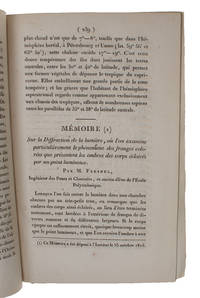
1816ref. 43910Paris Crochard 1816 No wrappers. In: 'Annales de Chimie et de Physique' Tome I Sec. Series Cahier Mars 1816. With htitle to vol. I. Pp. 225-336 and 1 folded engraved plate. The entire issue offered. Fresnel's paper: pp. 239-281. The plate shows the diffraction patterns. First appearance of Fresnel's landmark mémoir - this mémoir was his first paper on diffraction and was later given the prize of the French Academy and published in Memoires de l'Academie in 1826 in full together with his further developments of his light theory - in which he for the first time explained the causes of the diffraction effects as the mutual interference of the secondary waves emitted by those portions of the original wave-front which have not been obstructed by the diffraction screen. His methods of calculation utilized the principles of both Huygens and Young and he summed the effects due to different portions of the same primary wave-front. The memoir records also Fresnel's famous mirror-experiment."In broad context Fresnel's work can be viewed as the first successfull assault on the theory of imponderables and a major influence on the development of nineteenth-centurty energetics." DSB V p. 171."Augustin Fresnel seems to have adopted a wave theory of light from the very beginning of his studies. His first paper presented to the Academy.in October 1815 and entitled "La Diffraction de la Lumiere" the paper offered was written after a long correspondance with Arago who had promised Fresnel his full support. "The wave theory" Fresnel wrote "is well suited to explaining the complicated propagation of light phenomena and since as we know from the case of sound waves can surcomvent obstacles I decided to make a study of shadows.It is because they cross in regions common to them both that two pencils of rays can produce fringes. hence it follows that the vibrations of rays which cross at very small angles can cancel out whenever crests of one correspond to the throughs of the other." unknown
1816ref. 44120Paris Crochard 1816 1819. Bound in 2 contemp. hcloth. Gilt lettering to spines. In: "Annales de Chimie et de Physique" Series 2 Tome 1 a. Tome 11. Entire volumes offered.4452 pp. a. 3 engraved folded plates. 448 pp. a. 3 folded engraved plates. Fresnel's papers: pp. 239-281 a. pp. 246-296 a. pp. 337-378. Arago's paper: pp. 5-30. Some scattered brownspots. First appearance of Fresnel's landmark papers on the phenomena of diffraction presenting Fresnel's first priinted paper on the subject. These two papers won the Academy's prize for 1818 and were later expanded and published as a long memoir in 1826. The first paper offered initiated the attack on the corpuscular theory of light which was completely owerthrown by a series of succesfull papers by Fresnel the next few years. In the second paper Fresnel summed up all his work prior to this date in completed form. The paper is called "extract" but the longer memoir was not published until 1826. The paper is A CLASSIC IN PHYSICS."In broad context Fresnel's work can be viewed as the first successfull assault on the theory of imponderables and a major influence on the development of nineteenth-centurty energetics." DSB V p. 171.Diffraction arises because of the way in which waves propagate; this is described by the Huygens-Fresnel principle. The propagation of a wave can be visualized by considering every point on a wavefront as a point source for a secondary radial wave. The subsequent propagation and addition of all these radial waves form the new wavefront. When waves are added together their sum is determined by the relative phases as well as the amplitudes of the individual waves an effect which is often known as wave interference. The summed amplitude of the waves can have any value between zero and the sum of the individual amplitudes. Hence diffraction patterns usually have a series of maxima and minima. Wikipedia-The volumes contains many other importent papers by Arago & Petit Vaugelin Humphrey Davy d'Arcet Laplace Gay-Lussac Alex. v. Humboldt Thenard Will. Prout Stromeyer Berzelius Brewster Theod. de Saussure Ampère etc. hardcover
1816ref. 44516Paris Crochard 1816-25. Bound in 2 fine recent hmorocco. In: "Annales de Chimie et de Physique Redigées par MM. Gay-Lussac et Arago" Tome I IV IX X XI XV XVII XX XXI XXIII XXVIII and XXIX. Some memoirs with scattered brownspots. All but volume 15 with the orig. titlepages to the volumes. Vol. XV having instead of the titlepage a sample of the orig. printed wrappers December issue 1820. Bound at end of volume 2. The memoir no. 25a below is inserted at the end of volume 2. Some of the memoirs having textillustrations. Some versos of titlepages with stamps. First appearances of this groundbreaking series of papers and memoirs in which Fresnel established the scientific basis for the wave theory of light and gave the theoretical framework for explaining in the context of his theory of the transversal nature of lightwaves the phenomena of double refraction refraction dispersion polarization interference diffraction patterns diffraction fringes as light spreads around objects etc. He developed mathematically the hypothesis of the wave nature of light and he demonstrates its conformity with experience. His study of light was a dynamic interplay between theory and observation between mathematics and experiment. - The offered series also comprises the contributions from Arago and the rapports from The French Academy's committees by Ampère Biot and Fourier - see below nos. 6111415a.nd 18."From the point of view of method his investigations extended from the manual operations of the laboratory to the most abstract mathematical analyses. Few physicists since Newton had been so versatile."Silliman in "Historical Studies in the Physical Sciences" vol. 4 p. 155."The wave-thory at this time was still encumbered with difficulties. Diffraction was not satisfactorily explained; for polarization no explanation of any kind was forthcoming; the Huygenian construction appeared to require two different luminiferous media within double refracting bodies; and the universality of that construction had been impugned by Brewster's discovery of biaxial crystals. The upholders of the emission theory emboldened by the success of Laplace's theory of double refraction thought the time ripe for their final triunph; and as a step to this in March 1817 they proposed Diffration as the subject of the Academy's prize for 1818. Their expectation was disappointed; and the successful memoir afforded the first of a series of reverses of which in the short space of seven years the corpuscular theory was completely owerthrown. The author was Augustin Fresnel."Whittaker "A History of the Theories of Aether & Electricity" vol. 1 p.107 ff."This concept of transverse waves met with the greatest hostility from the scientists of the day who could not imagine an extremely fluid and rarified ether which at the same time possessed the mechanical properties of a rigid body. Even Arago admitted that he could not follow the exuberant engineer in his ideas. ButFresnel was convinced that at last he had the key to many mysteries and with his model of waves he gave a full clarification of the phenomena of polarization. With insuperable precision he explained a long series of extremely complicated experiments such as those of chromatic polarization that Arago himself had discovered by chance in 1811 and which the followers of Newton could not explain in spite of all their efforts. Following this line Fresnel reached the synthesis which is his masterpiece.we must recall the final interpretation that he gave of the famous phenomenon of partial reflection by transparent surfaces that simple phenomenon which until then had puzzled Grimaldi Newton and Huygens and which in Malus's experiments had unexpectedly acquired a special importencee as it had been compared to the great mystery of double refraction."Ronchi "The Nature of Light" p. 255 ff.Comprising:1. Mémoire sur la Diffraction de la lumière où l'on examine particululièrement le phénomène des franges colorées que présentent les ombres des corps éclairés par un point lumineux. "Ann.Chim.P." Tome 1. 1816. With titlepage to vol. 1. Pp. 239-281 and 1 folded engraved plate.2. Extrait d'une Lettre de M. Fresnel à M. Arago sur l'influence de la chaleur dans les couleurs développées par la polarisation.Tome 4. 1817. With titlepage to vol. 4. Pp. 298-300.3. Lettre de M. Fresnel à M. Arago sur l'influence du mouvement terrestres dans quelques phénomènes terrestres dans quelques phénoménes d'optique. Tome 9. 1818. With titlepage to vol. 18. Pp. 57-70.4. Note additionelle à la Lettre de M. Fresnel à M. Arago insérée dans le dernier Cahier des Annales. Tome 9. 1818. Pp. 286-287.5. FRESNEL & ARAGO. Sur l'Action que le rayons de lumiére polarisés exercent les uns sur les autres. Tome 10. 1819. With titlepage to vol. 10. Pp. 288-305. - Also with "Extrait d'un ouvrage du P. Grimaldi intitulé: Traité physico-mathérmatique de la lumiere des couleurs et de l'iris". Pp. 306-312.6. ARAGO. Rapport par M. Arago à l'Academie des Sciences au nom de la Commission qui avait été chargée d'examiner les Mémoires envoyés au concours pour le prix de la diffraction. Tome 11. 1819. With titlepage to vol. 11. Pp. 5-30.7. Mémoire sur la Diffraction de la Lumiere. Extrait. This importent Price-Memoir was only printed in full in 1826. Tome 11. 1819. Pp. 246-296.8. Suite Du Mémoire sur la Diffraction de la Lumière. Tome 11. 1819. Pp. 337-378. Note sur des Essais ayant pour but de décomposer l'eau avec un aimant. Pp. 219-222.9. Note sur des Essais ayant pour but de décomposer l'eau avec un aimant. Tome 15. 1820. Pp. 219-222. No titlepage to vol. 15.10. Résume d'un Mémoire sur la Reflexion de la lumière. Tome 15. 1820. Pp. 379-386. Tome 15 is here represented with the last issue of the year Decembre 1820 pp. 337-448 and instead of the titlepage having the orig. printed wrappers bound at end of the second volume.11. ARAGO & AMPÈRE. Rapport fait à l'Academie des Sciences le lundi 4 juin 1821 sur un Mémoire de M. Fresnel relatif aux couleurs des lames cristallisées douées de la double réfraction. Tome 17. 1821. Titlepage to vol. 17. Pp. 80-102.12. Note sur le Calcul des teintes que la polarisation développe dans les lames cristallisées. Tome 17. 1821. Pp. 102-111.13. IIe Note sur la Coloration des lames cristallisées. Tome 17. 1821. Pp. 167-196.14. BIOT. Remarques de M. Biot sur un Rapport lu le 4 juin 1821 à l'Academie des Sciences par MM. Arago et Ampere. Tome 17. 1821. Pp. 225-258.15. ARAGO. Examen des Remarques de M. Biot. Tome 17. 1821. Pp. 258-273. 16. Addition à la IIe Note insérée dans le Cahier précédent par M. Fresnel. Tome 17. 1821. Pp. 312-315.17. Note sur les remarques de M. Biot publiées dans le Cahier précédent. Tome 17. 1821. Pp. 393-403.18. FOURIER AMPÈRE ET ARAGO. Rapport fait à l'Academie sur un Mémoire de M. Fresnel relatif à la double réfraction. Commission: Fourier Ampère et Arago. Tome 20 1822. With titlepage to vol. 20. Pp. 337-344.19. Note sur la double réfraction du verre comprimé. Tome 20. 1822. Pp. 376-383.20. Explication de la Réfraction dans le système des ondes. Tome 21 1822. Titlepage to vol. 21. Pp. 225-241. LAGRANGE. Sur la Théorie de la lumière d'Huygens. Pp. 241-246.21. Sur l'Ascension des nuages dans l'atmosphère. Tome 21 1822. Pp. 260-263.22. Réponse de M. Fresnel à la Lettre de M. Poisson insérée dans le tome XXII des Annales p. 270. Tome 23 1823. Titlepage to vol. 23. Pp. 32-49.23. Note sur le Phénomène des anneaux colorés. Tome 23 1823. Pp. 129-134.24. Suite de la Réponse de M.A. Fresnel à la Lettre de M. Poisson. Tome 23 1823. Pp. 113-122.25. Extrait d'un Mémoire sur la double Réfraction particulière que présente le cristal de roche dans la irection de son axe. Tome 28 1825. Titlepage to vol. 28. Pp. 147-161. 25 a Extrait d'un Mémoire sur la double Réfraction. Tome 28 1825. Pp. 263-279. According to Buchwald "The Rise of the Wave Theory opf Light" p. 462 these 2 extracts composes the entire memoire.26. Note sur la Répulsion que des corps échauffés exercent les uns sur les autres à des distances sensibles. Lue à l'Institut le 13 juin 1825. Tome 29 1825. Titlepage to vol. 29. Pp. 57-62.27. Extrait d'un Mémoire sur la Loi des modifications imprimées à la lumière polarisée par sa réflexion totale dans l'intérieur des corps transparens. Tome 29 1825. Pp. 175-187. This paper was never printed in full. unknown
1819ref. 47357Paris, Crochard, 1819. 8vo. No wrappers. In ""Annales de Chimie et de Physique"", Tome X, 2. Series, Cahier 3. Titlepage to vol. X. Pp. 241-336 (entire issue offered, Cahier 3). Arago and Fresnel's paper: pp. 288-306.
1816ref. 44120Paris, Crochard, 1816, 1819. Bound in 2 contemp. hcloth. Gilt lettering to spines. In: ""Annales de Chimie et de Physique"" Series 2, Tome 1 a. Tome 11. Entire volumes offered.(4),452 pp. a. 3 engraved folded plates. + 448 pp. a. 3 folded engraved plates. Fresnel's papers: pp. 239-281 a. pp. 246-296 a. pp. 337-378. Arago's paper: pp. 5-30. Some scattered brownspots.
1816ref. 44516Paris, Crochard, 1816-25. Bound in 2 fine recent hmorocco. In: ""Annales de Chimie et de Physique, Redigées par MM. Gay-Lussac et Arago"", Tome I, IV, IX, X, XI, XV, XVII, XX, XXI, XXIII, XXVIII and XXIX. Some memoirs with scattered brownspots. All but volume 15 with the orig. titlepages to the volumes. Vol. XV having instead of the titlepage, a sample of the orig. printed wrappers, December issue 1820. Bound at end of volume 2. The memoir, no. 25a below is inserted at the end of volume 2. Some of the memoirs having textillustrations. Some versos of titlepages with stamps.
1816ref. 43910(Paris, Crochard, 1816) No wrappers. In: 'Annales de Chimie et de Physique', Tome I, Sec. Series, Cahier Mars 1816. With htitle to vol. I. Pp. 225-336 and 1 folded engraved plate. (The entire issue offered). Fresnel's paper: pp. 239-281. The plate shows the diffraction patterns.
1828ref. 45872(Paris, Crochard, 1828). No wrappers. In: ""Annales de Chimie et de Physique, Par MM. Gay-Lussac et Arago."", tome 39 (Sec. Cahier), With halftitle to vol. 39. pp. 113-224. (Entire issue offered). Ampere's paper: pp. 113-145 a. 1 folded engrave plate. The plate with a few, mostly marginal brownspots.
1846ref. 44101Paris, Victor Masson, 1846. No wrappers as extracted from ""Annales de Chimie et de Physique"", Tome 17, Troisieme Série. Titlepage to tome 17. Pp. 172-199 a. 1 engraved plate + pp. 316-338, textillustr. Brownspots to titlepage and some browspots to the second memoir.
197628 pages. Features: Some orchids in the 50th state; Two Orchidists in Waianae - Beatrice Krauss and Louise Wulff and Two in Wahiawa Beatrice Krauss and Louise Wulff; and more. Small date stamp upon front cover. Attractive copy with light wear. Book
1958ref. 2082702114605363Not Available 1958. Soft Cover. Fine. Number of books: 1 Not Available paperback
1972ref. 2082702114608412Not Available 1972. Soft Cover. Fine. Number of books: 1 Not Available paperback
1939ref. 2082702114603092Not Available 1939. Soft Cover. Fine. Number of books: 1 Not Available paperback
2023ref. 2-0367756269Routledge 2023. Paperback. New. 164 pages. 9.69x6.88x0.37 inches. Routledge paperback
ref. ria9781138453494_inpHardcover. New. New Book; Fast Shipping from UK; Not signed; Not First Edition; Divided into 3 parts part one of this book provides a historical perspective including a definition of nanotechnology and an evaluation of the global and national landscapes of the field. Part two evaluates the US model and compares it hardcover