8 802 résultats
1931Folio, in legatura originale con titolo impresso in oro ai piatti e al dorso. Ex libris Giovanni Treccani degil Alfieri.
1867réf. 129235Paris, E. Dentu, impr. Imprimerie générale Ch. Lahure 1867 2 volumes. In-folio 37,5 x 26,5 cm. Reliures demi-basane rouge, dos lisses ornés de filets dorés, 280-480 pp. 60 livraisons de 16 pp., imprimé sur 3 colonnes, moitié texte, moitié gravures., tables des matières, sommaires. Accrocs en tête et en pied de dos, intérieur très frais.
réf. 60077aafParis, Imprimerie Impériale, 1857, gr. in-8vo, 2 ff. + 511 p. + 2 planches dépl. (Plan d'ensemble de l'exposition / Plan de la cérémonie de cloture le 15 novembre 1855), qqs rousseurs épars, qqs lignes rouges, tirage sur beau papier (Hollande?) epais, pt. timbre rouge ‘N’ avec tête d'aigle sur le faux-titre ainsi ce texte en bleu ‘Admirable travail / monument de la première exposition !’, reliure en demi-chagrin à nerfs verte, dos orné de caissons doré et orné d'une abeille, plat devant avec texte doré ‘Don de S.A.I. le Prince Napoléon Président de la commission impériale’, le verso aux armes de Napoleon. Qqs pt. traces d'usage et ou tâches, en tout un très bel exemplaire avec 3 tranches dorées.
1901réf. 63092Buffalo NY & Chicago IL: Mackson; Lyman 1901. Archive of 46 original albumen photographs sized from 3 x 6 in. up to 4 x 6 in. all of the images smaller than 4 x 5 in. on albumen paper stock many w/ embossed photographer’s stamps several w/ photographer’s imprint w/in negative some w/ small rubber stamp at lower fore-edge of verso as well as pencil manuscript annotations identifying subject inventory nos. w/ in negatives of several a few w/ evidence of having been previously mounted a couple w/very slight dog-eared corners 1 w/ closed tear at lower fore-edge a couple w/ image evidencing poor process chemicals still an exceptional group of images. This set of photographs was created by two different Illinois & Missouri photographers at the 1901 Pan-American Exposition in Buffalo NY -- both of whom had lived and worked in Chicago at the beginning of the 1890’s offering reasonably priced “unofficial” vernacular images of the 1893 Columbian Exposition World’s Fair followed by the Pan-American World’s Fair. The fair featured a range of acts and attractions featured at the Exposition which included Bostock’s Trained Wild Animals “A Trip to the Moon” “Cleopatra’s Temple” Henry Roltair’s illusionist show “House upside down” and the Battle of Missionary Ridge Cyclorama. Many of the Exposition buildings including the prominent Electric Tower were covered in approximately 2 million 100 watt incandescent light bulbs producing an incredible display when turned on each night attracting millions of people who visited. This Exposition marked a defining moment in Buffalo history with the city becoming the focus of international architectural artistic technological and industrial attention at the Fair. It is sadly largely remembered as the scene of the tragic assassination of President McKinley. Vernacular souvenir photos are quite scarce and these have an unusual sharpness in light of the fact that like the 1893 Columbian all were prevented from bringing in tripods to shoot the Exposition. One of the photographs captures African natives from the Midway’s “African Village” which incorporated Africans from the colonial empires of Great Britain Belgium Germany & France along with participants from Georgia who were “staged” in the “Old Plantation” representing the enslavement of African-Americans in North America. Another Black History exhibit included was the “Negro Exhibit” previously exhibited at the 1900 L’Exposition Universelle in Paris depicting the accomplishments of formerly enslaved people and languished at the far back of the Manufacturers and Liberal Arts Building. Samuel Lyman 1854-1939 was an intrepid tinkerer junk dealer and photographer who shot souvenir photos for his customers during the Columbian Exposition in 1893. Two of his sons Joseph Lyman 1887-1953 and Harry Lyman 1883-1940 became successful photographers in Kansas City MO during the Roaring 20’s. Mackson fl. 1885-1910 immigrated from Russia into Chicago in the 1880’s and operated a small photo studio there until about 1900 before relocating to Kansas City and St. Louis MO during the opening decade of the 20th Century operating photography studios in both cities. See: The Midway Buffalo New York Uncrowned Community Builders 2025. Mackson; Lyman, unknown
1967réf. 1493Paris, Maeght éditeur, 1967-1982. 7 volumes in-folio (380 x 280 mm) en feuilles, couvertures illustrées. ENSEMBLE DE 30 LITHOGRAPHIES D'ANTONI TÀPIES. - DERRIÈRE LE MIROIR n° 168. TAPIES. Novembre 1967 (7 lithographies originales en couleurs). - DERRIÈRE LE MIROIR n° 175 (5 lithographies originales en couleurs et 3 lithographies originales en noir). - DERRIÈRE LE MIROIR n° 180 (1 lithographie originale en couleur se déroulant sur 28 pages). - DERRIÈRE LE MIROIR n° 200 (4 lithographies originales en couleurs en double page). - DERRIÈRE LE MIROIR n° 210: MONOTYPES (24 pages entièrement réalisées en lithographie dont 4 lithographies originales et 3 d'interprétation). - DERRIÈRE LE MIROIR n° 234 (2 lithographies originales en couleurs en double page). - DERRIÈRE LE MIROIR n° 253 (1 lithographie originale en triple page. Ultime numéro de la revue). TIRAGES ORIGINAUX POUR TOUS LES VOLUMES. Très nombreuses reproductions d'œuvres et documents photographiques. Textes de: Michel Tapié, Jacques Dupin, Julio Cortazar, Pierre Volboudt, Georges Raillard, Poème de Joan Brossa.
1877réf. 39388Stockholm 1877. Tvær-folio. Samt. halvlæderbind med forgyldt tekst på permer. Med 55 plancher de fleste vandskjoldede. Folio oblong. Contemporary half calf bindig with gilt lettering to boards. With 55 plates depicting the World exhibition of 1876. Most plates with dampstaining. hardcover
1877réf. 39388Stockholm 1877. Tvær-folio. Samt. halvlæderbind med forgyldt tekst på permer. Med 55 plancher, de fleste vandskjoldede. Folio oblong. Contemporary half calf bindig with gilt lettering to boards. With 55 plates depicting the World exhibition of 1876. Most plates with dampstaining.
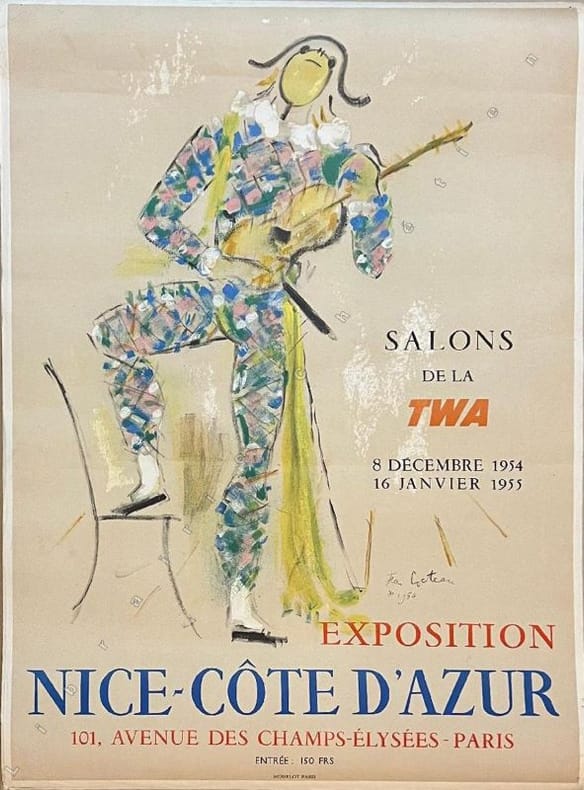
1954réf. 25036Paris Mourlot 1954 Affiche lithographiée signée à droite dans la planche, Paris, Mourlot, 1954, 70 x 50 cm.
1937réf. 238631937 Pastel signé en haut à gauche, (1937), 50 x 64.6 cm.
1992réf. 278401992 Une gouache originale en couleurs, Format : 62 centimètres de haut par 47,5 centimètres de large, sur papier canson crème, signée à la mine de plomb en bas à droite : JOEL DABIN et en haut à droite : JOEL DABIN 1992, affiche réalisée (pour un Concours organisé en 1992 par le C.I.E.R [Réfectoire et Cellier des Moines de labbaye de Tournus] et l'Ecole des Beaux-Arts de Nantes, 5 rue Fénelon) par Joel DABIN Peintre,
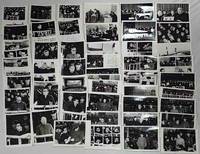
1981réf. 216885Beijing. Circa1981. A complete set of 50 black and white photographs of the trial of the Gang of Four during 1980-81. Images clearly show the judges the courtroom and the accused. In excellent condition each photograph is loosely inserted within an A5 polypropylene sleeve all contained in an archival-grade cardboard box. All images measure approximately 20.5 x 15cm. A fascinating series of photos from the trial of the Gang of Four and the so-called remnants of Lin Biao's Central Cultural Revolution Group including images of the court physical evidence and the accused themselves - including though not limited to Jiang Qing Zhang Chunqiao Wang Hongwen and Yao Wenyuan. Included are photos of the accused - in clearly poorer physical health compared to their peak in 1976 - after having reputedly given emotive vitriolic and stubborn statements to the court. Though Jiang Qing and Zhang Chunqiao appear openly hostile or contemptuous to the court - both in their own unique way - Wang Hongwen Yao Wenyuan and the other defendants appear more subdued and mournful in their demeanour seemingly having resigned themselves to their fate. Of particular note is the inclusion of a single page of images of what appears to be the badly charred and broken corpse of Lin Biao as well as the wreckage of his ill-fated flight. These images were presumably supplied to the court by the KGB who had very controversially handled the investigation at the time of the crash despite it having taken place over and within the territory of the Mongolian People's Republic not the Soviet Union. Perhaps to further affirm the position that the corpse was indeed Lin's a forensic-like comparison is made between an image of the body's skull and his distinctive forehead and brow ridge. . unknown
1862réf. 9027602London: Clay & Lea 1862. Hardcover. Very good. Expertly rebacked with original spine pieces. Gilt titling on spine is still bright. New endpapers. Clay & Lea hardcover
1862réf. 9027602London: Clay & Lea 1862. Hardcover. Very good. Expertly rebacked with original spine pieces. Gilt titling on spine is still bright. New endpapers. Clay & Lea hardcover books
1926réf. 181547China: The Commercial Press c. 1926. The Chinese typewriter comes to America A rare surviving example of the brochure issued by China's largest publisher and maker of scientific instruments to accompany its stand at the 1926 Philadelphia Sesqui-Centennial Exposition. Alongside print publications and cutting-edge laboratory equipment the Commercial Press displayed Shu Zhendong's newly invented Chinese typewriter a major advance in the development of modern information technology. The typewriter advertised and pictured on page 56 promises to solve "a serious problem in office administration in China. It is the miraculous achievement of the inventor that although there are 3000 characters in the font yet a typist after the practice of one or two weeks will be able to locate any character instantly." Online records show copies in the City of Philadelphia archives and six other institutions all in the US Library of Congress the Smithsonian Peabody Essex Temple Californian State University Los Angeles and University of Delaware. Octavo. Folding organization chart illustrations some colour in text; text printed within red borders. Original brown silk wrappers purple xianzhuang stitching spine ends capped with blue silk front cover blocked in gilt. Spine ends rubbed couple of faint stains to covers chart creased where sometime incorrectly refolded: near-fine. unknown
1910réf. 17612Paris, Librairie Aéronautique, 1910 (imprimerie Paul Dupont) ; 127 pp.
1839réf. zy108Paris, chez L. Bouchard-Huzard Relié 1839 RARE. Trois volumes in-8 (14,2 x 22 cm), reliure demi-basane, dos lisses ornés de filets dorés, lv-544, 531 et 568 pages, ces trois tomes comprennent les arts industriels suivants (liste non exhaustive) ; Tome 1 : Tissus (laines et lainages, soies et soieries, fils et tissus de coton, de lin et de chanvre) - Métaux (fonderies, fer, acier, limes, enclumes, outils, plomb, cuivre, chaudronnerie, coutellerie, quincaillerie, marbres, bitumes, stucs, ciment, ardoise, etc.) // Tome 2 : Machines et ustensiles agricoles (machines à élever l'eau, soufflets, appareils de filtrage, outils de sondage, machine pour fabriquer les tissus, grands mécanismes, constructions navales, machines hydrauliques, barrages, chemins de fer et routes, machines-outils, carrosserie, serrurerie, instruments aratoires, semoirs, faux et faucilles, machines à battre, etc.) - Instruments de précision et instruments de musique (horlogerie, pendules, dynamomètres, balances, baromètres, thermomètres, globes terrestres, éclairage, instruments de musique à cordes, archet, vent, cuivres, etc.) // Tome 3 : Beaux-arts (peinture sur verre, fonderie, bronzes d'art, billards, bijouterie, sculpture, orfèvrerie, dorure sur bois, parquets et mosaïques, gravure, imprimerie, typographie, librairie, reliure, lithographie, zincographie, calligraphie, ébénisterie, etc. - Arts céramiques (terre cuite, faïence, porcelaine, verrerie) - Arts divers (peaux et cuirs, papier peint, chapellerie, chaussures, ganterie, sellerie, instruments de chirurgie, gymnastique, dessin, etc.) ; coiffes et coupes frottées, usures du papier reliure aux plats, assez bon état général. Livraison a domicile (La Poste) ou en Mondial Relay sur simple demande.
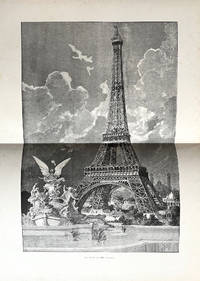
1890réf. 61004Paris: E. Dentu Editeur Libraire de la Societe des Gens de Letteres 1890. Four Vols. Folio. 9.75 x 13 in. xxxi 1 666 2; 4 618 2; 4 670 2; 8 pp unpaginated. with 82 engravings on 70 plates many double-page. Extra-illustrated title page frontispiece in vol. I 100’s of text woodcut-engravings tables diagrams charts decorated head- and tail-pieces decorated initials. Uniformly bound in elaborately decorated gray-lilac-coloured cloth embossed decorative borders in burgundy-colour gilt lettering front covers & spines t.e.g. minor edgewear inner hinges starting in a few places due to weight of the textblock minor wear and slight bumping to corners darkening and more wear to Atlas volume still a VG set. First edition of this nicely printed and weighty set chronicling the fourth great Paris World’s Fair an extraordinary Exposition which refashioned Paris and celebrated the Centennial of the French Revolution and the storming of the Bastille. The Exposition was intended to pull France out of a ruinous recession and attracted over 61000 exhibitors as well as 32 million visitors many of whom came to view the iconic Eiffel Tower and even a profit of 8000000 francs. This lavish production details the development and history of the Exposition the construction of the Eiffel Tower as well as the development of the sites along the Seine. The companion album includes 82 woodcut-engraved images executed by such artists as Baude Baulenaz and Hauger many of them from original photographs shot by Messiers J. Levy et Cie. Levy had also shot photographs for the 1867 Paris L’Exposition Universelle and his photos captured many views of the exhibition grounds and buildings and focused on many in the Javanese Tonkin and Streets of Cairo attractions. E. Dentu, Editeur, Libraire de la Societe des Gens de Letteres, hardcover
1915réf. 030333Peking (Beijing) 1915 Panama-Pacific International Exposition (P.P.I.E.) Hardcover 1st Edition
réf. 2459Schemit, Paris, 1927.
réf. Z1-C-048-02324Wellcome Institute for the History of Medicine. Used - Good. Ships from UK in 48 hours or less usually same day. Your purchase helps support Sri Lankan Children's Charity 'The Rainbow Centre'. Ex-library so some stamps and wear but in good overall condition. 100% money back guarantee. We are a world class secondhand bookstore based in Hertfordshire United Kingdom and specialize in high quality textbooks across an enormous variety of subjects. We aim to provide a vast range of textbooks rare and collectible books at a great price. Our donations to The Rainbow Centre have helped provide an education and a safe haven to hundreds of children who live in appalling conditions. We provide a 100% money back guarantee and are dedicated to providing our customers with the highest standards of service in the bookselling industry. Wellcome Institute for the History of Medicine unknown
1867réf. List01217Boston Paris: J.P. Whitney 1867. First Edition Thus. . 8vo publisher’s green cloth 107 pp. Some tearing and fraying to boards particularly at head of spine text block excellent very good minus overall. Very Good. The scarce Paris Universal Exposition edition of J.P. Whitney’s early title on the silver mines of Colorado. Whitney a wealthy sportsman from Boston with investments in Colorado traveled as the sole commissioner from Colorado to the Paris Universal Exposition in an effort to entice foreign investment in the mining industry which was suffering from a poor reputation as the costs of extraction grew higher. Whitney had published this title in pamphlet form a year earlier. Whitney shipped his own collection of Colorado minerals to France where it was the most extensive of any of the North American regions to be displayed receiving a gold medal from Napoleon III. A new title on Colorado minerals Colorado in the United States of America: Schedule of Ores Contributed by Sundry Persons to the Paris Universal Exposition of 1867 With Some Information about the Region and its Resources. Whitney also brought with him copies of his pamphlet in a special hardcover edition which we offer here. This is the second example we find on the market. Whitney would gain great popularity in Colorado for his efforts which did much to improve its standing. J.P. Whitney unknown
1867réf. List01217Boston Paris: J.P. Whitney 1867. First Edition Thus. . 8vo publisher’s green cloth 107 pp. Some tearing and fraying to boards particularly at head of spine text block excellent very good minus overall. Very Good. The scarce Paris Universal Exposition edition of J.P. Whitney’s early title on the silver mines of Colorado. Whitney a wealthy sportsman from Boston with investments in Colorado traveled as the sole commissioner from Colorado to the Paris Universal Exposition in an effort to entice foreign investment in the mining industry which was suffering from a poor reputation as the costs of extraction grew higher. Whitney had published this title in pamphlet form a year earlier. Whitney shipped his own collection of Colorado minerals to France where it was the most extensive of any of the North American regions to be displayed receiving a gold medal from Napoleon III. A new title on Colorado minerals Colorado in the United States of America: Schedule of Ores Contributed by Sundry Persons to the Paris Universal Exposition of 1867 With Some Information about the Region and its Resources. Whitney also brought with him copies of his pamphlet in a special hardcover edition which we offer here. This is the second example we find on the market. Whitney would gain great popularity in Colorado for his efforts which did much to improve its standing. J.P. Whitney unknown books
1854réf. BB120CRYSTAL PALACE aka GREAT EXHIBITION Descriptions of the Egyptian Court erected in the Crystal Palace by Owen Jones and Joseph Bonomi with an historical notice of the monuments of Egypt by Samuel Sharpe 71pp The Greek Court. 113pp An Apology for the Colouring of the Greek Court 56pp The Roman Court ii 86pp The Alhambra Court 119pp The Nineveh Court 80pp The Byzantine and Romanesque Court 116pp The Mediæval Court 123pp The Renaissance Court 108pp The Italian Court 91pp The Pompeian Court 73pp Guide to the Crystal Palace and Park by Samuel Phillips 193pp. London: Bradbury & Evans 1854 the last volume 1856. TWELVE volumes bound as three each of the dozen titles with a colored pictorial printed front wrapper folding frontispiece and profusely illustrated including additional folding plates. 8vo 3/4 leather scuffed marbled boards exterior worn internally near-fine. Individually issued as part of the Crystal Palace Library series rarely does one find such a large collection of these small titles bound together detailing the specific contents of each division. The Crystal Palace was a cast iron and plate glass structure originally built in Hyde Park London to house the Great Exhibition of 1851. After the exhibition the Palace was relocated to an area of South London known as Penge Place which had been excised from Penge Common. It was rebuilt at the top of Penge Peak next to Sydenham Hill an affluent suburb of large villas. It stood there from June 1854 until its destruction by fire in November 1936. The nearby residential area was renamed Crystal Palace after the landmark. The park still contains Benjamin Waterhouse Hawkins's Crystal Palace Dinosaurs which date back to 1854. Bradbury & Evans hardcover
1854réf. BB120CRYSTAL PALACE aka GREAT EXHIBITION Descriptions of the Egyptian Court erected in the Crystal Palace by Owen Jones and Joseph Bonomi with an historical notice of the monuments of Egypt by Samuel Sharpe 71pp The Greek Court. 113pp An Apology for the Colouring of the Greek Court 56pp The Roman Court ii 86pp The Alhambra Court 119pp The Nineveh Court 80pp The Byzantine and Romanesque Court 116pp The Mediæval Court 123pp The Renaissance Court 108pp The Italian Court 91pp The Pompeian Court 73pp Guide to the Crystal Palace and Park by Samuel Phillips 193pp. London: Bradbury & Evans 1854 the last volume 1856. TWELVE volumes bound as three each of the dozen titles with a colored pictorial printed front wrapper folding frontispiece and profusely illustrated including additional folding plates. 8vo 3/4 leather scuffed marbled boards exterior worn internally near-fine. Individually issued as part of the Crystal Palace Library series rarely does one find such a large collection of these small titles bound together detailing the specific contents of each division. The Crystal Palace was a cast iron and plate glass structure originally built in Hyde Park London to house the Great Exhibition of 1851. After the exhibition the Palace was relocated to an area of South London known as Penge Place which had been excised from Penge Common. It was rebuilt at the top of Penge Peak next to Sydenham Hill an affluent suburb of large villas. It stood there from June 1854 until its destruction by fire in November 1936. The nearby residential area was renamed Crystal Palace after the landmark. The park still contains Benjamin Waterhouse Hawkins's Crystal Palace Dinosaurs which date back to 1854. Bradbury & Evans hardcover books
1911Large and elaborate coloured engraved plan measuring approx. 1270mm x 1010mm (50.0 ins x 39.75 ins), folding in 20 panels to approx. 320mm x 210mm (12.5 ins x 8.0 ins); housed in original printed cartridge envelope with self-sealing flap (short tear in flap), A REMARKABLY CLEAN, NEAR FINE COPY. This is an engraved and coloured plan of the Crystal Palace prepared for the intended sale at auction of the buildings and grounds in 1911 (see below). The retaining envelope is printed 'PLAN OF THE CRYSTAL PALACE 1851-1911. Solicitors: Messrs Janson Cobb, Pearson & Company, 22 College Hill, E.C.; Receiver and Manager: Mr. Ernest I Husey (Messrs Jackson, Pixley & Co., Chartered Accountants, 58 Coleman Street, E.C; Auctioneers: Mr. Howard Frank (Messrs Knight, Frank & Rutley), 20 Hanover Sq, London W; and Mr. John Roy Lancaster (Messrs Horne & Co), 85 Gresham Street, E.C.' The plan in well executed and colour-coded to indicate the various leases and tenancies involved. It shows the scale and local context of the magnificent building, together with its world-famous gardens and grounds, including the tiered sculptural terraces, the patios, and the renowned lakes and fountains. Key features such as the Flying Machine, the Maze, Brunel's Polygonal Water Towers, the Lower Lake area housing Waterhouse Hawkins' recreations of dinosaurs (still present today) and the Sports Grounds are clearly highlighted. HISTORICAL CONTEXT. After the Great Exhibition of 1851, the Crystal Palace was re-erected in a considerably enlarged form in 1854 at Sydenham in South London. During the next half century it continued as a major metropolitan tourist attraction attracting visitors from all over the world to marvel at the building, its contents and gardens, and to witness a wide variety of entertainment including music, acrobatics, circuses and fireworks. By the turn of the century, however, the novelty was wearing thin and the number of visitors declined to the point where in 1911 the Palace was declared bankrupt and placed in the hands of a receiver. 'On 28 November it was to be sold by auction, to be offered in one lot as a going concern. This was a fateful period in its history. There was grave danger that it would pass into the hands of the developers. Every jerry builder within striking distance was eager for the moment when he might be in a position to swoop down on the beautiful grounds and reduce them to terms of bricks and mortar. But that ultimate indignity was not to be. The Earl of Plymouth produced £230,000 to buy the Palace as a going concern; at the same time the Lord Mayor of London opened a fund to purchase the Crystal Palace for the nation, and to reimburse Lord Plymouth. This was completed in 1913 and the Crystal Palace was saved.' [A.R. Warwick: The Phoenix Suburb (1972)]. During the Great War the revitalised Palace served as a Royal Naval base (HMS VICTORY VI). At the end of hostilities it became for a short time the home of the Imperial War Museum and then reverted to tourism with exhibitions of early flying, pioneer television, dirt-track racing, music festivals, dog and cat shows, dancing and fireworks. In this way it continued until completely destroyed by the tragic fire of 30 November 1936 - the end of a great era. IT IS UNCERTAIN HOW MANY OF THESE ELABORATE PLANS WERE PRODUCED, BUT THE NUMBER CANNOT HAVE BEEN GREAT. GIVEN THAT £230,000 (VERY APPROXIMATELY £7M BY TODAY'S STANDARDS) WAS REQUIRED TO OBVIATE THE NEED FOR SALE, THE NUMBER OF INTENDING BIDDERS MUST HAVE BEEN FEW INDEED. IN ANY CASE IT IS UNLIKELY THAT MANY COPIES SURVIVE, ESPECIALLY IN THIS VIRTUALLY UNOPENED STATE COMPLETE WITH ORIGINAL ENVELOPE. A DOCUMENT OF CONSIDERABLE SIGNIFICANCE IN THE HISTORY OF SOUTH LONDON, AND A VIVID REMINDER OF ONE OF LONDON'S GREATEST HISTORIC ATTRACTIONS.