9255 risultati
1877rif. 39388Stockholm 1877. Tvær-folio. Samt. halvlæderbind med forgyldt tekst på permer. Med 55 plancher de fleste vandskjoldede. Folio oblong. Contemporary half calf bindig with gilt lettering to boards. With 55 plates depicting the World exhibition of 1876. Most plates with dampstaining. hardcover
1877rif. 39388Stockholm 1877. Tvær-folio. Samt. halvlæderbind med forgyldt tekst på permer. Med 55 plancher, de fleste vandskjoldede. Folio oblong. Contemporary half calf bindig with gilt lettering to boards. With 55 plates depicting the World exhibition of 1876. Most plates with dampstaining.
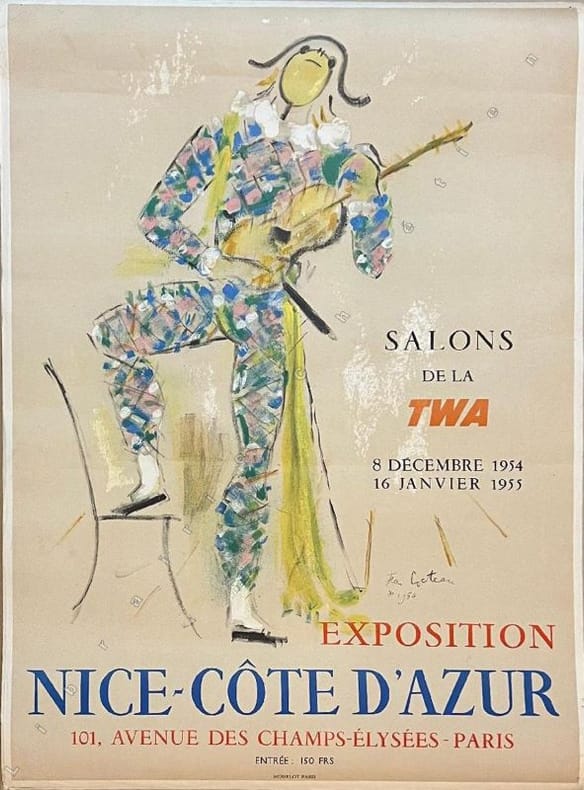
1954rif. 25036Paris Mourlot 1954 Affiche lithographiée signée à droite dans la planche, Paris, Mourlot, 1954, 70 x 50 cm.
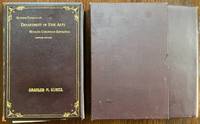
1893rif. 60194Chicago: W.B. Conkey Co. Publishers to the Exposition 1893. Two vols. 8vo. 506; 506 pp. Frontisp. both vols. With maps photo plates. 1st vol. -- Full dark brown morocco over beveled boards gilt ornamented borders gilt lettering & ownership stamp on front cover gilt lettering on spine gilt inner dentelles marbled endpapers t.e.g. minor rubbing edgewear front hinge tender rear hinge just starting very slight uniform interior toning as usual still VG- copy w/ presentation ALS on Conkey private letterhead presenting to Charles M. Kurtz dated Oct. 28th 1893; 2nd vol. -- Full flexible Bible calf dark purple silk moire endpapers gilt lettering stamped front cover & spine a.e.g. w/ dark maroon cloth d.j. backed in dark purple silk moire a F/F presentation copy from Conkey to Kurtz w/ inscription on half-title preserved in open-backed slipcase. First editions thus presentation copies and the second copy with publisher’s note indicating this was No. 91 of 275 Editor’s Deluxe copies signed & presented to Charles McMeen Kurtz 1855-1909 at the time one of Halsey Ives’s Assistants in the Fine Arts Department of the 1893 World’s Columbian Exposition Art Director of the 1894 St. Louis Exposition and later Museum Director at the Buffalo Museum of Art 1905-1909. Conkey writes in the letter for the first volume to Charles Kurtz “I send you herewith a copy of the Catalogue which you may deem to file away as a reminder of many hours spent in order that others might see intelligently the grand work which you with others have done in the Art Department.” Walter Blakesley Conkey had founded the printing house in 1877 occupied many different job printers and in 1890 absorbed the Illinois Printing & Binding Co. and in Jan. 1893 signed the contracts awarding him exclusive rights for printing the myriad of catalogues and handbooks for the Columbian Exposition receiving a deposit of $ 10000. W.B. Conkey Co., Publishers to the Exposition, hardcover
1937rif. 238631937 Pastel signé en haut à gauche, (1937), 50 x 64.6 cm.
1992rif. 278401992 Une gouache originale en couleurs, Format : 62 centimètres de haut par 47,5 centimètres de large, sur papier canson crème, signée à la mine de plomb en bas à droite : JOEL DABIN et en haut à droite : JOEL DABIN 1992, affiche réalisée (pour un Concours organisé en 1992 par le C.I.E.R [Réfectoire et Cellier des Moines de labbaye de Tournus] et l'Ecole des Beaux-Arts de Nantes, 5 rue Fénelon) par Joel DABIN Peintre,
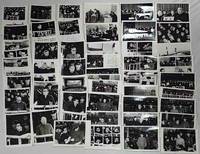
1981rif. 216885Beijing. Circa1981. A complete set of 50 black and white photographs of the trial of the Gang of Four during 1980-81. Images clearly show the judges the courtroom and the accused. In excellent condition each photograph is loosely inserted within an A5 polypropylene sleeve all contained in an archival-grade cardboard box. All images measure approximately 20.5 x 15cm. A fascinating series of photos from the trial of the Gang of Four and the so-called remnants of Lin Biao's Central Cultural Revolution Group including images of the court physical evidence and the accused themselves - including though not limited to Jiang Qing Zhang Chunqiao Wang Hongwen and Yao Wenyuan. Included are photos of the accused - in clearly poorer physical health compared to their peak in 1976 - after having reputedly given emotive vitriolic and stubborn statements to the court. Though Jiang Qing and Zhang Chunqiao appear openly hostile or contemptuous to the court - both in their own unique way - Wang Hongwen Yao Wenyuan and the other defendants appear more subdued and mournful in their demeanour seemingly having resigned themselves to their fate. Of particular note is the inclusion of a single page of images of what appears to be the badly charred and broken corpse of Lin Biao as well as the wreckage of his ill-fated flight. These images were presumably supplied to the court by the KGB who had very controversially handled the investigation at the time of the crash despite it having taken place over and within the territory of the Mongolian People's Republic not the Soviet Union. Perhaps to further affirm the position that the corpse was indeed Lin's a forensic-like comparison is made between an image of the body's skull and his distinctive forehead and brow ridge. . unknown
1862rif. 9027602London: Clay & Lea 1862. Hardcover. Very good. Expertly rebacked with original spine pieces. Gilt titling on spine is still bright. New endpapers. Clay & Lea hardcover
1862rif. 9027602London: Clay & Lea 1862. Hardcover. Very good. Expertly rebacked with original spine pieces. Gilt titling on spine is still bright. New endpapers. Clay & Lea hardcover books
1889rif. 59410Paris: n.p. 1889. 4to. 10.5 x 10.75 in. Six individual puzzles individually postcard sized approx. 3.5 x 4.75 in. w/ colour chromolithograph image dissected onto nine wooden pieces each 1 small piece has been supplied in facsimile for upper corner of the Cairo street puzzle. All contained w/in the original deep red paper-covered wooden box raised bed w/in the box to hold the puzzles lid w/ decorative gilt title lettering minor shelfwear very minor rubbing still a VG nearly complete artifact. Very scarce original souvenir puzzle game issued for the fourth great Paris World’s Fair celebrating through pomp and events the Centennial of the French Revolution and the storming of the Bastille. The Exposition was intended to pull France out of a ruinous recession and attracted over 61000 exhibitors as well as 32 million visitors many of whom came to view the iconic Eiffel Tower. This puzzle celebrates several of the pavilions at the Exposition including Palais des Beaux-Arts designed by Joseph Brouvard filled with painting and flanking the Eiffel Tower providing visitors; the Palais de Trocadero held over from the famed 1878 Exposition celebrating the renewal of Paris following the Franco-Prussian War; as well as the Ministere de la Guerre which featured an Arms & Armour exhibition as well as displays of knightly tournaments assorted uniforms and cannon. The Maison Egyptienne and Rue au Caire would fuel the Orientalist movement and fascination with the Middle East among artists writers and the industrial arts well into the 20th Century. These boxed puzzle games were quite popular souvenirs as well as educational tools in the Belle Epoque and have become remarkably scarce. No copies in Worldcat. n.p., unknown
1851rif. 3220148Lithograph strip panorama consisting of four sheets conjoined measuring 12 x 230 cm overall some light dust-soiling in places; folding into publisher's original boards the upper cover with an illustration of a showman in military attire drumming up an audience for a show consisting of a Punch and Judy-style booth with what appear curiously to be marionettes rather than glove-puppets dancing on the stage spine expertly repaired covers slightly marked but nevertheless still a good example. Rare panorama consisting of 75 captioned vignettes of the people of many nationalities idly wasting time or misbehaving themselves in mostly harmless ways: "A Highland Gentleman practising the Art of Boozing" "John Bull sleeping on the National Debt" "A Hindoo Gentleman enjoying Hookah" "Young Irish Lady doing penance by walking on sharp stones round a well" "A New Zealand Chief polishing the skull of one of his enemies" and so on. It concludes with 'A French Patriot playing Battledoor i.e. battledore & Shuttlecock' the character hitting two crowns and a bonnet-rouge into the air. Although unsigned the artist for the work is clearly Benjamin Clayton 1809-1883 what little we know of him comes mainly from his daughter the writer and artist Ellen Creathorne 1834-1900. Benjamin was born in Dublin but moved his family to London in 1841 hoping to be a history painter however his gifts lay instead with illustration firstly producing his own periodicals gChatg and gPunchinello. A journal of wit wisdom and romanceg but later having to work for other publishers first with Ackermann & Co. and later for Dean and Son. The publisher George Mann at 39 Cornhill together with Dean & Son issued several panoramas at the time of the Great Exhibition the partnership ending with Mann's death in 1852. Dean & Son, Printers. [Published by] G. Mann, Cornhill [London].
1926rif. 181547China: The Commercial Press c. 1926. The Chinese typewriter comes to America A rare surviving example of the brochure issued by China's largest publisher and maker of scientific instruments to accompany its stand at the 1926 Philadelphia Sesqui-Centennial Exposition. Alongside print publications and cutting-edge laboratory equipment the Commercial Press displayed Shu Zhendong's newly invented Chinese typewriter a major advance in the development of modern information technology. The typewriter advertised and pictured on page 56 promises to solve "a serious problem in office administration in China. It is the miraculous achievement of the inventor that although there are 3000 characters in the font yet a typist after the practice of one or two weeks will be able to locate any character instantly." Online records show copies in the City of Philadelphia archives and six other institutions all in the US Library of Congress the Smithsonian Peabody Essex Temple Californian State University Los Angeles and University of Delaware. Octavo. Folding organization chart illustrations some colour in text; text printed within red borders. Original brown silk wrappers purple xianzhuang stitching spine ends capped with blue silk front cover blocked in gilt. Spine ends rubbed couple of faint stains to covers chart creased where sometime incorrectly refolded: near-fine. unknown
1910rif. 17612Paris, Librairie Aéronautique, 1910 (imprimerie Paul Dupont) ; 127 pp.
1839rif. zy108Paris, chez L. Bouchard-Huzard Relié 1839 RARE. Trois volumes in-8 (14,2 x 22 cm), reliure demi-basane, dos lisses ornés de filets dorés, lv-544, 531 et 568 pages, ces trois tomes comprennent les arts industriels suivants (liste non exhaustive) ; Tome 1 : Tissus (laines et lainages, soies et soieries, fils et tissus de coton, de lin et de chanvre) - Métaux (fonderies, fer, acier, limes, enclumes, outils, plomb, cuivre, chaudronnerie, coutellerie, quincaillerie, marbres, bitumes, stucs, ciment, ardoise, etc.) // Tome 2 : Machines et ustensiles agricoles (machines à élever l'eau, soufflets, appareils de filtrage, outils de sondage, machine pour fabriquer les tissus, grands mécanismes, constructions navales, machines hydrauliques, barrages, chemins de fer et routes, machines-outils, carrosserie, serrurerie, instruments aratoires, semoirs, faux et faucilles, machines à battre, etc.) - Instruments de précision et instruments de musique (horlogerie, pendules, dynamomètres, balances, baromètres, thermomètres, globes terrestres, éclairage, instruments de musique à cordes, archet, vent, cuivres, etc.) // Tome 3 : Beaux-arts (peinture sur verre, fonderie, bronzes d'art, billards, bijouterie, sculpture, orfèvrerie, dorure sur bois, parquets et mosaïques, gravure, imprimerie, typographie, librairie, reliure, lithographie, zincographie, calligraphie, ébénisterie, etc. - Arts céramiques (terre cuite, faïence, porcelaine, verrerie) - Arts divers (peaux et cuirs, papier peint, chapellerie, chaussures, ganterie, sellerie, instruments de chirurgie, gymnastique, dessin, etc.) ; coiffes et coupes frottées, usures du papier reliure aux plats, assez bon état général. Livraison a domicile (La Poste) ou en Mondial Relay sur simple demande.
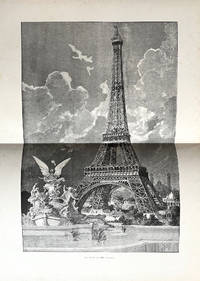
1890rif. 61004Paris: E. Dentu Editeur Libraire de la Societe des Gens de Letteres 1890. Four Vols. Folio. 9.75 x 13 in. xxxi 1 666 2; 4 618 2; 4 670 2; 8 pp unpaginated. with 82 engravings on 70 plates many double-page. Extra-illustrated title page frontispiece in vol. I 100’s of text woodcut-engravings tables diagrams charts decorated head- and tail-pieces decorated initials. Uniformly bound in elaborately decorated gray-lilac-coloured cloth embossed decorative borders in burgundy-colour gilt lettering front covers & spines t.e.g. minor edgewear inner hinges starting in a few places due to weight of the textblock minor wear and slight bumping to corners darkening and more wear to Atlas volume still a VG set. First edition of this nicely printed and weighty set chronicling the fourth great Paris World’s Fair an extraordinary Exposition which refashioned Paris and celebrated the Centennial of the French Revolution and the storming of the Bastille. The Exposition was intended to pull France out of a ruinous recession and attracted over 61000 exhibitors as well as 32 million visitors many of whom came to view the iconic Eiffel Tower and even a profit of 8000000 francs. This lavish production details the development and history of the Exposition the construction of the Eiffel Tower as well as the development of the sites along the Seine. The companion album includes 82 woodcut-engraved images executed by such artists as Baude Baulenaz and Hauger many of them from original photographs shot by Messiers J. Levy et Cie. Levy had also shot photographs for the 1867 Paris L’Exposition Universelle and his photos captured many views of the exhibition grounds and buildings and focused on many in the Javanese Tonkin and Streets of Cairo attractions. E. Dentu, Editeur, Libraire de la Societe des Gens de Letteres, hardcover
1915rif. 030333Peking (Beijing) 1915 Panama-Pacific International Exposition (P.P.I.E.) Hardcover 1st Edition
rif. 2459Schemit, Paris, 1927.
rif. Z1-C-048-02324Wellcome Institute for the History of Medicine. Used - Good. Ships from UK in 48 hours or less usually same day. Your purchase helps support Sri Lankan Children's Charity 'The Rainbow Centre'. Ex-library so some stamps and wear but in good overall condition. 100% money back guarantee. We are a world class secondhand bookstore based in Hertfordshire United Kingdom and specialize in high quality textbooks across an enormous variety of subjects. We aim to provide a vast range of textbooks rare and collectible books at a great price. Our donations to The Rainbow Centre have helped provide an education and a safe haven to hundreds of children who live in appalling conditions. We provide a 100% money back guarantee and are dedicated to providing our customers with the highest standards of service in the bookselling industry. Wellcome Institute for the History of Medicine unknown
1867rif. List01217Boston Paris: J.P. Whitney 1867. First Edition Thus. . 8vo publisher’s green cloth 107 pp. Some tearing and fraying to boards particularly at head of spine text block excellent very good minus overall. Very Good. The scarce Paris Universal Exposition edition of J.P. Whitney’s early title on the silver mines of Colorado. Whitney a wealthy sportsman from Boston with investments in Colorado traveled as the sole commissioner from Colorado to the Paris Universal Exposition in an effort to entice foreign investment in the mining industry which was suffering from a poor reputation as the costs of extraction grew higher. Whitney had published this title in pamphlet form a year earlier. Whitney shipped his own collection of Colorado minerals to France where it was the most extensive of any of the North American regions to be displayed receiving a gold medal from Napoleon III. A new title on Colorado minerals Colorado in the United States of America: Schedule of Ores Contributed by Sundry Persons to the Paris Universal Exposition of 1867 With Some Information about the Region and its Resources. Whitney also brought with him copies of his pamphlet in a special hardcover edition which we offer here. This is the second example we find on the market. Whitney would gain great popularity in Colorado for his efforts which did much to improve its standing. J.P. Whitney unknown
1867rif. List01217Boston Paris: J.P. Whitney 1867. First Edition Thus. . 8vo publisher’s green cloth 107 pp. Some tearing and fraying to boards particularly at head of spine text block excellent very good minus overall. Very Good. The scarce Paris Universal Exposition edition of J.P. Whitney’s early title on the silver mines of Colorado. Whitney a wealthy sportsman from Boston with investments in Colorado traveled as the sole commissioner from Colorado to the Paris Universal Exposition in an effort to entice foreign investment in the mining industry which was suffering from a poor reputation as the costs of extraction grew higher. Whitney had published this title in pamphlet form a year earlier. Whitney shipped his own collection of Colorado minerals to France where it was the most extensive of any of the North American regions to be displayed receiving a gold medal from Napoleon III. A new title on Colorado minerals Colorado in the United States of America: Schedule of Ores Contributed by Sundry Persons to the Paris Universal Exposition of 1867 With Some Information about the Region and its Resources. Whitney also brought with him copies of his pamphlet in a special hardcover edition which we offer here. This is the second example we find on the market. Whitney would gain great popularity in Colorado for his efforts which did much to improve its standing. J.P. Whitney unknown books
1893rif. 60192Chicago IL: C.D. Arnold World’s Columbian Exposition Department of Photography 1893. Oblong 4to. Seventeen albumen photographs mounted sized from 7 x 8 up to 7 x 8.5 in. on 9.5 x 8 in. printed studio board photographer’s imprint w/in negative of image and lower corners of board titles imprinted at lower blank board of each image Columbian Exposition medal stamped on versos minor edgewear slight rubbing very minor over-exposure on a few images still a VG bright set of original images. A group of very scarce mounted souvenir albumen photographs shot at the World’s Columbian Exposition in 1893 when patrons carrying small Kodak cameras were required to pay $ 2.00 license fee to bring a camera onto the grounds and no cameras or tripods able to shoot larger than 4 x 5 in. images were allowed. Most visitors bought the printed photo album versions wealthier ones would buy entire souvenir photo albums filled with Arnold images and yet others could buy them as individual mounted shots depicting their favorite or preferred venues. The 1893 Chicago World’s Fair ran almost six months featured grounds and gardens laid out by Fredrick Olmsted covering 630 acres and a Midway skyline dominated by the 250-foot Ferris wheel designed by George Ferris which could carry 2160 patrons when fully loaded. The “On the Midway” photo shows the Ferris wheel still under construction which much of the structure still clad in scaffolding. Others depict throngs of visitors individual exhibits and some Buildings just newly finished such as the U.S. Government Building featuring scaffolding off to the side for future installation to be completed. Arnold 1844-1927 was prior to the Fair an obscure Buffalo NY photographer who had been initially contracted to photograph the construction of the 1893 World’s Fair but proved to be an excellent architectural photographer so so became the Chief of the Fair’s Dept. of Photography. See; Thomas Yanul Charles Dudley Arnold Photographer 1844-1927 Official Photographer Chicago Columbian & Pan-American Expositions 2001. C.D. Arnold, [World’s Columbian Exposition, Department of Photography], unknown
1854rif. BB120CRYSTAL PALACE aka GREAT EXHIBITION Descriptions of the Egyptian Court erected in the Crystal Palace by Owen Jones and Joseph Bonomi with an historical notice of the monuments of Egypt by Samuel Sharpe 71pp The Greek Court. 113pp An Apology for the Colouring of the Greek Court 56pp The Roman Court ii 86pp The Alhambra Court 119pp The Nineveh Court 80pp The Byzantine and Romanesque Court 116pp The Mediæval Court 123pp The Renaissance Court 108pp The Italian Court 91pp The Pompeian Court 73pp Guide to the Crystal Palace and Park by Samuel Phillips 193pp. London: Bradbury & Evans 1854 the last volume 1856. TWELVE volumes bound as three each of the dozen titles with a colored pictorial printed front wrapper folding frontispiece and profusely illustrated including additional folding plates. 8vo 3/4 leather scuffed marbled boards exterior worn internally near-fine. Individually issued as part of the Crystal Palace Library series rarely does one find such a large collection of these small titles bound together detailing the specific contents of each division. The Crystal Palace was a cast iron and plate glass structure originally built in Hyde Park London to house the Great Exhibition of 1851. After the exhibition the Palace was relocated to an area of South London known as Penge Place which had been excised from Penge Common. It was rebuilt at the top of Penge Peak next to Sydenham Hill an affluent suburb of large villas. It stood there from June 1854 until its destruction by fire in November 1936. The nearby residential area was renamed Crystal Palace after the landmark. The park still contains Benjamin Waterhouse Hawkins's Crystal Palace Dinosaurs which date back to 1854. Bradbury & Evans hardcover
1854rif. BB120CRYSTAL PALACE aka GREAT EXHIBITION Descriptions of the Egyptian Court erected in the Crystal Palace by Owen Jones and Joseph Bonomi with an historical notice of the monuments of Egypt by Samuel Sharpe 71pp The Greek Court. 113pp An Apology for the Colouring of the Greek Court 56pp The Roman Court ii 86pp The Alhambra Court 119pp The Nineveh Court 80pp The Byzantine and Romanesque Court 116pp The Mediæval Court 123pp The Renaissance Court 108pp The Italian Court 91pp The Pompeian Court 73pp Guide to the Crystal Palace and Park by Samuel Phillips 193pp. London: Bradbury & Evans 1854 the last volume 1856. TWELVE volumes bound as three each of the dozen titles with a colored pictorial printed front wrapper folding frontispiece and profusely illustrated including additional folding plates. 8vo 3/4 leather scuffed marbled boards exterior worn internally near-fine. Individually issued as part of the Crystal Palace Library series rarely does one find such a large collection of these small titles bound together detailing the specific contents of each division. The Crystal Palace was a cast iron and plate glass structure originally built in Hyde Park London to house the Great Exhibition of 1851. After the exhibition the Palace was relocated to an area of South London known as Penge Place which had been excised from Penge Common. It was rebuilt at the top of Penge Peak next to Sydenham Hill an affluent suburb of large villas. It stood there from June 1854 until its destruction by fire in November 1936. The nearby residential area was renamed Crystal Palace after the landmark. The park still contains Benjamin Waterhouse Hawkins's Crystal Palace Dinosaurs which date back to 1854. Bradbury & Evans hardcover books
1911Large and elaborate coloured engraved plan measuring approx. 1270mm x 1010mm (50.0 ins x 39.75 ins), folding in 20 panels to approx. 320mm x 210mm (12.5 ins x 8.0 ins); housed in original printed cartridge envelope with self-sealing flap (short tear in flap), A REMARKABLY CLEAN, NEAR FINE COPY. This is an engraved and coloured plan of the Crystal Palace prepared for the intended sale at auction of the buildings and grounds in 1911 (see below). The retaining envelope is printed 'PLAN OF THE CRYSTAL PALACE 1851-1911. Solicitors: Messrs Janson Cobb, Pearson & Company, 22 College Hill, E.C.; Receiver and Manager: Mr. Ernest I Husey (Messrs Jackson, Pixley & Co., Chartered Accountants, 58 Coleman Street, E.C; Auctioneers: Mr. Howard Frank (Messrs Knight, Frank & Rutley), 20 Hanover Sq, London W; and Mr. John Roy Lancaster (Messrs Horne & Co), 85 Gresham Street, E.C.' The plan in well executed and colour-coded to indicate the various leases and tenancies involved. It shows the scale and local context of the magnificent building, together with its world-famous gardens and grounds, including the tiered sculptural terraces, the patios, and the renowned lakes and fountains. Key features such as the Flying Machine, the Maze, Brunel's Polygonal Water Towers, the Lower Lake area housing Waterhouse Hawkins' recreations of dinosaurs (still present today) and the Sports Grounds are clearly highlighted. HISTORICAL CONTEXT. After the Great Exhibition of 1851, the Crystal Palace was re-erected in a considerably enlarged form in 1854 at Sydenham in South London. During the next half century it continued as a major metropolitan tourist attraction attracting visitors from all over the world to marvel at the building, its contents and gardens, and to witness a wide variety of entertainment including music, acrobatics, circuses and fireworks. By the turn of the century, however, the novelty was wearing thin and the number of visitors declined to the point where in 1911 the Palace was declared bankrupt and placed in the hands of a receiver. 'On 28 November it was to be sold by auction, to be offered in one lot as a going concern. This was a fateful period in its history. There was grave danger that it would pass into the hands of the developers. Every jerry builder within striking distance was eager for the moment when he might be in a position to swoop down on the beautiful grounds and reduce them to terms of bricks and mortar. But that ultimate indignity was not to be. The Earl of Plymouth produced £230,000 to buy the Palace as a going concern; at the same time the Lord Mayor of London opened a fund to purchase the Crystal Palace for the nation, and to reimburse Lord Plymouth. This was completed in 1913 and the Crystal Palace was saved.' [A.R. Warwick: The Phoenix Suburb (1972)]. During the Great War the revitalised Palace served as a Royal Naval base (HMS VICTORY VI). At the end of hostilities it became for a short time the home of the Imperial War Museum and then reverted to tourism with exhibitions of early flying, pioneer television, dirt-track racing, music festivals, dog and cat shows, dancing and fireworks. In this way it continued until completely destroyed by the tragic fire of 30 November 1936 - the end of a great era. IT IS UNCERTAIN HOW MANY OF THESE ELABORATE PLANS WERE PRODUCED, BUT THE NUMBER CANNOT HAVE BEEN GREAT. GIVEN THAT £230,000 (VERY APPROXIMATELY £7M BY TODAY'S STANDARDS) WAS REQUIRED TO OBVIATE THE NEED FOR SALE, THE NUMBER OF INTENDING BIDDERS MUST HAVE BEEN FEW INDEED. IN ANY CASE IT IS UNLIKELY THAT MANY COPIES SURVIVE, ESPECIALLY IN THIS VIRTUALLY UNOPENED STATE COMPLETE WITH ORIGINAL ENVELOPE. A DOCUMENT OF CONSIDERABLE SIGNIFICANCE IN THE HISTORY OF SOUTH LONDON, AND A VIVID REMINDER OF ONE OF LONDON'S GREATEST HISTORIC ATTRACTIONS.
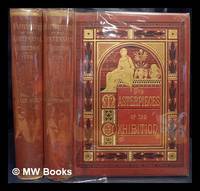
1876rif. 483970Philadelphia : Gebbie & Barrie 1876-1878. First Edition. Hardcover. Very good copies in the original gilt-blocked cloth all edges gilt. Spine bands and panel edges slightly dust-toned and rubbed as with age. Remain particularly well-preserved overall. Physical description: 2 volumes : illustrations. Contents: v. 1. Fine art / Edward Strahan -- v. 2. Industrial art / Walter Smith. Subjects: Centennial Exhibition 1876 : Philadelphia Pa. Art Modern 19th century ; Exhibitions. Decoration and ornament ; Exhibitions. Exhibitions Pennsylvania Philadelphia. Art Modern 19th century. Philadelphia : Gebbie & Barrie hardcover