1.660 Ergebnisse
Best.-Nr. DADAX0415655943New unknown
Best.-Nr. DADAX1138088684New unknown
Best.-Nr. DADAX0415603420New unknown
Best.-Nr. DADAX0415697476New unknown
Best.-Nr. DADAX1138346977New unknown
Best.-Nr. DADAX041548670XNew unknown
1877Best.-Nr. 0011261877 Lyon, N. Scheuring, 1877. In-8 (150 X 217 mm) demi-maroquin rouge à coins, dos cinq nerfs filetés, titre doré, caissons richement ornés, date en queue, tête dorée, double filet doré sur les plats (reliure de l'époque) ; VIII-384 pages.
Best.-Nr. DADAX0367368900New unknown
Best.-Nr. DADAX0367198169New unknown
Best.-Nr. DADAX0367315904New unknown
Best.-Nr. DADAX0415782902New unknown
Best.-Nr. DADAX0415899079New unknown
Best.-Nr. DADAX0415593115New unknown
Best.-Nr. DADAX1409468542New unknown
Best.-Nr. AQ22324Newcastle: W. Fordyce Printer s.d. c. 1820s Single leaf broadside edges uncut. A trifle creased and browned. An apparently unrecorded late Georgian playbill advertising three evenings of entertainment provided by a travelling troupe of actors in or around Newcastle including a performance of Church of Scotland minister John Home's 1722-1808 drama in blank verse Douglas. The play first performed in Edinburgh on 14th December 1756 found overwhelming approval with the general public despite having been rejected in London by actor and theatre manager David Garrick over concerns of taste. Not all found fault however Scottish philosopher David Hume said of Home; 'you possess the true theatric genius of Shakespeare and Otway refined from the unhappy barbarism of the one and the licentiousness of the other'. . Dimensions 150 x 230 mm. W. Fordyce, Printer, [s.d., c. 1820s] unknown
Best.-Nr. 21935Oblong 8 x 10 photograph GREAT CONDITION SIGNATURES GUARANTEED AUTHENTIC. Signed by Author. Unbound.
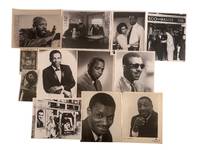
1940Best.-Nr. 225431940. Archive of African American entertainer photographs circa 1940s to 1970s documents the publicity performance and social spaces through which Black artists gained national visibility across film soul music jazz theater nightclub entertainment and stand-up comedy. Identified subjects include Isaac Hayes Harry Belafonte Sidney Poitier Dick Gregory Moses Gunn and John Marriott performers whose careers collectively illuminate the expanding but still restricted opportunities available to African Americans in twentieth-century entertainment. The group moves between controlled studio portraits motion-picture stills live-performance images and candid street photography showing how Black public identity was constructed both through commercial publicity and within community institutions. The survival of agency stamps press captions credits and editorial crop marks further documents how such photographs circulated through newspapers magazines studios and publicity departments; comparable institutional collections preserve these markings as evidence of publication and public-relations use. Twelve original silver gelatin photographs and halftone publicity prints circa 1940s to 1970s in various sizes the majority approximately 8 by 10 inches. Several bear photographer or agency stamps typed press captions printed credits or editorial markings on the versos or margins. Principal images include a tightly cropped portrait of Isaac Hayes with a caption identifying him as "composer singer actor black Moses of soul"; a film still of Harry Belafonte in a tense scene from the 1959 noir Odds Against Tomorrow; and Sidney Poitier embracing Barbara McNair in They Call Me Mister Tibbs! released in 1970. AFI records Belafonte's film as a November 1959 drama and Poitier's sequel as a July 1970 release filmed in San Francisco and Los Angeles. Additional portraits show comedian and civil-rights activist Dick Gregory; stage and screen actor Moses Gunn associated with the Negro Ensemble Company and Shaft; and veteran actor John Marriott. The unidentified material broadens the archive beyond established celebrity: a tuxedoed singer poses in a nightclub or theatrical setting; a well-dressed man stands before a facade displaying posters for entertainers identified as Kit Kara and Rio; two men shake hands beneath the marquee of Harlem's Savoy Ballroom; and smaller prints show a saxophonist performing and an image of a lobby card advertising comedian "Hot Ashes." The Savoy image is especially significant as a street-level record of a Harlem venue closely associated with Black social dance and jazz performance. Together the photographs trace several routes through which African American performers entered public view: Hayes through the assertive visual language of 1970s soul; Belafonte and Poitier through films that placed Black actors within politically charged dramatic narratives; Gregory through the union of comedy and civil-rights activism; and Gunn and Marriott through sustained stage and character work. The unidentified singer saxophonist theater facade and Savoy Ballroom scene preserve the broader entertainment culture surrounding nationally recognized artists preventing the archive from reducing Black performance history to celebrity alone. Light handling wear scattered corner creases and press crop marks; captions stamps credits and principal images remain legible and well preserved. Very good. A varied visual record connecting African American celebrity publicity with the theaters clubs films and performance networks that sustained Black entertainment across four decades. unknown
1940Best.-Nr. 225431940. Archive of African American entertainer photographs circa 1940s to 1970s documents the publicity performance and social spaces through which Black artists gained national visibility across film soul music jazz theater nightclub entertainment and stand-up comedy. Identified subjects include Isaac Hayes Harry Belafonte Sidney Poitier Dick Gregory Moses Gunn and John Marriott performers whose careers collectively illuminate the expanding but still restricted opportunities available to African Americans in twentieth-century entertainment. The group moves between controlled studio portraits motion-picture stills live-performance images and candid street photography showing how Black public identity was constructed both through commercial publicity and within community institutions. The survival of agency stamps press captions credits and editorial crop marks further documents how such photographs circulated through newspapers magazines studios and publicity departments; comparable institutional collections preserve these markings as evidence of publication and public-relations use. Twelve original silver gelatin photographs and halftone publicity prints circa 1940s to 1970s in various sizes the majority approximately 8 by 10 inches. Several bear photographer or agency stamps typed press captions printed credits or editorial markings on the versos or margins. Principal images include a tightly cropped portrait of Isaac Hayes with a caption identifying him as "composer singer actor black Moses of soul"; a film still of Harry Belafonte in a tense scene from the 1959 noir Odds Against Tomorrow; and Sidney Poitier embracing Barbara McNair in They Call Me Mister Tibbs! released in 1970. AFI records Belafonte's film as a November 1959 drama and Poitier's sequel as a July 1970 release filmed in San Francisco and Los Angeles. Additional portraits show comedian and civil-rights activist Dick Gregory; stage and screen actor Moses Gunn associated with the Negro Ensemble Company and Shaft; and veteran actor John Marriott. The unidentified material broadens the archive beyond established celebrity: a tuxedoed singer poses in a nightclub or theatrical setting; a well-dressed man stands before a facade displaying posters for entertainers identified as Kit Kara and Rio; two men shake hands beneath the marquee of Harlem's Savoy Ballroom; and smaller prints show a saxophonist performing and an image of a lobby card advertising comedian "Hot Ashes." The Savoy image is especially significant as a street-level record of a Harlem venue closely associated with Black social dance and jazz performance. Together the photographs trace several routes through which African American performers entered public view: Hayes through the assertive visual language of 1970s soul; Belafonte and Poitier through films that placed Black actors within politically charged dramatic narratives; Gregory through the union of comedy and civil-rights activism; and Gunn and Marriott through sustained stage and character work. The unidentified singer saxophonist theater facade and Savoy Ballroom scene preserve the broader entertainment culture surrounding nationally recognized artists preventing the archive from reducing Black performance history to celebrity alone. Light handling wear scattered corner creases and press crop marks; captions stamps credits and principal images remain legible and well preserved. Very good. A varied visual record connecting African American celebrity publicity with the theaters clubs films and performance networks that sustained Black entertainment across four decades. unknown books
Best.-Nr. DADAX1138754315New unknown
Best.-Nr. DADAX1138754358New unknown
Best.-Nr. DADAX1138754323New unknown
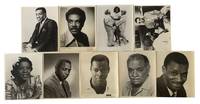
1960Best.-Nr. 224801960. African America Film and Entertainment Photo Archive of Black Entertainers Musicians Actors & Comedy Figures 1950s-1970s including Otis Redding Dinah Washington and Brock Peters. An archive of 9 original gelatin silver and glossy studio prints black and white measuring 10" x 8". Produced for press and promotional use in the United States during the mid 20th century. This archive comprises promotional portraits of major and lesser known Black entertainers. Multiple framed headshots feature blues and soul music legends Otis Redding and Dinah Washington as well as veteran character actors Brock Peters Moses Gunn John Marriott Thomas Anderson and gospel composer Howard A. Roberts. Additional images include a staged comedy scene produced by Laff Records featuring two older Black men in comedic poses surrounding a man in drag and a candid interview style photo of an unidentified Black entertainer at a desk with rotary telephone. Otis Redding and Dinah Washington headshots capture their poised midcentury publicity style: Washington smiles hair pinned with flower and pearls exuding jazz elegance; Redding presents a three quarter confident gaze in a dark suit. Otis Redding and Dinah Washington were among the most influential African American vocalists of the mid-20th century each achieving extraordinary success in a tragically abbreviated career. Redding hailed as the "King of Soul" became a defining figure of Southern soul with hits like "These Arms of Mine" and "Sittin' On The Dock of the Bay" the latter recorded just days before his death in a 1967 plane crash at the age of 26. His electrifying performance at the Monterey Pop Festival expanded his appeal beyond Black audiences and cemented his place in American music history. Washington known as the "Queen of the Blues" and "Queen of the Jukeboxes" crossed genres from gospel to jazz to pop with chart-topping hits in the 1950s earning a Grammy Award and influencing generations of vocalists with her dramatic phrasing and interpretive command. She died of an accidental overdose in 1963 at just 39 years old. Though their styles differed-Redding's raw emotive soul contrasting with Washington's polished versatility-their shared legacies lie in the groundbreaking commercial and artistic success they achieved in a racially segregated industry and in the profound cultural loss their premature deaths represented. The archive also includes studio portraits of lesser-known but notable Black figures: Brock Peters who achieved both stage and screen fame including pivotal roles addressing race in American culture; Moses Gunn a prominent character actor and Shakespearean performer; John Marriott and Thomas Anderson performers whose careers bridged regional theatre and early television. These studio shots display Peters with contemplative expression; Gunn looking directly toward the camera with intensity; Roberts identified by "Howard Roberts" printed beneath his image alongside performing arts agency credit; Thomas Anderson and John Marriott similarly styled in classic studio poses. The Laff Records comedic photograph shows two older men flanking a man in drag. Laff Records was an LA-based imprint which produced raunchy comedy records by Black comic icons such as Richard Pryor and Redd Foxx and was a vital platform which elevated subversive Black expression in a time of segregation and censorship. The final print shows a Black man at a desk holding a telephone receiver-a press snapshot suggestive of an interview or managerial context. Minor toning to margins on two prints; small creases at corners of three; image clarity remains strong; agency or studio credits legible. Overall very good condition. unknown
1960Best.-Nr. 224801960. African America Film and Entertainment Photo Archive of Black Entertainers Musicians Actors & Comedy Figures 1950s-1970s including Otis Redding Dinah Washington and Brock Peters. An archive of 9 original gelatin silver and glossy studio prints black and white measuring 10" x 8". Produced for press and promotional use in the United States during the mid 20th century. This archive comprises promotional portraits of major and lesser known Black entertainers. Multiple framed headshots feature blues and soul music legends Otis Redding and Dinah Washington as well as veteran character actors Brock Peters Moses Gunn John Marriott Thomas Anderson and gospel composer Howard A. Roberts. Additional images include a staged comedy scene produced by Laff Records featuring two older Black men in comedic poses surrounding a man in drag and a candid interview style photo of an unidentified Black entertainer at a desk with rotary telephone. Otis Redding and Dinah Washington headshots capture their poised midcentury publicity style: Washington smiles hair pinned with flower and pearls exuding jazz elegance; Redding presents a three quarter confident gaze in a dark suit. Otis Redding and Dinah Washington were among the most influential African American vocalists of the mid-20th century each achieving extraordinary success in a tragically abbreviated career. Redding hailed as the "King of Soul" became a defining figure of Southern soul with hits like "These Arms of Mine" and "Sittin' On The Dock of the Bay" the latter recorded just days before his death in a 1967 plane crash at the age of 26. His electrifying performance at the Monterey Pop Festival expanded his appeal beyond Black audiences and cemented his place in American music history. Washington known as the "Queen of the Blues" and "Queen of the Jukeboxes" crossed genres from gospel to jazz to pop with chart-topping hits in the 1950s earning a Grammy Award and influencing generations of vocalists with her dramatic phrasing and interpretive command. She died of an accidental overdose in 1963 at just 39 years old. Though their styles differed-Redding's raw emotive soul contrasting with Washington's polished versatility-their shared legacies lie in the groundbreaking commercial and artistic success they achieved in a racially segregated industry and in the profound cultural loss their premature deaths represented. The archive also includes studio portraits of lesser-known but notable Black figures: Brock Peters who achieved both stage and screen fame including pivotal roles addressing race in American culture; Moses Gunn a prominent character actor and Shakespearean performer; John Marriott and Thomas Anderson performers whose careers bridged regional theatre and early television. These studio shots display Peters with contemplative expression; Gunn looking directly toward the camera with intensity; Roberts identified by "Howard Roberts" printed beneath his image alongside performing arts agency credit; Thomas Anderson and John Marriott similarly styled in classic studio poses. The Laff Records comedic photograph shows two older men flanking a man in drag. Laff Records was an LA-based imprint which produced raunchy comedy records by Black comic icons such as Richard Pryor and Redd Foxx and was a vital platform which elevated subversive Black expression in a time of segregation and censorship. The final print shows a Black man at a desk holding a telephone receiver-a press snapshot suggestive of an interview or managerial context. Minor toning to margins on two prints; small creases at corners of three; image clarity remains strong; agency or studio credits legible. Overall very good condition. unknown books
Best.-Nr. DADAX0367368811New unknown
Best.-Nr. DADAX0367894556New unknown