Bartholomaeus Anhorn von Hartwiss & Johannes TonjolaLivre Rare Book

2 results
1674ref. GEJ-2Basel, Getrukt bey Johann Heinrich Meyer, 1674. In-8. Latin & German text. 1 volume complete itself. 1107 p. Colation complete. First edition of kind of warning against sorcery by the XVII c. Swiss Protestant pastor Bartholomäus Anhorn. Contains chapters on dreams, palmistry, duelling, witches, alchemy, and charming. Very rare book including an introductory eulogy by Johannes Tonjola. Internal condition: original gold ornamented brown calf binding. Rubbed, bumped, with minor defects on the spine with missing the closure ribbons. Title page and engraved title printed in black. Slightly browned due to paper, dampstained in places and few corners bent with XIX c. unknown bookplate on the endpaper. Red paper edges. Rare first edition. Bibliography: VD17 3:600284P. Graesse, BMP, 51. Goedeke III, 241, 22. Por. Faber du Faur 1265 and Jantz 378. Hayn-Gotendorf III, 172. USTC 6144407. Faber du Faur 1265: "Anhorn believed in devils and witchery, but advocated caution as regards such phenomena as the bleeding of corpses in the presence of their murderers, and thought that no one should be imprisoned and questioned under torture on such kind of evidence alone". Jantz 378: "A partially critical survey of occult phenomena and popular superstitions". Provenance: Unknown, probably XIX c. coat of arms bookplate on the first endpaper.
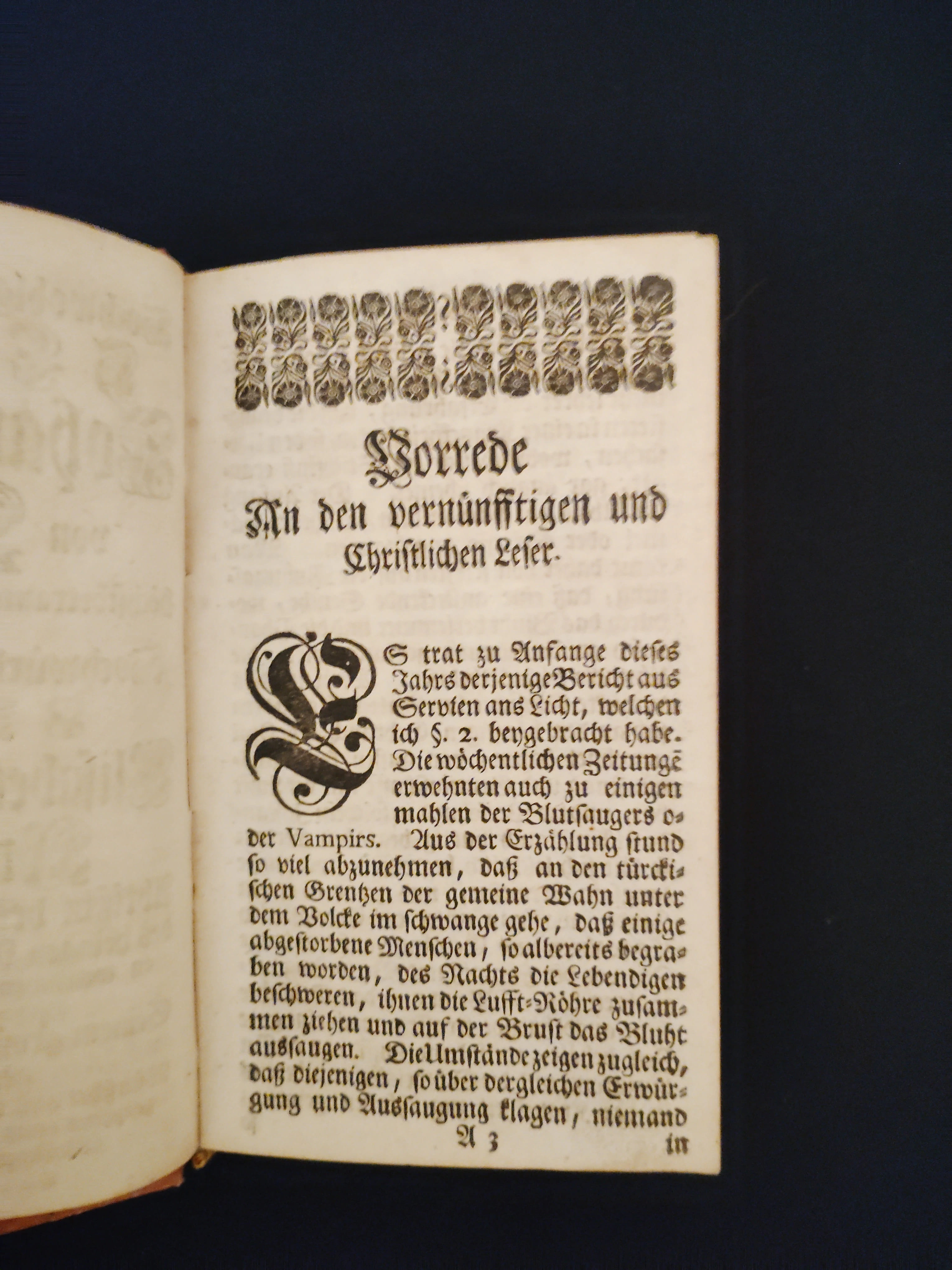
1733ref. GEJ-16Wolffenbüttel [Wolfenbüttel]: Zu finden bey Johann Christoph Meißner, 1733. In-8, 136 pp., [4] leaves (Register). Small octavo (17 x 10 cm). Contemporary red cardboard binding, incorporating the original paper wrapper. Covering material stained. Paper greyed. Interior minimally rubbed and bumped, slightly stained and dusty. 1st and only edition, Extremely Scarce!!! First edition of this exceptionally and unique rare and foundational text-monument of early European vampirology, published at the absolute zenith of the 18th-century "Vampire Controversy" (Vampyrstreit). This seminal octavo volume comprising the one-color title page in black, 136 pages of gothic Fraktur text, and the final index leaves, stands as one of the most critical contemporary intellectual responses to the vampire panic that swept Central and Southeastern Europe. The hysteria, which gripped the public imagination following the official Habsburg military and medical reports from the Serbian borders—most notably the grim exhumations related to Peter Plogojowitz in 1725 and Arnold Paole in 1732—effectively introduced the Slavic concept and the very word "vampire" into the lexicon of Western European Enlightenment discourse. The author, Johann Christoph Harenberg (1696–1774), an eminent German theologian, historian, and school rector, approaches this terrifying contemporary phenomenon with a sophisticated blend of early scientific rationalism and Protestant orthodoxy. While providing his readers with highly detailed, sensational, and meticulously recorded case studies of alleged vampiric attacks and ritualistic desecrations of corpses along the volatile Ottoman-Serbian frontiers ("Gräntzen des Servien-Landes"), Harenberg systematically deconstructs the supernatural myths surrounding them. He fiercely rejects the physical reality of the animated dead, brilliantly diagnosing the epidemic not as a literal threat, but as a "disease of the imagination" (Phantastische Seuche). He argues that the perceived visitations are the tragic products of mass psychological trauma, rural ignorance, premature burials, and the natural, misunderstood processes of bodily decomposition. Furthermore, from a theological standpoint, Harenberg maintains that God would never permit the souls of the deceased to return to the mortal realm for such grotesque purposes, attributing the sightings to demonic illusions or sheer human sensory deception. Preceding Dom Augustin Calmet’s celebrated and widely translated phantom treatise by more than a decade, Harenberg’s work represents a vital, transitional milestone bridging the late-baroque fascination with the occult and the burgeoning skepticism of the Age of Reason. Recorded in the German national bibliography under VD18, this remains a highly coveted, profoundly influential masterwork for specialized collections focusing on the history of magic, early medicine, folklore, and the European Enlightenment. An item of legendary rarity on the open market, this 1733 first edition represents an exceptional, census-proven acquisition opportunity for the discerning collector of early occult and Enlightenment literature. According to worldwide institutional databases and international library union catalogs (including WorldCat and the Karlsruhe Virtual Catalog / KVK), fewer than 12 institutional copies of the physical 1733 original printing are recorded globally, with the vast majority permanently secured within key European state repositories such as the Bayerische Staatsbibliothek in Munich, the Herzog August Bibliothek in Wolfenbüttel, and the Universitätsbibliothek Göttingen. The vast majority of library search results for this title point strictly to modern digital facsimiles, microform copies, or late 20th-century reprints, masking the true, extreme scarcity of the physical artifact. Since virtually all known original copies are institutionalized and perpetually removed from commerce, public auction appearances of this seminal vampire tract are virtually non-existent. A profoundly elusive work of early Vampyrologia, this piece stands as an ultimate desideratum that has historically escaped even the most exhaustive collections of early horror and paranormal history. Bibliographie: VD18 14205289; OCLC/WorldCat: 257577536 / 934812328; Hamberger-Meusel: III, 75; Summer, Montague: The Vampire: His Kith and Kin (London, 1928) – Cited as one of the critical early German works addressing the Serbian vampire epidemics of 1725–1732; Hock, Stefan: Die Vampyrsagen und ihre Verwertung in der deutschen Literatur (Berlin, 1900), p. 34; Not in Caillet; Graesse [Grasse]: Bibliotheca Magica et Pneumatica (1843), p. 125; Not in USTC; Cornell Library: Witchcraft BF1556 .H27. Provenance: Antiquariat Peter Fritzen, January 2018, No. 93., Librairie ancienne LIRI, 2025. Since 1990 only one auction record (2004, Falk & Falk, 12, no. 20). This copy has no owners annotations (ex-libris, marks, stamps, handwritten notes).