Giovanni Francesco PICO DELLA MIRANDOLALivre Rare Book
8 313 résultats
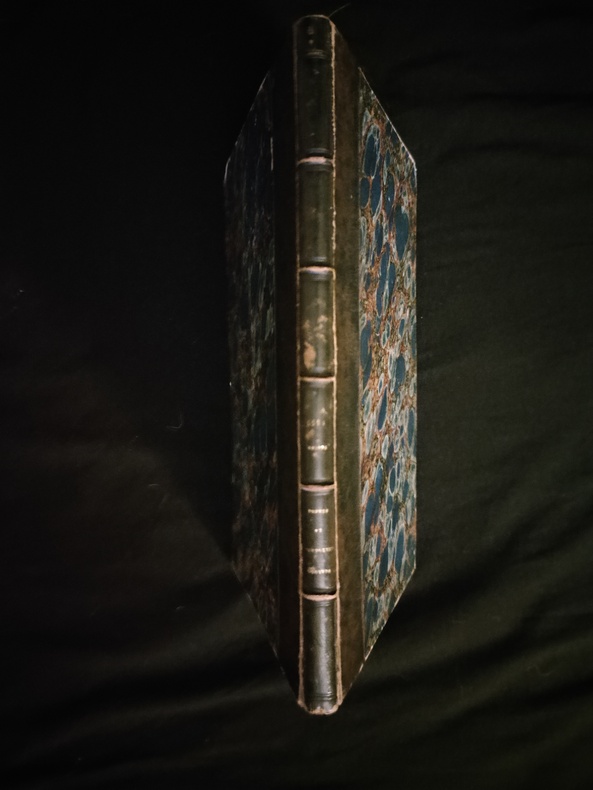
1555réf. GEJ-11Pescia: Lorenzo Torrentino, 1555, 4to, [13] 18-126 [1] of colophon 1 blank. Book in Italian. 1st Italian Edition (2nd overall) of this rare demonology tratise. Later (18/19 .century) later half morocco with gold lettered spine and blank pages. Marbled endpapers. Architectural woodcut border on title-page with a small view of Florence and with Medici coat of arms. Woodcut initials, woodcut vignette on verso of A4. Colophon leaf at end. Very ginuine interior, clean, without marks, annotations, stamps and ex libris. No foxing and stains. Complete. First Italian edition and the first translation from the 1523 Latin original by Turino Turini, marking the earliest book on witchcraft printed in the Italian vernacular. While the dialogue format reinforces the grim theological framework of the Malleus Maleficarum and contemporary inquisitorial manuals regarding sabbaths and demonic pacts, it stands apart for its erudition. By sophisticatedly weaving classical and pagan citations into medieval scholastic precepts, Pico della Mirandola effectively pioneered the "humanistic literature of witchcraft," bridging Renaissance intellectualism and counter-reformation demonology. The work embodies the Renaissance approach to demonology, demonstrating how a humanist could substantiate the reality of witchcraft, transvection, and the sabbath using classical sources alongside scripture and inquisitorial manuals. Ultimately, the early modern obsession with demonology is presented not as an irrational residue of a rational age, but as a foundational conceptual nexus essential to understanding sixteenth-century philosophy. Bibliography: Censimento 16 CNCE 34704; Riccardi II, 281; Moreni, Annali della tipografia di Lorenzo Torrentino, s. 394; Sander 5688; Graesse V, 283; USTC No. 848435; Caillet 8654; Encyclopaedia of Witchcraft 2006.
1620réf. GEJ-1France, Lyon, Claude Landry, 1620. In-8. Text in Latin. 2 volumes of 3 complete itself. Last part dated 1621 under title: Daemonomastix sive Vniversi operis adversus daemones et maleficos ad vsum praesertim exorcistarum concinnati, is not included. Colation: V 1: title page in black and red, indexes and 544 p.: Henricus Institoris & Jakob Sprenger - Malleus maleficarum : maleficas et earum haeresin framea conterens... 2. Fr. Ioannis Nideri - Formicarum de maleficis, & earum praestigiis ac deceptionibus... V2.1: title page in black and red, indexes and 317 p.: 3. Bernhardi Basin - Opusculum de artibus magicis ac magorum maleficiis. 4. Vlrici Molitoris - Dialogus de lamiis, & Pythonicis mulieribus. 5. Ioannis de Gerson - Libellus de triale spirituum. 6. Thomas Murner - Libellus de Pythonico contractu.7. Bartholomaei de Spina - Quaestio de strigibus seu maleficis. 8. Io. Franciscum Ponzinbium - De lamiis, apologia prima [-quarta]. V2.2: title page in black and red, indexes and 506 p.: 9. Joan. Laurentii Ananiae - De Natura daemonum. 10. R.P.F. Bernardi Comensis - Tractatus de strigibus, cum notis Franc. Pennae. 11. Ambrosii de Vignate - Elegans ac utilis quaestio de lamiis seu strigibus. 12. Joan. Gersonii - Tractatus de erroribus circa artem magicam et articulis reprobatis. 13. Joan. French Leonis - Libellus de sortilegiis. 14. Jacobi Simancae - Titulus unicus de lamiis. 15. Alphonsi a Castro, Zamorensis - de Impia sortilegarum. 16. Pauli Grillandi - Tractatus de sortilegiis eorumque poenis. A collected edition of the most famous book about witches ever written including other works dedicated to occult topic. 16 extremely rare treatises on demonology and witchcraft in a single binding in three parts! Over 1,300 pages, 3 separate title pages, tables of contents, and indexes. Complete 1620 edition itself. Internal condition: very good. Binding: good. Professionaly restored parchment on the spine. Solid antiquarian condition. Bibliography: The Encyclopedia of Witchcraft and Demonology, Robbins, 1964; Not in Caillet, Dorbon, Yve-Plessis or Bibliotheca esoterica; USTC 6902887. Provenance: XVII c. - Chistophori Solarij U.I.D. & Bibliothecae Slacoverdensis Scholarum Piarum.
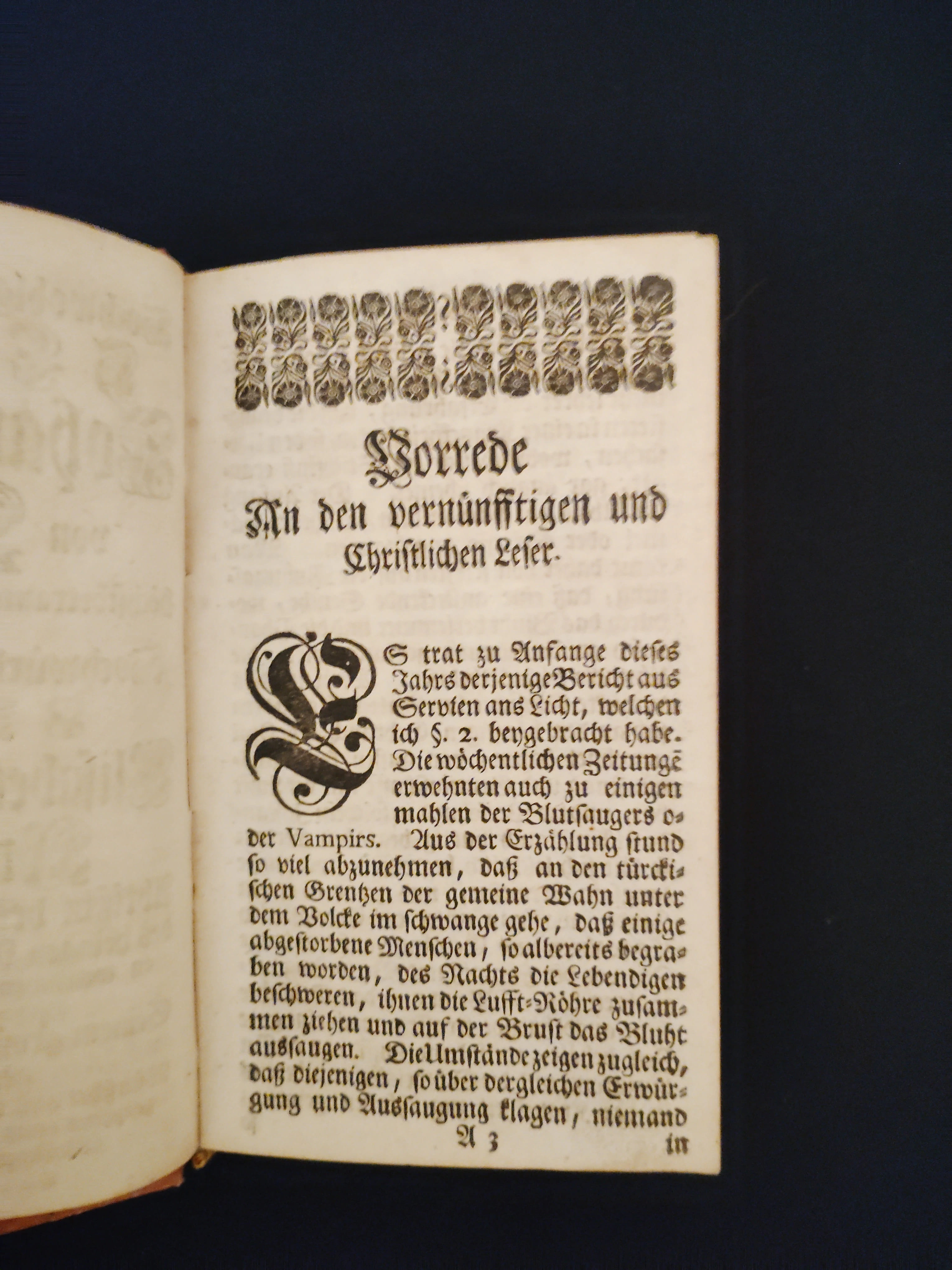
1733réf. GEJ-16Wolffenbüttel [Wolfenbüttel]: Zu finden bey Johann Christoph Meißner, 1733. In-8, 136 pp., [4] leaves (Register). Small octavo (17 x 10 cm). Contemporary red cardboard binding, incorporating the original paper wrapper. Covering material stained. Paper greyed. Interior minimally rubbed and bumped, slightly stained and dusty. 1st and only edition, Extremely Scarce!!! First edition of this exceptionally and unique rare and foundational text-monument of early European vampirology, published at the absolute zenith of the 18th-century "Vampire Controversy" (Vampyrstreit). This seminal octavo volume comprising the one-color title page in black, 136 pages of gothic Fraktur text, and the final index leaves, stands as one of the most critical contemporary intellectual responses to the vampire panic that swept Central and Southeastern Europe. The hysteria, which gripped the public imagination following the official Habsburg military and medical reports from the Serbian borders—most notably the grim exhumations related to Peter Plogojowitz in 1725 and Arnold Paole in 1732—effectively introduced the Slavic concept and the very word "vampire" into the lexicon of Western European Enlightenment discourse. The author, Johann Christoph Harenberg (1696–1774), an eminent German theologian, historian, and school rector, approaches this terrifying contemporary phenomenon with a sophisticated blend of early scientific rationalism and Protestant orthodoxy. While providing his readers with highly detailed, sensational, and meticulously recorded case studies of alleged vampiric attacks and ritualistic desecrations of corpses along the volatile Ottoman-Serbian frontiers ("Gräntzen des Servien-Landes"), Harenberg systematically deconstructs the supernatural myths surrounding them. He fiercely rejects the physical reality of the animated dead, brilliantly diagnosing the epidemic not as a literal threat, but as a "disease of the imagination" (Phantastische Seuche). He argues that the perceived visitations are the tragic products of mass psychological trauma, rural ignorance, premature burials, and the natural, misunderstood processes of bodily decomposition. Furthermore, from a theological standpoint, Harenberg maintains that God would never permit the souls of the deceased to return to the mortal realm for such grotesque purposes, attributing the sightings to demonic illusions or sheer human sensory deception. Preceding Dom Augustin Calmet’s celebrated and widely translated phantom treatise by more than a decade, Harenberg’s work represents a vital, transitional milestone bridging the late-baroque fascination with the occult and the burgeoning skepticism of the Age of Reason. Recorded in the German national bibliography under VD18, this remains a highly coveted, profoundly influential masterwork for specialized collections focusing on the history of magic, early medicine, folklore, and the European Enlightenment. An item of legendary rarity on the open market, this 1733 first edition represents an exceptional, census-proven acquisition opportunity for the discerning collector of early occult and Enlightenment literature. According to worldwide institutional databases and international library union catalogs (including WorldCat and the Karlsruhe Virtual Catalog / KVK), fewer than 12 institutional copies of the physical 1733 original printing are recorded globally, with the vast majority permanently secured within key European state repositories such as the Bayerische Staatsbibliothek in Munich, the Herzog August Bibliothek in Wolfenbüttel, and the Universitätsbibliothek Göttingen. The vast majority of library search results for this title point strictly to modern digital facsimiles, microform copies, or late 20th-century reprints, masking the true, extreme scarcity of the physical artifact. Since virtually all known original copies are institutionalized and perpetually removed from commerce, public auction appearances of this seminal vampire tract are virtually non-existent. A profoundly elusive work of early Vampyrologia, this piece stands as an ultimate desideratum that has historically escaped even the most exhaustive collections of early horror and paranormal history. Bibliographie: VD18 14205289; OCLC/WorldCat: 257577536 / 934812328; Hamberger-Meusel: III, 75; Summer, Montague: The Vampire: His Kith and Kin (London, 1928) – Cited as one of the critical early German works addressing the Serbian vampire epidemics of 1725–1732; Hock, Stefan: Die Vampyrsagen und ihre Verwertung in der deutschen Literatur (Berlin, 1900), p. 34; Not in Caillet; Graesse [Grasse]: Bibliotheca Magica et Pneumatica (1843), p. 125; Not in USTC; Cornell Library: Witchcraft BF1556 .H27. Provenance: Antiquariat Peter Fritzen, January 2018, No. 93., Librairie ancienne LIRI, 2025. Since 1990 only one auction record (2004, Falk & Falk, 12, no. 20). This copy has no owners annotations (ex-libris, marks, stamps, handwritten notes).
1620in-4 (mm 224x159), pp.(16), 372 (ultima bianca), leg. coeva in pergamena. Pagina di titolo racchiusa da un'elaborata bordura incisa e raffigurante il sole, alberi di palma e una campana. Prima edizione, assai rara e pregiata, di una delle opere più studiate e influenti del filosofo, al quale costò la prigione e la tortura, su condanna dell'Inquisizione per eresia. Il De Sensu Rerum rappresenta un completo esposto di filosofia neo-platonica ed ermetica. Campanella ivi tenta di dimostrare che il numero dei mondi è infinito, che i pianeti sono abitati e che il sole si avvicina gradatamente alla terra. Discute inoltre di magia, dei sensi, dell'intelletto, dell'anima, del mondo esterno, ecc. Il trattato lascia intuire di essere stato influenzato dalla linea filosofica di B. Telesio e G. Bruno. Scritto originalmente nel 1590-92, il manoscritto venne rubato a Campanella da alcuni frati a Bologna. Venne quindi riscritto dallo stesso autore attorno al 1604 e pubblicato nella presente edizione originale nel 1620.. Firpo n.7. Yates 381-82. Caillet 1984. Vinciana 2162: ''Opera rarissima scritta durante la prigionia...'' Mellon 79. Thorndike II, 291-300. Ferguson I, 138-139..
réf. 159183N.p.: N.p. 1970. Substantial archive of material belonging to Austrian-American stage hypnotist and magician John Kolisch including two three-ring card binders with typescript and manuscript notes for Kolisch's live shows and 271 vintage photographs of Kolisch in performance. Archive appears to date from the 1950s through the 1970s the heyday of Kolisch's career. One binder holds notes and scripts for Kolisch's magic tricks powers of suggestion and general show patter and jokes while the other binder focuses primarily on feats of hypnosis. The binders hold a variety of material relating to Kolisch's performances a mix of more formal typed scripts for routines alongside manuscript draft notes and annotations noting potential "ad-libbed" interjections. Several pages capture Kolisch recording his ideas for changes to the pacing and setup of his shows as well as reminders about modernizing his patter and updating his celebrity references. Although the bulk of Kolisch's material is undated earlier acts appear to reference specific actors films or shows such as opera singers or the television show "Cavalcade of Stars" while later routines simply note the names of prominent contemporary actors and celebrities to insert at random. Kolisch who billed himself as "The Fastest Hypnotist in the World" apparently used a blend of serious hypnotism stage magic and standup comedy in his shows and accordingly an entire binder section labeled "Funny Lines" is devoted to ripostes and one-liners. These zingers cover every performance eventuality from hecklers "Have you ever been to the zoo I mean as a visitor" to a silent audience "Well they say a silent tribute is the sincerest of them all!". The archive's considerable collection of photographs captures the spirit and energy of Kolisch's live shows with audience members engaged in a number of humorous activities-stripping saluting yelling and singing dancing acting as human furniture kissing and hugging each other playing musical instruments such as maracas and the ukulele-or simply sleeping. Several photographs bear Kolisch's name and company address in Jackson Heights New York in the recto margins an address that also appears in Kolisch's company letterhead on many of his show notes. Included in the archive are 17 contact sheets capturing images from performances and portrait photographs of Kolisch. Also included are two gatherings of typescript and copied material related to Kolisch's lectures on "dynamic auto-conditioning" and "dynamic auto-suggestion" with many pages annotated by Kolisch in manuscript ink or pencil. Archive also features a 17-page bound treatise titled "Your Incredible Subconscious Mind" published in 1956 by the "Subconscious Research Institute" an organization possibly created by Kolisch himself. Photographs range in size with the majority measuring 10 x 8 inches. Near Fine to Very Good plus with occasional edgewear and creasing. Binders contact sheets lecture material and treatise Near Fine to Very Good plus with some light edgewear creasing and soil on binder exteriors. N.p. unknown
réf. 159183N.p.: N.p. 1970. Substantial archive of material belonging to Austrian-American stage hypnotist and magician John Kolisch including two three-ring card binders with typescript and manuscript notes for Kolisch's live shows and 271 vintage photographs of Kolisch in performance. Archive appears to date from the 1950s through the 1970s the heyday of Kolisch's career. One binder holds notes and scripts for Kolisch's magic tricks powers of suggestion and general show patter and jokes while the other binder focuses primarily on feats of hypnosis. The binders hold a variety of material relating to Kolisch's performances a mix of more formal typed scripts for routines alongside manuscript draft notes and annotations noting potential "ad-libbed" interjections. Several pages capture Kolisch recording his ideas for changes to the pacing and setup of his shows as well as reminders about modernizing his patter and updating his celebrity references. Although the bulk of Kolisch's material is undated earlier acts appear to reference specific actors films or shows such as opera singers or the television show "Cavalcade of Stars" while later routines simply note the names of prominent contemporary actors and celebrities to insert at random. Kolisch who billed himself as "The Fastest Hypnotist in the World" apparently used a blend of serious hypnotism stage magic and standup comedy in his shows and accordingly an entire binder section labeled "Funny Lines" is devoted to ripostes and one-liners. These zingers cover every performance eventuality from hecklers "Have you ever been to the zoo I mean as a visitor" to a silent audience "Well they say a silent tribute is the sincerest of them all!". The archive's considerable collection of photographs captures the spirit and energy of Kolisch's live shows with audience members engaged in a number of humorous activities-stripping saluting yelling and singing dancing acting as human furniture kissing and hugging each other playing musical instruments such as maracas and the ukulele-or simply sleeping. Several photographs bear Kolisch's name and company address in Jackson Heights New York in the recto margins an address that also appears in Kolisch's company letterhead on many of his show notes. Included in the archive are 17 contact sheets capturing images from performances and portrait photographs of Kolisch. Also included are two gatherings of typescript and copied material related to Kolisch's lectures on "dynamic auto-conditioning" and "dynamic auto-suggestion" with many pages annotated by Kolisch in manuscript ink or pencil. Archive also features a 17-page bound treatise titled "Your Incredible Subconscious Mind" published in 1956 by the "Subconscious Research Institute" an organization possibly created by Kolisch himself. Photographs range in size with the majority measuring 10 x 8 inches. Near Fine to Very Good plus with occasional edgewear and creasing. Binders contact sheets lecture material and treatise Near Fine to Very Good plus with some light edgewear creasing and soil on binder exteriors. N.p. unknown books
1623"In-8°piccolo, (4cc), 643pp, (33cc), legatura in piena pergamena coeva con unghiature, titolo manoscritto al dorso. Prima edizione, curata da Peiresc. Raguseo, un chierico che arrivò a Padova come secondo professore ordinario di filosofia,diventando amico di Galileo, fu uno dei maggiori esponenti di quella corrente contraria all'astrologia, così in voga in quel periodo. Questo volume contiene le sue lettere sulla divinazione e sull'astrologia, che condanna assieme ad altre scienze occulte quali la chiromanzia, la fisiognomica e la geomanzia. ""Inizialmente coltivò l'eloquenza, quindi la filosofia e teologia, poi si dedicò interamente alla medicina e alla matematica...E non si fermò qui, ché diventò presto seguace dell'arte di Lullo...Possedeva una famosa biblioteca, che sfortunatamente venne venduta dopo la sua morte"" (Thorndike, VI, pp 201-02) Riccardi I. 336. Cantamessa 3693. In-8 ° small, (4cc), 643pp, (33cc), contemporary full vellum binding with overlapping fore-edges, handwritten title on the spine. First edition, published by Peiresc. Raguseo, a cleric who arrived in Padua as a second professor of philosophy, becoming a friend of Galileo, was one of the leading exponents of that current contrary to astrology, so in vogue at that time. This volume contains his letters on divination and astrology, which he condemns along with other occult sciences such as palmistry, physiognomy and geomancy. ""Initially he cultivated eloquence, then philosophy and theology, then he devoted himself entirely to medicine and mathematics ... And he didn't stop there, as he soon became a follower of Llull's art ... He owned a famous library, which unfortunately was sold after his death ""(Thorndike, VI, pp 201-02) Riccardi I. 336. Cantamessa 3693. "
1615réf. GEJ-13Paris, Jean Millot, 1615. In-12 : 109pp, (1). Full original vellum binding and endpapers with blank pages. Parchment with defects on the cover, few stains at the end of book. Shorter page 103/104 due to handmade paper inperfections. Some worm holes. Bright and complete copy. Two old ink different anotations on the first endpaper. This exceptionally rare 1615 Parisian first edition, published by Jean Millot, represents a foundational cornerstone in early modern demonological literature and the history of psychiatry. Written by the French physician Jean de Nynauld, De la lycanthropie, transformation et extase des sorciers is widely celebrated by historians Evans and Bartholomew as "the most extensive and detailed description of ointments in relation to both witchcraft and lycanthropy." Across four meticulous chapters dedicated entirely to the salves of sorcerers, Nynauld documents the grim contemporary lore surrounding these unguents, including the notorious belief that they utilized the fat of sacrificed children. However, rather than validating these horrors as supernatural reality, Nynauld applies a brilliant, early medical rationalism to the phenomenon. He boldly declares the numerous reports of murderous, cannibalistic shapeshifters and sabbat flights to be powerful hallucinations brought on by diabolical chemistry—specifically, the pharmacological effects of psychoactive herbs. Defying the harsh inquisitorial consensus of his era, he firmly regards those who claim they metamorphose into animals not as literal monsters or heretics, but as sufferers of severe mental disorders and clinical delusion. Consequently, this prized editio princeps stands as a crucial historical milestone, marking the transition from superstitious witch-hunting to a rational understanding of early pharmacology and mental health. Bibliography: "One of the "classic" works on Witchcraft and nevertheless one of the rarest." (Caillet 8124), The Encyclopedia of Extraordinary Social Behavior 333-39; Guaita, Bibliothèque occulte 774; Coumont, Demonology and Witchcraft: An Annotated Bibliography N38.3; Laehr, Die Literatur der Psychiatrie, Neurologie und Psychologie I: 159; Cioranescu 51435; Yve-Plessis, 975; USTC No. 6013581. Keywords : Keywords : Grimoire, Magie, Occultisme, Charmes, Sorcellerie, Diables
1561réf. GEJ-10Paris, apud Gilles Corrozet, 1561, [1], 40, [1] pp, 8°. Book in Latin. RARE AND UNCOMMON ON THE MARKET FIRST PARISIAN PRINTING! 17/18 century full calf binding, gold lettered spine, marbled endpapers, owner's ex libris of Emeric Bigot (?) on title page. Good antiquarian condition, woodcut printers device to title, woodcut initials. Few stains and discolorations. Complete. Published in Paris by Gilles Corrozet in 1561, this rare edition of Ulrich Molitor’s Tractatus de lamiis et pythonicis stands as a definitive cornerstone of early occult literature and a fascinating, skeptical counterpoint to fanatical witch-hunting manuals like the Malleus Maleficarum. Written by a prominent German jurist, the treatise is historically significant for its early skepticism, as Molitor boldly argued that supernatural acts like shape-shifting or flying to sabbaths were merely illusions and dreams induced by the Devil rather than physical realities. This text is equally famous for containing the earliest printed depictions of witches, establishing the modern iconography of the occult through striking woodcut imagery that includes scenes of witches brewing storms in cauldrons, a wizard riding a wolf, and the Devil corrupting a woman. Composed as a direct response to Europe's rising witchcraft hysteria, this treatise introduces cold legal logic and canonical jurisprudence into a debate previously dominated by religious fanaticism. Moving away from dry academic lecturing, the text adopts the dynamic structure of a scholarly dialogue between three real historical figures: Archduke Sigismund of Austria, the ruler of Tyrol, who acts as the voice of skepticism by raising logical doubts and challenging the validity of witch trials; Conrad Schatz, the magistrate of Constance, who champions the strict, traditional view by defending the physical reality of witchcraft and demanding harsh punishments; and Ulrich Molitor himself, the author, who serves as the impartial arbiter utilizing Roman and Canon law to systematically resolve the disagreements between his interlocutors. Ulrich Molitor (c. 1442–1507) was a pioneering German jurist, humanist, and diplomat who shaped early modern legal thought. After studying humanities in Basel, he earned a prestigious doctorate in civil and canon law from the University of Pavia, positioning him at the forefront of Renaissance jurisprudence. He spent the pinnacle of his career as a trusted legal advisor to Archduke Sigismund of Austria in Innsbruck and later served as chancellor to the Bishop of Worms. Molitor’s enduring legacy is his 1489 masterpiece, Tractatus de lamiis et pythonicis, which stands as one of history's earliest legal critiques of witch-hunt fanaticism. By utilizing rigorous Roman and Canon law to argue that witchcraft was largely a demonic illusion, he became a vehement opponent of judicial torture, forever marking his place as a trailblazer of European rationalism. Provenance: Emeric Bigot (?) - Ex Libris: Emeric Bigot (1626–1689) was a prominent French humanist, bibliophile, and a central figure in the 17th-century European intellectual network known as the Respublica Literaria (Republic of Letters). Born and based in Rouen, he used his substantial wealth to amass one of the most legendary private libraries in Europe, renowned for its rare Greek and Latin manuscripts and early printed books. Though he published little under his own name—focusing primarily on editing early Christian texts—Bigot served as an indispensable international scholarly coordinator. He maintained a vast correspondence with major thinkers like John Milton and Nicolas Heinsius, utilizing his unparalleled bibliographic expertise to source texts, verify translations, and generously assist scholars across the continent in preparing their own monumental works for print. Bibliography: Herbert M. Adams, M 1573; USTC, 153205; Pettegree i Walsby, 153205, only found in one US institution (Yale University, Beinecke Library), Not in VD 16, Yve-Plessis, Dorbon-Aîné and Bibliotheca Esoterica; Caillet, II, 7641; Grässe, p. 55; Bibliotheca Daemonologica (Robbins).
1900réf. G1ADNMOA0S9LKopenhagen 1900. Housed in the original publisher's wooden boxes. Includes 2 original projectors and 1 camera. More than 400 glass slides depicting various motifs related to coal mining chemical processes and astronomy as well as topographical motifs from Asia Africa China Europe and America. Remarkable all-encompassing collection of turn-of-the-century magic lantern slides. Several of the slides show cavalry horses: the "Krigen 1848-1864" set includes no. 45 an equestrian portrait of General Bülow victor of the 1849 Battle of Fredericia painted by Aug. Jerndorff; no. 29 Friedrich von Schleppegrell riding at the battle of Isted; no. 26 General Krogh on horseback all V. Richter Kopenhagen; no. 20. captioned "Pferdeablieferung" horse delivery.A box lebelled "København" includes: no. 21 Brandmajoren rykker ud; no. 20 a fire at the time of King Frederik VI of Denmark d. 1839.Other slides show workhorses in Denmark and Sweden during haying-time or spreading manure as well as works of the Danish painter Otto Bache: the Coronation of Christian IV in 1596; the conspirators escaping from Finderup on horseback after having murdered Eric V of Denmark in 1286. The collection also contains copies of paintings by various artists such as Leonardo da Vinci Raphael and Rembrandt. Among the remaining slides we find astronomical illustrations and pictures of observatories Greenwich Delhi Potsdam etc.; as well as numerous photographs and paintings of landscapes people and architecture in Africa Asia Europe China and America. unknown
réf. 14442(Venedig, de Zanis, nicht vor 1487). Romanische Type. 26 nn. Bll. (letztes weiss) mit 2 Spalten zu je 38 Zeilen mit unausgefüllten Initialspatien. 8°. Mod. HPgmt. unter Verwendung von Material des 18. Jahrhunderts.
2002DISPONIBILITÀ GARANTITA AL 99%; SFONDO DI MAGAZZINO PARI AL NUOVO. LIEVISSIMI SEGNI DEL TEMPO, GRAFFIETTI ALLA COPERTINA. Michel Zévaco (Ajaccio, 1º febbraio 1860, Eaubonne, 8 agosto 1918) è stato un romanziere, insegnante, giornalista, editore e attivista anarchico francese. Degno successore di Alexandre Dumas, Michel Zévaco, popolarissimo autore di feuilletons a cavallo tra Otto e Novecento, ci offre con Nostradamus, il primo romanzo del ciclo da lui dedicato alla figura del celebre autore delle profetiche Centurie. L'Autore dipinge il ritratto, cupo e sanguinoso, della Francia di Caterina de' Medici, delle guerre di religione, della caccia alle streghe... In un susseguirsi di duelli, agguati notturni, rapimenti, magie, evocazione di morti, prende corpo la trama della ventennale vendetta, con cui l'ormai anziano Nostradamus vuol punire coloro che gli hanno rovinato la giovinezza e sottratto Marie, la giovane sposa: re Enrico II di Valois, e i suoi infidi amici, Roncherolles e Saint-André. Recentemente ristampato in Francia dalla casa editrice Laffont, il romanzo ha riscosso un enorme successo. Descrizione bibliografica Titolo: Nostradamus Autore: Michel Zévaco Traduzione di: Marta Bellini Editore: Napoli: Tullio Pironti, 2002 Lunghezza: 685 pagine; 23 cm Peso: 1 Kg ISBN: 8879372939, 9788879372930 Soggetti: Romanzi storici, Fantasy, Letteratura francese, Ottocento, Classici, Eroi, Narrativa moderna e contemporanea (dopo il 1945), Streghe, Avventura, Magia, Previsioni, Futurologia, Futuro, Destino, Catastrofi, Racconti popolari, Intrighi, Duelli, Guasconate, Miguel de Zevaco, El hijo de Nostradamus, Gerfaut de Croixmart, Fran ois Ier, Romans populaires, écrivain français, Romanticismo, Cappa e spada, Cavalieri, Mantelli e spade, Pardaillan, Cape et d'épée, Suite romanesque, Cycle romanesque, Personnages romanesques, Cicli storici, Spagna, Francia, Filippo II, Roman-feuilleton, Le Matin, Fayard, Le Livre populaire, Romancier français du XXe siècle, Roman d'aventures, Affare Dreyfus, Romanzo d'appendice, Le Capitan, Borgia, Buridan, L'Héroïne, L'Hôtel Saint Pol, Parigi, Il Ponte dei sospiri, La marchesa di Pompadour, XX secolo, Ignazio di Loyola, Gesuiti, Carlo V, Caterina, Brabante, Enrico II, Re, Famiglie reali, Guerre, Battaglie, Corti, Regina, Cloak and dagger novels, Intrigue, Secrecy, Espionage, Mystery, Alexandre Dumas, Libri Vintage, Fuori catalogo, Magie, Morti, Evocazioni, Spiriti, Roncherolles, Valois, Cinquecento, Saint-André, Rapimenti, Vendette, Michel de Nostredame, Astrologia, Profezie, Medici, Montpellier, Montgomery, Myrtha, Montecuculi, Delfino, Marie, Chiaroveggenza, A posteriori, Beaurevers, Bouracan, Brabant, Trinquemaille, Renaud, Historical Novels, French Literature, Nineteenth Century, Classics, Heroes, Modern and Contemporary Fiction (after 1945), Witches, Adventure, Magic, Predictions, Futurology, Future, Destiny, Catastrophes, Popular Tales, Intrigues, Duels, Guasconades, Romance, Hood and sword, Knights, Cloaks and swords, Historical cycles, Spain, France, Philip II, Appendix novel, Paris, The Bridge of Sighs, The Marquise of Pompadour, 20th century, Ignatius of Loyola, Jesuits, Charles V, Catherine, Brabant, Henry II, Kings, Royal families, Wars, Battles, Courts, Queen, Books Out of print, Spells, Deaths, Evocations, Spirits, Saint-André, Abductions, Revenge, Astrology, Prophecies, Clairvoyance
réf. AMA-1201Paris, Les Belles Lettres, 1999. In 8°, broché. 304 pp., [1 f.].