8 571 résultats
18661st Edition Period Half Leather with raised bands and gilt spine lettering and adornment. 8vo, iv, 572, iv, 572 pages. Complete 1st 24 issues of the New Series of this monthly spiritualist periodical. Continuation of The British Spiritual Telegraph and The Christian spiritualist. Includes essays by Henry Ward Beecher, and about Bengal Spiritualism, Levitation in Spain, Spiritualism and Christianity, Zouave a Young Creative Medium, etc. Bibliography of Spiritualism, Lincolns Dream of Warning, Manx Superstitions, SUBJECT(S): Spiritualism -- Periodicals. OCLC: 728344879. OCLC lists only 3 holdings worldwide (Boston Pub Libm Kings Col London, British Lib). Front blank endpaper of Vol I loose, all text pages clean and nice, binding solid and good. Some rubbing and edgwear to boards and spine, Still attractive, About Very Good- Condition Overall. Rare and important. (AC-22-18)
19501 27.3x19.8 cm., XXIV, 334, [2] pp., XXV tavv. in b/n in fondo al testo, legatura in tela edit. con titoli al dorso e stemma dell'Universit? del Michigan impresso a secco al piatto anteriore, prima edizione, esemplare ben conservato, in inglese Rara edizione originale di questo importante studio sugli amuleti magici greci ed egiziani.
réf. 024837Paris, chez LESCLAPART, 1788 (pour les trois premiers volumes), Bruxelles, veuve Dujardin, et à Paris, chez Defer et Maisonneuve, 1789 (pour le quatrième et dernier volume) 0 Cinq ouvrages en quatre volumes petits in-8° (100 x 171mm), demi-percaline à coins rouge, dos lisses ornés de l'auteur, du titre et de petits fers dorés (reliure de la fin du xixe). ( dos insolés et légèrement salis, exemplaires très rognés avec la perte de quelques lettres, la plupart des feuillets des quatre volumes sont uniformément et fortement roussis, trace de brûlure au feuillet 89-90 du volume du Codicille et au feuillet 121-122 du volume des Petites Aventures, SONT MANQUANTS : les frontispices, le portrait, les feuillets 125-126 et 127-128 du volume de la Magie blanche dévoilée, les feuillets d'explication (8 pp.) et d'éclaircissements (32 pp.) ainsi que 2 planches du volume de Supplément à la Magie). VOLUME 1 : La Magie Blanche dévoilée, ou Explication des Tours surprenans qui font depuis peu l'admiration de la Capitale & de la Province, avec des réflexions sur la Baguette divinatoire, les Automates joueurs d'Échecs, &c. Seconde édition corrigée par l'auteur. Paris, chez LESCLAPART, 1788. XXIV 124 pp. (sont manquants les deux derniers feuilllets). Une figure page 117.; Relié à la suite du même : Supplément à la Magie Blanche dévoilée, Contenant l'explication de plusieurs Tours nouveaux, joués depuis peu à Londres, Avec des éclaircissements sur les artifices des Joueurs de profession. Les Cadrans sympathiques, le Mouvement perpétuel, les Chevaux savans, les Poupées parlantes, les Automates dansans, les Ventriloques, les Sabots élastiques, &c. Paris, LESCLAPART, 1788. VII 287 (1) pp. 2 planches de 2 figures chaque (homme enchaîné) et 29 figures; VOLUME 2 : TESTAMENT de JEROME SHARP, Professeur de Physique amusante, où l'on trouve parmi plusieurs tours de subtilité, qu'on peut exécuter sans aucune dépense, des préceptes et des exemples sur l' Art de faire des chansons impromptu ; pour servir de suite à la magie blanche dévoilée. Paris, LESCLAPART, 1788. XX 328 pp. 2 planches repliées (musique) et 69 figures. Bandeaux et vignettes; VOLUME 3 : CODICILE de Jérôme Sharp, Professeur de Physique amusante ; Où l'on trouve, parmi plusieurs Tours dont il n'est point parlé dans son Testament, diverses Récréations relatives aux Sciences & Beaux-Arts ; pour servir de troisième suite à la Magie blanche dévoilée ; avec 64 figures. Paris, LESCLAPART, 1788. 286 pp. (2) pp. (approbation). Nombreuses figures au feuillet 31-32, 64 figures et deux tableaux dépliants reliés en fin de volumes; VOLUME 4 : Les Petites Aventures de Jérôme Sharp, Professeur de Physique amusante ; ouvrage contenant autant de tours ingénieux que de leçons utiles, avec quelques petits portraits à la manière noire ; par l'auteur de la Magie Blanche. Bruxelles, chez la veuve DUJARDIN, et à Paris, chez Defer de Maisonneuve, 1789. 386 pp. 17 figures. Cachet d'ex-libris. Henri Decremps (1746-1826) publia en 1784 " La Magie blanche dévoilée " afin de démasquer charlatans et escrocs dont le plus fameux d'entre eux à la veille de la Révolution Joseph Pinetti, prétendu physicien et magicien de la cour de Louis XVI qui publiait la même année ses Amusements physiques. Decremps, le premier, démystifia l'escamoteur par l'explication de toutes ses expériences (tours de cartes, gobelets et gibecières etc.) et dressa la liste des techniques de tricherie, comme les faux mélanges, les sauts de coupe, la donne en second, etc. RARE
1744réf. GEJ-3Rome but Lille, Imprimerie de Blocquel, 1744 but probably 1830. Hardcover. In-12. Colation complete: 112 pp. and avertissement pp. Quarter leather binding, brown leather backstrip over marbled paper boards. Gilt titling on leather spine label, raised bands, gilt rules and decorations to spine. Marbled endpapers and page edges. Exlibris on the first endpaper: "Libraire Papeterie G.Cazaux".Frontispiece, full page plates, sigils and devices in text. Bright and clean inside. Little foxing interior. Rare 1744 edition of French Grimoire refers to an edition of Henri Corneille Agrippa famous grimoire, translated into French by Pierre d Aban, which includes occult secrets such as the ritual of the Queen of the Hairy Flies. Although dated 1744, the edition may be fanciful. Probably early XIX c. edition. This type of Bibliotheque Blue publication, although sometimes fanciful in its dating, was common at the time and refers to writings already circulating on occult and alchemical practices. Bibliography: Caillet, 97, Y. Plessis, 34.
1922ix, [1], [2]-206 pp. Color frontispiece. Black and white diagrams in text. Provides instruction for twenty-three paper tricks, seven paper folds, eleven paper tears, and sixteen paper puzzles. Square and unmarked with moderate wear to publisher's red cloth lettered in black. Binding intact. Moderate foxing to first few leaves. Chips from head of backstrip. Insect holes to upper periphery of backstrip partially touched up with bit of bleed to back hinge. No dust jacket. A sound copy of this wonderful Houdini collectible. Book
17504 volumes Veau marbré de l'époque, dos à nerfs et fleuronnés, pièces de titre rouges, tomaisons vertes, tranches rouges 1750, 1750, in-8, 4 volumes, Veau marbré de l'époque, dos à nerfs et fleuronnés, pièces de titre rouges, tomaisons vertes, tranches rouges, 136 planches gravées sur cuivre, certaines dépliantes, représentant différentes expériences, la plupart avec les instruments et appareils pour les réaliser. Nouvelle édition des célèbres Récréations. Ce grand classique, toujours très recherché, du mathématicien Ozanam (1640-1717), a paru à l'origine en 1692. Il contient le Traité des horloges, qui est une traduction de l'ouvrage de Domenico Martinelli : Horologii elementari publié à Venise en 1669. "Cet ouvrage curieux, beaucoup plus ample que ceux qui avaient déjà paru sous le même titre, contient la solution d'une foule de problèmes d'arithmétique, de géométrie, d'optique, de gnomonique, de mécanique, de pyrotechnique, etc." (Quérard). "Il contient la solution d'une quantité de problèmes mathématiques, tours de gobelets, de cartes et d'escamotage, tous décrits avec les perfectionnements désirables pour l'époque" (Ruegg). Une bonne partie du premier volume est consacrée à la théorie des nombres qu'Ozanam connaissait parfaitement. Bel exemplaire. Ruegg, Bibliographie de la prestidigitation française, p. 71-72
1650In-16 gr. (mm. 182x115), p. pergamena antica, tit. oro al dorso, pp. (14),662, marca tipografica al frontespizio, ornato da grandi capilettera figurati a vignetta, con alcune figure nel t., inc. su legno. Rara edizione di questa celeberrima summa del sapere umano dell’epoca, pubblicata per la prima volta nel 1588 in soli 4 libri, poi aumentati fino a 20. Vi sono trattati fra gli altri: l’origine delle specie animali - la conservazione di alimenti e la preparazione di conserve, tipi di pane, liquori, olii ecc. - la creazione di gemme false - il magnetismo - la preparazione di rimedi di vario tipo (sonniferi, balsami per labbra rotte, cure per mal di testa, coliche, calcoli, fertilità, peste, piaghe, ecc.) - gli specchi ustori e la rifrazione - pure inclusa è la prima descrizione della camera oscura e nell’ultimo capitolo, intitolato “Chaos”, sono affrontate tematiche di vario tipo, dal morso della vipera ai draghi volanti. L’opera ebbe numerose ediz. nel ‘5/’600 e traduzioni in varie lingue. Cfr. Brunet,IV,826 - Graesse,V,417 - Caillet,III,8853: "C'est le meilleur traité de Magie pratique ou céremonielle, et il renferme toutes les pratiques employées par les nécromanciens du Moyen Age. Il contient de fort curieux secrets sur la beauté des femmes, les teintures, les fards, les cosmétiques, etc." - Bibliotheca Esoterica,3733: “Porta contribua dans une très large mesure à répandre en Italie l’usage des substances vénéneuses. On rencontre en outre dans cet ouvrage une foule de renseignements intéressants sur divers points concernant l’histoire naturelle, la lumière, les feux d’artifice, l’optique, etc.”. Antiche scritte a penna, qualche fiorit. sulle prime 8 carte e con lievi tracce d’uso, ma certamente un buon esemplare.
1630Ad Illustriss. et Sapientiss. Anhaltinum Principem CHRISTIANUM, Comitem Ascaniae, Dynasten Servestae, ac Bemburgi Dominum, &cc. Dominum & Patronum suum clementissimum, Osvaldi Crollii Epist. Dedicatoria - Iho Hartmannus Med. D. et CHymiatriae in Academia Marpurgensi Professor Ordinarius, Lectori S. (Anno Gratiae MDCXI) - Pauli Melissi Franci... Ode Alcaica ad Osvaldum Crollium - PRAEFATIO Admonitoria 1 21x17 cm., legatura in piena pergamena rigida, titolo in oro su tassella al dorso, tagli in grigio scuro, pp. (16), 283 (25 Index), Frontespizio con grande marca figurata del " Osvaldi Crolii Tractatus de Signaturis Interni rerum, seu de vera e viva Anatomia majoris & minoris mundi" pp. (14 Epistola Nuncupatoria ad ...Petrum Wok Ursinum Dominum Rosenberg...), 80 (14 Index ), Frontespizio con marca "Elegia De Vera Antiqua Philosophica Medicina scripta da M. Ulrico Bollingero ad Osvalum Crollium...e Frontespizio "Encomium ..."24; pagine con filetto di contorno e uno spazio di circa 2 cm. al lato esterno dedicato a numerose annotazioni, testate, capilettera e finalini importanti, 2 tavole nel testo. In lingua latina. In apertura importante e interessante Frontespizio generale pieno di simboli, emblemi, stemmi, personaggi ecc, relativi alla materia. Difetti: Frontespizio sbiadito e macchiato, ma completo; pagine tutte pi? o meno brunite e con gore sparse. Buon esemplare.
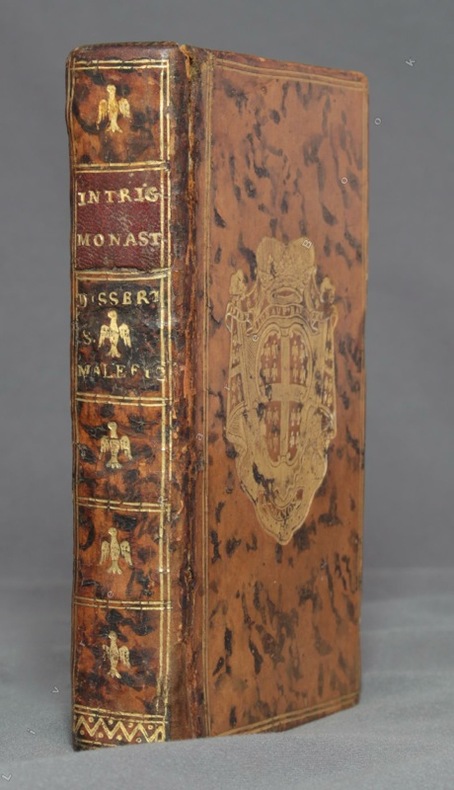
réf. 9367A La Haye [et] A Tourcoing, chez Jean van den Bergh [et] sans nom, 1739 [et] 1752. 2 tomes en un volume in-16 de [6]-256; de 2 à 102 pages (manque p. 3/4), plein veau marbré fauve, dos lisse orné de filets et 4 alérions dorés, double filet doré encadrant les plats, simple sur les coupes, armes d'Anne Léon (Ier) de Montmorency avec la devise: Dieu aide au premier baron chretien, ainsi que la devise grecque. Mors frottés et légèrement fendus, tampon rose répété deux fois sur chaque page de titre, restauration à la première, avec une cote de bibliothèque à l'encre bleue.
réf. 120553aafLondon, Luzac and Co, 1900, lg. in-8vo, XVII + 85 plates + 30 p. (publ. ads) / XCI (+1) + 1 leaf + 147 p., full publisher’s clothbound, spine richly gilt with titles, series and author, first cover with gilt impression of series, light stains on both volumes. In all a desirable copy.
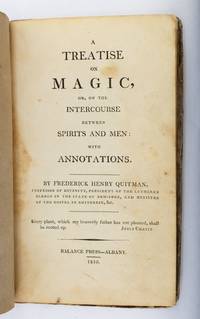
1810réf. ST17557Albany New York: Balance Press 1810. FIRST EDITION. 170 x 103 mm. 6 3/4 x 4". vi 76 pp. Errata slip tipped onto final page. Contemporary marbled boards backed with sheepskin smooth spine divided into panels by single gilt rules. Front free endpaper with bookplate of the Ricky Jay Collection. Front pastedown with neat early owner's signature pencilled initials "M. A." in a juvenile hand adjacent to a rudimentary pencil sketch of two people; rear pastedown with pencilled signature of Sally E. Original errata slip pasted onto bottom half of final page the slip defective at lower left corner. Sabin 67364; Shaw & Shoemaker 21169. Sheepskin a bit rubbed marbled paper boards somewhat chafed stained and quite worn at corners endpaper a bit spotted torn or at back missing other minor defects but the unsophisticated original insubstantial binding still solid. Title page and front flyleaves with light dampstain to gutter and tail margin a little foxing and faint browning other imperfections but the volume still generally clean and surprisingly fresh despite its cheap paper. Written by a Lutheran minister in upstate New York this entertaining treatise gives a brief history of the supernatural from ancient times to the present day and seeks to educate the audience about the dangers and follies of harboring magical beliefs noting that "witchcraft can never take root unless it be supported by credulity." According to the author's preface Frederick Henry Quitman 1760-1832 was motivated to write this work after a neighbor's home was besieged by supposed "supernatural" occurrences that included thrown stones and theft. Even though Quitman a staunch skeptic endeavored to attribute the activity to mischievous entities of the human variety the damage had been done: "Scarcely had the rumour about the forementioned witchcraft a little subsided when we heard the report of the appearance of apparitions in several quarters of the town. And it is really to be feared that during this dull winter all the corners of the town for want of other employment will be infested with demons." The Annotations at the end of the book contain many amusing definitions and descriptions of such things as talismans popular magic gothic novels and ventriloquists. Our copy was owned by the eminent magician actor writer scholar and sleight of hand artist Ricky Jay 1946-2018. In their catalogue Sotheby's notes that "Ricky Jay's accomplishments were as varied as are the formats and subjects of the material in his celebrated Collection . . . . He is one of the very select company of persons who assembled a collection of the very first rank in a field in which he was not only a world-renowned practitioner but also a scholar of considerable note." Our 1810 printing--the only early edition of this work--is rare on the market with RBH recording just four copies at auction in more than 60 years. Balance Press
1810réf. ST17557Albany New York: Balance Press 1810. FIRST EDITION. 170 x 103 mm. 6 3/4 x 4". vi 76 pp. Errata slip tipped onto final page. Contemporary marbled boards backed with sheepskin smooth spine divided into panels by single gilt rules. Front free endpaper with bookplate of the Ricky Jay Collection. Front pastedown with neat early owner's signature pencilled initials "M. A." in a juvenile hand adjacent to a rudimentary pencil sketch of two people; rear pastedown with pencilled signature of Sally E. Original errata slip pasted onto bottom half of final page the slip defective at lower left corner. Sabin 67364; Shaw & Shoemaker 21169. Sheepskin a bit rubbed marbled paper boards somewhat chafed stained and quite worn at corners endpaper a bit spotted torn or at back missing other minor defects but the unsophisticated original insubstantial binding still solid. Title page and front flyleaves with light dampstain to gutter and tail margin a little foxing and faint browning other imperfections but the volume still generally clean and surprisingly fresh despite its cheap paper. Written by a Lutheran minister in upstate New York this entertaining treatise gives a brief history of the supernatural from ancient times to the present day and seeks to educate the audience about the dangers and follies of harboring magical beliefs noting that "witchcraft can never take root unless it be supported by credulity." According to the author's preface Frederick Henry Quitman 1760-1832 was motivated to write this work after a neighbor's home was besieged by supposed "supernatural" occurrences that included thrown stones and theft. Even though Quitman a staunch skeptic endeavored to attribute the activity to mischievous entities of the human variety the damage had been done: "Scarcely had the rumour about the forementioned witchcraft a little subsided when we heard the report of the appearance of apparitions in several quarters of the town. And it is really to be feared that during this dull winter all the corners of the town for want of other employment will be infested with demons." The Annotations at the end of the book contain many amusing definitions and descriptions of such things as talismans popular magic gothic novels and ventriloquists. Our copy was owned by the eminent magician actor writer scholar and sleight of hand artist Ricky Jay 1946-2018. In their catalogue Sotheby's notes that "Ricky Jay's accomplishments were as varied as are the formats and subjects of the material in his celebrated Collection . . . . He is one of the very select company of persons who assembled a collection of the very first rank in a field in which he was not only a world-renowned practitioner but also a scholar of considerable note." Our 1810 printing--the only early edition of this work--is rare on the market with RBH recording just four copies at auction in more than 60 years. Balance Press books
1653in-4, pp. (12), 210, (8), 1 cb, leg. carta dec. inizi ‘900. Front. a due colori. Gr. vignetta in rame al front., fregi e iniziali xilogr. Prima ediz. Rarissimo trattato sui malocchi, maledizioni e stregonerie: interess. i capitoli dedicati al fascino “diabolico” e ai rimedi per debellare il morbo. Manca a Graesse. Wellcome cita di questo autore un’altra opera. Sconosciuta anche a Hirtsch che cita solo la “Febrilogiae”. Solo 2 copie censite nelle biblioteche italiane.
2000réf. 010348New York: Knopf 2000. First American edition of book 3 of the "His Dark Materials" trilogy; A most acceptable copy; 518pp. First U.S. Edition. Hard Cover. VG/VG. Knopf Hardcover
2000réf. 010348New York: Knopf 2000. First American edition of book 3 of the "His Dark Materials" trilogy; A most acceptable copy; 518pp. First U.S. Edition. Hard Cover. VG/VG. Knopf Hardcover books
1691réf. 90853HBAmsterdam:, Daniel van den Dalen, 1691-1693. 4 Bände in 1 Band: 10 Bll., 24, 131 (1) Seiten; 4 Bll., 262 Seiten, 1 Bl.; 4 Bll., 188 Seiten, 1 Bl.; 3 Bll., 277 (3) Seiten [recte: 285 Seiten, 3 nicht paginierte Seiten; Seiten 217-224 mit Paginierungsfehler], Pergamentband der Zeit mit auf den Falz gezogenen Pergamentriemchen, Rückentitel von alter Hand, farbiger Blattschnitt, 19,5 x 15 cm.
1593In-16 p. (mm. 150x95), 2 parti in 1 volume, p. pergamena coeva (restaur., risg. rifatti), pp. (16),247,(1),102,(2); (16),350; marca tipografica al frontespizio, con grandi iniziali ornate, inc. su legno. Nell'opera: "Remediaque probatissima, ac doctrinam singularem in malignos spiritus expellendos, facturasque et maleficia fuganda de obsessis corporibus complectens; cum suis benedictionibus & omnibus requisitis ad eorum expulsionem". In questa raccolta è stata unita l'altra opera di Mengus “"Fustis Daemonum" adiurationes formidabiles & potentissimas, in malignos spiritus fugandos de oppressis corporibus humanis, con proprio frontesp., sempre datata 1593. Cfr. Caillet,III,7378 che cita numer. altre ediz.: "Curieux recueils d'exorcismes tardivement mis à l'index en 1709" - Bibliotheca Esoterica,3040 per un'ediz. del 1604: "Ces recueils d'exorcismes furent très en usage pendant tout le XVII et une partie du XVIII siècles. L'Auteur qui s'appuie sur l'autorité des Pères de l'Eglise, dit, entre autres, que les démons peuvent habiter dans le corps humain, que ceux-ci se querellent et que l'infidélité des exorcistes peut empecher la délivrance de possédés". Corto del marg. super.; ca. 40 carte restaur. al marg. infer. per fori di tarlo; con arross. e fiorit. interc. nel t.; al verso dell’ultima c.b. antiche frasi mss., ma complessivam. discreto esemplare.
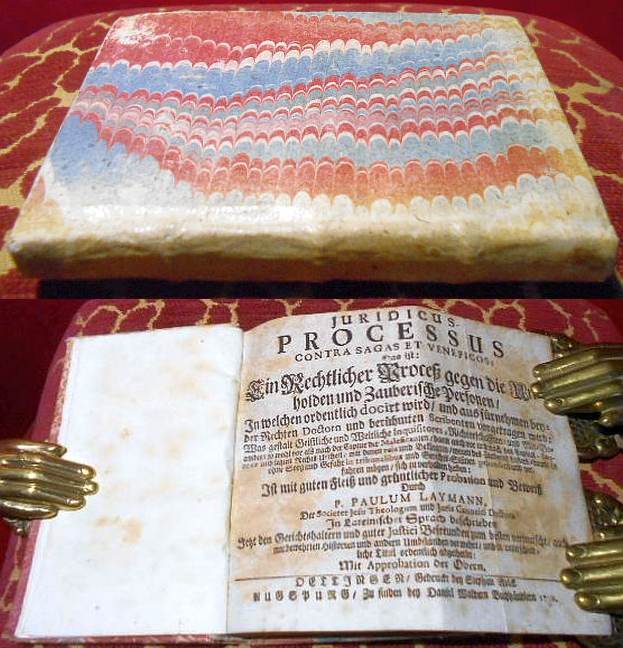
1710réf. 025946Rolck, Waldern, Oettingen, Augsburg 1710. Halbpergament Sehr gut
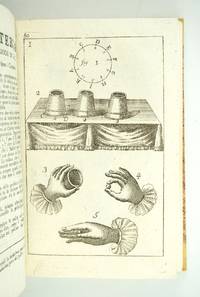
1795réf. ST20614Venice: Giuseppe Orlandelli 1795. Fourth Edition. 180 x 114 mm. 7 x 4 5/8". 154 pp 1 leaf. Pedestrian 19th century half vellum over pink marbled paper boards smooth spine with old ink lettering. WITH 16 ENGRAVED PLATES SHOWING MAGIC TRICKS and numerous diagrams in the text. Tomash & Williams A56; Riccardi I 15. Marbled paper a little chafed title washed first and last leaf a bit soiled and with repairs at inner and outer margins but no text affected half a dozen other leaves with minor repairs or mounted isolated small smudges or corner creases but still an acceptable copy of a book expected to be found in poor shape--the text clean the impression of the engravings crisp and the binding solid. This is a pleasing copy of a rather scarce collection of mathematical puzzles magic tricks and illusions abounding with illustrations and diagrams. Our author Bolognese architect and engineer Giuseppe Antonio Alberti 1712-68 had a varied career which is reflected in his literary output: his publications discuss civil engineering pyrotechnics mathematics and factories among other topics. Described by Tomash and Williams as "the type of book that mischievous uncles like to own" the present work begins with a study of amusing and unusual arithmetic equations and puzzles before discussing magic tricks and illusions including card tricks dice games and even complex stage illusions involving specialized equipment. These are illustrated with a series of delightful copper engravings with labelled mechanisms sometimes operated by lively little figures or disembodied hands with ruffled sleeves. "Giuochi" was first published in Bologna in 1747 and remained in print for a further 20 years after the present edition. Because this is the kind of book that would have been subjected to uncareful use early editions are difficult to find in the attractive condition seen here. Giuseppe Orlandelli unknown
1795réf. ST20614Venice: Giuseppe Orlandelli 1795. Fourth Edition. 180 x 114 mm. 7 x 4 5/8". 154 pp 1 leaf. Pedestrian 19th century half vellum over pink marbled paper boards smooth spine with old ink lettering. WITH 16 ENGRAVED PLATES SHOWING MAGIC TRICKS and numerous diagrams in the text. Tomash & Williams A56; Riccardi I 15. Marbled paper a little chafed title washed first and last leaf a bit soiled and with repairs at inner and outer margins but no text affected half a dozen other leaves with minor repairs or mounted isolated small smudges or corner creases but still an acceptable copy of a book expected to be found in poor shape--the text clean the impression of the engravings crisp and the binding solid. This is a pleasing copy of a rather scarce collection of mathematical puzzles magic tricks and illusions abounding with illustrations and diagrams. Our author Bolognese architect and engineer Giuseppe Antonio Alberti 1712-68 had a varied career which is reflected in his literary output: his publications discuss civil engineering pyrotechnics mathematics and factories among other topics. Described by Tomash and Williams as "the type of book that mischievous uncles like to own" the present work begins with a study of amusing and unusual arithmetic equations and puzzles before discussing magic tricks and illusions including card tricks dice games and even complex stage illusions involving specialized equipment. These are illustrated with a series of delightful copper engravings with labelled mechanisms sometimes operated by lively little figures or disembodied hands with ruffled sleeves. "Giuochi" was first published in Bologna in 1747 and remained in print for a further 20 years after the present edition. Because this is the kind of book that would have been subjected to uncareful use early editions are difficult to find in the attractive condition seen here. Giuseppe Orlandelli unknown books
1854No Date [1854] 1st edition. Original Green Cloth with embossed gilt illustrated front board & spine Small 8vo, [i]-x, [11]-282 pages; with 6 pages of undated ads. Includes 2 dramatic frontispieces separated by a tissue guard, one shows casting out the evil spirits, the other shows table tipping (reproduced in gilt on the front cover), both with attractive young women at the center. Published just 6 years after the founding of the Spritualist movement in America. Spiritualists often set March 31, 1848, as the beginning of their movement. On that date, Kate and Margaret Fox, of Hydesville, New York, reported that they had made contact with a spirit that was later claimed to be the spirit of a murdered peddler whose body was found in the house, though no record of such a person was ever found. The spirit was said to have communicated through rapping noises, audible to onlookers. The evidence of the senses appealed to practically-minded Americans, and the Fox sisters became a sensation .many early participants in Spiritualism were radical Quakers and others involved in the mid-nineteenth-century reforming movement. These reformers were uncomfortable with more prominent churches because those churches did little to fight slavery and even less to advance the cause of women's rights. Such links with reform movements, often radically socialist, had already been prepared in the 1840s, as the example of Andrew Jackson Davis shows. After 1848, many socialists became ardent spiritualists or occultists. Socialist ideas, especially in the Fourierist vein, exerted a decisive influence on Kardec and other Spiritists (Wikipedia). Only one copy has appeared at a major auction house in the last 100 years. OCLC: 504493987. OCLC lists only 1 copy worldwide (British Library). Rear board also attractively embossed. Spine sunned, occasional light foxing. Very Good Condition. An excellent attractive copy of this exceedingly rare book. (AC-22-20)
1665in-4°; pp. (8), 212, e 90 tavole a piena pagina fuori testo che riproducono oltre mille e duecento figure di mani con le linee evidenziate, Edizione originale. Quest’opera è uno dei migliori e più completi trattati di chiromanzia del XVII secolo, notevole anche per l’enorme quantità di casi di mani; in quesro apparato iconografico praticamente si comprendono tutte le possibilità di cvarianti che si esprimono nell’interpretazione chiromanztica. Inoltre a ogni figura corrisponde la descrizione nel testo. In una ristampa l’opera è attribuita a Jean Taisnier; proprio le sucessive ristampe denotano l’importanza che veniva attribuita all’opera.. Marginali fori di tarlo. Al frontespizio leggero timbro non sul testo. Sabattini 589 “edizione orig. rara”; Cicognara 2467; Caillet 10053; Ainè Biblioteca esoterica 4478 cita solo la II ed.. Legatura in piena pelle con fregi e titolo in oro al dorso.
In Fiorenza, nella Stamperia di Zanobi Pignoni, 1643, volume unico, in-4, legatura settecentesca che riutilizza due pergamene più antiche (probabilmente smontate da rilegature di libri di formato inferiore), con dorso rinforzato in carta decorata antica e titolo calligrafato su tassello in carta, pp. 610, [2]. Frontespizio stampato in rosso e nero con stemma mediceo, 23 incisioni xilografiche nel testo (fra cui forme geometriche, la pianta di un passaggio segreto, mobili a doppio fondo, teschi e ossa umane) e una tavola allegorica in rame fuori testo (che quasi mai si trova) raffigurante un liuto senza una corda su cui si poggia una cicala e con motto latino "Ut suppleat" - simbologie per la stonatura delle perversioni del genere umano, sostenuta però dall'intelletto personificato dall'apollinea cicala -. Rara opera seicentesca sul diritto criminale scritta da Antonio Maria Cospi, giudice in varie sedi dello Stato toscano fra la fine del Cinquecento e l'inizio del Seicento, ed edita postuma dal nipote Ottaviano. Si tratta di un testo di pratica giudiziaria che tenta di organizzare i ricordi e le conoscenze professionali dell'autore. Si spazia infatti dalla trattazione scientifica alla spicciola quotidianità del criminalista, passando per la superstizione e l'aneddotica. Il Cospi si sofferma nella prima parte sulla deontologia del giudice, indicando la lussuria e quindi - in una visione fortemente antifemminile - la donna come "ianua diabuli". Nella seconda parte tratta gli ambiti della criminalità, soprattutto quelli fra reato e peccato, quali la magia, la divinazione, l'eresia, la stregoneria. Nella terza, oltre che su negromanzia, avvelenamenti, stupri, aborti, ladri, zingari e bari (alle carte o ai dadi), si sofferma a lungo sull'importanza della ricognizione del cadavere e del luogo del suo ritrovamento. Ci troviamo di fronte a un quasi manuale per "la scena del crimine", con tanto di descrizioni dettagliate e illustrazioni. L'autore sostiene proprio che il giudice necessiti di conoscenze scientifiche, anatomiche, chimiche e di disegno, oltre a quelle prettamente giuridiche e morali, per poter analizzare al meglio e mettere a verbale ogni caso in modo critico. Altro concetto innovativo e fondamentale è quello della testimonianza, intesa come interrogatorio al fine di trarre indizi dall'esame del reo e vista come unica via laddove la scienza non può arrivare. Dalle bibliografie a nostra disposizione (Piantanida/Diotallevi/Livraghi 1948, Michel 1970 e la rivista "Le Carte e la Storia" edita da Il Mulino 2002) questa del 1643 risulterebbe come prima edizione, anche se, probabilmente in tempi successivi, ne sarebbe stato censito un unico esemplare, alla Biblioteca Nazionale di Firenze, datato invece 1638. Più probabilmente però, secondo la nostra interpretazione, si tratterebbe di un errore tipografico sulla data di quest'ultimo esemplare: MDCXXXVIII (1638) invece di MDCXXXXIII (1643). La carta Oo presenta uno strappo con perdita di qualche carattere; minuto camminamento di tarlo alle 6 carte da Vv3 a Xx4, solamente marginale; alcuni fascicoli leggermente bruniti per la fattura della carta. Comunque un bell'esemplare.
1675in-4 antico, pp. (8), 249 (i.e. 239), (4), leg. settecentesca m. pelle con tass. e tit. oro al d., angoli. Vignetta inc. in rame al front. Fregi xilogr. Con 50 gr. belle incis. in rame a p. pag. di Jean-Louis Duran raff. divinità, profeti e sibille. Prima rara edizione sull'arte divinatoria presso gli antichi, con la descrizione di indovini, veggenti e dei premonitori del futuro, e nozioni di magia, astrologia, chiromanzia. Casanatense 608. Caillet II, 5191 (per ediz. 1680). Cantamessa n. 5425. Lieve alone marginale, ma bell'esempl. [223]
réf. 20024Paris, Charles Hulpeau, 1629 pour les 3 premiers textes, S.l.n.d., s.n pour le dernier. 4 ouvrages en 1 vol. in-16, [14]-103 pp. + [8]-152 pp. + 63 pp. + 39 pp., parchemin rigide de l'époque, tranchefile à passe, dos long (exemplaire défraîchi mais solide, annotations).