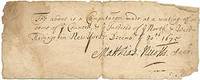
1675réf. 407229North & West Ridings Long Island New York 1675. Unbound. Good. Manuscript document. A single paragraph possibly removed from a larger document Signed at the conclusion by Matthias Nicolls. Approximately 8" x 3". Old fold some age-toning and small nicks and tears a little fragile but good. The document reads in full: "The above is a computacon made at a meeting of some of ye Councell & ye Justices of ye North & West Ridings in New York. Decembr. ye 30th 1675. Matthias Nicolls. secr." Matthias Nicholls 1626-1687 was the Provincial Secretary of New York. Born in Plymouth England he was selected to serve as secretary by Samuel Maverick who was one of the Royal Commissioners investigating conditions in New England. Accompanying the commission to New England which was headed by appointed Governor Richard Nicolls they were assigned the task of wresting the province of New York from the Dutch. Matthias held the position of provincial secretary continuously until 1680 except for the short period of 1674-75 when the Dutch briefly reoccupied New York. He was the Secretary of the Commission that accepted the Dutch surrender of New York. He served as the sixth Mayor of the city of New York in 1672-73. He is widely known as "the principal author of the legal code known as the 'Duke's Laws'." He was at least partially responsibility for religious tolerance in New York and founded the town of Plandome around his estate of the same name. unknown books
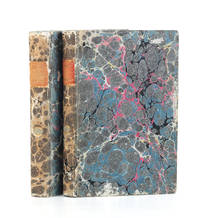
réf. 4876Six folding engraved plates. 1 p.l. xvi 322 pp.; 1 p.l. 238 pp. Two vols. 8vo cont. marbled boards orange & pale blue lettering pieces on spines. Lausanne: J. Mourer 1789. First edition. Razoumovsky 1759-1837 a wealthy Russian aristocrat spent most of his life in Switzerland Austria and Italy and wrote many noteworthy works on geological and mineralogical subjects see Zittel pp. 91 & 119. “Very scarce…First and only edition of an illustrated account of the fauna and geology of the Swiss Jura in the vicinity of Neuchâtel Murten and Biel northwest of Bern…The first volume describes the fauna according to the Linnean system. The second includes a geological description with notes on mining minerals fossils etc. The illustrations cover zoology especially reptiles entomology and geology including fossils.”–Schuh Mineralogy & Crystallography: A Biobibliography 1469 to 1920 4045. Fine and attractive set. ⧠Poggendorff II 578-79. unknown books
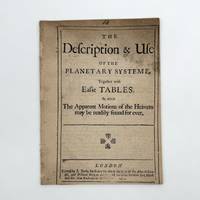
1675réf. 371490London: Printed by J. Darby for Robert Morden . and William Berry 1675. Second issue with the added Postscript. 26 2 blank 4pp. Tables. 4to. Disbound. Trimmed close minor soiling. Second issue with the added Postscript. 26 2 blank 4pp. Tables. 4to. This second issue with the added Postscript dated 1675 in which the author defends himself from criticism by John Flamsteed. The work is an early use of the term "planetary system" in the title and includes a 12-line poem on the solar system on the final page. Streete 1621-1689 Irish-born astronomer is best known for his 1661 work Astronomia Carolina a new theorie of Coelestial Motions which was read and praised by Halley Newton Flamsteed and others. A follower of Kepler Streete argued that the Earth's velocity in its annual revolution around the sun was not uniform and increases in velocity as it approaches the Sun and decreased as it moves away. ESTC calls for a plate but we find no reference to one in other extant copies. Scarce. ESTC R606; cf. Wing S5955 Printed by J. Darby, for Robert Morden ... and William Berry unknown books
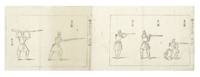
réf. 682128 folding engraved plates. 74; 86; 60; 35 folding leaves. Four vols. Oblong 8vo orig. patterned wrappers orig. block-printed title labels on upper covers new stitching. Tokyo: Government Publication issued under the Author’s name Yosoda Masayoshi a pen name for Tanabe 1869. First edition in Japanese translated from an unidentified French text which according to the Preface was issued in 1863 with a sequel in 1867. Tanabe also states that this work includes information gained from the French military mission of 17 men four officers ten non-commissioned officers and two soldiers led by staff captain Charles Sulpice Jules Chanoine who came to Japan in early 1867 at the request of the Japanese Shogunate for training in Western warfare. Several of these men became deeply involved in Japanese politics unsuccessfully fighting on the side of the Shogunate. Tanabe wrote several works on military subjects including military formations 1865 a glossary of French military terms with Japanese translations 1867 military gymnastics and training exercises 1868 and our work. This is a complete work on infantry drills and tactics including training of new soldiers how to form tactical units and deploy them effectively how to operate a variety of weapons etc. The fine copper-engraved plates depict military formations tactical positions military stances etc. Fine set. unknown books
1836réf. ST14728eLondon 1836-50. Various editions. 224 x 137 mm. 8 3/4 x 5 1/2". 16 volumes. FINE CONTEMPORARY FULL CALF MOST EITHER TREE OR POLISHED CALF see below raised bands spines intricately gilt in compartments morocco labels marbled endpapers and edges. Some works with frontispiece portraits. Front pastedowns with engraved bookplate of Edward Nicholas Hurt see below. A LOVELY COLLECTION--WITH VIRTUALLY NO SIGNS OF USE. Handsomely bound with beautifully gilt spines and just about uniform in size these volumes make an impressive appearance on the shelf. The six titles here include: 1 DE SAUMAREZ JAMES. ROSS JOHN. "MEMOIRS AND CORRESPONDENCE OF ADMIRAL LORD DE SAUMAREZ." 1838 Two volumes. Polished calf. 2 ELDON JOHN LORD CHANCELLOR. TWISS HORACE. "THE PUBLIC AND PRIVATE LIFE OF LORD CHANCELLOR ELDON." 1844 Three volumes. Polished calf. 3 HORNER FRANCIS. "MEMOIRS AND CORRESPONDENCE OF FRANCIS HORNER M. P." 1843 Two volumes. Tree calf. 4 STANHOPE PHILIP DORMER. "THE LETTERS OF PHILIP DORMER STANHOPE EARL OF CHESTERFIELD." 1845; 1853 Five volumes. Tree calf. 5 TAYLOR WILLIAM. "THE LIFE AND WRITINGS OF THE LATE WILLIAM TAYLOR OF NORWICH." 1843 Two volumes. Tree calf. 6 WARD ROBERT PLUMER. PHIPPS EDMUND. "MEMOIRS OF THE POLITICAL AND LITERARY LIFE OF ROBERT PLUMER WARD ESQ." 1850 Two volumes. Polished calf. The bookplate here is that of notable bibliophile and barrister Edward Nicholas Hurt 1795-1867 of Derbyshire and Marylebone London. He married Caroline Strutt daughter of the immensely wealthy philanthropist and social reformer Joseph Strutt 1765-1844 who was twice Mayor of Derby. As the Strutt arms are incorporated into the escutcheon of Hurt's ornate bookplate the plate can be dated to no earlier than their wedding in 1828. unknown books
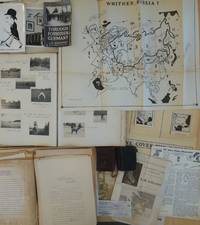
1950réf. List2425Europe and California 1950. Includes two small diaries from 1901 and 1917 with sporadic entries a large photo album measuring 14 x 11 with appx. 400 small photographs from 1906-1909 attached to album pages most measuring 3 x 2 as well as a few larger format images laid in. With 100 plus pages of typed pages including retained correspondence story ideas and various other manuscripts. With eleven maps produced for his “Of Men and Maps” series including five copies of a large map entitled “Whither Russia” in varied states and in large sizes up to 30 by 36 inches and a handful of small ephemeral pieces. Generally near fine condition with the exception of the album which is missing its rear board and has some pages loose and torn. Very Good. J.M. de Beaufort a war correspondent for the London Daily Telegraph and New York American during World War I recounted his wartime adventures in the 1917 book "Behind the German Veil: A Record of a Journalistic War Pilgrimage." Originally arriving in Chicago in 1909 he married a steel magnate's daughter and pursued a career in show business. However by 1912 he had gone through a divorce and transitioned to newspaper work earning the moniker of the "Dude Reporter." Originally born in the Netherlands as Jacques Albert Uilenbroek he was thought to be a deserter. He spent the latter part of his life in the United States apparently jailed in San Francisco for a stint in the 1920s and eventually settled in Los Angeles. Offered here is an interesting smattering of material from the life of the mysterious De Beaufort which bookends his most unusual career and life with a large visual photographic record of his life in Europe as a young man and over a hundred pages of manuscript material from late in his life with a highlight being several maps in draft form for an apparently unpublished project called “Of Men and Maps.” As a group the material shows the work of an ex-con artist and war correspondent trying to regain his form while living in Los Angeles. He was still writing as a “Special Correspondent” at this point though the title seems to have been fully honorary. Also included are two small pocket journals with sporadic notations from his life in Europe in 1900 and in 1917. In its entirety the group gives an interesting visual and manuscript record of a literary fraudulent and imaginative transatlantic life and intellect. The cartographic highlight of the group is several iterations of a large map called “Whither Russia” in varied forms which show an interesting interpretation of the sphere of influence of the USSR and its growth from 1939 to 1946. Also included are two drafts of a map of Operation Market-Garden in the Netherlands in 1944 an unidentifed tactical map of a military battlefield a map called “Middle East Jackpot” showing the division of territory between the Allied and Axis powers a map called “Dawn’s Early Light some reproduced small format maps from the De Beaufort’s and a small map called “Gifts from Yalta.” De Beaufort was working on these maps for a column called “Of Men Maps and Memories” that was published in the East Los Angeles Tribune. He also sent the columns out in newsletter form from his address at 1635 N. Ogden Drive in Los Angeles. The collection of manuscripts drafts and retained correspondence tackle a range of subjects perhaps most interestingly those detailing De Beaufort’s creative process - drafts of stories lists of ideas for stories and letters. His over the top style is on display in a lot of the writings some of which are of unknown origin and purpose. The documents contain correspondence between De Beaufort and Edwin Pauley the oil man and presidential advisor. In one untitled essay he asks himself the question “What has been your most thrilling experience” and his reply is “ Silly questions. Who or at least what newspaperman of some 25 turbulent years standing - and falling - could answer such a question. A reporter’s life has a thousand thrills. There was that rainy day in Marcy 1915 in the fortress of Loetzen when I stood face to face with Hindenburg. Hm yes that was quite a thrill…” De Beaufort was entrenched in the Los Angeles journalistic scene at this point and the documents show the degree to which he relied on his former glories to attempt various career revitalizations endeavors. The album of photographs from 1906-1909 over 400 in total give a visual record of the young Uilenbroek’s life in Europe. The star of the collection is his bulldog Bob who travels throughout Europe with him and eventually comes to America by 1907. Mary who we presume to be his future wife is featured heavily in the images. It is unclear whether he was working at this point the images show affluent young people and their dog in varied cities and are purely of a personal nature. Other photographs laid in are relics from his war correspondent period. The loose photographs and ephemera are a mix of portraits from different periods from his life including two pictures of Sydney Turing Barlow Lawson one signed by his widow. The journals are sporadically filled and hard to decipher though one legible passage says “drinking all day.” Overall the group gives evidence of this intriguing life and is the only extant group of material relating to Beaufort to our knowledge with the exception of a single journal from his time in Belgium during WWI that was sold at Bonhams and is still available in the trade as of this writing. unknown books
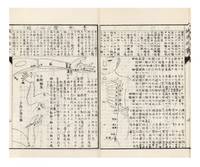
réf. 7485Numerous woodcut illustrations in the text. Title-page 31 folding leaves one leaf of colophon. 8vo orig. patterned blue semi-stiff wrappers orig. block-printed title label on upper cover label rubbed new stitching. Tokyo Kyoto & Osaka: 1864. First edition and rare. Imamura 1814-90 was a leading physician and historian of Japanese medicine of his period. Professor of medicine at Tokyo University he was physician to the future Emperor Taisho when he was a youth. Imamura found that many of the contemporary Japanese works on acupuncture had strayed from the classic teachings of the Chinese physicians. In this work he makes a series of corrections to refine the fourteen meridians. The numerous woodcuts depict various parts of the body and pressure points. Very nice copy. Light stain to first few leaves. ⧠Mestler Old Japanese Medical Books I p. 297. unknown books
réf. 6812Eight full-page drawings & one illus. in the text. 17 folding leaves. 8vo 243 x 165 mm. orig. blue semi-stiff wrappers some dampstaining to upper portion of each leaf. Japan: mid-Edo. Kagawa 1683-1755 a member of the medical family dynasty studied in Kyoto with Ryozan Goto and Jinsai Ito from whom he learned moxibustion and the therapeutic value of the waters of hot springs. Kagawa established the successful Ippondo medical school and was one of the most enthusiastic practitioners of moxibustion of his time. There is another manuscript of this text at Kyoto University attributed to Kagawa. Some of the illustrations are very different. The introductory remarks describe the importance of the precise placement of the moxa on the skin how to measure the placements based on distance from certain bones or joints of the body and the various techniques and occasions for moxibustion applications. Following this the text precisely describes the moxibustion locations on the body and how to locate each one with references to Simiao Sun’s classic text Qian jin fang Essential Prescriptions Worth a Thousand Gold Pieces compiled in 650-59. Kagawa lists many diseases and injuries for which moxibustion is appropriate. There is a most interesting section on how to treat unsuccessful moxibustion procedures application of certain ointments etc. The attractive illustrations depict moxibustion loci on an osteological background and loci on the stomach arms legs and feet. As mentioned above there is dampstaining to the upper fifth of each leaf but all the characters remain completely legible. unknown books
réf. 1053143 folding leaves. 8vo 240 x 170 mm. orig. patterned semi-stiff wrappers with orig. title-slip old stitching. Japan: 1791 date of Preface. A rare manuscript of Japanese natural studies or the “learning of roots and herbs” honzÅgaku 本è‰å¸ by ZÅ doctor and botanist 1758-1834. It was one of the major intellectual trends of the Tokugawa period with a large portion of the educated classes taking an interest in the topic. Initially inspired by the Chinese encyclopedic work Bencao gangmu 本è‰ç¶±ç›® Systematic Materia Medica Japanese natural studies came with time to focus on the natural environment of Japan in contradistinction to China. Our manuscript explicitly concerned with the mushrooms of “Our August Japan” is a case in point. It contains descriptions of 129 mushrooms divided into categories: wood mushrooms ground mushrooms bamboo mushrooms wood-ear mushrooms and poisonous mushrooms. Our author lists alternative names for a mushroom in question notes where it grows and describes its appearance. Literary references are given in many of the entries. Curiously despite the manuscript’s title ZÅ Han quotes from Chinese local gazetteers which often contained lists of local products. There is an appendix which contains four essays. discusses in turn different names of the mushroom in various parts of Japan; the etymology of the character kinoko 蕈 meaning mushroom; the method of ascertaining the poisonous character of a mushroom; and a prescription for breaking down the poison. ZÅ was the author of Seikei zusetsu An Illustrated Book of Agricultural Things the great agricultural and botanical work issued in the early years of the 19th century. It is an encyclopedic survey of all the agricultural products and practices of Japan. He served the Satsuma fiefdom under the lord Shimazu Shigehide Our text was never printed circulating only in manuscript form. ⧠Ueno MasuzÅ 上野益三 Nihon hakubutsugakushi 日本åšç‰©å¦å² Tokyo: Heibonsha 1973 p. 416. unknown books
réf. 11598Eight double-page & 24 full-page woodcuts. .5 32; 36 folding leaves. 8vo orig. semi-stiff wrappers now mottled title-slips new stitching. Japan: 1867; Preface dated 1865 & Postscripts dated 1861 & 1866. First edition. The tragic story of Hayashi Shihei æž—åå¹³ 1738-93 and his efforts to prepare Japan for changing times is well known. A Japanese scholar and a specialist in military affairs he travelled to Nagasaki in 1777 where he was greatly impressed by the size and strength of the Dutch ships. While there he learned of Russian intentions to advance south from Siberia into Asia. This prompted him to go to the northernmost island of Hokkaido to study the situation. As a result of this journey he became alarmed at the weakness of Japan's coastal defenses and ignorance of the outside world. In 1787 Hayashi began to privately issue in a series of 16 volumes only 38 sets were produced his famous and controversial Kaikoku heidan which recommended stronger military forces and a maritime defense capability. His series is a remarkable example of a study on modern strategy introducing the military sciences of the West to Japan. Hayashi describes the powerful weaponry of the Western powers and openly criticizes the shogunate for its ignorance of the rest of the world and reliance upon an isolationist policy while neglecting maritime defenses. Kaikoku heidan caused a sensation and was banned by the government in 1792 on the grounds that national security matters were being discussed without official consent. Almost all copies and the woodblocks were confiscated. Hayashi was placed under house arrest in 1792 and died the following year. In his final years he used the pen name "Rokumusai" meaning "Six Losses" enumerated as: "no parents no wife no children no woodblocks no money and no desire to die." The present work by his nephew Michiyuki who had studied under the military theorists Oikawa Kanzaemon åŠå·å‹˜å·¦è¡›é–€ and Hishita JūzŠ日下å蔵 is both an homage to his uncle and an addendum on the modern role of horses and cavalry in warfare as practiced in the West. Michiyuki believed that the traditional Japanese methods of using horses in battle were no longer relevant and that the samurai must be trained in the methods practiced by the cavalries of Western countries. The book is richly illustrated. In the first volume are fine woodcuts of training patterns designed to improve the horses' agility. Also shown are a series of horses' eyes and teeth each revealing the character of the animal and its suitability in warfare. Acupuncture points on legs of horses are also shown. The woodcuts in the second volume depict modernized saddles stirrups bridles and horseshoes. Fine set and very scarce. Preserved in a chitsu. unknown books
réf. 7548151 folding leaves. Three parts in one vol. Thickish 8vo orig. patterned wrappers upper wrapper a little worn orig. block-printed title label on upper cover label somewhat defective new stitching. From the colophon: Kyoto: Nakamura Magobei 1710. First edition of this important and useful bibliography. In 1710 “the Kyoto publisher Nakamura Magobei compiled a catalogue known as Bengi shomokuroku. The aim of this catalogue was to help the reader disentangle book titles which could be easily confused because they were read in the same way because they used the same characters but different readings or because they were known by several titles…Nakamura Magobei included manuscripts kakihon and explained that he had ‘given the majority of the many titles of manuscripts that have been circulating since past times’.”–Laura Moretti “The Japanese Early-Modern Publishing Market Unveiled: A Survey of Edo-Period Booksellers’ Catalogues” in East Asian Publishing and Society Vol. 2 2012 pp. 206n & 245. Nice copy preserved in a chitsu. Some minor worming carefully repaired. ⧠Peter Kornicki The Book in Japan pp. 441-42–”The publication of Bengisho mokuroku in 1710 went considerably further. The author was Nakamura Magobee a Kyoto publisher and bookseller and it was written for fellow members of the book trade. He considered books printed with movable type as a separate category and was the first to draw up a catalogue of them. He directed some attention to the book trade which also explains his attention to the titles of books not yet published and to books with homophonic titles that could easily be confused. At the same time the compilation of catalogues for commercial and for private purposes was becoming commonplace and bespeaks a growing concern with the identification of books by their distinguishing characteristics.”. unknown books
1541réf. 6509Luguduni sic: Lyon: Seb. Gryphium Sebastian Gryphius 1541. Early reprint. Leatherbound. Good. 12mo. Pp. 314 13. Early 18th-C. tree calf five raised bands with gilt tooled decorations and lettering piece edges trimmed and dyed red. Decorative initial caps italic text with roman titles table of Latin and Greek chapter titles marginal notes index following text followed by a tail-piece that of a gryffin in reference to printer Gryphius. Includes Appendicula de condituris varijs ex Ioanne Damasceno a section of fourteen recipes for "condimenta" and "condituræ" between De Re Culinaria and Facultatibus alimentorum. Spine ends chipped edges rubbed endpapers stained marginal annotations in ink tight binding. Presents four culinary and health texts as called for appearing together with Torinus' introduction the same year as a nearly identical Basel edition but in smaller format for a different market. The collection of Roman recipes De Re Culinaria attributed to Apicius first appeared in this form in the fifth century AD. Torinus' sources were "codexes" found in Maguelone and Transylvania. Bartolomeo Sacchi Platina's De Honesta Voluptate given an alternate title by Torinus was the first movable-type cookbook based on Maestro Martino da Como's recipes. Paul of Aegina was a Byzantine Greek physician. Gryphius learned printing from his father in Germany then in Venice moving to Lyon around 1520. By the 1540s he had the city's largest printing establishment and reputation for a high standard of editing and impression specializing in Humanist works in small format modeled on Aldus Manutius. DURLING Sixteenth Century Printed Books in the National Library of Medicine 232. . Seb. Gryphium [Sebastian Gryphius] unknown books
1759réf. 137120Paris: J. Barbou 1759. Full period French binding in Calf five raised bands gilt ornamentation on spine author and title in gilt on red leather spine label in second compartment. 8vo. Full period French binding in Calf five raised bands gilt ornamentation on spine author and title in gilt on red leather spine label in second compartment. 263 pages. First edition Bigmore and Wyman p.228. Minor soiling to the text block else a fine copy. In this volume Fournier sets out to prove that Gutenberg was not the inventor of the printing press by examining the history of printing. He believes that the technology Gutenberg made popular existed long before the German printer's work. "Peter Simon Fournier a French engraver and letter-founder was born at Paris 1712 and died 1768. He studied under Colson painter of the Academy of Saint Luc and devoted himself first to the art of wood-engraving; he afterwards as an engraver on steel rendered himself famous in all countries. In some of his works he seeks to prove that Gutenberg is not the inventor of printing and maintains that long before Gutenberg engraving on wood had been employed for printing images and inscriptions; that during his residence in Strasburg Gutenberg attempted the application of this art to the printing of books and that on his return to Mayence he first printed the Donatus and the Catholicon of Johannes de Janua with engraved and solid blocks. Fournier's ingenious theories were ably refuted by Baron Heinecken in his "Idée Générale d'une Collection complette d'Estamples" Leipsic: 1771" Bigmore & Wyman p 229. J. Barbou unknown books
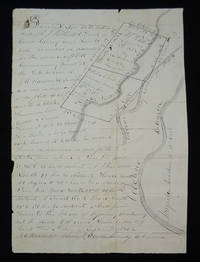
1852réf. 68368Placer County California 1852. GOLD RUSH. Gold Rush Map Manuscript. Being a Survey for the adjoining plots of land belonging to H.H. Watson and A.J. Polhill. Placer County California: 1852. Two pages on a single sheet 17 1/8 x 10 7/8 in.; 438 x 275 mm. Manuscript document with map dated variously between 4-24 September 1852 and signed by H.H. Watson A.J. Polhill and others. Sheet with some mild staining and ink blots. Some minor chipping at edges and some separations at the creases. Creases reinforced with nearly invisible tape. Overall a very interesting piece of gold rush history. We could not find any other California mine surveys at auction in the past 50 years. "Survey for H.H. Watson and A.J. Polhill. A Tract of land laying near ville bounded as described in the annex plot commencing point as the S.W. corner of J.H. Hancock survey." "Survey made by N.O. Hinman County Surveyor." "In the present survey the tracts of land being issued to Watson and Polhill are bounded on the right by the Volcano Mining Company Ditch and Volcano Canion sic with the Todds sic Valley Company Ditch running through each plot. The Volcano Gold Gravel Mining Company was one of the most extensive gravel mines during the Gold Rush and hundreds of acres of valuable mining lands were drained by its enterprises. Placer County falls in both the Sacramento Valley and Sierra Nevada regions in what is known as the Gold Country. The discovery of gold in this region in 1848 brought tens of thousands of miners from around the world and thousands more settled in the area to provide goods and services to them. The name "Placer" is taken from the Spanish word for gravel or sand deposits containing gold." From Sotheby's. HBS 68368. $3500. Placer County, California unknown books
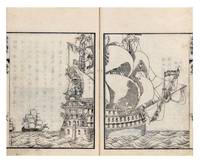
réf. 10340Many fine woodcuts throughout. Four parts & appendices in five vols. 8vo orig. semi-stiff wrappers a little frayed old stitching orig. title slips on covers. Tokyo: Yamasakiya Seishichi 山崎屋清七 et al. 1852. First printed edition of this artillery manual from the bakumatsu period. In the early 19th century Japan came under increased pressure from Western nations that wanted access to Japanese ports. “The Shogunate government issued the Order to Drive Away Foreign Ships in 1825 and commanded that foreign ships appearing along the coast of Japan be fired upon so the domains along the coast began building gun batteries and installing cannons. This is when the gun batteries and emplacements were built at Odaiba in Edo Bay and at Uraga Nakaminato Tahara Maiko Dannoura Uwajima Kagoshima and elsewhere. Dutch coastal artillery books were referred to when building these gun batteries” NDL Japan-Netherlands Exchange in the Edo Period online. Our book was published in this historical context. The book had already been translated by Motoki Masahide 1767-1822 who had left it unpublished at his death manuscript copies exist. Nunokawa Tsūboku 布å·é€šç’ž who edited Motoki’s translation and brought it to print in his Preface referenced the order that the domains build coastal defenses as one justification for publication. Motoki had studied not only Dutch but also French Russian and English. He published an English-language primer in 1811 and an English-Japanese dictionary in 1814. The Dutch original from which the book was translated was titled Het Nieuwe Licht Der Bosschieterye 1699 and was written by Gerrit van der Tollen fl. 1721-23 who worked for the Dutch East India Company. Our book is richly illustrated with a series of fine single- and double-page woodcuts of many kinds of cannons and mortars cannonballs and Western warships along with diagrams of problems in ballistics. Sections include illustrations and explanations of the structure and dimensions of cannons the measurement of gunpowder and lists of Dutch terms translated into Japanese. Some sections are written in a question-and-answer format “Which countries produce cannons Is there a difference in the making of light and heavy cannonballs”. The book begins with a history of artillery a topic that is treated further in the appendices which were not written by Motoki. The appendices treat the history of artillery both in Europe and in China. Note that Google Books presents the copy at the Bavarian State Library as being published in 1825 but the digitized title page says Kaei mizunoene which corresponds to 1852 and is the same date as seen in our book. Very fine set. ⧠Motoki: Christopher Joby The Dutch Language in Japan 1600-1900 Leiden & Boston: 2021 pp. 74 121 186 191 196-97 276 285 & 320. unknown books
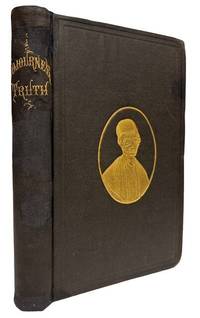
1875réf. 93724Boston: Published for the Author 1875. Hardcover. Very Good. frontis portrait 320p. Original black cloth. Simple gilt oval portrait on front cover. 19 cm. Four separate sizeable cloth pieces adding up to almost half of the total area were missing from backstrip which did still have the original gilt title at the top. Vintage black cloth added under partial backstrip. Wear at cover corners stiffened and some black paper added. Internally sound and clean with almost no foxing. We have also had this 1875 edition in publisher's cloth that was rust brown and perhaps in other colors. Published for the Author hardcover books
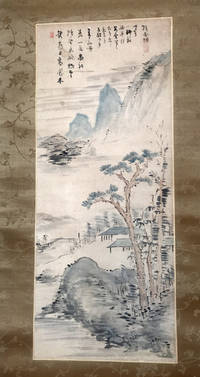
réf. 90223Rai KyÅhei 頼京平 aka ShunsÅ or Manshiro artist. Kakemono 掛ã‘物 - Hanging Scroll Landscape. N.p. n.d. Landscape painting of a mountain scene with pine trees. Hanging scroll kakemono 掛ã‘物 beautifully mounted on brocade with black wooden jiku handles. Image size 44.7x18.4cm with 49.5cm silk fabric at top 26.5cm at bottom and borders of approx 5-5.5cm on either side. Rai KyÅhei 頼京平 c.1756-1834 was an influential Confucian scholar and the uncle of the famous kanshi poet Rai SanyÅ. Sanyo was known for TÅjun KagetsuchÅ å旬花月帖 Journal of Flowers in 100 Days/ A Few Brief Moments Describing Moon and Flowers a collaborative work of poetry with floral and landscape paintings created after a three month walking tour through central Japan with his nephew and mother in the 1820s. The three poets and their entourage were influenced by the lyrical scenes of nature observed in Kyoto and Nara during their travels. This scroll is likely inspired by that period of travel and reflection in nature. Slight foxing on the image. Encased in a wooden scroll box 40.7 x 6.4cm with artist’s name brushed on label laid down on end of box. unknown books
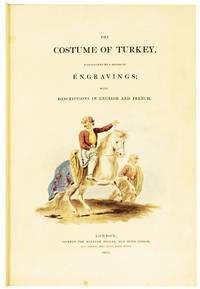
1802réf. 6160"ONE OF THE BASIC WORKS ON TURKISH COSTUME" ATABEY Folio 35 x 24.4 cm. Hand-colored vignette title-page in English followed by title-page in French; preface in English and French 8 pp; table of contents in English and French 2 pp.; and 60 hand-colored stipple engravings many on paper with watermarks dated 1796 after Octavian Dalvimart and engraved by John Dadley or William Poole the title-page vignette by R. Jones; each engraving always printed on the verso with facing description page English on recto and French on verso. Occasional light spotting and off-setting from plates to the facing description; plate 1 and tissue guard bound at the beginning preceding English title-page. Early 20th-century red straight morocco by Bayntun-Rivière their stamp in upper left-hand corner of front flyleaf blind- and gilt-stamped tooling on boards turn-ins and spine marbled endpapers; some rubbing but generally excellent. First edition with watermarks dated 1796 of "one of the basic works on Turkish costume which has provided the prototypes for numerous other illustrative material" Atabey. Dalvimart's vivid plates primarily depict the vibrant attire of the ruling classes and their servants but they also showcase traditional garments—especially those worn by women—from the extensive territories of the Ottoman Empire at the time encompassing regions such as Bosnia Albania Greece Syria and Egypt. Octavian Dalvimart remains a somewhat enigmatic figure. He appears to have been active as an artist and engraver in England and France in the early 19th century. According to the preface he traveled to Athens in 1797 and Turkey in 1798 where he created the original drawings for the plates consistently sketching from life. The characters are precisely drawn and handsomely depicted in vivid colors. The accompanying descriptive text is sometimes attributed to William Alexander drawing heavily from the published accounts of Turkey by James Dallaway 1797 Baron de Tott who resided in Constantinople for many years until 1790 and other sources. This first edition was followed by subsequent editions in 1818 and 1820. Little is known about the two engravers John Dadley 1767–after 1807 who worked in London and William Poole active 1803-1807. R. Jones active early 19th century exhibited at the Royal Academy from 1780 to 1812. Abbey Travel 370; Atabey 312; Blackmer 444 ca. 1820 impression Colas 782; H. Hiler Bibl. of Costume 1939; Lipperheide 1422; Vinet 2337; Bénézit III p. 317 Dadley III p. 335 Dalvimart and VI p. 95 Jones no entry for Poole. London, Printed for William Miller, Old Bond Street, by T. Bensley, Bolt Court, Fleet Street hardcover books
1526réf. 4610Florence: Per haeredes Philippi Iuntae 1526. SECOND GIUNTA EDITION 1st 1519. Hardcover. Fine. A tall unsophisticated copy in its original limp vellum binding vellum stained lacking ties short split to upper hinge. The text is in very good condition with intermittent foxing heavier in some gatherings. A compendium of ancient geographical texts including descriptions of the known world by Pomponius Mela Dionysius Periegetes and Gaius Julius Solinus. Shorter texts include a catalogue of the regions within the city of Rome "De regionibus urbis Romae" by "Publius Victor". The work is possibly a literary forgery of the 15th century presented as the work of a newly-discovered author. The name was coined by Pomponius Leto of the Roman Academy. The volume was edited by Antonio Francino 1480- after 1537 a scholar of great talent who taught in the households of important Florentines and who produced starting in 1517 numerous editions of Greek and Latin authors for the Giunta firm. Francino's opening letter in this volume is addressed to the twenty-year old Pietro Vettori who would himself become a philologist of great renown. Pomponius Mela's Description of the World: "A generation earlier than the work of the natural historian Pliny under the reign of Claudius or Caligula we find the first Latin author whom to the best of our knowledge we can call a pure geographer and whose work has come down to us complete. This is Pomponius Mela a Spaniard from Tingentera near Gibraltar whose Chronographia "Description of Places" in three books is preserved. The Chronographia describes the world taking the Mediterranean as its basic point of reference. It proceeds counterclockwise from the Strait of Gibraltar whither it returns at the end of the description."Conte "After a short prooemium in which he dwells upon the importance and difficulties of his undertaking he proceeds to define the cardinal points and to explain the division of the world into two hemispheres and five zones. The northern hemisphere is that portion of the Earth which is known and is separated by the impassable torrid zone from the southern hemisphere which is altogether unknown and is the abode of the Antichthones. The northern known hemisphere is completely surrounded by the ocean which communicates with the four great seas: one on the north the Caspian; two on the south the Persian and the Arabian; and one in the west The Mediterranean with its subdivisions. Next follows a description of the three continents: Asia Europe and Africa and an enumeration of its inhabitants. These preliminaries being discussed the author enters upon more minute details and makes a complete circuit of the known world. "Thus commencing at the straits of Hercules with Mauritania he passes on in regular order to Numidia Africa Proper the Cyrenaica Egypt Arabia Syria Phoenicia Cilicia Pamphylia Lycia Caria Ionia Aeolis Bithynia Paphlagonia the Asiatic nations on the Euxine and the Palus Maeotis European Scythia Thrace Macedonia Greece the Peloponinesus Epirus Illyricum Italy from the head of the Adriatic round by Magna Graecia to the Ligurian Gulf Gallia Narbonnensis and the eastern coast of Spain. Hispaniae ora citerior. The tour of the Mediterranean being now completed a chapter is devoted to its islands. Passing beyond the Straits we stretch along the western coast of Spain Hispaniae ora exterior the western coast of Gaul Galliae ora exterior the islands of the Northern Ocean Germany Sarmatia the shores of the Caspian the Eastern Ocean and India the Mare Rubrum and its two gulfs the Persian and Arabian Aethiopia and those portions of Aethiop a and Mauritania bordering upon the Atlantic which brings him round to the point from which he started. It will be seen from the above sketch that the existence of the northern countries of Europe and of the northern and eastern countries of Asia were unknown it being supposed that these regions formed part of the ocean which in like manner was supposed to occupy the whole of Central and Southern Africa."Smith Dictionary of Greek and Roman biography Solinus: "Gaius Julius Solinus who probably lived between the middle and the end of the third century was concerned with geography though not in the modern sense of the term. His work is entitled Collectanea Rerum Memorabilium but in the Middle Ages when it was widely read it was also known as Polyhistor to emphasize the great number of curiosities that were collected there. The work is a careful compilation from many literary sources chiefly Pliny the Elder but also Pomponius Mela and Suetonius along with various other geographical treatises that are no longer extant. Solinus noted down all the unusual things he came across when reading these works about peoples and their customs animals and plants. "The work opens with a full treatment of Rome and Roman history from the kings to the principate of Augustus. The area examined is then extended to Italy and then to Greece and the Black Sea Germany Gaul Britain and Spain; this counterclockwise tour ends with Africa Arabia Asia Minor India and the kingdom of the Parthians in accordance with a systematic geographical plan that is one of the most characteristic features of the work. It enjoyed considerable success in the Middle Ages when it was also read and studied as a summary of the excessively vast Naturalis Historia of Pliny the Elder. It did not however altogether replace it with the result that it enjoyed so to speak a success parallel to that of its more illustrious predecessor."Conte "Referring to the reading of Pliny and Solinus in the Middle Ages and Renaissance Anthony Grafton writes: 'Generations of readers thrilled like Desdemona listening to Othello at these tales of strange creatures foods and burial customs - and were no doubt stimulated by them to see the inhabitants of strange lands as literally outlandish less than civilized or even less than human.' Charles Raymond Beazley has made note of this remarkable appeal: 'The compilation of Solinus. became so fashionable in the Middle Ages and exercised so powerful an influence on the geographical imagination that it cannot be passed over. It is simply a collection of marvels chiefly of natural history brought together apparently on the principle 'Credo' or at least 'Lego quia impossibile.'. no one ever influenced Christian geography more profoundly or mischievously." "References to and borrowings from Solinus can be found in a wide variety of medieval texts stretching though the whole of the medieval period. Readers of Solinus ranged from Augustine to Bede to Dante and Solinus' influence can be seen in examples as varied as the Hereford Mappa mundi ca. 1300 and Fazio degli Uberti's verse epic 'Dittamondo' 14th c. in which Solinus in the place of Dante's Virgil guides a pilgrim on a tour of the known world. The interest in Solinus had not waned by the fifteenth century. While geography was not a primary area of interest for the humanists Solinus Pliny and authors like them were widely read and commented upon by Renaissance scholars. The strong interest in antiquity that characterized the Renaissance continued the medieval curiosity for the Roman compilers who seemed to have succeeded in encapsulating the entire world and all the knowledge in it."Dover and McDonough. Per haeredes Philippi Iuntae hardcover books
1851réf. 28441New York: Nagel & Weingaertner 1851. Hand-coloured lithograph after Hanson titled below the image. Expert restoration closing tears. The first America's Cup: a rare hand coloured lithographed view of the winning yacht which gave its name to the cup. In 1851 the Royal Yacht Squadron proposed a race around the Isle of Wight. A group of New York Yacht Club members led by Commodore John Cox Stevens built a yacht designed to compete in such races. Designed by Steers and Co. and captained by Richard Brown the yacht America would win the race by eighteen minutes giving its name to one of the oldest and best-known trophies of the sport: the America's Cup. This lithograph and lithographer are not recorded by Harry T. Peters; we find no other extant examples of this rare print. For Nagel and Weingaertner see Peters America on Stone pp. 291-294. Nagel & Weingaertner unknown books
1850réf. 68036Northumberland NY and Tuolumne County CA. 1850–1857. New Yorker in the "Land of Gold" A scattered but intriguing collection of manuscripts related to New York native Isaac Vanderwerker or Vanderwarker who made for the California gold mines in 1850 and remained out west until at least 1857. This group consists primarily of letters written to Isaac by his brother at home in Northumberland inquiring after Isaac's activities in the gold fields and commenting on matters at home though it also contains a detailed letter from Isaac himself a letter from his ill-fated sister Joann and two letters written by business partners in California. The earliest letter here written by Isaac's brother who signs only with initials is dated October 7 1850 shortly after Isaac arrived in California. Isaac was apparently one of many gold-seekers who elected to take a slow sailing ship from Panama rather than wait on the heavily delayed steamships though he weathered the journey better than most. Isaac's brother also notes several acquaintances who "have returned without making their fortune" and still more who are leaving regularly for the mines including a "Justus" who "made a vendue and sold his personal property" in order to fund the journey. Everyone in town it seems either wants to head to California or has an excuse not to. "I hope you will be one of the lucky ones and get well paid for all your toil sufferings and anxieties" he writes to his brother. "We have most of the California news every month. I saw in the last paper an account of the riot and burning of Sacramento City it spoke of some large lumps of gold being taken out weighing from one to forty pounds at Carsons new diggings on the Stanislaw another instance where a man took out four thousand dollars in two days at Murphy diggings but these cases are something extra John L. Cramer is at the Northern Mines on the Yuba…." The Vanderwerkers were early settlers of upstate New York and appear to have done well for themselves – Isaac and his brother are involved in several substantial properties and much of their correspondence relates to the management of their farms. The next letter in the group comes from the following summer written by Isaac's sister Joann. Joann discusses more details of the family's properties and notes that her health is poor enough that she is not sure to see the end of the week. Regardless news of California remains at front of mind: "There is a story in circulation that Aron Bliss Jaines Brother in law has stoll 15 thousand dollars at San Francisco and the owner has followed him here and there a going to take him back and hang him. John Cramer is on the yube never his Father said he guest by his writing he was not doing very well." From here we skip two years to October 16 1853 when Isaac's brother writes to tell him that large numbers are still heading for California. Joann has been holding on the last two years and "Old Frank" who used to work with them before moving to Canada would like to know if Isaac has work for him in California. He also goes on to discuss a bit of contentious New York politics: "We shall have five state tickets this fall viz whig Barnburner or soft hunker Adamantine or hard Temperance & abolition. The whigs no dout will carry the Election. The Barnburners had quite a majority in the State Convention….the Canal board are Barnburners & they are making a clean sweep of the hunkers." The letters continue over the next few years regarding more transcontinental legal matters real estate dealings Joann's eventual death in 1855 and the usual litany of deaths and marriages at home. The most content rich letter in the group is the only one written by Isaac himself sent to New York from Tuolumne County on May 18 1857. As Isaac describes his life in the west he also reveals himself to be a talented writer: "Dear Brother I will again endeavour to correspond with you by a few rude caught characters on paper which may put you in mind that you have a Brother Still in the land of gold…." He sends some gold home not present describes a chance meeting with the aforementioned John Cramer remarks on the high cost of goods in the mines and recent fires in San Francisco and Stockton. Business isn't cheap in the "land of gold" and he claims he "can do as much business in the States for 10 Dollars as I can Here for one Hundred." With that in mind he adds a postscript stating that he has sold out his plot and mining apparatus for $1500 and will try to go into business burning lime or supplying bricks and lumber in Benicia. He describes the new town and the rapid pace of development in California: "Benicia is situated about thirty miles up the Bay from San Francisco and about Six miles from the present Capital of the state named Vallejo. About three months ago the first building was erected which is a Hotel about two weeks ago they commenced building there is now about twenty small houses up and one three story Hotel. The government officers reside at Vallejo after the 10 of this month. I had an introduction to the governor at Vallejo last week he is a clever sort of man but not Dignified hardly fit for the Station…." Isaac's brother responds to this letter a few months later curious about his sibling's new business ventures. He also comments that "by what I can learn of the character of the Mexicans and Indians I should hate to travel alone without being well armed. I see by our papers that Lynch Law is that that governs all the mines I saw an account of a man being hung at San Francisco by Mr. Lynch at short notice." Unsurprisingly more and more are returning home by 1857 including a man named Wells " come in the same steamer your letter did he was sick but made out to keep up till he got home and died less than a week after he was not very successful in California." A heartfelt letter from a friend about the health of Isaac's mother also present seems to have convinced him and Isaac returned home for a visit to New York in the latter part of 1857. A September 3rd letter from his business partner John W. Kelly sent from Sawmill Flatt is addressed to Isaac in Saratoga and discusses business dealings in California. It would appear Isaac never pulled completely out of mining as the letter regards efforts to secure mortgage payments for Isaac's "ditch." The final letter in this collection is dated December 17 1857 and is addressed to Isaac from the offices of A.C. Goodrich in Columbia California. Goodrich describes a large flume his company has built 180 miles long and twelve feet wide by three feet deep "exclusive of the artificial embankment or five hundred ton stream capacity this day and night as we have reservoirs in abundance to hold the night & Sunday water. Would give 1000 ton streams which sold at the precent price viz $4.00 per day would pay ten per cent on a Capital of $1000.000. This would give a large basis for waste and reduction in price and still leave room for handsome profits on our Capital stock of $450000. The present cost of the work we can only approximate to but it is not far from 100000$." They hope that Isaac can become their agent and help them find investors. An interesting group of letters sent between brothers in California and New York during the Gold Rush stretching across seven long years of separation. Old folds occasional light tanning and staining. Very good. unknown books
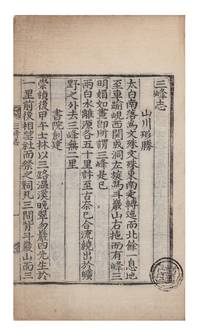
réf. 942031 folding leaves. Large 8vo 305 x 190 mm. orig. patterned semi-stiff wrappers wrappers slightly soiled new stitching. Yeongju: 1774. First edition and very rare of this gazetteer for the Confucian Three Peaks Academy WorldCat 46318280. The word “gazetteer” is used in reference to a genre of East Asian historical and geographical texts generally known in Korea as ŭpchi 邑志 which translates roughly to “local treatises.” The now rare word “gazetteer” is used in analogy with a similar genre that existed in British India. It was not unusual for Korean gazetteers to be published by a local Confucian academy as seems to be the case here. Confucian academies were important centers of intellectual life in ChosÅn Korea. Several of the leading thinkers of the era spent parts of their career teaching at academies thus creating a following. The Three Peaks Academy Sambong sÅwÅn 三峰書院 was founded in the village Valley of Three Peaks sambonggol 三峰谷 in 1654. The colophon explains the genesis of the gazetteer: “The late Mr. Ch’Ål-nam éµå— i.e. Kim Si-hwa é‡‘å§‹éµ 1662-1772 wrote and edited the gazetteer taking note of the geographical features and dates of buildings the positions and names of halls houses ponds and lookouts and recording them for posterity.” Kim Si-hwa furthermore recorded key events in the lives of scholars who had taught at the academy. Kim Wi 金㙔 1709-89 who authored the colophon dated 1774 wrote about the updates that had been made to Kim Si-hwa’s text for our edition. We find no record of an earlier printing; probably Kim Si-hwa’s text was first published in this edition. Nice copy. WorldCat locates only the Berkeley copy. References Digital culture encyclopedia for Yeongju 디지털ì˜ì£¼ë¬¸í™”ëŒ€ì „. http://www.grandculture.net/yeongju Korean Old and Rare Collection Information System í•œêµê³ 문헌종합목ë¡. https://www.nl.go.kr/korcis/index.do PÅk’ŭlli taehak Tongasia tosÅgwan sujip Han’guk kojÅnjÅk mongnok 버í´ë¦¬ëŒ€í•™ ë™ì•„시아ë„서관 수집 韓國å¤å…¸ç±ç›®éŒ„. Seoul: KoryÅ taehakkyo minjok munhwa yÅn'guwÅn 2009. “Sambong ha sambong sÅwÅn maŭl ‘Sambonggol’” 삼봉三峯 下 삼봉서ì›ä¸‰å³¯æ›¸é™¢ ë§ˆì„ ‘삼봉골三峯谷’. YÅngju simin sinmun ì˜ì£¼ì‹œë¯¼ì‹ 문 November 26 2018. https://www.yjinews.com/news/articleView.htmlidxno=49174. unknown books
réf. 8576Many fine black & white double-page & single-page woodcuts throughout. Ten vols. 8vo orig. blue semi-stiff wrappers orig. block-printed title labels on upper covers three labels are somewhat defective new stitching. Osaka: Tenmaya Yasubei; Kyoto: Yoshida Jihei 1835. with: — & MATSUKAWA Hanzan; —. Ehon Toyotomi Ryukyu gunki Illustrated Tale of the Ryukyu War. Many fine black & white double-page & single-page woodcuts throughout six in Vol. I are color-printed. Ten vols. 8vo orig. pale blue patterned wrappers orig. block-printed title labels on upper covers new stitching. Osaka: Kawachiya Tobei & Kawachiya Mohei colophon dated 1864; title-page dated 1862. First edition of these finely illustrated stories of the conquest of the Ryukyu kingdom in 1609 by the Shimazu clan of southern Kyushu. The main artist Okada Gyokuzan Issei or Ishida is a rather shadowy figure; he probably studied under the famous Okada Gyokuzan of Osaka but we know very little about him. The second work Ehon Toyotomi Ryukyu gunki has an additional artist Matsukawa Hanzan 1818-82 who studied painting under Suga Shoho and worked in Osaka as a book illustrator. This is a splendid example of an ehon yomihon a type of long novel combining text with frequent illustrations. Our works are finely illustrated throughout with scenes of battles the notable figures in the conquest both winners and losers historical figures scenes of important ceremonies scenes of the extravagant lifestyles of the Ryukyu royal family seen in their gardens famous castles etc. The most useful captions in each woodcut name participants and explain the scene. The woodcuts are clear and impactful; many of the scenes have a pronounced Chinese atmosphere. Several types of battles are shown: conflicts involving cavalry fighting in the water assaults on castles hand to hand combat etc. In the first series Vol. I has a single-page woodcut world map and Vol. III has a fine double-page woodcut map of Ryukyu and its 36 islands. In the first volume of the second series are six full-page woodcut portraits of the heroic leaders of the Shimazu clan’s military forces in full attire with wonderfully delicate color printing. The text furnishes important details on the history of the relationship between Ryukyu and China and Japan; the quantities and types of weapons and number of soldiers drummers and doctors including veterinarians who traveled by ship to Ryukyu; and the major military actions of the conquest. These statistics are broken down by the contributions of men and materiel made by each region of Satsuma. The names of the leaders of each military section are given; we believe this is unique information. Family crests and banner symbols are depicted. Fine and fresh copies. Rare when complete and in excellent condition like our sets; WorldCat lists only the University of Hawaii copies part of the famous Frank Hawley Ryukyu collection. In Vol. 9 of the first series there is misnumbering but the text is absolutely complete and is identical to the set in the National Diet Library. unknown books
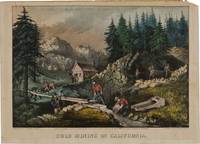
1871réf. 67574New York: Currier & Ives 1871. Attractive Gold Rush Print by Currier & Ives A fine handcolored lithograph by Currier & Ives depicting placer miners in California during the Gold Rush. In the foreground two men are shown shoveling sediment into a Long Tom capped with a sluice box while another man scoops up the remainder and deposits it into a rocker box. Behind them another trio work hard rock with pickaxes and a high-pressure hose. A small mining camp can be seen in the distance with a group of redwood stumps as evidence of their construction activities. Number eleven in the New Best 50 Currier & Ives prints. Not in Peters. Light tanning and soiling small chip to upper right corner. Very good. Matted. CONNINGHAM 2412. CURRIER & IVES CATALOGUE RAISONNÉ 2622. unknown books
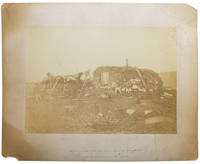
1872réf. 303445London 1872. Albumen print measuring 11-5/8 x 16-1/4 in 295 x 412 mm. Laid down on thick cream card with manuscript caption measuring 17 x 21 in. Image slightly faded card chipped with some minor soiling one tear not affecting image. Albumen print measuring 11-5/8 x 16-1/4 in 295 x 412 mm. A rare survival. This image appears in William Bradford's fabled book of photographs Arctic Regions. It was taken by either Dunmore or Critcherson the two professional photographers from Boston who accompanied Bradford on his 1869 expedition to the Arctic on the steamship Panther. It was probably taken at Upernavik a settlement on an island off Greenland's west coast or Godhavn. Arctic Regions included 141 albumen prints in addition to Bradford's account of the voyage. The title of the photograph here varies from the printed caption in the book where it reads: "Plate Number: 116 Esquimaux igloe or winter hut made of turf and stones. The entrance is to the left through a door which is about three and a half feet high. The length of the passage is about twelve or fifteen feet and at the farther end is another door through which one almost has to crawl on his hands and knees. After passing through there is then room to stand erect but one is forced to leave very soon owing to the bad air." This photograph is slightly larger than the one in the book which is 277 x 365mm. Furthermore the image in the book is cropped closer on the right and left margins. The New York Public Library has a folio of 26 images of near identicle size mounted on card. The portfolio was donated to the library in 1892 as part of the Robert Stuart Collection. According to Horch originally all of these images were captioned in manuscript though were later remounted with typed captions as "the original ink-written captions for the photographs had badly faded by 1940." It's interesting that the caption on their duplicate of this image is the same as ours and the image itself has not been cropped. Horch writes that Bradford probably not only selected these images himself but "closely directed the actual taking of the photographs." It's entirely likely that Bradford would have had extra prints made to distribute to friends repay favors and most of all to solicit subscribers to what was a very expensive book to publish. Given how it conforms to the examples in the Robert Stuart portfolio this particular image is probably one of them. Horch Frank. "Photographs and Paintings by William Bradford". American Art Journal 5.2 1973: pp 61-70; cf Parr and Badger I p31Prm/photo unknown books