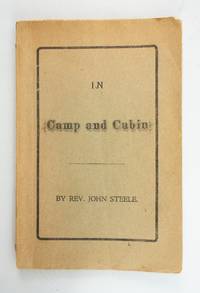
1901réf. ST20777Lodi Wisconsin: J. Steele 1901. FIRST EDITION. 232 x 155 mm. 9 1/8 x 6". 81 pp. Original green faded to brown printed paper wrappers. Housed in a fine modern caramel-colored morocco clamshell box with gilt lettering on spine. Inside front wrapper with ink signature of M. R. Skinner; occasional pencil underlining in the text. Howes S-924; Graff 3964; Streeter 3027; Wagner-Camp 244 note. Top inch of spine chipped away a little fraying to edges first three leaves with overall browning minor corner creases but QUITE AN EXCELLENT COPY of a very fragile item clean and fresh internally with the insubstantial binding entirely intact against all odds. Based on the author's diaries written between September 1850 and July 1853 this work as the introduction tells us lays out events "just as they happened" being "ludicrous solemn serious tragic inexpressibly sad but always interesting." Kurutz calls the book a "detailed and important account of mining life" and notes that Steele "provided important information on mining techniques and laws while laboring in the Coloma District and on the Yuba and Feather rivers." This account includes some fascinating stories about the many hardships and dangers experienced by the author and his associates including nearly constant fatigue and hunger dreadful weather conditions and dicey encounters with desperados dishonest miners and disgruntled frontier men of commerce. John Steele 1832-1905 was only 18 years old when he left his home in Wisconsin for the gold fields of California. After three and a half years of adventuring he returned to the Midwest where he pursued a career in teaching. Steele also volunteered for the Union army during the Civil War and spent the last 30 years of his life as a minister in the Methodist Episcopal Church. The present work was privately printed by the author in a small number of copies and is as expected quite rare on the market now. Besides the present one RBH lists just two other copies sold since 1981 and as of this writing no other dealer seems to be offering one. Furthermore our copy is a remarkably well-preserved survival with its delicate wrappers and text in condition as attractive as one could hope to find. J. Steele unknown books
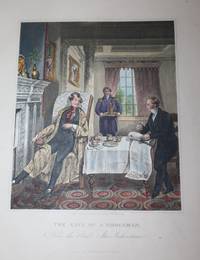
1825réf. 007994London: George Henderson. Printed by George Dawe who also was engraver 1825. First Edition. Full Morocco. Near Fine. Suite of nine hand-colored aquatint plates depicting the louche hedonistic and self-destructive life of a young aristocrat. Bound by Riviere & Son in full red morocco with ruled border raised bands other gilt decoration including turn-ins marbled endpapers. N.d. circa 1820s. 4to. 31 by 25 cm. No title page -- this was issued as a suite of plates not in a book form. A blank sheet in front two in back and tissue guards between plates. Each plate is depicting a scene and basically a step in the descent to self-destruction by the young buck aristocrat. Scenes are The Inheritance The First Party The Night House in other words the bordello The Betting Booth at the racetrack The Gambling House The Usurer The Mess Room clearly the dining room of an elite military unit The Duel and finally The Sick Room. We would note that the Usurer has the casual anti-Semitic trope so prevalent throughout history of the hook-nosed lender. The artwork has a pleasant slightly naive quality with the loosest of adherence to perspective. The settings are generally quite resplendent capturing Regency England grandeur perfectly. Scarce. Yale has several copies. Only two other complete sets held by institutions according to OCLC First Search one at Harvard and one somewhat later and published by Tegg at the Art Institute in Chicago. The Henderson version clearly the first was issued without color we would add. The Harvard Hollis catalogue gives no indication whether the copy at Houghton has hand-coloring -- something that Hollis generally will denote if it does. No copies found in commerce on date of this description was prepared. Light wear to binding. Light soiling in the margins of the plates. Pictorial elements consistently bright and attractive. George Henderson. Printed by George Dawe, who also was engraver unknown books
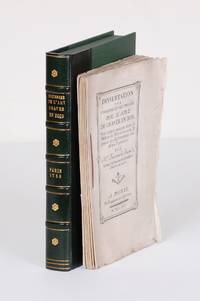
1758réf. 76869Paris: J. Barbou 1758. unbound cord tied housed in a green half-morocco goat over cloth boards clamshell case spine tooled in gold leaf with title author and date. large 12mo. unbound cord tied housed in a green half-morocco goat over cloth boards clamshell case spine tooled in gold leaf with title author and date. 92 3 pages. Pour éclaircir quelques traits de l"histoire de l'Imprimerie & prouver que Guttemberg n'en est pas l'Inventeur. Very rare first edition Bigmore and Wyman p.227. Unbound textblock lightly soiled with minor creasing at corners. Faint moisture staining throughout with some affecting the text. In this text Fournier sets out to prove that Gutenberg was not the inventor of the printing press by examining the history of printing. He believed that the technology Gutenberg made popular existed long before the German printer's work. Fournier also followed up this text with two additional works which are not present: De l'origine et des productions de l'imprimerie primitive en taille de bois 1759 and Observations sur un ouvrage intitulé Vindiciae Typographicae 1760. These two works provided further discussion of the origins of woodcut prints including a passage refuting popular belief about the origin wood engraving and some ideas for further study. Fournier 1712--1768 was born in Paris and trained as a wood engraver and type founder being a member of the 18th century dynasty of the well-known Fournier family. He later turned to steel engraving. He published a table of the proportions of the different printing characters whose purpose was to propose for all typefaces a fixed measurement in "typographic points" and a systematic gradation. He worked closely with the collaborators of the Encyclopédie providing the printer Le Breton with all the documentation relating to the typographic foundry and plans for his own instruments as well as providing Diderot with his collection of ancient alphabets. Finally after multiple disputes with his Parisian colleagues he became infamous for the printing of his famous Manuel Typographique 1764 1766 just prior to his death. J. Barbou unknown books
1566réf. 4765No place Venice: no printer Niccolò Bevilacqua no date 1566. ONE OF NUMEROUS EARLY EDITIONS. Hardcover. Fine. Bound in modern vellum. A very good copy with light marginal soiling and a little bit of mild marginal foxing verso of final leaf a little dusty. With woodcut arms of the Knights of Malta on the title page. The dedication to Cardinal Ippolito d'Este is dated December 1565. There are several other undated editions without imprint as well as further undated editions with the title "Trattato del successo della potentissima armata del Gran Turcho Ottoman Solimano". For the printing of this edition see D.E. Rhodes Silent Printers. Anonymous printing at Venice in the sixteenth century p. 104. One of the earliest and most complete narratives on the siege of Malta in 1565. It was quickly appropriated by other authors for their own accounts. Led by Suleiman the Magnificent the Ottoman Turks tried unsuccessfully to wrest control of the island from the Knights of St John of Jerusalem. The knights had taken up residence on Malta after they had been forced by Suleiman to leave Rhodes in 1530. The success of the knights in repelling the Turks is one of the most important events in the decades-long contest between the Turks and the Christian powers for control of the Mediterranean. The work closes with a list of those who lost their lives in the battle "Cavalieri morti nell' assedio di Malta". The Great Siege of Malta is one of the most famous military encounters of the 16th century and marked a signal victory of the Christian European forces over the Ottoman Turks. On 18 May 1565 the Ottoman Sultan Suleiman the Magnificent d. 1566 launched an armada of over 30000 men to besiege the island of Malta which was protected and governed by the Knights Hospitallers of St. John. The Knights of Malta a force of only 14000 men -many of them untrained- successfully defended the island and its civilian population against the Turkish invaders who departed on 11 September. Yet the losses were high on both sides. Historians estimate the Turkish dead at 10000. The Knights last about a third of their number and the island lost a third of the civilian inhabitants. The valiant efforts of the Knights inspired widespread celebration and the written accounts of the victory influenced a shift in the European view of the Ottoman Empire as an inexorable threat to Christian Europe. Although Ottoman successes against European fleets continued the European nations united to defeat the Turks at Lepanto in 1571. The Ottoman failure to take Malta was a crucial one for had the Turks succeeded they would have established a strategic base for launching strikes more deeply into the western Mediterranean. no printer [Niccolò Bevilacqua], no date hardcover books
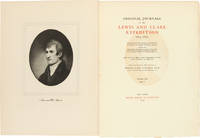
1904réf. 52627New York: Dodd Mead & Company 1904-1905. One of 200 Sets on Large Paper One of 200 large paper sets on Van Gelder paper with the atlas supplied from the reprint edition done by Argosy-Antiquarian Press. "The most elaborate work on this expedition" - Howes. A cornerstone of modern historical research printing for the first time many major primary documents which did not appear in the Biddle edition including the Floyd and Whitehouse journals and material from the Clark-Voorihis papers along with facsimile manuscripts maps portraits and other illustrative matter. Also valuable is Victor Paltsits' bibliography of the Lewis and Clark expedition in the first volume. "This edition is notable for its thorough Introduction covering the history of the expedition and earlier exploration and a detailed account of the original journals and their various editions.In its maps and numerous illustrations the Thwaites edition is an outstanding source of visual materials relating to the expedition" - LITERATURE OF THE LEWIS AND CLARK EXPEDITION. Quarto. Original gilt green cloth. Octavo atlas maps laid in a red cloth drop-front box. Cloth somewhat worn particularly at spine ends. Ex-library bookplates with withdrawal stamps on front pastedowns shelf labels on spines reference stamps across top edges. Some occasional offsetting from plates but generally clean internally. A good set. Text volumes untrimmed. HOWES L320 "c." LITERATURE OF THE LEWIS AND CLARK EXPEDITION 5d.1. WAGNER-CAMP 13:7 note. TWENEY WASHINGTON 76. REESE BEST OF THE WEST 233 note. hardcover books
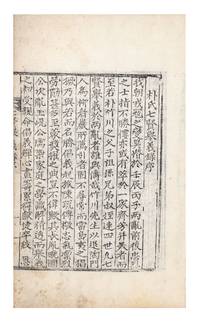
réf. 9423Woodblock printed. 57 folding leaves. Two juan in one vol. Large 8vo 313 x 204 mm. orig. semi-stiff yellow patterned wrappers upper wrapper a little soiled. Korea: 1832 or after. First edition and very rare; we find no copy in WorldCat. This is the collected poetry and prose by KwÅn 1575-1652 who lived through the tumultuous years of the early 17th century when ChosÅn Korea was twice invaded by the Manchus. KwÅn was from an early age taught by his father KwÅn Tae-gi 權大器 who had studied under one of the most important Neo-Confucian scholars of the ChosÅn period Yi T’oegye æŽé€€æºª Yi Hwang 滉 1501-70. The younger KwÅn passed a lower-level civil service examination and entered officialdom at a low rank. He served in the royal retinue when the court retreated to Ganghwa island during the 1627 Manchu invasion. KwÅn was promoted but retired from office citing illness. After the Manchus invaded the country again in 1636 KwÅn withdrew to a cottage at the foot of a peak of Mount Taebaksan called Chinbong 震峯 “Thunderous Peak” whence the name of his posthumously published oeuvre. The book contains a Preface written by Yi Ya-sun æŽé‡Žæ·³ 1755-1831 a ninth-generation descendant of Yi T’oegye dated 1825 “fourth ŭlyu since the Chongzhen reign”. An appendix contains eulogies for KwÅn and an account of KwÅn’s life written by Kim Si-ch’an 金是瓚 dated 1818 “third muin since the Guangde reign period of the August Ming” referencing the reign name of the abortive rebellion by Yang Qilong 楊起隆 1633-80. KwÅn Hun 權勳 a sixth-generation descendant of KwÅn Koeng wrote the colophon dated 1832 “fourth imjin since the first year of Chongzhen.” KwÅn Hun described how “I his unworthy distant descendant with pain and regret carefully searched far and wide to collect the writings bit by bit transcribing them for posterity. The years passed as I was putting them in order.” Fine copy. unknown books
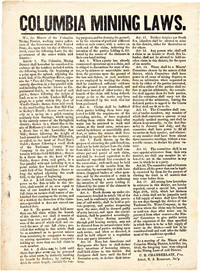
1853réf. 46036Columbia Ca.: Gazette Print 1853. The Laws of the Diggings A rare broadside printing of the laws of the Columbia Mining District in California in 1853 created and enforced by the miners for their own self-government. The seventeen articles all deal with regulations for mining and claims. The first nine set out rules for making and operating claims. The next three address foreign ownership of claims. Article 10: "None but Americans and Europeans who have or shall declare their intentions of becoming citizens shall hold claims in this district." Article 11: "Neither Asiatics nor South Sea Islanders shall be allowed to mine in this district either for themselves or for others." Article 12 sets out a punishment for any miner who sells a claim to an Asian or a Polynesian. The final five articles set out rules for enforcing the laws including the creation of a Miners Committee and a system of binding arbitration. According to the text the laws were adopted "at a meeting of the Miners of the Columbia Mining District held Oct. 1st 1853." and the laws are signed in print by "C.H. Chamberlain Pres." and "R.A. Robinson Sec'y." "The item is of basic importance.as an example of how the California miners - or men beyond the reach of government anywhere else in our States and Territories for that matter - banded together and enacted and enforced codes of law for their own protection" - Eberstadt. The COLUMBIA GAZETTE which printed this broadside was according to Kemble the second newspaper to operate in Columbia starting operations in the fall of 1852. The first newspaper in the area the COLUMBIA STAR apparently printed only two or three issues in October-November of 1851 before the printing press was destroyed by vandals. Greenwood locates only three copies at the California Historical Society and the Bancroft Library and the Streeter copy which was sold at the Clifford sale in 1994. Rocq lists a copy at the Huntington Library. OCLC adds copies at Yale Library of Congress University of California at San Diego Stanford and DeGolyer Library at Southern Methodist University. A rare and interesting example of the search for order in the tumult of the gold rush. The Streeter copy sold to Howell for $550 in 1968. It later reappeared in the sale of California collector Henry Clifford in 1994. Broadside 10¾ x 8 inches. Printed in three columns. A bit of light foxing mostly in margins. Near fine. In a folding cloth clamshell case spine gilt. GREENWOOD 381. ROCQ 15427. EBERSTADT 131:105. STREETER SALE 2735. CLIFFORD SALE 26. OCLC 29876358. hardcover books
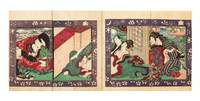
réf. 11587By Tanekiyo Ryūsuitei 柳水亭種清. Two title-pages four pages of Preface one port. of Lady Murasaki and eleven double-page & 17 single-page woodcut color illus. 23.5; 16.5; 15 folding leaves. Three vols. 8vo orig. patterned semi-stiff wrappers decorated with Genji mon emblems wrappers a bit soiled orig. block-printed vignette labels pasted on upper covers new stitching. Japan: n.d. but WorldCat suggests 1861-64. This is apparently the only known complete set of the first series of two of this superbly illustrated shunga parody of The Tale of Genji. We can trace only two sets of the complete three-volume second series at the Royal Ontario Museum and the International Resource Center for Japanese Studies. Our set contains Chapters 1-27 while the second series consists of Chapters 28-54. This is a very late shunga and one of the last before the end of the Edo period. Almost all of the techniques that make Japanese illustrated books so remarkable are utilized here. Each illustration has in the upper right- or left-hand corner a picture scroll that shows the original scene from a chapter in The Tale of Genji with a label stating which chapter it is from. Our set is finely illustrated richly colored and employs bokashi the delicate variation of shading of pigment within the image; blind-embossing even tiny noses are in relief; and the very ample use of gold and silver. The depicted garments are a mixture of extremely complex textures colors and patterns all accentuated by blind-embossing and multiple woodblock impressions. There are two kinds of black flat black and shiny burnished black and the gold has been painted over with black pigment giving a most unusual appearance. Each of the woodcut illustrations has a border with the Genji mon symbols. Koikawa 1821-1907 was a prolific artist. He illustrated as well as wrote numerous books in using various pen names. The Preface in Vol. I is written by "Insuitei" a pen name for Koikawa. Very fine set. The title-page in Vol. I has a 90 mm. tear in the lower outer corner. This is occasionally catalogued under Utagawa Kunimori II. Colin Franklin attributes the illustrations to Kunisada. ⧠See Colin Franklin Exploring Japanese Books and Scrolls p. 74-"one of Kunisada's wittily erotic interpretations of Genji's courtly love all stops pulled out for an organ-blast of color printing" & see plates 49 & 50. unknown books
1564réf. 60128vo. 112 ff pages 2 and 110-112 are blank. Bound in modern paneled calf with gilt-stamped fleurons on front and back covers raised bands. Generally good. The first edition of this plague treatise by Paracelsus Theophrastus Bombastus von Hohenheim 1493-1541 the "Luther of Medicine" and one of the key figures in the history of medicine. Written originally in Nördlingen in 1529-1530 it remained unpublished during Paracelsus' lifetime and subsequently taken up and edited for publication by the Paracelsian scholar Adam von Bodenstein 1528-1577. The latter dedicated it to Johann Rudolph Stör von Störenberg Abbot of Murbach and Luders. In addition to the study on pestilence the text includes two short works by Paracelsus: "Vom Preservatiff durch den Schwebel" and "Von der Mummia." In the primary tract Paracelsus for the first time presents his complex theory on the origins of the plague which he believed were the result of astrological and corporeal events set in motion by human sins. "This anthropocentric view of an individual disease is in harmony with Paracelsus' whole philosophy and indeed with Renaissance philosophy in general" Pagel p. 179. Paracelsus also postulates the importance of the principle of sulphur the corresponding agent of the planet Mars in pestilence's causation. He believed that sulphur hidden in three minerals—antimony arsenic and marcasite—affected three corresponding organs: the groin the axillae and the ears. The chapters on causation are followed by sections on remedies. The doctor must cure the agent causing the disease rather than the symptoms of the disease Paracelsus writes. Humoral pathology and its insistence on diet is of no use. "Paracelsus' plague remedies include sulphur spirit of vitriol sulphur sublimate and metals also—for external treatment of boils—toads and decoctions of beetles designed to remove the evil of magnetic attraction but herbs and drugs as prescribed by Ficino and Agrippa are greatly amplified and still appear in a prominent place" Pagel pp. 180-181 n. 151. The editor of this volume Adam von Bodenstein was one of the key figures in the revival of Paracelsian ideas in the German lands in the middle of the sixteenth century. A son of a radical reformer he believed in transmutation of metals into gold and played a key role in the publication of over 80 works by Paracelsus. For his Paracelsianism he was excluded from the faculty and council of Basel University. OCLC records US copies at NYAM NLM Wash. U and UMn. Karl Sudhoff Bibliographia Paracelsica Berlin 1894 60; Walter Pagel Paracelsus: An Introduction to Philosophical Medicine in the Era of the Renaissance Boston 1982 2nd revised edition; Georgiana D. Hedesan "Alchemy Potency Imagination Paracelsus's Theories of Poison" in John Arrizabalaga Ole Peter Grell Andrew Cunningham eds. It All Depends on the Dose: Poisons and Medicines in European History. The History of Medicine in Context Series New York 2018 pp. 81-102; Peter J. Forshaw "'Paradoxes Absurdities and Madness:' Conflict over Alchemy Magic and Medicine in the Works of Andreas Libavius and Heinrich Khunrath" Early Science and Medicine vol. 13 no. 1 2008 pp. 53-81. Paul Messerschmidt hardcover books
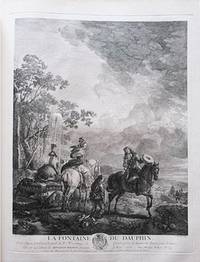
1762réf. 41877Paris: Chez Moyreau 1762. Folio. 23 1/2 x 19 1/2 inches. Engraved portrait of Moyreau by Nonnette dated 1749 and 100 engraved plates numbered 1-100 with the engraved rococo title being numbered as plate 25. 88 plates engraved by Moyreau and the others by Cochin Chedel etc. The title is engraved by Le Parmentier after J. de la Joue. Included are 5 double page plates and one page with 2 plates on the page. The final 8 plates are numbered in manuscript and the last 2 plates are proofs 'before letters'. Full contemporary calf gilt hinges strengthened A rare magnificent collection of engravings showcasing the works of the renowned Dutch Golden Age painter Philips Wouwerman. Engraved by master engraver Jean Moyreau the illustrations meticulously reproduce Wouwerman's celebrated equestrian and rural scenes capturing the dynamic compositions intricate details of the originals. Featuring some of the artists finest works carefully selected from the most esteemed collections in Paris and beyond the volume serves as a homage to Wouwerman's enduring artistry. Cohen de Ricci 1068; Bulletin Morgand 1889 No. 17315 '1 frontispice et 100 planches; Thiebaud p. 945-946; Brunet V 1480. Chez Moyreau unknown books
réf. 8347Vol. I: Illustrated "title-page" one double-page woodcut with foldouts to form a four-panel diptych with the addition of a "trick super flap" depicting three female genitalia young woman mistress & wife six double-page woodcuts & two single-page woodcuts all color-printed; & three double-page black & white woodcuts. Vol. II: Illustrated "title-page" five double-page woodcuts & two single-page woodcuts all color-printed; & four double-page black & white woodcuts. Vol. III: Illustrated "title-page" four double-page woodcuts & two full-page woodcuts all color-printed; & three black & white double-page woodcuts. All leaves have color-printed borders. .5 1 folding leaf of preface color-printed 13 folding leaves; .5 13 folding leaves; .5 12 folding leaves. Three vols. 8vo orig. decorated semi-stiff patterned boards with color-printed symbols of the moon flowers & snowflakes orig. block-printed title labels on upper covers of Vols. I & II lacking on Vol. III but there is no evidence a label was ever there new stitching. Japan: Preface dated 1850. First edition and very rare; we can find no copy in WorldCat or NIJL. Almost all of the techniques that make Japanese illustrated books so remarkable are utilized here. Finely illustrated and richly colored this late shunga employs bokashi the delicate variation of shading of pigment within the image; blind-embossing; and the very ample use of metallic pigments. The depicted garments are a mixture of extremely complex textures colors and patterns all accentuated by blind-embossing and multiple woodblock impressions. In Vol. I the folding woodcuts - which reveal a man and woman engaging in sex - open to reveal a fine and complex four-panel scene in which we see three couples also having sex: a young couple a man with his mistress and the same man with his wife. On the third panel from the right a hidden "trick" flap is revealed depicting and comparing the genitalia of these three women. This "trick" panel has the title printed with seven kanji characters the first two are indecipherable: ".mitate setsugekka" ".Visual Puns of Snow Moon Flower". Each volume begins with a finely colored paste-down leaf artistically depicting the themes of snow moon and flower with poems. Facing each of these leaves is a portrait of a woman: mistress young and wife. All the black & white woodcuts also depict men and women engaging in sex and self-pleasuring. Koikawa 1821-1907 was a prolific artist. He illustrated as well as wrote numerous books under various pen names. At the end of the Preface in Vol. I we find "Insuitei" one of his pen names. Fine set with fresh coloring. The four-panel diptych has several small burn holes on the right-hand side. One black & white illustration has been "heightened" with red ink in a very minor way. Slight thumbing and a few minor stains. unknown books
1850réf. List1929California 1850. With thirteen letters most multi-page written from Monterey in 1850 a 7 pp facsimile transcription of a 1834 Mexican land grant on cloth measuring 11 x 14 inches and and eleven page document on paper in Spanish relating to a Monterey land grant transcribing an 1841 document. Letters heavily worn with some loss at margins but mostly legible land grant in good to very good condition transcribed document in Spanish in fair condition with water damage to margins. Fair. An interesting archive of 1850s-era material relating to the life and career of the surveyor Edward Williams which recently surfaced in the central mother lode region. The group includes his personal letters from the California Gold Rush as well as well two interesting documents form his work for the Surveyor General J.W. Mandeville in 1858 where he transcribed two Mexican land grants. Lt. Edward Williams was a member of Company E New York Volunteers under Capt. Nelson Taylor. He came to California around 1847 and found employment as a deputy surveyor later working for the Office of the Surveyor General of the Unites States for California. In 1858 Surveyor General J.W. Mandeville commissioned a report on Mexican-era California Land Grants. Mandeville had Williams copy the original documents exactly - inclusive of an ink copy on linen that is an "exact tracing" of the original documents starting with 1834 up through about 1840. These "copies" were submitted to the Surveyor General in 1858 for use in the report. Williams continued the title work by copying other documents from about 1841 though this time not as a tracing but hand copied on the usual blue paper of the 1850s. The documents illustrate the length officials went to while they investigated Mexican Land Grant titles to California properties in the 1850s. The process was difficult and involved two distinctly separate cultures and legal systems that clearly conflicted. The Mexican Government granted rights for these large land parcels in California to various people but clearly stated they could not sell parts of the property. The wording was used many times in litigation of the period in both defense of the land grants and in opposition to how the land grants were handled. The issues were actually quite simple in that the Mexican legal standards for land grants was far different from those in the United States and the two differing forms of written land ownership and use clashed. These documents reflect a parcel of land granted to Francisco Mesa at "Corral de Tierra" a large parcel in Monterrey County California. Mesa had requested land for "his personal use and that of his family." In the Grant the title papers reflect "while the land is under Francisco's possession it cannot be divided mortgaged or a levy placed on it nor handed down." These original documents help illustrate the complex story of Mexican Land Grants in California. Also included are thirteen letters from Ed aka "Ned" to various family members primarily his mother and sister Alice and vice versa. About half are from Ed the other half are written to him. The dates of the letters are; 1850: February 10th April 15th April 16th April 28th June 10th July 30th October 11th and November 17th and 1851: September 9th. One undated letter with heavy loss is written from Panama. The letters are generally readable but the condition far from perfect with water stains throughout and chips abundant along edges and significant textual loss. The letters are generally at least two pages sometimes four or more inclusive of writing in the crossed line custom to save paper. Most are datelined at Monterrey where he discusses the people the customs setting and more. Despite the condition flaws there is much to be gleaned from his correspondence. In his April 15 1850 letter . he describes his trip to San Juan Bautista from Monterrey in detail while he was on his way to San Francisco. Williams writes of his great pleasure on tasting cooked beef by the Indians that he found was the best he ever tasted as they camped on the way to San Jose with the ultimate goal Mission Dolores in San Francisco: “this the beef they put on the embers of the fire and broiled it - I never tasted anything like it before so tender so juicy…” One of his first notes on San Francisco: "There are regular streets filled with all kinds of sorts of stores… The shipping covers the water as far as you can see. And those nearest the shore are converted into store houses the rigging being taken down and the and holes cut in the sides for doors.The best houses in town are occupied by gamblers . a large saloon filled with tables on which are played all kinds of games of chance - at some of the tables are displayed immense amounts of coin and gold in lumps worth from 1 to 5000 dollars which some poor infatuated fool of a miner has at some time lost to them." In his letter of April 16th he discusses both his difficulties with women in California and his lack of fitting in back east: “The Spanish Girls are very nice and all that sort of thing but the trouble is to find one that is educated. I can’t bear an uneducated wom an and I think I shall have to come to N.Y. and bring one out here… I know one or two in N.Y. but I don’t believe they would have such an uncouth specimen of an ‘hombre’ as me…” In his next letter he describes Carmel in detail. He states: “I haven’t been to the mines nor have I any inclination to go” though he intends to settle in California permanently. In his next letter he discusses the people he’s met and how he detests the anglophone community there: “How do I like the People Those of Spanish whom I call my friends I love with all my soul - there is not much society except among them… the Eng. and Am. population I detest from the bottom of my heart. This may sound strange but you will know the por que when you arrive.” He then praises the climate and scenery of Monterey. One letter written from Panama which has unfortunately sustained heavy losses at margins offers some details of the trip on the Chagres River. The replies to Williams from his family offer details on life in New York and are similarly compromised in condition but overall there is enough to glean from the group to provide a detailed example of family correspondence from the period. Overall a very interesting and unusual archive of a young professional who moved to California during the Gold Rush period and rejected the Anglophone mining community with particular interest to historians of Monterey and of the systems of land grants that shaped Mexican and American land policy in the nineteenth century. unknown books
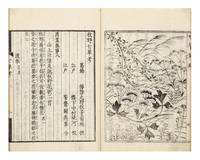
réf. 8333One full-page woodcut. .5 29 .5; 15.5 folding leaves. Two vols. 8vo orig. blue wrappers orig. block-printed title labels on upper cover later decorated wrappers later stitching. From the colophon at end of Vol. II: Edo Kyoto & Osaka: Hanabusaya Heikichi et al. 1812. with: —. Haru nanakusa ko Thoughts about Seven Herbs in Spring. Three full-page woodcuts & nine smaller woodcuts in the text. .5 36 folding leaves. 8vo orig. blue wrappers as above later decorated wrappers later stitching. From the colophon: Edo: Yamashiroya Sahei 1814. First editions a rare complete set of these two works which are concerned with two important seasonal celebrations. The first of the year is the Festival of Seven Herbs in Spring Nanakusa no sekku a traditional Japanese ritual of eating seven-herb rice porridge on the 7th of January; its consumption would bring longevity and health and ward off evil. The tradition derives from ancient China. The seven herbs are seri Japanese parsley nazuna shepherd’s purse gogyo cudweed hakobera chickweed tahirako nipplewort suzuna turnip and suzushiro daikon radish. The other is the Festival of Seven Autumn Herbs Akino nanakusa less well known then the spring celebration. These herbs are hagi bush clover obana/susuki Japanese pampas grass kuzu kudzu nadeshiko Japanese dianthus ominaeshi Patrinia scabiosifolia fujibakama Eupatorium fortunei and kikyo balloon flower. While many of them have medicinal qualities for this festival they are not for eating but for viewing and admiring. Kikuu Kitano 1762-1831 a native of Sendai came to Edo in the 1780s and opened an antiques gallery that enjoyed great success. In 1804 he purchased a large piece of land in the Mukojima section of Edo where he established a botanic garden today known as the Mukojima Hyakkaen Garden. It is Tokyo’s only surviving garden from the Edo period. There he planted a landscaped orchard of 360 plum trees and other plants including the seven herbs of both spring and autumn selected by Kitano and his literati friends both poets and painters. These works are very beautifully printed using a wide variety of character styles to express meanings and authorship. The first two volumes to be published — on the autumn festival — contain a fine full-page woodcut designed by the author showing all seven herbs. The text contains references to each herb in waka and kanshi Chinese poetry written by Japanese a guide to understanding the nuances of the poetry and the botanical literature. The spring festival volume published two years later describes each of the seven spring herbs and their uses in medicine and gastronomy with many references to the Japanese botanical literature. There is a long passage on how to prepare the springtime porridge. The woodcuts depicting each of the seven herbs are by prominent artists including Kita Busei 1776-1856 and an unidentified woman artist. PROVENANCE: With the seals of Mayori 1829-1906 and Mamichi 1866-1925 Kurokawa prominent father and son book collectors. Their collection was largely concerned with botanical and herbal books; most of the collection was destroyed in the great Kanto earthquake. Our set later entered the collection of Frank Hawley scholar and one of the most discerning collectors of Japanese books and manuscripts. His stamp appears on the first page of text. See R.H. van Gulik’s “In Memoriam. Frank Hawley 1906-1961” in Monumenta Nipponica Vol. 16 No. 3/4 Oct. 1960-Jan. 1961 pp. 434-47. Fine set preserved in a fine chitsu. With some mostly marginal worming much of which has been carefully repaired. unknown books
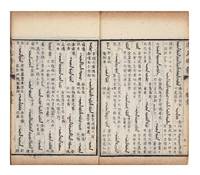
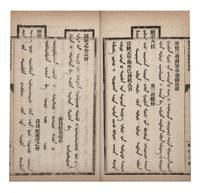
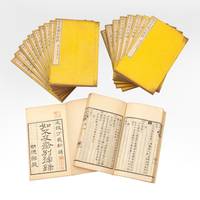
réf. 9990Eight vols. Large 8vo orig. wrappers orig. stitching. China: 1802 date of colophon. Second edition of this landmark Manchu-Chinese dictionary the last of the great Manchu dictionaries of the 18th century. Ihing first published his dictionary privately in 1786 the date of the Preface. We know of only one copy of this edition held at a Chinese library. All other copies in circulation are to the best of our knowledge of the second edition. In 1708 on the Kangxi emperor’s command a Mirror of the Manchu Language had been published at court. In 1724 Li Yanji published Ch.: Qingwen huishu 清文彙書 Ma.: Manju isabuha bithe Manchu Collected which translated the contents of the Mirror into Chinese and rearranged the entries in Manchu alphabetical order. Li’s book became outdated however when the Qianlong emperor reformed the Manchu lexicon and published a number of new lexicographical works the most important of which was the Mirror of the Manchu Language Expanded and Emended from 1772-73. Our book did to the “expanded and emended” Mirror what Li Yanji had done to Kangxi’s original: rearrange its contents in Manchu alphabetical order. Yet Ihing went further than that. He also culled words from other Manchu books published on imperial command in the preceding years including a book with phrases from pre-conquest Manchu sources and translations of the Confucian classics. The result is that Ihing’s dictionary contains words that were not in Qianlong’s expanded Mirror making it in these cases the more complete lexicographical resource. For example a term such as deyengge nimaha “flying fish” is included in our book but not in Qianlong’s Mirror. In such cases Ihing noted that the words had been announced by the Grand Secretariat on such-and-such a date. Our copy has slips on the outside cover of the volumes with Manchu syllables written in manuscript. The syllables indicate which word initials are covered in the volume in question facilitating searching the dictionary. There is a colophon by Fa-ke-jing-e æ³•å…‹ç²¾é¡ dated 1802. A nephew of Ihing Fa-ke-jing-e revised the book at his uncle’s request. Ihing Ch.: Yi-xing 1747-1809 belonged to the Bordered Yellow Manchu Banner and as a descendant of Nurhaci was a member of the imperial clan. He rose to the post of vice minister of several of the boards in the Qing secondary capital at Mukden and later served as governor of several southern provinces and as an imperial agent in Outer Mongolia. Very good set some light dampstaining in the final volume; preserved in a hantao. ⧠Mårten Söderblom Saarela The Early Modern Travels of Manchu: A Script and Its Study in East Asia and Europe 109. unknown books
réf. 10493Woodblock-printed map 830 x 1715 mm. finely hand-colored. Edo: Sagamiya Tahei 相模屋太兵衞 1697. The 1697 printing of Ishikawa’s famous map of Japan; a less complex printing was first issued in 1691 an earlier version with a different title appeared in 1689. The series of maps published by Ishikawa an ukiyo-e artist “established a model for woodblock maps throughout most of the eighteenth century. Works based on Ishikawa's original version and published mainly in the area of Edo are referred to as Ryūsen-type maps of Japan. Ishikawa’s maps were both decorative and practical and they served as a combined Who’s Who and travel map. Useful information to administrators travelers and the general public included the names of feudal lords the standard productivity of the land in koku of rice and important and scenic places along the routes. Each new edition tended to expand both the informative and ornamental aspects of the work.”–Kazutaka Unno “Cartography in Japan” in The History of Cartography Vol. 2 Book 2 Chicago: 1994 pp. 412-13. Our map is finely hand-colored showing fiefdoms and includes lists of important place names and shrines a chart of tidal variations and a chart of seasonal changes. Another chart gives distances from Nagasaki to far-away destinations such as Holland Indonesia Thailand the Philippines and several port cities of China. The main highways are shown as well as the inland and coastal sea routes. Also indicated are post stations on highways such as the TÅkaidÅ running from Edo present-day Tokyo to Kyoto and the distances between stations. Thanks to the beautiful colors and wealth of information Ryūsen’s maps became very popular and this style of map set the pattern for most published maps of Japan for the next century. In the extremities of the map small portions of China Korea Ryūkyū and Hokkaido are shown. Fine copy. Short clean splits in a couple of folds. Well-backed and minor worming mended. ⧠Mary Elizabeth Berry Japan in Print. Information and Nation in the Early Modern Period California: 2006 pp. 2-3–The map is “so legible and packed with information that it has been revised and reissued annually since its first publication in 1689. It charts the nation’s provinces and castle towns land and water routes famous sites and scenic places. It labels every ferry crossing and every post station along the major highways listing the distances between stops in an index. Thick with social and political geography it also identifies all regional lords or daimyo with notes on the gross productivity of their domains.”. unknown books
réf. 10372Ten vols. 8vo orig. wrappers old stitching. China: 1909-12. An important one-of-a-kind trilingual textbook. In 1905 the Qing government took the radical move to abolish the civil service examinations which had been contested for a long time and reformed in 1901. Rather than a system of examinations supported by schools preparing students for the lowest level of the exams the court instituted a tiered system of schools from elementary to advanced with students across the country using new textbooks. Our book is a product of the extension of this new educational regime to “present-day” Inner Mongolia. One of the two textbooks chosen for the new Chinese schools — and the most popular — was Zuixin chudeng xiaoxue guowen jiaokeshu 最新åˆç‰å°å¸åœ‹æ–‡æ•™ç§‘書 The Up-to-Date National Language Reader for Lower Primary Schools which Jiang Weiqiao 1873-1958 and Zhuang Yu 1878-1940 published in 1905 with the Commercial Press in Shanghai. Jiang was a low-level examination graduate who had been exposed to Western learning through the publications of the Jiangnan arsenal. After a first career as a teacher in new-style schools he entered the translation department at the Commercial Press in 1903 where he planned and wrote many of the textbooks that the press published. His later career was spent in education administration at the national provincial and university levels. Zhuang was trained in geography and entered the Commercial Press on Jiang’s recommendation. He too later worked in school administration while continuing to write textbooks. The purpose of Jiang and Zhuang’s book was as they explained in the Preface to “provide everyone basic moral values and knowledge and enable them to learn about important thoughts of ancient sages and academics arts and skills of all countries in the world.” Like others in the genre this book “touched on a wide range of topics such as science history geography and civics” and included “the newest terms concerning every subject at the time and reflected the most recent findings of scholars” He pp. 100-01. As the Qing government attempted to bring the empire’s Inner Asian possessions closer to China proper in the face of foreign aggression new schools were instituted in parts of Inner Mongolia. What textbooks to use presented a problem. Ungde or Rongde who was appointed as honorary supervisor of the Fengtian Mongolian Language School in what is now the city of Shenyang was aware of this issue. Ungde also taught Mongolian at the school. He noted that the school used Gao E’s 高鶚 Lizhi jiyao åæ²»è¼¯è¦ Essentials of Administrative Discipline which Tongšui 通瑞 had translated into Manchu and Meng boo å¤¢ä¿ in turn translated into Mongolian. Gao’s text had been written sometime before his death in 1814 and it was not a textbook fit for molding an informed citizenry in the early 20th century. Ungde therefore decided to translate Zuixin chudeng xiaoxue guowen jiaokeshu into Mongolian. Mongolia had traditionally been administered in the two languages of Mongolian and Manchu the Qing dynastic language and not in Chinese. Accordingly most of the Mongolian pedagogical literature that circulated in China — as opposed to the Tibeto-Mongolian literature that circulated in the Buddhist milieus of Mongolia itself — contained Manchu as a bridge language between Chinese and Mongolian. Ungde felt the need to keep Manchu in the new textbook as well. Translating a textbook concerned with modern industrial society meant that Ungde had to invent many new terms for which there were no Manchu or classical Mongolian equivalents. Scholars who have studied this issue in reference to Manchu have pointed out new words such as “society” ba-i acan “civilization” šu genggiyen “automobile” sukdun-i sejen “machine” šurdere tetun “telephone” talkiyan-i gisun and “telegraph” talkiyan-i serkin Qu p. 62. Before the translation received official endorsement Ungde translated four volumes between 1907 and 1909. These four were subsequently published along with two more in 1909 for distribution to the new schools. In 1910 Volumes 5 to 8 were published. Volumes 9 and 10 appeared only at the very end of 1912 when the Manchu dynasty had already fallen and China had been declared a republic. These different printings were presented to the throne and subsequently the president’s office. Reportedly an additional eight volumes were translated but they were never printed and do not appear to have survived Li first article p. 41. Our copy is a later printing. The Preface contains the list of Ungde’s students who assisted by writing the fair copy of the book which is missing in the early printings Li second article p. 67. The book is rare today; we are able to only locate four copies in North American libraries Walravens no. 248 WorldCat. Nice set with minor browning. Preserved in two hantao. ⧠Li Qinpu æŽå‹¤ç’ž Man-Meng-Han sanwen hebi jiaokeshu de fanyi banxing shang 《满蒙汉三文åˆç’§æ•™ç§‘书》的翻译é¢è¡Œï¼ˆä¸Šï¼‰ Manyu yanjiu 2014 No. 1: pp. 34-42; idem “.xia” 下 Manyu yanjiu 2014 No. 2: pp. 67-74; Qu Liusheng 屈六生 “Lun Qingmo Manyu de fazhan: Jianping Man-Meng-Han sanwen jiaokeshu” 論清末滿語的發展——兼評《滿蒙漢三åˆæ•™ç§‘書》 Manyu yanjiu 2004 No. 2: pp. 60-65; He Jiani “From Empire to Nation: The Politics of Language in Manchuria 1890-1911” PhD dissertation Cambridge 2018; Hartmut Walravens “Vorläufige Titelliste der Mandjurica in Bibliotheken der USA” Zentralasiatische Studien 10 1976: pp. 551-613. unknown books
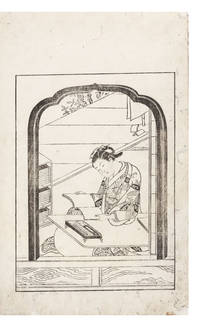
réf. 6330Edited by Yusuishi Tanaka. Woodcut frontis. & eight fine double-page woodcut illus. 21; 18 folding leaves. Two vols. Large 8vo orig. blue wrappers wrappers rather worn & rubbed orig. block-printed title labels on upper covers rubbed new stitching. Osaka Edo & Kyoto: 1749. First edition of this beautifully illustrated book; the fine woodcuts are by Sukenobu Nishikawa 1671-1750 or -51 or -54 who “counts among the foremost masters of so-called ukiyo-e primitive prints. His subject matter like that of his contemporaries revolved around images of women walking. These images are stylised lending the rhythmic movement of the sumptuous robes an almost sculptural effect. Nishikawa also did many book illustrations…Nishikawa founded a whole school and according to his family archives Harunobu 1725-1770 was a follower of his.”–Oxford Art Online. This work is concerned with the education of women in its widest sense combining knowledge with taste. Four types of girls’ “play” are described and illustrated; each providing instruction in behavior and ethics. The fine woodcut frontispiece depicts a young woman reading a book surrounded symbols of knowledge and refinement: bookshelves and brushes for calligraphy. Her clothes and hairstyle are appropriate. The first volume is concerned with dolls hina. In Japan dolls are not for play but have high spiritual value which offer girls preparation for adulthood and marriage. For the Japanese dolls are living creatures possessing heart and soul from which girls can learn discipline obedience and control. Nakanishi 1634-1709 was a scholar and writer on Shintoism and the present text was edited and posthumously published by Yusuishi Tanaka who has contributed a preface. The theme of the text is instructional and written for girls and young women: there are many references to texts essential for proper behavior and ethics. Nakanishi draws on the Nihon Shoki the oldest chronicle of Japan; Man’yoshu the eighth-century anthology of Japanese poetry; the Tale of Genji; and Makura no Soshi the famous Pillow Book. There are four fine double-page woodcut illustrations in the first volume. The first illustration depicts an upper-class woman sending her dolls away in a boat thereby sending her suffering away. The second illustration depicts the hinamatsuri doll festival with dolls arranged on shelves. The following illustration depicts a young woman facing her suitor her dowry behind her all are objects of knowledge and culture: a calligraphy set fine papers in a box picture scrolls books etc. The final illustration in this volume depicts an offering made to the sky referencing tanabata the star festival. According to legend the Milky Way separates two lovers; they are allowed to meet only once a year on the seventh day of the seventh lunar month of the lunisolar calendar. The second volume is concerned with kai-awase the Japanese shell-matching game. Again there are four fine double-page illustrations each filled with deep meaning. Matching the shells symbolizes the unity of partners in a marriage. There are many references to the Tale of Genji and Lady Murasaki; scenes from this novel were often used to illustrate the shells. One of the illustrations depicts the traditional card game called uta-garuta being played by several women. A very good set and rare. Some carefully repaired worming mostly confined to the margins. The lower outer corners of many leaves are “thumbed.” ⧠Brown Block Printing & Book Illustrations in Japan p. 131. unknown books
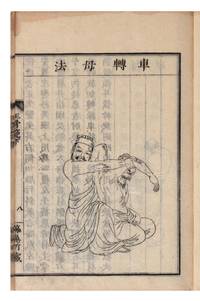
réf. 7010Many fine full-page woodcut illus. 46; 59 folding leaves. 8vo orig. yellow wrappers wrappers a little soiled orig. woodblock title-slips on upper covers labels a little soiled new stitching. Kyoto Osaka & Edo: 1808. First edition of one of the three most important Japanese works on orthopedic medicine. The book is based on Chinese medical science most notably the Sheng ji zong lu è–濟總錄 written in the 11th century and the Yi zong jin jian 醫宗金鑑 by Qian Wu active 1736-43 who also wrote the famous Yuzuan Yizong Jinjian 御纂醫宗金鑑 Imperially Commissioned Golden Mirror of Medical Learning published in 1742. Our work presents a system of surgical treatment to cure injuries to bones principally fractures and dislocations with instructions on how to stop bleeding and to bind or immobilize the injured part by bandaging. There is a substantial section on materia medica and the compounding of prescriptions considered essential to the treatment of bones in Japan. The numerous and fine woodcuts depict braces and corsets plasters manipulations bandaging techniques casts etc. Many of these techniques are clearly taken from Western medicine. Ninomiya 1754-1827 was a prominent medical doctor who laid down the foundations of orthopedic surgery in Japan. He studied in Nagasaki where he learned Western and Japanese techniques from Kogyu Yoshio 1724-1800 interpreter of Dutch and a famous physician and surgeon who had a "Western-style" room at his home in the city. After further study under a number of doctors throughout Japan including Gento Yoshiwara Ninomiya established himself in Edo where he had an extremely successful practice. After contracting syphilis as a baby from his wet nurse Ninomiya lost his nose and wore a artificial nose for the rest of his life. Nice set. Both volumes have some minor marginal dampstaining. ⧠Mestler A Galaxy of Old Japanese Medical Books III p. 152. unknown books
1938réf. 312786N.p.: Privately printed for the members of the Royal Guild of Wisconsin Fisherman 1938. First edition one of a very few copies known. Illustrations from photographs. vi 25 pp. 1 vols. 8vo. White printed wrappers stapled. Very good. Some minor wear. Green quarter morocco slipcase. First edition one of a very few copies known. Illustrations from photographs. vi 25 pp. 1 vols. 8vo. Salmon fishing during four days in the first part of July 1938 by a party of six who styled themselves the Royal Guild of Wisconsin Fishermen comprising: Evan A. Evans Louis M. Hanks Roy F. Tomlinson Theodore G. Montague William S. Kies and George I. Haight to whom authorship is attributed by the Wisconsin Historical Society. The last page of text records their catch by weights. Rare. Wetzel p. 171 tentatively ascribed to William Kies. "A rare work."; Bruns K-45 not seen; Bibliotheca Salmo Salar 105. OCLC 2 copies Princeton Wisconsin Historical Society Privately printed for the members of the Royal Guild of Wisconsin Fisherman] unknown books
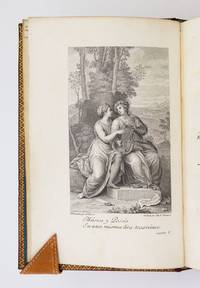
1779réf. ST19371Madrid: Imprenta Real 1779. FIRST EDITION. 235 x 150 mm. 9 1/4 x 6". 10 p.l. 126 XL pp. 1 leaf errata. EXCELLENT CONTEMPORARY CRIMSON MOROCCO BY DEROME LE JEUNE his ticket with address of Rue St. Jacques on verso of front free endpaper covers framed with thick and thin gilt rules raised bands spine compartments with central floral sprig surrounded by a lozenge of small tools volute cornerpieces gilt titling gilt-rolled turn-ins gilt edges cobalt blue paste-paper endpapers. WITH SIX CHARMING ENGRAVED ALLEGORICAL PLATES after G. Ferre. Front pastedown with morocco bookplate of Mortimer L. Schiff and small book label with a gilt cipher on a red peach. A Large Paper Copy. Palau y Dulcet IV 107; RSIM B VI 429; MGG VI 1403 f.; Gregory-Bartlett I 129. Three minute dents to front board a hint of wear to bands and corners isolated faint foxing blank recto of frontispiece leaf and blank verso of final leaf with faint blue shadown from endpapers but all of these quite trivial and otherwise A BEAUTIFUL COPY--fresh clean and bright internally with very wide margins and strong impressions of the plates and in a lustrous binding showing with few signs of use. This is surely one of the handsomest poetical treatises on music ever produced and it is offered here in a binding done by one of the finest craftsmen working in Europe during the period of the book's publication. The work is written in the "silva" form of poetry used by persons of high rank illustrated with fine engravings and put into elegant morocco by the finest hands among the large Derome family of binders. According to Palau our first edition is "beautiful and printed on fine paper." He says further that although the strongly expressed opinions of the youthful author on contemporary composers caused the work to be "unfairly attacked" it was "appreciated by professors of music and collectors of literature in that genre" especially in Italy and America. A child of the Enlightenment Iriate 1750-91 gained entry to intellectual and artistic circles in Madrid through his uncle who was librarian to the king of Spain. He translated works by Horace and Virgil into Spanish by royal request and wrote criticism poetry and dramas. He is best known for his satirical fables on the contemporary literary scene "Fábulas literarias." There were no fewer than 18 members of the Derome family who made their livings as binders in Paris from the middle of the 17th century until the first quarter of the 19th but by far the most distinguished family member was Nicolas-Denis called "le jeune" 1731-88. Known for the gracefulness of his bindings and for being capable of "amazing delicacy" in Hobson's words Derome le jeune was simply the leading binder of the day and his work was much in demand. Because he refused to turn away customers Derome was forced to hire a number of assistants whose work he could not always supervise closely. However Thoinan says that the binder's best work is indicated by the presence of his ticket as here. The volume's provenance adds to its luster: it was in the distinguished library of American bibliophile Mortimer Schiff 1877-1931. In Dickinson's words Schiff a financier and philanthropist Schiff "brought together an unrivaled collection of decorative bindings." His library included works by great printers important illustrated books and works printed on vellum but chiefly fine and historic bindings. The "Reliures" database of the Bibliothèque Nationale de France commends Schiff for assembling "one of the most important inter-war libraries" noting that his collection was "renowned for its collection of French bindings.". Imprenta Real unknown books
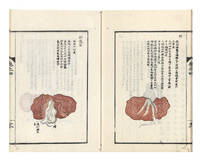
réf. 6006Numerous fine woodcut illus. 18 of which are finely handcolored. 48 irregularly paginated; 33; 39; 26; 28 3 folding leaves. Five vols. 8vo orig. wrappers some worming in upper margin of each vol. orig. block printed title label on each upper cover new stitching. Tokyo: Mankyudo Hanabusa Heikichi Preface dated 1810. First edition of one of the three most important early Japanese books on the history and technique of Chinese and Japanese acupuncture. This work is very different from all earlier Chinese and Japanese books on the subject. For the first time the illustrations are finely and realistically rendered and are anatomically accurate clearly influenced by European medical works which had circulated in Japan. Another important aspect of this book is that eighteen of the woodcuts each depicting organs of the body are finely handcolored. Also the body is described in full from head to foot and is not entirely dependent on the fourteen meridians. Kosaka was a court physician of the fiefdom of Kameyama who had studied under the famous physician Motonori Taki 1731-1801 who was himself a member of a distinguished family of doctors. The publisher of this work was the exclusive publisher for the government sponsored medical school. Very good set. unknown books
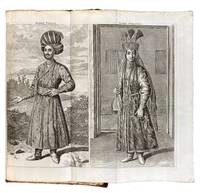
1718réf. 42045Amsterdam: Chez les Freres Wetstein 1718. 2 volumes small folio. 13 3/4 x 8 1/2 inches. Half-title in volume I titles printed in red and black. Vol 1: engraved portrait of the author by G. Valck after G. Kneller engraved allegorical frontispiece by B. Picart dedication with engraved headpiece 3 engraved double-page maps 111 engraved plates numbered 1-110 plus 1 unnumbered on 52 sheets 29 double-page 7 folding 24 engraved illustrations within the text illustration on p. 164 pasted on slip as issued. Vol 2: 162 engraved plates numbered 111-262 plus 10 unnumbered on 56 sheets 33 double-page 9 folding 20 engraved illustrations within the text. Quarter calf and marbled paper boards spines with raised bands forming six compartments tooled and lettered gilt. Uncut Provenance: Princes of Liechtenstein bookplate "Ex Libris Liechtensteinianis" of Franz Joseph II 1906-1989 on front paste-downs A fine clean uncut copy of the First edition in French of Le Bruyn's important illustrated account of his voyage to Russia Persia India and Java. From the library of the Princes of Liechtenstein. In his first expedition of 1674 Dutch traveller and painter Cornelius Le Bruyn remained in the Levant for seven years travelling principally in Asia Minor Syria the Holy Land and Egypt. On his return he published his Voyages au Levant and encouraged by its success undertook a second more far-reaching expedition. "In 1701 Le Bruyn started on the second of his journeys taking a ship to the country of the Samoyeds . and then proceeding to Moscow. Travelling by way of Asia Minor he arrived in Persia where he remained for the years 1704-05. Leaving Persia he proceeded by ship to India stopping at Cochin Ceylon and the East Indies i.e. Batavia. He returned by much the same route residing in Persia between 1706 and 1707 and describing the ruins of Persepolis and Pasargades" Howgego. The numerous finely engraved illustrations include large folding panoramas of Moscow and Isfahan views of Astrakhan and the antiquities at Persepolis and many of the forts encountered on his journey as well as portraits of native peoples and depictions of the flora fish birds animals etc. Of particular note are Le Bruyn's description and images of the Samoyeds and their country among the earliest for the region. Le Bruyn also gives an account of an encounter with William Dampier in Batavia and describes the route taken by Everard Ysbrants Ides the Danish Russian ambassador to China. Brunet III:911 calls for 262 plates based on the numbering of the plate list which does not include the unnumbered plates; Chadenat II 5085; Chahine 2078; Cohen-de Ricci 610; Lipperheide Kaa 6 calls for 128 plates and 45 engraved illustrations; Howgego B177. Chez les Freres Wetstein unknown books
1550réf. 5044Rome: ca 1550. SECOND STATE of three with the addition of "Romae" incised at lower right. Hardcover. Fine. A very fine example with high contrast of this rare print. This is the first published engraving dedicated to Michelangelo's Moses and one of only two made in the 16th century. The funerary monument of Julius II occupied Michelangelo in various phases from 1505 to the 1540s. Prints of the entire monument are few. In them the figure of Moses is necessarily reduced in size and imperfectly executed. Later prints of the statue in isolation such as that by the Netherlandish artist Jacob Matham 1571-1631 in which the figure is shown in reverse fail to match the standard set by this early engraving. The inscription reads: Moysis ingens ex marmore simulacrum in Julij Secundi/ Pontificis Maximi ad petri in Exquilijs uincula sepulcro / præstanti Michaelis Angeli Bonarotae manu fictum. The immense marble statue of Moses in the Church of San Pietro in Vincoli on the Esquiline Hill sculpted by the hand of Michelangelo Buonarroti for the tomb of Pope Julius II. Michelangelo's design for the tomb of Pope Julius II with the master's iconic figure of Moses was originally intended for St. Peter's but was ultimately installed in the church of San Pietro in Vincoli in Rome. The work was commissioned by Pope Julius in 1505 at which time Michelangelo received an initial payment of 100 gold ducats but was not completed until March 1545. Michelangelo re-worked his initial design numerous times first in 1513 after Julius' death and again in 1516 1525/1526 1532 and 1542. The final monument includes three figures carved by Michelangelo: the aforementioned Moses and Leah and Rachel symbols respectively of the active and contemplative life. Michelangelo's sculptures of the dying and rebellious slaves now in the Louvre and the Genius of Victory Palazzo Vecchio Florence were not used in the final design. On the second tier of the monument as it stands is an effigy of the reclining Julius II attributed to Tommaso di Pietro Boscoli 1503-1574 but with the face possibly the work of Michelangelo watched over by the Madonna and Child carved by Alessandro Scherano di Settignano after a model by Michelangelo and flanked by a sibyl and a prophet; these last two sculptures were carved by Michelangelo's pupil Raffaello da Montelupo ca. 1504-ca. 1567. "The engraving reproduces accurately in the same direction and without substantial variations the sculpture of the tomb of Julius II identifying the light source at the top left. The work attributed by Bottari to Beatrizet Heinecken 1768 was treated as anonymous by Heinecken in the Nachrichten of 1768 but later included by him in the list of Beatrizet's works Dictionnaire 1788. Nagler recorded it both under the monogram of Cornelis Bos and as the work of Beatrizet. Appearing in the Hollstein repertoire as Bos it was subsequently treated among works of doubtful attribution both of Bos Schéle 1965 and of Beatrizet Bianchi 2004. "Due to the fact that copies of this print are found in volumes of Roman composition on the model of the Speculum Romanae Magnificentiae El Escorial; Madrid Biblioteca Nacional; both datable between the mid-1580s and the 1590s one would be led to believe that the plate was engraved in Rome where in the last decade of the 16th century it was acquired by Van Aelst. This does not however exclude Cornelis Bos as a possible author since more than one of his plates is known to bear a Roman address in late editions even if it makes it more likely -in our opinion- the identification with a Flemish engraver active in Italy. In the sparse and luminous texture and in the clean geometries one could also perceive the burin of Niccolò della Casa."Alberti Rovetta and Salsi "D'après Michelangelo"2015 p. 219 ff. ca hardcover books
réf. 835348 parts & one index in 20 vols. 8vo orig. yellow wrappers orig. block-printed title labels on upper covers new stitching. Kubota: Meitokukan Academy 1827. Second edition 1st ed.: 1825 and rare; this was printed in the Kubota domain in northwestern Japan. Following the death of his father in 1785 Yoshimasa Satake 1775-1815 became daimyo of the Kubota domain in Dewa Province modern-day Akita Prefecture. He instituted a number of reforms ordering the planting of extensive windbreaks to improve crop yields; encouraged the mining silk and lacquerware industries; instituted land reforms; dismissed incompetent and corrupt officials; and hired forestry management experts. He also established the domain academy the Meitokukan “House of Virtues” which developed an active publishing division. The present work is a rare example of an early publication from the school which specialized in Chinese learning and Confucian traditions. The Preface was written under the pseudonym “Rakuo” by Sadanobu Matsudaira 1758-1829 who instituted the “Kansei Reforms” of 1789-1801 which included a number of educational changes improving the quality of learning through Japan. The compiler of this work Ichimei Suzuki d. 1818 was a teacher at the Meitokukan and was encouraged by Satake referred to here by his pen name “Jofukyusai” to prepare this work. It is a list of pseudonyms of authors and other people of the Three Kingdoms era 220-80 AD in China with biographical sketches of each person. For each name Suzuki and his fellow compilers have given citations of the Chinese books in which they were able to determine the actual names. Fine and fresh set preserved in two old chitsu. With the “Kanda ke zo” seal of the Kyoto collector Kogan Kanda d. 1918 who formed a large and fine library which was inherited by his grandson Kiichiro Kanda. unknown books
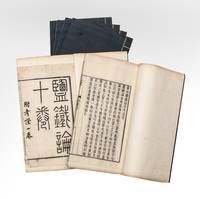
réf. 821136; 19; 20; 27; 37; 31 folding leaves neatly interleaved throughout. Ten juan in five vols. plus one vol. of commentary by Dunren Zhang. 8vo modern blue wrappers new stitching. China: 1807. A rare and important edition of this notable text; the sixth volume contains the valuable commentary and notes of Dunren Zhang 1754-1834 Qing scholar mathematician historian and book collector. After the death of Emperor Wu in 87 B.C. his successor summoned to the capital scholars from throughout the empire to discuss the most important problems of the day. Emperor Wu had “implemented a series of centralized economic measures to support his territorial expansion particularly to sustain wars with Xiongnu a confederation of nomadic tribes from Central Asia. For example the state monopolized salt iron and liquor industries; operated nationwide transportation facilities; and ran retail businesses. After the emperor died the new emperor gathered his officials and more than sixty Confucian literati to reassess these measures. The consultation turned into a lengthy debate not only on economic issues but also on topics such as agriculture border defense diplomacy legality and Confucianism… “The debate was later reconstructed under the title Yan tie fan by a Confucian bureaucrat-scholar Huan Kuan who consulted both living debaters and the historical record. The text delineates the debate in sixty episodes spanning over several days. In each episode the debaters focus on a specific issue that emerges during the debate.” You “Building Empire through Argumentation” 369. As a result of the debates the monopolies on salt and iron were briefly abolished but were soon resumed only to be abolished again after the overthrow of Emperor Wang Mang in 23 A.D. “The text of this book the Yantielun has been brought in the shape of a dialogue between the opponents. Except the state monopolies the text also touches political questions of the time like the power of the nomad federation of the Xiongnu in the north or the general style of politics as a ‘rule of the law’ versus ‘rule by virtue.’ Huan Kuan’s book is an important document about the internal discussions about political affairs during the Former Han period" ChinaKnowledge.de online. Fine set preserved in a slightly worn hantao. References ChinaKnowledge.de Wagner Donald B. Ferrous Metallurgy. Science and Civilisation in China. Vol. 5. Part 11. Cambridge: Cambridge University Press 2008. You Xiaoye. “Building Empire through Argumentation: Debating Salt and Iron in Western Han China.” College English Vol. 72 No. 4 March 2010. unknown books