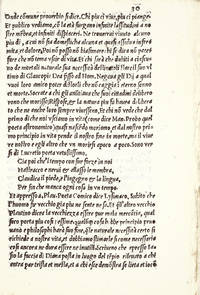
1551réf. 32892-1119Florence Lorenzo Torrentino 1551. With large historiated woodcut initial at the beginning. 90 pp. 1 blank leaf. Sm.-4to 193 x 138 mm. 17th-century polished calf gilt panelled spine red edges blind library stamps on first and last leaves back rep. From the collection of Charles Spencer 3rd Earl of Sunderland lot 10608 in his sale 1882. Florence Lorenzo Torrentino 1551. First edition. Probably originally published and later reprinted Palau: Se reimprimio en coleccion en la obras. as part of the larger work by the Spanish born Jesuit Torres 1509-1584 "De summi pontificis supra concilia auctoritate libri tres" 1551 against Ambrosius Catharinus Archbishop of Conza 1484-1553. Torres was professor at the Roman College and wrote more than seventy books principally polemical mainly against Protestants. "Can also exist independently": State Library Berlin transl. - Palau 33697 knows only the BN copy; FRBNF31481832; CNCE 48142 no copy in Florence; cf. Adams 1192; not in EDIT 16; not in STC Italian but cf. p. 687. Florence, (Lorenzo Torrentino) unknown
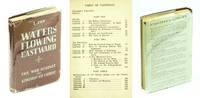
1953réf. 237j0879London: Britons Publishing Society. Good in Good dust jacket. 1953. Fourth Edition - Revised and Enlarged. Hardcover. "On the surface it would seem madness for millionaires to strive for Communism but there is irrefutable evidence that they do so strive and in Russia have in fact created a dictatorship which masquerades under the name of Communism while its only real achievement has been the liquidation of the gentile aristocracy and every Christian institution. The facts revealed in this book including the detailed plan for world revolution and world government discovered long before the first world war are so damning that no newspaper would dare to offend British readers by denying the truth. Hence the discreet silence in the Press and the slowness with which vital knowledge is spread. Their aim is a World State and a Slave State in which the masters will be of one tribe and one religious persuasion. There may be only a short time in which to learn the truth and act upon it." - dust jacket. 8-267 p. Index. Rubber stamp upon back free endpaper otherwise tanned contents clean and unmarked. Binding intact. Average wear to dust jacket now preserved in archival-grade Brodart. A sound copy. Singerman 882. ; 12mo - over 6¾" - 7¾" tall; Waters Flowing Eastward: The War Against the Kingship of Christ Unemployment World Wars Revolution Slumps Depression Antichrist . Britons Publishing Society hardcover
réf. 11598Eight double-page & 24 full-page woodcuts. .5 32; 36 folding leaves. 8vo orig. semi-stiff wrappers now mottled title-slips new stitching. Japan: 1867; Preface dated 1865 & Postscripts dated 1861 & 1866. First edition. The tragic story of Hayashi Shihei æž—åå¹³ 1738-93 and his efforts to prepare Japan for changing times is well known. A Japanese scholar and a specialist in military affairs he travelled to Nagasaki in 1777 where he was greatly impressed by the size and strength of the Dutch ships. While there he learned of Russian intentions to advance south from Siberia into Asia. This prompted him to go to the northernmost island of Hokkaido to study the situation. As a result of this journey he became alarmed at the weakness of Japan's coastal defenses and ignorance of the outside world. In 1787 Hayashi began to privately issue in a series of 16 volumes only 38 sets were produced his famous and controversial Kaikoku heidan which recommended stronger military forces and a maritime defense capability. His series is a remarkable example of a study on modern strategy introducing the military sciences of the West to Japan. Hayashi describes the powerful weaponry of the Western powers and openly criticizes the shogunate for its ignorance of the rest of the world and reliance upon an isolationist policy while neglecting maritime defenses. Kaikoku heidan caused a sensation and was banned by the government in 1792 on the grounds that national security matters were being discussed without official consent. Almost all copies and the woodblocks were confiscated. Hayashi was placed under house arrest in 1792 and died the following year. In his final years he used the pen name "Rokumusai" meaning "Six Losses" enumerated as: "no parents no wife no children no woodblocks no money and no desire to die." The present work by his nephew Michiyuki who had studied under the military theorists Oikawa Kanzaemon åŠå·å‹˜å·¦è¡›é–€ and Hishita JūzŠ日下å蔵 is both an homage to his uncle and an addendum on the modern role of horses and cavalry in warfare as practiced in the West. Michiyuki believed that the traditional Japanese methods of using horses in battle were no longer relevant and that the samurai must be trained in the methods practiced by the cavalries of Western countries. The book is richly illustrated. In the first volume are fine woodcuts of training patterns designed to improve the horses' agility. Also shown are a series of horses' eyes and teeth each revealing the character of the animal and its suitability in warfare. Acupuncture points on legs of horses are also shown. The woodcuts in the second volume depict modernized saddles stirrups bridles and horseshoes. Fine set and very scarce. Preserved in a chitsu. unknown
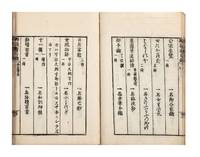
réf. 7548151 folding leaves. Three parts in one vol. Thickish 8vo orig. patterned wrappers upper wrapper a little worn orig. block-printed title label on upper cover label somewhat defective new stitching. From the colophon: Kyoto: Nakamura Magobei 1710. First edition of this important and useful bibliography. In 1710 “the Kyoto publisher Nakamura Magobei compiled a catalogue known as Bengi shomokuroku. The aim of this catalogue was to help the reader disentangle book titles which could be easily confused because they were read in the same way because they used the same characters but different readings or because they were known by several titles…Nakamura Magobei included manuscripts kakihon and explained that he had ‘given the majority of the many titles of manuscripts that have been circulating since past times’.”–Laura Moretti “The Japanese Early-Modern Publishing Market Unveiled: A Survey of Edo-Period Booksellers’ Catalogues” in East Asian Publishing and Society Vol. 2 2012 pp. 206n & 245. Nice copy preserved in a chitsu. Some minor worming carefully repaired. â§ Peter Kornicki The Book in Japan pp. 441-42–”The publication of Bengisho mokuroku in 1710 went considerably further. The author was Nakamura Magobee a Kyoto publisher and bookseller and it was written for fellow members of the book trade. He considered books printed with movable type as a separate category and was the first to draw up a catalogue of them. He directed some attention to the book trade which also explains his attention to the titles of books not yet published and to books with homophonic titles that could easily be confused. At the same time the compilation of catalogues for commercial and for private purposes was becoming commonplace and bespeaks a growing concern with the identification of books by their distinguishing characteristics.”. unknown
réf. elala6170London: Atchley And Co. c1850. Including views of Southampton Isle of Wight Bay of Biscay Berlingas Cintra the Tagus Trafalgar Tarifa Gibraltar Algiers Panteleria Malta Alexandria Mahmoudie Canal Boulac Cairo Cemetery of the Mussulmans Dead Camel Central Station Arabs on Horseback Encampment by Night Women Drawing Water Joseph's Well Red Sea Suez Jeddah Mocha Aden Point de Galle in Ceylon Madras and Calcutta. oblong folio. 32 wood-engraved plates incl. engraved title by W.Measom H.Sears & others after drawings by the aforementioned artists. with tissue guards. 4-page folio prospectus with plate descriptions loosely inserted. original pictorial bds joints cracked & chipped spine ends damaged light foxing to few plates. inscription dated 1851 on front flyleaf. elala6170 London: Atchley And Co., [c1850] unknown
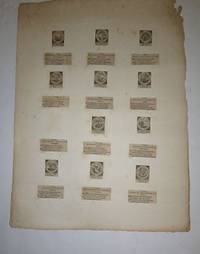
réf. 51-5496Francofurti : Impensis Lucae Jennisii MDCXXVII 1627 Frankfurt: Luca Jennis 1627. A Collection of 88 of 160 engravings with related text mounted on 9 sheets. The text to each image is numbered in Roman numerals between L and CLX. Each sheet is signed and dated 1759 on the verso. Engravings 41 x 32mm.The engravings of famous thinkers from first edition of this important alchemical emblem book. The allegorical engravings in this work first appeared two years prior at the end of a German alchemical miscellany by the same publisher with no explanatory text. The present offering combines the images with explanatory prose and poetic captions to express the secrets of transmutation on the model of Michael Maier’s 1617 Atalanta fugiens and Stoltzius’s own 1624 Viridarium Chymicum. Caillet 10386; Duveen p. 566; Ferguson II p. 410-411; Landwehr 561.NOTE: It is possible that the engravings are from Johann Daniel Mylius' "Opus medico-chymicum: Continens tres Tractatus sive Basilicas: Quorum prior inscribitur Basilica Medica. Secundus Basilica Chymica. Tertius Basilica Philosophica" Frankfurt : Lucam Jennis 1618. Francofurti : Impensis Lucae Jennisii, MDCXXVII [1627] (Frankfurt: Luca Jennis, 1627) unknown
1817réf. 26835London: Printed by McMillan Sold By T. Egerton / John Murray Albemarle Street 1817. Book. Very Good. Hardcover. First Edition / Revised and Enlarged. Octavo. 2 Volumes bound in one: 1 A NARRATIVE OF OCCURRENCES IN THE INDIAN COUNTRIES OF NORTH AMERICA SINCE THE CONNEXION OF THE RIGHT HON. THE EARL OF SELKIRK WITH THE HUDSON'S BAY COMPANY AND HIS ATTEMPT TO ESTABLISH A COLONY ON THE RED RIVER; WITH A DETAILED ACCOUNT OF HIS LORDSHIP'S MILITARY EXPEDITION TO AND SUBSEQUENT PROCEEDINGS AT FORT WILLIAM IN UPPER CANADA. London: Printed by B. McMillan Sold by T. Egerton 1817. First Edition. Attributed to Samuel Hill Wilcocke - The Macmillan Dictionary of Canadian Biography / W. Stewart Wallace. Attributed also to Simon McGillivray or to Edward Ellice the elder - National Union Catalog pre-1956 imprints. Pp. xiv 152 iv 87 - Appendix. Volume 2 STATEMENT RESPECTING THE EARL OF SELKIRK'S SETTLEMENT UPON THE RED RIVER IN NORTH AMERICA; ITS DESTRUCTION IN 1815 AND 1816; AND THE MASSACRE OF GOVERNOR SEMPLE AND HIS PARTY. WITH OBSERVATIONS UPON A RECENT PUBLICATION ENTITLED "A Narrative of Occurrencies in the Indian Countries" &c. London: John Murray 1817. A new revised and enlarged edition with the added "Observations Upon a Recent Publication ." published the same year. Pp. viii 194 ii i - xcx - Appendix 4 - publ. adverts dated July 1817. With a frontispiece map of Part of Hudsons Bay Company's Territory. Drawn and engraved by A. Arrowsmith London 12th February 1817. Bound together in half red morocco and comb-marbled boards gilt titles direct to spine top edge gilt others deckled matching marbled endpapers with binders' ticket T.W. Taylor Winnipeg. Covers scuffed front free endpaper splitting near gutter some offsetting to text and map else very good copy. Printed by McMillan, Sold By T. Egerton / John Murray, Albemarle Street Hardcover
réf. 20219London: Printed for A. Bettesworth and J. Pemberton. 1720. First edition. First edition. Octavo. Twentieth-century half calf in period style over marbled boards. The spine with five raised bands and morocco title label lettered in gilt. Woodcut head- and tail-pieces and decorative initials. A very good copy the binding square and firm. The contents with some occasional scholarly annotations in pencil to page margins the odd minor crease to the top corner of a handful of pages a pinprick hole to the title page light scattered foxing and a little browning to the margins of the preliminary pages are otherwise in very good order. The first edition of this collection of stories and essays most notable for its inclusion of an important early Australian imaginary voyage - "The Fortunate Shipwreck or a Description of New Athens" - a castaway narrative detailing the discovery of a utopian society on the southern coast of the Terra Australis published just one year after Defoe's Robinson Crusoe. Taking the form of a series of letters the work traces the experiences of the fictional English adventurer Maurice Williams after his chance arrival on the Australian continent following a shipwreck. Once ashore he discovers a utopian society founded by ancient Greeks who had themselves travelled for three years across desert and ocean in order to realise their "New Athens" in "Terra Australis incognita" Country of the South. As Williams explains after their arrival the Greeks had peacefully integrated with the original inhabitants those who "may properly be call'd the Aborigines of the place" and established a new society free from the manifold follies of contemporary Europe. In the tradition of utopian literature as established by Thomas More's seminal 1516 work Williams describes in detail the architecture and administration of the great Greek-Australian city its politics and laws and the customs and manners of its inhabitants. He then goes on to discuss the way in which he and his companions introduce the New Athenians to English poetry the art of printing the manufacture of gunpowder and the construction of war ships apparently to the great benefit of the latter. In addition to its early Australian setting the narrative also notably contains the first reference to the American territory of "Carolina" in fiction as Williams after having been caught in yet another violent storm on his return from New Athens finds himself "very well pleas'd" to be able to get ashore on Carolina's cost knowing that he was "pretty secure of finding a passage to Old England". The main contributor to the collection was the dramatist Thomas Killigrew the younger 1657-1719 although Charles Gildon recorded by CBEL as the editor may be the author of the second imaginary voyage. Chief amongst the work's other contents are: "A Voyage to the Mountains of the Moon under the Æquator" "Mahomet no Imposter written in Arabick by Abdulla Mahumed Omar" a defence of Islam purportedly written by a Muslim "Alberoni or a Vindication of that Cardinal" "The Secret History of the Amours of Don Alonzo" "The Garden of Adonis" and "An Account of Bad and Good Women Ancient and Modern". Scarce in commerce. Grove Imaginary Voyages p.234; ESTC T117537. Further details and images for any of the items listed are available on request. All items are catalogued by humans. Lucius Books welcomes direct contact with our customers. London: Printed for A. Bettesworth and J. Pemberton. 1720 hardcover
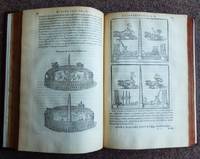
réf. 53954Lugduni apud Joan. Tornaesium 1552. TITLE CONTINUED: Accesserunt Gulielmi Philandri Castilionii civis Romani annotationes castigatiores & plus tertia parte locupletiores. Adiecta est Epitome in omnes Georgii Agricolae de mensuris & ponderibus libros eodem autoter cum Graeco pariter & Latino indice lucupletissimo. FIRST JEAN DE TOURNES EDITION OF VITRUVIUS 1552 Latin text. 4to approximately 235 x 155 mm 9¼ x 6¼ inches printer's device of vipers on title page a different De Tournes device on verso final page 83 woodcut illustrations 1 folding plate of an inscription portrait of Philandrier the editor on final page of prelims arabesque headpieces to the 10 books and historiated initials throughout pages: 16 447 57 - including index errata and Extrait du Privilege with last line: Achevé d'imprimer le huitieme février 1552 the last leaf with printer's device on verso bound in modern full blind panelled calf raised bands blind rules and gilt lettered morocco label to spine all edges red new endpapers. Small repair to inner edge of title page plus 2 ink names pages lightly age-browned tiny chip to fore-edge of 1 prelim page small closed tear to 1 margin repaired neatly some early mostly neat ink marginal notes some small corrections to text and a little neat underlining a couple of small ink stains and smudges text still easily legible very light foxing to a few margins. A good tight copy. This edition published in Lyon by Jean de Tournes was the second edited by Guillaume Philandrier the first was published in Strasbourg in 1550 as a 16mo. As the secretary to the bishop of Rodez the French humanist Philandrier friend of Rabelais had spent 10 years in Italy in Venice and Rome many of them studying Vitruvius and in 1544 he published his illustrated annotations separately in Rome. See: Laurence Hall Fowler The Fowler Architectural Collection of the Johns Hopkins University pages 318-319; Adams Books Printed in Europe 1501-1600 Volume II V908; Harvard French 16th Century Books Volume II No. 550. MORE IMAGES ATTACHED TO THIS LISTING ALL ZOOMABLE FURTHER IMAGES ON REQUEST. Postage at cost and all parcels sent fully tracked and fully insured. . Lugduni, apud Joan. Tornaesium, 1552. hardcover
1551réf. 33109-74Augsburg Philip Ulhard October 1551. Diagrams showing eclipses and celestial positions in the format of astrological squares. 346 leaves author's name crossed out on title. 4to. Contemporary vellum. Augsburg Philip Ulhard October 1551. First edition of a little known work by Cyprian Leowitz 1524-1574. The celebrated Bohemian astronomer was professor of astronomy and appointed mathematician to Elector Palatine Otho Henry German: Ottheinrich 1502-1559 and acquired a high reputation at the time of the reception of the Copernican theory. It is well known that the cosmological elements of the Copernican theory i.e. the "centrality" of the Sun and the Earth's revolution about it were not widely accepted for nearly a century after the publication of the "De Revolutionibus". Leowitz played a central role in facilitating conjunctionist theory and the actual contents of the "Tabulae" are in line with those by Stöffler. From the end of the 15th century onwards many editions of the tables of Regiomontanus were produced with commentaries and additions i.e. by Erasmsus Reinhold Luca Gaurico Leowitz with participation of Melanchthon etc. The present huge work by Leowitz appeared without introduction and without explanation. It contains so-called position plates for the places from the 33rd to the 60th latitude the pole height of the places gradus latitudinis. A final short "secundes pars" with plates up to the 66th latitude appeared in November 1551 and is not present here as in a microfiche copy stored in the Herzogin Anna Amanlia Bibliothek Weimar. . "Position" is not be taken here in the sense of modern astronomy. It is well known that the cosmological elements of the Copernican theory was not widely accepted for a long time after the publication of the "De Revolutionibus" see Burmeister Magister Rhecicus 2015. A current subject of investigation is the variety in response to the theory in the various countries of Europe. Tycho Brahe 1546-1601 visited Cyprian Leowitz in 1569. According to Tycho Leowitz told him that in his opinion the predictions of Copernicus agreed better with observations of the superior planets and solar eclipses while Ptolemy's predictions were more accurate for lunar eclipses and the positions of the inferior planets. Leowitz was correct about the relative superiority of the two theories in predicting the longitudes of the planets.- Good copy. _ _ - Adams L-520; Zinner 2018; NBG 30 814; not in Houzeau & Lancaster; cf. VD 16 L 1276. SCIENCE:ASTRONOMY & ASTROLOGY ; Augsburg, Philip Ulhard hardcover
1802réf. 0009162BETHEL TOWNSHIP LEBANON COUNTY PENNSYLVANIA. Good. 1802. On offer is an interesting document of early 19th century education an original handwritten note book covering a myriad of subjects related to mathematics. The owner and creator of this book was a man named Henry Snevely also written as Snavely and the book dates from 1802 - 1803. It seems Snevely was born in the United States and lived his whole life in Southeastern Pennsylvania. At the time of the creation of the book Snevely was almost 50 years old an established land owner in Bethel Township Lebanon County. Why he had a book of mathematics is unknown however I have found records of a Henry Snavely who taught at a school in Bethel Township from 1797 onwards. It may be likely that this book is actual not for Henry himself but for the instruction of his students. Either way the book presents a fantastic overview of early 18th century knowledge. The book covers a very large range of topics however Math pertaining to financial matters is dominant throughout. As well there are conversions of Irish and British currency. The primary immigrants to the area at the time of the book were indeed Scotch-Irish so teaching Irish and British currency conversions wouldnt be too far off. Currency exchange in particular is a primary focus owing to the large amount of immigrants to the area. Individual page headings in the book include Exchange many pages Exchange of Arbitrations Barter Profit and Loss Fellowship Fellowship with Time Allegation Media Alternate Partial and Total Square Root Cube Root Arithmetical and Geometric Progression Compound Interest Single and Double Position Reduction Addition Subtraction Multiplication and Division of Fractions and Vulgar Fractions Rule of Three in Fractions and Questions for Exercise. There is a later manuscript memorandum on rear endpaper dated 1829 bearing the names of additional members of the Pennsylvania Snavely clan Molly George and John. The name Martin Rupp also appears in memorandum and our research confirms various Martin Rupps residing in southeastern Pennsylvania during this time. The book is in fair to good condition. The volume is bound in the original stiff paper wraps. The cover is very worn and the spine is torn and partially detached. There is mild age-toning and occasional staining but the internal pages are generally clean. The black ink is still bold and easily legible throughout. The book contains about 85 pages of manuscript entries and the book itself is approximately 90 pages. It measures 12.5 x 8 inches. Biography: Henry Snavely was born on August 2 1755 in Bethel Township Lebanon County Pennsylvania. .Henry Snavely was a Lutheran. At that time he was considered a good scholar and is said to have been a hard student obtaining his knowledge principally by his own exertion. He taught the school from 1797 to 1807.; A report from 1773 shows his farm had 150 acres 5 horses 4 cattle and no servants. OVERALL: G; Manuscript; Folio - over 12" - 15" tall; KEYWORDS: HISTORY OF HENRY SNEVELY HENRY SNAVELY EARLY 19TH CENTURY KNOWLEDGE SCIENTIFIC REVOLUTION MATHEMATICS GEOMETRY TRIGONOMETRY FINANCIAL CALCULATIONS BARTERING INTEREST TEACHER'S BOOK BETHEL TOWNSHIP LEBANON COUNTY SOUTHEASTERN PENNSYLVANIA COMPLEX MATHEMATICS ALGEBRA MARTIN RUPP PRACTICAL MATH FOR FARMERS 19TH CENTURY AMERICA EARLY 1800S IN THE MID-ATLANTIC STATES CYPHER BOOK AMERICANA HANDWRITTEN MANUSCRIPT DOCUMENT LETTER AUTOGRAPH WRITER HAND WRITTEN DOCUMENTS SIGNED LETTERS MANUSCRIPTS HISTORICAL HOLOGRAPH KEEPSAKE WRITERS AUTOGRAPHS PERSONAL MEMOIR MEMORIAL ARCHIVE DIARY DIARIES JOURNAL LOG ANTIQUITÉ CONTRAT VÉLIN DOCUMENT MANUSCRIT PAPIER ANTIKE BRIEF PERGAMENT DOKUMENT MANUSKRIPT PAPIER OGGETTO D'ANTIQUARIATO ATTO VELINA DOCUMENTO MANUSCRITTO CARTA ANTIGÜEDAD HECHO VITELA DOCUMENTO MANUSCRITO PAPEL . paperback
1999réf. SBBI-mon0000038656Cis Pub 1999. paperback. Acceptable. Stains to cover page edges and/or pages inside. Please see the condition note after this for details if this is missing please consider Acceptable to mean poor quality that could include major staining water damage writing missing dustjacket etc etc. Our books are dispatched from a Yorkshire former cotton mill. We list via barcode/ISBN so please note that the images are stock images and may not be the exact copy you receive furthermore the details about edition and year might not be accurate as many publishers reuse the same ISBN for multiple editions and as we simply scan a barcode or enter an ISBN we do not check the validity of the edition data when listing. If you're looking for an exact edition please don't order at least not without checking with us first although we don't always have time to check. We aim to dispatch prompty the service used will depend on order value and book size. We can ship to most countries see our shipping policies. Payment is via Abe only. Cis Pub paperback
2000réf. SBBIH-STLVJJAEFB6VSimon & Schuster Children's 2000. paperback. Very Good. Most of our very good books have only minor imperfections such as shelf wear consistent with a new book that's sat on a bookshop shelf for a year or two. Occasionally we may miss other minor imperfections as we have to grade books at speed. Our books are dispatched from a Yorkshire former cotton mill. We list via barcode/ISBN so please note that the images are stock images and may not be the exact copy you receive furthermore the details about edition and year might not be accurate as many publishers reuse the same ISBN for multiple editions and as we simply scan a barcode or enter an ISBN we do not check the validity of the edition data when listing. If you're looking for an exact edition please don't order at least not without checking with us first although we don't always have time to check. We aim to dispatch prompty the service used will depend on order value and book size. We can ship to most countries see our shipping policies. Payment is via Abe only. Simon & Schuster Children's paperback
1543réf. 888° mm 151x104; cc. 32. Marca tipografica al frontespizio. Margine superiore un poco rifilato. Pergamena posteriore. Seconda edizione del dialogo albertiano - meglio conosciuto sotto il titolo di Theogenius - dopo quella che priva di dati tipografici ISTC cataloga come: "Florence 1500" cfr. L.B. Alberti Opere volgari II Rime e trattati morali a cura di C. Grayson Bari 1966 p. 409. Il Theogenius rappresenta un capitolo poco noto della fortuna e dell'influsso dell'epicureismo nel Quattrocento. In questo dialogo infatti l'Alberti illustra diversi temi dell'etica epicurea e traduce alcuni versi del De rerum natura di Lucrezio S. Gambino Alberti lettore di Lucrezio: motivi lucreziani nel "Theogenius" "Albertiana" IV 2001 pp. 69-84. Leon Battista Alberti's Theogenius revived and revised the ancient view developed in the Hellenistic age according to which philosophy aims to form rather than inform people showing them how to cultivate a specific attitude towards existence through a rational comprehension of the nature of humanity and its place in the cosmos. This view of philosophy as a way of life was challenged by the development of scholastic philosophy seen as a body of speculative doctrines and professional skills ancillary to the superior wisdom of theology. Nevertheless it survived thanks to Renaissance humanists like Petrarch Alberti Erasmus and Montaigne. On the influence of Lucretius on Italian Humanism after Poggio Bracciolini's discovery of the only surviving manuscript of De rerum natura 1417 cf. A. Brown The Return of Lucretius to Renaissance Florence Harvard University Press 2010 and S. Greenblatt The Swerve: How the Renaissance Began London 2011. Appresso Paulo Girardo, [colophon:] per Venturino Rosinello
1541réf. 6509Luguduni sic: Lyon: Seb. Gryphium Sebastian Gryphius 1541. Early reprint. Leatherbound. Good. 12mo. Pp. 314 13. Early 18th-C. tree calf five raised bands with gilt tooled decorations and lettering piece edges trimmed and dyed red. Decorative initial caps italic text with roman titles table of Latin and Greek chapter titles marginal notes index following text followed by a tail-piece that of a gryffin in reference to printer Gryphius. Includes Appendicula de condituris varijs ex Ioanne Damasceno a section of fourteen recipes for "condimenta" and "condituræ" between De Re Culinaria and Facultatibus alimentorum. Spine ends chipped edges rubbed endpapers stained marginal annotations in ink tight binding. Presents four culinary and health texts as called for appearing together with Torinus' introduction the same year as a nearly identical Basel edition but in smaller format for a different market. The collection of Roman recipes De Re Culinaria attributed to Apicius first appeared in this form in the fifth century AD. Torinus' sources were "codexes" found in Maguelone and Transylvania. Bartolomeo Sacchi Platina's De Honesta Voluptate given an alternate title by Torinus was the first movable-type cookbook based on Maestro Martino da Como's recipes. Paul of Aegina was a Byzantine Greek physician. Gryphius learned printing from his father in Germany then in Venice moving to Lyon around 1520. By the 1540s he had the city's largest printing establishment and reputation for a high standard of editing and impression specializing in Humanist works in small format modeled on Aldus Manutius. DURLING Sixteenth Century Printed Books in the National Library of Medicine 232. . Seb. Gryphium [Sebastian Gryphius] unknown
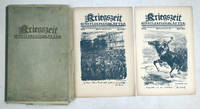
réf. 92759Berlin Paul Cassirer 1914-16. 2° 48 x 32 cm je 2 Bl zahlreiche Abb. davon teilweise blattgrosse Orig.-Lithogr. Lose Hefte in Original-Flügelmappe Mappe etwas fleckig u. eingerissen. Hefte sauber 3 Hefte min. wasserrändig am Fuss. Die ersten Hefte auf sehr holzhaltigem sprödem Papier darum gebräunt u. kleine Fehlstellen am Rande - insgesamt gute Exemplare. Alle Lithographien im Stein signiert.Mit Beiträgen in Form von Originallithographien von Ernst Barlach Max Beckmann Hans Baluschek Erich Büttner August Gaul Rudolph Grossmann Franz Heckendorf Otto Hettner Dora Hitz Ferdinand Hodler Heinrich Hübner Willy Jaeckel Georg Kolbe Max Liebermann Hans Meid Oskar Nerlinger Max Oppenheimer Max Slevogt Ottomar Starke Max Unold Wilhelm Wagner E.R. Weiss und vielen anderen.Die überwiegend nationalistisch kriegsbejahenden Lithographien etwa Max Liebermanns erscheinen neben Arbeiten von Ernst Barlach Max Beckmann August Gaul Willy Jaeckel Käthe Kollwitz oder Wilhelm Trübner mit teilweise sogar chauvinistischem Unterton die speziell für diese Zeitschrift angefertigt wurden. Künstler die gemeinhin eher für eine oppositionelle Haltung zum politischen Establishment des Deutschen Kaiserreichs bekannt sind fügten sich nach Kriegsausbruch zunächst dem politischen „Burgfrieden“ und stellten sich freiwillig in den Dienst einer nationalen Begeisterung für den Krieg. Dieser Grundströmung folgte aber schon bald die Ernüchterung die ihren Niederschlag in veränderten Themen fand. Statt hurra-patriotisch stürmender Soldaten in Kampfszenen erschienen zunehmend eskapistische mit kritischen Untertönen versehene Bildwerke mit teils sogar auch verstohlen pazifistischen Ansätzen.Schon Mitte 1915 begann der Verleger die zunächst wöchentliche Erscheinungsweise des Periodikums auf einen zweiwöchigen Publikationsrhythmus zu strecken ehe es vor seiner Einstellung 1916 nurmehr unregelmäßig veröffentlicht wurde. Ihm folgte „Der Bildermann“ das neue Zeitschriften-Projekt Paul Cassirers das in gleichem Umfang und mit gleicher Ausstattung wie die „Kriegszeit“ aber mit anderer inhaltlicher Ausrichtung ab 1916 erschien. 010 Berlin, Paul Cassirer, 1914-16 unknown
1716réf. 1469Haarlem: Weduwe van Hermanus van Hulkenroy 1716. Early 19th-century marbled boards with a paper title label on the spine. 4to. With an etched frontispiece an etching of a mermaid on the title 2 folding etchings 2 full-page etchings and 21 etchings in the text all after Adriaen van Ostade. Further with musical annotation to all songs. First edition of a rare Dutch songbook with songs for farmer's festivals all with musical annotation. The work has been beautifully illustrated with etchings after the famous Dutch painter of country life Adriaen van Ostade 1610-1685. The fine etchings newly made and in reverse present an exemplary survey of Van Ostade's work showing busts of peasants women on their way to the market carrying baskets farmers smoking merry parties dancing in front of the farm a knife-grinder a schoolmaster etc. Together they give a lively impression of country life.The work was published anonymously but has been attributed to either Jan van Gijsen 1668-1722 or Aäron van Hulkenroy 1687-1733. Van Gijsen was a popular author who wrote a large number of occasional poems. His collected works were published at Amsterdam in three volumes in 1707-1711 but the present selection was probably published only once partly with the address of the Widow of Van Hulkenroy and partly with the address of J. van Egmont who had also published the collected works. Aäron van Hulkenroy was the son of publisher Hermanus van Hulkenroy and took over the publishing company after both his parents had passed. He was also a poet who wrote various poetry collections which were always published by his mother or later himself. The present work has been attributed to him because the very first poem on the verso of the half title is signed with his initials.The boards and spine are rubbed with some loss of material at the lower outer corner of the front board. The leaves and plates are somewhat foxed a small tear in the margin of first folding plate has been repaired on the back. Otherwise in good condition.l Goovaerts 1011; Cat. Muziekhist. Museum Scheurleer II p. 92; Scheepers I 284 "Hoogst zeldzaam"; Scheurleer Liedboeken 199 lists both 1716-issues; STCN 154032301; cf. Hollstein XV pp. 1-70 for the etchings; NNBW 8 col. 648 Gijsen and NNBW 4 col. 790 Hulkenroy; not in Arents Tobacco. Weduwe van Hermanus van Hulkenroy, hardcover
1759réf. 137120Paris: J. Barbou 1759. Full period French binding in Calf five raised bands gilt ornamentation on spine author and title in gilt on red leather spine label in second compartment. 8vo. Full period French binding in Calf five raised bands gilt ornamentation on spine author and title in gilt on red leather spine label in second compartment. 263 pages. First edition Bigmore and Wyman p.228. Minor soiling to the text block else a fine copy. In this volume Fournier sets out to prove that Gutenberg was not the inventor of the printing press by examining the history of printing. He believes that the technology Gutenberg made popular existed long before the German printer's work. "Peter Simon Fournier a French engraver and letter-founder was born at Paris 1712 and died 1768. He studied under Colson painter of the Academy of Saint Luc and devoted himself first to the art of wood-engraving; he afterwards as an engraver on steel rendered himself famous in all countries. In some of his works he seeks to prove that Gutenberg is not the inventor of printing and maintains that long before Gutenberg engraving on wood had been employed for printing images and inscriptions; that during his residence in Strasburg Gutenberg attempted the application of this art to the printing of books and that on his return to Mayence he first printed the Donatus and the Catholicon of Johannes de Janua with engraved and solid blocks. Fournier's ingenious theories were ably refuted by Baron Heinecken in his "Idée Générale d'une Collection complette d'Estamples" Leipsic: 1771" Bigmore & Wyman p 229. J. Barbou unknown
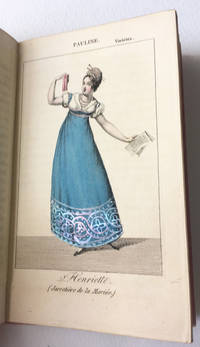
1818réf. Flo136Very rare complete set of all 8 volumes of this review of French theatre in the years 1818-1824. All eight years of publication complete with 8 handcolored engraved title pages and over 90 finely handcolored engraved portraits of actors actresses opera singers ballet dancers and comedians in costumes of their famous roles. "Very interesting almanac attributed to Charles Malo or Francois-Adolphe Loeve-Weimars giving a summary of Parisian and provincial theaters reviews on the plays and their performers notes on debuts repertoires etc." Grand-Carteret Les almanachs français Includes portraits of sopranos Mme. Gavaudan and Angelica Catalini tenors Jean-Blaise Martin and Simon Cheard ballet dancers Emilie Bigottini Genevieve Gosselin Antoine Paul and Mlle. Clotilde child actress Leontine Fay actors Francois-Joseph Talma and Charles-Gabriel Potier and many more. Odd volumes turn up occasionally but it is very rare to find the complete set of this intriguing anecdotal overview of Parisian theatre from the first quarter of the 19th century. Condition: All volumes in their pastel card slipcases paper bindings holding some spots of foxing to a few plates but overall very good with tissue guards. Complete with all engravings and calendars at end. Charles Malo 1790-1871 was a French author editor and translator whose books included a series of gift books for women illustrated by Pancrace Bessa almanacs city guides battlefield guides etc. Louis Janet paperback
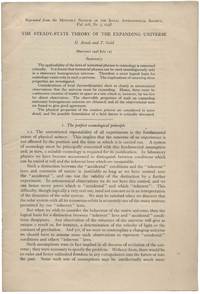
1948réf. 4162London: Monthly Notices of the Royal Astronomical Society 1948. First edition. First edition the extremely rare offprint of the first published paper to propound the 'steady-state' model of the universe according to which the universe is expanding but unchanging with no beginning or end and in which matter is continually being created throughout space so that its average density remains constant. Hardcover. THE STEADY-STATE MODEL OF THE UNIVERSE. First edition the extremely rare offprint of the first published paper to propound the 'steady-state' model of the universe according to which the universe is expanding but unchanging with no beginning or end and in which matter is continually being created throughout space so that its average density remains constant. Bondi and Gold's Cambridge colleague Fred Hoyle published his own formulation of steady-state theory four months later in the same journal 'A New Model for the Expanding Universe' MNRAS Vol. 108 No. 5 pp. 372-382. Bondi Gold and Hoyle were led to steady state theory because of well-known problems associated with the then current evolving models of the expanding universe: such models predicted a cosmic age that was problematic less than the known age of some stars and they disliked Lemaȋtre's idea of a universe with an explosive beginning. Although the steady-state theory was eventually disproved by the discovery of the cosmic microwave background in the 1960s "Steady state was of enormous importance in the history of astronomy because it turned cosmology into a serious observational part of science by making predictions different from those of an evolutionary universe for which Hoyle coined the name big bang. The predictions included numbers sizes colors and brightnesses of galaxies at large distances compared to those near us" DSB under Gold. In 2014 an unpublished manuscript was discovered probably dating from early 1931 in which Einstein himself considered the possibility of a universe that expands but remains essentially unchanged his 'cosmological constant' being responsible for the continuous creation of matter from empty space O'Raifeartaigh et al. We have located only one other copy of this offprint at the Royal Society in London no copy on OCLC. No copies in auction records. "To the extent that there existed a standard cosmology in the late 1940s it was the evolutionary universe based on Einstein's field equations of 1917 either in the big bang version or the ever-expanding but no-bang Lemaître-Eddington version. In their discussions of 1946 and 1947 Hoyle Gold and Bondi agreed that an evolutionary universe governed by general relativity was unsatisfactory in whatever version. They concluded that an unchanging yet expanding universe was preferable and for this reason they postulated continual creation of matter to occur throughout space at such a rate that it compensated for the expansion and left the average density of matter constant the idea came from Gold. In early 1948 Gold and Bondi and independently Hoyle worked out their two formulations of the steady state universe. The theory presented in the 1948 Bondi-Gold paper was deductively founded on what they called the perfect cosmological principle the postulate that the universe is uniform not only spatially but temporally as well: it has always looked the same. This principle they claimed was a fundamental axiom from which physical results should be deduced; if theoretical extrapolations from experiments conflicted with the principle such as did the law of energy conservation they had to be rejected. Bondi and Gold consequently denied that the universe could be described by the energy-conserving theory of general relativity. Moreover they objected that relativistic cosmology was "utterly unsatisfactory" because it covered so many models and was based on so many free parameters that as a whole it could not be falsified observationally. In spite of the qualitative and philosophical flavor of their paper Bondi and Gold could prove that their theory led to a number of definite predictions including a specific rate of matter creation of about 10-43 g/s/cm3. It also followed from their theory that the metric of the steady state universe had to be of the De Sitter type a flat space expanding exponentially" DSB under Bondi. "There is a charming story not taken seriously by all historians about how steady state theory began. The idea came in 1947 Hoyle claimed when he and his fellow scientists Hermann Bondi and Tommy Gold went to a movie. The three knew each other from shared research on radar during World War II. Hoyle was versatile undisciplined and intuitive; Bondi had a sharp and orderly mathematical mind; Gold's daring physical imagination opened new perspectives. The movie was a ghost story that ended the same way it started. This got the three scientists thinking about a universe that was unchanging yet dynamic. According to Hoyle "One tends to think of unchanging situations as being necessarily static. What the ghost-story film did sharply for all three of us was to remove this wrong notion. One can have unchanging situations that are dynamic as for instance a smoothly flowing river." But how could the universe always look the same if it was always expanding It did not take them long to see a possible answer-matter was continuously being created. Thus new stars and galaxies could form to fill the space left behind as the old ones moved apart. "To many philosophical minds the steady-state universe proposed by Hoyle Bondi and Gold had a major advantage over the big-bang expanding universe. In their universe the overall density was kept always the same by the continuous creation of matter. In the big-bang universe with its radically changing density various physical laws might not apply the same way at all times. It would be impossible to extrapolate with confidence from the present back to the super-dense origin of the universe. "Steady-state theory also had an observational advantage over big-bang theory in 1948. The rate of expansion then observed when calculated backward to an initial big bang gave an age for the universe of only a few billion years-well below the known age of the solar system! That was certainly an embarrassment for the big bang theory. For some time cosmologists had measured ideas against a "cosmological principle" which asserted that the large-scale properties of the universe are independent of the location of the observer. In other words any theory that put we humans at some special place like the center of the universe could be rejected out of hand. Bondi and Gold insisted that the universe is not only homogenous in space but also in time-it looks the same at any place and at any time. They grandly called this the "perfect cosmological principle" and insisted that theory should be deduced from the axiom that we are not at any special place in either space or time. "Hoyle was less insistent that the perfect cosmological principle was a fundamental axiom. He preferred to have theory follow from a modification he proposed to Einstein's relativistic universe adding the creation of matter. The two different steady-state theories had enough in common however to be considered one for most purposes. "Much of the later development of steady-state theory came in response to criticism. In Great Britain especially scientists gave considerable attention to elaborating the theory. Their arguments were largely of a philosophical nature with little appeal to observation. "The cosmological debate acquired religious and political aspects. Pope Pious XII announced in 1952 that big-bang cosmology affirmed the notion of a transcendental creator and was in harmony with Christian dogma. Steady-state theory denying any beginning or end to time was in some minds loosely associated with atheism. Gamow even suggested steady-state theory was attached to the Communist Party line although in fact Soviet astronomers rejected both steady-state and big-bang cosmologies as "idealistic" and unsound. Hoyle himself associated steady state theory with personal freedom and anti-communism. "Astronomers in the United States found the steady-state theory attractive but they took a pragmatic approach. The rival claims of big-bang and steady-state theory must be settled by observational tests. One test involved the ages of galaxies. In a steady state with continuous creation of matter there would be a mixture of young and old galaxies throughout the universe. In a big bang with only an initial creation galaxies would age with time. And astronomers could look back in time by looking at more distant galaxies for observing a galaxy a billion light-years away meant seeing it in light that had left it a billion years ago. Observations reported in 1948 purported to find that more distant galaxies were indeed older. Score one for the big bang. Bondi and Gold reviewed the data carefully and in 1954 they showed that the reported effect was spurious. Score one for steady state. The age test might be able to distinguish between the rival theories in principle but in practice it could not. "Another possible test involved the rate of expansion of the universe. In a big bang the expansion rate would slow; in a steady state universe it would remain constant. Data from the Mount Wilson Observatory seemed to favor the big bang but not certainly enough to constitute a crucial test. "Meanwhile there was a solution to the embarrassing calculation that put the age of a big-bang universe less than the age of the solar system. Walter Baade showed that estimates of the distances to galaxies had mixed together two different types of stars. As a result the size of the universe had been underestimated by about a factor of two. If galaxies were twice as distant as previously thought then calculation with the observed rate of expansion gave an age of the universe twice as great as previously calculated - safely greater than the age of the solar system. "The most serious challenge to steady-state theory came from the new science of radio astronomy. Fundamental knowledge in the techniques of detecting faint radio astronomy signals advanced greatly during World War II especially with research on radar and especially in England. After the war research programs at Cambridge at Manchester and at Sydney Australia built radio telescopes to detect signals from outer space. They dominated radio astronomy for the next decade. "The program at Cambridge was led by Martin Ryle who in 1974 would receive the Nobel Prize in physics for his overall contributions to radio astronomy. In 1951 Ryle believed that radio sources were located within our galaxy and hence were of no cosmological interest. But over the next few years he became convinced that most of the radio sources he was detecting were extragalactic. His observations then could be used to test cosmological models. Ryle argued that his survey of almost 2000 radio sources completed in 1955 contradicted steady-state theory because more distant/older sources seemed to be distributed differently from nearby ones. But he overstated the significance of his initial data. Only after more years of work would radio observations argue strongly against steady-state theory" American Institute of Physics ;/a>. Both Bondi 1919-2005 and Gold 1920-2004 were born into Jewish families in Vienna but left Austria shortly before the Anschluss. Bondi was admitted as a foreign student at Trinity College Cambridge where he arrived in the fall of 1937; Gold became an undergraduate student at Trinity in the following year. In 1940 the British government concerned about possible fifth columnists interned many Austrian and German émigrés as enemy aliens. Thus it was that Bondi and Gold who did not previously know each other met as internees in a camp in Quebec Canada where they soon became close friends. The slightly more senior camp resident Max Perutz organized an informal "school" at which the young students could teach each other. Bondi's extraordinary mathematical skills and Gold's outstanding physical insights soon became obvious and complementary. Bondi and Gold did not return to England until 1942. Hoyle 1915-2001 entered Emmanuel College Cambridge in 1933 and went on to do graduate work in theoretical physics under Rudolf Peierls and Paul Dirac. In 1939 he secured a fellowship at St. John's College Cambridge. In 1940 the Admiralty the British government department responsible for the Royal Navy recruited Hoyle for theoretical research on radar. As director of the theory division at the radar establishment Hoyle recruited Bondi in June 1942 and on Bondi's advice in October 1942 Hoyle brought in Thomas Gold. Bondi Gold and Hoyle shared a small rented house close to their place of work spending their evenings and weekends debating problems in astrophysics. All three returned to Cambridge in 1945 and from 1947 they started to work together on cosmology. O'Raifeartaigh et al 'Einstein's steady-state theory: an abandoned model of the cosmos' European Physical Journal 39 353-367. For a very detailed account of the Bondi & Gold and Hoyle papers see Kragh Cosmology and Controversy 1996 pp. 162-201. The Einstein manuscript on a steady-state universe is 'Zum kosmologischen Problem' Albert Einstein Archive Online Archive No. 2-112 Offprint from: Monthly Notices of the Royal Astronomical Society Vol. 108 No. 3 1948. 8vo pp. 252-270. Stapled as issued in self-wrappers. / Hardcover. Monthly Notices of the Royal Astronomical Society unknown
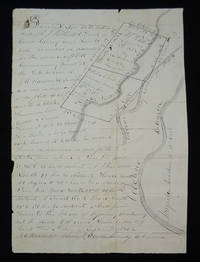
1852réf. 68368Placer County California 1852. GOLD RUSH. Gold Rush Map Manuscript. Being a Survey for the adjoining plots of land belonging to H.H. Watson and A.J. Polhill. Placer County California: 1852. Two pages on a single sheet 17 1/8 x 10 7/8 in.; 438 x 275 mm. Manuscript document with map dated variously between 4-24 September 1852 and signed by H.H. Watson A.J. Polhill and others. Sheet with some mild staining and ink blots. Some minor chipping at edges and some separations at the creases. Creases reinforced with nearly invisible tape. Overall a very interesting piece of gold rush history. We could not find any other California mine surveys at auction in the past 50 years. "Survey for H.H. Watson and A.J. Polhill. A Tract of land laying near ville bounded as described in the annex plot commencing point as the S.W. corner of J.H. Hancock survey." "Survey made by N.O. Hinman County Surveyor." "In the present survey the tracts of land being issued to Watson and Polhill are bounded on the right by the Volcano Mining Company Ditch and Volcano Canion sic with the Todds sic Valley Company Ditch running through each plot. The Volcano Gold Gravel Mining Company was one of the most extensive gravel mines during the Gold Rush and hundreds of acres of valuable mining lands were drained by its enterprises. Placer County falls in both the Sacramento Valley and Sierra Nevada regions in what is known as the Gold Country. The discovery of gold in this region in 1848 brought tens of thousands of miners from around the world and thousands more settled in the area to provide goods and services to them. The name "Placer" is taken from the Spanish word for gravel or sand deposits containing gold." From Sotheby's. HBS 68368. $3500. Placer County, California unknown
1573réf. 662556Richard Tottle 1573. Second Edition. Leather Binding. Near Fine. SECOND EDITION of this important 16th-century work on royal powers under English law by a leading jurist. A Very Good copy bound in period full brown polished calf covers tooled in blind rebacked in period-style calf with raised bands and red leather label boards rubbed; some minor stains to text with some wear to text margins. Text Latin and English the latter partly in black letter. Sir William Stanford also Stannforde Stamford or Staunford 1509 - 1558 important English jurist and pioneering author of legal texts including in 1557 'Les Plees del Coron' the first textbook on English criminal law. 'An Exposicion of the Kinges Prerogative' an important exploration of royal powers was first issued posthumously in 1567 with the title being changed in this SECOND 1573 edition to 'An Exposition of the Kinges Prerogatiue'. Written during Queen Mary's reign and published during that of Elizabeth I this work explored questions of great interest and importance to legal practitioners and jurists of the era. 854 leaves. Collation A8-K8 L6. PROVENANCE: Ownership signature on dedication leaf of William Kempe 1555-1628 of Lincoln's Inn and MP for Boroughbridge. STC 23215. Richard Tottle unknown
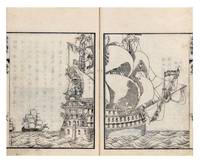
réf. 10340Many fine woodcuts throughout. Four parts & appendices in five vols. 8vo orig. semi-stiff wrappers a little frayed old stitching orig. title slips on covers. Tokyo: Yamasakiya Seishichi 山崎屋清七 et al. 1852. First printed edition of this artillery manual from the bakumatsu period. In the early 19th century Japan came under increased pressure from Western nations that wanted access to Japanese ports. “The Shogunate government issued the Order to Drive Away Foreign Ships in 1825 and commanded that foreign ships appearing along the coast of Japan be fired upon so the domains along the coast began building gun batteries and installing cannons. This is when the gun batteries and emplacements were built at Odaiba in Edo Bay and at Uraga Nakaminato Tahara Maiko Dannoura Uwajima Kagoshima and elsewhere. Dutch coastal artillery books were referred to when building these gun batteries” NDL Japan-Netherlands Exchange in the Edo Period online. Our book was published in this historical context. The book had already been translated by Motoki Masahide 1767-1822 who had left it unpublished at his death manuscript copies exist. Nunokawa Tsūboku 布å·é€šç’ž who edited Motoki’s translation and brought it to print in his Preface referenced the order that the domains build coastal defenses as one justification for publication. Motoki had studied not only Dutch but also French Russian and English. He published an English-language primer in 1811 and an English-Japanese dictionary in 1814. The Dutch original from which the book was translated was titled Het Nieuwe Licht Der Bosschieterye 1699 and was written by Gerrit van der Tollen fl. 1721-23 who worked for the Dutch East India Company. Our book is richly illustrated with a series of fine single- and double-page woodcuts of many kinds of cannons and mortars cannonballs and Western warships along with diagrams of problems in ballistics. Sections include illustrations and explanations of the structure and dimensions of cannons the measurement of gunpowder and lists of Dutch terms translated into Japanese. Some sections are written in a question-and-answer format “Which countries produce cannons Is there a difference in the making of light and heavy cannonballs”. The book begins with a history of artillery a topic that is treated further in the appendices which were not written by Motoki. The appendices treat the history of artillery both in Europe and in China. Note that Google Books presents the copy at the Bavarian State Library as being published in 1825 but the digitized title page says Kaei mizunoene which corresponds to 1852 and is the same date as seen in our book. Very fine set. â§ Motoki: Christopher Joby The Dutch Language in Japan 1600-1900 Leiden & Boston: 2021 pp. 74 121 186 191 196-97 276 285 & 320. unknown
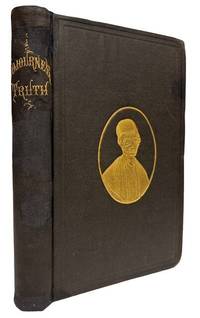
1875réf. 93724Boston: Published for the Author 1875. Hardcover. Very Good. frontis portrait 320p. Original black cloth. Simple gilt oval portrait on front cover. 19 cm. Four separate sizeable cloth pieces adding up to almost half of the total area were missing from backstrip which did still have the original gilt title at the top. Vintage black cloth added under partial backstrip. Wear at cover corners stiffened and some black paper added. Internally sound and clean with almost no foxing. We have also had this 1875 edition in publisher's cloth that was rust brown and perhaps in other colors. Published for the Author hardcover
1922réf. 32975-509Moscow and Berlin Gelikon January 1922. Illustrated with 16 photogravures on plates and line illustrations by F. Léger and others. 140 2 publisher's adv. 2 blank pp. 8vo. Orig. illus. wrappers with a Cubist drawing by F. Léger 220 x 160 mm. Moscow and Berlin Gelikon January 1922. First edition of an important work with a strong visual preseentation of Erenburg's text. One of 100 copies of an edition limited to 500 copies. The typography is Futurist amd is stikingly juxtaposed with Leger's illustrations. This rare treatise on contemporary avant-garde art by Erenburg 1891-1967 is not only noteworthy for its typographical experimentation but it defends Contructivism in early art "Oblozhka raboty Fernanda Lezhe" and includes also a penetrating analysis of the "new architecture" which Vladimir E. Tatlin and his work are seen to have generated. Among the artists the Russian critic considers are Léger Lipchitz Lissitzky Picasso Rodchenko Van Doesburg and even from a Charlie Chaplin film. - A very good uncut copy in the original wrappers designed by Léger. - Senkevitch Soviet Architecture 1917-1962 no. 1120; cf. Compton Russian Avent-Garde Books 1917-34 p. 52 & p. 153 no. 64; MoMA no. 401. LITERATURE: RUSSIAN ; ART - GENERAL & APPLIED ; ARCHITECTURE ; Moscow and Berlin, Gelikon unknown