TACQUET, Andre (or Andreas)Biblio.com
17 248 résultats
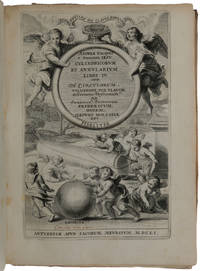
1651réf. 5427Antwerp: Jacob van Meurs 1651. First edition. First edition very rare and a fine copy. "Tacquet's most important mathematical work Cylindricorum et annularium contained a number of original theorems on cylinders and rings. Its main importance however lay in its concern with questions of method. Tacquet rejected all notions originating with Cavalieri that solids are composed of planes planes of lines etc." DSB. "It was Tacquet's decisive influence followed by Pascal's large-scale implementation which allowed the passage from indivisibles to infinitesimals" Julien Seventeenth-Century Indivisibles Revisited. . 'ALLOWED THE PASSAGE FROM INDIVISIBLES TO INFINITESIMALS' . First edition very rare and a fine copy. "Tacquet's most important mathematical work Cylindricorum et annularium contained a number of original theorems on cylinders and rings. Its main importance however lay in its concern with questions of method. Tacquet rejected all notions originating with Cavalieri that solids are composed of planes planes of lines and so on except as heuristic devices for finding solutions. The approach he adopted was that of Luca Valerio and Gregorius of Saint-Vincent an essentially Archimedean method" DSB. "Tacquet's criticisms must have been effective because indivisibles became homogeneous magnitudes as a result of innovations introduced during the course of the seventeenth century" Rossini p. 465. The historian of mathematics Henri Bosmans "states that it was Tacquet's decisive influence followed by Pascal's large-scale implementation which allowed what is sometimes referred to as the passage from indivisibles to infinitesimals" Julien p. 187. "In this work the ideas that the tangent and the area under a curve were inverse to each other appeared. It arises from the way that Tacquet thought of curves generated by moving points but not actually comprising of points. Of course this idea is an early form of what would become clear when the calculus was invented namely that the derivative and integral were inverse to each other. This book had a considerable effect on Pascal and was important in setting the scene for the invention of the calculus" MacTutor. Bosmans has pointed out the debt owed to Tacquet's Cylindricorum et annularium by Pascal in his preparation of the Lettres de Dettonville 1659. Indeed in the Lettre à Carcavy Pascal writes that Tacquet's book is full of "learned geometry" praises how Tacquet "handles the indivisibles with all desirable rigour" and refers specifically to Tacquet for a result on the approximation of a surface by inscribed and circumscribed polyhedra see Descotes. "The change in Pascal to a clear point of view with respect to infinitesimals may well have come from Pascal's reading of Tacquet's Cylindricorum et annularium in which the author denied the validity of concluding anything about the ratio of surfaces from the ratio of their indivisibles or lines" Boyer p. 151. This is a rare work particularly in commerce. ABPC/RBH list only the Turner copy from the University of Keele offered by a prominent London dealer in 2002 and subsequently sold at Reiss in 2005 quite a poor copy in modern binding with some paper repairs and a partially removed library stamp. Ours is a fine untouched copy in contemporary binding. Provenance: Contemporary ownership inscription on title of "Conde da Torre" possibly the Portuguese nobleman João de Mascarenhas 1633-1681 second Count of Torre and first Marquis of Fronteira. "The Jesuit mathematician André Tacquet 1612-60 was by the standards of his time a man of the world. Although he may never have left his native Flanders his network of correspondents spanned Europe's religious divide reaching to Italy and France but also to Protestant Holland and England. Only months before his death he entertained the Dutch polymath Christiaan Huygens who had travelled to Antwerp with the express purpose of meeting Tacquet by then regarded as one of the brightest mathematical stars ever to come out of the Society of Jesus . It was his mathematical excellence that transcended 17th-century prejudices. In England Henry Oldenburg secretary of the Royal Society of London and no friend of the Jesuits spent so much time describing Tacquet's Opera mathematica at the Society's meeting in January 1669 that he felt compelled to apologise to the fellows for abusing their patience. But it was he insisted 'one of the best books ever written on mathematics'" Alexander p. 118. "In 1651 André Tacquet the urbane Fleming whose work was celebrated by Catholics and Protestants alike published hisCylindricorum et annularium libri IV 'Four books on cylinders and rings' a work dedicated to the study of geometrical features of these figures and their applications. Befitting a Jesuit publication the frontispiece shows two angels bathed in divine light holding up a ring enclosing the book's title; on the ground below them a band of cherubs is busy putting the theory into practice. The implication is clear: divine mathematics universal and perfectly rational orders and arranges the physical world to the best possible effect. It is a fetching visual depiction of the Jesuit view of the role and nature of mathematics. "The Cylindricorum et annularium is Tacquet's most celebrated work the one that established his reputation as one of Europe's most original and creative mathematicians. As it turned out it may have been a bit too 'original and creative' for his superiors: when Tacquet sent a copy of the book the newly appointed superior general Goswin Nickel the general's response was surprisingly cool. After thanking the mathematician and congratulating him on the book Nickel added that it would be better if Tacquet applied his impressive gifts to producing textbooks of elementary geometry for use by students at the Society's colleges rather than original works aimed at a select audience of professional mathematicians . Tacquet a good soldier in the Army of Christ obeyed. From then on he published no more original work but concentrating instead on producing textbooks some of which are of such quality that they became standards in the field for over a century . "In his critique Tacquet is respectful even deferential toward his rivals. He refers to Cavalieri as 'a noble geometer' and insists that he 'does not wish to detract from the deserved glory' of Cavalieri's 'most beautiful invention' Geometria indivisibilibus 1635. Tacquet knew of what he spoke because he was himself deeply familiar with the work of Cavalieri and Torricelli and was no less capable than they of using their method to arrive at new results. But once he gets beyond his congenial style and mathematical mastery it becomes clear that Tacquet's opposition to the infinitely small is . unyielding . 'I cannot consider the method of proof by indivisibles as either legitimate or geometrical' he states flatly at the opening of his discussion of indivisibles. 'It proceeds from lines to surfaces from surfaces to solids and applies to the surface the quality or proportion obtained from the lines and transfers what was obtained from the surfaces to the solid.' 'By this method' he concludes 'nothing can be proven by anyone'" ibid. pp. 161-2. "André or Andreas Tacquet resembles his contemporary Torricelli in the generality of his adoption from his predecessors of varied infinitesimal methods. In his Cylindricorum et annularium libri IV he gave for example four demonstrations of the proposition that the volume of a sphere is equal to that of a cylindrical wedge whose base is half a great circle of the sphere and whose altitude is equal to the circumference of the sphere. This theorem had been given by a number of mathematicians since Kepler as well as by Archimedes in the Method probably not then extant. Tacquet however after proving the theorem in two ways by the use of inscribed and circumscribed figures gave two further demonstrations by indivisibles based on the equality of triangles and circular sections. Torricelli had himself been satisfied with the rigor of proofs by means of indivisibles although he supplied alternative demonstrations for the benefit of others. Tacquet on the other hand said that he did not consider that the method of Cavalieri was to be admitted as either legitimate or geometrical. He maintained that the cylindrical wedge could not in all strictness be considered as made up of triangles; nor could the sphere be regarded as composed of circles . A geometrical magnitude he asserted is made up only of homogenea that is parts of like dimension - a solid of small solids and area of small areas and a line of small lines - and not of heterogenea or parts of a lower dimension as Cavalieri had maintained. He therefore felt that a proposed magnitude is exhausted a word he undoubtedly acquired from Gregory of St. Vincent by inscribing homogenea within them 'as in the manner of the ancients'" Boyer pp. 139-140. Tacquet gave a famous example where Cavalieri's method led to incorrect results. On pp. 23-24 he considers a right-angled triangle with one horizontal and one vertical side. Rotating this triangle around the vertical side generates a cone. Each plane section of the cone parallel to the base determines a circle and the circumference of each of these circles bears the same ratio to its radius namely 2π to use our notation. Since the surface of the cone is made up of all these circular cross-sections and the triangle is made up of all the radii Cavalieri's method would imply that the same ratio is also that between the surface area of the cone and the area of the triangle. But this is not the case. Archimedes had used a double reductio ad absurdum style of proof to find areas and volumes and this argument continued to be used until the publication of Cavalieri's work. To show that the area of a given region is equal to A Archimedes showed that for any number B smaller than A an inscribed figure could be constructed whose area is greater than B the inscribed area was usually composed of rectangles or triangles so that its area could easily be determined. This shows that the area of the given region cannot be smaller than A. A similar argument with circumscribed figures shows that the area cannot be larger than A. This technique is usually referred to as the 'method of exhaustion.' In the Cylindricorum et annularium Tacquet gives two proofs of most of his results on rings and cylinders the first using a modified form of the exhaustion technique the second using indivisibles; the precision and rigour of the traditional method is repeatedly stressed. But Tacquet introduces a number of innovations in the use of the method of exhaustion. "Tacquet's book has two theorems dealing with exhaustion which are the foundation for nearly all other theorems in the book. The first proposition of the first book is reminiscent of Valerio's theorem De Centro Gravitatis Solidorum Libri Tres 1604: Let A and B be two magnitudes either areas or volumes and let the ratio of E to F be given. If one can consecutively inscribe into A and B a sequence of magnitudes that relate to one another as E to F and if these magnitudes exhaust A and B i.e. they differ from these by an arbitrarily small amount then the magnitude A will relate to the magnitude B as E to F. "Tacquet's general theorem has the advantage that he does not have to repeat a double reductio ad absurdum with each proof . "The first proposition of the second book introduces another exhaustion method: If a sequence of magnitudes Ain and Bin can be inscribed in magnitudes A and B and if likewise a sequence of magnitudes Acn and Bcn can be circumscribed about magnitudes A and B and if moreover Ain and Acn exhaust A and for the corresponding magnitudes we have Ain / Bin = E/F and Acn / Bcn = E/F then A/B = E/F. "The simplification lies in the fact that it is no longer necessary to exhaust the inscribed and circumscribed magnitudes for each of the magnitudes A and B as it suffices to calculate the ratio for one or the other . "An important new concept is found in Tacquet's definitions of surfaces and solids. He defines the cylinder for instance as a solid that is generated by the movement of a circle in such a way that one of the points of the circle segment moves along a straight line. The axis of this cylinder is the straight line joining the centre of two of the generated circles. Despite this definition he does not accept that the cylinder is composed of circles" ibid. pp. 214-5. An important example of Tacquet's 'kinetic' method of generating curves and surfaces is contained in the second part of the Cylindricorum et annularium entitled 'Dissertatio physico-mathematica de circulorum volutionibus' in which Tacquet studies the cycloid a curve traced out by a point on the circumference of a circle as it is rolled along a straight line. This curve was to be the focus of Blaise Pascal's work on indivisibles published in the Lettres de A. Dettonville 1659. "Although Pascal was undoubtedly attracted by the power of indivisible methods he was impressed by the careful geometrical approach of Grégoire de Saint-Vincent and swayed by the vigorous criticism of Cavalierian indivisibles launched by André Tacquet in his work Cylindricorum et annularium. Pascal was accordingly impelled to examine carefully the basis for the use of indivisibles in geometry" Baron pp. 199-200. "Blaise Pascal in a sense represents the highest development of the method of infinitesimals carried out under the tradition of classical geometry . Pascal was not a professional geometer and as a result his geometrical work was accomplished in two periods which were separated by an interval of mathematical inactivity from 1654 to 1658 during which he devoted his interests to theology. These two periods moreover are characterised by somewhat different views as to the nature of infinitesimals . In this connection he enunciated in the Potestatum numericarum summa of 1654 the theorem on the integral of xn . The essential point in Pascal's demonstration is the omission of terms of lower dimension . The geometrical intuition of indivisibles of lower dimension was carried over into arithmetic to justify the neglect of certain terms of lower degree . "In the later period of his mathematical activity his view appears to be modified. In connection with problems such as those in his Traité des sinus du quart de cercle of 1659 contained in the Lettres de Dettonville . he used the language of infinitesimals in speaking of the sum of all the ordinates; but he added that one need not fear to do this inasmuch as what is really meant is the sum of arbitrarily small rectangles" Boyer pp. 147-151. Bosmans sees Pascal's Potestatum numericarum summa as containing two mutually incompatible ideas about indivisibles. On the one hand Pascal sometimes regards indivisibles as rigorously null quantities as had Cavalieri. On the other hand he sometimes regards indivisibles as simply quantities that are negligible in comparison to other quantities. "Bosmans then strongly underlines the difference with the clarity of the Lettres de Dettonville where Pascal expresses himself with impeccable rigour substituting for the strict indivisibles of Cavalieri homogeneous quantities whosesums differ from that to be measured by less than any given quantity. He then finds the reason for this progress in the reading that Pascal would have made between 1654 and 1658 of the book published by Tacquet in 1651" Descotes pp. 1-2 our translation. In the last section of the Lettre à Carcavy Pascal refers specifically to Tacquet in his discussion of the problem of finding the area of a surface obtained by rotating a curve around a vertical axis. When an infinitesimal section of the curve is rotated one obtains a circular band; these bands together make up the whole surface. "This is properly what according to Dettonville Tacquet has demonstrated: 'The sum of these semi-circumferences of the surface of the semi-solid makes up this very surface as others have demonstrated among them Tacquet'. We find in fact in the Cylindricorum et annularium Book II 1st part a Proposition VI which corresponds to Pascal's words. Its object is to prove that if we consider in a great-circle BICQ on a sphere with diameter BC if we inscribe and circumscribe regular polygons on the semi-circle BIC and if we rotate these polygons around the diameter BC they inscribe and circumscribe in the sphere with solids whose surfaces differ from that of the sphere by a quantity which can be made as small as one wishes. We see how it accords with Pascal's thought: the inscribed and circumscribed segments generate bands during the rotation which at the limit can be said to compose the curved surface. In accordance with his principles Father Tacquet demonstrates it in the manner of the Ancients" ibid. p. 4. "Tacquet was the son of Pierre Tacquet a merchant and Agnes Wandelen of Nuremberg. His father apparently died while the boy was still young but left the family with some means. Tacquet received an excellent education in the Jesuit collège of his native town and a contemporary report describes him as a gifted if somewhat delicate child. In 1629 he entered the Jesuit order as a novice and spent the first two years in Malines and the next four in Louvain where he studied logic physics and mathematics. His mathematics teacher was William Boelmans a student of and secretary to Gregorius Saint Vincent. After his preliminary training Tacquet taught in various Jesuit collèges for five years notably Greek and poetry at Bruges from 1637 to 1639. From 1640 to 1644 he studied theology in Louvain and in 1644-45 he taught mathematics there. He took his vows on 1 November 1646 and subsequently taught mathematics in the collèges of Louvain 1649-55 and Antwerp 1645-49 1655-60" DSB. A second edition of the Cylindricorum et annularium was published in 1659 with the addition of a fifth book devoted to an unrelated subject the paradox of 'Aristotle's wheel'. The perceived unsuitability of the Cylindricorum at annularium for the Jesuit colleges may explain why it was not added to all copies of the Opera mathematica 1669 it was not present in the Macclesfield copy for example. De Backer-Sommervogel VII 1806 3; Poggendorff II 1064. Alexander Infinitesimal 2014. Baron The Origins of the Infinitesimal Calculus 1969. Boyer The History of the Calculus and its Conceptual Development 1949. Descotes 'Documents relatifs aux lettres de A. Dettonville I. Pascal et le Père Tacquet' Courrier du Centre international Blaise Pascal 14 1992 pp. 1-13. Julien ed. Seventeenth-Century Indivisibles Revisited 2015. Malet From indivisibles to infinitesimals 1996. Meskens Between Tradition and Innovation: Gregorio a San Vicente and the Flemish Jesuit Mathematics School 2021. Rossini 'Giordano Bruno and Bonaventura Cavalieri's theories of indivisibles: a case of shared knowledge' Intellectual History Review 28 2018 pp. 461-476. Small 4to 217 x 162 mm pp. xx 284 4 with 18 folding engraved plates the first 9 bound preceding title the remainder at end as in the instructions to binder on p. 286 full-page engraving on title second work with special half-title occasional light browning and spotting. Contemporary yapped limp vellum with manuscript title on spine remains of ties a few stains and light rubbing. Jacob van Meurs unknown
1802réf. B5905Roma: : Work I: Roma: Niccola de Antoni; Work II: Roma: n.p. Work I: c. 1802; Work II: c.1770. . A handsome fine example. Prints are clean and crisp. . Binding: Skillfully rebacked half calf preserving contemporary blue speckled - marbled boards. Spine raised with six 6 bands; compartments elegantly gilt ornamented at borders corners and centres and gilt lettered title on two. Notes: Work I: Raphael 1483-1520 painted the ceilings walls and columns of the Vatican Logge over the two-year period before he would pass away. Together with Michelangelo and Leonardo da Vinci he forms the traditional trinity of great masters of that period. These particular images are renowned for their clarity and accessibility. Much of the subject matter on the columns is traced to Roman iconography. Such items as coins vases sarcophagi and various other items are done with stunning clarity and accuracy. Carlo Lasinio 1759 – 1838 was an Italian engraver who worked chiefly in Florence. Lasinio started as a painter at the Accademia di Belle Arti Venice. He quickly placed more emphasis on printmaking especially after moving to Florence in 1778. He established his reputation with two large series of etchings in 1787 and 1789. Lasinio also taught engraving at the Accademia in Florence becoming a Professor in 1800. Work II: A collection of plates from this work with no title page. The Raphael fresco decorations in the Vatican's three-storied balconies known as the 'Logge' quickly became famous and various suites of plates were issued from the 17th century onward. However this set was the first to attempt to show all the decoration of the pilasters and pillars. A set of the present engravings stimulated Catherine the Great to have a replica of the Logge built at the Hermitage in St. Petersburg. Size: Folio 621x478mm. Illustration: Illustrated with plates after Raphael: Work I: 14 decorative copper engraved plates; engraved title page by Giovanni Balzar; remaining by Carlo Lasinio after Raphael’s depictions of the Vatican’s loggia and columns. Work II: collection of 31 full page etchings amounting to thirteen 13 pairs or sets of engravings after the Vatican frescoes by Raphael. Volume: Two works in one volume Provenance: Upper pasted endpaper ex libris bookplate marked “Dampierre”. All leaves of the first work of wove paper contain the watermark “Pietro Miliani Fabriano.” References: Berlin Kat. 1048 Pages: Work I: illustrated half-title plates numbered figure: II No. I &II III No. III & IV IV No. V& VI V No. VII & VIII VI No. IX&X I No. I&II II No. III&IV III No. V&VI IV No.VII&VIII V No. IX&X dated 1802 VI No.XI&XII VII No.XIII&XIV VIII No.XI&XII ; Work II: plate I-XIII Num I-XIII I-V Category: Book Art Architecture & Design; Book Europe Italy; Book Plate Books General; Work I: Roma: Niccola de Antoni; Work II: Roma: [n.p.] hardcover
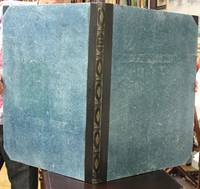
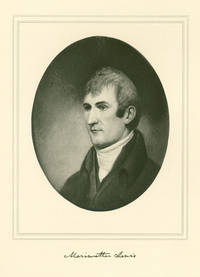
1905réf. 247478New York: Dodd Mead and Co 1905. First edition one of 200 large paper sets on Van Gelder paper. Seven volumes bound in fourteen parts plus atlas volume atlas with 56 maps & plates on 62 sheets. 15 vols. Large 8vo. Original gilt green cloth. Bookplate on front pastedowns. Spines lightly worn several lightly faded. Internally fine much of the text unopened. A very good set. First edition one of 200 large paper sets on Van Gelder paper. Seven volumes bound in fourteen parts plus atlas volume atlas with 56 maps & plates on 62 sheets. 15 vols. Large 8vo. "The most elaborate work on this expedition" - Howes. A cornerstone of modern historical research printing for the first time many major primary documents which did not appear in the Biddle edition including the Floyd and Whitehouse journals and material from the Clark-Voorihis papers along with facsimile manuscripts maps portraits and other illustrative matter. Also valuable is Victor Paltsits' bibliography of the Lewis and Clark expedition in the first volume. "This edition is notable for its thorough Introduction covering the history of the expedition and earlier exploration and a detailed account of the original journals and their various editions.In its maps and numerous illustrations the Thwaites edition is an outstanding source of visual materials relating to the expedition" - LITERATURE OF THE LEWIS AND CLARK EXPEDITION. Graff 2485; Howes L320 "b"; Wagner-Camp 13:7 note to 1842 Harpers ed.; Tweney Washington 76; Literature of the Lewis and Clark Expedition 5d.1 Dodd, Mead and Co unknown
1905réf. 247478New York: Dodd Mead and Co 1905. First edition one of 200 large paper sets on Van Gelder paper. Seven volumes bound in fourteen parts plus atlas volume atlas with 56 maps & plates on 62 sheets. 15 vols. Large 8vo. Original gilt green cloth. Bookplate on front pastedowns. Spines lightly worn several lightly faded. Internally fine much of the text unopened. A very good set. First edition one of 200 large paper sets on Van Gelder paper. Seven volumes bound in fourteen parts plus atlas volume atlas with 56 maps & plates on 62 sheets. 15 vols. Large 8vo. "The most elaborate work on this expedition" - Howes. A cornerstone of modern historical research printing for the first time many major primary documents which did not appear in the Biddle edition including the Floyd and Whitehouse journals and material from the Clark-Voorihis papers along with facsimile manuscripts maps portraits and other illustrative matter. Also valuable is Victor Paltsits' bibliography of the Lewis and Clark expedition in the first volume. "This edition is notable for its thorough Introduction covering the history of the expedition and earlier exploration and a detailed account of the original journals and their various editions.In its maps and numerous illustrations the Thwaites edition is an outstanding source of visual materials relating to the expedition" - LITERATURE OF THE LEWIS AND CLARK EXPEDITION. Graff 2485; Howes L320 "b"; Wagner-Camp 13:7 note to 1842 Harpers ed.; Tweney Washington 76; Literature of the Lewis and Clark Expedition 5d.1 Dodd, Mead and Co unknown books
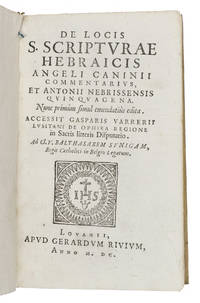
1600réf. 19698Louvain 1600. 8vo. Gerardus Rivius Contemporary limp vellum with the manuscript title on the spine remnants of ties. With a woodcut "IHS" vignette on the title-page. 8 197 9 3 14 299-250 6 pp. Extremely rare edition containing several works most notably an important account of the New World and its discovery by Christopher Columbus: De Ophira Regione written by the Portuguese geographer Gaspar Barreiros = Caspar Varrerius d. 1574 first published in his Chorographia Coimbra 1561.The first two works by the Italian philologist Angelo Canini 1521-1557 and the Spanish classical scholar Antonio de Nebrija 1444-1522 reflect on the names of places also of people and animals etc. of Hebrew origin in the New Testament. The collection also contains Barreiros's letters including one to the King of Portugal and other short works. The collection was simultaneously printed in Antwerp by the Heirs of J. Bellerus and in Louvain. The present Louvain printing is of the utmost rarity.Some slight browning in a few quires. Good copy of an extremely rare collection of works including an early Americanum.l Alden & Landis 600/28; Belg. Typ. 548; Index Aureliensis 131.043; Leclerc 414; USTC 414149 3 copies; cf. Adams C-507 Antwerp ed.; Machiels C-85 Antwerp ed.; Sabin 3596 Antwerp ed.; not in KVK; STCV; WorldCat. ABE CAT Bibles Sermons & Psalmbooks hardcover
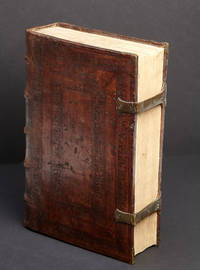
réf. 6759Numerous fine woodcut initials diagrams tables & maps in the text. Woodcut printer’s device at end. 14 p.l. 18 leaves 6 leaves 30 xxxi-cxxvi leaves 4 leaves. Folio cont. Flemish blindstamped calf binding over wooden boards rather well rebacked a few unimportant stains rolls of medallion heads & foliage forming a double panel orig. clasps and catches metal corner guards. Cologne: J. Prael for P. Quentel 1537. bound after: ANSELM ARCHBISHOP OF CANTERBURY. In Omnes Pauli Apostili Epistolas enarrationes. Title within fine woodcut border by Anton Woensam of Worms. Some fine large woodcut initials. 8 p.l. 531 pp. Folio. Cologne: E. Cervicornus for G. Hittorp 1533. A most attractive sammelband of two well-illustrated books in an attractive contemporary blind-stamped binding probably made at the Stavelot monastery in Belgium. I. First collected and illustrated edition of the scientific writings of the Venerable Bede including De Natura Rerum dealing with cosmology and natural history and De Temporum Ratione a work on chronology that still exercises a considerable influence over our daily life today. This edition was edited and commented upon by Joannes Noviomagus i.e. Jan van Bronchorst of Nijmegen 1494-1570 philosopher and mathematician then a professor of philosophy at the Collegium Montanum in Cologne. It would appear that he used the manuscript at the Dombibliothek no. 103 of Cologne to prepare this edition. The De Temporum Ratione is a significant book in several ways. Most notably “this book helped to establish the custom of counting years from the birth of Christ. When we say that Queen Elizabeth II was born in 1926 not ‘in the 16th year of the reign of George V’ or ‘in the year 2678 after the foundation of Rome’ or in the ‘2nd year of the 481st Olympiad’ we are indebted to the Venerable Bede.”–Printing & the Mind of Man 16n. “Bede’s greatest practical effect was on the Western calendar. His decisions beginning the year calculation of Easter names of days and months calculations of eras and so forth in most instances finally determined usage that was only refined not changed by Gregorian reform.”–D.S.B. I p. 565. “The De Ratione Temporum first published in 1505 is particularly important. It contains a remarkable theory of tides based upon Pliny but also upon personal observation; first mention of the establishment of a port i.e. the mean interval between the moon’s meridian passage and high water following; this interval is different in different ports.”–Sarton I p. 511. Pierre Duhem described Bede’s establishment of a port as the only original formulation of nature to be made in the West for some eight centuries. Also contained here is the De Natura Rerum 1st printing: 1529 which contains such physical science as was then known. It collects the wisdom of the ancient world on these subjects and has the special merit of referring phenomena to natural causes. It contains a particularly important section — the “De Comptu vel Loquela digitorum” — which is “our main almost our only source for the study of mediaeval finger reckoning or symbolism.”–Sarton I pp. 510-11. See also Smith History of Mathematics II p. 200. The rest of the book contains further treatises by Bede on arithmetic astronomy and the calendar and chronology. II. Very rare. PROVENANCE: Early inscription of “Antonius abbatis a Sancto Remaclo” on front flyleaf; Benedictine monastery of Stavelot Belgium inscription “Liber Monasterii Stabulensis” on title-page of Anselm; auction sale of the monastery library Catalogue d’une belle Collection de Livres et Manuscrits précieux sur vélin du VIIIe et du IXe siècle Ghent 26 April 1847 lot 42; Michel Chasles 1793-1880 the mathematician with bookplate his sale Paris 27 June-18 July 1881 lot 28; Robert B. Honeyman 1897-1987 his sale Sotheby’s 30 October 1978 lot 265. BINDING: Stavelot had its own bindery at this time and it is quite likely that this binding was executed there see Goldschmidt Gothic & Renaissance Bookbindings no. 90. Fine large copies preserved in a box. ⧠I. Adams B448–calling for two additional preliminary leaves but no other collation calls for them. Smith Rara Arithmetica p. 159n. Zinner 1657. II. Adams A1174. unknown
réf. 6759Numerous fine woodcut initials diagrams tables & maps in the text. Woodcut printer’s device at end. 14 p.l. 18 leaves 6 leaves 30 xxxi-cxxvi leaves 4 leaves. Folio cont. Flemish blindstamped calf binding over wooden boards rather well rebacked a few unimportant stains rolls of medallion heads & foliage forming a double panel orig. clasps and catches metal corner guards. Cologne: J. Prael for P. Quentel 1537. bound after: ANSELM ARCHBISHOP OF CANTERBURY. In Omnes Pauli Apostili Epistolas enarrationes. Title within fine woodcut border by Anton Woensam of Worms. Some fine large woodcut initials. 8 p.l. 531 pp. Folio. Cologne: E. Cervicornus for G. Hittorp 1533. A most attractive sammelband of two well-illustrated books in an attractive contemporary blind-stamped binding probably made at the Stavelot monastery in Belgium. I. First collected and illustrated edition of the scientific writings of the Venerable Bede including De Natura Rerum dealing with cosmology and natural history and De Temporum Ratione a work on chronology that still exercises a considerable influence over our daily life today. This edition was edited and commented upon by Joannes Noviomagus i.e. Jan van Bronchorst of Nijmegen 1494-1570 philosopher and mathematician then a professor of philosophy at the Collegium Montanum in Cologne. It would appear that he used the manuscript at the Dombibliothek no. 103 of Cologne to prepare this edition. The De Temporum Ratione is a significant book in several ways. Most notably “this book helped to establish the custom of counting years from the birth of Christ. When we say that Queen Elizabeth II was born in 1926 not ‘in the 16th year of the reign of George V’ or ‘in the year 2678 after the foundation of Rome’ or in the ‘2nd year of the 481st Olympiad’ we are indebted to the Venerable Bede.”–Printing & the Mind of Man 16n. “Bede’s greatest practical effect was on the Western calendar. His decisions beginning the year calculation of Easter names of days and months calculations of eras and so forth in most instances finally determined usage that was only refined not changed by Gregorian reform.”–D.S.B. I p. 565. “The De Ratione Temporum first published in 1505 is particularly important. It contains a remarkable theory of tides based upon Pliny but also upon personal observation; first mention of the establishment of a port i.e. the mean interval between the moon’s meridian passage and high water following; this interval is different in different ports.”–Sarton I p. 511. Pierre Duhem described Bede’s establishment of a port as the only original formulation of nature to be made in the West for some eight centuries. Also contained here is the De Natura Rerum 1st printing: 1529 which contains such physical science as was then known. It collects the wisdom of the ancient world on these subjects and has the special merit of referring phenomena to natural causes. It contains a particularly important section — the “De Comptu vel Loquela digitorum” — which is “our main almost our only source for the study of mediaeval finger reckoning or symbolism.”–Sarton I pp. 510-11. See also Smith History of Mathematics II p. 200. The rest of the book contains further treatises by Bede on arithmetic astronomy and the calendar and chronology. II. Very rare. PROVENANCE: Early inscription of “Antonius abbatis a Sancto Remaclo” on front flyleaf; Benedictine monastery of Stavelot Belgium inscription “Liber Monasterii Stabulensis” on title-page of Anselm; auction sale of the monastery library Catalogue d’une belle Collection de Livres et Manuscrits précieux sur vélin du VIIIe et du IXe siècle Ghent 26 April 1847 lot 42; Michel Chasles 1793-1880 the mathematician with bookplate his sale Paris 27 June-18 July 1881 lot 28; Robert B. Honeyman 1897-1987 his sale Sotheby’s 30 October 1978 lot 265. BINDING: Stavelot had its own bindery at this time and it is quite likely that this binding was executed there see Goldschmidt Gothic & Renaissance Bookbindings no. 90. Fine large copies preserved in a box. ⧠I. Adams B448–calling for two additional preliminary leaves but no other collation calls for them. Smith Rara Arithmetica p. 159n. Zinner 1657. II. Adams A1174. unknown books
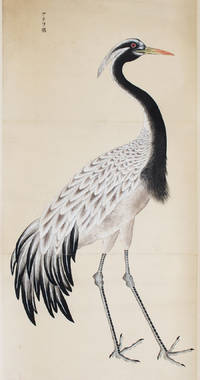
réf. 6952Scroll 420 x 12000 mm. with elaborate silk brocade endpaper at beginning. Japan: 1880-86. This beautifully rendered scroll of natural history paintings was executed with one exception by Akio or Keigu Yamamoto 1827-1903 Confucian scholar doctor botanist and highly gifted artist. He was born in Kyoto the son of the prominent doctor and botanist Boyo Yamamoto 1778-1859 the direct disciple of Ono Ranzan 1729-1810 the famous professor of botany who wrote a series of classic botanical books. Keigu “continued his father’s work in his private school in Osaka and spent his time organizing meetings that were regularly attended by both honzogaku amateurs and Japanese biologists.”–Federico Marcon The Knowledge of Nature and the Nature of Knowledge in Early Modern Japan p. 301. Keigu travelled widely throughout Japan drawing plants and animals. He gave botanical instruction to the Meiji emperor and other members of the royal family. Keigu also wrote several standard works on materia medica and left many sketch books and scrolls which entered the Kyoto rare book trade in 1932; some of these were published only in the 1980s. All of his sketch books and scrolls offered valuable and unique information regarding native plants and animals as well as those that had been introduced into Japan. Our scroll contains 14 very finely executed color paintings of plants birds and animals. The paintings are quite unique in their remarkable spaciousness. For instance the image of the octopus is 1410 mm. long. The images include a most unusual morning glory three joined sheets and 1190 mm. long; an edible yellow lily two joined sheets 800 mm.; an ungei flower two joined sheets 795 mm.; a magnificent red toki a now-endangered crane species three joined sheets 765 mm.; a large akowa tsuru another species of crane three joined sheets 815 mm.; a young white crane three joined sheets 935 mm.; a sea lion umiuso painted in many shades of delicate black two joined sheets 545 mm.; a carp two joined sheets 597 mm.; an octopus four joined sheets; a chameleon three joined sheets 844 mm. dated “1880”; a deer antler two sheets 545 mm.; a “Dutch” dog two sheets 545 mm.; a lion seen at exhibitions in Tokyo and Kyoto two sheets 640 mm. with a seal and note stating this was the work of “Ariyoshi” dated “1886“; and two camels two sheets 545 mm. long. Four of the paintings have the signature and seal of Yamamoto and another painting — the final — has the seal only. Three of the paintings have additional text by Yamamoto regarding where seen and painted alternative regional names date etc. Very fine condition preserved in a new wooden box. All but the penultimate painting are the work of Yamamoto. unknown
réf. 6952Scroll 420 x 12000 mm. with elaborate silk brocade endpaper at beginning. Japan: 1880-86. This beautifully rendered scroll of natural history paintings was executed with one exception by Akio or Keigu Yamamoto 1827-1903 Confucian scholar doctor botanist and highly gifted artist. He was born in Kyoto the son of the prominent doctor and botanist Boyo Yamamoto 1778-1859 the direct disciple of Ono Ranzan 1729-1810 the famous professor of botany who wrote a series of classic botanical books. Keigu “continued his father’s work in his private school in Osaka and spent his time organizing meetings that were regularly attended by both honzogaku amateurs and Japanese biologists.”–Federico Marcon The Knowledge of Nature and the Nature of Knowledge in Early Modern Japan p. 301. Keigu travelled widely throughout Japan drawing plants and animals. He gave botanical instruction to the Meiji emperor and other members of the royal family. Keigu also wrote several standard works on materia medica and left many sketch books and scrolls which entered the Kyoto rare book trade in 1932; some of these were published only in the 1980s. All of his sketch books and scrolls offered valuable and unique information regarding native plants and animals as well as those that had been introduced into Japan. Our scroll contains 14 very finely executed color paintings of plants birds and animals. The paintings are quite unique in their remarkable spaciousness. For instance the image of the octopus is 1410 mm. long. The images include a most unusual morning glory three joined sheets and 1190 mm. long; an edible yellow lily two joined sheets 800 mm.; an ungei flower two joined sheets 795 mm.; a magnificent red toki a now-endangered crane species three joined sheets 765 mm.; a large akowa tsuru another species of crane three joined sheets 815 mm.; a young white crane three joined sheets 935 mm.; a sea lion umiuso painted in many shades of delicate black two joined sheets 545 mm.; a carp two joined sheets 597 mm.; an octopus four joined sheets; a chameleon three joined sheets 844 mm. dated “1880”; a deer antler two sheets 545 mm.; a “Dutch” dog two sheets 545 mm.; a lion seen at exhibitions in Tokyo and Kyoto two sheets 640 mm. with a seal and note stating this was the work of “Ariyoshi” dated “1886“; and two camels two sheets 545 mm. long. Four of the paintings have the signature and seal of Yamamoto and another painting — the final — has the seal only. Three of the paintings have additional text by Yamamoto regarding where seen and painted alternative regional names date etc. Very fine condition preserved in a new wooden box. All but the penultimate painting are the work of Yamamoto. unknown books
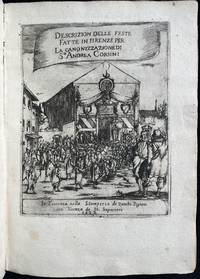
réf. 54765Florence: nella Stamperia di Zanobi Pignoni 1632. Quarto 20.8 × 15 cm. Contemporary limp vellum; 8 86 2 pp. including printed half-title etched pictorial title as well as the final leaf containing woodcut devite of Giorgio Marescotti errata and colophon; historiated initials on pp. 6 8 and 1. Illustrated throughout with twenty etchings by Stefano della Bella. Later manuscript title to spine in pencil; very minor wear to edges of boards; tiny closed tear to margin of title; p. 79/80 with small closed tear to margin; else a very good wide-margined copy. First edition of this rare work documenting the festivities for the canonization of St. Andrea Corsini which had already taken place in 1629. Pignoni's preface makes it clear that its appearance was delayed because of the outbreak of the bubonic plague in 1629 to 1631. The large-scale event included a festive procession into Santa Maria del Carmine as depicted on the title page. The church was richly adorned and decorated including a series of twenty paintings depicting scenes from Corsini's life and various miracles attributed to him explained by poems by Alessandro Adimari; the event also included musical accompaniment including by the famous organist and composer Girolamo Frescobaldi. The present work is illustrated with Stefano della Bella's etched interpretations of the original paintings. Measuring ca. 9.5 × 10.5 cm the etchings are printed within the text. Each scene features a decorative border as well as a combination of an engraved motto and allegorical motif inside a cartouche at the bottom. The accompanying text describes at length the various sonnets mottos and other words displayed during the festivities dwelling on various emblems symbols and anagrams that shed further light on the life and miracles of Saint Corsini. The author was the Florentine priest Benedetto Buommattei or Buonmattei 1581-1648 a member of the Accademia della Crusca as well as Professor of Tuscan first at Pisa and then at Florence where he also lectured on Dante and met John Milton in 1638. He also authored the important "Della lingua toscana" 1613. The striking etchings are unsigned and were long attributed to Jacques Callot who was active in Florence between 1612 and 1621. De Vesme later established them to have been the work of a still very young Stefano della Bella 1610-1664. They depict key episodes in the life of Andrea Corsini 1301-1374 the Bishop of Fiesole at his time of death whose reputation for saintliness was based in part on his heroic works of mercy during the 1347 outbreak of the plague in Florence. A procession with his relics still takes place each year in Florence on his feast day. Cicognara 1439. Gamba 2750. De Vesme/Massar Stefano Della Bella 884-904. Getty Festival Collection 94-B8960 online catalog. unknown
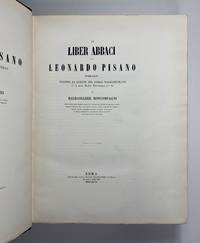
1862réf. 4120Rome: Tipografia delle Scienze Mathematiche e Fisiche 1862. Very good. 2 vols. folio. Numerous diagrams; occasional light spotting and foxing. Modern brown morocco uncut. In slipcases. EDITIO PRINCEPS OF THE WRITINGS OF FIBONACCI THE GREATEST MATHEMATICIAN OF THE MIDDLE AGES STILL THE ONLY COMPLETE EDITION PUBLISHED. IN THE HISTORY OF MATHEMATICS THIS UNABRIDGED EDITION OF THE LATIN TEXT IS ESSENTIAL AND WAS THE VEHICLE BY WHICH FIBONACCI'S WORKS WERE DISSEMINATED THROUGHOUT MODERN AND CONTEMPORARY CULTURE. Rare in private ownership. This copy which sold at Sotheby's forty years ago is the ONLY copy that has ever appeared at public auction according to Rare Book Hub which currently lists more than 15 million records in the Rare Book Transactions database; furthermore it is the only copy currently available on the market. Leonardo of Pisa ca. 1170-1250 a.k.a. Fibonacci is justly considered to be the most important mathematician of the Middle Ages if only for being the first Christian mathematician to systematically explain Arabic numerals. Indeed the mathematical renaissance in the West began with him according to George Sarton. The first volume contains the the 'Liber Abaci' devoted to problems of computation including algebraic quadratic problems; here Fibonnaci here introduces Arabic numerals the fraction bar and the numerical approach to square roots and cube roots. The second volume contains the 'Practica Geometriae' devoted to the application of algebra to geometric problems; 'Flos' written for Frederick II in answer to a number of mathematical problems posed by Magister Johannes; "Letter to Magister Theodorus" developing a general method for the solution of indeterminate problems; and finally the great "Liber quadratorum" described by Vogel as "a first-rate scientific achievement and showing Fibonacci as "a major number theorist." Vogel continues to assert correctly that Fibonacci was far ahead of his time without a successor until 1621 when Bachet made the text of Diophantus available which in turn stimulated Fermat in founding number theory. "In addition to the antique manuscripts there also undeniably exists however a vehicle that notwithstanding the inadequate and problematic access to the manuscript sources has spread the text of the Fibonaccian treatise throughout modern and contemporary culture: the well known Italian mathematician and historian of science Baldassarre Boncompagni Ludovisi in fact in his brilliant far-reaching project which brought into focus the personality of Fibonacci as well as his surviving works realized and published in Rome in 1857 i.e. THIS EDITION what can with ample justification be defined the editio princeps of the entire treatise." Germano. Despite the flaws in Boncompagni's work "it of course was a noteworthy editorial operation especially as it made available in print to a vast number of interested parties a work which had almost fallen into oblivion and that up to that time could be consulted only from its manuscript sources with all the difficulties and inconvenience which this could entail." Germano. It is fair to say that Fibonacci's contributions to mathematics languished unappreciated until the rediscovery of his texts and their presentation in the present -- surprisingly rare -- volumes. Despite its flaws Boncompagni's edition serves as the basis for only complete translation of the Liber Abici made into a modern language thus far namely Lawrence E. Sigler's "Fibonacci's Liber Abaci. A Translation into Modern English of Leonardo Pisano's Book of Calculation" 2002. Whereas Sigler corrected some errors he introduced many others usually on account of inability to understand and effectively translate the Renaissance Latin text. Before Boncompagni's edition only the "Prologus" and Chapter XV of Fibonacci's Liber Abaci had received a respectful circulation in print that was due to G. Libri's "Histoire des sciences mathématiques en Italie dépuis la renaissance des lettres jusqu'à la fin du dixseptième siècle" Paris 1838 vol. II respectively pp. 287-290 and 307-476. REFERENCES: Giuseppe Germano "The Modern Dissemination in Print of the 'Liber Abaci' and its Pitfalls" Part 3 of his New Editorial Perspectives on Fibonacci's Liber Abaci in: Reti Medievali Rivista 14:2 Firenze University Press 2013 pp. 161-163 and passim. George Sarton Introduction to the History of Science II p. 611 et seq. On Boncompagni see V. Cappelletti's in DBI XI pp. 704-709. M. Mazzotti "For Science and for the Pope-King: Writing the History of the Exact Sciences in 19th-century Rome" in: British Journal for the History of Science 33 2000 pp. 257-282 especially pp. 259-265. On the strengths and weaknesses of Boncompagni's edition see R.E. Grimm "The Autobiography of Leonardo Pisano" in: The Fibonacci Quarterly 11 1973 pp. 99-104. John D. Stanitz Sources of Science and Technology: an Exhibit of One Hundred and One Books and Documents Kent State 1972 no. 14 this copy. PROVENANCE: John D. Stanitz his sale Sotheby's New York 25 April 1984 lot 268 with with Sotheby's label on the slipcase of vol. II --> Messrs. Bernard Quaritch June 1984 Mathematics list $3000 --> James M. Vaughn 1939-2022 enigmatic American philanthropist and bibliophile who assembled the finest mathematics collection ever formed by a private individual: 125 rare and foundational books in the history of mathematics were donated to the Harry Ransom Center in 2021; our volume was kept in Vaughn's home in River Oaks Houston and sold to us by his estate. Vaughn funded the Mathematical Association of America and helped support the solution of the 300-year-old math puzzle Fermat's Last Theorem; it is therefore meaningful that he owned this copy of the Editio Princeps of the complete works of Fibonacci. With J.M.V. bookplate in each volume. Tipografia delle Scienze Mathematiche e Fisiche unknown
1862réf. 4120Rome: Tipografia delle Scienze Mathematiche e Fisiche 1862. Very good. 2 vols. folio. Numerous diagrams; occasional light spotting and foxing. Modern brown morocco uncut. In slipcases. EDITIO PRINCEPS OF THE WRITINGS OF FIBONACCI THE GREATEST MATHEMATICIAN OF THE MIDDLE AGES STILL THE ONLY COMPLETE EDITION PUBLISHED. IN THE HISTORY OF MATHEMATICS THIS UNABRIDGED EDITION OF THE LATIN TEXT IS ESSENTIAL AND WAS THE VEHICLE BY WHICH FIBONACCI'S WORKS WERE DISSEMINATED THROUGHOUT MODERN AND CONTEMPORARY CULTURE. Rare in private ownership. This copy which sold at Sotheby's forty years ago is the ONLY copy that has ever appeared at public auction according to Rare Book Hub which currently lists more than 15 million records in the Rare Book Transactions database; furthermore it is the only copy currently available on the market. Leonardo of Pisa ca. 1170-1250 a.k.a. Fibonacci is justly considered to be the most important mathematician of the Middle Ages if only for being the first Christian mathematician to systematically explain Arabic numerals. Indeed the mathematical renaissance in the West began with him according to George Sarton. The first volume contains the the 'Liber Abaci' devoted to problems of computation including algebraic quadratic problems; here Fibonnaci here introduces Arabic numerals the fraction bar and the numerical approach to square roots and cube roots. The second volume contains the 'Practica Geometriae' devoted to the application of algebra to geometric problems; 'Flos' written for Frederick II in answer to a number of mathematical problems posed by Magister Johannes; "Letter to Magister Theodorus" developing a general method for the solution of indeterminate problems; and finally the great "Liber quadratorum" described by Vogel as "a first-rate scientific achievement and showing Fibonacci as "a major number theorist." Vogel continues to assert correctly that Fibonacci was far ahead of his time without a successor until 1621 when Bachet made the text of Diophantus available which in turn stimulated Fermat in founding number theory. "In addition to the antique manuscripts there also undeniably exists however a vehicle that notwithstanding the inadequate and problematic access to the manuscript sources has spread the text of the Fibonaccian treatise throughout modern and contemporary culture: the well known Italian mathematician and historian of science Baldassarre Boncompagni Ludovisi in fact in his brilliant far-reaching project which brought into focus the personality of Fibonacci as well as his surviving works realized and published in Rome in 1857 i.e. THIS EDITION what can with ample justification be defined the editio princeps of the entire treatise." Germano. Despite the flaws in Boncompagni's work "it of course was a noteworthy editorial operation especially as it made available in print to a vast number of interested parties a work which had almost fallen into oblivion and that up to that time could be consulted only from its manuscript sources with all the difficulties and inconvenience which this could entail." Germano. It is fair to say that Fibonacci's contributions to mathematics languished unappreciated until the rediscovery of his texts and their presentation in the present -- surprisingly rare -- volumes. Despite its flaws Boncompagni's edition serves as the basis for only complete translation of the Liber Abici made into a modern language thus far namely Lawrence E. Sigler's "Fibonacci's Liber Abaci. A Translation into Modern English of Leonardo Pisano's Book of Calculation" 2002. Whereas Sigler corrected some errors he introduced many others usually on account of inability to understand and effectively translate the Renaissance Latin text. Before Boncompagni's edition only the "Prologus" and Chapter XV of Fibonacci's Liber Abaci had received a respectful circulation in print that was due to G. Libri's "Histoire des sciences mathématiques en Italie dépuis la renaissance des lettres jusqu'à la fin du dixseptième siècle" Paris 1838 vol. II respectively pp. 287-290 and 307-476. REFERENCES: Giuseppe Germano "The Modern Dissemination in Print of the 'Liber Abaci' and its Pitfalls" Part 3 of his New Editorial Perspectives on Fibonacci's Liber Abaci in: Reti Medievali Rivista 14:2 Firenze University Press 2013 pp. 161-163 and passim. George Sarton Introduction to the History of Science II p. 611 et seq. On Boncompagni see V. Cappelletti's in DBI XI pp. 704-709. M. Mazzotti "For Science and for the Pope-King: Writing the History of the Exact Sciences in 19th-century Rome" in: British Journal for the History of Science 33 2000 pp. 257-282 especially pp. 259-265. On the strengths and weaknesses of Boncompagni's edition see R.E. Grimm "The Autobiography of Leonardo Pisano" in: The Fibonacci Quarterly 11 1973 pp. 99-104. John D. Stanitz Sources of Science and Technology: an Exhibit of One Hundred and One Books and Documents Kent State 1972 no. 14 this copy. PROVENANCE: John D. Stanitz his sale Sotheby's New York 25 April 1984 lot 268 with with Sotheby's label on the slipcase of vol. II --> Messrs. Bernard Quaritch June 1984 Mathematics list $3000 --> James M. Vaughn 1939-2022 enigmatic American philanthropist and bibliophile who assembled the finest mathematics collection ever formed by a private individual: 125 rare and foundational books in the history of mathematics were donated to the Harry Ransom Center in 2021; our volume was kept in Vaughn's home in River Oaks Houston and sold to us by his estate. Vaughn funded the Mathematical Association of America and helped support the solution of the 300-year-old math puzzle Fermat's Last Theorem; it is therefore meaningful that he owned this copy of the Editio Princeps of the complete works of Fibonacci. With J.M.V. bookplate in each volume. Tipografia delle Scienze Mathematiche e Fisiche unknown books
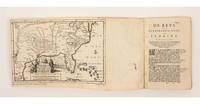
1706réf. 3719Te Leyden: By Pieter Vander Aa Boekerkoper 1706. First edition. Later half-cloth boards covered with marbled paper spine with title vignette. Small wormhole affecting the first five leaves and the folding map; otherwise in very good condition. First edition. Later half-cloth boards covered with marbled paper spine with title vignette. 6 86 4 p. and an engraved folding map and 9 engraved folding plates. Scarce Dutch illustrated edition of the first eyewitness account of Hernando de Soto's expedition complete with a folding map of Florida and nine double-page engraved plates. Dutch abridged edition of the earliest published eyewitness narrative of Hernando de Soto's expedition to Florida and the interior of North America. The text derives from the Relaçam verdadeira dos trabalhos Évora 1557 written by an anonymous Portuguese gentleman from Elvas who participated in the expedition. That work is the first printed account of de Soto's journey and remains a foundational source for the early Spanish exploration of the southeastern regions of what is now the United States. De Soto landed in Florida in May 1539 and led a large expedition through present-day Florida Georgia the Carolinas Tennessee Alabama Mississippi Arkansas and Louisiana reaching the Mississippi River before his death in 1542. The narrative records sustained contact with Indigenous societies and documents the challenges of an extended inland expedition through the southeastern regions of North America. This Leiden edition was issued by Pieter van der Aa as part of his Naaukeurige versameling der gedenkwaardigste zee- en landreysen presenting the narrative in Dutch translation in an abridged form. It is illustrated with an emblematic engraved title a folding engraved map of Florida attributed to de Soto's discoveries and nine double-page engraved plates depicting episodes from the Spanish conquest. Van der Aa's engravings played a significant role in shaping early eighteenth-century European visual conceptions of Spanish America and its exploration. A well-preserved copy complete with the folding map and plates. An important Dutch contribution to European-Americana transmitting one of the principal sixteenth-century sources for the exploration of the North American interior. Not in Sabin. Scarce on the market; RBH records only four copies offered in the past 100 years. . By Pieter Vander Aa, Boekerkoper unknown
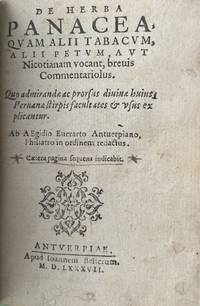
1587réf. 3021Antverpiae Antwerp: Antverpiae Antwerp 1587. First edition a variant with 246 pages in the second part was published in the same year by the same publisher; no priority has been established. In 17th-century limp vellum. Title lettered in ink on spine. Occasional annotations and underlines by a 17th-century hand in ink. Binding restored new endpapers and thongs. Pages restored throughout heavily in the first third at some places affecting the text few leaves over trimmed. Overall in very good condition. First edition a variant with 246 pages in the second part was published in the same year by the same publisher; no priority has been established. In 17th-century limp vellum. Title lettered in ink on spine. Occasional annotations and underlines by a 17th-century hand in ink. 78 =98 4; 234 pp. The first book devoted entirely to tobacco. “This little work produced by a physician who is said to have practiced with distinction in Antwerp appears to have been the first published entirely devoted to the subject of tobacco . a neat compendium of much of the information then available. It was consequently popular.” Arents De herba panacea concerns with the beneficial medicinal properties of tobacco and describes most of what was then known of this New World plant including its origin native methods of curing and cultivation and lore surrounding tobacco. Everard gives numerous recipes depending on tobacco for ailments to all kinds of illnesses. The book also contains texts by Castore Durante Gérard van Bergen Galen Jean de Jonghe and Andrés de Laguna. The book was included in the John Carter Brown Library’s 1974-published Rare Americana list A Selection of One Hundred & One Books Maps & Prints not in The John Carter Brown Library. Ref.: Sabin 23218; Adams E1150; Alden 587/15; Arents 32; Books not in JCB 21. Antverpiae [Antwerp] unknown
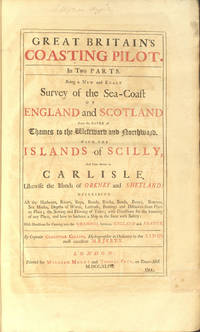
1744réf. 007689London: Tower-Hill: William Mount and Thomas Page 1744. 1st Edition 4th Printing. Hardcover. Very Good. Elephant Folio - over 15 - 23" tall. COLLINS Greenvile Captain. The most important work in the history of British maritime cartography. A Landmark in the Charting of Great Britain. Folio 18th century mottled half calf over blue-green marbled paper boards decorative gilt spine red morocco lettering piece pp. iv 26. Fine allegorical copperplate title incorporating a small map of the British Isles letter press title printed in red & black 47 copperplate charts & profiles 5 folding 3 single page the remainder double page & one chart in the text at p18. A couple of the folding maps just torn at fold some browning & offsetting text spotted in places but still a handsome copy. First published in 1693 & reissued many times throughout the eighteenth century this formidable & costly project was the first systematic survey of British coastal waters Moreland & Bannister Antique Maps 3rd ed p163. 511322 mm. Phillips 5199. Moreland & Bannister. In 1667 the Dutch sailed up the Thames & destroyed a great part of the British Navy in the Medway & bombarded Chatham. and the Government was shaken. by the realisation that the Dutch new more about the coastline of England than the English themselves & their confidence was not increased when it was found that John Seller in producing the first volume of his marine atlas the English Pilot in 1671 was still using Dutch plates & often very old ones at that. As now government was tardy in action & it was not until 1681 that Samuel Pepys as Secretary of the Navy instructed Captain Greenville Collins to carry out a survey of British coasts & harbours. In due course after a seven year survey Captain Collins issued in 1693 the Great Britain's Coasting Pilot an outstanding work consisting of 48 charts the first complete Pilot Book in English of all the coasts of Great Britain & the surrounding islands with special attention of course to the ports Moreland & Bannister. In 1693 he finally published his results in a folio volume of two parts Great Britain's Coasting Pilot containing sailing directions tide tables coastal views & about forty-nine charts. The charts were not completely accurate but with all their shortcomings they were an enormous advance on anything before them & entitle Collins to rank not only with the earliest but with the best of English hydrographers. The work covered England and Scotland & though Collins proposed a further study to cover Ireland the plan came to nothing. Collins recorded that he had spent £40 on instruments & charged £80 for the 120 manuscript maps he delivered. With his claim for expenses set at £200 per annum & his wages of £394 10s. he claimed a total of £1914 10s. for his work which was eventually paid in arrears. The cost was more than three times the original estimate. His cousin Freeman Collins printed the Coasting Pilot which Richard Mount sold. Mount's subsequent firm then went on to publish twenty-one further editions of the pilot throughout the nineteenth century. William Mount and Thomas Page hardcover
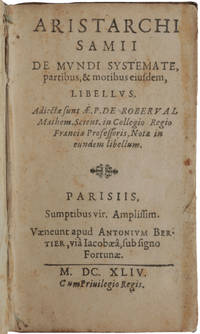
1644réf. 5431Paris: Antoine Bertier 1644. First edition. First edition exceptionally rare of Roberval's cosmology in which he expresses covertly his support for Copernicus and also formulates for the first time the law of universal attraction - that any two material bodies in the universe attract each other. This principle is normally ascribed to Robert Hooke who published it three decades later and to Newton in the Principia 1687. . THE LAW OF UNIVERSAL ATTRACTION . First edition exceptionally rare of Roberval's cosmology in which he expresses covertly his support for Copernicus and also formulates for the first time the law of universal attraction - that any two material bodies in the universe attract each other. This principle is normally ascribed to Robert Hooke who published it three decades later and to Newton in the Principia 1687. Roberval 1602-75 was one of the most brilliant members of Mersenne's circle. He developed indivisibles independently of Cavalieri invented an original method of drawing tangents and solved many of the problems on the cycloid that were formulated and solved by Pascal two decades later. However since almost nothing of his work was published in his lifetime he was for long eclipsed by Fermat Pascal and above all by Descartes his irreconcilable adversary. In fact Roberval himself published only two works the Traité de mécanique 1636 and the Aristarchi offered here; several of his other works appeared posthumously in the Divers ouvrages de mathématique et de physique 1693 but many remain unpublished even today. "Roberval's positivism appears in a particularly nuanced form in the book De mundi systemate of 1644 where he claimed to have translated an Arabic manuscript of Aristarchus to which he had added his own notes all of them favorable to the author. Yet he did not adhere to the system of Aristarchus to the exclusion of those of Ptolemy and Tycho Brahe. In the dedication of the work Roberval wrote: 'Perhaps all three of these systems are false and the true one unknown. Still that of Aristarchus seemed to me to be the simplest and the best adapted to the laws of nature.' It is with this reservation that Roberval expressed his opinion on the great system of the world the solar system the minor systems planetary the motions of the sun and the planets the declination of the moon the apogees and perigees the agitation of the oceans the precession of the equinoxes and the comets. Despite this reservation Roberval appeared convinced of the existence of universal attraction which-under the inspiration of Kepler-he put forth as the foundation of his entire astronomy: 'In all this worldly matter the fluid of which the world is composed according to our author and in each of its parts resides a certain property or accident by the force of which this matter contracts into a single continuous body'" DSB. Like Copernicus Aristarchus ca. 310-230 BCE maintained that the Earth rotates on its axis and revolves around the Sun. However Aristarchus's work has not survived and the Arabic manuscript which Roberval claimed to have translated almost certainly did not exist. Roberval uses it as a cover to express his support albeit nuanced for heliocentrism still a dangerous idea at the time. OCLC lists Cornell Huntington and Linda Hall in US. No other copies in auction records. "Gilles Personne was born in the village of Roberval near Senlis in 1602. Nothing is known about his early education; his father was a poor farmer or farmworker and the young mathematician who would later add 'de Roberval' his surname seems to have led the peripatetic life of an impoverished student passing through several universities and alternately studying and teaching. In 1628 he settled in Paris; there he got to know Mersenne who recognised his talents and encouraged him to work on the problem of the curve known as the 'trochoid' 'roulette' or 'cycloid.' In 1632 Roberval was given a teaching post at the Collège de Maître Gervais; two years later he obtained a more eminent position the Ramus chair of mathematics at the Collège Royal. He would remain in this professorship for forty-one years - a permanent fixture as it were of Parisian intellectual life - until his death in 1675. But the peculiar terms on which holders of this Ramus chair were appointed had a very negative influence on both his work and his later reputation. The chair was tenable for a period of three years; at the end of that time it was opened to a public competition in which anyone including the incumbent could apply for it. Candidates were required not only to lecture but also to demonstrate theorems and solve problems put to them by all comers. As a result the practice grew up of the incumbent trying to ensure his reappointment by proposing problems which only he could solve. Whatever were the most advanced discoveries Roberval was making at any time therefore he had an incentive to keep them secret so that he could use them to confound his competitors on these triennial occasions. One consequence was that most of his important work in his special field - geometry - remained unpublished in his lifetime. And another consequence was that Roberval would more than once become embroiled in disputes about precedence insisting that he had made key discoveries long before they were published by others; in 1646 for example he would make bitter accusations against Torricelli alleging that his analysis of the cycloid had been derived in an underhand way from Roberval's unpublished work. Even when he did allow some of his work to circulate he favoured a method of publication that was both limited and carefully monitored. As the English mathematician John Pell would later recall 'many yeares agoe some pieces of Mr Roberval were published after the old fashion. That is they were not given to a Printer; but any man that would pay for the transcribing might have had a coppy of them.' "Roberval was by all accounts a prickly character quick to take offence and with a high opinion of his own worth. As those were also the most prominent characteristics of René Descartes it is hardly surprisingly that a fierce enmity quickly sprang up between them. Roberval was almost ostentatiously unimpressed by Descartes' 'Géométrie' one of the essays published with his Discours de la méthode in 1637; his cool and critical comments transmitted to the author by their mutual friend Mersenne elicited an angry reaction. Relations between them were further soured by Descartes' quarrel with Fermat about the construction of tangents in 1638 in which Roberval became one of Fermat's leading defenders; not long afterwards Descartes accused Roberval of purloining his own ideas about the cycloid. Meanwhile Mersenne himself remained on the best of terms with both of these disputants. Indeed he seems to have had not only a deep admiration of Roberval's mathematical talents - he described him as scarcely inferior to Archimedes - but also a real personal fondness for him. Mersenne made a special effort to promote the writings of this far from prolific author: he added Roberval's brief treatise on mechanics at the end of book 3 of his own Harmonie universelle Paris 1636; he included material from the Latin version of that treatise in his compilation of 1644 Cogitata physico-mathematica; he encouraged and assisted the publication of Roberval's astronomical work Aristarchi Samii de mundi systemate libellus in 1644; he also reprinted that entire work in his own later compilation of 1647 Novarum observationum . tomus III. And throughout his own writings Mersenne referred to Roberval in terms both laudatory and affectionate calling him simply 'our geometer' - 'Geometra noster'" Malcolm pp. 157-8. "In 1644 Gilles Personne de Roberval published a small cosmological treatise entitled Aristarchi Samii de Mundi Systemate partibus & motibus eiusdem libellus. The book is attributed to the ancient Aristarchus of Samos and Roberval claims it to be an annotated translation of a recently recovered Arabic manuscript . Roberval tells the reader that the Arabic manuscript was translated under his and Mersenne's supervision at the expense of the royal counsellor. He does not explicitly defend the authenticity of the manuscript or even its origin as a true ancient source. Roberval does however imply the manuscript's authenticity at least by the style and disposition of the treatise. The epistle informs us that in addition to the translated text Roberval will also help the reader by inserting certain notes. These are given within the text are labelled as 'NOTA' and end with the abbreviation 'P.N.E.M.' 'pondere numero et mensura' the motto of the mathematicians of the Collège Royal. Usually the notes present new discoveries which were unknown by the author in order to corroborate or refute Aristarchus's opinions. "Not many took the book to be an authentic ancient treatise. Most philosophers mathematicians or scientists realized that the book was not authentic and that the name of Aristarchus was used just as a cover for a seventeenth century author. They were of course right. However as Heath observed more than a hundred years ago 'there was every excuse for Roberval. The times were dangerous.' Only ten years before he wrote the Aristarchi Galileo's Dialogue on the Two Chief Systems of the World was condemned. The French context was uncertain as geocentric systems were actively defended in the 1630s. In 1632 Libert Froidmond arguing against Philip and Jacob Lansbergen's heliocentric system published the Anti-Aristarchus sive Orbis-terrae immobilis. Two years later Froidmond followed up with another treatise the Vesta sive Ant-Aristarchi Vindex. Furthermore Roberval's Parisian colleague Jean Baptiste Morin had published the Famosi et antique problematis de telluris motu strongly arguing against Galileo and Copernicanism" Babeş pp. 95-97. In the Aristarchi Roberval not only discusses heliocentrism he gives a complete theory of the motion of the Earth Moon and planets. It is based on three principles. "The Sun as a cause of motion. From the very first chapter of the Aristarchi Roberval explains all motion of the system of the world by two principles. One of them is a principle of attraction stating that the fluid heavenly matter has in every one of its parts a certain property by which it tends to unite with all the other parts of matter. If the Sun would be absent from the world all heavenly matter would reunite in a perfect sphere. The second principle concerns the action of the Sun. By its heat the Sun continuously rarefies the surrounding matter. The rarefaction results in the elongation of matter which is pushed towards the extremity of the system. The sun also has an axial motion of its own by which the eviction of the rarefied matter takes place. This motion impresses upon the celestial bodies their periodical movement around the Sun. However throughout the Sun's axial rotations the ejections of rarefied matter do not have a constant flux and thus the motions of heavenly bodies around the sun are not uniform. "The movements of the Earth's system. As one of the planetary systems the Earth is moved around the Sun by the continuous pushing of the elongated matter coupled with the attractive property of the celestial matter. The system of the Earth retains its quasi-spherical shape due to an analogous attractive property of the elemental matter which accounts for the weight of terrestrial bodies. The terrestrial matter is however different from the heavenly matter. It is very mixed and it is unevenly disposed on the surface of the Earth. Therefore the Sun unevenly elongates the airy and fiery atmosphere surrounding the Earth and as a result the diurnal motion of the Earth is irregular. To this is added a third reason of the irregularity the influence of the Moon. "The periodical movement of the Moon. According to Roberval the Moon is a part of the system of the Earth. Its density is similar to that of the superior atmosphere such that it revolves together with the air and fire around the Earth. Roberval claims that the moon floats in the superior atmosphere in the same way as a submerged piece of wax floats in water. Its orbit however in not circular but oval-shaped. This shape is responsible for the ebb of the seas: at its perigee the Moon compresses the air below it which in turn exerts a pressure on the ocean. Likewise the Moon disturbs the flow of rarefied matter coming from the Sun which also affects the diurnal motion of the Earth" Babeş pp. 110-111. What is particularly noteworthy here is the "property of matter by which it tends to unite with all the other parts of matter" the first suggestion of the 'universal attraction' between material bodies. "In his System of the World Roberval asserts that each part of the fluid matter which fills the universe is endowed with a certain property that makes all parts draw together and attract each other reciprocally p. 39. At the same time he admits that in addition to this universal attraction there are other similar forces proper to each of the planets something that Copernicus and Kepler also admitted which hold them together and explain their spherical shapes . "Roberval's cosmology as it is presented in his System of the World . was heartily condemned by Descartes and Newton was deeply angered by Leibniz's identification of Newton's views with those of Roberval. Yet historically Roberval's work is interesting not only because it was the first attempt to develop a 'system of world' on the basis of universal attraction but also because it presented some characteristic features or patterns of explanation which or at least the analogues of which we shall find discussed later by Hooke and advocated by Newton and Leibniz. "Thus according to Roberval the fluid and diaphanous matter which fills or constitutes the 'great system of the world' forms a huge - but finite - sphere in the center of which is the sun. The sun a hot and rotating body exerts a double influence on this fluid matter: a It heats and thus rarefies it; it is this rarefaction and the ensuing expansion of the world-matter that counterbalances the force of the mutual attraction of its various parts and prevents them from falling upon the sun. This rarefaction also confers on the world-sphere a particular structure; the density of its matter increases with the distance from the sun. b The sun's rotating motion spreads through the whole world-sphere the matter of which turns around the sun with speeds diminishing with its distance from the sun. The planets are considered as small systems analogous to the great one which swim or place them selves at distances from the sun corresponding to their densities that is in regions the density of which is equal to their own; thus they are carried around the sun by the circular motion of the celestial matter as is the case with bodies swimming in a rotating vessel. Strangely enough Roberval - who never takes any account of centrifugal forces - believes that these bodies will describe circular trajectories!" Koyré pp. 59-60. The engraved plate which is repeated in this copy appears to be often lacking: it is not present in the BNF copy digitized on Gallica for example. In the reprint of the work in Mersenne's Novarum observationum . tomus III the two astronomical diagrams on the plate are printed within the text each of them several times. Babeş 'Roberval's scepticism in the Aristarchi Samii De Mundi Systemate' Studia Ubb. Philosophia 65 2020 pp. 95-114. Koyré Newtonian Studies 1965. Malcolm Aspects of Hobbes 2002. 12mo 142 x 83mm pp. viii 148 with one engraved plate showing two astronomical diagrams bound before title and repeated at end two small paper flaws in aii affecting three letters but not the sense occasional light browning and foxing. Contemporary vellum darkened and stained. A genuine untouched copy of an extremely rare book. Antoine Bertier unknown
1634réf. 57767London. 1634. 1st. Ed. 1st. Iss. pp.xx 326 iv with woodcuts throughout the text last 4 leaves with woodcut illus. Royal 4to. Hardback. Title page professionally reinforced at gutter lightly chipped to fore-edge. Overall contents in nr. fine condition. Contemporary full-calf boards in thoroughly vg. condition more recent spine in fine condition. A very pleasing copy indeed. One of three variant imprints Lisney identifies this variant as the first issue given the appearance of 'apud Benjam Allen' on the title page. Lisney 3 British Bee Books 25. A very significant work indeed. A first edition first issue copy of the first book about insects published in Britain. Partly compiled from the writings of Edward Wotton Conrad Gesner and Gesner's assistant Thomas Penny Moffett's copiously illustrated treatise remained the 'standard work' on insects until the early 1700s. London. hardcover
1610réf. 62508Florence, In officina Iuntaru, Barnardi Filiorum, 1560. Small folio. 18th century full vellum with gilt labels to spine. Wear to capitals and small worm tracts towrad opper hinges. Corners a bit bumped. A very nice and sturdy binding. Marbled edges. Some browspotting throughout. Small wormholes to blank margin of final leaf, far from affecting imprint. Woodcut vignette to title-page and to verso of colophon-leaf. (10), 308, (12) ff.
1610réf. 62508Florence In officina Iuntaru Barnardi Filiorum 1560. Small folio. 18th century full vellum with gilt labels to spine. Wear to capitals and small worm tracts towrad opper hinges. Corners a bit bumped. A very nice and sturdy binding. Marbled edges. Some browspotting throughout. Small wormholes to blank margin of final leaf far from affecting imprint. Woodcut vignette to title-page and to verso of colophon-leaf. 10 308 12 ff. The rare first edition of Vittore's main work his great edition translation and commentary on Aristotle's Poetics which is arguably the most important and influential commentary on the work ever published profoundly shaping our understanding and interpretation of Aristotelian literary theory. Petrus Victorius or Piero/ Pietro Vittore/Vettore 1499-1584 is not only the “first great editor of the Poetics” McMahon he is also considered "the greatest Greek scholar of Italy" Whibley “the leading Italian scholar of his time” Encycl. Britt. “the last great figure from that period in the domain of Greek studies” Willamowitz and “the foremost representative of classical scholarship in Italy during the sixteenth century which for Italy at least may well be called the “saeculum Victorianum”.” Sandys. His magnum opus and without doubt most influential work is his edition with commentary of Aristotle’s Poetics which is of seminal importance in several respects. It is crucial to our understanding of Aristotle’s great work shaping the way that all later scholars have read it. The understanding of Aristotle’s work on poetry came to define the way that we have understood literature and fiction ever since the Renaissance and Victorius is the leading interpreter. ““From the sixteenth century to Romanticism European literary theory used the term marvel or wonder It. meraviglia ammirabile Fr. merveille Sp. maravilla to designate everything that was on the conceptual margins of the poetics of probability and imitation. The discovery and complete reception of Aristotle’s Poetics between the fifteenth and sixteenth centuries resulted in the dissemination of an idea of poetry as the imitation of the actions of men whose main part was the plot or the structuring of actions ordered according to the laws of necessity credibility and probability. This formed the basis of Neo-Aristotelian poetics which determined the ways of thinking about literature and fiction for more than four centuries.” Vega p. 280. Especially the idea of “wonder” in Aristotle’s Poetics came to be one of the founding ideas of modern literary theory. And especially here Victurius’ reading is groundbreaking playing a central part in the reception and understanding of the work over the centuries to come. “A single editorial decision in just one passage and what is more in a complex fragmentary unfinished text like the Poetics affects the entire work…” Vega p. 284. “The text of the Poetics that can be read in the editions and translations of the sixteenth century and a large part of the seventeenth with one exception as we shall see NB. This exception is Victorius does not include the term alogon in the passage that deals with wonder. It does not appear in the first Greek edition the famous Aldine princeps of 1508 or in the Latin translations of the end of the fifteenth century; it is not in the edition and translation by Alexander Paccius or Pazzi the one most widely read in the sixteenth century neither does it appear in the edition with commentary by Francesco Robortello nor in Vincenzo Maggi’s Enarrationes nor in the vernacular commentaries of Ludovico Castelvetro and Alessandro Piccolomini. What is more a detailed revision of the history of the text reveals that no manuscript of the Poetics and no direct or indirect testimonies not even in the Arabic branch of its transmission have ever included the term alogon.” Vega p. 282. It is Victorius who is solely responsible for the reading that is generally accepted today as well. “The moment when the idea of irrationality alogon appears for the first time in Aristotle’s text can be identified without hesitation as 1560 which is the date when the edition translation and commentary on the Poetics by the philologist and Hellenist Pier Vettori or Victorius was printed on the presses of Giunti in Florence. Vettori is the one who first edits alogon even though no testimony provides him with this reading and he does so fully aware of his choice and its implications” Vega pp. 287-89. “The success of Victorius’ reading while not immediate was extraordinary.” Vega p. 287 Antonio Viperano accepts the reading “alogon” with all it involves De poetica libri tres Ricciboni adapts it in his edition of Aristotle’s Poetics Tasso embraces it Discorsi dell’arte poetica Discorsi del poema eroico and it is implicit in Alonso López Pinciano’s Philosophia Antigua Poetica. Vossius in 17th century Germany makes abundant glosses on alogon in his books on poetics and the commentators and translators of the “Poetics” in France preferred Victorius’ reading in every case. “Victorius’ conjecture seems to have convinced all editors and commentators who reproduce it without question in every case.” Vega p. 289. The influence of Victorius’ interpretation of Aristotelian literary theory that he presented in his magnum opus i.e. the present work was not limited to the use of specific words that changed the reception history of Aristotle’s Poetics. His entire view of poetry through an interpretation of Aristotle was highly original and came to define the way we understand literature in general. Victorius was one of the first to put forth the belief that heroic poetry should present a Platonic idea of perfect virtue contributing to the centuries long doctrine of the perfect hero as perfect exemplar and he was one of the first to revive Aristotle’s idea of purgation from tragedy still widespread today and to also understand the existence of a purgation from poetry. “He viewed poetry as a moderator of minds “By reading poetry men “become moderate in temper and their turbid motions are extinguished.” Poems “purge our minds of blemish and spot”. Vettori realized that Aristotle’s reference to catharsis should be applied to tragedy alone but he added that similar purgations could be achieved by other kinds of poetry effective however on other passions than pity and fear and with the aid of other instruments.” Hathaway pp. 292-93. Apart from his overall interpretation of Aristotle’s literary theory and his groundbreaking reading of the most central passages of the Poetics Victorius was also the first to determine that the Aristotelian text that has come down to us is not complete. “Victorius was the first to see that the treatise now known as the Poetics is only the surviving portion of a larger work.” Bywater p. XX. “during his lifetime five medals were struck in his i.e. Victorius’ honour and his portrait was painted by Titian… His fame was not limited to his own land or his own time. His scrupulous care and unwearied industry are lauded by Turnebus who declines to be compared with him even for a moment; the epiteths doctissiums optimus and fidelissimus are applied to him by the younger and the greater of the two Scaligers while Muretus calls him eruditorum coryphaeus; and similar eulogies might be quoted from Justus Lipsius. Dacius … and Graevius. He is described as having climbed the “hill of virtue” and taken his place on its summit between Cicero and Aristotle. In his funeral oration Salviati says of him in the personification of Italia: “Now no more shall distant peoples cross the snows of the Alps to see Victorius or men of mark arrive from every land to hear him; or princes hold converse with him. Now no more shall the works of scholars in all parts of the world be sent here for his approval; or youth learn wisdom from his lips.” Sandys pp. 139-40. “No one said a contemporary of his in a funerary laudatio ‘left Aristotle in a cleaner state purgatior’.” Baldi. _____________________________________________ Adams: 1905; Brunet V: 1179; Graesse I: 213 ”édition excellente quant à la critique” and noting that some copies bear the dates 1563 and 1564. Sandys: A History of Classical Scholarship Vol. II 2003 pp. 135-140. Hathaway Baxter: The Age of Criticism: The Late Renaissance in Italy. Cornell University Press 1962. A.Philip McMahon: On the Second Book of Aristotle's Poetics and the Source of Theophrastus' Definition of Tragedy Authors. In: Harvard Studies in Classical Philology 1917 Vol. 28 1917 pp. 1-46. Christopher Rowe: Petrus Victorius and Aristotle’s Eudemian Ethics Cambridge University Press online 2025. Vega Maria José: Wonder and the Irrational. The Invention of Aristotle’s Poetics in the Sixteenth Century. In: Nous Polis Nomos. Berlin Academia Verlag 2016. Baldi: Il greco a Firenze e Pier Vettori 1499–1585 Alessandria 2014 117. hardcover
réf. 51-6118London: Printed by Tho. Johnson for the author and are to be had at his house in White Fryers M. DC. LXXI. 1671. Folio. 26 x 42cm. vi 724pp. Contemporary gilt paneled calf with later gilt calf spine and repaired innner hinges. .Sub-title: The Second and Third Embassy to the Empire of Taysing or China.Bookplate dated 1738 of Thomas Trevor 2nd Baron Trevor of Bromham 1692-1753.Printed in red and black throughout: With one engraved double-page map; six single page plates; 31 double page plates and 57 third page engravings. Very good without foxing.OCLC Number / Unique Identifier:35077336; Cox I 326; Cordier BS 2349;Kress 01964.2; Landwehr VOC 545. London: Printed by Tho. Johnson for the author, and are to be had at his house in White Fryers, M. DC. LXXI. [1671] unknown
réf. 20264Small 4to 192 x 137 mm 18 pp. A-D4 E2 woodcut printer's device on title four woodcut illustrations in text historiated initials italic and roman types. Modern binding reusing an old parchment. First edition of Biondo's extremely rare treatise on navigation. This important and exceedingly scarce work presents one of the earliest systematic treatments of navigation. It includes detailed chapters on the causes and dangers of winds the classification and names of the cardinal winds storms and their effects and the influence of celestial bodies on navigation. A further section discusses the dimensions of the Earth. Chapter 23 introduces a new compass. "The writer gives on fol. 14 ch. xxiii a careful description of the compass including theory and rules for use. The compass is called on fol. 15 pixis or buxulos cf. "the French boussole" Wheeler. One chapter is devoted to America folio 16: De navigatione oceani ad novum orbem. Biondo offers one of the earliest attempts to calculate the breadth of the Atlantic Ocean and to explain how navigation across it is possible. He estimates that the sea from the Straits of Gibraltar to the newly discovered lands beyond the Equator the New World extends about 64000 stadia or roughly 8000 Roman miles. Michelangelo Biondo was born in Venice and studied the humanities and medicine under Agostino Nifo in Naples where he also practiced as a physician. Between 1535 and 1545 he resided primarily in Rome with a brief return to Venice in 1542. During his Roman period he secured the patronage of Pope Paul III and published numerous works. He took part in the controversy on dies critici between Fracastoro and the papal physician Andrea Turino revealing he still adhered to Arabic astrology. In 1545 Biondo settled permanently in Venice and became the editor of his own writings as well as those of other authors. Although he styled himself "bookseller and printer" and his publications typically carry the imprint "Ex Tigurio Blondi" the printing was carried out by established Venetian presses such as those of the Sabbio brothers or Comin da Trino. REFERENCES: BM/STC Italy p.105; Harrisse 274; Libri 341: "one of the rarest books respecting America"; Sabin 5518; Wheeler Gift 24: "very rare". G. Innamorati "Ex tugurio Blondi" Paragone. Letteratura XXXVI/428 1985 pp. 10–37. . [Colophon: Ex Tigurio Blondi. Venice: Cominus de Tridino Montisferrati, 1546.] hardcover
1621réf. 34518Lisbon and Hangzhou China: Manuscripts ca.1623 and 1621. Very Rare A Similar Manuscript Exists in Brussels. We know of no others. The Latin text of both letters is written in a neat uniform cursive hand in brown. Folio leaves 33 x 20.5 cm The transcripts bound in 18th Century stiff blue wrappers the blank paste-downs and endpapers are late 18th century most likely the third quarter between 1745/1753 and 1776 since they contain a clear "lion/vryheit/pro patria" watermark with a crowned GR countermark which resembles Heawood 3148 3149 and 3154. The paper used for the manuscript contains a faint double-headed eagle watermark and it has been reinforced in the gutters. A very pleasing survival very well preserved edges slightly mellowed the wrappers show some signs of wear. VERY RARE MANUSCRIPT TRANSCRIPTS. Chrysostomus Johann Gall 1586-1643 was a German Jesuit and scholar. He left Ingolstadt Germany to teach astronomy mathematics and navigation in Lisbon fro 1620to 1627 before leaving to work in the Jesuit missions in India. The Colégio de Santo Antŕo benefitted from the arrival of many foreign mathematicians and other scholars as Lisbon serves as a gateway for all missionaries departing for Asia. The original letter by Gall was written in Lisbon September 1623 and concerns a newspaper style description of various events including details of the perseution of Christians in Japan particularly the execution of large numbers of the Christian community in Nagasaki in 1622. The second letter in the present work is especially interesting as the original was written by Johannes Terentius also known as Johannes Schreck an Deng Yuhan Hanpo 1576-1630. Terentius was a prominent Jesuit scholar specialized in natural science and mathematics. Before joining the Jesuits as a novice1611 he already enjoyed a grea reputation in Germany as a scholar. In 1621 Terentius left for China to join the Jesuit mission. The original letter by Terentius was written in Hangzhou China on 30 August 1621 to the rector of teh Jesuit College in Munich Jakob Keller 1568-1631. He discusses his journey to China which he started in 1618 his intentions to participate in the planned calendar reform in China and his impressions of the city of Hangzhou which he reached in 1621 Terentius wrote several works on european medicine mathematics and technology in Chinese and together with Johann Adam Schall von Bell and G. Roho introduced European tigonometry and European astronomical instruments to China. In 1629 he began to reform the calendar which J.A. Schall von Bell ocmpleted after Terentius' early death a year later. Backer & Sommervogel VII col. 1929-F Manuscripts unknown
1609réf. 22968Brussels: Rutger Velpius 1609. Contemporary brown calf sewn on 4 supports with corresponding raised bands on the spine gold-tooled spine with the title lettered in gold in the second compartment red sprinkled edges. 8vo. With a small woodcut vignette on both title-pages some woodcut head- and tail-pieces and woodcut decorated initials. Ad 1 with an engraved illustration depicting a Biblical scene mounted as a frontispiece on the verso of the second free flyleaf. 2 works in 1 volume the 2nd in 2 parts. With:2 GLEN Jean Baptise de and Aleixo de MENEZES. La messe des anciens Chrestiens dicts de S. Thomas en l' évesché d' Angamal és Indes Orientales . Brussels Rutger Velpius 1609. Ad 1: First French edition of António de Gouvea's account Jornada do Arcebispo de Goa Dom Frey Aleixo de Menezes first published in Portuguese in Coimbra 1606. It details the Jesuit-Portuguese success in aligning the St. Thomas Christians of Malabar with the Latin Church which was related to the trade struggles in the 16th and early 17th century between the Portuguese and their European and Indian rivals. The original Portuguese text was translated into French by Jean Baptiste de Glen 1552-1613 an Augustinian theologian. There are two issues of this edition with two different imprints: one published by J. Verdussen in Antwerp and one our copy published in Brussels by R. Velpius. The text was also translated into Spanish by Francois Munoz but remained in manuscript. Ad 2: Published under a separate title these two texts do in fact belong together. The Historie orientale and the two texts in La messe des anciens Chrestiens form a single book. Following the dedication to Abbot Gilles de Sprimont is the Remonstrance Catholique by Jean Baptise Glen. He expands on the Histoire Orientale and presents the edifying lessons the inhabitants of the Southern Netherlands can draw from it including interesting remarks on the Christian Syro-Malabar ritual and liturgy purified from the influence of Nestorianism a Christian heresy that held Jesus to be two distinct persons.The subsequent part is by Aleixo de Menezes on the Mass of the first Christians La messe des anciens Chrestiens on pp. 77-123 in which he deals with the content of the Mass and in which he gives the full Latin text. These two parts together published as one book are considered as a major contribution to the history of Christianity in India in general and the St. Thomas Christians on the Malabar Coast in particular.With a contemporary manuscript inscription on the recto of the second free flyleaf and a contemporary manuscript inscription on the title-page of ad 1. The binding shows some signs of wear second free flyleaf the title-page and the the first page of the dedication to ad 1 are restored in the upper outer corner the top margin is cut rather close to the text without affecting it. Otherwise in good condition.l Bibl. Belg. III G3; Cioranescu 33232 33233; Lach Asia in the Making of Europe III I pp. 320-1 395; USTC 6167300 7 copies; cf. STCV 6689348 1 copy other issue Rutger Velpius, hardcover
1872réf. 160588Istanbul: al-Matba'a al-Mahmudiyah 1289 H / 1872. Significant hajj texts by two distinguished scholars Rare first edition combining two important and complementary texts which outline the rites of hajj and umrah with descriptions of Mecca Medina and Jerusalem; an online institutional search locates five copies only: Library of Congress Stanford Ohio State Utah and University of Basel; included is the first printed edition of Majmu'at al-manasik by the eminent 16th century Hanafi scholar Rahmatullah al-Sindi. Rahmatullah al-Sindi d. 993 H/ 1585 CE was as his name implies born in Sind in modern day Pakistan. As a young man he fled with his father to Hejaz "frequently the destination for Sindhi scholars fleeing imperial unrest" Baig p. 63. Having completed his studies at Mecca under the Indian Sunni scholar al-Muttaqi he proceeded to Medina where he lectured in hadith literature. In 1574 he travelled to India accompanying Haji Begu empress consort of the Mughal emperor Humayun who had just completed the hajj. He visited Agra and read hadith with the distinguished historian and translator 'Abd al-Qadir Badayuni before teaching at Ahmadabad. Returning to Hejaz he "contributed to a new generation of Hanafi scholarship that was steeped in the hadith sciences and was intimately connected to political and intellectual developments in South Asia The vast oeuvre of Rahmatullah al-Sindi's work was on 'ilm al-manasik the discipline of the rites of pilgrimage. He wrote encyclopaedic tomes for scholars as well as abridgements as hajj guides for general pilgrims thus encompassing both scholarly and non-scholarly communities. Rahmatull h wrote his largest Jam' al-Manasik wa Naf' al-Nasik The Compilation of Rites and the Benefit of the Pilgrim in 950/1543 in Medina while still in his early twenties this is not to be confused with the work of the same name by Gümüshânevî. Though it initially attracted local opposition it became a landmark in the field that Hanafi scholars in South Asia and the Ottoman Empire consulted for centuries. Drawing upon more than 150 sources of Hanafi law Rahmatull h laid out in encyclopaedic detail the rulings of pilgrimage claiming to have produced an unprecedented compilation striving to synthesize the vast array of differences amongst Hanafi scholars" ibid. 65. Fittingly he died at Mecca. On the page Rahmatull h's text surrounds that of the Turkish mystic Ahmed Ziyauddin 1813-1893 known as Gümüshânevî or Kumushkhanawi. Gümüshânevî's text Jam' al-Manasik wa Naf' al-Nasik The Compilation of Rites and the Benefit of the Pilgrim was also published separately the same year. "Ziyauddin Gümüshânevî had been initiated into the Khalidiya a branch of Naqshbandiya Sufiism in 1847 by Shaykh Ahmad b. Sulaiman al-Arwadi After his initiation Gümüshânevî acquired a steadily expanding following which met under his guidance at the Fatma Sultan mosque in the Cagaloglu section of Istanbul. Numerous members of the Ottoman bureaucracy became his followers and the tekke religious lodge he established was visited several times by Sultan Abdulhamid II. In addition to activities conventionally associated with Sufi shaykhs Gümüshânevî was remarkable for enlisting with his murids Sufi novices to fight on the eastern front in the Russo-Ottoman War of 1877; for establishing a printing press to produce works written by himself and others; and for setting up public libraries in Trabzon Rize and Of" Gross p. 118. The present work may have been published by Gümüshânevî's own press in Istanbul. It is lithographed throughout in naskh script the first 16 leaves comprising a comprehensive index and the page preceding decorated with simple biomorphic motifs in the hatâyî style; the opening of the text is embellished with an intertwining foliate headpiece. Lithography was introduced to Ottoman Turkey in 1831 by Henri Cayol a Marseille printer who established a press at Istanbul under the patronage of the admiral and statesman Koca Hüsrev Mehmed Pasha. Lithography proved a very popular medium as it "reproduced the beauty of the handwritten Arabic script in a way which the type-face of the letterpress could not equal" Flemming p. 153. Octavo 240 x 176 mm. Contemporary envelope-flap binding of black quarter sheep green pebble-grain paper boards. A little wear to edges occasional foxing and browning yet this remains a very good copy. Sohaib Baig Indian Hanafis in an Ocean of Hadith: Islamic Legal Authority between South Asia and the Arabian Peninsula 16th to 20th Centuries UCLA doctoral dissertation 2020; Carl Brockelmann Handbook of Oriental Studies Section One: The Near and Middle East vol. 11 7/S2 2018; Barbara Flemming Essays on Turkish Literature and History 2018; Jo-Ann Gross Muslims in Central Asia: Expressions of Identity and Change 1992. hardcover
1546réf. 5968Venice: Cornelio Adelkind for Daniel Bomberg 1546. First edition. Very Good. Folio 32 cm; 93 leaves. Text in Hebrew. Title within architectural border reproduced in Amram "Makers of Hebrew Books in Italy" p. 215 also in the Jewish Museum's 1989 exhibition catalogue "Gardens and Ghettos: the Art of Jewish Life in Italy" page 50. Some section headings within ornamental borders. Bound in c19 or c20 dark red crushed morocco ruled in gilt and decorated with arabesques on both boards; spine with raised bands and compartments tooled and titled in gilt; green polished leather doublures with red crushed morocco dentelles bordered in pointillé accented with arabesques; green moiré free endleaves. Edges gilt. Binding not signed. Joints and crown adroitly reinforced with Japanese paper; corners somewhat worn down. Occasional contemporary notes in manuscript in text; brief stain on leaf mem-tet and lightly along the bottom edge of leaves nun-bet and nun-gimmel. Text otherwise pristine. Title page light possibly washed. Old library ink stamps from an institution in Warsaw on title page. Red morocco ex-libris of mining magnate and philanthropist Adolph Lewisohn 1849-1938. References: Adams T-766; BM Italian 674; Steinschneider 7304 #1; Amram 215 illustration and 222. First printed edition editio princeps of the 11th century commentary on portions of the pentateuch by the Bulgarian poet and Talmudist Tobiah ben Eliezer. Published by the house of the seminal printer of Hebrew books Daniel Bomberg under the supervision of his scholar-in-residence extraordinaire Cornelio Adelkind. Venetian law at this time limited Hebrew publishing to Gentile printers. Bomberg a protestant from Antwerp entered this lucrative market and with Adelkind's help became its prime exponent until his death in 1549. Cornelio Adelkind for Daniel Bomberg hardcover