13 125 résultats
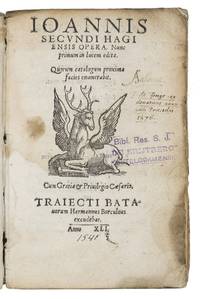
1541réf. M23NGJ7IKRQ5Utrecht: Herman van Borculo 1541. Contemporary vellum wrapper straight-sewn on 3 tanned calf straps laced through the wrapper with the authors name in large textura lettering reading up the spine. Small 8vo 16 x 10.5 cm. With Van Borculos winged stag couchant regardant and book device on the title page and another salient regardant with 2 books on the verso of the otherwise blank last leaf; and 3 vine-leaf ornaments Vervilet 7 8 & 43. Set in an Aldine-style italic type with upright capitals; 92 mm/20 lines with roman capitals for occasional words phrases and 2-line initials. Rare first edition in the original Latin of the collected poetic works of the humanist and neo-Latin poet Janus or Joannes Secundus Jan Everaerts 1511-1536 who "ranks among the foremost poets of the world" as "the only famous 16th-century Dutch poet" Guépin p. 231: "one of the most significant and enduring poets of the Renaissance" and "the outstanding Latin love poet of the northern Renaissance" Price p. 1. Although not quite twenty-five when he died he published numerous poetic works from 1532 to 1536 but left most of his work unpublished at his premature death. Much of his poetry appeared for the first time in the present posthumous edition. Janus is most famous for his "Basia" kisses: 19 lyric love poems influenced by Catullus. Janus's three books of elegies especially the first book comprising 11 love poems to his possibly fictional first love Julia are also masterpieces of neo-Latin poetry.Although revered internationally in his own century and influential throughout the 17th and 18th centuries among his avid readers were Ronsard Fleming Huygens Milton and Goethe Janus's name has been eclipsed in the Netherlands by those of Cats and Vondel in part because they wrote in Dutch.Janus Secundus was born in The Hague. His father was a lawyer at the leading courts of the Low Countries and the family moved to Maastricht when Janus was sixteen. He studied law there and later studied at Bourges and at the University in Louvain. Though a native Dutch speaker and fluent in French Janus had learned Latin with his older brothers at an early age and corresponded with them in Latin.With 3 French verses in a near contemporary hand on the endleavesFurther with a near contemporary donation inscription on the title-page; a 19th-century bookplate on the inside front wrapper and blue ink stamp on the title-page. With the title-page somewhat worn and with stains in its margins plus a water stain in the first 10 leaves and a fainter marginal one some of the last few leaves but otherwise in good condition. The sewing supports have broken at the front hinge and the velum wrapper is somewhat soiled with a small corner of the back wrapper lost. Rare first edition of a seminal work of neo-Latin poetry by the first great Dutch poet Janus Secundus.l Adams S837 1 copy; BMC STC Dutch p. 185; G. Joos Uitgaven van Janus Secundus 10; Netherlandish books 27713 10 copies; USTC 421142 same 10 copies; Valkema Blouw Typ. Batava 2673 13 copies; not in Oberlé Poètes néo-Latins; for Secundus: J.P. Guépin "Tres fratres Belgae: brothers poets and civil servants in the sixteenth century" in: The Low Countries 8 2000 pp. 231-238; David Price Janus Secundus 1996. Herman van Borculo, hardcover
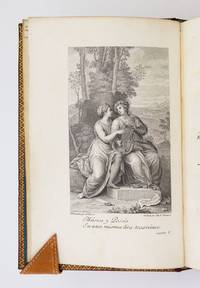
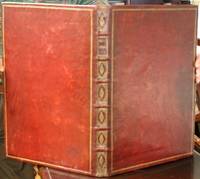
1779réf. ST19371Madrid: Imprenta Real 1779. FIRST EDITION. 235 x 150 mm. 9 1/4 x 6". 10 p.l. 126 XL pp. 1 leaf errata. EXCELLENT CONTEMPORARY CRIMSON MOROCCO BY DEROME LE JEUNE his ticket with address of Rue St. Jacques on verso of front free endpaper covers framed with thick and thin gilt rules raised bands spine compartments with central floral sprig surrounded by a lozenge of small tools volute cornerpieces gilt titling gilt-rolled turn-ins gilt edges cobalt blue paste-paper endpapers. WITH SIX CHARMING ENGRAVED ALLEGORICAL PLATES after G. Ferre. Front pastedown with morocco bookplate of Mortimer L. Schiff and small book label with a gilt cipher on a red peach. A Large Paper Copy. Palau y Dulcet IV 107; RSIM B VI 429; MGG VI 1403 f.; Gregory-Bartlett I 129. Three minute dents to front board a hint of wear to bands and corners isolated faint foxing blank recto of frontispiece leaf and blank verso of final leaf with faint blue shadown from endpapers but all of these quite trivial and otherwise A BEAUTIFUL COPY--fresh clean and bright internally with very wide margins and strong impressions of the plates and in a lustrous binding showing with few signs of use. This is surely one of the handsomest poetical treatises on music ever produced and it is offered here in a binding done by one of the finest craftsmen working in Europe during the period of the book's publication. The work is written in the "silva" form of poetry used by persons of high rank illustrated with fine engravings and put into elegant morocco by the finest hands among the large Derome family of binders. According to Palau our first edition is "beautiful and printed on fine paper." He says further that although the strongly expressed opinions of the youthful author on contemporary composers caused the work to be "unfairly attacked" it was "appreciated by professors of music and collectors of literature in that genre" especially in Italy and America. A child of the Enlightenment Iriate 1750-91 gained entry to intellectual and artistic circles in Madrid through his uncle who was librarian to the king of Spain. He translated works by Horace and Virgil into Spanish by royal request and wrote criticism poetry and dramas. He is best known for his satirical fables on the contemporary literary scene "Fábulas literarias." There were no fewer than 18 members of the Derome family who made their livings as binders in Paris from the middle of the 17th century until the first quarter of the 19th but by far the most distinguished family member was Nicolas-Denis called "le jeune" 1731-88. Known for the gracefulness of his bindings and for being capable of "amazing delicacy" in Hobson's words Derome le jeune was simply the leading binder of the day and his work was much in demand. Because he refused to turn away customers Derome was forced to hire a number of assistants whose work he could not always supervise closely. However Thoinan says that the binder's best work is indicated by the presence of his ticket as here. The volume's provenance adds to its luster: it was in the distinguished library of American bibliophile Mortimer Schiff 1877-1931. In Dickinson's words Schiff a financier and philanthropist Schiff "brought together an unrivaled collection of decorative bindings." His library included works by great printers important illustrated books and works printed on vellum but chiefly fine and historic bindings. The "Reliures" database of the Bibliothèque Nationale de France commends Schiff for assembling "one of the most important inter-war libraries" noting that his collection was "renowned for its collection of French bindings.". Imprenta Real unknown
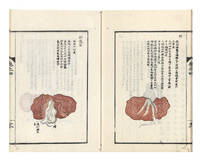
réf. 6006Numerous fine woodcut illus. 18 of which are finely handcolored. 48 irregularly paginated; 33; 39; 26; 28 3 folding leaves. Five vols. 8vo orig. wrappers some worming in upper margin of each vol. orig. block printed title label on each upper cover new stitching. Tokyo: Mankyudo Hanabusa Heikichi Preface dated 1810. First edition of one of the three most important early Japanese books on the history and technique of Chinese and Japanese acupuncture. This work is very different from all earlier Chinese and Japanese books on the subject. For the first time the illustrations are finely and realistically rendered and are anatomically accurate clearly influenced by European medical works which had circulated in Japan. Another important aspect of this book is that eighteen of the woodcuts each depicting organs of the body are finely handcolored. Also the body is described in full from head to foot and is not entirely dependent on the fourteen meridians. Kosaka was a court physician of the fiefdom of Kameyama who had studied under the famous physician Motonori Taki 1731-1801 who was himself a member of a distinguished family of doctors. The publisher of this work was the exclusive publisher for the government sponsored medical school. Very good set. unknown books
1972réf. 145005Burbank CA: Warner Brothers 1972. Original maquette demonstrating an early poster design for the 1973 film featuring a vintage silver gelatin photograph of the legendary streetlit scene of Father Merrin's first arrival to Georgetown in the film mounted to the poster. A minimal design without the credits information seen in the completed original "purple style" poster variant and with a proposed but ultimately unrealized release date of Christmas Day shown at the bottom margin. This maquette compares both to the "purple style" poster in its use of said purple text but also to the original black and white "special poster" design both in size and compositional austerity. The "special poster" measured 25 x 19 inches as opposed to the standard 27 x 41 inches for the one sheet and stated nothing but the film's title and the stark photo of Father Merrin. Based on the 1971 novel by William Peter Blatty and written for the screen by Blatty. One of the great genre films of the 1970s that accomplished the uncommon feat of being an over-the-top sensation upon its release and gaining subsequent status as a classic with a strangeness and depth supplied by Ellen Burstyn and Max von Sydow that only increases with repeated viewings. Another distinction was that it walked away with two Oscars including Best Screenplay for Blatty along with eight nominations including Best Picture a feat nearly unheard for a horror film. Set in Washington DC and shot on location in Washington DC notably Georgetown University New York City and Mosul Iraq. 18 x 12.5 inches mounted on a 30 x 20 inch mat. Black with the vintage black and white photo of Father Merrin affixed at the center and a hand painted release date. Title letters are hand cut from purple paper and affixed in place. Good condition with water damage to the bottom three inches of the mat and with soil and loss of glue adhesion to the white mat. Archivally matted and framed in a museum-quality frame with UV glass. National Film Registry. Clover "Men Women and Chainsaws. Warner Brothers unknown books
1938réf. 312786N.p.: Privately printed for the members of the Royal Guild of Wisconsin Fisherman 1938. First edition one of a very few copies known. Illustrations from photographs. vi 25 pp. 1 vols. 8vo. White printed wrappers stapled. Very good. Some minor wear. Green quarter morocco slipcase. First edition one of a very few copies known. Illustrations from photographs. vi 25 pp. 1 vols. 8vo. Salmon fishing during four days in the first part of July 1938 by a party of six who styled themselves the Royal Guild of Wisconsin Fishermen comprising: Evan A. Evans Louis M. Hanks Roy F. Tomlinson Theodore G. Montague William S. Kies and George I. Haight to whom authorship is attributed by the Wisconsin Historical Society. The last page of text records their catch by weights. Rare. Wetzel p. 171 tentatively ascribed to William Kies. "A rare work."; Bruns K-45 not seen; Bibliotheca Salmo Salar 105. OCLC 2 copies Princeton Wisconsin Historical Society Privately printed for the members of the Royal Guild of Wisconsin Fisherman] unknown
1938réf. 312786N.p.: Privately printed for the members of the Royal Guild of Wisconsin Fisherman 1938. First edition one of a very few copies known. Illustrations from photographs. vi 25 pp. 1 vols. 8vo. White printed wrappers stapled. Very good. Some minor wear. Green quarter morocco slipcase. First edition one of a very few copies known. Illustrations from photographs. vi 25 pp. 1 vols. 8vo. Rare. Salmon fishing during four days in the first part of July 1938 by a party of six who styled themselves the Royal Guild of Wisconsin Fishermen comprising: Evan A. Evans Louis M. Hanks Roy F. Tomlinson Theodore G. Montague William S. Kies and George I. Haight to whom authorship is attributed by the Wisconsin Historical Society. The last page of text records their catch by weights. Rare. Wetzel p. 171 tentatively ascribed to William Kies. "A rare work."; Bruns K-45 not seen; Bibliotheca Salmo Salar 105. OCLC 2 copies Princeton Wisconsin Historical Society Privately printed for the members of the Royal Guild of Wisconsin Fisherman] unknown books
1611réf. 3462Latin manuscript on vellum with large 6 in diameter suspended black wax seal of James I of England and autograph of Anne of Denmark dated July 23 1610 granting title to Corrodownan Manor in County Cavan Ulster to one John Browne Gent. of Gorgiemill near Edinburgh and his descendants during the Plantation i.e. colonization of Ulster under James I beginning in 1609. The colonists were settled on land confiscated from the Irish inhabitants following the conquest of Ulster 1594-1603 under James's predecessor Elizabeth I. The Plantation was intended to consolidate royal control of Ulster and repress rebellion by importing a substantial Protestant population. Like John Browne and indeed James himself many of the new colonists were Scottish. Some of these families went on to form the backbone of the Protestant Ascendancy in the province. John Browne and his heirs however were not among them. Sir George Carew sent by the king in 1611 to report on the progress of the Plantation noted that "he Browne . sent an agent who took possession set the lands to the Irish returned to Scotland and . performed nothing." The land was sold in 1613 to another Scottish colonist Archibald Acheson. Acheson's descendants were raised to the peerage of Ireland in 1806 as Earls of Gosford and still owned the property in the late nineteenth century. The first nineteen lines of the document grant the Scottish Browne the rights and privileges of James's English and Irish citizens. Especially notable are the requirement that the grantee maintain an adequate supply of arms for defense against the king's enemies lines 77-80 the attempt to encourage the growth of towns 74-76 and the ban on sale of the property to "mere Irish" or to anyone who failed to acknowledge the sovereign as head of the church thus excluding all Catholics by swearing the Oath of Supremacy 114-121. See Rev. George Hill The Conquest of Ireland. An Historical Account of the Plantation of Ulster at the Commencement of the Seventeenth Century 1608-1620 Belfast 1877 308; idem Plantation Papers. Containing a Summary Sketch of the Great Ulster Plantation in the Year 1610 Belfast 1889 188-190; F.J. McCaughey Arvagh. Sources for a Local History Arvagh 1998 16.; Moiré chemise lined with exact recess for seal housed in handsome ruled red morocco clamshell case with gilt title to front cover and raised bands gilt particulars and decoration to spine; gilt rolled edges. Two leaves 65 x 81 cm; the first illuminated with a portrait of the king. Stain to upper left see image.; 65 x 81 cm; 1 pages; Signed by Notable Personage Related; All shipments through USPS insured Priority Mail. . hardcover books
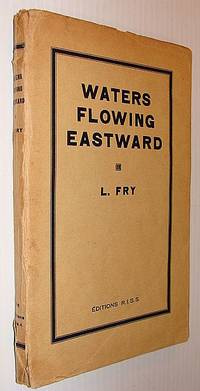
1931réf. 328c6774Paris: Editions R.I.S.S. 1931. First Edition. Paperback. Fair. 225 pages. "Beneath the great westward flow of our civilization there are undercurrents moving eastward. These are impelled by a spirit which looks back to the east to the days of tyrant and slave of luxury and misery and incidentally to the suppression of western culture. The following pages are designed to cast light on these eastern undercurrents which have undermined western states." - Preface. Black and white photographic portrait of Sergius A. Nilus who "published the first complete version of the Protocols of the Elders of Zion in Russia in 1905." - Wikipedia. In this work "the genesis of the Protocols is traced to Asher Ginzberg better known by his Hebrew pen name Ahad ha-Am who supposedly wrote the Protocols in Hebrew in 1880 while in Odessa." - Singerman 0221. Erratum list affixed inside front cover. Unmarked. Above-average wear. Age-yellowing to card covers and contents. Covers nearly detached. Binding tender.; 8vo - over 7¾" - 9¾" tall; Protocols of the Learned Elders of Zion Zionism Israel Balfour Declaration Jacob Brafmann Russia Asher Ginzberg Political Zionism Ahad ha-Am . Editions R.I.S.S. paperback
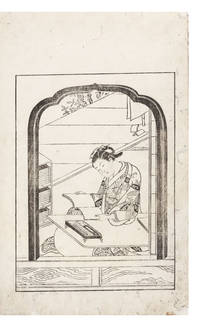
réf. 6330Edited by Yusuishi Tanaka. Woodcut frontis. & eight fine double-page woodcut illus. 21; 18 folding leaves. Two vols. Large 8vo orig. blue wrappers wrappers rather worn & rubbed orig. block-printed title labels on upper covers rubbed new stitching. Osaka Edo & Kyoto: 1749. First edition of this beautifully illustrated book; the fine woodcuts are by Sukenobu Nishikawa 1671-1750 or -51 or -54 who “counts among the foremost masters of so-called ukiyo-e primitive prints. His subject matter like that of his contemporaries revolved around images of women walking. These images are stylised lending the rhythmic movement of the sumptuous robes an almost sculptural effect. Nishikawa also did many book illustrations…Nishikawa founded a whole school and according to his family archives Harunobu 1725-1770 was a follower of his.”–Oxford Art Online. This work is concerned with the education of women in its widest sense combining knowledge with taste. Four types of girls’ “play” are described and illustrated; each providing instruction in behavior and ethics. The fine woodcut frontispiece depicts a young woman reading a book surrounded symbols of knowledge and refinement: bookshelves and brushes for calligraphy. Her clothes and hairstyle are appropriate. The first volume is concerned with dolls hina. In Japan dolls are not for play but have high spiritual value which offer girls preparation for adulthood and marriage. For the Japanese dolls are living creatures possessing heart and soul from which girls can learn discipline obedience and control. Nakanishi 1634-1709 was a scholar and writer on Shintoism and the present text was edited and posthumously published by Yusuishi Tanaka who has contributed a preface. The theme of the text is instructional and written for girls and young women: there are many references to texts essential for proper behavior and ethics. Nakanishi draws on the Nihon Shoki the oldest chronicle of Japan; Man’yoshu the eighth-century anthology of Japanese poetry; the Tale of Genji; and Makura no Soshi the famous Pillow Book. There are four fine double-page woodcut illustrations in the first volume. The first illustration depicts an upper-class woman sending her dolls away in a boat thereby sending her suffering away. The second illustration depicts the hinamatsuri doll festival with dolls arranged on shelves. The following illustration depicts a young woman facing her suitor her dowry behind her all are objects of knowledge and culture: a calligraphy set fine papers in a box picture scrolls books etc. The final illustration in this volume depicts an offering made to the sky referencing tanabata the star festival. According to legend the Milky Way separates two lovers; they are allowed to meet only once a year on the seventh day of the seventh lunar month of the lunisolar calendar. The second volume is concerned with kai-awase the Japanese shell-matching game. Again there are four fine double-page illustrations each filled with deep meaning. Matching the shells symbolizes the unity of partners in a marriage. There are many references to the Tale of Genji and Lady Murasaki; scenes from this novel were often used to illustrate the shells. One of the illustrations depicts the traditional card game called uta-garuta being played by several women. A very good set and rare. Some carefully repaired worming mostly confined to the margins. The lower outer corners of many leaves are “thumbed.” ⧠Brown Block Printing & Book Illustrations in Japan p. 131. unknown
réf. 29286THWAITES Reuben Gold ed. Early Western Travels 1748-1846. A Series of Annotated Reprints of some of the best and rarest contemporary volumes of travel descriptive of the Aborigines and Social and Economic Conditions in the Middle and Far West during the Period of Early American Settlement. Edited with Notes Introductions Index etc. Cleveland: The Arthur H. Clark Company 1904-1907. 31 vols. plus folio Atlas vol. Illus. Maps. Orig. cloth. Fine set. Howes T-255. Limited to 750 copies signed by the publisher. RARELY FOUND COMPLETE. Includes the travel journals of Brackenridge Bradbury Bullock Croghan Cuming De Smet Evans Farnhaum Faux Flagg Flint Flower Franchere Gregg Harris Hulme James Long Maximilian Michaux Morris Nuttall Ogden Pattie Ross Townsend Welby Wood and Wyeth among others. unknown
Stable Money Association gift bookplate inside front board is signed by Irving Fisher, James Rand, Jr., and Frederic A. Delano. Delano [1863-1953] was uncle to FDR, President of the Stable Money Association and was appointed to serve on the first Board of the Federal Reserve by Woodrow Wilson. James Rand Jr. [1886-1968] was Chairman of the Committee For the Nation and a prominent American businessman. This copy inscribed to Ethan Bates Stanley who was President of the American Laundry Machinery Company. pp. [vi], vii-xxiii, 484. Selected bibliography. Index. Extensive footnotes. "The present book is intended to be not so much a history of [monetary] catastrophes, due to unstable money and endured by unsuspecting millions subject to the money illusion, but rather a history of the efforts of a few to remedy or prevent such catastrophies." - xxi. Pages 443-484 constitute a lengthy list of Stable Money Pioneers, individuals who supported the movement. Corporate affiliations are included for most of these names, thus the list reads like a corporate Who's Who of America. Dust jacket not included. Average wear to publisher's pebbled navy cloth. Binding sound. Bookseller ink stamp inside front board. 21 x 14.5cm. Rist p.379, Cohen p.186, Fisher M-2058, Book
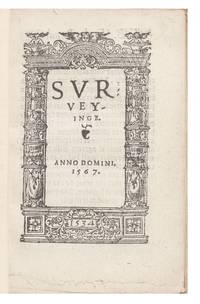
réf. 6566Title within architectural woodcut border incorporating the date "1534." Largely printed in black letter. 67 leaves 8 pp. Small 8vo antique calf by Sangorski & Sutcliffe spine gilt red leather lettering pieces on spine. London: Printed by H. Wykes 1567. An early edition of the first text on surveying printed in English. The first edition was printed by Richard Pynson in 1523; all early editions are rare as copies were used to death. Our copy is most unusual as it is fine and large with a number of lower edges uncut. Fitzherbert's book is concerned primarily with giving instruction to land stewards and overseers of the manor. The authorship of this work has long been disputed: was it Anthony Fitzherbert ca. 1470-1538 judge and legal writer or his older brother John d. 1531 The current scholarship supports John Fitzherbert as the more likely author. The book is "addressed to the landed interest and is an explanation of the laws relating to manors. Fitzherbert sets forth the relation between the landlord and the tenant with observations on their respective moral rights and mutual obligations to each other. The author is also concerned with the best means of developing and improving an estate to the advantage of both the lord and the tenant. "As defined by Fitzherbert the duties and functions of the surveyor were many and varied. In the preface he states that the surveyor should prepare his findings in a small book or put them on a large piece of parchment. This parchment or book should show the 'buttes' and 'bounds' of all the holdings as well as the leases grants and tenures. Along with this information he should state the number of buildings and their location and give a description of the lands specifying whether they are meadow grainland or woodland and by whom held. He should also record the value of all properties along with their rents and fines. The author then goes into considerable detail in giving the form for the preparation of this information. "The author states that the word 'surveyor' is from the French signifying an overseer and that the surveyor must appraise and make recommendations to the lord of the manor."-Richeson English Land Measuring to 1800: Instruments and Practices pp. 33-34. Fine copy. ❧ Fussell I p. 6-"contains a great deal of matter of service to farmers in particular as well as to the agricultural community in general." ODNB. hardcover books
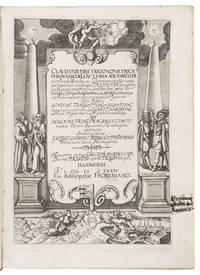
réf. 6761Finely engraved added title & numerous woodcut diagrams & printed tables in the text. Printed title in red & black. 9 p.l. incl. engraved title 323 184 pp. Two parts in one vol. Large 4to cont. vellum over boards covers nicely decorated with coats-of-arms in gilt & silver now oxidized on each cover a.e.g. ties gone. Hamburg: Frobenius 1634. First edition of this handsome and rare work on trigonometry by a student of Tycho Brahe. Frobenius 1566-1645 after studying in Tübingen and Wittenberg went in 1591 to the island of Hven where he intended to live and study with Tycho Brahe. Upon leaving he wrote a recently discovered memorandum see John Robert Christianson's On Tycho's Island. Tycho Brahe and His Assistants 1570-1601 which is full of "critical insight" on Tycho and his relationships with his students and assistants. Later Frobenius moved to Hamburg where he married well and became a leading printer publisher and bookseller of that city specializing in learned and scientific works. He wrote and self-published a number of works - like this one - a number of works on trigonometry astronomy and philology. The first part of the present book is devoted to spherical trigonometry as applied to astronomy and the text contains many references to Brahe and Longomontanus. The second part includes the famous trigonometric tables of Rheticus which first appeared in 1596. A very fine and large copy with the Nordkirchen bookplate. The attractive engraved title-page present here is usually missing ❧ Poggendorff I 809. Tomash & Williams F101. hardcover books
réf. 6330Edited by Yusuishi Tanaka. Woodcut frontis. & eight fine double-page woodcut illus. 21; 18 folding leaves. Two vols. Large 8vo orig. blue wrappers wrappers rather worn & rubbed orig. block-printed title labels on upper covers rubbed new stitching. Osaka Edo & Kyoto: 1749. First edition of this beautifully illustrated book; the fine woodcuts are by Sukenobu Nishikawa 1671-1750 or -51 or -54 who "counts among the foremost masters of so-called ukiyo-e primitive prints. His subject matter like that of his contemporaries revolved around images of women walking. These images are stylised lending the rhythmic movement of the sumptuous robes an almost sculptural effect. Nishikawa also did many book illustrations.Nishikawa founded a whole school and according to his family archives Harunobu 1725-1770 was a follower of his."-Oxford Art Online. This work is concerned with the education of women in its widest sense combining knowledge with taste. Four types of girls' "play" are described and illustrated; each providing instruction in behavior and ethics. The fine woodcut frontispiece depicts a young woman reading a book surrounded symbols of knowledge and refinement: bookshelves and brushes for calligraphy. Her clothes and hairstyle are appropriate. The first volume is concerned with dolls hina. In Japan dolls are not for play but have high spiritual value which offer girls preparation for adulthood and marriage. For the Japanese dolls are living creatures possessing heart and soul from which girls can learn discipline obedience and control. Nakanishi 1634-1709 was a scholar and writer on Shintoism and the present text was edited and posthumously published by Yusuishi Tanaka who has contributed a preface. The theme of the text is instructional and written for girls and young women: there are many references to texts essential for proper behavior and ethics. Nakanishi draws on the Nihon Shoki the oldest chronicle of Japan; Man'yoshu the eighth-century anthology of Japanese poetry; the Tale of Genji; and Makura no Soshi the famous Pillow Book. There are four fine double-page woodcut illustrations in the first volume. The first illustration depicts an upper-class woman sending her dolls away in a boat thereby sending her suffering away. The second illustration depicts the hinamatsuri doll festival with dolls arranged on shelves. The following illustration depicts a young woman facing her suitor her dowry behind her all are objects of knowledge and culture: a calligraphy set fine papers in a box picture scrolls books etc. The final illustration in this volume depicts an offering made to the sky referencing tanabata the star festival. According to legend the Milky Way separates two lovers; they are allowed to meet only once a year on the seventh day of the seventh lunar month of the lunisolar calendar. The second volume is concerned with kai-awase the Japanese shell-matching game. Again there are four fine double-page illustrations each filled with deep meaning. Matching the shells symbolizes the unity of partners in a marriage. There are many references to the Tale of Genji and Lady Murasaki; scenes from this novel were often used to illustrate the shells. One of the illustrations depicts the traditional card game called uta-garuta being played by several women. A very good set and rare. Some carefully repaired worming mostly confined to the margins. The lower outer corners of many leaves are "thumbed." ❧ Brown Block Printing & Book Illustrations in Japan p. 131. hardcover books
1650réf. B6295Rome/Romae: Formis Io. Iacobi de Rubei apud templum S. Mariae de Pace. Undated c.1650-latest c.1690 most probably c.1660 c.1675-1677. . Lacks folding double-page plan of the Villa Pamphilia and the first of 5 folding plates “Primus”. Otherwise a very good example plates are crisp and clean. . Edition: First and only edition. Italic and Roman type. Tex Binding: Contemporary panelled full burgundy morocco double-gilt filleted; spine with six 6 raised bands gilt lettered title on two with remaining compartments gilt ornamented; all edges gilt; contemporary endpapers with watermark of a fleur-de-lis within two concentric circles. Wide margin paper. Notes: An architectural plate book depicting statues and fountains displayed in Villa Pamphili an important 16th-17th century Roman villa designed by the painter Giovanni Francesco Grimaldi 1606 - 1680 and Alessandro Algardi 1598 - 1654 followed by the construction of the garden layout; …1652-1657. The publication of the present work printed by G.G. de Rossi possibly c.1675-1677 was commissioned by Pamphili’s son and heir Giambattista with the engraver Dominique Barrière documenting the statues placed both in cornices of the villa and the gardens and with further plates included such as some by Giovanni Battista Falda's ‘Le fontane di Roma’ fountains of Rome plus general views of the villa and its gardens. Giovanni Battista Falda c.1643 – 1678 Rome was an Italian architect engraver and artist. He is known for his engravings of both contemporary and antique buildings and structures of Rome. Falda studied and worked under Bernini; his draughtsmanship drew G. G. de Rossi’s attention. He became well-known for his “Le fontane di Roma” Fountains in Rome and “Palazzi di Roma” Palaces of Rome particularly popular with visitors to Rome. Giovanni Giacomo de Rossi Italian engraver and printer active in Rome during the second half of the 17th century. His father Giuseppe de Rossi 1570-1639 was the founder of the most important and active printing press of the 17th century in Rome. The press started in 1633 it was then passed to Giovanni Giacomo and his brother Giandomenico; and later to Lorenzo Filippo. In 1738 it became the “Calcografia Camerale” from 1870-1945 the “Regia Calcografica”; today it is known as the “Calcografia Nazionale”. Here are conserved amongst many others the plates of Giambattista Piranesi 1720-1778. Giovanni Giacomo de Rossi the most involved of all family members who ran the press from 1638-1691 took the company to its height of success. He printed etchings for artists including Giovanni Benedetto Castiglione 1609-1665 Pietro Testa 1612-1650 and Giovan. Francesco Grimaldi 1606–1680. Barrière c.1622–1678 was a French painter and engraver. Barrière was born at Marseilles in about 1622. He spent most of his career in Rome where he engraved a considerable number of plates after Claude and other landscape painters as well as other subjects. They are neatly etched in the manner of Stefano della Bella. He died in Rome in 1678. Size: Folio 434x312mm. Illustration: Fine illustrations of the famous Villa Pamphili the most important architectural constructions of Baroque Rome with its Italian garden and the fine collection of antiquities. Illustrated dedication with head- & tail-vignettes and a large rubricated initial; plus a total of 82 full page and double page oblong folding copper-engraved plates. References: Woodfall G.; British Museum: Catalogue of Maps Prints Drawings Etc. Forming the Geographical and Topographical Collection vol. II p. 146 1829. Rossetti 4827. Cicognara 3911. Berlin Katalog 3491. Kissner 394. Vinciana 4360. Giorgetta F. Hortus libro Category: Book Europe Italy; Book Art Architecture & Design; Book Plate Books General; Formis Io. Iacobi de Rubei, apud templum S. Mariae de Pace. hardcover
1897réf. 526A collection of 50 albumen prints from the British Museum Series numerous manuscript captions slight age-related toning photographs mounted to album occasional light marginal foxing not affecting image original maroon cloth with quarter morocco spine retaining studs title gilt to spine slightly rubbed folio London: W.A. Mansell c.1897 The 50 photographs of antiquities in the British Museum covering Greek Roman and Etruscan Statues and Vases including 24 of the Parthenon Frieze. Many of the images are accompanied by manuscript captions. Other photographs include: Horse of Selene Ilissos "Colossal Lion" The Piranesi Vase "Marble Vase found in the Villa of Hadrian at Tivoli" "Mercury" "Venus de Medici" "The "Townley" Venus" "Venus Entering Bath" "Apollo as a Player of the Lyre from Cyrene" "Hercules" Hercules found in Hadrian's villa at Tivoli Drum of Sculptured Column from Temple of Diana Artemision Ephesus "Casts from Balustrade of Temple of Wingless Victory - Athens -" Etruscan Sepulchral Monument in terracotta "Thalia" T. Aurelius Fulvius Antonius Pius Aurelius Antoni Satyr Apollo Demeter Ceres and Sepulchral Rites at the Tomb of a Hero. The Elgin Marbles are a collection of statues and architectural decoration acquired by the Earl of Elgin during his time as Ambassador to the Ottoman Empire. He successfully petitioned the authorities to be able to measure draw and remove figures in various ruins. The most extensive work was on the Parthenon or Temple of Athena but he also received permission to remove sculptural and architectural elements from a number of other ruins including the Acropolis and the Temple of Nike Athena. The most famous of the Elgin Marbles are the Parthenon Sculptures a collection of different types of marble architectural decoration on the Parthenon. The Parthenon Frieze 75 metres in length depicts various scenes including the battle between the Lapitas and the Centaurs at the marriage feast of Peirithoos. Elgin originally intended on using the Frieze as decoration in his private home but due to the collapse of his marriage he sold them to the British Museum. There have been debates over the legitimacy of Elgin's excavation. After an investigation from a Parliamentary Select Committee in 1816 Elgin's actions were found to be entirely legal. Since 1983 Greece has formally requested the British Museum to return all the Parthenon Sculptures in the Museum's collection the British Museum states there are no current discussions with the Greek Government on this issue. Roger Fenton is one of the most celebrated figures in the history of photography. He was a creative and highly influential photographer in the mediums "golden age" of the 1850s. In his role as the British Museum's first official photographer Fenton demonstrated his sure sense as a 'photo artist'. He was initially engaged to photograph cuneiform tablets but that soon developed into taking pictures of other antiquities. As early as 1852 Fenton received permission from the Trustees to photograph antiquities within the museum establishing a small studio inside the museum the following year. He left in 1854 to serve as a photographer in the Crimean War for which he is most widely known but he was re-appointed on his return in 1856 until the termination of his contract in July 1859. The Trustees decided that photography was not cost effective and after they failed to negotiate the South Kensington Museum now the V&A as an alternative Fenton terminated his association with the British Museum. References: The British Museum The Metropolitan Museum of Art Luminous-Lint. W.A. Mansell
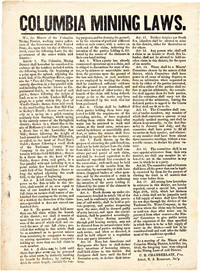
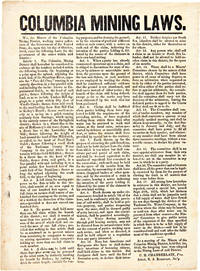
1853réf. 46036Columbia Ca.: Gazette Print 1853. The Laws of the Diggings A rare broadside printing of the laws of the Columbia Mining District in California in 1853 created and enforced by the miners for their own self-government. The seventeen articles all deal with regulations for mining and claims. The first nine set out rules for making and operating claims. The next three address foreign ownership of claims. Article 10: "None but Americans and Europeans who have or shall declare their intentions of becoming citizens shall hold claims in this district." Article 11: "Neither Asiatics nor South Sea Islanders shall be allowed to mine in this district either for themselves or for others." Article 12 sets out a punishment for any miner who sells a claim to an Asian or a Polynesian. The final five articles set out rules for enforcing the laws including the creation of a Miners Committee and a system of binding arbitration. According to the text the laws were adopted "at a meeting of the Miners of the Columbia Mining District held Oct. 1st 1853." and the laws are signed in print by "C.H. Chamberlain Pres." and "R.A. Robinson Sec'y." "The item is of basic importance.as an example of how the California miners - or men beyond the reach of government anywhere else in our States and Territories for that matter - banded together and enacted and enforced codes of law for their own protection" - Eberstadt. The COLUMBIA GAZETTE which printed this broadside was according to Kemble the second newspaper to operate in Columbia starting operations in the fall of 1852. The first newspaper in the area the COLUMBIA STAR apparently printed only two or three issues in October-November of 1851 before the printing press was destroyed by vandals. Greenwood locates only three copies at the California Historical Society and the Bancroft Library and the Streeter copy which was sold at the Clifford sale in 1994. Rocq lists a copy at the Huntington Library. OCLC adds copies at Yale Library of Congress University of California at San Diego Stanford and DeGolyer Library at Southern Methodist University. A rare and interesting example of the search for order in the tumult of the gold rush. The Streeter copy sold to Howell for $550 in 1968. It later reappeared in the sale of California collector Henry Clifford in 1994. Broadside 10¾ x 8 inches. Printed in three columns. A bit of light foxing mostly in margins. Near fine. In a folding cloth clamshell case spine gilt. GREENWOOD 381. ROCQ 15427. EBERSTADT 131:105. STREETER SALE 2735. CLIFFORD SALE 26. OCLC 29876358. hardcover
réf. elala5445Cleveland: The Burrows Brothers Company 1896-1901. First Thwaites Edition Limited to 750 sets. This set bears rubberstamps "Unnumbered set bound from waste sheets for editorial use." “A monumental editorial achievement. Contains all reports official and unofficial made by members of this missionary order on their activities in North America from 1601 to 1791. In all 238 pieces are given in their original French Latin and Italian texts with English translations.” Howes Spanning the years 1632 to 1673 the relations were the regular reports sent back by the priests of the Canadian mission to their superiors in France. Not only do they record the progress of the missions in converting the Canadian aboriginals to Christianity they are also an important source of historical information on the exploration of New France the manners and customs of the natives and the daily life of the French settlers. Thwaites was assisted in the compilation of the Relations by an impressive array of European and American scholars. In the introduction to his volume of Errata and Addenda which was published in 1967 Joseph P.Donnelly highlighted some of the significant aspects of the work: “The identification of persons even very obscure individuals is an extremely valuable editorial contribution. The bibliographical information regarding the heuristics and provenance of material included in the series is of inestimable worth to the historian…An outstanding editorial feature…is the exhaustive two-volume index…”. This set belonged to Dr. Lorris Elijah Borden 1877-1963 a long-standing associate of the Arctic Institute. Borden was the last surviving member of the 1903-04 Canadian Arctic Expedition in the Neptune under Captain A.P.Low in which he took part as medical officer. This expedition constituted the first significant step towards the assertion of Canadian authority in the eastern Arctic. During that time Borden studied the diseases afflicting the Inuit and gathered a collection of carvings and other artifacts that was gifted together with his notes and diaries to the Public Archives of Canada in 1964 by his widow. The artifacts are now housed in the Canadian Museum of Civilization. TPL 630. Howes J-106. 73 vols. 8vo. 137 of 138 plates maps views portraits facsimiles incl. 3 multi-page facsimile letters; some folding: lacking the map of Huronia in Vol. XXXIV. 4 text illus. untrimmed in original cloth t.e.g. others uncut dampstaining to lower margins covers & spines of Vols. IX X & LVI. dampstain to lower spines & covers of a few other volumes last volume spine faded 1 plate torn in half & crudely repaired - no loss some foxing throughout. bookplate of Dr. L.E.Borden see below. elala5445 Cleveland: The Burrows Brothers Company, 1896-1901 hardcover
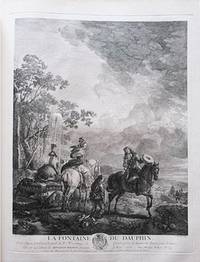
1762réf. 41877Paris: Chez Moyreau 1762. Folio. 23 1/2 x 19 1/2 inches. Engraved portrait of Moyreau by Nonnette dated 1749 and 100 engraved plates numbered 1-100 with the engraved rococo title being numbered as plate 25. 88 plates engraved by Moyreau and the others by Cochin Chedel etc. The title is engraved by Le Parmentier after J. de la Joue. Included are 5 double page plates and one page with 2 plates on the page. The final 8 plates are numbered in manuscript and the last 2 plates are proofs 'before letters'. Full contemporary calf gilt hinges strengthened A rare magnificent collection of engravings showcasing the works of the renowned Dutch Golden Age painter Philips Wouwerman. Engraved by master engraver Jean Moyreau the illustrations meticulously reproduce Wouwerman's celebrated equestrian and rural scenes capturing the dynamic compositions intricate details of the originals. Featuring some of the artists finest works carefully selected from the most esteemed collections in Paris and beyond the volume serves as a homage to Wouwerman's enduring artistry. Cohen de Ricci 1068; Bulletin Morgand 1889 No. 17315 '1 frontispice et 100 planches; Thiebaud p. 945-946; Brunet V 1480. Chez Moyreau unknown
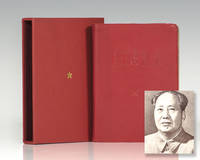
1964réf. 100159Beijing: Central Political Department of the Chinese People's Liberation Army 1964. First edition of Quotations from Chairman Mao. Duodecimo in the original iconic red vinyl title to front cover in blind frontispiece portrait of Chairman Mao. With the textual error on pp. 82/83 corrected and Lin Biao's calligraphic endorsement leaf after the frontispiece tipped in from a later printing. In 1972 an edict was issued that Lin's name was to be obliterated from history following disclosures that he had plotted a coup and planned to assassinate Mao; consequently "many surviving copies in the Chinese language have that page legitimately torn away mutilated or censored" Schiller p. 36. In near fine condition. Housed in a custom red slipcase. Printed for the General Political Department of the People's Liberation Army the first edition of Mao's Quotations was issued in two states and bindings: the uncorrected first state text in red vinyl plastic and the corrected second state in paper wrappers. The corrected copies issued in wrappers and intended for high-ranking officers were released first; the uncorrected copies issued in red vinyl and for use by brigade teams were released shortly afterwards as the sturdier binding took longer to manufacture. By the start of the Cultural Revolution in 1966 the red vinyl design had become symbolic of Mao's slogan "The East is Red" and the paper wrappers were discontinued. The year 1966 also "signaled the start of a major translation and publication project when the Little Red Book was issued in over 50 different languages of countries where Socialism might triumph" Schiller p. 55. The book was printed in large quantities until Mao's death in 1976; by the late 1970s however a change of government meant further circulation of the book was discouraged with millions of copies were collected and destroyed. His Little Red Book however sometimes referred to as the "Chinese Bible" "forms a brilliant compilation that is still readable and admired today for its political theories and strategies" ibid. p. 57. Central Political Department of the Chinese People's Liberation Army unknown books
réf. 9423Woodblock printed. 57 folding leaves. Two juan in one vol. Large 8vo 313 x 204 mm. orig. semi-stiff yellow patterned wrappers upper wrapper a little soiled. Korea: 1832 or after. First edition and very rare; we find no copy in WorldCat. This is the collected poetry and prose by KwÅn 1575-1652 who lived through the tumultuous years of the early 17th century when ChosÅn Korea was twice invaded by the Manchus. KwÅn was from an early age taught by his father KwÅn Tae-gi 權大器 who had studied under one of the most important Neo-Confucian scholars of the ChosÅn period Yi T’oegye æŽé€€æºª Yi Hwang 滉 1501-70. The younger KwÅn passed a lower-level civil service examination and entered officialdom at a low rank. He served in the royal retinue when the court retreated to Ganghwa island during the 1627 Manchu invasion. KwÅn was promoted but retired from office citing illness. After the Manchus invaded the country again in 1636 KwÅn withdrew to a cottage at the foot of a peak of Mount Taebaksan called Chinbong 震峯 “Thunderous Peak” whence the name of his posthumously published oeuvre. The book contains a Preface written by Yi Ya-sun æŽé‡Žæ·³ 1755-1831 a ninth-generation descendant of Yi T’oegye dated 1825 “fourth ŭlyu since the Chongzhen reign”. An appendix contains eulogies for KwÅn and an account of KwÅn’s life written by Kim Si-ch’an 金是瓚 dated 1818 “third muin since the Guangde reign period of the August Ming” referencing the reign name of the abortive rebellion by Yang Qilong 楊起隆 1633-80. KwÅn Hun 權勳 a sixth-generation descendant of KwÅn Koeng wrote the colophon dated 1832 “fourth imjin since the first year of Chongzhen.” KwÅn Hun described how “I his unworthy distant descendant with pain and regret carefully searched far and wide to collect the writings bit by bit transcribing them for posterity. The years passed as I was putting them in order.” Fine copy. unknown
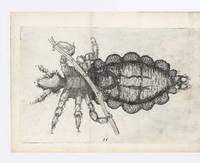
réf. 5444Added engraved title & 40 engraved plates three are folding. 1 p.l. 106 pp. one blank leaf. Small 4to cont. English panelled calf corners renewed rebacked some dampstaining in gutter at foot to first ten leaves. Rome: A. de Rubeis 1703. First separate edition originally published as the second part of the author's Observationes circa viventia 1691. Our edition - which is actually the original printing of the second part with a new title-page - is very rare with only one copy located by WorldCat. Buonanni 1738-1725 one of the most learned Jesuits of his time was a pupil of Athanasius Kircher and succeeded his master as teacher of mathematics at the Collegium Romanum. This work is one of the earliest Italian treatises on microscopy. It contains interesting observations on early microscopes and a precise description of Buonanni's own compound microscopes which are illustrated on two plates. The rest of the plates show objects seen through the microscope including a number of illustrations of insects. "The quality of his illustrations of various insects was excellent - particularly those of the fly louse mite flea and mosquito. Indeed his drawings of the Culex pipiens common house mosquito are the best of the seventeenth century."-D.S.B. II p. 591. Very good copy. Duplicate from the British Museum with their duplicate stamp dated 1787. Armorial bookplate of Sir John Ingilby Bart. 1758-1815 M.P. and Fellow of the Royal Society. ❧ Clay & Court The History of the Microscope pp. 84-86. Garrison-Morton 264-1st ed. of 1691. unknown books
1853réf. WRCAM46036Columbia Ca.: Gazette Print 1853. Broadside 10 3/4 x 8 inches. Printed in three columns. A bit of light foxing mostly in margins. Near fine. In a folding cloth clamshell case spine gilt. A rare broadside printing of the laws of the Columbia Mining District in California in 1853 created and enforced by the miners for their own self-government. The seventeen articles all deal with regulations for mining and claims. The first nine set out rules for making and operating claims. The next three address foreign ownership of claims. Article 10: "None but Americans and Europeans who have or shall declare their intentions of becoming citizens shall hold claims in this district." Article 11: "Neither Asiatics nor South Sea Islanders shall be allowed to mine in this district either for themselves or for others." Article 12 sets out a punishment for any miner who sells a claim to an Asian or a Polynesian. The final five articles set out rules for enforcing the laws including the creation of a Miners Committee and a system of binding arbitration. According to the text the laws were adopted "at a meeting of the Miners of the Columbia Mining District held Oct. 1st 1853." and the laws are signed in print by "C.H. Chamberlain Pres." and "R.A. Robinson Sec'y." "The item is of basic importance.as an example of how the California miners - or men beyond the reach of government anywhere else in our States and Territories for that matter - banded together and enacted and enforced codes of law for their own protection" - Eberstadt. The COLUMBIA GAZETTE which printed this broadside was according to Kemble the second newspaper to operate in Columbia starting operations in the fall of 1852. The first newspaper in the area the COLUMBIA STAR apparently printed only two or three issues in October-November of 1851 before the printing press was destroyed by vandals. Greenwood locates only three copies at the California Historical Society and the Bancroft Library and the Streeter copy which was sold at the Clifford sale in 1994. Rocq lists a copy at the Huntington Library. OCLC adds copies at Yale Library of Congress University of California at San Diego Stanford and DeGolyer Library at Southern Methodist University. A rare and interesting example of the search for order in the tumult of the gold rush. The Streeter copy sold to Howell for $550 in 1968. It later reappeared in the sale of California collector Henry Clifford in 1994. GREENWOOD 381. ROCQ 15427. EBERSTADT 131:105. STREETER SALE 2735. CLIFFORD SALE 26. OCLC 29876358. Gazette Print hardcover books
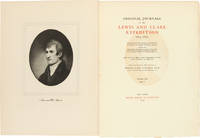
1904réf. 52627New York: Dodd Mead & Company 1904-1905. One of 200 Sets on Large Paper One of 200 large paper sets on Van Gelder paper with the atlas supplied from the reprint edition done by Argosy-Antiquarian Press. "The most elaborate work on this expedition" - Howes. A cornerstone of modern historical research printing for the first time many major primary documents which did not appear in the Biddle edition including the Floyd and Whitehouse journals and material from the Clark-Voorihis papers along with facsimile manuscripts maps portraits and other illustrative matter. Also valuable is Victor Paltsits' bibliography of the Lewis and Clark expedition in the first volume. "This edition is notable for its thorough Introduction covering the history of the expedition and earlier exploration and a detailed account of the original journals and their various editions.In its maps and numerous illustrations the Thwaites edition is an outstanding source of visual materials relating to the expedition" - LITERATURE OF THE LEWIS AND CLARK EXPEDITION. Quarto. Original gilt green cloth. Octavo atlas maps laid in a red cloth drop-front box. Cloth somewhat worn particularly at spine ends. Ex-library bookplates with withdrawal stamps on front pastedowns shelf labels on spines reference stamps across top edges. Some occasional offsetting from plates but generally clean internally. A good set. Text volumes untrimmed. HOWES L320 "c." LITERATURE OF THE LEWIS AND CLARK EXPEDITION 5d.1. WAGNER-CAMP 13:7 note. TWENEY WASHINGTON 76. REESE BEST OF THE WEST 233 note. hardcover
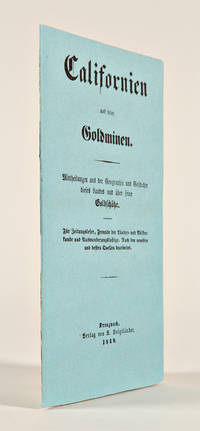
1849réf. WRCAM52151Kreuznach: R. Voigtlander 1849. 32pp. Printed blue wrappers rear wrapper original front wrapper in facsimile. Small corner repairs to rear wrapper. Some foxing two ink stamps on titlepage. Else very good. In a half morocco slipcase and cloth chemise. The first edition of an exceedingly rare Gold Rush pamphlet printed in the hallowed year of that epochal event. "Like many guidebooks for Europeans this pamphlet gives general information on California's physical features history and 'Notes for Emigrants' on the gold discovery. The portion on California's gold riches consists primarily of an article reprinted from the KOELNER ZEITUNG of January 14 1849 which in turn summarizes R.B. Mason and others. The guide mentions the many German settlers in the Sacramento Valley and speaks proudly of Captain Sutter" - Kurutz. Only four institutions worldwide report a copy of this book: the California State Library the University of California at Berkeley Yale and the State Library in Berlin. It is even more difficult to encounter at auction this copy being the only one on record to pass through the rooms. COWAN II p.102. HOWES C43 "aa." KURUTZ 112. SABIN 9984. R. Voigtlander hardcover books