19 309 résultats
réf. #[60288]Jesus Christ sitting on the globe placed in a car drawn by Bishops and preceded by a great number of persons among whom are distinguished Adam and Eve and the Sybils carrying standards; the disciples of Christ Martyrs Saints of both sexes are following; several Latin inscriptions particularly on the margin above and below. Small and oblong from left to right. On the verso collector's marks of Collection A.J. Domela Nieuwenhuis Lugt 356B and Museum Boymans. l Engraving on paper trimmed within platemark; reinforced and pasted on thicker paper; total: 75 x 382 mm; state I/2; Hollstein/Wurzbach 6 unknown
1862réf. 053672Athinais Athens: Ek Tis Typografias Ton Tekn. And. Koromilâ 1862. 1st Edition . Leather. Very Good. 8vo - over 7¾ - 9¾" tall. Original half morocco with four raised bands to gilt spine. Second compartment has title 'Ali Pasha' in Greek. All edges marbled. Text block slightly stained. A clean copy with minimal wear on extremities of boards and spine with no restorations of any kind. Marbled end-papers. Demy 8vo. 21 x 14 cm. In Greek Modern. 272 p. engraved portrait of Ali Pasha on frontispiece. This historical novel is written by Konstantinos Ramfos 1776-1871 and published in 1862 "accompanied by a new articulation of the enunciative and denotative position" is one of the most interesting cases of intertextuality in MG prose-fiction. Constantinos Ramphos was originally from Chios he devoted himself to trade was a member of the Hétairie and took part in the fights of the Greek war of independence before participating in the politics of his country. He was a diplomat and then a journalist from 1860 he began to publish stories devoted to the heroes of the insurrection Katsandonis "Despot l'Epirote" Ali Pasha for example and the most famous Halet Efendi. He mixed in his novels realism dreams patriotism against a historical background. Ali Pasha of Ioannina or Tepedelenli Ali Pasa Tepelena or of Janina the Lion of Yannina 1740-1822 was an Ottoman Albanian ruler who served as pasha of a large part of western Rumelia the Ottoman Empire's European territories which was referred to as the Pashalik of Yanina. His court was in Ioannina and the territory he governed incorporated most of Epirus and the western parts of Thessaly and Greek Macedonia. Ali had three sons: Muhtar Pasha who served in the 1809 war against the Russians Veli Pasha who became Pasha of the Morea Eyalet and Salih Pasha governor of Vlore. Ali first appears in historical accounts as the leader of a band of brigands who became involved in many confrontations with Ottoman state officials in Albania and Epirus. He joined the administrative-military apparatus of the Ottoman Empire holding various posts until 1788 when he was appointed Pasha ruler of the sanjak of Ioannina. His diplomatic and administrative skills his interest in modernist ideas and concepts his popular piety his religious neutrality his suppression of banditry his vengefulness and harshness . Western writers and poets such as Alexander Dumas Lord Byron were inspired and influenced by Ali Pasha in their works. Only two copies located in OCLC 835283685 Institut français d'études Byzantines and Sorbonne Université. A fine printing and a very early "historical novel" example in the Greek literature. First Edition. Very scarce. Ek Tis Typografias Ton Tekn. And. Koromilâ hardcover
réf. 51-4086Antwerp: Theodoor or Johannes Galle ca 1580. Engraving. 21 x 25.5 cm. Trimmed to borderline; mounted on an old rag support sheet. Plate 14 in lower right corner. .OCLC Number: 54949249; The New Hollstein X 125 ff. 2196-2209; Huth 10; Mennessier de la Lance II 537; Lipperheide Tc 13; Hollstein VII 81 484-423 Galle and VIII 113 334-348 Goltzius.Stradanus's series depicts the horses of Don Juan of Austria Governor-General of the Netherlands from 1576 to 1578. His designs were executed between 1578 to 1580 by several prominent engravers including Adriaen Collaert Hieronymus Wierix and Hendrik Goltzius. Don Juan of Austria was the illegitimate son of Charles V and a half-brother to Philip II 1555-1598 King of Spain and the Netherlands. He lead Spanish troops to their decisive victory against the Ottoman Empire at the Battle of Lepanto 1571 and became Governor-General of the Netherlands in 1576. He died of the plague in 1578. It was in the Netherlands that Stadanus drew Don Juan's collection of horses from the different regions of Europe. Mennessier p. 537.Strauss lists an additional 11 engravings not signed by an engraver as by Goltzius and Mauquoy-Hendrickx adds 2 to those bearing Wierix's name.Jan van der Straet is given as draughtsman on most of the plates or in their legends variations of "TheÌodore Galle excudit" on many. Three engravers are named: Adrian Collaert 1 12 Jeronimus Wierix 4-7 9-11 19 22 24 28 29 and Hendrik Goltzius 15 17 34 39. "Ioan Galle excud." 38 39 previously bearing "Phls Galle excud.".Several editions of varying numbers of the engravings variously numbered were issued prior to 1600 by Philip Galle one in 1578 with the title: Equile Joannis Austriaci Caroli V . Antwerp: Theodoor or Johannes Galle, ca 1580 unknown
1921réf. 362511Tokyo: Nihon Shoin 1921. First Edition. A writer for the Rafu Shimpo Japanese newspaper in Los Angeles offers a satirical lexicon of Japanese American terms. The book is reminiscent of Ambrose Bierce's Devil's Dictionary. For example an early entry is for "寫眞çµå©š" shashin kekkon or Picture Marriage: "The Japanese who have always imitated foreign countries in every aspect of their lives are now the only ones in the world with this unique and original invention." Picture Marriage is just one example of Yamazaki's commentary on the anti-Japanese climate in the United States at the time. The introduction to this book is by the novelist Ubukata Toshiro. OCLC: 673765878 National Diet Library. First edition first printing; the book was reissued in 1922 under a slightly different title. A very good copy in thin flexible boards. Lacking the printed white dust jacket. Nihon Shoin unknown
Manuscrito datable entre 1616 y 1618. Un volúmen en 4to., compuesto de 395 folios útiles, de apretada caligrafía y con numerosas notas marginales. Encuadernación en pergamino, de la época. Un excelente documento de la enseñanza de la Escolástica en el Siglo de Oro. Fray Juan de Biescas, nacido en Graus, fue durante muchos años Catedrático en la Universidad de Huesca. Según se desprende de Latassa, que es quien únicamente recoge datos sobre el mismo, publicó entre 1637 y 1641 en Huesca, en las prensas de Pedro Bluson, dos "Partes" de Comentarios a Santo Tomás, dejando inédita una 'Tercera Parte' cuyo original sería el manuscrito aquí ofrecido.
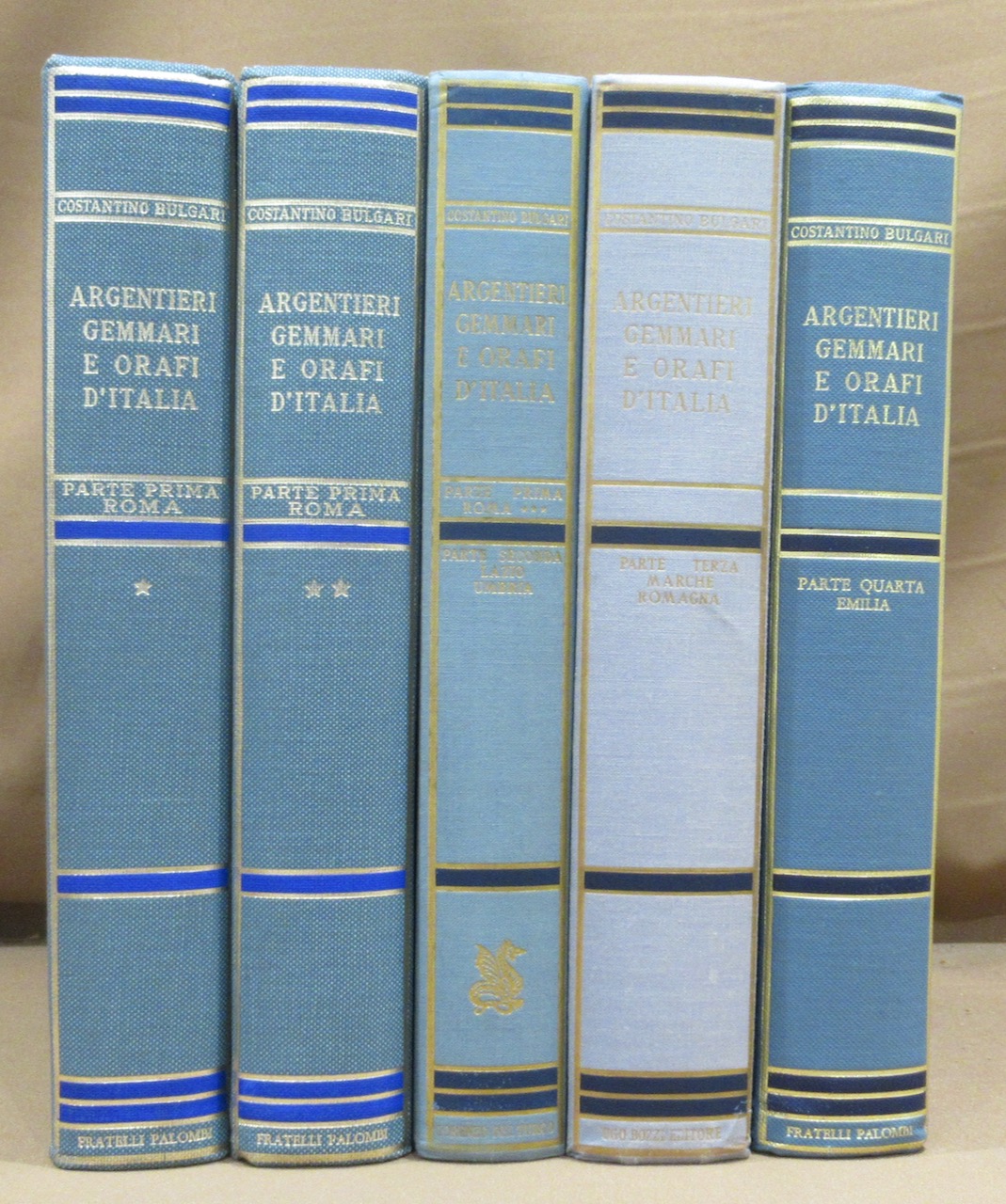
1966réf. 106901Roma, Lorenzo Del Turco - Ugo Bozzi - Fratelli Palombi 1966 - 1974. 1966. 4° (30 x 24 cm), zus. ca. 2400 S. mit vielen teils farbigen Abbildungen, Orig.-Leinen.
1759Lorenzo Lorenzi (1720 - 1780), nato a Volterra, attivo intorno al 1760, fu allievo di Cigna, incise parte della collezione del marchese Gerini e soggetti dal Carracci. Incisione al bulino impressa su carta vergellata. Da un soggetto di Ciro Ferri, pittore romano del sec. XVII (Roma 1634 - ivi 1689). Pubblicata a pag. 151 rif. 236 del catalogo "Per Bacco" di Alberto Alberghini.
Medina del Campo: Metymnae Campi, expensis Petri Landry & Ambrosii Duport, 1587. Folio; portada con el escudo real grabado, 1 hoja, 536 pp., 26 hojas. Ex libris manuscrito en portada del jurisconsulto de Albarracín Juan Sanchez de Ruesta. Encuadernación de época en pergamino. Presenta manchas en el plano posterior de origen dudoso. Luis de Molina, sobrino de Ambrosio de Morales, está considerado como uno de los más notables juristas del Siglo XVI. Defendió en su obra "Pro succesione regni Portugalliae Allegatio" los derechos de sucesión a la corona de Portugal de Felipe II, a quien dedicó ésta su obra más conocida, en la que se analiza detalladamente la regulación de la muy hispánica institución de los Mayorazgos y sus vinculaciones, de sustancial importancia en la vida social y económica española hasta mediado el Siglo XIX. -
Amberes: Antverpiae, excudebat Martinus Nutius, 1547. 12vo; portada, 192 hojas numeradas. Bella encuadernación de finales del siglo dieciocho, en piel valenciana, con lomera ornada y ruedas doradas en los planos.
Vollständiges Oeuvre sämtlicher Mitglieder der berühmten Goldschmiedefamilie. Zu den erhaltenen Goldschmiedearbeiten kommen verlorene Werke, die nur noch in Abbildungen erhalten sind, sowie bisher unbekannte Handzeichnungen. Der einleitende Text enthält einen Stammbaum u. sämtliche Jamnitzerstempel.
1998réf. 61055Düsseldorf, Edition GS, 1989-1998. 4°. Mit ca. 6.000 Abbildungen. Zus. ca. 1.280 S., OLwd.-Bde. m. OUmschlägen.
réf. DADAX3319346385New unknown
1668réf. V70198Antwerp: Andreae Frisi 1668. Hardcover. Good. Copperplates 45 numbered of cruel tortures including the engraved pictorial titlepage by Antonio Tempesta large copperplate printer's device of man consulting books in a library optimi Consultores Mortui. Duodecimo contemporary calf blind rules with corner floral ornaments spine with gilt label top cover nearly detached tips worn chipped to head/foot of spine All edges red sprinkled. Engraved Titlepage of the stoning of a martyr Titlepage 19pp dedication & preface 1p blank 576pp 47pp index 1p blank A-Cc12. Page 456 with small adhesion obscuring 2 or 3 letters and initial. Inscription E.lib R.S. on blank back of engraved Title. Endpapers bit browned else a clean tight neat copy needing repair to front hinge. All copperplates are present shewing gruesomely detailed plates of all the possible torture methods being administered to the martyrs which also are in crisp V.G. condition.The early editionshad fewer plates from 25 with later additions Andreae Frisi hardcover
1875"National bank notes retired - legal tenders the only paper money - prosperity for every industry." - subtitle. "This little work makes no pretensions to literary merit. It was written, by the author, at intervals snatched from his other occupations as a farmer... The leading facts stated, and the great and fundamental truths of the science of money enunciated, are in accordance with the true principles of Political Economy when applied to the present conditions of America, and are believed to be sound and incontrovertible." - from Preface. Contains the following five essays: As long as America is so heavily indebted to European Nations it will be impossible to have a good and uniform currency upon a gold basis; Specie-based currency with the shackles of gold redemption and the national bank system are anti-republican and dangerous to human liberty; A second system of paper money freed from the shackles of specie redemption and based upon the faith of the nation; How contraction and gold redemption will affect the debtors and tax-payers; Industry and productions stimulated by a greater volume of currency. Usual library markings. Spine Slant. Above-average wear. Binding intact. Gilt lettering mostly worn from backstrip but clearly legible upon blue front board. Upper portions of almost all pages lightly stained yellow - all text remains clearly legible. Book
1898231 pages. History certainly does repeat itself as the following statement appears upon the title page: "Equity and justice demand that the merchant, manufacturer, farmer, and wage-earner shall receive as much consideration at the hands of the law-makers as is accorded to those who deal in money." Clearly, the author would not be a fan of Goldman Sachs and their modern-day ilk. Chapter titles include the following: Thirty Years' Fall in Prices; Disastrous Effects of Falling Prices; Opinions Regarding the Cause of the Fall in Prices; Money, its use and abuse; Our Money a Banker's Money; A Monetary System Which Will Restore Prosperity; Bimetallism as a Cure; Immigration; Trusts and Department Stores as a Cause; Overproduction; Hard Times - The Effect of "Improved Machinery"; Confidence; Supply and Demand; Review and Summary of Overproduction; Review and Summary of Bimetallism; Conclusion. Tissue-protected black and white photographic frontisplate of author. Bright gilt lettering upon maroon backstrip and decorated front board. Prior owner's signature upon front free endpaper, otherwise unmarked. Moderate wear. Binding sound. An above-average copy of this important and timely work. Book
réf. SONG0590715054Used: Good unknown
réf. DADAX0312550898New unknown
réf. DADAX0670262358New unknown
réf. 23533Address given in text 181 Grand-Lancy Geneva Switzerland; 17 Aug.1901. Two pages 8vo bifolium blank second leaf laid down on former album page 22 x 14cm good condition. Text: "The last time I saw you I spoke to you about the necessity of translating and printing in russian sic 'Barclay's Apology'. I think that the sooner it will be printed the better and ought to be printed in russian without any abriviations sic. But I have not the means of paying the translation and printing. Do you think the Society of Friends would give the necessary money for the translation and printing If the Society of Friends cannot pay the money then I think of making extracts from the book and will print them at my own expense but as the work is much the same I would like to earn the money for the printing of extracts by translating the whole book. There would be then two editions. 1/ The whole book and 2/ extracts. What do you think of my idea Some time ago I wrote about all this to Aylmer Maude and asked him to write to you about this affair but not receiving any answer from him I now write directly to you and hope you will soon give me a reply address given and plan for the winter for his family". Autograph Material by Hilkoff is scarce. Address given in text, 181 Grand-Lancy, Geneva, Switzerland; 17 Aug.1901. unknown
1672réf. QQ0466No publisher 1672. Original full dark brown mottled calf triple blind fillets framing boards triple fillets parallel to spine to front and rear boards. Raised bands blind decor and red gilt label to spine. Remains of blind decor to board edges. Hinges secure cords all holding firm though leather of front hinge cracked except for a 1cm section at base and rear board is cracked at top over hinge c. 3cm. Small loss to top spine. 8vo 11.8 x 18.4cm. All edges marbled faded. Endpapers cracked at gutters. Recent bookplate and minor pencil annots to inside front board. Typographic headpiece. Very minor tidemark to bottom margin of pp. 437-444. A response to Stillingfleet's 'notorious book on Idolatry among Catholics' Clancy the 1671 'Discourse concerning the idolatry practised in the Church of Rome' which was itself answered by Daniel Whitby and Stillingfleet himself. The 5pp. dedication to the queen is signed 'T. G.' for Thomas Godden pseudonym of Thomas Tylden or Tilden 1622-1688 Roman Catholic controversialist. The son of a tanner from Kent Tylden converted to Catholicism as a young man and by 1656 was president of the English College in Lisbon where he was created D.D. in 1660. In 1661 he was appointed chaplain and preceptor to Princess Catherine of Braganza: he accompanied her to England and was among the witnesses to her marriage to Charles II after which he remained a member of her household serving as chaplain and treasurer: 'it is said that he taught her to speak English' ODNB. According to Bishop John Russell Tylden 'spent his life at court as though in the cloister and "he was very dear to the Queen and not disliked by the King"' ODNB. His refutation of Stillingfleet in Catholicks No Idolaters was his 'most important work' ODNB. This copy has the separate section of 48pp. before the main body of the work called for in ESTC but according to Clancy 'not to be found in most . copies'. ESTC R16817; Clancy 962.3. Robust packaging. Tracking is always added to USA orders. It can be added to other overseas orders on request. Used books are exempt from USA tariffs. 1st edition. Very Good. 32 48 448pp. No publisher Hardcover
1722réf. 7302Londini London: Impensis Richardi Sare . 1722. Folio pp. xliv 468. Parallel Greek and Latin text contemporary panelled calf neatly rebacked retaining original spine corners and end-papers renewed. Nineteenth century book label: Bishopric of Cornwall. Second century Christian author probably martyred under Marcus Aurelius. Styan Thirlbys edition is described by Dibdin as splendid and carefully executed although Dibdin is cautious regarding Thirlbys achievements as editor: ingenious but vain seems to be his opinion. Book Impensis Richardi Sare [...] unknown
réf. DADAX0688031137New unknown
réf. 9781634822985NOVA SCIENCE PUBLISHERS INC
Madrid, por la viuda de Alonso Martin, a costa de Domingo Gonçalez, 1628. 4to.; 4 hojas, 324 pp., 40 páginas y una lámina plegada "Vandera dedicada a Don Alvaro de Azpeytia y Seuane, el dia qe recibio el Grado de Doctor en Bolonia". Ejemplar falto de dos hojas de preliminares. Encuadernación en pergamino, de la época, con pérdidas en el plano posterior. El autor real de este famoso canon métrico manierista fue el jesuíta abulense Diego Garcia de Rengifo (1553-1615) y su primera edición es de Salamanca, 1592. Todas las ediciones del Siglo XVII son muy raras, dado su éxito entre los innumerables aspirantes a poetas en el Siglo de Oro.
1953réf. 76489Barcelona: Edicions Hora 1953. First edition in Catalan Llull's native tongue and the first edition with Campany aquatints. One of XVI special copies. Text printed in Catalan Llull is known for being among the first authors to use his vernacular language Catalan to communicate his ideas. Folio . 175 1 pp. with 11 full page hand-colored etchings drawn engraved and colored by the artist and ten large chapter headings all signed in pencil by the artist. Loose as issued in vellum-backed chemise with gilt spine lettering. Housed in a custom acrylic slipcase. A wonderful copy.This is a Catalan translation of Llull's 1305 although first published in 1512 work entitled Liber de Ascensu et Descensu Intellectus The Book of the Ascent and Descent of the Intellect. Ramon Llull is often thought of as an alchemist of the first order but strictly speaking he was a philosopher/theologian. His magnum opus Ars Magna displays his chief theme; the understanding of eternal truths by way of the intellect. While not himself an alchemist the seekers of the philosopher's stone were very influenced by Llull's ideas. In this book Llull describes the movement of the intellect through the many levels of understanding which some Renaissance alchemists such as Heinrich Khunrath interpreted as analogous to the transmutation process in alchemy. This striking volume was issued in an edition of 165 copies. This copy is one of XVI #VII copies containing an original drawing of one of the plates or of 2 of the vignettes a complete set of the proofs a series of sanguine proofs of the plates and the vignettes and the final proof of all the plates. It is the most desired format. Ramon de Capmany y de Montaner 1899 - 1992 was a Catalan painter engraver and bibliophile. He trained as a painter at the Escuela de la Lonja where he studied under the supervision of Francesc Labarta. He was one of the members of the the Evolutionists and one of the regulars of the Sala Pares. The Evolutionists were an artistic group from Barcelona in the aesthetic sphere of Noucentisme and who rejected programmatic orthodoxy and influenced by Cezanne and the Fauvists developed a personal work constructed and of austere colors. Mainly a landscape painter he mostly painted the surroundings of the Montseny Massif and the old part of the city of Barcelonain a naturalistic style. He also illustrated bibliophile editions such as this one. He held the position of curator in the board of the Ateneo Barcelones during the presidency of Pedro Gual Villalbi between 1952 and 1962. Some of his works can be found in the National Art Museum of Catalonia.One of the proofs of the work apart from the one designated to be signed by the artist is dedicated by Capmany to a Mr. Riera with the following words: ‘Prueba dedicada al Sr. Riera por el artista. Ramon Campmany.’ An original steel etched plate one used in the making of this volume comes with the work. It’s an additional object and no other copies have such a plate. This plate was a gift from the artist to the same Mr. Riera. Edicions Hora hardcover