Rupert, G.G.MareMagnum

1911526 pages. List of black and white maps and illustrations. Black and white photographic portrait of author. Marbled text edges. "...Not designed to build up any sect, but to build up truth in the minds of the people and help all who wish truth, believing there are such in every division of Christendom." - from Preface. Maroon cloth bears somewhat above-average wear. Decorations upon front board partially rubbed. Binding sound. Short openings at each end of back strip and two-inch opening between top of backstrip and front board. Small piece missing from upper corner of page 526 does not affect contents. Minor openings to fore-edge of front free endpaper and first blank leaf. Erasures faintly visible atop front free endpaper. Modest quantity of light pencil markings to contents. A sound copy. Book
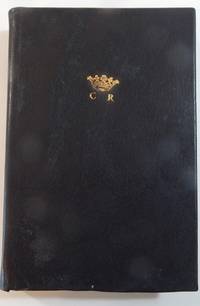
1648réf. 23711n.p. London: n.d. Richard Roylston 1648. First edition. Hardcover. Good. 112mo. Folding frontispiece. viii 269pp. Recent black leather gilt spine title and gilt crown and 'C.R.' on the upper board. Textblock generally soiled and with stains form old tape marks but still in good condition. The second issue with the place of publication and publisher removed from the title page but with the misnumbering on section G uncorrected. The frontispiece in state 'a ii' with the pattern in the roof above the inscription similar to that in the remaining panels the right edge of the window cutting the 'c' of 'specto' and with three plants to the left of the palm tree top. This state according to Maden appeared within a few days of the King's death. Maden I second issue. . n.d. (Richard Roylston) hardcover books
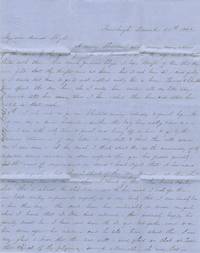
1849réf. BK0018Ferrisburgh Vermont 1849. Autograph letter signed "Anne R. M." to her husband Lloyd Minturn in San Francisco "Upper California." 8 pp.; approximately 1700 words. With stampless cover bearing a black "NEW-YORK / 40" datestamp of January 17 and manuscript routing "per Cherokee. Significant edge wear and central vertical crease; text generally clear and complete. An intimate Christmas letter from Anna Robinson Minturn of Ferrisburgh Vermont to her husband Lloyd then engaged in the hotel and real estate business at Pueblo San José during the California Gold Rush. Writing on the anniversary of his departure Anna describes the four-month-old son Lloyd had never seen questions whether California's speculative "mania" could last and repeatedly urges him to return home. Lloyd Minturn had traveled to California in January 1849 with David Lion Gardiner and other eastern emigrants. By November Gardiner reported that Minturn was "at Pueblo San Jose keeping a hotel and speculating in real estate."1 Anna's references to Lloyd's hotel and stables their rental and the uncertain recovery of his investment relate directly to his California business. He later appears in San Francisco as a member of the Committee of Vigilance of 1851 with his place of business on California Street and his residence at the Mansion House.2 Anna begins writing late on Christmas day imagining a future holiday spent with Lloyd "by thy quiet fire-side in Vermont-with thy wife and darling child with thee." Returning to the letter three days later she reflects on the year since his departure: "Oh how much I think about thee as the anniversary of thy departure comes round . When I think of thee my dearest ask then what a weary dreary time it seems . Our little darling improves so rapidly is so very lovely that I can hardly bear to have thee away." News that another California emigrant Dr. Stone had returned safely made Lloyd's absence still more painful. Although she understood that "the object of thy pilgrimage" at last appeared attainable Anna wondered why the management of his property could not be entrusted to an agent asking why "Mr. Ruckle" cannot "receive the rents & pay the former owner and send thee thy portion of the profits." However she immediately checks her own advice with an observation on marriage and gender: "You men know so much more how these things work than we so that it is rather labor wasted to advise much and I do hate to see a woman trying to rule her husband-don't thee" Anna feared that Lloyd might remain away sacrificing his domestic life only to lose the anticipated reward. Her skepticism extends to the Gold Rush itself: "I do hope though that the man who has taken your property will be able to pay you-that would be so bad to stay away so long-sacrificing so much & lose thy reward entirely-don't thee suppose this mania in California will end much as the land speculation did here seems to me it must. I hope thee won't get drawn in." Much of the letter is devoted to their infant son whose birth Lloyd may initially have learned of from another returning emigrant because of the "shamefully neglected" Pacific mails. At four months the boy weighed eighteen and one-quarter pounds and had "cheeks as hard as little apples." Anna encloses a lock of his hair explaining that she had kissed it before sending it. The contrast between California and the Vermont household runs throughout the letter. Anna describes the snow distant mountains sleighing baked apples and buckwheat cakes while Lloyd remains in a place known to her mainly through contradictory reports and unreliable correspondence. She cites Bayard Taylor's account of portions of California as suitable wheat country while noting that other observers claimed wheat could not be grown there at all remarking on the "contradictory accounts about California" that make it hard to "tell what to believe." Her anxiety was heightened by reports of cholera progressing toward California. She closes by asking Lloyd to protect his health and praying that he might be restored to her "in sound health both body & soul." Anna was a daughter of Rowland Thomas and Rachel Robinson of Rokeby the prominent Ferrisburgh Quaker family whose home later became known for its role in the Underground Railroad. Other letters from Anna to Lloyd during his California absence survive at the Bancroft Library and the Smithsonian.3 Overall a substantial and affecting account of the Gold Rush from the perspective of a wife left behind. 1 David Lion Gardner Letter to Juliana McLachlan Gardiner November 30 1849 David Gardiner Letters BANC MSS 2006/127 box 1.The Bancroft Library University of California Berkeley. 2 Anna Robinson Minturn Letters to Lloyd Minturn 1849-1851 Warshaw Collection of Business Americana Subject Categories: Steamboats box 1 folder 6 J-L Archives Center National Museum of American History Smithsonian Institution Washington DC. 3 Anna R. Minturn "Anna R. Minturn to Mr. Lloyd Minturn Ferrisburgh December 2 1849" California Gold Rush Letters BANC MSS C-B 547 box 5 The Bancroft Library University of California Berkeley. . unknown books
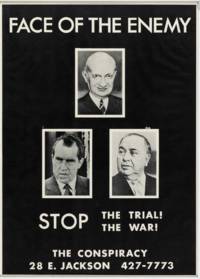
1969réf. List911Chicago 1969. 21 1/4 x 29 1/4 inches. Some light toning and edgewear near fine condition overall. The first example of this poster we have encountered which shows Judge Julius Hoffman Chicago Mayor Richard Daley and President Richard Nixon. We find no other records and can only assume it was produced in the same era as the previous offering as it bears the same address of 28 E. Jackson. unknown books
1999réf. 573405Los Angeles California: Tom of Finland Company 1999. Softcover. Fine. Magazine. Two volume set. Pictorial wrappers. Quartos. 64pp. 64pp. A fine set with illustrations in both color and black-and-white. Containing tributes to the American homoerotic artist Etienne by Jeff Kincaid Bob Yuhnke and Durk Dehner. Scarce gay erotica art with OCLC showing only 4 copies of Book 2 and only 1 copy of Book 1. Seldom found in trade. Tom of Finland Company unknown books
1923réf. 30251HARDBACK NODUSTJACKET 1926 ON TITLE PG First Illustrated Edition. 1923 ON COPYRITE PG TITLE TO SPINE COVER Hardcover. patterned gold foil paper-covered boards w/ red device on front cover Owner inscription on the front free endpaper; moderate wear to covers. Near Fine in a Near Fine- Slipcase LITE RUB. Parchment-backed decorated gold boards LITE WEAR 7-1/4" x 10" in a possible later slipcase with a large GOLD & RED label on the front as well as a label on the spine. The First Illustrated Edition of this popular title with 12 plates reproduced from drawings by the author. Printed by the Southworth Press Portland Maine. The artist Rodin compared Gibran to William Blake. An attractive early edition of this modern classic. Cover w/ COLLOTYPE Illustrations by Author Collector's Edition PRINTING PLATE Made by Exposing a Sensitive Gelatin Plate to Action of Light Thru Photographic Negative a collection of philosophical spiritual mystical and inspirational poetic essays that have been treasured by generations around the world Alfred A. Knopf hardcover
1863réf. 2111902160201223Not Available 1863. Soft Cover. Fine. Volume: 1 Not Available paperback
1595réf. V67175Venice: Haeredem Hieronymi Scotus 1595. Hardcover. Very Good. Large woodcut portrait Aristotle over 50 diagrams in the text historiated woodcut intial capitals . Folio modern cream linen with red leather label with gilt title tips rubbed 16pp 316pp Tideline from waterstaining at the front but becoming marginal & faint by text page 13. Some gatherings with more or less paper tanning but paper always supple and strong. Part of an 18 volume collected edition of Thomas Aquinas. It is printed in double columns with side-notes and deals with Aristotelian physics not in Adams or STC. Haeredem Hieronymi Scotus hardcover
réf. 1913Paris: A la Cite des Livres 1925-1927. 26 volumes complete. First and only edition of this extremely important collection of 26 short novels each by an author whose last name begins with a different letter from Claude Anet to Emile Zavie. Edition limited to 440 copies. This is an out-of-series LARGE PAPER COPY printed throughout on Madagascar and Japan paper. Squarish 12mo. Original pink wraps. Entirely uncut and largely unopened. A fine set with no defects. Paris: A la Cite des Livres, 1925-1927 paperback
1939réf. 38110Paris: Les presses de l'Hôtel de Sagonne / Société des Bibliophiles Les Plaquettes 1939. First and only edition. THE EXTRAORDINARILY RARE FIRST PUBLICATION of a grand total of two OF THE SOCIETE DE BIBLIOPHILES "LES PLAQUETTES" AN OUTSTANDING EXAMPLE OF FRENCH PRE-WAR FINE AVANT-GARDE TYPOGRAPHIC PRINTING. 2 blank leaves; 27 pp. This bibliophile society was conceived by Gaston-Louis Vuitton in 1929 and by 1932 it had 57 members but hadn't yet published anything. In that year it lost all of its funds when its bank went belly up. The Society got rolling again in 1938 and finally printed this gorgeous book in 1939. The text of course is about booklets and their history in France and in the world. Shortly after this book was printed World War II and the German Occupation put a final end to this Bibliophile Society: its only other publication was an equally rare edition of St Francis' "Cantique du soleil" printed in 1943. Fleuret died in 1945. Notable avant-garde typographical design on cover. Edition limited to 111 numbered copies but much rarer as few if any copies were ever actually distributed to the members of the Société beautifully printed with huge margins on fine Montval laid paper. Folio. Publisher's wraps. UNCUT AND UNOPENED FINE AND BRIGHT LIKE NEW WITH NO DEFECTS. Original paper knife laid in. An incredible survival even more so in such pristine condition. The only copy in WorldCat is the one in the Bibliothèque Nationale. Les presses de l'Hôtel de Sagonne / Société des Bibliophiles Les Plaquettes paperback
réf. 133505aaf(1657): 39x50 cm (view) 41.5x52 cm (lichtmass) vue à vol d’oiseau, coloriée à la main d’époque, pli au milieu avec légères traces, / fine handcolored view, light wear on middle fold, sous passepartout dans un cadre or. 56x65 cm (cadre) / framed.
réf. 112621Hamburg Johann Christoph Kistner 1723. 8vo. Engr. front 14; 2 168 10; 2 240 10; 2 202 2; 2 306 4; 167 1 pp. 17 engr. plates 3 fold. printed tabs. Contemporary full calf spine with raised bands and red label boards with gilt frame red marbled edges. This is the third and last part of the anonymoue edited ”Des Geöfneten Ritter-Platz” in a mixed edition with separate title pages for the different parts: ”Raritäten-und Naturalien- Kammern” 1707 with 12 plates ”Berg-Werken” 1720 with 5 plates ”Kauffmansbörse” 1707 with 3 printed tables ”Manufacturen-Haus” 1721 ”Curieuse Nachricht” 1707.The first part is about the creation and maintenance of a cabinet of curiosities or Wunderkammern. It is a description on how to assemble an ”ideal” cabinet with instructions and advice how and what to collect: Naturalia plants minerals animals alive and stuffed shells and fossils ethnographic material coins and medals antiquities scientific instruments globes and maps clocks pictures manufactured curiosities and there is even a section devoted to ‘curiosities’ produced by women. There is also information on how to store and display the collection and the final 40 pages contain an annotated account of the chief cabinets throughout Europe. The third part on commerce and trade also contain a long chapter on coins and cureencies in Europe. hardcover
1720réf. NC0225E. Curll 1720. hardcover. Acceptable. 0x0x0. London 1720; rebound in brown leather covered boards; corner and spine edge wear; 12mo - over 6 3/4" to 7 3/4" tall; new end papers; Previous owner's name on front end papers; lightly foxed; coffee colored discoloration at hinges pages original front end paper fading through 225; From the library of ABAA bookseller Tom Nicely; 320 pages. E. Curll hardcover
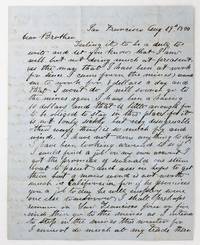
1850réf. 6357San Francisco: August 29 1850. Very good. 3pp. on a folded folio sheet. Old folds some light wear and soiling. Letter from a disillusioned painter living in San Francisco to his family back home in New Bedford Massachusetts. Currently in San Francisco proper Allen finds the town quite disagreeable with fog and wind and very little work. He writes that he isn't working at present because his employer will only pay him $8 a day which "won't do." He says "I will sooner go to the mines again. I have been a haveing 10 dollars and that is little enough for to be obliged to stay in this place for it is not only sickly but very disagreeable other ways." He's had little success in his job hunt with a glut of painters in town. "I have been looking around to see if I could find a job on my own account. I got the promise of several & one steamboat to paint and am in hopes of getting them but a man's word is not worth much in California for if he promises you a job today he will employ some one else tomorrow." He notes that he will go back to the mines in the winter: "Men enjoy much better health in the mines than do in this place as a general thing but mining is rather uncertain though I am determined to give it a good try this winter and then quit the country that is to say this section of it." He complains about a lack of correspondence and closes with a statement about the terrible plague of fleas he is currently suffering. A candid and grim look at life in San Francisco in 1850. August 29 unknown
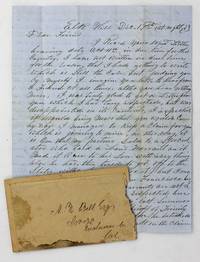
1853réf. 4788Elk Hill Ca: December 17 1853. Very good. 3pp. on a folded folio sheet. Old folds light wear and soiling. With original mailing envelope. An informative letter sent from a miner in Gold Rush-era California to a friend in Tuolumne County primarily concerning a mining claim but also providing many interesting local details. The author writes "I managed to keep a claim for you which is joining to mine in this way it is one that my partner sold to a speculator who laid a land warrant on it." He discusses the process of the land warrants and how he made the man title the claim properly in San Francisco. "This claim was jumped last summer by W.H. Dixon first sheriff of Trinity City who died the day before he intended to occupy the house he built on the claim. He shot himself accidentally and never spoke." The author immediately stepped in and nabbed it for his friend but it was short-lived. "The claim is cheap at $2000 as soon as I made it known that I should not administer it was jumped by 3 in one day before 9 o'clock. So much for your not coming as I told you I could not keep them off any longer and you would not come if I had." He further mentions that he is digging potatoes which he deems the finest in the world discusses issues with the crop and further talks about new arrivals in the area. December 17 unknown
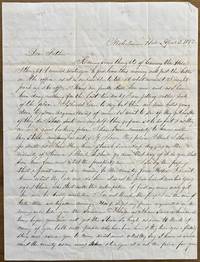
1852réf. 4789Mokilomni Hill Ca: April 3 1852. Very good. 2pp. plus integral address leaf. Quarto on a folded folio sheet. Old fold lines minor wear. In a highly legible script. An interesting letter from a disillusioned fortune-seeker in Calaveras County advising his father not to come west as all the easy pickings are gone. He writes "Times are pretty dull here now and as I have been doing nothing for the last two weeks I am getting rather sick of the place. I should leave today but there are some holes going down by some acquaintance of mine & I want to see if they get anything. If they do I shall sink one myself they go from 50 to 60 feet & as they are in a good looking place I have some curiosity to know whether they strike anything or not. If I leave this place I think I shall go south as I hear they have struck some deep diggings in the vicinity of Sonora & think I shall go down that way. I see by the papers that a great many are coming to the country from Boston. I do not know what they all will do here it is not the place here it was two years ago & those who start with the anticipation of finding money easily got here will be badly mistaken. April 3 unknown
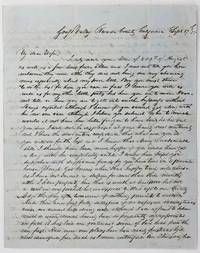
1855réf. 4791Grass Valley Ca: September 17 1855. Very good. 4pp. on a folded folio sheet. Old fold lines minor wear. An intimate letter from a gold seeker in Nevada County California. Theodore Shaw writes to his wife about mixed luck in California a terrible fire his concern for their children and his great anxiety about the future. He writes in part: "I have property here that is worth at least $1000 but not a cent in my pocket but we expect to start up to our quartz ledge the day after tomorrow if nothing prevents to errect a mill up there. And now our plans have been nearly frustrated by a most dreadful fire such as I never witnessed. On Thursday last about 11 o'clock p.m. an alarm of fire was heard and by about half past 12 some 350 stores dwellings and buildings were consumed with a large portion of their contents our hotel included. . The entire business part of the town is in ruins.we have been sleeping under an old shed in the suburbs. This fire has injured us in this way several who had taken stock in our company have lost their means still we intend going on in a smaller way. We had formed a company with a Capital Stock of $50000 divided into 50 shares of $1000 each. Do you know Lydia I have more anxiety about your health than anything else as I know you work hard; only think what would happen to our dear children if anything serious should happen to your health and I away here in California. September 17 unknown
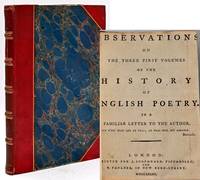
1782réf. 298728London: J. Stockdale; R. Faulder 1782. First Edition. Half Leather. Very Good binding. 8vo.; in an attractive later binding of red half-goat over marbled boards with raised bands with morocco label lettered vertically; with marbled endpapers; 2 49 1 pages.~~A note on this rather interesting binding: we assume that the binder was charged with binding a group of different books to a uniform size -- the title page is trimmed and mounted and all the other leaves are folded neatly to fit the bottom edge and then the leading edge over it. Rather astonishing actually.~~This is Ritson’s first book in which he attacks Thomas Warton’s History of English Poetry in such vitriolic tones -- Warton is a pretender a cheater and a liar -- as to cause quite a contretemps in late 18th century English literary circles. One assumes this actually pleased Ritson as he went on the next year to attack Samuel Johnson and George Steevens. Eventually Ritson went complete mad barricading himself in his rooms at Gray’s Inn and setting fire to a pile of manuscripts. Very Good binding. J. Stockdale; R. Faulder unknown
1871réf. 7912San Francisco: A. L. Bancroft & Company 1871. First Edition. Hardcover. Good . 12mo. 256 pp. original green cloth lettered in gilt index to advertisers advertisements i-lvii. -- Moderate wear to the extremities some fraying to the spine tips & corner edges corners bumped. Blank paste-down and first free end-paper paper a little separated but hinges still strong. Rear hinges strong. Rear paste-down has an advertisement pasted on and a small stamp at bottom near the gutter of "H. K. Van Siclen Bibliophile 133 Nassau St. Ny". --. "This tourist guide for visitors of San Francisco and the Yosemite Valley offers a look at travel and accommodations in the late 19th century".-googlebks. A. L. Bancroft & Company hardcover
1419réf. 16009JUnion Hill / Grass Valley California 1914-1915. Original hardcover ledger 11.5” x 8” bound in half leather with gilt stamping over light brown corduroy metal spine with locking mechanism no key marbled paper pastedowns and gilt embossed leather alphabet tabs on front page edges. 168 pages of handwritten text showing detailed internal records from the historic Union Hill Mining Company that had offices in both Grass Valley and San Francisco. Union Hill is adjacent to Grass Valley. Detailed information for 1914-1915 including operating expenses profit and loss income expenses production vendors payroll cash bullion production tungsten production names vouchers insurance and marketing. Entries include operating expenses for the South Idaho Mine and names of the local companies they did business with such as Grass Valley Hardware Empire Mining Company Nevada County Narrow Gauge R. R. Company and Thomas Diggs Company an entry for Augustus D. Cox who was the Mine supervisor to very specific mining operating expenses for example: “Shaft Above 600’ Level” “Shaft Below 600’ Level” “Storage Dam 600’ Level” with expenses for mining tools hoisting compressing fire protection etc. A rare and unique Gold Country artifact this original handwritten Ledger offers compelling insight into an historic Mother Lode gold mine. The corduroy covers have some staining the rear leather corner has a corner chip the rear spine fold has a two inch half oval chip revealing the board beneath the front hinge is split and the metal spine has some rust internally the ink stamp of the Union Hill Mining Company on the front endpaper. Gold was discovered at Union Hill in 1854 the first recorded claim was in 1866 as Union Hill Gold Quartz Mine and Mining Stock Certificates for Union Hill Mining Company exist from the 1860’s. Although very profitable it appears Union Hill Mine opened & closed changed ownership &/or operators several times from the 1870’s until purchased by Idaho-Maryland Mines Company around 1920. In 2016 this historic mine was purchased by a gold mining company with plans to restart operations in the unexplored areas below the Idaho-Maryland Mine Property. hardcover
1838réf. 70800London: Saunders & Otley 1838. First volume 302 pages; second volume 325 pages with 2 pages of ads. Translated by Henry Reeve. Date 1838 on title pages. Third Edition Stated. Hardbacks. Good Used Condition. Saunders & Otley Paperback
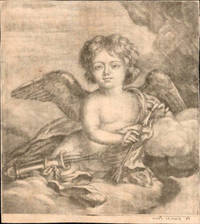
réf. 16-4872Circa late 17th- early 18th Century. Mezzotint. 20 x 17.6cm. Slightly trimmed. Signature in reverse "H. Gascarpinx." A reverse image of British MuseumRegistration number 18640813.16; and Chaloner Smith 1883 / British Mezzotinto portraits from the introduction of the art to the early part of the present century Part II. p. 524 no. 2 Circa late 17th- early 18th Century. unknown
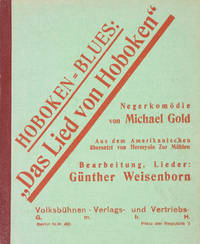
1929réf. 19326Berlin: Volksbünen-Verlags- und Vertriebs-G.m.b.H. 1929. Softcover. vg. 8vo. 100pp. Maroon cloth spine over green wraps with red lettering. Sunning to top edge of front- and rear wraps. Translated from the English into German by Hermynia zur Mühlen. "Bearbeitung Lieder: Günther Weisenborn." The News Playwrights' Theatre production of "Hoboken Blues" in 1928 was a bold experiment that failed with audiences and critics because it appeared to be racist although the playwright wrote it to expose the injustice done to African-Americans. Michael Gold wanted African-Americans to play the parts but director E. Massey cast white actors wearing black make-up. Fascinating piece of American Theatre history. Mimeographed typescript. Wraps in very good interior in near fine condition. Rare German edition. Volksbünen-Verlags- und Vertriebs-G.m.b.H. unknown
1963réf. 15874Garden City: Doubleday Crime Club 1963. First edition. Hardcover. Very Good/Very good . Police novel which was made into the Steve McQueen film "Bullitt". Bump on bottom front board corner. Two tiny specks at top of front free endpaper. Dust jacket with $3.50 price has a little rubbing on the rear panel. Jacket is bright except for the publisher's name at bottom of spine which is somewhat faded. Doubleday, Crime Club hardcover
1689réf. 16034London: Printed by Edw. Jones for Abel Swall.and Henry Bonwicke. 1689 Second English edition of an important history of the Reformation. Contemporary reverse calf ruled in blind. Folio. Title-page printed in black and red. The Bohun work with separate title-page. With six engraved portrait plates. Joints starting to crack but sound. Armorial bookplate of Cobbold of Ipswich later ownership annotation dated 1980 on front pastedown. A good clean copy. Johannes Sleidanus 1506-66 was born in Schleidan Luxembourg and studied ancient languages and literatures at Liège and Cologne and law and jurisprudence at Paris and Orléans. At Lièges he encountered humanist scholars and developed an interest in Protestant ideas. He went to work for Cardinal du Bellay and was employed in the futile negotiations of the French court to make an alliance with the German Protestants against the Emperor Charles V. In 1542 he settled in Strassbourg. He was in the habit of copying all papers that had any bearing on the Reformation to which he had access and Martin Bucer who had seen his papers suggested that Philip of Hesse appoint him historian of the Reformation giving him a salary and access to all necessary documents. Thus began his great work the first volume of which appeared in 1545. That same year he traveled to England in a French embassy to Henry VIII and there he collected further materials for his work. He later went to Marburg to view the archives of Philip of Hesse. In 1551 he attended the Council of Trent. He finished his history in 1554 despite financial problems. He died in poverty the following year. Printed by Edw. Jones, for Abel Swall...and Henry Bonwicke.. unknown