18.723 risultati
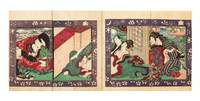
rif. 8347Vol. I: Illustrated "title-page" one double-page woodcut with foldouts to form a four-panel diptych with the addition of a "trick super flap" depicting three female genitalia young woman mistress & wife six double-page woodcuts & two single-page woodcuts all color-printed; & three double-page black & white woodcuts. Vol. II: Illustrated "title-page" five double-page woodcuts & two single-page woodcuts all color-printed; & four double-page black & white woodcuts. Vol. III: Illustrated "title-page" four double-page woodcuts & two full-page woodcuts all color-printed; & three black & white double-page woodcuts. All leaves have color-printed borders. .5 1 folding leaf of preface color-printed 13 folding leaves; .5 13 folding leaves; .5 12 folding leaves. Three vols. 8vo orig. decorated semi-stiff patterned boards with color-printed symbols of the moon flowers & snowflakes orig. block-printed title labels on upper covers of Vols. I & II lacking on Vol. III but there is no evidence a label was ever there new stitching. Japan: Preface dated 1850. First edition and very rare; we can find no copy in WorldCat or NIJL. Almost all of the techniques that make Japanese illustrated books so remarkable are utilized here. Finely illustrated and richly colored this late shunga employs bokashi the delicate variation of shading of pigment within the image; blind-embossing; and the very ample use of metallic pigments. The depicted garments are a mixture of extremely complex textures colors and patterns all accentuated by blind-embossing and multiple woodblock impressions. In Vol. I the folding woodcuts - which reveal a man and woman engaging in sex - open to reveal a fine and complex four-panel scene in which we see three couples also having sex: a young couple a man with his mistress and the same man with his wife. On the third panel from the right a hidden "trick" flap is revealed depicting and comparing the genitalia of these three women. This "trick" panel has the title printed with seven kanji characters the first two are indecipherable: ".mitate setsugekka" ".Visual Puns of Snow Moon Flower". Each volume begins with a finely colored paste-down leaf artistically depicting the themes of snow moon and flower with poems. Facing each of these leaves is a portrait of a woman: mistress young and wife. All the black & white woodcuts also depict men and women engaging in sex and self-pleasuring. Koikawa 1821-1907 was a prolific artist. He illustrated as well as wrote numerous books under various pen names. At the end of the Preface in Vol. I we find "Insuitei" one of his pen names. Fine set with fresh coloring. The four-panel diptych has several small burn holes on the right-hand side. One black & white illustration has been "heightened" with red ink in a very minor way. Slight thumbing and a few minor stains. unknown books
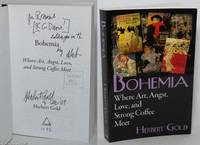
1993rif. 102297New York: Simon and Schuster 1993. 253p. paperback from the library of SF Mime Troupe founder R. G. Davis with an inscription to him by the author. Simon and Schuster unknown books
1936rif. 69089New York: International Publishers 1936. Hardcover. 272p. spine faded. Seidman G185. International Publishers hardcover books
2001rif. 2493First UK Edition/First Printing with the complete number line: A Near Fine book in a Fine dust jacket with minor foxing to the exterior text block and page edges. SIGNED by the author on the title page. Not remaindered not price clipped not ex-library; in a protective Mylar cover and will ship in a sturdy box. Sceptre hardcover books
1555rif. 6824Padova: Gratioso Perchacino 1555. Original edition. Very Good. Quarto 20 cm; 12 leaves signed a-c4 last leaf blank. Printer's device a crowned salamander ensconced in flames on title page. Woodcut initial at start of text. Bound in recent half morocco over marbled boards. Trimmed close to top edge. Gutters guarded. Some spotting on title page but generally clean. Reference: EDIT 16 CNCE 57958; For attribution to Lando see Silvana Seidel Menchi Chi fu Ortensio Lando "Rivista storica italiana" #106 1994 501-564. Not in Grendler. This is an essay about death. In particular it is a eulogy on the death of young Elizabetta Dotta who it is stated in the text died recently married at the age of 16 years 8 months 24 days and 12 hours. The cause of her death is not given. It does not indulge in a moment's sorrow over the young woman's early demise. Instead it is an extended encomium of death itself praising death as liberation from the essential misery of life in this corrupt and depraved world. As such it is an eloquent statement of philosophical pessimism the tradition which views life as the soul's exile as suffering and sees death as a preferable alternative. While the text is not signed the author is presumed to be Ortensio Lando the uncomfortable peripatetic humanist who never stayed in one place for very long either physically or philosophically. "What is life" Lando asks. "Smoke a dream a running shadow a ship that leaves no trace an arrow shot to its destination. Gratioso Perchacino hardcover books
1546rif. 5968Venice: Cornelio Adelkind for Daniel Bomberg 1546. First edition. Very Good. Folio 32 cm; 93 leaves. Text in Hebrew. Title within architectural border reproduced in Amram "Makers of Hebrew Books in Italy" p. 215 also in the Jewish Museum's 1989 exhibition catalogue "Gardens and Ghettos: the Art of Jewish Life in Italy" page 50. Some section headings within ornamental borders. Bound in c19 or c20 dark red crushed morocco ruled in gilt and decorated with arabesques on both boards; spine with raised bands and compartments tooled and titled in gilt; green polished leather doublures with red crushed morocco dentelles bordered in pointillé accented with arabesques; green moiré free endleaves. Edges gilt. Binding not signed. Joints and crown adroitly reinforced with Japanese paper; corners somewhat worn down. Occasional contemporary notes in manuscript in text; brief stain on leaf mem-tet and lightly along the bottom edge of leaves nun-bet and nun-gimmel. Text otherwise pristine. Title page light possibly washed. Old library ink stamps from an institution in Warsaw on title page. Red morocco ex-libris of mining magnate and philanthropist Adolph Lewisohn 1849-1938. References: Adams T-766; BM Italian 674; Steinschneider 7304 #1; Amram 215 illustration and 222. First printed edition editio princeps of the 11th century commentary on portions of the pentateuch by the Bulgarian poet and Talmudist Tobiah ben Eliezer. Published by the house of the seminal printer of Hebrew books Daniel Bomberg under the supervision of his scholar-in-residence extraordinaire Cornelio Adelkind. Venetian law at this time limited Hebrew publishing to Gentile printers. Bomberg a protestant from Antwerp entered this lucrative market and with Adelkind's help became its prime exponent until his death in 1549. Cornelio Adelkind for Daniel Bomberg hardcover books
1837rif. 4940London: Longman Rees Orme Brown Green & Longman 1837. First edition. References: Ibrahim-Hilmy i 310; Kalfatovic 0338. Fine. 22 cm; xvi 338 i.e. 341 pages map and 20 engraved plates 3 of them folding. Bound in recent half leather over marbled boards in period style. Marbled edges. Ownership inscription of W. Cushman of Watertown. Living in Luxor in 1836 Hoskins traveled with Robert Hay and Frederick Catherwood to the oases of Libya where he ran into Joseph Bonomi. "A good account" Kalfatovic illustrated with maps and engravings from Hoskins's own drawings. Longman, Rees, Orme, Brown, Green & Longman, unknown books
rif. 9678GOLD Harry. THE DOLPHIN'S PATH. Chapel Hill North Carolina: The Author 1979. Folio. Cloth. x 319 1 pages. First edition. Being a bookseller's memoir in verse. Gold was a Fourth Avenue book seller in New York before being implicated in the theft of Poe's Tamerlaine from the New York Public Library; a presentation copy. Very good. unknown books
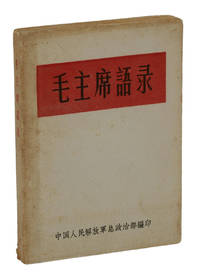
1964rif. 140939355China: General Political Department of the Chinese People's Liberation Army 1964. First Edition. Very Good. First edition. 250 pp. Printed wraps; text in Chinese with 30 chapters. The endorsement leaf by Lin Baio has been excised as is common in many copies. In promoting the Little Red Book Biao rose to prominence in Mao's inner circle with Biao becoming seen as Mao's successor. However when unsubstantiated rumors surfaced that Biao was plotting to assassinate Mao Biao was killed and subsequently the endorsement leaf was excised from remaining copies. Very Good or better with wear at foot of spine toning and light foxing occasional corner crease to pages. Following the Bible this is the most-printed text in the world. [General Political Department of the Chinese People's Liberation Army] unknown books
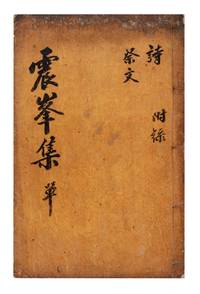
rif. 942552 folding leaves. Large 8vo 298 x 190 mm. orig. patterned semi-stiff wrappers wrappers a little soiled old stitching stitching partially defective. Korea: Preface dated 1801 Afterword dated 1816. A very rare edition of this collection of documents relating to seven men and their actions during the Imjin War and the Manchu invasion of Korea in 1636. The invasions of Korea first by the Japanese in the 1590s and then by the Manchus in the 1620s and 1630s were important moments in the course of events that led to the rise of the Manchu Qing empire in continental East Asia. The large-scale fighting and movement of troops from Japan and China into the Korean peninsula in the late 16th century mark a watershed in Korean history. The cost of the wars also severely weakened the Chinese Ming dynasty which eventually collapsed in 1644 ushering in an entirely new balance of power in the region. The "seven worthies" of the title include Pak Kwang-jÅn æœ´å…‰å‰ 1526-97 style name Chuk-ch'Ån or Juk-cheon ç«¹å· and his sons Kŭn-hyo æœ´æ ¹å 1550-1607 and Kŭn-je 根悌 all of whom distinguished themselves during the Japanese invasion in the 1590s and grandsons and great-grandsons who resisted the Manchus in 1636 as commanders of irregulars. Our copy has a Preface dated 1801 by Song Hwan-gi 宋煥箕 1728-1807 a ChosÅn scholar-official. Song writes that "in the history of armed invasions of our dynasty none were more brutal than the two disorders of the imjin 1592 and pyÅngja 1636 years." Four generations of the Pak family - "fathers and sons ancestor and descendants older and younger brothers uncles and nephews" - had distinguished themselves during those trying times. Song ends the Preface by saying that "the person who now came to ask me for my text is Chae-hwan an eighth-generation descendant of Chuk-ch'Ån." The wording suggests that Pak Chae-hwan edited the work hence our attribution of authorship. We find no matches to our copy in either WorldCat or the Korean Old and Rare Collection Information System KORCIS. In addition to the Preface dated 1801 our copy has a colophon pal 跋 by Yi æŽé¶´ä¾† also known as Yi Ch'Ång æŽð¤²Ÿ 1792-1861 dated 1816. Some copies described in KORCIS have 20 characters per column while our copy has 19 on some pages and 18 on others. Some catalogues ascribe authorship of the book to Pak Chung-hong 朴é‡æ´ª 1802-72 probably because one edition of the present work was published in 1856 along with a collection of Pak Kwang-jÅn's works that Pak Chung-hong edited. This is the case with the Harvard-Yenching copy K 5568.2 4398 4 WorldCat 40280697 which has a Preface dated 1856 byÅngjin 丙辰. References Encyclopedia of Korean Culture 한국민족문화대백과사전. https://encykorea.aks.ac.kr/ Korean Old and Rare Collection Information System í•œêµê³ 문헌종합목ë¡. https://www.nl.go.kr/korcis/index.do. unknown books
1916rif. BOOKS0059952 volumes. 867 pages; 826 pages. Octavo 8 3/4" x 6 1/2" bound in quarter blue cloth with gilt lettering to spine over marbled boards. Edited by Jeranimo Becker. Second edition. Pedro de Aguado was a Spanish Franciscan friar who spent around 15 years in the New Kingdom of Granada preaching to the Indians. During this time he collected source material for a history of the region and began a manuscript Recopilacion historial which he completed in Spain between 1576 and 1583 but was unable to publish. The manuscript was used by other historians but was not published until the twentieth century. De Aguado's date of birth is uncertain. He is believed by Juan Friede to have been baptized in Valdemoro on 26 January 1513 whilst Guillermo Morón argues for 16 February 1538. Arriving in the New World in 1560 or 1561 in Cartagena his movements are uncertain until his arrival in Bogota in 1571 although it is likely he soon left Cartagena to minister to the Muisca people. By around 1564 he was a pastor to the Muisca at Cogua and he was able to build two churches there. Cogua was considered the first Indian town in New Granada where all the Indians were converted to Christianity an achievement of Aguado's recognized by King Philip II. In 1571 de Aguado moved to Bogota and became a "minister provincial" of the local Franciscan Province. In 1575 de Aguado was sent by the Province on a mission to Spain to answer charges that the local monks were greedy and abusive. He was not able to leave Spain to return to Bogota¡ until 1583. During this time he developed a manuscript on the history of the region Recopilacion historial begun during his "idle hours" in Bogota¡ It is likely that Part I on Santa Marta and the New Kingdom of Granada was written in Bogota and Part II on Venezuela and Cartagena in Spain. De Aguado tried unsuccessfully to secure publication over a number of years. A series of bureaucratic hurdles around censorship were complicated by a change in the rules invalidating the royal license to print which de Aguado obtained in 1581 while a second license in 1582 was complicated by a new requirement to have the printed copy checked against the original manuscript signed off by the king's secretary. Financial difficulties also played a role but a definitive reason for publication failing to materialize is not known. A planned Part III appears to have been abandoned possibly in frustration at the difficulties with publication with the witness statements that would have been the source material left in Spain on his return to Bogota in 1583. Dates for de Aguado's death are even less certain than those for his birth; dates vary from 1589 1595 to 1608. After his death his work was used directly and indirectly by other authors notably by Fray Pedro de Simon who appears to have had access to a copy of Part II of the manuscript which de Aguado took with him on his return to Bogota The manuscript de Aguado left in Spain was obtained in the late eighteenth century by the historian Juan Bautista Munoz; his collection became part of the University of Valencia on his death and was transferred to the Real Academia de la Historia after the university was partly destroyed in 1812 during a French siege of Valencia. There the manuscript was discovered in 1845 by Joaquin Acosta and it was consulted by some historians in the latter part of the nineteenth century. However it was not published until 1906 Part I Historia de Santa Marta y Nuevo Reino de Granada and 1913 Part II Historia de Venezuela. Condition: Shelf wear with some rubbing to extremities spine gilt dulled else a very good copy. Real Academia de la Historia 1916-17 Madrid hardcover books
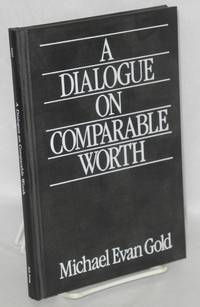
1983rif. 46309Ithaca: ILR Press 1983. Hardcover. vii 111p. very good condition. No dj as issued. ILR Press hardcover books
1526rif. 4610Florence: Per haeredes Philippi Iuntae 1526. SECOND GIUNTA EDITION 1st 1519. Hardcover. Fine. A tall unsophisticated copy in its original limp vellum binding vellum stained lacking ties short split to upper hinge. The text is in very good condition with intermittent foxing heavier in some gatherings. A compendium of ancient geographical texts including descriptions of the known world by Pomponius Mela Dionysius Periegetes and Gaius Julius Solinus. Shorter texts include a catalogue of the regions within the city of Rome "De regionibus urbis Romae" by "Publius Victor". The work is possibly a literary forgery of the 15th century presented as the work of a newly-discovered author. The name was coined by Pomponius Leto of the Roman Academy. The volume was edited by Antonio Francino 1480- after 1537 a scholar of great talent who taught in the households of important Florentines and who produced starting in 1517 numerous editions of Greek and Latin authors for the Giunta firm. Francino's opening letter in this volume is addressed to the twenty-year old Pietro Vettori who would himself become a philologist of great renown. Pomponius Mela's Description of the World: "A generation earlier than the work of the natural historian Pliny under the reign of Claudius or Caligula we find the first Latin author whom to the best of our knowledge we can call a pure geographer and whose work has come down to us complete. This is Pomponius Mela a Spaniard from Tingentera near Gibraltar whose Chronographia "Description of Places" in three books is preserved. The Chronographia describes the world taking the Mediterranean as its basic point of reference. It proceeds counterclockwise from the Strait of Gibraltar whither it returns at the end of the description."Conte "After a short prooemium in which he dwells upon the importance and difficulties of his undertaking he proceeds to define the cardinal points and to explain the division of the world into two hemispheres and five zones. The northern hemisphere is that portion of the Earth which is known and is separated by the impassable torrid zone from the southern hemisphere which is altogether unknown and is the abode of the Antichthones. The northern known hemisphere is completely surrounded by the ocean which communicates with the four great seas: one on the north the Caspian; two on the south the Persian and the Arabian; and one in the west The Mediterranean with its subdivisions. Next follows a description of the three continents: Asia Europe and Africa and an enumeration of its inhabitants. These preliminaries being discussed the author enters upon more minute details and makes a complete circuit of the known world. "Thus commencing at the straits of Hercules with Mauritania he passes on in regular order to Numidia Africa Proper the Cyrenaica Egypt Arabia Syria Phoenicia Cilicia Pamphylia Lycia Caria Ionia Aeolis Bithynia Paphlagonia the Asiatic nations on the Euxine and the Palus Maeotis European Scythia Thrace Macedonia Greece the Peloponinesus Epirus Illyricum Italy from the head of the Adriatic round by Magna Graecia to the Ligurian Gulf Gallia Narbonnensis and the eastern coast of Spain. Hispaniae ora citerior. The tour of the Mediterranean being now completed a chapter is devoted to its islands. Passing beyond the Straits we stretch along the western coast of Spain Hispaniae ora exterior the western coast of Gaul Galliae ora exterior the islands of the Northern Ocean Germany Sarmatia the shores of the Caspian the Eastern Ocean and India the Mare Rubrum and its two gulfs the Persian and Arabian Aethiopia and those portions of Aethiop a and Mauritania bordering upon the Atlantic which brings him round to the point from which he started. It will be seen from the above sketch that the existence of the northern countries of Europe and of the northern and eastern countries of Asia were unknown it being supposed that these regions formed part of the ocean which in like manner was supposed to occupy the whole of Central and Southern Africa."Smith Dictionary of Greek and Roman biography Solinus: "Gaius Julius Solinus who probably lived between the middle and the end of the third century was concerned with geography though not in the modern sense of the term. His work is entitled Collectanea Rerum Memorabilium but in the Middle Ages when it was widely read it was also known as Polyhistor to emphasize the great number of curiosities that were collected there. The work is a careful compilation from many literary sources chiefly Pliny the Elder but also Pomponius Mela and Suetonius along with various other geographical treatises that are no longer extant. Solinus noted down all the unusual things he came across when reading these works about peoples and their customs animals and plants. "The work opens with a full treatment of Rome and Roman history from the kings to the principate of Augustus. The area examined is then extended to Italy and then to Greece and the Black Sea Germany Gaul Britain and Spain; this counterclockwise tour ends with Africa Arabia Asia Minor India and the kingdom of the Parthians in accordance with a systematic geographical plan that is one of the most characteristic features of the work. It enjoyed considerable success in the Middle Ages when it was also read and studied as a summary of the excessively vast Naturalis Historia of Pliny the Elder. It did not however altogether replace it with the result that it enjoyed so to speak a success parallel to that of its more illustrious predecessor."Conte "Referring to the reading of Pliny and Solinus in the Middle Ages and Renaissance Anthony Grafton writes: 'Generations of readers thrilled like Desdemona listening to Othello at these tales of strange creatures foods and burial customs - and were no doubt stimulated by them to see the inhabitants of strange lands as literally outlandish less than civilized or even less than human.' Charles Raymond Beazley has made note of this remarkable appeal: 'The compilation of Solinus. became so fashionable in the Middle Ages and exercised so powerful an influence on the geographical imagination that it cannot be passed over. It is simply a collection of marvels chiefly of natural history brought together apparently on the principle 'Credo' or at least 'Lego quia impossibile.'. no one ever influenced Christian geography more profoundly or mischievously." "References to and borrowings from Solinus can be found in a wide variety of medieval texts stretching though the whole of the medieval period. Readers of Solinus ranged from Augustine to Bede to Dante and Solinus' influence can be seen in examples as varied as the Hereford Mappa mundi ca. 1300 and Fazio degli Uberti's verse epic 'Dittamondo' 14th c. in which Solinus in the place of Dante's Virgil guides a pilgrim on a tour of the known world. The interest in Solinus had not waned by the fifteenth century. While geography was not a primary area of interest for the humanists Solinus Pliny and authors like them were widely read and commented upon by Renaissance scholars. The strong interest in antiquity that characterized the Renaissance continued the medieval curiosity for the Roman compilers who seemed to have succeeded in encapsulating the entire world and all the knowledge in it."Dover and McDonough. Per haeredes Philippi Iuntae hardcover books
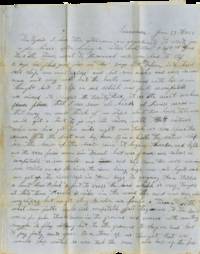
1851rif. List3716Panama City Panama 1851. Single three-page letter measuring appx. 8 x 10 inches. Stampless cover marked "STEAMSHIP" and circled rate marking "40. Folded with some small tears and fading at folds some stains with tear at seal overall bright and legible; excellent. A letter from Henry Francis Douglass 1826-1897 while on his way to the California gold mines sent to his wife Lydia Lillibridge 1828-1904 in Voluntown Connecticut. The letter is highlighted by Douglass' description of Panama City including a brutal execution that he witnessed there: "of all the wickedest places that I ever saw this is the worst there is robery evry day most and murders I keep myself clost nights last night there was a lady on the other side of the street robed of her watch worth $100 and seventy dollars I saw while seting on the piaser piazza to the house. about fifteen minets ago two black men were brout out of the prison by the soldiers dresed in white acompaned by a cathalic prest led up to the stakes the preist sat down on a stool the murders kneeled down to prests throde the cloaks over ther heads and whispered to parden there sins then they was each one tied to the stake while forteen native soldier shot them one strugld but they shot him over again such site I never saw before but it was two good for them they was two of the five that murderd the ten on shagres Chagres river men women and chrilden". The murder for which the men were executed had occurred around the end of February 1851. Eleven people Americans and Europeans transiting the Isthmus were killed: six men three women and two children. Contemporaneous newspaper reporting described the murderers as "Carthagenians negroes and half-breed Indians who hate the whites."1 The gold rush in California had caused a massive influx of people and money to Panama and with it an increase in crime and racial tension. Douglass had arrived in Chagres and traveled to Gorgona which Douglass renders "gorgoney" via the Chagres River then overland to Panama City the typical route before the construction of railroads or the canal. Chagres is "the most sunken place that I ever saw all kinds of bisness carred on that anyon could think of" and the route is "very Dangers at this time" "very wet" and plagued by lice disease and seasickness. However he reports encountering "a lot just returning from the mines with good nuse" and felt "in couraged to go on". Douglass mined in California for two years before returning to his family.2 Of interest to historians of Panama in the California Gold Rush and of social conditions there especially crime and punishment before the construction of the railroads and canal. 1 "Murders on the Isthmus" The Brandon Post April 3 1851 2. 2 Charles Henry James Douglas A collection of family records with biographical sketches and other memoranda of various families and individuals bearing the name Douglas or allied to families of that name E.L. Freeman & Co. 1879. books
1836rif. ST14728eLondon 1836-50. Various editions. 224 x 137 mm. 8 3/4 x 5 1/2". 16 volumes. FINE CONTEMPORARY FULL CALF MOST EITHER TREE OR POLISHED CALF see below raised bands spines intricately gilt in compartments morocco labels marbled endpapers and edges. Some works with frontispiece portraits. Front pastedowns with engraved bookplate of Edward Nicholas Hurt see below. A LOVELY COLLECTION--WITH VIRTUALLY NO SIGNS OF USE. Handsomely bound with beautifully gilt spines and just about uniform in size these volumes make an impressive appearance on the shelf. The six titles here include: 1 DE SAUMAREZ JAMES. ROSS JOHN. "MEMOIRS AND CORRESPONDENCE OF ADMIRAL LORD DE SAUMAREZ." 1838 Two volumes. Polished calf. 2 ELDON JOHN LORD CHANCELLOR. TWISS HORACE. "THE PUBLIC AND PRIVATE LIFE OF LORD CHANCELLOR ELDON." 1844 Three volumes. Polished calf. 3 HORNER FRANCIS. "MEMOIRS AND CORRESPONDENCE OF FRANCIS HORNER M. P." 1843 Two volumes. Tree calf. 4 STANHOPE PHILIP DORMER. "THE LETTERS OF PHILIP DORMER STANHOPE EARL OF CHESTERFIELD." 1845; 1853 Five volumes. Tree calf. 5 TAYLOR WILLIAM. "THE LIFE AND WRITINGS OF THE LATE WILLIAM TAYLOR OF NORWICH." 1843 Two volumes. Tree calf. 6 WARD ROBERT PLUMER. PHIPPS EDMUND. "MEMOIRS OF THE POLITICAL AND LITERARY LIFE OF ROBERT PLUMER WARD ESQ." 1850 Two volumes. Polished calf. The bookplate here is that of notable bibliophile and barrister Edward Nicholas Hurt 1795-1867 of Derbyshire and Marylebone London. He married Caroline Strutt daughter of the immensely wealthy philanthropist and social reformer Joseph Strutt 1765-1844 who was twice Mayor of Derby. As the Strutt arms are incorporated into the escutcheon of Hurt's ornate bookplate the plate can be dated to no earlier than their wedding in 1828. unknown books
1971rif. 32742Athenai: Bibliotheke tes Boules ton Hellenon 1971. First edition. Black cloth stamped in gilt. Corners slightly bumped else fine copies in very good soiled dust jackets. 262; 275 pp. Illus. with 608 facsimiles. 4to. Prologos Vasileiou I. Krapsite Vassilios I. Krapsitis. "Incunabula and Publications of the 15th and 16th c." in the Library of the Greek Parliament. Warmly inscribed by Vassilios I. Krapsitis Secretary General to the Parliament and author of the preface to the late book dealer and Latin American scholar Maury Bromsen. Text in Modern Greek. Preface also in English. Primarily facsimiles of incunabula and early printed books of the 15th and 16th centuries. 418 pages of facsimiles 66 pages of bibliographical descriptions in Latin and Greek 16 pages of indices 6 pages of introduction and preface. Bibliotheke tes Boules ton Hellenon hardcover books
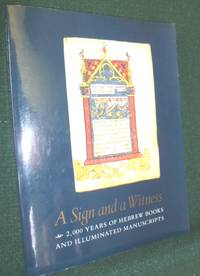
1988rif. 013490New York Oxford: The New York Public Library and Oxford University Press 1988. This volume edited by Dr. Gold was four years in the making. It accompanied the exhibition of Hebrew works at the New York Public Library-October 151988 to January 14 1989. The exhibit drew from the extensive holdings of the Library as well as loans of important manuscripts and printed books from other collections in the US Europe and Israel.Illustrations throughoput the catalogue many in color. Four small brown spots on final page may be binder's glue. Otherwise a clean crisp copy. 224pp. First Edition. Color Illustrated Wrappers. Nearly Fine/No Jacket. Quarto. The New York Public Library and Oxford University Press Paperback books
1827rif. 1354952Boston: Richardson and Lord 1827. Hardcover. Octavo viii 9-334 pp. Good; bound in contemporary tan cloth with some areas of discoloration and surface marks and wear to corners; binding tight; text block clean but somewhat rough; foxing throughout; ex-library copy with usual markings including institutional stamps to several pages and call number written in pencil; ex-library copy with usual markings including a bookplate to front pastedown institutional stamps to several pages and call number written in pencil. MF consignment. 1354952. Special Collections - Downstairs. Richardson and Lord hardcover books
1940rif. ST13395Tokyo:: Scientific Papers of the Institute of Physical and Chemical Research 1940. 1940. 8 offprints 1 extract. Original wrappers. From the collection of Abraham Pais. Very good. INVENTORY: 1. TOMONAGA Sin-itiro. Uber den Zusammenstoß des Mesotrons mit Elektronen. Offprint from: Scientific Papers of the Institute of Physical and Chemical Research no. 976 vol. 37 pp. 399-413 June 1940. Original yellow printed wrappers. Signed by Pais. "In 1940 Dr. Tomonaga directed his attention to the meson theory and developed the intermediate coupling theory in order to clarify the structure of the meson cloud around the nucleon." :: Nobel Lectures 1972. 2. TOMONAGA Sin-itiro. Zur Theorie des Mesotrons. I. Offprint from: Scientific Papers of the Institute of Physical and Chemical Research no. 1071 vol. 39 pp. 247-266 Dezember 1941. Original yellow printed wrappers. Signed by Pais. 3. TOMONAGA Sin-itiro. Bemerkung uber die Streuung der Mesotronen am Kernteilchen. Offprint from: Scientific Papers of the Institute of Physical and Chemical Research no. 1105 vol. 40 pp. 73-86 September 1942. Original yellow printed wrappers. Signed by Pais. 4. TOMONAGA Sin-itiro; Miyazima Tatuoki. Zur Theorie des Mesotrons. II. Offprint from: Scientific Papers of the Institute of Physical and Chemical Research no. 1103 vol. 40 pp. 21-67 August 1942. Original yellow printed wrappers. Signed by Pais. 5. TOMONAGA Sin-itiro; Miyazima Tatuoki. On the Mesotron Theory of the Nuclear Forces. Offprint from: Scientific Papers of the Institute of Physical and Chemical Research no. 1124 vol. 40 pp. 274-310 March 1943. Original yellow printed wrappers. Signed by Pais. 6. TOMONAGA Sin-itiro. Remarks on Bloch's Method of Sound Waves applied to Many-Fermion Problems. Offprint from: Progress of Theoretical Physics vol. 5 no. 4 pp.544-569 July-August 1950. Signed by Pais. 7. TOMONAGA Shin-ichiro. Elementary Theory of Quantum-Mechanical Collective Motion of Particles I. Offprint from: Progress of Theoretical Physics vol. 13 no. 5 pp.467-481 May 1955. 8. TOMONAGA Shin-ichiro. Elementary Theory of Quantum-Mechanical Collective Motion of Particles II. Offprint from: Progress of Theoretical Physics vol. 13 no. 5 pp. 482-496 May 1955. 9. TOMONAGA Sin-itiro. Development of Quantum Electrodynamics. Extracted from: Physics Today vol. 19 no. 9 pp. 25-32 September 1966. Signed by Pais. . / BIOGRAPHY: Tomonaga was a prominent Japanese physicist influential in the development of quantum electrodynamics work for which he was jointly awarded the 1965 Nobel Prize in Physics :: along with Richard Feynman and Julian Schwinger :: for the study of QED specifically for the discovery of the renormalization method. Nobel biography: Tomonaga completed work for Rigakushi bachelor's degree in physics at Kyoto Imperial University in 1929 with one of his intimate friends. Dr. Hideki Yukawa Nobel laureate. He was engaged in graduate work for three years at the same university and was then appointed a research associate by Dr. Yoshio Nishina at the Institute of Physical and Chemical Research Tokyo where he started to work in a newly developed frontier of theoretical physics quantum electrodynamics - under the guidance of Dr. Nishina. His paper on the photoelectric pair creation is well-known. Tomonaga stayed in Leipzig Germany from 1937 to 1939 to study nuclear physics and the quantum field theory in collaboration with the theoretical group of Dr. W. Heisenberg where he published a paper "Innere Reibung und Warmeleitfahigkeit der Kernmaterie" which was chosen as the thesis for Rigakuhakushi Doctor of Science at Tokyo Imperial University in December1939. In 1940 Dr. Tomonaga directed his attention to the meson theory and developed the intermediate coupling theory in order to clarify the structure of the meson cloud around the nucleon. He joined the faculty of Tokyo Bunrika University which was absorbed into the Tokyo University of Education in 1949 as Professor of Physics in 1941. It was in 1942 when he first proposed the covariant formulation of the quantum field theory in which the concept of the quantum state was generalized so as to be relativistically covariant. During the Second World War Dr. Tomonaga was interested in developing a theory of microwave systems. He solved the motion of electrons in the magnetron and also developed a unified theory of the systems consisting of wave guides and cavity resonators. As soon as the War was over Tomonaga came back to academic research again with a programme in which he was first to summarize and extend the intermediate coupling theory and secondly to apply the covariant field theory to actual physical systems. His aim was to investigate the nature of field reaction in the meson theory as well as in quantum electrodynamics. He was confident prior to the Lamb-Retherford experiment by means of a model calculation that divergence difficulty in quantumelectrodynamics could be overcome simply by handling the infinite mass and charge due to field reactions in some way or another. It was only a step further for him to develop the renormalization theory with covariant formalism in his right hand and experimental support in his left. Dr. Tomonaga was invited to the Institute for Advanced Study Princeton in 1949 where he was engaged in the investigation of a one-dimensional fermion system. Thus he first succeeded in clarifying the nature of collective oscillations of a quantum-mechanical many-body system and opened a new frontier of theoretical physics modern many-body problem. In 1955 he published an elementary theory of quantum mechanical collective motions. Dr. Tomonaga took the leadership in establishing the Institute for Nuclear Study University of Tokyo in 1955. From 1956 to 1962 he was appointed President of the Tokyo University of Education and since 1963 he has been President of the Science Council of Japan and Director of the Institute for Optical Research Tokyo University of Education. He occupies an important position in various governmental committees for scientific research and policymaking. Tomonaga's honours and awards include the Japan Academy Prize 1948; the Order of Culture 1952; the Lomonosov Medal U.S.S.R. 1964. Dr. Tomonaga is a member of the Japan Academy the Deutsche Akademie der Naturforscher "Leopoldina" and a foreign member of the Royal Swedish Academy of Science. He is a corresponding member of the Bayerische Akademie der Wissenschaften and a foreign associate of the National Academy of Science of U.S.A. Tomonaga has published widely in scientific journals on such subjects as quantum electrodynamics the meson theory nuclear physics cosmic rays and the many-body problem. His book "Quantum Mechanics" was published in 1949 and translated into English in 1963. Scientific Papers of the Institute of Physical and Chemical Research, 1940. unknown books
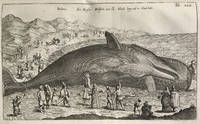
1767rif. S13771Heilbronn:: Franciscus Josephus Eckebrecht 1767. 1767. Tall 4to. 335 x 211 mm 228 4 pp. 47 plates; text with some foxing. Original paper over boards. Housed in a custom clamshell box. Rare. FINE. An extensive work on the morphology of boned fish cartilaginous fish sharks rays skates and cetaceans. This work is illustrated with forty-seven full-page engraved plates that are executed in superb form. Plate XLII shows a beached baleen whale and its enormous size compared to the men in the engraving. A bit fanciful plate XL shows a pair of Mermen; a fish on plate XXVII has the features of a human face whilst a 'shark' on plate VII has semi-human fore-limbs. Except for these anomalies the zoological drawings are quite dramatic and relatively accurate. Jonston's works were frequently re-edited and translated into German Latin Dutch and English. Born in Poland but of Scottish origin Jonston was educated and traveled extensively. He attended St. Andrews 1623-5 studying botany and medicine at Cambridge Leiden and Frankfurt Universities. He earned degrees from Cambridge and in Leiden his M. D. in 1632 where he later practiced medicine and gained a great reputation. In 1642 he briefly taught at Frankfurt as professor of medicine. He retired to his private estate in Silesia in 1655. His "four dictionary-style works on fish birds quadrupeds and insects -- published between 1650 and 1653 with excellent illustrations -- were widely read and translated." DSB. BM Readex Vol. 13 p. 765; DNB Vol. X pp. 968-9; DSB Vol. VII p. 164-5; Nissen 2133. See Garrison and Morton 287. Franciscus Josephus Eckebrecht, 1767. hardcover books
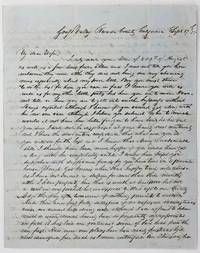
1855rif. 4791Grass Valley Ca: September 17 1855. Very good. 4pp. on a folded folio sheet. Old fold lines minor wear. An intimate letter from a gold seeker in Nevada County California. Theodore Shaw writes to his wife about mixed luck in California a terrible fire his concern for their children and his great anxiety about the future. He writes in part: "I have property here that is worth at least $1000 but not a cent in my pocket but we expect to start up to our quartz ledge the day after tomorrow if nothing prevents to errect a mill up there. And now our plans have been nearly frustrated by a most dreadful fire such as I never witnessed. On Thursday last about 11 o'clock p.m. an alarm of fire was heard and by about half past 12 some 350 stores dwellings and buildings were consumed with a large portion of their contents our hotel included. . The entire business part of the town is in ruins.we have been sleeping under an old shed in the suburbs. This fire has injured us in this way several who had taken stock in our company have lost their means still we intend going on in a smaller way. We had formed a company with a Capital Stock of $50000 divided into 50 shares of $1000 each. Do you know Lydia I have more anxiety about your health than anything else as I know you work hard; only think what would happen to our dear children if anything serious should happen to your health and I away here in California. September 17 unknown books
1566rif. 4765No place Venice: no printer Niccolò Bevilacqua no date 1566. ONE OF NUMEROUS EARLY EDITIONS. Hardcover. Fine. Bound in modern vellum. A very good copy with light marginal soiling and a little bit of mild marginal foxing verso of final leaf a little dusty. With woodcut arms of the Knights of Malta on the title page. The dedication to Cardinal Ippolito d'Este is dated December 1565. There are several other undated editions without imprint as well as further undated editions with the title "Trattato del successo della potentissima armata del Gran Turcho Ottoman Solimano". For the printing of this edition see D.E. Rhodes Silent Printers. Anonymous printing at Venice in the sixteenth century p. 104. One of the earliest and most complete narratives on the siege of Malta in 1565. It was quickly appropriated by other authors for their own accounts. Led by Suleiman the Magnificent the Ottoman Turks tried unsuccessfully to wrest control of the island from the Knights of St John of Jerusalem. The knights had taken up residence on Malta after they had been forced by Suleiman to leave Rhodes in 1530. The success of the knights in repelling the Turks is one of the most important events in the decades-long contest between the Turks and the Christian powers for control of the Mediterranean. The work closes with a list of those who lost their lives in the battle "Cavalieri morti nell' assedio di Malta". The Great Siege of Malta is one of the most famous military encounters of the 16th century and marked a signal victory of the Christian European forces over the Ottoman Turks. On 18 May 1565 the Ottoman Sultan Suleiman the Magnificent d. 1566 launched an armada of over 30000 men to besiege the island of Malta which was protected and governed by the Knights Hospitallers of St. John. The Knights of Malta a force of only 14000 men -many of them untrained- successfully defended the island and its civilian population against the Turkish invaders who departed on 11 September. Yet the losses were high on both sides. Historians estimate the Turkish dead at 10000. The Knights last about a third of their number and the island lost a third of the civilian inhabitants. The valiant efforts of the Knights inspired widespread celebration and the written accounts of the victory influenced a shift in the European view of the Ottoman Empire as an inexorable threat to Christian Europe. Although Ottoman successes against European fleets continued the European nations united to defeat the Turks at Lepanto in 1571. The Ottoman failure to take Malta was a crucial one for had the Turks succeeded they would have established a strategic base for launching strikes more deeply into the western Mediterranean. no printer [Niccolò Bevilacqua], no date hardcover books
1598rif. 4299London: By Arn. Hatfield for Bonham and Iohn Norton 1598. Hardcover. Fine. Bound with as issued: The End of Nero and Beginning of Galba. Fower Bookes of The Histories of Cornelius Tacitus. The Life of Agricola. The second edition. London: By Edm. Bollifant for Bonham and Iohn Norton 1598 Folio: 30 x 20.7 cm. 8 271 1 p. 1st 2 p. blank Collation: par.â´ A-YⶠZâ´1st leaf blank save sig. mark; 6 12 227 3 p. last 3 p. blank Collation: par.ⶠA-SⶠTâ´ Vâ¶las leaf blank. FIRST EDITION of the "Annales". SECOND EDITION of the "Histories". The "Histories" and "Agricola" were translated by Richard Greenwey. The translations of the "Annales" and "Germania" are the work of Sir Henry Savile first ed. 1591. Bound in contemporary English calf scuffed moderate wear; skillfully rebacked original spine elements preserved boards ruled in gold and blind gilt ornaments at the corners large ornate gilt arabesque at the center of each board. Text is excellent condition with a few trivial marginal tears a few minor stains and a closed tear to one leaf not affecting the text. Complete with the first leaf blank except for sig. mark and the final leaf blank. Woodcut initials large schematic engraving of a Roman military camp. Contemp. price in ink at head of title. Provenance: Viscount Mersey Bignor Park bookplate. Tacitus witnessed both the horror of Domitian's tyrannical reign -a reign that ended with the emperor's murder- and the benevolent rule of Trajan. The former marked the lowest point of corruption to which the principate had fallen. The latter brought with it the promise of a restored system of adoptive emperors a model that Tacitus himself offered the greatest promise of maintaining a stable and cohesive empire. Tacitus' two historical works the "Histories" and "Annales" cover the years 69 to 96 A.D. the years from the death of Nero to the death of Domitian and the earlier reigns of the Julio-Claudian emperors beginning with the death of Augustus respectively. Their tone is rather dark; the "Annales" begins with a discussion of whether or not Augustus' wife had poisoned him. The "Histories" opens with the chaotic power-grab that followed Nero's murder the so-called "year of the four emperors". The picture that emerges is one of violence dishonesty and injustice. In contrast to this dark tone Tacitus' "Agricola" in which he recounts the noble honorable and heroic deeds of his father-in-law Julius Agricola stands as a testament to all that is positive and good in a true leader. Agricola an imperial officer under Domitian was responsible in large part for the conquest of Britain. In praising Agricola's character Tacitus emphasizes how as governor of Britain and head of an army at war he had been able to serve the state faithfully honorably and well even under a terrible tyrant such as Domitian. "Tacitus' historical work began while he was in the midst of public activity. The 'Agricola' whose subject is his father-in-law's life and work especially in Britain with some ethnographical detail seems to have been 'published' in 98; and the 'Germania' a primarily geographical and ethnographic work on that important area on the fringe of the empire shortly thereafter. "Of the major works of Tacitus 'Historiae' and 'Annales' as they are now called the former was perhaps already in progress when the minor works began to appear. The subject of the 'Historiae' is the years 69 to 96 and may have been completed by 110 in 12 or 14 books of which only I-IV and part of V covering the year 69-70 survive today. The end of Tacitus' life was devoted to the writing of the 'Annales' in 18 or 16 books in which he went back and began annalistic treatment 'ab excessu divi Augusti'. Of this work there survive only Books I-VI and XI-XVI. Ulery 'Tacitus' CTC VI "Tacitus' plan for a long historical work was already present in the Agricola where in one of the early chapters Tacitus expresses his intention to narrate the years of Domitian's tyranny and then the freedom recovered under the regimes of Nerva and Trajan. In the Histories the project appears modified. Although the extant part narrates the events of the years 69-70 from the reign of Galba to the Jewish rebellion the work in its entirety was to extend to 96 the year of Domitian's death. In the preface Tacitus expressly says that he is saving for his old age the treatment of the principates of Nerva and Trajan 'richer and less risky material'. The Histories thus dealt with a gloomy period one disturbed by civil wars and finished by a long tyranny." Gian Biagio Conte "Latin Literature A History" A Machiavellian Tacitus: Savile's additional texts: In addition to the Tacitean texts the second volume includes two Elizabethan works Henry Savile's "End of Nero and Beginning of Galba" praised by Ben Jonson and "A View of Certain Military Matters for the Better Understanding of the ancient Roman stories" one of the first contributions by an English scholar to the study of classical antiquity Sandys. In the first of these two works Savile bridged the void between the "Annales" and "Histories" a void created by the loss of the final two and a half books of the "Annales". "The period of time that Savile had to cover in 'The Ende . . . ' is of the order of two years. But since those two years contain the successful rebellion against Nero they are years crowded with incident and character. Thus Savile's subject poses obvious problems of narrative. The events he must narrate occur in various theatres. He must keep his reader abreast of the happenings in all these locales and also show the influence events in each exert on those in the others. It is not the least of the literary virtues of 'The Ende . . . ' that Savile managed to bring off this narrative juggling act and produced a clearer account of this confused period than can be found in any of his classical sources. Savile's main sources for the years 66 to 69 A.D. are Suetonius' lives of Nero and Galba Plutarch's Life of Galba and sections of Cassius Dio largely Bk. LXIII. Savile confined himself to these authors. but when one looks more closely one can appreciate that 'The Ende." is much more than a mosaic from classical writers. In writing 'The Ende.' Savile used wit conjectures and a profound knowledge of Machiavelli's 'The Prince' when filling the blank spaces left by his sources." Womersley Sir Henry Savile's Translation of Tacitus and the Political Interpretation of Elizabethan Texts in The Review of English Studies Aug. 1991 Vol. 42 No. 167 Aug. 1991 pp. 313-342. By Arn. Hatfield, for Bonham and Iohn Norton] hardcover books
1994rif. 1413442New York: G. P. Putnam's Sons Publishers 1994. First Edition First Printing. Hardcover. Octavo 336 pages. In Very Good condition with a Very Good minus dust jacket. Spine purple with white lettering. Exterior has slight wear including mild sunning to the spine with price clipped front flap. Boards have slight wear including minor edge wear. Text block has slight wear including slight age toning to the edges. Illustrated. First edition first printing. Inscribed by Ann-Margret. NOTE: Shelved in Locked Annex Column CC. 1413442. FP New Rockville Stock. G. P. Putnam's Sons, Publishers hardcover books
1964rif. 17886INSIDE MAN being an original 15 page 4500 word typescript with 6 additional pages of text and both a typed and hand-written letter. An orphan of sorts with no release in hard-cover format and originally issued in Galaxy Magazine in 1965 and then again as an audio production. H. L. Gold manuscripts rarely show up in the marketplace. Here's your chance to nab one by the renown editior of Galaxy Magazine. Nominated for the Nebula Award. N.p. unknown books